Category: Sci & Tech

  • Israel’s NSO Pegasus Spyware International Weapon Used By Horrific Regimes To Silence Critics

    Israel’s NSO Pegasus Spyware International Weapon Used By Horrific Regimes To Silence Critics

    On March 2, 2017, Mexican journalist Cecilio Pineda took out his mobile phone and in a Facebook live broadcast spoke about alleged collusion between state and local police and the leader of a drug cartel. Two hours later, he was dead – shot at least six times by two men on a motorcycle.

    It was a few weeks later that Forbidden Stories – a global network of journalists engaged in investigations – confirmed that not just Pineda, but also the state prosecutor who investigated the case, Xavier Olea Pelaez, were the targets of Israel’s Pegasus spyware in the weeks and months before his murder.

    Pineda’s phone was also never found, as it had disappeared from the crime scene by the time the authorities had arrived.

    Two weeks after Washington Post columnist Jamal Khashoggi was killed in the Saudi Consulate in Istanbul, Turkey in October 2018, the digital rights organization Citizen Lab reported that a close friend of Khashoggi, Omar Abdulaziz, had been targeted with Pegasus software developed by NSO Group Technologies — an Israeli technology firm.

    New revelations from Forbidden Stories and its partners have found that Pegasus spyware was successfully installed on the mobile phone of Khashoggi’s fiancée, Hatice Cengiz, just four days after his murder. The phone of Khashoggi’s son, Abdullah, was selected as a target of an NSO client based on the consortium’s analysis of the leaked data.

    Overall, the phones of 180 journalists around the world are claimed to have been selected as targets by clients of NSO Group Technologies. Its spyware Pegasus enables the remote surveillance of smartphones.

    Forbidden Stories, which conducted investigations along with Amnesty International’s Security Lab, found that the phones of many politicians, civil society activists and even judges were being monitored in many countries, breaching privacy laws.

    According to Forbidden Stories, they had access to a leak of more than 50,000 records of phone numbers belonging to journalists, politicians, officials, activists and even judges that NSO clients had selected for surveillance.

    Forensic analysis

    The forensic analyses of their phones – conducted by Amnesty International’s Security Lab and peer-reviewed by the Canadian organization Citizen Lab – were able to confirm infection or attempted infection with NSO Group’s spyware in 85% of cases.

    “The numbers vividly show the abuse is widespread, placing journalists’ lives, those of their families and associates in danger, undermining freedom of the press and shutting down critical media,” said Agnes Callamard, secretary-general of Amnesty International.

    NSO Group, in a written response to Forbidden Stories, said the consortium’s reporting was based on “wrong assumptions” and “uncorroborated theories” and reiterated that the company was on a “life-saving mission”.

    “The alleged amount of leaked data of more than 50,000 phone numbers cannot be a list of numbers targeted by governments using Pegasus,” it added.

    NSO Group maintains that its technology is used exclusively by intelligence agencies to track criminals and terrorists. According to NSO Group’s Transparency and Responsibility report released in June this year, the company has 60 clients in 40 countries around the world.

    Pegasus “is not a mass surveillance technology and only collects data from the mobile devices of specific individuals suspected to be involved in serious crime and terror,” NSO Group wrote in the report.

    In India, the phone of Paranjoy Guha Thakurta, an investigative journalist and author of several books, was hacked in 2018.

    Quoting Thakurta, Forbidden Stories said he was targeted when he was working on an investigation into the finances of the famous Ambani business group.

    “The purpose of getting into my phone and looking at who are the people I’m speaking to would be to find out who are the individuals who have been providing information to me and my colleagues,” he said.

    Thakurta is one of at least 40 Indian journalists selected as targets of an NSO client in India, based on the consortium’s analysis of the leaked data.

    The phones of two of the three cofounders of the independent online news outlet The Wire – Siddharth Varadarajan and MK Venu – were both infected by Pegasus, with Venu’s phone hacked as recently as July.

    Top journalists targeted

    Several other journalists who work for or have contributed to the independent news outlet The Wire– including columnist Prem Shankar Jha, investigative reporter Rohini Singh, diplomatic editor Devirupa Mitra and contributor Swati Chaturvedi – were all selected as targets, according to the records accessed by Forbidden Stories and its partners.

    “It was alarming to see so many names of people linked to The Wire, but then there are lots of people not linked to the Wire,” said Varadarajan, whose phone was compromised in 2018.

    Addressing parliament on Monday, Information Technology Minister Ashwini Vaishnaw said there is “no substance behind this sensational” claim and that “with checks and balances in place, illegal surveillance [is] not possible.”

    “A highly sensational story was published by a web portal last night. Many over-the-top allegations [were] made around this story. The press reports appeared a day before [the] monsoon session of parliament. This can’t be a coincidence,” he said.

    He described these revelations as an attempt to malign Indian democracy.

    The Committee to Protect Journalists (CPJ) had previously documented 38 cases of spyware – developed by software companies in four countries – used against journalists in nine countries since 2011.

    How does Pegasus work?

    Eva Galperin, director of cybersecurity at the Electronic Frontier Foundation (EFF), was one of the first security researchers to identify and document cyber-attacks against journalists and human rights defenders in Mexico, Vietnam and elsewhere in the early 2010s.

    “Back in 2011, you would receive an email, and the email would go to your computer, and the malware would be designed to install itself on your computer,” she said.

    But the installation of Pegasus spyware on smartphones has become subtler. Instead of the target having to click on a link to install the spyware, so-called “zero-click” exploits allow the client to take control of the phone without any engagement on the part of the target.

    Once successfully installed on the phone, Pegasus spyware gives NSO clients complete device access and thereby the ability to bypass even encrypted messaging apps like Signal, WhatsApp and Telegram. Pegasus can be activated at will until the device is shut off. As soon as it’s powered back on, the phone can be reinfected.

    According to Galperin Pegasus operators can remotely record audio and video, extract data from messaging apps, use the GPS for location tracking and recover passwords and authentication keys, among other things.

    Spying governments have moved in recent years toward a more “hit and run” strategy to avoid detection, she said, infecting phones, exfiltrating the data and quickly exiting the device.

    Over the years, governments the world over have moved to gather intelligence using technology instead of humans. In the past, they developed spyware tools in-house until private spyware companies like NSO Group, FinFisher and Hacking Team stepped in to sell their products to governments, according to Galperin.

    In June 2021, French spyware company Amesys was charged with “complicity in acts of torture” for selling its spyware to Libya from 2007-2011. According to plaintiffs, in that case, information gleaned through digital surveillance was used to identify and hunt down opponents of deposed dictator Muammar Gaddafi, who were later tortured in prison.

    The revelations stemming from this international collaborative investigation have thrown into question the safeguards put in place to prevent misuse of cyber weapons like Pegasus and, more specifically, NSO Group’s commitment to creating “a better, safer world.”

  • Pegasus Project: Apple iPhones Compromised By Israeli’s NSO Spyware

    Pegasus Project: Apple iPhones Compromised By Israeli’s NSO Spyware

    New evidence uncovered by Amnesty International and Forbidden Stories has revealed a massive wave of attacks by cyber surveillance company NSO Group’s customers on iPhones, potentially affecting thousands of Apple users worldwide.

    Our forensic analysis has uncovered irrefutable evidence that through iMessage zero-click attacks, NSO’s spyware has successfully infected iPhone 11 and iPhone 12 models. Thousands of iPhones have potentially been compromised.
    Danna Ingleton, Deputy Director, Amnesty Tech

    Deputy Director of Amnesty Tech Danna Ingleton said:

    “Apple prides itself on its security and privacy features, but NSO Group has ripped these apart. Our forensic analysis has uncovered irrefutable evidence that through iMessage zero-click attacks, NSO’s spyware has successfully infected iPhone 11 and iPhone 12 models. Thousands of iPhones have potentially been compromised.

    “These attacks have exposed activists, journalists and politicians all over the world to the risk of having their whereabouts monitored, and their personal information and used against them.

    “This is a global concern – anyone and everyone is at risk, and even technology giants like Apple are ill-equipped to deal with the massive scale of surveillance at hand.

    “NSO Group can no longer hide behind the claim that its spyware is only used to fight crime. There is overwhelming evidence that NSO spyware is being systematically used for repression and other human rights violations. NSO Group must immediately stop selling its equipment to governments with a track record of abusing human rights.

    “These findings show that the surveillance industry is out of control. States must immediately implement a global moratorium on the export, sale and use of surveillance equipment until a human rights-compliant regulatory framework is in place.”

    Background

    NSO Group’s spyware has been used to facilitate human rights violations around the world on a massive scale, according to a major investigation into the leak of 50,000 phone numbers of potential surveillance targets. These include heads of state, activists and journalists, including Jamal Khashoggi’s family.

    The Pegasus Project is a ground-breaking collaboration by more than 80 journalists from 17 media organizations in 10 countries coordinated by Forbidden Stories, a Paris-based media non-profit, with the technical support of Amnesty International, who conducted cutting- edge forensic tests on mobile phones to identify traces of the spyware.

    The investigation today revealed that Pegasus zero-click attacks have been used to install spyware on iPhones.

    Amnesty International was able to confirm that thousands of iPhones were listed as potential targets for Pegasus spyware, though it was not possible to confirm how many were successfully hacked.

    Thousands of Google Android phones were also selected for targeting, but unlike iPhones their operating systems do not keep accessible logs useful for detecting Pegasus spyware infection. Among the Apple products successfully infected were iPhone 11 and iPhone 12 models, equipped with the latest updates which were believed to have high levels of security.

    Israeli surveillance company NSO Group has been bankrolled by major private equity firms Novalpina Capital and Francisco Partners, with numerous investors behind them. Pension firms in the UK and US also have a stake in the rights abusing company.

    The Pegasus Project

    NSO Group’s spyware has been used to facilitate human rights violations around the world on a massive scale, according to a major investigation into the leak of 50,000 phone numbers of potential surveillance targets. These include heads of state, activists and journalists, including Jamal Khashoggi’s family.

    The Pegasus Project lays bare how NSO’s spyware is a weapon of choice for repressive governments seeking to silence journalists, attack activists and crush dissent, placing countless lives in peril.
    Agnès Callamard, Secretary General of Amnesty International.

    The Pegasus Project is a ground-breaking collaboration by more than 80 journalists from 17 media organizations in 10 countries coordinated by Forbidden Stories, a Paris-based media non-profit, with the technical support of Amnesty International, who conducted cutting- edge forensic testson mobile phones to identify traces of the spyware.

    “The Pegasus Project lays bare how NSO’s spyware is a weapon of choice for repressive governments seeking to silence journalists, attack activists and crush dissent, placing countless lives in peril,” said Agnès Callamard, Secretary General of Amnesty International.

    “These revelations blow apart any claims by NSO that such attacks are rare and down to rogue use of their technology. While the company claims its spyware is only used for legitimate criminal and terror investigations, it’s clear its technology facilitates systemic abuse. They paint a picture of legitimacy, while profiting from widespread human rights violations.”

    “Clearly, their actions pose larger questions about the wholesale lack of regulation that has created a wild west of rampant abusive targeting of activists and journalists. Until this company and the industry as a whole can show it is capable of respecting human rights, there must be an immediate moratorium on the export, sale, transfer and use of surveillance technology.”

    In a written response to Forbidden Stories and its media partners, NSO Group said it “firmly denies… false claims” in the report. It wrote that the consortium’s reporting was based on “wrong assumptions” and “uncorroborated theories” and reiterated that the company was on a “life-saving mission”. A fuller summary of NSO Group’s response is available here.

    The Investigation

    At the centre of this investigation is NSO Group’s Pegasus spyware which, when surreptitiously installed on victims’ phones, allows an attacker complete access to the device’s messages, emails, media, microphone, camera, calls and contacts.

    Over the next week, media partners of The Pegasus Project – including The Guardian, Le Monde, Süddeutsche Zeitung and The Washington Post – will run a series of stories exposing details of how world leaders, politicians, human rights activists, and journalists have been selected as potential targets of this spyware.

    From the leaked data and their investigations, Forbidden Stories and its media partners identified potential NSO clients in 11 countries: Azerbaijan, Bahrain, Hungary, India, Kazakhstan, Mexico, Morocco, Rwanda, Saudi Arabia, Togo, and the United Arab Emirates (UAE).

    NSO Group has not taken adequate action to stop the use of its tools for unlawful targeted surveillance of activists and journalists, despite the fact that it either knew, or arguably ought to have known, that this was taking place.

    The Pegasus Project revelations must act as a catalyst for change. The surveillance industry must no longer be afforded a laissez-faire approach from governments with a vested interest in using this technology to commit human rights violations.
    Agnès Callamard, Secretary General of Amnesty International

    “As a first step, NSO Group must immediately shut down clients’ systems where there is credible evidence of misuse. The Pegasus Project provides this in abundance,” said Agnès Callamard.

    Khashoggi family targeted 

    During the investigation, evidence has also emerged that family members of Saudi journalist Jamal Khashoggi were targeted with Pegasus software before and after his murder in Istanbul on 2 October 2018 by Saudi operatives, despite repeated denials from NSO Group.

    Amnesty International’s Security Lab established that Pegasus spyware was successfully installed on the phone of Khashoggi’s fiancée Hatice Cengiz just four days after his murder.

    His wife, Hanan Elatr was also repeatedly targeted with the spyware between September 2017 and April 2018 as well as his son, Abdullah, who was also selected as a target along with other family members in Saudi Arabia and the UAE.

    In a statement, the NSO Group responded to the Pegasus Project allegations saying that its “technology was not associated in any way with the heinous murder of Jamal Khashoggi”. The company said that it “previously investigated this claim, immediately after the heinous murder, which again, is being made without validation”.

    Journalists under attack

    The investigation has so far identified at least 180 journalists in 20 countries who were selected for potential targeting with NSO spyware between 2016 to June 2021, including in Azerbaijan, Hungary, India and Morocco, countries where crackdowns against independent media have intensified.

    The revelations show the real-world harm caused by unlawful surveillance:

    • In Mexico, journalist Cecilio Pineda’s phone was selected for targeting just weeks before his killing in 2017. The Pegasus Project identified at least 25 Mexican journalists were selected for targeting over a two-year period. NSO has denied that even if Pineda’s phone had been targeted, data collected from his phone contributed to his death.
    • Pegasus has been used in Azerbaijan, a country where only a few independent media outlets remain. More than 40 Azerbaijani journalists were selected as potential targets according to the investigation. Amnesty International’s Security Lab found the phone of Sevinc Vaqifqizi, a freelance journalist for independent media outlet Meydan TV, was infected over a two-year period until May 2021.
    • In India, at least 40 journalists from nearly every major media outlet in the country were selected as potential targets between 2017-2021. Forensic tests revealed the phones of Siddharth Varadarajan and MK Venu, co-founders of independent online outlet The Wire, were infected with Pegasus spyware as recently as June 2021.
    • The investigation also identified journalists working for major international media including the Associated Press, CNN, The New York Times and Reuters as potential targets. One of the highest profile journalists was Roula Khalaf, the editor of the Financial Times.


    “The number of journalists identified as targets vividly illustrates how Pegasus is used as a tool to intimidate critical media. It is about controlling public narrative, resisting scrutiny, and suppressing any dissenting voice,” said Agnès Callamard.

    “These revelations must act as a catalyst for change. The surveillance industry must no longer be afforded a laissez-faire approach from governments with a vested interest in using this technology to commit human rights violations.”

    Exposing Pegasus infrastructure

    Amnesty International is today releasing the full technical details of its Security Lab’s in-depth forensic investigations as part of the Pegasus Project.

    The Lab’s methodology report documents the evolution of Pegasus spyware attacks since 2018, with details on the spyware’s infrastructure, including more than 700 Pegasus-related domains.

    “NSO claims its spyware is undetectable and only used for legitimate criminal investigations. We have now provided irrefutable evidence of this ludicrous falsehood,” said Etienne Maynier, a technologist at Amnesty International’s Security Lab.

    There is nothing to suggest that NSO’s customers did not also use Pegasus in terrorism and crime investigations, and the Forbidden Stories consortium also found numbers in the data belonging to suspected criminals.

    “The widespread violations Pegasus facilitates must stop. Our hope is the damning evidence published over the next week will lead governments to overhaul a surveillance industry that is out of control,” said Etienne Maynier.

    In response to a request for comment by media organizations involved in the Pegasus Project, NSO Group said it “firmly denies” the claims and stated that “many of them are uncorroborated theories which raise serious doubts about the reliability of your sources, as well as the basis of your story.” NSO Group did not confirm or deny which governments are NSO Group’s customers, although it said that the Pegasus Project had made “incorrect assumptions” in this regard.  Notwithstanding its general denial of the claims, NSO Group said it “will continue to investigate all credible claims of misuse and take appropriate action based on the results of these investigations”.

  • HIV Vaccine Trial Start At Oxford University

    HIV Vaccine Trial Start At Oxford University

    Trials of a new HIV vaccine have begun at Oxford University, building on the success of the Covid vaccine developed by the institution.

    It is the first in a series of evaluations in HIV-negative individuals, for prevention, and in people living with HIV, for a cure.In phase one of the trial, which is run by the university’s Jenner institute, 13 HIV-negative adults, aged 18-65 and who are considered not to be at high risk of infection, will initially receive one dose of the HIV vaccine. A further booster dose will be given after four weeks.

    HIV-positive adults will be involved in later phases of the trial, while plans exist to start similar trials in Europe, Africa and the US.

    The trial is part of the European Aids Vaccine Initiative, an internationally collaborative research project funded by the European Commission.

    At present, prevention of HIV largely focuses on behavioural and biomedical interventions, such as voluntary medical male circumcision, condom use, and anti-retroviral drugs used prior to exposure.

    Oxford University said its vaccine candidate would be the “best solution” to ending the Aids epidemic.

    Professor Tomáš Hanke, Professor of Vaccine Immunology at the Jenner Institute , and lead researcher on the trial said: “The pace of decline in new HIV infections failed to reach the fast-track target agreed upon by the United Nations General Assembly in 2016: fewer than 500,000 new infections per year in 2020.

    “Even in the broader context of increasing antiretroviral treatment and prevention, an HIV-1 vaccine remains the best solution and likely a key component to any strategy ending the AIDS epidemic.”

    Dr Paola Cicconi, Senior Clinical Research Fellow at the Jenner Institute and the trial Chief Investigator, said: “Achieving protection against HIV is extremely challenging and it is important that we harness the protective potential of both the antibody and T cell arms of the immune system.”

    The researchers hope to report results of the by April 2022.

  • LinkedIn Hacked, Data Of 700M Users Being Sold On Dark Web

    LinkedIn Hacked, Data Of 700M Users Being Sold On Dark Web

    LinkedIn data of over 700 million users has reportedly been exposed in a new breach. LinkedIn has a total of 756 million users, which means that the data of more than 92 percent of its users has been compromised in this new breach. The new dataset obtained by an unknown hacker is said to consist of personal details of LinkedIn users, including phone numbers, physical addresses, geolocation data, and inferred salaries. In April, LinkedIn confirmed a data breach affecting 500 million subscribers wherein personal details like email address, phone number, workplace information, full name, account IDs, links to their social media accounts, and gender details were listed online.

    According to LinkedIn, it did not face a data breach, but rather the information was gained from scraping the network. In an emailed statement, LinkedIn told Gadgets 360: “While we’re still investigating this issue, our initial analysis indicates that the dataset includes information scraped from LinkedIn as well as information obtained from other sources. This was not a LinkedIn data breach and our investigation has determined that no private LinkedIn member data was exposed. Scraping data from LinkedIn is a violation of our Terms of Service and we are constantly working to ensure our members’ privacy is protected.”

    The new dataset of 700 million users is also on sale on the Dark Web, wherein the hacker has posted a sample set of 1 million users for buyers. RestorePrivacy was the first to spot this listing on the Dark Web and the sample data was cross-verified by 9to5Google. The sample dataset that has been published on the Dark Web includes user information like email addresses, full names, phone numbers, physical addresses, geolocation records, LinkedIn username and profile URL, inferred salaries, personal and professional experience/ background, gender, and social media accounts and usernames.

    9to5Google reached out directly to the hacker who says that the data was obtained by exploiting the LinkedIn API to harvest information that people upload to the site. The dataset does not include passwords, but the information is still very valuable and could amount to identity theft or phishing attempts.

    To protect your data, it is important to look at the safety, security, and privacy settings of the apps you use and make sure that these are set up properly. Ensure that you have set up a strong password and indulge in the habit of changing them frequently. Also, enable two-factor authentication (2FA) wherever available, and do not accept connections, especially on LinkedIn and Facebook, from unknown people. Subscribe to sites like Have I Been Pwned for notifications if your email address is part of a data breach.

  • BEWARE: Paper Wave Is The Latest Pyramid Scheme And Crypto Fraud In Kenya

    BEWARE: Paper Wave Is The Latest Pyramid Scheme And Crypto Fraud In Kenya

    The more things change, the more they remain the same. Kenyans have been treated to all levels of pyramid schemes and they never seem to stop despite ever flowing tears. Why? The schemers often plan their exit plan before they launch and with a gullible, looking for overnight riches population, a ready market is always available for the cons to sell snake oil.

    Even before the dust settles down after Kenyans were ripped off millions in the Amazon Web Worker pyramid scheme, another one is already up, The Paper Wave.

    In a well-coordinated and orchestrated scheme, investors were duped into investing their money in an online app known as Amazon Web Worker, on the premise that they would earn huge profits of up to 38% for a deposit lasting only seven days.

    Social media platforms were awash with advertisements wooing Kenyans to the mouthwatering scheme, that promised to double one’s deposits in a month. In one such advertisement, investors who deposited KSh100,000 were promised KSh351,000 after 30 days!

    All one needed for his/her application to be successful was to register their personal details such as full names, M-Pesa account details and mobile phone numbers in the online app.

    Unsuspecting Kenyans downloaded the app in their hundreds, registered and made their deposits. Some referred their spouses, children and close friends to the scheme, in a bid to make a fortune overnight. It is not until when the app was deleted from the internet without prior notice, that the investors discovered they had been duped.

    They were shocked to learn that the app was not in any way linked to Amazon, a multinational technology company based in the United States.

    The app allegedly went down with deposits worth hundreds of millions of shillings from gullible investors, who had hoped to hit the jackpot, once their deposits earned profits.

    Paper Wave Pyramid Scheme

    A new money making opportunity by the name The Paper Wave is slowly making waves in the Kenyan market.

    Quick summary

    Paper Wave is a trading platform where you trade system coins, Stellar Coins with peers. Besides, it’s a multilevel marketing platform which compensates you for recruiting members. You can also play Spin the Wheel games and win cash prices.

    Paper Wave is risky, but can potentially make you a lot of money if you’re influential or if you join early. Although it claims to offer cryptocurrency trading features, it does not. Rather it excels in trading system coins and promising a guaranteed value growth for investors money.

    What is The Paper Wave

    According to the website, The Paper Wave is a cryptocurrency platform

    • Where you can trade system coins known as Stellar coins and make profits fast
    • With a referral program to reward multi level marketing
    • Which provides different types of spins based on amount staked
    • Where you can trade Bitcoin, DogeCoin Tron and others with peers
    • Where you can learn about cryptocurrencies, how to buy and sell and other good trading practices.

    At least that’s how the founders define it.

    Let’s get to the real stuff.

    What Really is Paper Wave

    I hate doing this, busting people’s bubbles. But it’s gotta be done anyway.

    I’ll put it plain and simple;

    The Paper Wave is a pyramid scheme which banks on the crypto naivety of kenyans to conceal the creators’ true agenda of selling a dream, making money through multilevel marketing and disappearing with it when the seat gets hot.

    Now, I’m not against that. In fact, I have previously advised people how to make money from pyramids.

    Weird, isn’t it?

    In my perspective, pyramid schemes are made by clever individuals who exploit the system to make money. That happens everyday.

    If banks, stock traders, lawyers and insurance companies don’t ring a bell, then I cannot imagine the hem of your moral fabric.

    What then irritates me is the part where they claim to offer services which they don’t, tarnish the cryptocurrency concept and use influencers to do so.

    On a wide spectrum, when things go down (not if but when) the mainstream who will be affected by this fallacy will find it hard to adopt cryptocurrency.

    Their mental and emotional scars from this fiasco will extend adoption; time before cryptocurrency transforms the entire financial system. Because of so much doubt built upon fake cryptocurrency projects.

    The Red Flags

    It’s not a cryptocurrency

    The Paper Wave is not a cryptocurrency. It offers Stellar coins which also are not cryptocurrencies.

    A cryptocurrency is a digital currency in which transactions are verified and records maintained by a decentralized system using cryptography, rather than a centralized authority.

    By definition, The Paper Wave already falls on different fronts.

    1. The stellar coin is not a digital currency. It’s just a name to represent numbers jumbled up on their system.
    2. The Paper Wave is a centralized system; everything is on the site: thepaperwave.com. This beats blockchain logic.
    3. There are no independent entities forming a network that verifies and records transactions. The centralized system is built on the website.

    So the claim that The Paper Wave likens Bitcoin and Dogecoin in functionality is a blatant lie. Its like calling beefsteak a vegetable.

    What goes behind building a cryptocurrency, let alone the blockchain to support the cryptocurrency is beyond the scope of many.

    You need cryptography experts, economists, high-tech programmers, millions of dollars and many months to build something that meets the basic requirements of a coin listable on Coinmarketcap.

    Kenyans’ with these characteristics do exist, and an indeginous cryptocurrency can be built if a serious believer and investor comes through.

    But not The Paper Wave.

    • It has no face. Nowhere on the site does it indicate the people behind it.
    • It’s not backed by any known investor.
    • It doesn’t have a whitepaper to elaborate the concept behind it, the problems it tackles and solutions
    • There is no network
    • There is no open source program
    • No mining, minting, farming or staking system.

    I could go on and on but the point still remains, The Paper Wave and its Stellar coins are not cryptocurrency.

    No legit crypto marketplace exists

    One of the features the platform boasts about which allows trading of other cryptocurrencies is not functional.

    As mentioned earlier, the trading page display is good enough to dupe a none-trader. But for traders who have used LocalBitcoins, Paxful, Coinbase among other legit crypto marketplace will laugh it off.

    It seems like if you wanna buy or sell any crypto, you put forward a request to the authority who should then find a suitable trader and connect them with you.

    Then you’ll have to transact offline because the site has no trading capabilities. It’s like going to a chamaa and being connected with a fellow mama who sells good Avocados, then you’ll have to meet later to trade.

    That’s not a digital marketplace?

    A functional crypto marketplace offers an avenue for a trader to deposit crypto (needs a wallet), request of offer crypto at prices close to standard crypto prices, hold crypto in escrow for credible transactions, and transfer of coins (requires a connection to the blockchain)

    All these abilities don’t come cheap.

    That is why Paper Wave designed a makeshift market display to stand in place of legit peer to peer crypto trading platform.

    And you know what made me laugh out loud? The last section on that page showing ready buyers. Here’s a screenshot.

    Imagine, there’s a trader ready to sell 10 Bitcoins at Ksh 1,000. One bitcoin at the moment costs Ksh 4.5 million.

    They are simple offers fabricated with the highest impunity!

    A Controlled Market.

    As expected, the challenge of a centralized system is that the authority has power to control the market. And that’s the case with this platform.

    Fundamentally in credible markets, the supply and demand of coins should determine their value.

    But on Paper Wave, the authority sets a price of their liking. They can decide to increase its value by 5% after every 24 hours. Yet still, they must consider the amount of money being withdrawn to ensure they stay profitable.

    For instance, if you double the price for Ksh 4.50 now to Ksh 9, many people will sell their Stellar coins.

    That’s not desirable for these cunning goons.

    So they’ll alter the prices however they want as long as it influences profitable transactions on the platform.

    If they drop the price below the original value, it will scare investors and many will sell

    Note: They will do this; (drop the price of Stellar Coin) and let people withdraw coins when time comes to close shop. A perfect escape plan.

    The Referral System

    I just took a look at the referral system and knew what Paper Wave is; a multilevel marketing platform hiding under the guise of cryptocurrency.

    Public Likes, EarnSmart, Live Auction. Ring a bell?

    They came in many dimensions, but the one thing that never changes, is their referral system which encourages recruitments of new members on multiple levels to increase earning potential.

    You are paid by a recruit referred by your referral. Very convenient. A cash cow for those that come first (top of the pyramid).

    No Accountability or Credibility

    The people behind Paper Wave are none existent. No registered entity claims ownership of this project. They just picked a gullible influencers to back them up and the avalanche set off.

    Xtian Dela, one of the most influential social media personality in Kenya has become the face of the ferocious campaign. The owners of the scheme found a good asset in him.

    According to the model of the fraud scheme, the more you invite, the more the bonus earned.

    If you have great influence, at least within your circle, this feature will potentially earn you most of the money.

    Xtian Dela the influencer backing this project made Sh714,416 within less than 48hours from the moment he published it on social media handles.

    What the influencers being used by the Paper Wave owners have failed in is to inform their followers of the risks involved. The potential to lose their money and the fact that they should invest only what they can afford to lose.

    Sample of misleading influencer tweets sponsored by Paper Wave.

    https://twitter.com/crazy_brayo/status/1403588919686541314?s=21

    https://twitter.com/crazy_brayo/status/1403588469037936640?s=21

    https://twitter.com/pedroblessing_/status/1403587987871502338?s=21

    If things were to go wrong now, if they closed shop now, who will you blame? Who will you report to the police? No one.

    The closest they come to being accountable is providing a Customer Care Whatsapp number and you are certain that number will not be enough to serve the ballooning clientele.

    Late or no replies will be common for sure and that number will always be off.

    However, when you pay through MPesa, the receipt message mentions an entity; Stkella Enterprises. That could be useful.

    You could ask Safaricom to name the people registered under that business name.

    But they are obligated not to disclose information about their customers unless it is a police case.

    Is it worth investing?

    Well, it depends.

    Here’s a fact, pyramid schemes will always exist. It’s a reality we must live with.

    While governments try forming laws to prevent such projects which exploit naive citizens, jobless computer savvy university graduates will find a way to maneuver the booby-trapped but ineffective systems built.

    That’s why these schemes pop up every now and then and you’ll rarely see someone behind bars.

    So you have a responsibility to use your brain to judge this. You choose the perspective to consider.

    And in such cases there are two conclusions to make.

    • To avoid them entirely
    • To find a way to make money out of it

    The first option is for non-risk-takers and those without disposable income; money they cannot afford to lose.

    The second option is for risk-takers. People who understand the world is like a game, learn the rules and play. People who can find opportunities anywhere and make a few bucks. When pyramid schemes collapse, the majority lose their money. But this caliber of hardcores makes a living out of it.

    I’ve done it before. You could do it too.

    If you’re interested, ask yourself these 2 IMPORTANT questions

    1. Do you have money you can afford to lose?
    2. Do you have influence? Friends you can pitch to, show them the opportunity, list the risks involved and still recruit a good percentage of them?

    If you do, then this might work for you.

    Because you need to understand that these ‘heavenly opportunities’ don’t last and whoever you recruit to a project, will bail for your blood when things fall apart.

    Pyramid schemes have made enemies, broken relationships and led to big debts and depression. So you need to tread wisely.

    Lastly, you need to make a decision right at this moment.

    To Join Paper Wave

    Or to look the other way

    Because your chances of making money from multilevel marketing platforms diminishes by the minute.

    These platforms have a lifespan. Normally 2-3 months. If you join within the first month, you might just be lucky.

    Signing up thereafter, you’ll be juggling obsidian knives.

    Thepaperwave.com was registered on 3rd June 2021.

    It started going wild on 15th June 2021 courtesy of Xtian Dela’s endorsement. That could be its real start off.

    Do the math.

    Conclusion

    I’ll end with some audacious statements

    Paper Wave is an MLM. Early adopters (20%) will make money. Late comers (80%) will lose money.

    Paper Wave is not a cryptocurrency.

    Invest only if you have some spare money or you’re a good marketer.

    All the best.

    Additional reporting by El Gwaro

  • Nigerian Government Has Suspended Twitter Operations In The Country

    Nigerian Government Has Suspended Twitter Operations In The Country

    Nigeria’s government is suspending Twitter operations in the country “indefinitely”, the country’s information minister has said.

    Lai Mohammed said the ban was due to “the persistent use of the platform for activities… capable of undermining Nigeria’s corporate existence”.

    It comes just days after a tweet by President Muhammadu Buhari was removed for breaching the site’s rules.

    No reference was made to the social media giant’s decision.

    The site – which was still available to users in Nigeria following Friday’s announcement – removed a tweet sent by the president on 1 June.

    It referred to the 1967-70 Nigerian Civil War and to treating “those misbehaving today” in “the language they will understand”.

    A Twitter spokesperson said the post “was in violation of the Twitter Rules. The account owner will be required to delete the violative Tweet and spend 12 hours with their account in read-only mode”. The statement gave no further details.

  • Russian ‘King of Fraud’ Is Found Guilty of Online Ad Scam

    Russian ‘King of Fraud’ Is Found Guilty of Online Ad Scam

    A Russian national was convicted of U.S. charges that he used a bot farm and rented servers to fake internet traffic at media sites, leading companies to pay inflated advertising rates.

    Aleksandr Zhukov, 41, was the mastermind of a scheme known as Methbot in which 1,900 servers were employed to create millions of phony online ad views at websites including those of the New York Times and the Wall Street Journal, prosecutors said. Zhukov earned $7 million running the racket and funneled the money into offshore banks around the world, according to the U.S., which cited a text in which he described himself the “King of fraud.”

    Jurors in federal court in Brooklyn, New York, returned the verdict on Friday.

    Read More: Russian ‘King of Fraud’ Defends Fake Web Traffic as Not Criminal

    Companies such as PepsiCo, charities and other advertisers were charged inflated rates only for digital robots to “watch” their ads, the U.S. said. In effect, Zhukov and co-conspirators in Russian and Kazakhstan corrupted the complex, vulnerable ecosystem of online advertising by using rented servers in Dallas and Amsterdam to circumvent fraud protections and simulate the online activity of millions of people viewing online advertisements, prosecutors said.

    Zhukov took the stand during the three-week trial, claiming he never misled anyone and figured he was only giving the industry what it wanted — a way to cheaply, if artificially, boost site traffic.

    “There was nothing to conceal,” he testified. “Why to lie to them if we have bot traffic? Why to lie, try to sell it as human if it’s bot? We were making business. We are not making scam or fraud.”

    Zhukov was arrested in Bulgaria in 2018 and extradited to New York. He was charged with wire fraud conspiracy, wire fraud, money-laundering conspiracy and engaging in monetary transactions involving property derived from unlawful activity.

    The case is U.S. v. Zhukov, 18-cr-633, U.S. District Court, Eastern District of New York (Brooklyn).

  • Why State Is Warning Nigerians Against Using WhatsApp

    Why State Is Warning Nigerians Against Using WhatsApp

    THE National Information Technology Development Agency (NITDA) has advised Nigerians to consider adopting other social media platforms as WhatsApp implements a new privacy policy for its users worldwide, except countries under the European Union.

    The new policy, which came into force on May 15th this year, grants WhatsApp the right to share users’ data with Facebook and its companies.

    The new policy also allows Whatsapp users the liberty to decide whether to give out consent to processing of their data.

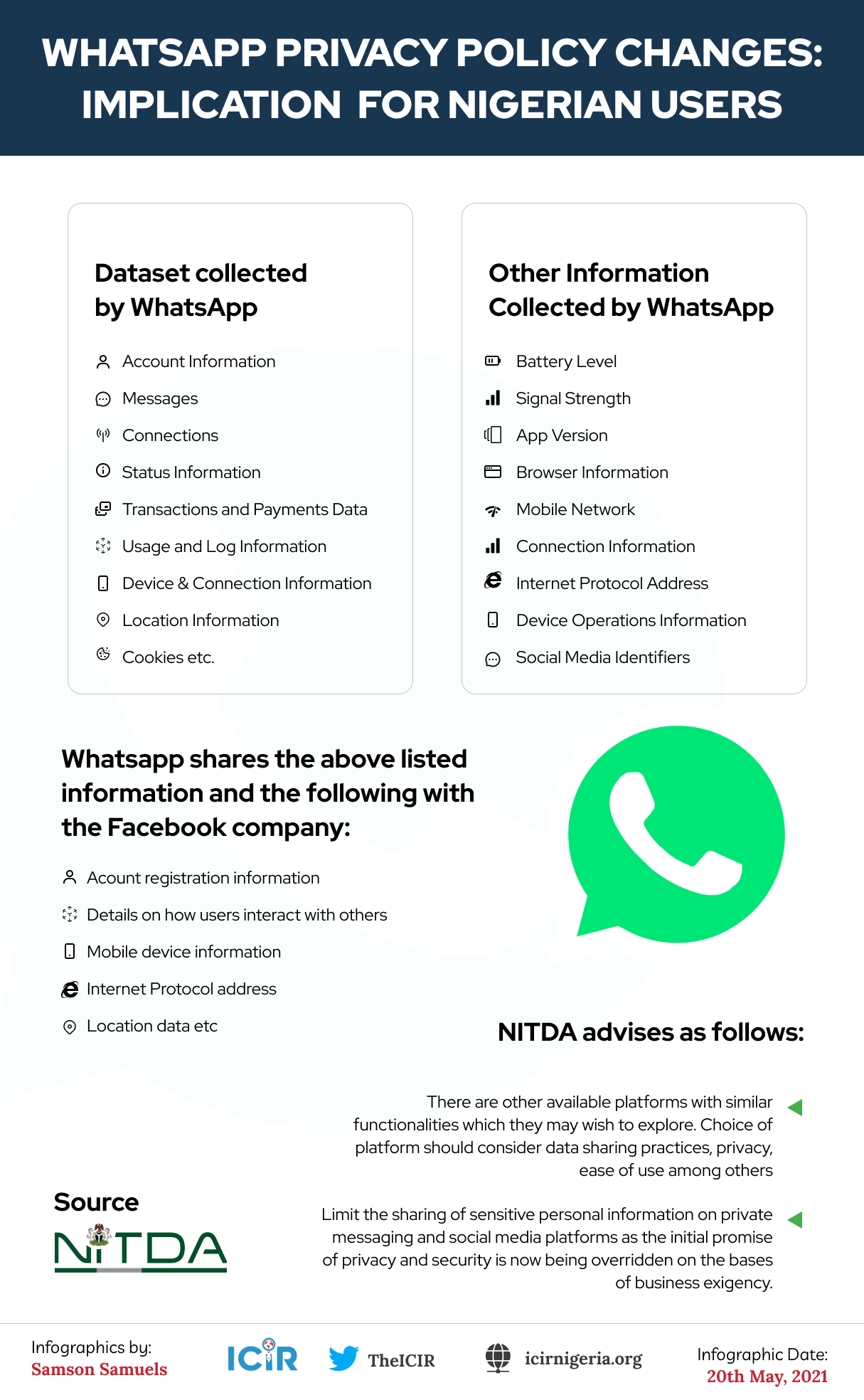
    According to a statement on Tuesday by NITDA Head of Corporate Affairs and External Relations Hadiza Umar, data to be collected and shared would include: account information; messages (including undelivered messages, media forwarding); connections; status information; transactions and payments data; usage and log information; device and connection information; location information; and cookies.

    Others were: battery level; signal strength; app version; browser information; mobile network; connection information (including phone number, mobile operator or ISP), language and time zone; Internet Protocol address; device operations information and social media identifiers.

    Although Facebook, in response to inquires by NITDA on the new policy, had confirmed that private messages shared on WhatsApp consumer version were encrypted and not seen by the company, the metadata (data about the usage of the service), which are also personal information, would be shared with other members of the its subsidiaries.

    WHATSAPP PRIVACY POLICY CHANGES_ IMPLICATION FOR NIGERIAN USERS
    WHATSAPP PRIVACY POLICY CHANGES_ IMPLICATION FOR NIGERIAN USERS

    These data, according to Facebook, would be shared with its companies to further enhance, “operate, provide, improve, understand, customize, support, and market our services and their offerings, including the Facebook Company Products.”

    NITDA, however, called on Nigerians to limit the sharing of sensitive personal information on private messaging and social media platforms as the initial promise of privacy and security was now being overridden on the basis of business exigency.

    “Nigerians may wish to note that there are other available platforms with similar functionalities which they may wish to explore. Choice of platform should consider data sharing practices, privacy, ease of use among others.”

    According to the statement, NITDA noted that it was engaging with Facebook to find a better way of protecting the data of Nigerians.

    “We have given them our opinion on areas to improve compliance with the Nigeria Data Protection Regulation (NDPR). We have also raised concerns as to the marked difference between the privacy standard applicable in Europe, under the GDPR and the rest of the world.

    “Given the foregoing and other emerging issues around international technology companies, NITDA, with stakeholders, is exploring all options to ensure Nigerians do not become victims of digital colonialism. Our national security, dignity and individual privacy are cherished considerations we must not lose.”

    It added that it would work with the Federal Ministry of Communications and Digital Economy to organise a hackathon for Nigerians to pitch solutions that could provide services offering functional alternatives to existing global social platforms.

  • Reasons Behind Search by Image Innovation

    Reasons Behind Search by Image Innovation

    There is a famous proverb, which is Necessity is the mother of invention. One of the benefits to live in the digital world is that all you need, you can get instantly with just a single tap.

    Now, at this time we are availing of that opportunity. Search byimage is an online tool that has been a rave in the domain of creating content because of its accessibility & quality.

    These picture search services are the best for your social media requirements, and make the journey of your content creation hassle-free.

    Why do you need reverse image search tool?

    There is no doubt that it is difficult to contain because the digital community is growing rapidly. The never-ending range of different products is out there in the world, so there is an open invitation for everyone to select and make use of their desired products. Search by image plays an integral part in the success of your venture, but there is a bundle of information in this regard out there, who should trust.

    You need not worry about time consumption while searching for something as the reverse image tool helps the to save his precious time. The image lookup tool is the best option to find duplicate & similar images in the database of major search engines.

    Reasons behind the innovation of image by search tools:

    As fascinating as it looks, the easy-to-use picture search tool is not just a platform of web technicalities. However, it contains the database that is associated with the top-ranked search engines of the present time, which provides you with the best possible results. On the other hand, a question that bothers almost all of us is “who said that there is something inappropriate with the traditional method of searching. Well, if you are from the old school thoughts, then, it’s fine to. The search by image finder allows you to vocalize your words as input for reverse image lookup.  

    Stepping into the Modern Era of Graphical Content:

    Over the previous decade, the search industry has grown altogether by the advancement of personalization, language handling, & media interactive results. But someone can be content that the intensity of the picture remains undiscovered.  Some web crawlers & digital marketers indicated that the visual search is the eventual fate of the search. So, for what reason do you use the search by image? However, the reasons for using the reverse photo search are not all the same, but ordinarily, it is used for the verification of the image by discovering the source of the image that you are searching for or to track its utilization of different online platforms.

    Tracking of the Images:

    The second one is said to be the major reason behind the innovation of image by search free & paid tool is the tracking of your images. For instance, if you are running a website, then you may distribute pamphlets, or commit public statements, or post the copyrights of the image online, so here the fact you need to admit that is the image you use can be re-utilized. The visual image search will let you know when and where your image is used. You can also choose whether the re-use of images is legitimate & proper or not, and whether to make the move.

    Authenticating Images:

    When you see a picture in your email or any other platform then, you don’t understand how old this image is and from where it originated. Here, the reverse photo tool can help to figure it all for you. There are times when the image finder claims to showcase a particular event, but it’s possible that it was taken earlier at a different platform.

    Here are some of the famous image search platforms!

    Image finder by SearchEngineReports:

    It’s an online search by image tool by Searchenginereports.net that allows the user to search for similar images available on the web. You just need to upload the image file or drag the picture in the designated section of the tool to get similar results for the picture.  You can also search by inserting the website URL or type the keyword for the photo to get the relevant results within no time.

    Google Images:

    Google images by search online free tools are undoubtedly considered as a popular search engine, and it is the primary resource for most marketers. It allows you to search the exact picture, check the copyrights, and size of the picture. This photo finder by Google is super easy to use & free for everyone. To get the results for the picture upload or drag the picture into the search bar and hit the click button.

    Pinterest Visual Search Tool:

    Pinterest is the tool that makes its prominent place in the list of well-known image finders within a very short time. It describes its visual search tool as a crazy image finder tool. It was launched in the year 2015, and quickly became a favourite resource for many users.

    Conclusion:

    Reverse image search is an ideal alternative tool for the content creation journey as an across the globe service. In the article, we outlined the basic reasons behind the amazing innovation of reverse image search tools. Some tools for the reverse search are also taken into account.

  • Elon Musk Has Stopped Using Bitcoin

    Elon Musk Has Stopped Using Bitcoin

    Tesla has suspended vehicle purchases using bitcoin due to climate change concerns, its CEO Elon Musk said in a tweet.

    Bitcoin fell by more than 10% after the tweet, while Tesla shares also dipped.

    Tesla’s announcement in March that it would accept the cryptocurrency was met with an outcry from some environmentalists and investors.

    The electric carmaker had in February revealed it had bought $1.5bn (£1bn) of the world’s biggest digital currency.

    But on Thursday, it backtracked on its previous comments.

    “We are concerned about rapidly increasing use of fossil fuels for Bitcoin mining and transactions, especially coal, which has the worst emissions of any fuel,” Mr Musk wrote.

    “Cryptocurrency is a good idea… but this cannot come at great cost to the environment.”

    He also said the electric carmaker would not sell any of its bitcoin and intends to use it for transactions as soon as mining shifts to using more sustainable energy.

    Market analysts see the move as an attempt by Tesla to assuage the concerns of investors who are focused on climate change and sustainability.

    “Environmental, Social and Corporate Governance (ESG) issues are now a major motivation for many investors. Tesla, being a clean energy-focused company, might want to work better in the environmental area of ESG,” Julia Lee from Burman Invest told the BBC.

    “But a cynic might suggest that this is just another move by Elon Musk to influence the cryptocurrency market, as he has done on so many other occasions,” she added.

    Last month, Tesla announced profits for the first three months of the year were $438m, up from $16m last year, boosted by sales of bitcoin and environmental credits.

    Musk has been one of the world’s most high profile proponents of cryptocurrencies, often tweeting about bitcoin and the once-obscure digital currency dogecoin.

    His tweets in recent months helped to turn dogecoin, which was started as a social media joke, into the world’s fourth-biggest cryptocurrency.

    What are the climate concerns around bitcoin?

    Bitcoin is created by miners using high-powered computers to compete against each other to solve complex mathematical puzzles.

    It is an energy-intensive process that often relies on electricity generated with fossil fuels, particularly coal.

    The dominance of Chinese bitcoin miners and lack of motivation to switch from cheap fossil fuels to more expensive renewable energy sources could mean there are few quick solutions to the emissions concerns over bitcoin.

    China accounts for more than 75% of bitcoin mining around the world, according to recent research.

    The cryptocurrency’s carbon footprint is as large as one of China’s ten largest cities, the study found.

    That is because those bitcoin miners tend to use electricity produced with fossil fuels, primarily coal, for most of the year, only shifting to renewable energy, mostly hydropower, during the rainy summer months.

    Source: BBC News.

  • Clubhouse Finally Launches Android App After iOS Exclusivity

    Clubhouse Finally Launches Android App After iOS Exclusivity

    Live audio app Clubhouse will begin introducing a test version of its app to Google’s Android users in the United States on Sunday, the company said, in a potentially big expansion of its market.

    The app, which spiked in popularity early this year after celebrity billionaire Elon Musk and others appeared in audio chats, has sparked copy cats from startups and larger rivals including Facebook Inc and Twitter Inc.

    It has been available only to users of Apple devices and by invitation. In some markets such as China, invitations were so sought after some were auctioned on online marketplaces.

    But downloads of the app, one measure of popularity, have significantly fallen.

    After peaking in February with 9.6 million downloads, that number fell to 2.7 million in March and then 900,000 downloads in April, according to Sensor Tower.

    The drop has sparked questions about its long term viability and whether its success was owed in part to people spending more time at home during the pandemic.

    https://twitter.com/clubhouse/status/1391426008205733888?s=21

    The long anticipated Android launch is expected to reach more new users globally. The Android version will reach other English-speaking markets and then the rest of the globe days and weeks after the U.S. market beta launch.

    Clubhouse, which created the category, now faces the likes of Facebook, whose CEO Mark Zuckerberg announced in April a slew of audio products, including Clubhouse-style live audio rooms and a way for users to find and play podcasts.

  • Twitter Adds ‘Tip Jar’ Feature That Will Allow Users Get Paid For Good Tweeting

    Twitter Adds ‘Tip Jar’ Feature That Will Allow Users Get Paid For Good Tweeting

    The company says the feature is “an easy way to support the incredible voices that make up the conversation”.

    To begin with, only a select group of people can receive tips – a group Twitter said was made up of “creators”, journalists, experts, and non-profits.

    But the feature has also been criticised for exposing personal information such as email addresses.

    The tip jar function essentially adds a small icon to a user’s profile – on mobile devices only for now – with a drop-down menu for other payment providers such as PayPal, Venmo, or the Cash App, the latter two of which are popular in the United States.

    But because the payment is made through those external systems, some Twitter users noticed that tipping a PayPal account lets the recipient know the postal address of the tip sender.

    In other cases, the recipient’s email address could be seen, whether or not any money was sent.

    After security expert Rachel Tobac highlighted the issue, Twitter product lead Kayvon Beykpour thanked her for the “good catch” – but said Twitter could not control how PayPal handled that information.

    Instead, Twitter said it was updating the information around the tip jar to make clear that some details might be shared.

    PayPal, meanwhile, said the issue arose because the Twitter tip jar was using its “goods and services” payment option – which shares details for shipping those goods. It said people can toggle to the “friends and family” option during payment to avoid the issue.

    The tip jar function also has support for Bandcamp – widely used by musicians – and Patreon, used by all sorts of independent digital creators such as YouTubers and podcasters.

    Twitter says the addition was inspired by people who added payment links or Patreon ads in replies to viral tweets.

    “We $ee you – sharing your PayPal link after your Tweet goes viral, adding your $Cashtag to your profile so people can support your work, dropping your Venmo handle on your birthday or if you just need some extra help,” wrote Twitter’s senior product manager Esther Crawford in the blog post announcing the feature.

    It said more people would be able to add the function to their profile “soon”.

    But there are some concerns about the way the function will be used.

    Journalists, in particular, are often banned from accepting gifts – and it’s not clear how “tips” will be treated by news organisations.

    “Seems like Twitter’s tip jar feature is going to raise some issues for newsrooms,” tweeted Ryan Lizza, Politico’s Washington correspondent.

    “Should reporters at your favourite [publications] and networks be allowed to accept money from anyone on the internet?” he asked.

    Another reporter writing for a US-based newspaper wrote: “On the one hand… seems ripe for creating unethical situations.

    “On the other hand… I don’t make a lot of money and it’s a tough world out there.”

    The tip jar is the latest in a string of experiments from the social network, which has seen user growth slow in recent years.

    Earlier this month, it acquired Scroll, a subscription service that removes adverts from participating news websites – and announced it would be part of Twitter’s upcoming subscription service.

    As part of that deal, Twitter also pitched paying Twitter as a way of supporting journalism.

    “As a Twitter subscriber, picture getting access to premium features where you can easily read articles from your favourite news outlet or a writer’s newsletter from Revue, with a portion of your subscription going to the publishers and writers creating the content,” it said.

  • China Says Rocket Debris Landed In Indian Ocean West Of Maldives

    China Says Rocket Debris Landed In Indian Ocean West Of Maldives

    Remnants of China’s biggest rocket landed in the Indian Ocean on Sunday, with the bulk of its components destroyed upon re-entry into the Earth’s atmosphere, according to Chinese state media, ending days of speculation over where the debris would hit.

    The coordinates given by state media, citing the China Manned Space Engineering Office, put the point of impact in the ocean, west of the Maldives archipelago.

    Debris from the Long March 5B has had some people looking warily skyward since shortly after it blasted off from China’s Hainan island on April 29, but the China Manned Space Engineering Office said most of the debris was burnt up in the atmosphere.

    State media reported parts of the rocket re-entered the atmosphere at 10:24 a.m. Beijing time (0224 GMT) and landed at a location with the coordinates of longitude 72.47 degrees east and latitude 2.65 degrees north.

    The Long March launched last week was the second deployment of the 5B variant since its maiden flight in May 2020. Last year, pieces from the first Long March 5B fell on Ivory Coast, damaging several buildings. No injuries were reported.

    With most of the Earth’s surface covered by water, the odds of populated area on land being hit had been low, and the likelihood of injuries even lower, according to experts.

    But uncertainty over the rocket’s orbital decay and China’s failure to issue stronger reassurances in the run-up to the re-entry fueled anxiety.

    During the rocket’s flight, Harvard-based astrophysicist Jonathan McDowell told Reuters that the potential debris zone could have been as far north as New York, Madrid or Beijing, and as far south as southern Chile and Wellington, New Zealand.

    Ever since large chunks of the NASA space station Skylab fell from orbit in July 1979 and landed in Australia, most countries have sought to avoid such uncontrolled re-entries through their spacecraft design, McDowell said.

    “It makes the Chinese rocket designers look lazy that they didn’t address this,” said McDowell, a member of the Harvard-Smithsonian Center for Astrophysics.

    The Global Times, a Chinese tabloid published by the official People’s Daily, dismissed as “Western hype” concerns that the rocket is “out of control” and could cause damage.

    “It is common practice across the world for upper stages of rockets to burn up while reentering the atmosphere,” said Wang Wenbin, a spokesman at the Chinese foreign ministry, at a regular media briefing on May 7.

    “To my knowledge, the upper stage of this rocket has been deactivated, which means that most of its parts will burn up upon re-entry, making the likelihood of damage to aviation or ground facilities and activities extremely low,” Wang said at the time.

    The rocket, which put into orbit an unmanned Tianhe module containing what will become living quarters for three crew on a permanent Chinese space station, is set to be followed by 10 more missions to complete the station by 2022.

    Heavy-lift Long March 5 rockets have been key to China’s near-term space ambitions – from the delivery of modules and crew of the planned space station to launches of exploratory probes to the Moon and even Mars.

    Source: Reuters.

  • Potential New Malaria Vaccine Shows 77% Efficacy in Trial

    Potential New Malaria Vaccine Shows 77% Efficacy in Trial

    A potential new malaria vaccine has shown a preliminary efficacy rate of 77% during a trial on infants, in what scientists hope is a breakthrough in developing a highly effective malaria inoculation.

    Scientists at England’s University of Oxford said that the yearlong trial involved 450 children in the African nation of Burkina Faso and that no serious events were reported during the trial.

    It is the first candidate vaccine for malaria to surpass a target set for researchers by the World Health Organization: to develop a shot with at least 75% efficacy.

    Researchers say they now plan to conduct a Stage 3 trial for the vaccine on 4,800 children between the ages of 5 months and 3 years in four African countries — Burkina Faso, Kenya, Mali and Tanzania. Those trials will be conducted in collaboration with the Serum Institute of India and the U.S. biotechnology company Novavax.

    The research is led by Adrian Hill, director of Oxford’s Jenner Institute and one of the lead researchers behind the Oxford-AstraZeneca COVID-19 vaccine. Hill told VOA in an exclusive interview that the vaccine is showing game-changing results, noting that over many years,140 malaria vaccine candidates have been tried in clinical trials, and none of them has had an efficacy over 75%.

    “In our first attempt with this vaccine, we see 77%, and we think we can improve on that further. So, it’s real progress. It’s unprecedented,” he said.

    Malaria, a mosquito-borne disease, infects millions of people each year and kills more than 400,000 — most of them young children in sub-Saharan Africa.

    If the next round of trials, called R21/Matrix-M, is successful, the vaccine could be widely available in as little as two years.

    Hill said the Jenner Institute was talking to regulators to see whether the vaccine could be fast-tracked for quicker use.

    “We’re making the point that more people died of malaria in Africa last year by a factor of maybe four than died of COVID. So why isn’t malaria a priority?” he said.

    The trial for the vaccine involved dividing the 450 child participants into three groups: one receiving a high dose of the vaccine, one receiving a low dose, and one receiving a control vaccine.

    Results showed an efficacy of 77% in the high-dose group and of 74% among the low-dose group.

    The results of the trial were reported in a preprint article on the website of the British medical journal The Lancet, with researchers saying the results will soon be published in the journal.

  • Safaricom: Empire, Kingdom or Republic?

    Safaricom: Empire, Kingdom or Republic?

    By ArKan Yasin

    There is a Capitalist idiom, “Borrow a dollar from a bank, the bank owns you; borrow a billion dollars from the bank, you own the bank”. It is a lesson in the utility drawn of possession and by it, Safaricom owns Kenya. Safaricom’s footprint occupies 51% of the economy, with a subscriber base of over 23.3 million. To put this is context, in a total population of 45.6 million with a labour force of 17.7 million with an unemployment growth rate of 24.3% and total mobile subscriber base of 33.6 million, Safaricom holds 23.3 million.

    Put another way, Safaricom holds as subscribers more than half the entire population and, by other metrics, over 88% (88.25%) of the entire adult population. This is to say Safaricom has in its grip the voice communications, finances, savings, transactions (individual and business), location information, and full bio data for 88% of the entire adult population. Society now communes through the mobile network. It follows that social polity is now expressed within the Network, thus the adage, the Network Society. The followers your social identity garners measure your popularity. This shift can most easily be perceived by the surpassing in importance of your cellular number than that of your Government issued Identity Card number. You are even required to record your cellular number in a column in parallel with your Identity card number in all access-controlled environments. As an aside, when the question was raised as to what the need or purpose for this “compulsory” disclosure is, the writer was once replied by the security guard at the desk, without even a hint of irony that, “It is for your own good. For instance, in case the building collapsed we would know how to reach you”. By this measure, Safaricom is the primary arbiter of all social and economic relations for the population of the entire territory.  The centre has moved; Safaricom is the new centre.

    President Uhuru Kenyatta keeps shouting he is powerless, but no one listens. If the United Food Company made Honduras and Guatemala “Banana Republics” then Kenya and the other nations in Safaricom’s grip are of necessity “Safaricom Republics”. Safaricom is unique not just in the fact that it straddles commerce, banking, voice and data communications, security surveillance and entertainment, but in the depth of its dominance in terms of reach in numbers, brand and socio-political power. Safaricom wields all the societal scale tools of arbitration, power and oversight without societal scale authority and culpability, and here in lies the problem. Put simply, the question we need to ask is; to correct the skew, should Bob Collymore be handed the sceptre of power and crowned King? Or should Safaricom be cleaved and lobotomised? Safaricom is the de facto polity, socially and economically but not politically. Given the sheer scale of Safaricom’s dominance over the social entity, political theory dictates it should bear the burden and weight of the entity’s social and economic challenges proportionately.

    The M-PESA, transaction fee by virtue of its ubiquity and inescapability (given it is extracted from over 88% of the adult population), is a society-wide economic rent and de-facto tax.Safaricom is the Treasury for over 88% of the adult population, given this 88% cannot escape the Safaricom tax; Safaricom therefore has a social and economic obligation to this 88%, which transcends public relations false wealth re-distribution “photo-op” exercises like Corporate Social Responsibility. This is not lost on Safaricom as it states in its True Value Report that “Societal value is now linked to Safaricom’s corporate value”. While it definitely does not hold true that Safaricom success would by any means translate to societal success, Safaricom’s failure would most certainly lead to societal scale failure. This is because the territory and its administration, unlike the story of AIG and the United States Government, would never be able to absorb a Safaricom scale failure. Safaricom is not Imperial Bank, Chase Bank, Kenya Airways or National Bank.

    The Sh48 billion profit declaration is, as we will show in the next issue, most probably significantly understated. Elementary arithmetical analysis suggests net profit take of Sh60 billion (given its operational opacity, give or take Sh5 billion). But what is important to us as a society is that the Sh48 billion “profit” is in reality tax revenue. This was not a CEO releasing a commercial profit report; it was a tax service Commissioner General’s revenue announcement. For, to the citizens, there exists no choice in the issue of whether or not to submit to Safaricom. Just like tax, everyone, except the King, must pay. As Safaricom stands, Bob Collymore is entitled to a seat on the Central Banks vaunted Monetary Policy Committee for being singularly the most determinant factor in the velocity of currency. Bob Collymore is also entitled to a seat on the National Security Council given Safaricom is the Administration’s primary signal intelligence and surveillance infrastructure.

    A Safaricom Economic Index would also be a far more precise measure of commercial activity at any one time than any other. The Safaricom technical glitch of Monday 24, April 2017 manifests its micro-economic dominance and control. The streets ground to a halt, from Kirinyaga Road all the way up Juja Road and probably throughout the country, every citizen (read subject), every transaction (read task) even the CEO Bob Collymore waited for advice from the Safaricom technical team (read Conseil du Roi). But would granting Bob Collymore this policy making power go far enough relative to Safaricom’s de-facto writ? Would it be proportionate to Safaricom’s “True Value”? Keep in mind Safaricom reminds us time and time again in the Safaricom KPMG ‘True Value Report’ that “their corporate value” and “our societal value” are linked, are conspecific. Simply put, Safaricom has conquered Kenya.

    What to be or what not to be… what to do or not to do

    How long was it going to be from the Monday 24th, April 2017 before the proletariat in Eastlands visited Bob Collymore’s citadel in bourgeois Westlands with spanners and cudgels? Weeks? Days? Hours? What alternative is there to Safaricom? Which institution or combination of institutions can catch the ball if Safaricom drops it? What… where is the Safaricom fail-over? As man is to err, institutions are prone to failure and it is important to understand that the greatest vulnerability is not the technology; it is man… Kenya may need to seriously consider submission. We are serendipitously fortunate it is election season. Kenya is already primed for political transition. Should we be Safaricom Kingdom or Safaricom Republic? In reality, Waiyaki Way should be bumper to bumper in Lexus traffic all the way to the Safaricom castle.

    As the entire kleptocratic elite; principals, gubernatorial et al queue to pay tribute, receive patronage and extract rations (re-distribute the wealth) to feed the soldiers (political) and hungry desperate masses that protect the base stations in all their fiefdoms (probably negotiated proportionately to base-station numbers and scale of revenue extracted by the King from populations in these footprints). Accelerating forward this natural trajectory without being deceitful about what it means may make more surreal sense.

    Merge the territory, population, administration and supra-national multi-national corporation in to a Corporatocracy. Safaricom is “Empire” given the number of nations in its grip, but Kenya being its imperial heart earns the right to be middle “Kingdom”. It would take a Jacobin scale conspiracy between CAK, COFEK and COTU et al to organise a revolt of sufficient scale to throw off Safaricom’s imperial yoke and turn us “Republic”. But then again, monarchy and its inheritance of political power is antiquated…. so Safaricom Republic it is!

  • Investor On Why He Bought Jack Dorsey’s First Tweet For $2.9M

    Investor On Why He Bought Jack Dorsey’s First Tweet For $2.9M

    The buyer of Twitter’s first ever tweet by its founder Jack Dorsey for $2.9m (£2.1m) sees it as a wise investment.

    “It’s a piece of human history in the form of a digital asset. Who knows what will be the price of the first tweet of human history 50 years from now,” Malaysia-based Sina Estavi said.

    Mr Estavi compared his newly-acquired tweet to Leonardo da Vinci’s Mona Lisa.

    Experts agree that the first tweet from the Twitter founder on his own platform is a highly valuable asset.

    Jack Dorsey’s tweet, which said “just setting up my twttr,” was first published on 21 March 2006 and was auctioned off by Mr Dorsey for Give Directly’s Africa Response charity.

    Mr Estavi, the chief executive of cryptocurrency firm Bridge Oracle, bought the tweet using ether, a rival currency to bitcoin.

    It was sold as a non-fungible token (NFT), a unique digital certificate that states who owns a photo, video or other form of online media.

    NFTs have become hugely popular this year, with expensive digital artwork also being sold this way.

    “I believe it’s an emerging market and it’s just the beginning. All forms of digital arts and creations such as music, photos, videos, tweets and blog posts can be traded in the form of an NFT,” Mr Estavi, a 29-year-old Malaysian national told the BBC.

    He added that his investors and colleagues “are really appreciative and happy about this investment because they know the value and future price of this particular NFT and the impact it made on social media.”

    Overpriced?

    While the price paid for the tweet raised a few eyebrows, experts believe it could be a shrewd investment.

    “A way to explain it is that owning this first tweet can be viewed in the future almost like the first edition of a rare book,” said Cathy Hackl, a social media expert.

    “Twitter ushered in a new era of communication and this tweet launched it.”

    Mr Dorsey’s tweet was sold via an online platform called Valuables, owned by US-based company Cent.

    Cameron Hejazi, co-founder of Cent, said this was the highest valued asset sold on the platform so far.

    “I was shocked but not surprised – the value of these assets is highly subjective. Plus we are happy the money is going to such a good cause,” he told the BBC.

    The NFT market is now worth $1bn and uses the same blockchain technology that underpins digital currencies such as bitcoin to establish ownership and authentication.

    However, it’s still early days to determine precisely how buyers will value other online social media posts.

    Social media history

    “To be able to capture the first tweet, of the person who invented this, makes it very important memorabilia,” said Nanne Dekking, the founder of Artory, which records artworks on blockchain technology.

    Others think some of Donald Trump’s controversial tweets as US president might make for future investment targets.

    As the buyer, Mr Estavi will receive a certificate, digitally signed and verified by Mr Dorsey,

    “If that person is a crypto investor, it makes even more sense as they will find a way to make the investment work for them,” added Ms Hackl.

    While Mr Estavi owns the Dorsey tweet, anyone with internet access can see and read it.

  • Jack Dorsey’s First Tweet Sold For $2.9M At Auction

    Jack Dorsey’s First Tweet Sold For $2.9M At Auction

    The first message ever fired off at Twitter sold on Monday for $2.9 million when its sender Jack Dorsey accepted the winning bid for the collectible as a “non fungible token” or NFT at an auction.

    “Jack accepted the offer from sinaEstavi for $2,915,835.47,” read a tweet from the Valuables by Cent auction platform.

    “This tweet is now minted on the blockchain.”

    The profile on the auction-winning account indicated it belonged to Sina Estavi, chief executive of blockchain technology-related startup Bridge Oracle.

    A copy of Dorsey’s inaugural tweet and a history of the bidding was posted at the v.cent.co website.

    Dorsey’s tweet highlighted a surge of interest around NFTs, or non-fungible tokens.

    NFTs use the same blockchain technology behind cryptocurrencies to turn anything from art to sports trading cards into virtual collector’s items that cannot be duplicated.

    Fifteen years ago Dorsey typed out a banal message — “just setting up my twttr” — which became the first ever tweet, launching a global platform that has become a controversial and dominant force in civil society.

    The short tweet was sent March 21, 2006 by the Twitter co-founder and chief, who said he would donate the money from its sale to charity.

    “I think years later people will realize the true value of this tweet, like the Mona Lisa painting,” Estavi said in a Twitter post.

    Dorsey on Monday tweeted thanks to @sinaEstavi, along with a message indicating the proceeds were sent to Give Directly nonprofit in East Africa that helps people living in poverty.

    “Hey @jack , thank you for accepting my offer, and I’m glad this money is being donated to charity,” Estavi responded in tweet from @sinaEstavi.

  • Tinder Will Soon Allow Users To Run Background Checks On Would-Be Dates

    Tinder Will Soon Allow Users To Run Background Checks On Would-Be Dates

    Online dating is on the verge of becoming a whole lot safer. Tinder, along with its parent company Match Group, partnered with a non-profit background check platform, called Garbo, to help customers determine if their blind date is hiding a criminal record.

    “Match Group will begin testing and building out capabilities for Garbo on Tinder in the coming months,” according to a news release. Once Garbo is integrated on Tinder, other Match Group brands (Match, OkCupid, Hinge, PlentyOfFish, OurTime, among others) will follow. 

    When it comes to Tinder and Hinge, and other online dating apps, very little is known about the other person before the blind date. Garbo transforms online dating experience to become a safer environment.

    “For far too long, women and marginalized groups in all corners of the world have faced many barriers to resources and safety,” said Tracey Breeden, Head of Safety and Social Advocacy for Match Group.

    “We recognize corporations can play a key role in helping remove those barriers with technology and true collaboration rooted in action. In partnership with Match Group, Garbo’s thoughtful and groundbreaking consumer background check will enable and empower users with information, helping create equitable pathways to safer connections and online communities across tech.”

    Once Tinder fully integrates Garbo, users can check public records and reports of violence or abuse before the first date.

    “Before Garbo, abusers were able to hide behind expensive, hard-to-find public records and reports of their violence; now that’s much harder,” Garbo CEO Kathryn Kosmides said. “Being able to reach historically underserved populations is fundamental to Garbo’s mission and the partnership with Match will help us connect with these communities.”

    The move by Match comes as Tinder murders have been reported over the years. Here are some recent news stories:

    Rethinking safety appears to be Match’s biggest push this year across all dating platforms. It would not surprise us if COVID health passports were also an additional option for Tinder dates.

  • France Opens Privacy Probe Into Audio App Clubhouse

    France Opens Privacy Probe Into Audio App Clubhouse

    France’s data privacy watchdog has launched an investigation into Clubhouse, a US-based audio chat app.

    The National Commission for Informatics and Liberties said it opened an investigation on March 12, after receiving complaints to verify if the application’s publisher Alpha Exploration had taken steps to comply with the EU’s General Data Protection Regulation (GDPR).

    The regulation, enforced in May 2018, aims to ensure any organization, even if not based in the EU but processing the personal data or offering goods or services to EU citizens or residents, must adhere to data protection principles like consent and data portability.

    The investigation, a statement issued by CNIL, said “should make it possible to confirm that the GDPR is applicable to the company and to determine if it is ignored.”

    If confirmed that the application does not comply with the GDPR, the CNIL may, if necessary, “use its own repressive powers,” which could include heavy fines.

    Since the Clubhouse’s original publishing company has no establishment in the EU, CNIL said it was intervening as a lead authority in France to take a decision with regard to cross-border data processing.

    Other European authorities are also working in tandem to ensure “consistent application of the GDPR” by the app.

    The by-invitation app launched last April for iPhone allows users to join audio rooms led by organizers to converse with several people or to simply listen in silence. It has faced criticism over loose data protection safeguards and transmitting user’s personal data potentially allowing a third party to track actions in the app.

    A petition is currently circulating in France with more than 12,000 signatures, alerting the CNIL on the possible breaches by Clubhouse on privacy laws.

    “Its privacy rules state that if a person signs up, the names and numbers of all of their contacts will be uploaded to a secret database […] which can then be sold to third parties,” the petition said.

  • Facebook To Start Paying News Corp For Content Shared

    Facebook To Start Paying News Corp For Content Shared

    Facebook has agreed to pay Rupert Murdoch’s News Corp Australia for journalism from its local mastheads.

    The deal has been secured just weeks after Australia passed a controversial world-first law aimed at making tech platforms pay for news content.

    News Corp has not disclosed the value of the three-year contract in Australia. Last month, it clinched a global deal with Google.

    Murdoch’s media empire began with his Australian newspapers.

    The deal covers all of News Corp’s content in the country – which is a significant amount.

    News Corp Australia controls about 70% of newspaper circulation in Australia with mastheads including The Australian, The Daily Telegraph and The Herald Sun. It also owns news.com.au.

    It also owns the Fox News-modelled conservative TV network Sky News Australia, which has grown to become the most-shared Australian news brand on Facebook.

    News Corp already has a different deal with Facebook for its US media titles. It involves the platform paying for stories to include in its Facebook News tab – a product not available in Australia.

    The Australian deal is far broader – it covers all News Corp Australia content shared on Facebook.

    How has this been achieved?

    Like other publishers globally, Australian media outlets have lost revenue in the past decade as advertisers turned to internet giants such as Facebook and Google.

    News Corp spearheaded a lobbying campaign in Australia – with support from its traditional rivals – to get politicians to make the tech firms pay for news content from its sites.

    The Australian government then drew up legislation it said aimed to enshrine “fairer” contract negotiations between media and tech companies.

    Both Google and Facebook had been strongly resistant to the media bargaining code.

    It encourages tech firms to strike their own commercial deals with media outlets, such as this one between Facebook and News Corp.

    Without such deals, the law would potentially force tech firms into forced arbitration with publishers over the value of content.

    Battles over the law’s design-led Facebook to suddenly block all access to Australian news content on its site last month.

    The news ban lasted for about a week before the Australian government made concessions and passed the law on 25 February.

    On Tuesday, News Corp chief executive Robert Thomson praised the Facebook deal as a “landmark in transforming the terms of trade for journalism”.

    Also Read  Bitcoin surges past $60,000 for first time

    “Rupert and Lachlan Murdoch led a global debate while others in our industry were silent or supine as digital dysfunctionality threatened to turn journalism into a mendicant order,” said Mr Thomson.

    “This digital denouement has been more than a decade in the making.”

    Analysts looking at Australia’s media law have long suggested that it is primarily designed to help big firms like News Corp as opposed to smaller media titles.

    Another one of Australia’s top three media companies – Seven West – also signed a deal with Facebook last month.

    The Facebook-News Corp deal comes as a parliamentary inquiry in Canberra that examined News Corp’s media dominance and influence in domestic affairs.

    It was sparked by an anti-Murdoch petition from former Prime Minister Kevin Rudd which received over 500,000 signatures.