Category: Sci & Tech

  • How Journalists, Bloggers And Activists Can Stay Safe From Secret Spying Online

    How Journalists, Bloggers And Activists Can Stay Safe From Secret Spying Online

    Journalists should protect themselves and their sources by keeping up-to-date on the latest digital security news and threats such as hacking, phishing, and surveillance. Journalists should think about the information they are responsible for and what could happen if it falls into the wrong hands, and take measures to defend their accounts, devices, communications, and online activity.

    Protect your accounts

    To protect your accounts:

    Journalists use a variety of online accounts and these hold both personal and work-related information on themselves, their colleagues, families and sources. Securing these accounts and regularly backing up and removing information will help protect against hackers. These steps are particularly important for journalists who may be targeted by an adversary with sophisticated tech capacity.

    • Think about what information is stored in each account, and what the consequences would be for you, your family, and your sources if your account is breached.
    • Review your privacy settings and understand what information is public, especially on social media.
    • Create backup copies of any information that is sensitive or that you would not want made public, including private messages, then delete them from your account or device. Store the copies securely on an external drive or in the cloud.
    • Delete any accounts that you no longer use. Remember to create copies of any information you want to save.
    • Create long, unique passwords for every account. Do not reuse passwords. Use a password manager to help you manage your passwords.
    • Turn on two-factor authentication (2FA), and use a security key like a Yubikey if possible.
    • Regularly review the ‘account activity’ section of each of your accounts. This will reveal if devices you don’t recognize are logged in.

    Phishing

    Journalists often have a public profile and share their contact details to solicit tips. Adversaries looking to access journalists’ data and devices can target them–or a colleague or family member–with phishing attacks in the form of tailored email, SMS, social media, or chat messages designed to trick the recipient into sharing sensitive information or installing malware by clicking on a link or downloading a file. There are many types of malware and spyware which range in sophistication, but the most advanced can grant a remote attackers access to the device and all of its content.

    To defend against phishing attacks:

    • Research the tech capabilities of your adversaries to understand the threat and the likelihood you or someone you know could be a target.
    • Be wary of messages that urge you to do something quickly or appear to be offering you something that appears to good to be true, especially if they involve clicking on a link or downloading an attachment.
    • Check the details of the sender’s account and the message content carefully to see if it is legitimate. Small variations in spelling, grammar, layout, or tone may indicate the account has been spoofed or hacked.
    • Verify the message with the sender using an alternative method, like a phone call, if anything about it is suspicious or unexpected.
    • Think carefully before clicking on links even if the message appears to be from someone you know. Hover your cursor over links to see if the URL looks legitimate.
    • Preview any attachments you receive by email; if you do not download the document, any malware will be contained. If in doubt, call the sender and ask them to copy the content into the email.
    • Upload suspicious links and documents to Virus Total, a service that will scan them for possible malware , though only those that are known.
    • Enable automatic updates and keep all software on your devices up-to-date. This will fix known vulnerabilities that malware relies on to compromise your security.
    • Stay particularly alert to phishing attempts during elections and periods of unrest or if colleagues or local civil society groups report being targeted.

    Device security

    Journalists use a wide range of devices to produce and store content, and to contact sources. Many journalists, especially freelancers, use the same devices at home as well as at work potentially exposing a vast amount of information if they are lost, stolen, or taken. Encrypt computer hard drives, phones, tablets, and external storage devices, especially if you travel, to ensure that others will not be able to access this information without a password.

    To secure your devices:

    • Lock devices with a password, code, or PIN. Longer personal identification numbers or passwords are more difficult for others to unlock.
    • Update your operating system when prompted to help protect devices against the latest malware.
    • Audit the information stored on your devices and consider how it could put you or others at risk.
    • Back up your devices regularly in case they are destroyed, lost, or stolen. Store the backup copies securely, away from your regular workstation.
    • Delete sensitive information regularly, including chat messages. To prevent an adversary from restoring deleted files, use secure deletion software to wipe the device, if available; otherwise reset it and use it for unrelated activities in order to rewrite the device memory. (Back up anything you want to keep first or you will lose all your data.)
    • Don’t leave devices unattended in public, including when charging, as they could be stolen or tampered with.
    • Don’t plug devices into public USB ports or use USB flash drives that are handed out free at events. These could come loaded with malware which could infect your computer.
    • Be aware that your device may back up your data to the cloud account linked to the phone. Information stored in the cloud may not be encrypted. You can turn off automatic backups in the settings.
    • Set up your devices to allow you to wipe any data remotely if they are stolen. This feature must be set up in advance, and the device will only wipe if it is connected to the internet.
    • Always get devices repaired with a reputable dealer.

    To encrypt your device:

    • Newer smartphones come with an encryption function, just make sure it is switched on in the settings.
    • Use Bitlocker to turn on full-disk encryption for Windows, Firevault for Mac, or the free Veracrypt software for hard drives and external storage.
    • Creating a long, unique password is key to using encryption; on a smartphone, check the custom settings to add a longer, more complex password.
    • Be aware that an adversary with knowledge of your password or power to compel you to decrypt your device will be able to look at the information.
    • Always research the law to ensure encryption is legal in the country you are living in or travelling to.

    Encrypted communications

    Journalists can communicate with sources more securely using encrypted messaging apps or software that encrypts email so only the intended recipient can read it. Some tools are easier to use than others. Encryption protects the content of messages, but the companies involved can still see the metadata, including when you sent the message, who received it, and other revealing details. Companies have different policies on how they store this data and how they respond when authorities ask for it.

    Recommended messaging apps offer end-to-end encryption, meaning that the information is encrypted when it is being sent from the sender to the recipient. Both parties must have an account with the same app. Anyone with access to a device sending or receiving the message or to the password of the account linked to the app can still intercept the message content. Examples of messaging apps with end-to-end encryption include Signal, WhatsApp, and Telegram.

    Encrypted email is a more secure way of exchanging information with a source or contact. Both parties must download and install specific software in order to send and receive encrypted email.

    To use encrypted messaging apps:

    • Research who owns the app, what user data they keep, and whether that data has been subpoenaed by a government. Check to see what their policy is for responding to requests to share user data.
    • Use a PIN or password with the app where possible to prevent someone from opening it if they steal your phone.
    • Understand where information sent to your messaging apps is stored on your phone.
    • Anything you download, like photos, will be saved on your device and may be copied to other devices and apps, especially when you back up your data.
    • Some services, like WhatsApp, back up your message content to the cloud account linked to the telephone number.
    • Contacts stored in your phone sync with messaging apps and cloud accounts, so numbers you try to delete in one place may be preserved somewhere else.
    • Back up and delete messages regularly to store as little as possible on a single device or account. Create a process for reviewing content, including documents and multimedia messages, and store downloads or screenshots on an encrypted external storage device.
    • Signal’s disappearing message function allows you to automatically delete messages after a certain time.

    To use encrypted email:

    • Get help from a trusted contact who is tech savvy. Encrypted email is not always easy to set up if you are new to it.
    • Choose reputable email encryption software that has been peer reviewed. Always update your software to protect against security vulnerabilities.
    • Take time in advance to create a long, unique password for your encrypted email software. If you forget this password you will lose access to encrypted emails.
    • Send encrypted emails regularly so that you don’t forget how to use the software.
    • Details about the email, including the title and the email addresses sending and receiving the message, are not encrypted.

    Examples of email encryption software include GPG Suite for Mac, GPG4win for Windows and Linux, Thunderbird with the Enigmail extension, and Mailvelope.

    Secure internet use

    Journalists rely on the internet, but may not want to share their online activity with every internet service provider, internet cafe, or hotel with free WiFi. Criminals, as well as sophisticated adversaries, can steal information or monitor journalists using insecure websites or public WiFi connections.

    To use the internet securely:

    • Look for https and a padlock icon at the start of every website URL (https://cpj.org), indicating that traffic between you and the site is encrypted.Check sites you visit are secure using the Electronic Frontier Foundation’s HTTPS Everywhere browser extension.
    • Check that the website address is authentic, not a spoof. The URL should be spelled correctly and include https.
    • Install an ad-blocker to protect against malware, which is often hidden in pop-up advertising. Ad-blockers allow you to exempt certain sites from being blocked.
    • Install Privacy Badger to block websites and advertisers from tracking what sites you visit online.
    • Disable Bluetooth and other file-sharing apps and services when not in use.
    • Use a VPN to protect Internet traffic, especially when using public WiFi, which is not secure and leaves you vulnerable to hacking or surveillance.
    • Avoid using public computers, especially at internet cafes or press rooms. Log out of all sessions and clear your browsing history after use if it cannot be avoided.
    • Consider installing the free Tor Browser Bundle to use the Internet anonymously or Tails, a free operating system that routes all your internet traffic through Tor. Tor is especially recommended for journalists who investigate sensitive topics like high-level government corruption in countries with sophisticated tech capacity.
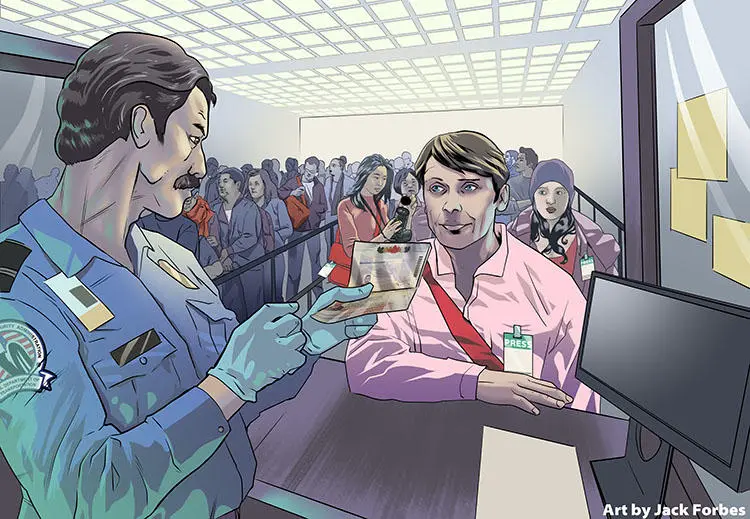
    Artwork: Jack Forbes
    Artwork: Jack Forbes

    Crossing borders

    Many journalists cross borders carrying work and personal information that they may not want others to access on electronic devices. If border guards take a device out of your sight they have an opportunity to search it, access any accounts, copy information, or install spyware. Journalists crossing U.S. borders should consult CPJ’s safety note, “Nothing to Declare.”

    Before you travel:

    • Find out what information is on your devices and how it could put you and your contacts at risk. Assume your devices could be subject to the same level of scrutiny as notebooks and printed material in your luggage.
    • Back up all your devices to an external hard drive or to the cloud. Remove any information that you would not want border officials to access from your devices.
    • Buy clean devices to use only for travel if possible, especially if you are working on highly sensitive stories. If you are traveling with a personal or work device, securely back up your content then perform a wipe or reset.
    • Turn on full-disk encryption for all devices to ensure that your information cannot be accessed without a password. Research restrictions on encryption of the country you are visiting to ensure you are not breaking any laws. Be aware that security forces may legally be allowed to ask for your password. Seek advice from your employer or lawyer before travel if there is a possibility you will be stopped at the border.
    • Log out of all accounts on your devices and uninstall apps until you have crossed the border and reached a secure Internet connection.
    • Clear your browsing history on all your devices. (Your internet service provider will still have a record of which websites you have visited.)
    • Lock all devices with a PIN or password instead of biometric data like your face or fingerprint.
    • Enable remote wiping of your devices and leave clear instructions with someone you trust to wipe your devices remotely if you are detained.

    At the border:

    • Power off your devices to activate disk encryption.
    • Keep an eye on your devices as they pass through security.
    • Do not turn on your phone until you are away from the airport. Any calls and SMS messages will be routed through a local service provider who may collect the content or share it with authorities. Use a VPN when connecting to the airport WiFi.

    If any device is confiscated at the border or anything is inserted into it, assume it is compromised and that any information on it has been copied.

    Editors’ note: This article is an initiative of  The Committee to Protect Journalists for safety online.

  • Beneath the Surface: Understanding The Deep And Dark Web

    Beneath the Surface: Understanding The Deep And Dark Web

    We are all familiar with the web that Google shows us – the “visible” surface web that is indexed by search engines. When you search for your own name on Google, you’re likely met with results that are familiar to you, including social media profiles, your bio on your employer’s website, and maybe a few local media clippings if you’ve been interviewed by the press. As vast as it may seem, with millions of results for even just a simple search of your name, the surface web actually only makes up about 4% of the entire web. Just like an iceberg, there is a much larger part of the web, the deep web, that is beneath the surface and not indexed. This means search engines cannot “crawl” this information (think: paywalled content, bank account information, medical records, etc.). You cannot locate it with a simple Google search. Enterprises focus much of their attention on the surface web, and rightfully so, because these results make up your company’s public presence. However, monitoring the hidden corners of the internet is just as if not more important for risk professionals.

    The deep web has many common uses, so perhaps it is not exactly hidden, but it does require a password or additional security measure to gain access. The infamous dark web – or dark net – a subset of the deep web, is more commonly associated with nefarious activities, and you must use a specific browser, such as Tor, to access this underground ecosystem. While web browsers typically reveal a user’s IP address, Tor and other dark web networks hide this information, thus masking the identity of the users. Interestingly enough, the original technology behind Tor, also known as onion routing, was developed by the United States Navy “and has received about 60% of its funding from the State Department and Department of Defense.”

    What goes on in the dark web?

    In recent years, the amount of cybercrime has continued to rise, especially in underground markets. This is increasingly true in the wake of COVID-19. Data has suggested that the first half of 2020 saw an approximate 35% increase in total attack volume compared to the second half of 2019, with cyber criminals taking advantage of the cybersecurity gaps that accompany remote workforces. The formula is quite simple: the lower the barriers to entry (in other words, you do not need advanced computer skills or sophisticated tools to access the dark web) coupled with more data and infrastructure will result in more and more cybercrimes.

    This is not to say everything that takes place in the dark web is illicit – Facebook, BBC, and The New York Times all have onion sites, for instance – but the anonymized and encrypted nature of this hidden corner of the internet lends itself to criminal activity, ranging from buying, selling, and trading (via cryptocurrency) drugs to weapons to large data sets amassed from breaches.

    More than likely, you, a colleague of yours, or a family member has personally identifiable information (PII) that is either exposed or for sale on the dark web right now. Millions of accounts are compromised in data breaches every year and billions of exposed credentials continue to circulate and re-circulate in underground communities. In my firm’s 2020 Breach Report, we found that there were more than 18 billion raw identity records being passed around through these underground marketplaces. Threat actors will sell or leak this information onto forums and private channels, and, alarmingly, are able to compile digital profiles of citizens and businesses, fueling a host of identity-based attacks, including Account Takeover (ATO), Business Email Compromise (BEC) and sophisticated Social Engineering (SE) attacks.

    This doesn’t just mean that criminals are trying to hack into your bank account to drain the balance or use your credit card for an online purchase. Using social engineering techniques, bad actors can now use compromised data to develop nearly indistinguishable identities from their true owners – deceiving others in their networks. This is increasingly troublesome when you consider that many are continuing to work from home during the COVID-19 pandemic. With more correspondence taking place digitally, you might not think twice if you get an email that appears to come from your boss asking you to authorize a payment to a supplier, when in reality it may actually be a sophisticated cyber criminal impersonating your executive.

    Underground marketplaces run very much like a business, to the point where people can even leave reviews for websites, similar to an Amazon review. You can also report scams to the admin or community in some markets so that they may ban the seller or buyer. Identity records get sold in chatrooms, hacking sites, forums, you name it – and the average prices for different identity record types vary by country, type of account, etc. My firm foundthat in 2019, social security numbers went for around $67; passports were roughly $53; drivers licenses were $48; credit cards were $40.80; and tax IDs were $28.75.

    Tips to protect data

    Despite the vast amount of data already circulating on the dark web, there are still actions you can, and should, take to safeguard your identity and information. First and foremost, password reuse exacerbates the proliferation of exposed credentials. Identity records exposed from one breach can be reused to compromise completely separate accounts through credential stuffing attacks. This happens when criminals attempt to log into different platforms using the same stolen credentials, hoping the users don’t have unique passwords across their accounts. So, even if your organization has an excellent security posture, a single employee’s breached information makes for an easy entry point for cybercrime if they don’t update their credentials after the breach. This puts the entire organization’s reputation and finances at risk and goes beyond their employer to potentially others in their business’ supply chain. Human error can be costly.

    People must use unique, complex passwords for all their accounts, both work and personal, and use a password manager to safely keep track of them all. Multi-factor authentication, when possible, provides an added layer of protection as well. Enable automatic software updates and be sure to back up your data in case it does get pilfered. When you suspect your credentials could have been compromised, updating them will immediately make the data obsolete. Do not provide personal information if it is not mandatory; many forms request your address, phone number, etc., but only fill out the minimum information that is required. Lastly, practice internet awareness; always err on the side of caution and only visit sites you trust. If an email or website asks you for personal information and threatens punishment for a lack of compliance, it is wise to be suspicious.

    At an enterprise level, companies need to do a better job of either preventing their information from getting into the wild or having an early warning system that enables them to secure their networks as soon as it does. This means businesses have processes and tools in place that swiftly alerts them when their sensitive information — credentials, documents, intellectual property — is exposed. The sooner organizations and individuals know about the breach, change credentials, and lock down networks, the less damage occurs. No single service can parse through the entire dark web but knowing where to look in this space is key.

    In the context of onboarding, due diligence, and risk rating for potential new customers, it can be  immensely valuable for an enterprise to know at the earliest point in time if a company has data floating around the deep and dark web. For anti-money laundering (AML) transaction monitoring, the ability to automatically populate and update electronic case filing with information about parties involved in transaction can make for an easy and efficient investigation. The examples could go on and on. Simply put, the deep and dark web is just as important to monitor as the indexed web and social – keep pace with constantly evolving threat actors by looking beneath the surface.

    External Source.

  • Aviation Authority Sets Price For Operating A Drone In Kenya

    Aviation Authority Sets Price For Operating A Drone In Kenya

    Kenyans and entities wishing to own and operate Unmanned Aircraft Systems popularly known as drones will now pay a Ksh3,000 registration fee.

    This is after the Kenya Civil Aviation Authority (KCAA) received the go-ahead to operationalize the Civil Aviation (Regulatory Fees and Charges for Unmanned Aircraft Systems) Regulations, 2020 which was acceded to by the National Assembly on 6 March 2021.

    The proposed charges had been gazetted by the Cabinet Secretary, Ministry of Transport, James Macharia on 22 January 2021.

    The approval paves the way for full implementation of the Unmanned Aircraft Systems (UAS) regulatory framework in Kenya.

    These charges are a reduction from the revoked rates under the Kenya Civil Aviation (Remotely Piloted Aircraft Systems) Regulations, 2017.

    “Under the new cost structure, Kenyans and entities wishing to own and operate Unmanned Aircraft Systems popularly known as drones will now pay a Ksh3,000 registration fee. Details of the charging structure can be obtained from www.kcaa.or.ke” said KCAA in a statement.

    KCAA director general Gilbert Kibe said the gazettement of the Regulations heralded a new era in the country’s aviation ecosystem by opening up the sector to innovations.

    “Innovation in Unmanned Aircraft Systems (UAS) has been accelerating at such an exponential rate. The capabilities of this technology are limitless – from the positives such as filming movies, documentaries, sports, weddings and delivering medicines.”

    Individuals or entities that have already imported UAS are encouraged to apply to the Kenya Civil Aviation Authority for registration and approval to lawfully engage in safe and secure drone operations of all types which could include precision agriculture, wildlife management, inspection of power grid, building, dams, solar inspection, research, crop spraying and data collection, forest management, road traffic monitoring and surveillance and aerial mapping.

    The Civil Aviation (Unmanned Aircraft Systems) Regulations, 2020 categorises drones based on the risks posed by their operations, from low risks to high risks under categories, A, B and C. The purpose of the UAS, and risk to public safety and security form the basis for consideration by the Authority in registering, issuing of approvals and authorizations for operations.

    In an era where privacy of persons and property is an important issue, the regulations have made provisions that ensure such discretion is respected as provided in the constitution and other national laws.

    Additionally, KCAA will be undertaking public sensitisation on the application and implication of the regulations.

  • How Multichoice Case On Illegal Streaming Will Impact Bloggers In Kenya

    How Multichoice Case On Illegal Streaming Will Impact Bloggers In Kenya

    Safaricom this week suffered rare defeat in the Court of Appeal after its bid to post-pone a High Court ruling ordering it to disable access to over 100 piracy websites was declined.

    In one week’s time, the giant telco responsible for carrying much of the country’s internet traffic, along with rival Jamii Telecom, will learn their fate in a case filed by subscription sports broadcaster, Multichoice Kenya seeking to enforce compliance with Section 35D of the Copyright (Amendment) Act, 2019.

    The Section introduced a Notice and Takedowns (NTDs)regime in the country’s laws where holders of copyright to digital content can issue a demand for infringers such as illegal streaming sites to take the content down.

    Jurisdictions with NTDs like the U.S. have also gone ahead to find that Internet Service Providers are also liable for providing access to such illegal content and should take it down once served with the notice. Failure to do so results in loss of the limited liability protection they enjoy under Safe Harbour Rules.

    “An ISP which fails to take down or disable access when it receives a takedown notice shall be fully liable for any loss or damages resulting from non-compliance to a takedown notice without a valid justification,” Section 35D of the Copyright Act reads.

    Multichoice which holds rights over premium sports content such as English Premier League Football, Formula 1 racing among others, had issued takedown notices to Safaricom and JTL last year but the two did not heed to them.

    Multichoice then filed suit in the High Court where Justice Wilfrida Okwany  granted Orders for the two telcos to disable their users’ access to 141 websites said to be infringing copyright.

    Safaricom and JTL appealed and asked the Court of Appeal to waive the takedown order until the full hearing and determination of the case. This is the request that the Appeals court rejected.

    If the lower court’s order is upheld, it could have far reaching consequences for the online space in Kenya.

    It will also give added muscle to rejuvenated Kenya Copyright Board (KECOBO) to flex its mandate more broadly.

    The bruising fight for Safaricom is but one of the challenges it faces even as it resumed rollout of its fiber-to-home network this month. The telco is also facing an ultimatum from tech giant Facebook to comply with certain requirements. The social media company brought data to Safaricom engineers showing gaps in its network service across the country with some places lacking network completely while others could only access 2G services.

    Other likely targets for takedowns if the Multichoice case is upheld will be bloggers and other social media guns for hire.

    Victims of salacious gossip and infringement of privacy might now be able to invoke takedown orders to issue against telcos or ISPs disabling access to content seen to bear defamatory meaning. It’s likely for cartels determined to keep their diets under wraps to take advantage of the loopholetake advantage of the loophole to frustrate and muzzle whist blowing blogs which is a good reason enough for the courts to thruway the baiting case.

    (GBC)

  • Google Deals A Blow To YouTube Content Creators In Kenya

    Google Deals A Blow To YouTube Content Creators In Kenya

    Content creators in Kenya, India and other parts of the world have began receiving emails from Google informing them that the YouTube video platform will begin taxing their earnings. Apparently, Google is now required to deduct taxes from YouTube content creators regardless of them not residing in the U.S.

    The email reads:

    We’re reaching out because Google will be required to deduct U.S. taxes from payments to creators outside of the U.S. later this year (as early as June 2021). Over the next few weeks, we’ll be asking you to submit your tax info in AdSense to determine the correct amount of taxes to deduct, if any apply. If your tax info isn’t provided by May 31st, 2021, Google may be required to deduct up to 24% of your total earnings worldwide.

    What this means is that income that is generated by viewers residing in the U.S.A is what will be taxed. This new imposition is set to affect up to hundreds of thousands of creators and could come into play beginning June 1st.

    Google will begin deducting taxes from non-U.S. creators on earnings generated by U.S. viewers through ad views, YouTube Premium, Super Chat, Super Stickers, and Channel Memberships.

  • Twitter Boss Jack Dorsey Is Auctioning His First Ever Tweet And It’s Drawn $2M Bid

    Twitter Boss Jack Dorsey Is Auctioning His First Ever Tweet And It’s Drawn $2M Bid

    Twitter boss Jack Dorsey is selling his first tweet at auction, with bidding Saturday reaching $2 million in a sign of the appetite for virtual objects authenticated through blockchain technology.

    “just setting up my twttr,” Dorsey tweeted on March 21, 2006.

    On Friday he posted a link to “Valuables @Cent,” an online marketplace for tweets where, the site says, investors or collectors can “buy and sell tweets autographed by their creators.”

    The top bid Saturday for Dorsey’s tweet — $2 million — came from Justin Sun, the founder of TRON, a platform for blockchain, the technology underlying cryptocurrencies. He also heads the BitTorrent streaming platform.

    “The creator of a tweet decides if they would like to mint it on the blockchain, creating a 1-of-1 autographed version,” Valuables explains.

    Buying a tweet means purchasing “a digital certificate of the tweet, unique because it has been signed and verified by the creator,” according to Valuables.

    In Dorsey’s case, the tweet itself remains visible to all, so long as he and Twitter leave it online.

    The approach is much like the online sales of dramatic digital “moments” from National Basketball Association games; the short video sequences remain visible for free on the internet but a blockchain-backed “Non-Fungible Token” (NFT) is generated to guarantee the identity, authenticity and traceability of the video, confirming its value.

    Thus, a 10-second clip showing a spectacular sequence by basketball superstar LeBron James fetched $208,000 on the NBA Top Shot site late last month.

    Top Shot has generated more than $200 million in transactions this year, according to Dapper Labs, which partnered with the NBA to create Top Shot.

    In 2019, Sun paid $4.6 million in a winning bid to lunch with iconic billionaire Warren Buffett. Sun reportedly tried but failed to convince the elderly investor of the value of bitcoins.

    NFTs have soared in popularity, to the point that prestigious auction house Christie’s last month sold an entirely digital artwork.

  • Twitter Is Testing A New Feature That Will Allow Users To ’Unsend’ Tweets

    Twitter Is Testing A New Feature That Will Allow Users To ’Unsend’ Tweets

    Twitter is once again working on updates that no one wants, and ignoring basic functions prevalent on other social media platforms that its users have been begging to see roll out, with the news of an ‘undo send’ feature for Tweets.

    Currently, the only way to deal with a typo, factual error, or other niggle that is ruining your carefully curated timeline is to delete your Tweet, but of course, any traction it gained and engagement it fostered are scrapped alongside it. And so it remains; a blemish for all the world to see, and you’d better just lump it.

    Twitter is reportedly working on the ‘undo send’ feature, which you can see in action below courtesy of app researcher Jane Manchun Wong. Essentially it gives you a very brief window of time after you hit send to ‘undo’ your action, and is likely geared towards making users think twice about what they’ve posted, rather than being of any use to anyone who’s unknowingly used the wrong ‘there’ and won’t discover it for several minutes. And by then, it’s too late.

    The thread is full of Twitter users complaining about the lack of an edit button, or suggestions that this new functionality should at least providing a preview of the tweet you’ve just sent so that you can cast your eye over it once more before allowing the timer to run down.

    Gmail has a similar feature, but why Twitter is aping email features rather than a commonplace aspect of fellow platforms like Instagram and Facebook, that its users have been requesting for years, is mystifying. What’s more, ‘undo send’ could actually be implemented as part of a paid subscription model that we heard about last year , which seems like an odd bonus to throw in, given that it’s not resonating with users.

    Twitter seems to be embracing its role as an archive of content showcasing people’s mistakes, with the ‘undo send’ acting as one last ‘are you really sure you want to post this?‘ prompt, before releasing your hot takes into the world.

    From a point of view of the average user who just wants to avoid spelling and grammatical errors, which can quickly derail conversations, the ‘undo send’ button is useless.

  • Opera Introduces Hype In Kenya, It’s Newly Dedicated Chat Service

    Opera Introduces Hype In Kenya, It’s Newly Dedicated Chat Service

    In Brief.

    • Kenyans will become the first adopters of Hype in the world. 
    • Opera becomes the first browser developer to collaborate with local artists to design truly African inspired sticker packs for Hype
    • Opera Mini with Hype provides Kenyans with a fun and engaging browsing experience that no other mobile browser can offer today on Android devices.


    Opera, the Norwegian browser developer is announced the launch of its new dedicated chat service Hype, built into mobile web browser Opera Mini. With the introduction of Hype in the Opera Mini browser, Opera is rethinking the concept of mobile browsers providing its users with a personalized, engaging browsing experience that enables seamless surfing, sharing and communication – without compromising speed or driving increased data consumption.

    “Chat services and browsers are apps people use every day and feel very personal about,” said Charles Hamel, Product Lead for Hype. “With the integration of Hype in Opera Mini, we are not only rethinking what a chat service should be like in 2021, but also changing the very definition of what a mobile browser should be.”

    Hype is launching first in Kenya as a pilot market, where starting today, users will be able to easily set up their Hype account and start chatting with secure end-to-end encryption. This launch is a facet of Opera’s emphasis on investing and growing its digital ecosystem in Africa, with the goal of bringing more people online; since 2018, Opera has grown its user base in Africa by 40%.

    “Hype was developed first and foremost with African consumers in mind. Today, 40% of the Kenyan population has access to smartphones, with younger generations dominating as 75% of their 47 million inhabitants are under 30 years old,” said Hamel. “With such early adopter demographics at play, there is massive potential for the growth of Hype in Kenya. On top of that, we are also partnering with the leading telecommunication carriers in the country, offering free daily browsing to all Opera Mini users. We believe the combination of these factors will lead to the rapid adoption of Hype in the country.”

    First major browser developer to collaborate with Kenyan artists

    Hype is the first African inspired chat service built into a mobile browser. It offers its users a series of stickers created by Kenyan artists Brian Omolo and Lulu Kitololo to create original sticker packs for Hype that reflect everyday expressions unique to Kenyans.

    “We are extremely happy to celebrate African culture with Hype and we are very excited with the end result and the collaboration we had with Brian and Lulu.” said Hamel. “These unique stickers with original designs are something we are very proud of at Opera as we become the first major browser to integrate real African art and pop culture into our products.”

    Current messaging services were created almost a decade ago, and none of these has ever focused on having such a collaboration with local artists to make online conversations more engaging. This unique offer from Hype stands out from other chat services and provides Kenyans the ability to express themselves more accurately when using chat apps.

    This announcement follows similar browser innovation from Opera, which was the first to integrate messenger services as part of their PC browser, in 2019. Today, its more than 80 million users enjoy the integration of services such as Facebook messenger, Telegram, Whatsapp, Instagram and Twitter.  

    Share internet content in a snap

    The way people communicate is constantly evolving. Today, new generations are relying on new formats like memes and stickers to express themselves, often relating to pop culture references and internet content they find. To make this easier and fun, Hype brings WebSnap, a feature previously known from the Opera desktop browser, that allows users to take snapshots from the web.

    Once a websnap is captured, users can edit it by adding colors, text, and emojis, making it fun and entertaining before sharing with others.

    WebSnap also allows users to smoothly share the link of the original website from which they took their snaps. This comes in handy as users no longer need to copy links from websites and switch between apps to share the content they want. 

    Opera Mini is a leading mobile browser

    Launched in 2006, Opera Mini is a small, fast and powerful browser. It comes with unique features such as Data Compression, Offline File Sharing, and built-in Ad-blocker. Opera Mini also enables access to free ebooks through the Worldreader speed dial, and the music catalogue of the Kenyan music-streaming service, Mdundo, allowing users to stream or download music through the Opera Mini browser.

    Today, Opera Mini is used by more than 100 million MAUs who chose it over the pre-installed browsers on Android mobile devices. Opera Mini has a 4.4-star rating on Google Play and has been reviewed by more than six million people worldwide.

  • WhatsApp To Switch Off Messages For Those Who Won’t Accept New Terms

    WhatsApp To Switch Off Messages For Those Who Won’t Accept New Terms

    WhatsApp users who do not accept its updated terms and conditions by the 15 May deadline will be unable to receive or send messages until they do so.

    Their account will be listed as “inactive”. And inactive accounts can be deleted after 120 days.

    Calls and notifications will still function for “a short while” but, TechCrunch reported, probably only a “few weeks” .

    WhatsApp announced the update in January.

    There was a backlash among many users who thought it meant the company was planning to change the amount of data it shared with its parent company, Facebook.

    It later clarified this was not the case – the update is actually aimed at enabling payments to be made to businesses.

    Notifying users

    WhatsApp already shares some information with Facebook, such as the user’s IP address (a sequence of numbers attached to every device which connects to the internet, it can also be used to pin down its location) and purchases made via the platform.

    But this is not the case in Europe and the UK, where different privacy laws exist.

    Following the initial announcement, platforms such as Telegram and Signal saw a huge surge in demandas WhatsApp users sought alternative encrypted-messaging services.

    WhatsApp delayed the initial rollout and has now changed the way it is notifying users of the changes.

    (BBC)

  • Facebook Introduces A New Product For Practicing Journalists In Kenya

    Facebook Introduces A New Product For Practicing Journalists In Kenya

    Facebook has rolled out a product that practicing journalists in Kenya can voluntarily register as the social media giant seeks to curtail misinformation on the platform.

    The firm says the platform allows registered Kenyan journalists to receive features and tools designed to support them including safety and security features that help further secure their Facebook and Instagram accounts.

    Journalists serve an essential role of keeping us informed and connected with the communities we care about. In the course of doing their jobs, journalists can face threats both in the physical world and online. We know that journalists and news media professionals are at a higher risk of online harm because of their occupation, and we want to provide better account protections for them,” said Janet Kemboi, Facebook Communications Manager for East Africa.

    However, the firm has barred journalists who are currently candidates for political office, are campaign staffers working for a candidate for political office, or for a government employee from registration.

    The decision to bar journalists affiliated with politicians is seen as move to curb politically charged hate and misinformation which is rife especially during elections.

    Journalists are required to verify the news organization they work for which should also be registered as a news page on Facebook besides submitting five bylined news articles, a link to your biography on a news organization’s staff directory page, or by providing a professional email address.

    Journalist registration is a continuation of our work to better identity and support journalists on our platform. While we’re starting with account protections, in the future registered journalists may also be eligible for other news-specific benefits, tools, and features. We’ll continue working with news organizations, academics, and industry groups to explore other ways to support registered journalists.” added Kemboi.

    According to Kemboi, once a journalist has registered, their personal Facebook accounts will be added to an internal list of accounts that will receive safety and security protections geared towards keeping vulnerable groups safe.

    Applicants may also be eligible to receive Facebook Blue Badge Verification and access to Crowd Tangle Search – a platform which allows for searches across social media platforms.

    Journalists can either register through an in-app quick promotion (QP) sent proactively by Facebook to accounts who are likely to be journalists, or through Help Center page where anyone can access the registration flow.

  • No, Safaricom Was Not Being Simple, Transparent And Honest, Netizens Accuse Firm Of Dishonesty In The New Home Fiber Plan

    No, Safaricom Was Not Being Simple, Transparent And Honest, Netizens Accuse Firm Of Dishonesty In The New Home Fiber Plan

    On 8th February, Safaricom PLC gave a Customer Notice ‘We are permanently increasing Home Fibre speeds effective 1st March 2021.’ The announcement meant that Home Fibre customers will get about double the bandwidth they have paid for, while Diamond Package customers will get more than double the speed at 250 per cent.

    Under the adjusted packages, effective 1st March 2021, customers on the Gold and Diamond Packages will enjoy Secure Net service in their package.

    The Bronze package which initially comprised of 5MBs at a monthly fee of Sh2,900 will now offer speeds of up to 8MBs at the same price.

    Silver package customers who initially got 10MBs for Sh3,999 per month will now get 20MBs for the same price monthly.

    Gold Package holders will get 40 MBs, up from 20MBs for Sh5,999 while Diamond Package customers will now get 100MBs, up from 40MBs for Sh11,999 monthly.


    This gained positive reviews mostly from customers who’ve been complaining lately about slower Internet speeds.

    However, this didn’t take long before the hawk eyes of IT gurus on Twitter unearthed what could be said to contradict Safaricom’s working motto of ‘Simple. Transparent. Honest.’

    “Safaricom doubled internet speeds to hide that their fibre internet is now LIMITED!” One user Mavavya tweeted in the opening of a lengthy thread that broke down the dynamics. “Safaricom coming through with the nonsense.” Opined Eric Mugendi on the new home fiber plan.

    While introducing the ‘Fair Usage Policy’ targeting many people who’re now working from home due to the COVID-19 challenges, Safaricom is not only doubling the speeds but doing away with the traditional UNLIMITED home fiber packages option that made the product popular in the first place.

    Safaricom currently is the dominating fiber internet provider, its fibre coverage grew by 34.3% in 2020 to a cumulative 9000 km.

    Under the reviewed packages prices, customers will pay as below.

    So what’s the ‘Fair Usage Policy’ being introduced by Safaricom? “Ideally, ‘Fair Usage’ is an approach a company takes to ensure every customer gets to share a resource equally without others missing out. We’ve seen “fair usage policies” with limited resources like 4G connections where after a certain amount of data usage, your speeds are reduced to a certain level. That reduction in speed is an artificial restriction created by the company to limit a customer from accessing certain internet speeds, so that they do not strain the network and thereby hinder others from accessing the resource.” As defined by tech-ish.com.

    The major issue is about putting cap on data despite the attractive bundles. “This is extremely disappointing. Take away the double speeds. Return to the original speeds but DO NOT introduce data caps. That is BS.” One user commented.

    But even this, there’s an explanation as one user replied, “The previous arrangement was tied to a “contention ratio of 4:1”. That means you share your connection with 3 other people. So, when all of you are online, speeds drop. But with FUP limits you get to enjoy your allocation at full speed with no contention ratio limits.”

    He continued, “Using the example of 10mbps @3,999, under the contention ratio tier (4:1), you’re only guaranteed 2.5mbps throughout the month and not as you assume. Under the new FUP terms, you’re guaranteed 20mbps always for as long as you stay within the 1TB limit. Should you exhaust it, you get guaranteed 3mbps speeds, which is still much better than the contention ratio tier of 2.5mbps.”

    However, the new policy has attracted different reactions from users.

    https://twitter.com/w_asherah/status/1360855509503516674?s=21

    https://twitter.com/w_asherah/status/1360856179153502208?s=21

    https://twitter.com/mainneli_/status/1360856730041802753?s=21

    Safaricom appears to have replied to the concerns about of many on their new policy suggesting that the new data caps are well within the average user’s data consumption.

    This reply too has attracted harsh reactions from users who feel it is underwhelming.

    https://twitter.com/w_asherah/status/1360928161253441540?s=21

    There are those who also agree with Safaricom that the data bundles are well within the satisfaction range of an average user.

    Obv, this is a topic of personal preferences that can go on and continues to be online. What you need to know is that the end of an holiday is here with Safaricom making changes in installations.

    https://twitter.com/cisnyakundi/status/1361169303157039104?s=21


    According to the firm’s directives, effective 1st March, things will change further on home fiber in summary:

    1. There will be a fee of Kshs. 3,000.00 for a new connection. If you do not carry your router when relocating, you will be charged Kshs. 6,500 as a replacement fee for the router. This is however subject to change based on router models and technology.(Initially, signing up was free including installation).
    2. Customers will be allocated internet speeds with a 1:4 contention ratio. This means that in instances of heavy traffic causing congestion on the network, applicable speeds may be reduced to up to 25% of the advertised speed for the package.
    3. The Safaricom Home Fibre plans are subject to a Fair Usage Policy with usage limits and throttle speeds as indicated in the table above. Upon reaching the Fair Usage limit for the package, the speeds will be throttled to 1Mbps for Bronze plans and 3Mbps for Silver, Gold and Diamond plans for the remainder of the validity period of the subscription.
    4. The fair usage limit is a consumption limit assigned for each usage cycle and not a volume resource or bundle allocation hence it will not be possible to roll over or extend the validity of the fair usage limit beyond the package validity cycle. (You don’t deplete the data, it’s forfeited).
  • Is It Possible For Authorities To Hack Signal App?

    Is It Possible For Authorities To Hack Signal App?

    Currently, many media report that it is possible for investigative authorities to hack, among other things, the Signal Messenger, which is considered a secure messenger. Even Forbes magazine is grandly titled “Can The FBI Hack Into Private Signal Messages On A Locked iPhone? Evidence Indicates Yes“. You have to look at some aspects that may make the whole topic appear a little clearer, because nothing was hacked here.

    The FBI also does not hack the messenger signal, but the smartphone on which the messenger is installed, in this case, Forbes was referring to iPhone The iPhone in question appears to be either an iPhone 11 (whether Pro or Max) or a second generation iPhone SE. It is essential here that leading manufacturers of forensics solutions have succeeded in reading out smartphones.

    The decisive factor here is also how the smartphone could be read out. A forensic 1:1 copy of all data is usually the choice to really get to the data from the system, where usually the keys used by messengers to encrypt their data are also stored. Furthermore, an iPhone, for example, behaves differently once it has been started and unlocked, than if it is switched off and remained (AFU). But even this does not work for all devices.

    Therefore, rather the decisive point is how to get the data of the smartphone bypassing the device lock and that with iPhones and Android devices. Because these also come up with KNOX (Samsung) or Secure Boot with new security features. But if you have the data from a smartphone, the supreme discipline, the decoding, takes place. The data from the file system is again assigned and displayed in such a way that it becomes visible and readable.

    Since forensics manufacturers invest a lot of effort and development in it, it is also possible for them to assign the keys of the messengers when decoding so that the encrypted data becomes visible again in clear text. All these facts inevitably lead to encrypted mails, messenger messages, etc. being decrypted, but do not make the products insecure in themselves as long as there is no security vulnerability there.

    (Ps.: the renowned forensics manufacturers have been able to do this for a long time)

    What should also be mentioned in this context is the fact that programs that pretend to be keyboards can also read data from messengers, namely everything that will enter via the keyboard. Spyware, if it is present on a device, can of course also get data from encrypted messengers.

    A Signal spokesperson speaking to Forbes said: “If someone is in physical possession of a device and can exploit an unpatched Apple or Google operating system vulnerability in order to partially or fully bypass the lock screen on Android or iOS, they can then interact with the device as though they are its owner.

    “Keeping devices up-to-date and choosing a strong lock screen passcode can help protect information if a device is lost or stolen.”

    Forensic exploitation of devices affects any encrypted communications app, from WhatsApp to Wickr, not just Signal. What is apparent is that the government has a tool that can bypass encryption to get into what most people would assume are private messages.

    According to a report ‘tactical approval for killings’ by Declassified UK released recently, Kenya’s investigative authorities use Cellebrite for surveillance.

    Cellebrite, an established Israeli forensics tech provider, has long served American law enforcement, as well as global police agencies.

    In December, Cellebrite indicated it had developed “advanced techniques” to bypass Signal encryption, though Signal issued a statement lambasting not just the company but media reports that had repeated Cellebrite’s claims. In a blog post, Signal said all Cellebrite had done was “parse Signal on an Android device they physically have with the screen unlocked.


  • Parler, Trump Aligned Social App Might Never Come Back, CEO Admits

    Parler, Trump Aligned Social App Might Never Come Back, CEO Admits

    Social media platform Parler, which has gone dark after being cut off by prominent service providers that accused the app of failing to police violent content, may never get back online, said its CEO John Matze.

    As a procession of business vendors severed ties with the two-year-old site following the storming of the United States Capitol last week, Matze said in an interview with the Reuters news agency on Wednesday that he does not know when or if it will return.

    “It could be never,” he said. “We don’t know yet.”

    After Reuters published his initial comments, Matze later added: “I am an optimist. It may take days, it may take weeks but Parler will return and when we do, we will be stronger.”

    Matze said Parler was talking to more than one cloud computing service but refused to disclose names, citing the likelihood of harassment for the companies involved. He said the best thing would be if Parler could get back on Amazon.com Inc.

    Parler, which claims it had more than 12 million users, on Monday filed a lawsuit against Amazon’s cloud computing division.

    Amazon cut off the social media platform, which styles itself as a “free-speech” space and is favoured by supporters of US President Donald Trump, from its servers this weekend for failing to effectively moderate violent content.

    In the interview, Matze said its relationship with Amazon appeared to deteriorate overnight and without much warning, an assessment that Amazon disputes in legal filings.

    As late as this summer, Amazon invited Parler to join an initiative to connect it with potential investors, Matze said, which was independently confirmed by a source who characterised the offer as standard for startup customers.

    Amazon later ended the programme and did not secure funding for Parler, the source said. Matze said the company did not need more funding at the time.

    ‘Form MILITIAS now’

    By November, however, Amazon had received reports that Parler hosted threatening content in what it says breached the companies’ agreement, according to an Amazon legal filing. Amazon flagged more than 100 examples to a Parler executive, such as content exhorting people to “Form MILITIAS now and acquire targets”, the filing said.

    [File: Chris Helgren/Reuters]

    In another court filing on Wednesday, Parler said that Amazon had not provided proof that the platform was used to incite and organise the January 6 US Capitol siege. It called Amazon’s termination of its services “catastrophic”.

    Amazon Web Services (AWS) is by far the largest cloud-computing provider, and its on-demand software services are the backbone for many of the most popular internet services. Parler has “no other options” to be on the web, it said in the suit.

    Disinformation researchers have said far-right groups that appeared at the riot maintained a vigorous online presence on alternative platforms including Parler, where they spread violent rhetoric before the unrest.

    ‘Hard to keep track’

    Amazon was not alone in taking action against the social media company. Apple Inc and Alphabet Inc’s Google also kicked Parler from their app stores.

    Matze said, “It’s hard to keep track of how many people are telling us that we can no longer do business with them.”

    He said Parler had also been booted from online payments service Stripe and had lost its Scylla Enterprise database as well as access to Twilio Inc and Slack Technologies Inc, a popular workplace messaging app. He also said it had been ditched by American Express Co, but the company said it did not have a direct merchant relationship with Parler.

    ScyllaDB and Twilio said Parler violated their policies over violent content. Slack and Stripe did not immediately respond to requests by Reuters to comment.

    Matze said Parler relies on about 600 paid and unpaid “jurors” to make decisions in small groups on problematic content.

    He said he thought Parler had done a good job on moderation but was trying to be more proactive. After vendors told the platform there was a problem, Parler had put an algorithm in place by the end of Sunday to flag problematic posts, he said.

    AWS did not immediately respond to a Reuters request for comment about the algorithm.

    As of Wednesday, Matze said there had been no changes to investors in Parler. Hedge fund investor Robert Mercer and his daughter Rebekah Mercer and conservative commentator Dan Bongino are investors of the service.

  • Google Responds To Museveni’s Request To Delete YouTube Channels That Criticizes Him

    Google Responds To Museveni’s Request To Delete YouTube Channels That Criticizes Him

    Google has responded to the Uganda Communications Commission (UCC).

    The head of Communication and Public Affairs for Africa at Google, Dorothy Ooko has said “it is very hard to just have a channel removed due to a government request.”

    That was her quick and brief response to a letter by Uganda Communications Commission (UCC) requesting Google to take down 17 YouTube accounts that have largely been publishing or live-streaming content from presidential candidate Robert Kyagulanyi’s campaign trail.

    The channels that UCC is targeting have been gaining traction because of the content they publish, most of which is enhancing Kyagulanyi’s messages. They had more than 59 million views and 300,000 subscribers as of December 15, when URN analyzed YouTube stats of the said channels.

    In a letter dated December 9, 2020, to the Chief Executive Officer Google Inc, UCC said that the YouTube channels it listed violated Ugandan laws and that the continued broadcast by the channels might cause economic sabotage and compromise Uganda’s national security.

    UCC says, without evidence detailed in the letter, that most of the channels were used to mobilize riots that resulted in loss of lives. UCC also accuses the YouTube channels of reporting news in a sensational, unbalanced and unprofessional manner.

    “The broadcasts contain gruesome pictures including pictures of dead bodies, wounded victims of attacks and accidents, in a manner likely to cause public anxiety. Glorifies lawlessness and undermines public interest, confidence in the law and its enforcement in Uganda,” the letter reads.

    But for YouTube channels to be removed, Ooko said, the governments have to submit court orders. “We always follow local law, but it would have to be a valid court order. The letters just show what the UCC submitted to the Embassy; they are not court orders,” she said.

    Ghetto is among channels targeted by UCC

    A transparency report on YouTube community guidelines indicates that the site does not allow pornography, incitement to violence, harassment, or hate speech, and relies on a combination of people and technology to flag inappropriate content and enforce these guidelines. It adds that a YouTube channel is terminated if it accrues three warnings in 90 days, has a single case of severe abuse, or is determined to be wholly dedicated to violating the entity’s guidelines.

    “Flags can come from our automated flagging systems, from members of the Trusted Flagger program (NGOs, government agencies, and individuals) or from users in the broader YouTube community,” the page reads.

    The request to have the channels removed in the middle of a presidential campaign in which Kyagulanyi has leveraged the use of online platforms has been viewed as an attempt to limit online space for the musician turned politician, according to lawyers.

    “This is political, it’s not about business or registration,” Robert Kirunda, a lecturer at Makerere University says.  “UCC gagged mainstream media and they thought that once you control radio and TV and say don’t air Bobi Wine rallies, you have solved the problem,” he added.

    But he argues that the complexities came when Bobi Wine supporters started using online channels to broadcast his messages. These channels are hard to regulate, Kirunda says because when you shut down a page, another will be created in minutes, and the process continues.

    Kirunda adds that Google’s response to UCC will be informed by two factors: If there is evidence that the channels that UCC is requesting to be removed violate YouTube community standards, and if they violated Uganda law.

    Human rights lawyer, Nicholas Opiyo says UCC’s attempt is meant to restrict the use of YouTube, a popular alternative platform for politicians such as Kyagulanyi who are denied access to mainstream media.

    Nicholas Opiyo says  that the letter by UCC is indicative that it doesn’t understand how big-tech companies such as Google operate. “You can’t cite the UCC act and claim that these big tech companies are in violation of these laws,” he says. Opiyo says companies such as Google can act on the basis of legitimate court orders.

    Opiyo also argues that UCC should know that YouTube and other big tech companies are not policemen of content that doesn’t violate community standards on their platform. Such content, he says, doesn’t include legitimate political concerns.

    Abdul Salam Waiswa, the head of Legal and Compliance at UCC, told URN yesterday that these channels have not registered as required by the law. UCC early this year directed all online publishers to register.

    Both Opiyo and Kirunda say it doesn’t require the intervention of Google to have the platforms register.

    “Without going to google, there are enough laws in this country that you can use to go after someone who is not registering. You don’t need to go to Google,” Kirunda says.

    External Source.

  • Google Services Temporarily Down Worldwide

    Google Services Temporarily Down Worldwide

    Google services, including Gmail and YouTube, suffered a temporary outage worldwide on Monday.

    While Google search was functioning well, users faced errors when trying to log in to applications including Google Drive, Maps, Gmail and YouTube.

    “We are aware that many of you are having issues accessing YouTube right now – our team is aware and looking into it,” YouTube said on Twitter. “We’ll update you here as soon as we have more news.”

    The cause of the malfunction is unclear, however, Google’s service dashboard switched to red status across all services before being turned green except for Gmail.

    “We’re investigating reports of an issue with Gmail. We will provide more information shortly,” the statement said. “The affected users are able to access Gmail, but are seeing error messages, high latency, and/or other unexpected behavior.”

  • List Of Kenya’s Top Most Searched Topics On Google In 2020

    List Of Kenya’s Top Most Searched Topics On Google In 2020

    Google has released its annual Year in Search list for 2020. The list is a major reveal about the people who shaped the year, and the moments that captures the world’s attention. This year had a spike in searches because there is so much the human race needed to learn about, Re: Pandemic, not to mention we were at home a lot. The biggest questions revolved around the word “why”. “Why is Australia on fire?”, “Why is toilet paper sold out?” “Why are flights cancelled?”, and so on.

    Back at home, it’s ironic that Coronavirus was not our most searched topic. Politics and local trending topics took centre stage. Papa Shirandula (RIP) was the most googled personality when it comes to loss and ‘How to file nil returns’ was the most searched ‘How to’ topic.

    Check out the most searched topics for Kenya:

    Loss

    1. Papa Shirandula
    2. Kobe Bryant
    3. Former president Daniel Moi
    4. Ken Walibora
    5. Kenny Rogers

    Trending Health

    1. Coronavirus
    2. Quarantine
    3. Dexamethasone
    4. Pfizerr
    5. Vitamin C

    Trending How To (Cook)

    1. How to bale using a jiko
    2. How to cook Mandazi
    3. How to make pancakes
    4. How to make samosa
    5. How to make ice cream

    Trending Local Personalities

    1. Miguna Miguna
    2. Babu Owino
    3. Raphael Tuju
    4. Ruth Matete
    5. Joan Kubai

    Trending What Is

    1. What is Coronavirus
    2. What is curfew
    3. What is happening in Nigeria
    4. What is Halloween
    5. What is fever

    Trending General

    1. EPL Standings
    2. US elections
    3. Thankyou Coronavirus helpers
    4. Coronavirus in Kenya
    5. Schools reopening in Kenya

    Also Read  Chimano, Azziad, Kipchoge make ADIA nominee list

    Trending How To (Tech)

    1. How to fill Tpad online
    2. How to create a website
    3. How to connect a phone to TV
    4. How to make my electric plate cooker work
    5. How to take a screenshot on a laptop

    Trending How To (General)

    1. How to file nil returns
    2. How to open pdf file
    3. How to check NHIF status
    4. How to write a report
    5. How to play chess

    Trending Movies & TV Shows

    1. Money Heist
    2. Maria
    3. Ringo
    4. Extraction
    5. contagion

    What a weird and funny list.

    For the full list visit https://trends.google.com/trends/yis/2020/KE/

  • Apple Debuts New Gadgets

    Apple Debuts New Gadgets

    Apple introduced a cheaper version of its smartwatch, its latest attempt to broaden the appeal of its trend-setting products while many consumers are forced to scrimp during the coronavirus pandemic.

    The scaled-down Apple Watch follows on the heels of a budget iPhone the company released five months ago as the economy cratered and unemployment rates rose above the levels reached during the Great Recession more than a decade ago.

    Apple also took the wraps off a new high-end watch model, a next-generation iPad and a couple of new subscription services during a virtual event held Tuesday. The company normally also rolls out its new iPhones at this time of year, but production problems caused by the pandemic have delayed their release until at least October.

    CEO Tim Cook didn’t mention iPhones during Tuesday’s one-hour presentation recorded at the company’s massive, but now mostly empty, headquarters in Cupertino, California.

    The Apple Watch has never come close to rivaling the iPhone’s popularity, but it does dominate the market for smartwatches. Canaccord Genuity analyst T. Michael Walkley estimates about 51 million Apple Watches will be sold this year, a 5% increase from last year. The research firm GlobalData pegs Apple’s share of the $64 billion smartwatch market at roughly 60%.

    The new discount model, called the Apple Watch SE, will sell for $279 and be available beginning Friday. The price is a markdown from the $399 that Apple is asking for the next version of its higher end watch, the Series 6. Apple watches have been selling for an average of $377, based on Walkley’s calculations.

    Apple added more features to help the watch monitor its owner’s health, including a sensor that can read blood oxygen levels. The feature, specific to the Series 6, could be timely, given that COVID-19 frequently attacks the lungs.

    Apple also announced a new fitness subscription service tailored for its watches for $10 per month, as well as a new option that will bundle its existing music, video, news and gaming services into a package that will cost $15 to $30 per month.

    Tens of millions of people already subscribe to Apple’s various services, helping the company double its revenue during the past four years within a division that creates products for the more than 1 billion iPhones, iPads, watches and other devices that the people already use.

    The services division also includes Apple’s app store, which is under regulatory scrutiny for charging a commission of up to 30% for products sold through other companies who have no other option but to use the store to reach the mostly affluent consumers who buy iPhone products.

  • How Money Laundering Is Done By Cyber Criminals In Large Scale Heists

    How Money Laundering Is Done By Cyber Criminals In Large Scale Heists

    In a new report, SWIFT and BAE Systems reveal how cyber attackers launder money and ‘cash out’ following large-scale heists.

    SWIFT and BAE Systems Applied Intelligence have published a new report describing the complex web of money mules, front companies and cryptocurrencies that criminals use to siphon funds from the financial system after a cyber-attack.

    SWIFT commissioned BAE Systems to investigate this element of the money laundering process as part of its Customer Security Programme (CSP), which seeks to help the financial community to strengthen its cyber defences.

    Although there has been much research into the methods that cyber criminals use to conduct attacks, there has been less investigation into what happens to funds once they have been stolen, SWIFT says. The report highlights the ingenuity of money laundering tactics to obtain liquid financial assets and avoid any subsequent tracing of the funds.

    According to the report, cyber criminals often recruit unsuspecting job seekers to serve as money mules that extract funds, in addition to using insiders at financial institutions to evade or undermine the scrutiny of compliance teams carrying out KYC and due diligence checks on new account openings.

    In addition, the report says, they convert stolen funds into assets such as property and jewellery that hold value and are less likely to attract the attention of law enforcement, indicating their levels of professionalism and experience. Less experienced criminals who immediately make extravagant purchases have drawn the attention of law enforcement agencies and been arrested.

    According to the report, cyber criminals tend to use textile, garment, fishery and seafood businesses as front companies to obfuscate funds, typically in parts of East Asia where less stringent regulations make it easier to conduct their activities.

    Cryptocurrencies are also being used by cyber criminals for money laundering, albeit to a lesser degree, but where major incidents still involve millions of dollars. Digital transactions conducted in a peer-to-peer manner circumvent compliance and KYC checks at banks, and often requiring only an e-mail address, making them appealing to cyber criminals.

    “The threat posed by cyber-attacks to the financial sector has never been greater,” said SWIFT’s Head of the Customer Security Programme, Brett Lancaster. “Attackers are well-resourced, constantly evolving their modus operandi and using untraceable money laundering techniques.”

    “The report highlights how the growth in cyber-attacks is increasing the need for the convergence of anti-money laundering, fraud and cybersecurity processes in financial institutions.”

    The report calls for financial institutions to increase information sharing, tighten due diligence requirements and smartly invest in maintaining systems to strengthen their defences.

    The full report is available here.

  • Twitter Announces Crackdown On User Accounts Copy Pasting Content

    Twitter Announces Crackdown On User Accounts Copy Pasting Content

    You’re likely to read the same tweet from different users as you scroll down the timeline. Known as copypasta, the unethical trend of stealing creative content from others has seen Twitter crack the whip in order to give the original creators the upper hand.

    This trend is mostly common with big accounts who target the smaller accounts and steal their content and push as theirs.

    In latest update, Twitter now say they’ll be flagging accounts copy pasting contents and limit their reach. Your audience reachability will be minimized and earmarked as an offender which risks your account from being suspended. Twitter has been merciless lately to accounts that flout their rules.

    https://twitter.com/twittercomms/status/1298810494648688641?s=21

    Maybe it’s time people put their creativity right in place don’t you think?

  • Chinese Phones With Built-In Malware Sold In Africa

    Chinese Phones With Built-In Malware Sold In Africa

    BBC-Malware which signed users up to subscription services without their permission has been found on thousands of mobiles sold in Africa.

    Anti-fraud firm Upstream found the malicious code on 53,000 Tecno handsets, sold in Ethiopia, Cameroon, Egypt, Ghana and South Africa.

    Manufacturer Transsion told Buzzfeed it was installed in the supply chain without its knowledge.

    Upstream said it was taking advantage of the “most vulnerable”.

    “The fact that the malware arrives pre-installed on handsets that are bought in their millions by typically low-income households tells you everything you need to know about what the industry is currently up against,” said Geoffrey Cleaves, head of Upstream’s Secure-D platform.

    The Triada malware found by the firm on the Android smartphones installs malicious code known as xHelper which then finds subscription services and submits fraudulent requests on behalf of users, doing so invisibly and without the user’s knowledge.

    If the request is successful, it consumes pre-paid airtime, the only way to pay for digital services in many developing countries.

    In total, Upstream found what it described as “suspicious activity” on more than 200,000 Tecno smartphones.

    According to research firm IDC, Transsion Holdings is one of China’s leading phone manufacturers and in Africa it is the top-selling mobile manufacturer.

    In response Tecno Mobile said that the issue was “an old and solved mobile security issue globally” to which it issued a fix in March 2018.

    “For current W2 consumers that are potentially facing Triada issues now, they are highly recommended to download the over-the-air fix through their phone for installation or contact Tecno’s after-sales service support for assistance in any questions,” the firm told the BBC in a statement.

    It added that it is attached “great importance to consumers’ data security and product safety”.

    “Every single software installed on each device runs through a series of rigorous security checks, such as our own security scan platform,” it added.

    Common problem

    At the beginning of the year, security firm Malwarebytes warned that similar pre-installed apps were found on another Chinese Android phone – the UMX U686CL. This handset was offered to low-income families in the US via a government scheme.

    And in 2016, researcher Ryan Johnson found that more than 700 million Android smartphones had malware installed.

    Google, which developed the Android operating system, is aware of the issue.

    In a blog written last year it blamed third-party vendors, used by manufacturers to install features such as face unlock, for pre-installing Triada malware.

    It said it had worked with manufacturers to remove the threat from devices.