Category: Sci & Tech

  • Twitter Ban Accounts As New Research Reveals How Elites Used Influencers To Spread Propaganda On Pandora Papers

    Twitter Ban Accounts As New Research Reveals How Elites Used Influencers To Spread Propaganda On Pandora Papers

    On 3rd October 2021, the International Consortium of Investigative Journalists (ICIJ) published the Pandora Papers, a massive investigation into how several public figures use offshore tax havens to hide assets worth billions of dollars. Almost immediately, the story provoked a sharp reaction from the Kenyan public. This is because the family of Kenya’s outgoing president, Uhuru Kenyatta, was among those whose offshore financial engagements were exposed.

    Kenya has indeed had a long history of political families stashing massive amounts of money abroad. This news, however, came at an especially charged time. Political tensions in Kenya are at a high as the country nears the 2022 elections. The Pandora Papers also showed up at a time when the country’s political scene was fresh from a heated debate on wealth declaration — one ignited by the government’s public revelation of the wealth belonging to the neo-opposition leader, Kenyatta’s deputy, William Ruto.

    For many Kenyans, the Pandora Papers were the perfect summation of Uhuru Kenyatta’s regime: One that has been plagued by corruption scandals, soaring inequality, debt and skyrocketing commodity prices. Therefore, through social media, they let their frustrations be known loud and clear. Very quickly, the hashtag, #Pandorapapers, went trending on Twitter’s Kenyan ecosystem and remained a topic of conversation for the entirety of that week. However, peculiarly absent from the conversation within the first 48 hours of the Pandora revelations, was coverage from local media outlets in Kenya.

    While the rest of the world and Kenyans dissected the implications of ICIJ’s revelations, Kenya’s mainstream media outlets were peculiarly silent. The silence didn’t go unnoticed. Alongside #Pandorapapers going trending, the term “Githeri Media” also surfaced on Twitter’s trending section. Kenyans started calling out the media demanding that they cover this issue.

    The temporary absence of critical mainstream media coverage of the Pandora Papers created an information vacuum that became fertile ground for a disinformation campaign aiming to pacify the scandal following the leaks.With the government and the president under pressure, due to soaring online outrage, a counternarrative operation was mounted and found a strong ally in Twitter.

    Twitter’s trending algorithm amplified these campaigns to millions of Kenyans who were using the platform to find information about the leaks and engage in discussions about them. As a result, a distorted perspective began to gain momentum one where Kenyans appeared outraged not by the Pandora Paper’s damning findings, but by their implication that Uhuru Kenyatta is guilty of wrongdoing.

    As Kenya’s outgoing President Uhuru Kenyatta faces blowback from the bombshell Pandora Papers, online disinformation campaigns are attempting to exonerate the leader, according to new research by two Mozilla Fellows.

    The investigation by Odanga Madung and Brian Obilo reveals that Kenya’s flourishing disinformation industry has once again sprung into action, with well-paid disinformation influencers and sophisticated tactics successfully manipulating Twitter’s trending algorithm.

    Meanwhile, Twitter is doing little to curb the spread of this disinformation. The report is titled “How to Manipulate Twitter and Influence People: Propaganda and the Pandora Papers in Kenya.”

    READ THE REPORT

    Madung and Obilo carried out the research over a four-week period. They spoke with multiple disinformation influencers in Kenya, who receive regular payments and detailed instructions about when and what to tweet from shadowy employers. Madung and Obilo also used data from Twitter’s Firehose to comb through over 10,000 tweets and 2,000 accounts that behaved inauthentically.

    This latest report builds on the pair’s previous research, titled “Inside the Shadowy World of Disinformation for Hire in Kenya” and published in September. In both cases, Madung and Obilo amassed a trove of evidence, from sockpuppet accounts, to counterfeit memes, to WhatsApp exchanges with disinformation influencers.

    Says Odanga Madung, lead author of the report: “When the Pandora Papers were first released, Kenyan Twitter users were outraged that their president was implicated. But like clockwork, an alternative sentiment quickly emerged, supporting the president and his offshore accounts. Some of the tweets promoting this alternative sentiment included outright lies. But other tweets were more nuanced: technically true, but clearly inauthentic and coordinated to feign public support. In short: Kenyan Twitter was awash in Pandora Paper astroturfing.”

    Says Brian Obilo: “This report is about Pandora Paper disinformation in Kenya, but also the larger issues at play. It is further evidence of the scale and influence of Kenya’s flourishing disinformation industry. And it is further evidence of how Twitter is unwilling — or unable — to address this problem.”

    Odanga Madung is a Mozilla Fellow and data journalist based in Nairobi, Kenya and is the lead author of the report. Brian Obilo is a Mozilla Fellow and cybersecurity analyst based in Nairobi, Kenya.

    Highlights of the investigation include:

    • Astroturfing was the tactic of choice. The Pandora Paper disinformation campaigns used astroturfing to game Twitter’s trending algorithm. They flooded the platform with manufactured tweets, ultimately getting two hashtags in support of President Uhuru Kenyatta (#phonyleaks and #offshoreaccountfacts) to trend. But there was ample evidence of their illegitimacy: Several of the participating accounts tweeted nothing but political hashtags for days. The accounts involved also repetitively used the same set of media assets in their tweets, or repeated specific phrases. And accounts mimicking celebrities were used heavily in classic bait and switch fashion.
    • Outright lies were also deployed.Completely fabricated content was also sprinkled in with the astroturf content. For example, Reginald Kadzutu, an economist with Amana Capital, had his likeness used in several tweets to make it appear as if he had done an interview for the BBC supporting President Uhuru Kenyatta. The image attributes a quote about the legalities of offshore accounts to him. But Kadzutu and the BBC confirmed that no such interview had happened. The image is fake, but it remains published on Twitter.
    • Kenya’s disinformation industry continues to flourish. Kenya’s shadowy and sophisticated network of fake accounts, artificial hashtags, and well-paid disinformation influencers continues to grow and mature. Some of the disinformation influencers interviewed said that they’ve been in this business for over six years and have never been caught. There are Whatsapp groups that serve as disinformation-for-hire marketplaces. And one interviewee explained: “I know a guy who started doing this business when he was very broke and now the guy even got married, bought himself a car and his cheeks are very round. There’s money in this thing.”
    • Twitter remains negligent. Although some of these Pandora Paper campaigns unfolded on Facebook, the majority occurred on Twitter, and two of the hashtags were promoted by Twitter’s own trending feature. As one disinformation influencer said, “Twitter is easy [to manipulate].”
  • Facebook Changes Name To Meta

    Facebook Changes Name To Meta

    (Reuters) – Facebook is now called Meta, the company said on Thursday, in a rebrand that focuses on its ambitions building the “metaverse,” a shared virtual environment that it bets will be the next big computing platform.

    The name change comes as the world’s largest social media company battles criticisms from lawmakers and regulators over its market power, algorithmic decisions and the policing of abuses on its platforms.

    CEO Mark Zuckerberg, speaking at the company’s live-streamed virtual and augmented reality conference, said the new name reflected its ambitions to build the metaverse, rather than its namesake social media service.

    The metaverse, a term first coined in a dystopian novel three decades ago and now attracting buzz in Silicon Valley, refers broadly to the idea of a shared virtual environment which can be accessed by people using different devices.

    “Right now, our brand is so tightly linked to one product that it can’t possibly represent everything that we’re doing today, let alone in the future,” said Zuckerberg.

    The company, which has invested heavily in augmented and virtual reality, said the change would bring together its different apps and technologies under one new brand. It said it would not change its corporate structure.

    The tech giant, which reports about 2.9 billion monthly users, has faced increasing scrutiny in recent years from global lawmakers and regulators.

    In the latest controversy, whistleblower and former Facebook employee Frances Haugenleaked documents which she said showed the company chose profit over user safety. Zuckerberg earlier this week said the documents were being used to paint a “false picture.”

    The company said in a blog post that it intends to start trading under the new stock ticker it has reserved, MVRS, on Dec. 1. On Thursday, it unveiled a new sign at its headquarters in Menlo Park, California, replacing its thumbs-up “Like” logo with a blue infinity shape.

    Facebook shares were up more than 3% late on Thursday afternoon.

    Facebook said this week that its hardware division Facebook Reality Labs, which is responsible for AR and VR efforts, would become a separate reporting unit and that its investment in it would reduce this year’s total operating profit by about $10 billion.

    In an interview with tech publication the Information, Zuckerberg said he has not considered stepping down as CEO, and has not thought “very seriously yet” about spinning off this unit.

    The division will now be called Reality Labs, its head Andrew “Boz” Bosworth said on Thursday. The company will also stop using the Oculus branding for its VR headsets, instead calling them “Meta” products.

    This year, the company created a product team focused on the metaverse and it recently announced plans to hire 10,000 employees in Europe over the next five years to work on the effort.

    The company has had multiple hits to its reputation over recent years, including over its handling of user data and its policing of abuses such as health misinformation, violent rhetoric and hate speech. The U.S. Federal Trade Commission has also filed an antitrust lawsuit alleging anticompetitive practices.

    “While it’ll help alleviate confusion by distinguishing Facebook’s parent company from its founding app, a name change doesn’t suddenly erase the systemic issues plaguing the company,” said Forrester Research Director Mike Proulx.

    Zuckerberg said the new name, coming from the Greek word for “beyond,” symbolized there was always more to build. Twitter CEO Jack Dorsey on Thursday tweeted out a different definition “referring to itself or to the conventions of its genre; self-referential.”

    Zuckerberg said the new name also reflects that over time, users will not need to use Facebook to use the company’s other services.

  • America On Fire: Facebook Watched As Trump Ignited Hate

    America On Fire: Facebook Watched As Trump Ignited Hate

    COLUMBUS, Ohio (AP) — The reports of hateful and violent posts on Facebook started pouring in on the night of May 28 last year, soon after then-President Donald Trump sent a warning on social media that looters in Minneapolis would be shot.

    It had been three days since Minneapolis police officer Derek Chauvin kneeled on the neck of George Floyd for more than eight minutes until the 46-year-old Black man lost consciousness, showing no signs of life. A video taken by a bystander had been viewed millions of times online. Protests had taken over Minnesota’s largest city and would soon spread throughout cities across America.

    But it wasn’t until after Trump posted about Floyd’s death that the reports of violence and hate speech increased “rapidly” on Facebook across the country, an internal company analysis of the ex-president’s social media post reveals.

    “These THUGS are dishonoring the memory of George Floyd and I won’t let that happen,” Trump wrote at 9:53 a.m. on May 28 from his Twitter and Facebook accounts. “Any difficulty and we will assume control but, when the looting starts the shooting starts!”

    The former president has since been suspended from both Twitter and Facebook.

    Leaked Facebook documents provide a first-hand look at how Trump’s social media posts ignited more anger in an already deeply divided country that was eventually lit “on fire” with reports of hate speech and violence across the platform. Facebook’s own internal, automated controls, meant to catch posts that violate rules, predicted with almost 90% certainty that Trump’s message broke the tech company’s rules against inciting violence.

    Yet, the tech giant didn’t take any action on Trump’s message.

    Offline, the next day, protests — some of which turned violent — engulfed nearly every U.S. city, big and small.

    “When people look back at the role Facebook played, they won’t say Facebook caused it, but Facebook was certainly the megaphone,” said Lanier Holt, a communications professor at Ohio State University. “I don’t think there’s any way they can get out of saying that they exacerbated the situation.”

    Social media rival Twitter, meanwhile, responded quickly at the time by covering Trump’s tweet with a warning and prohibiting users from sharing it any further.

    Facebook’s internal discussions were revealed in disclosures made to the Securities and Exchange Commission and provided to Congress in redacted form by former Facebook employee-turned-whistleblower Frances Haugen’s legal counsel. The redacted versions received by Congress were obtained by a consortium of news organizations, including The Associated Press.

    The Wall Street Journal previously reported that Trump was one of many high-profile users, including politicians and celebrities, exempted from some or all of the company’s normal enforcement policies.

    Hate speech and violence reports had been mostly limited to the Minneapolis region after Floyd’s death, the documents reveal.

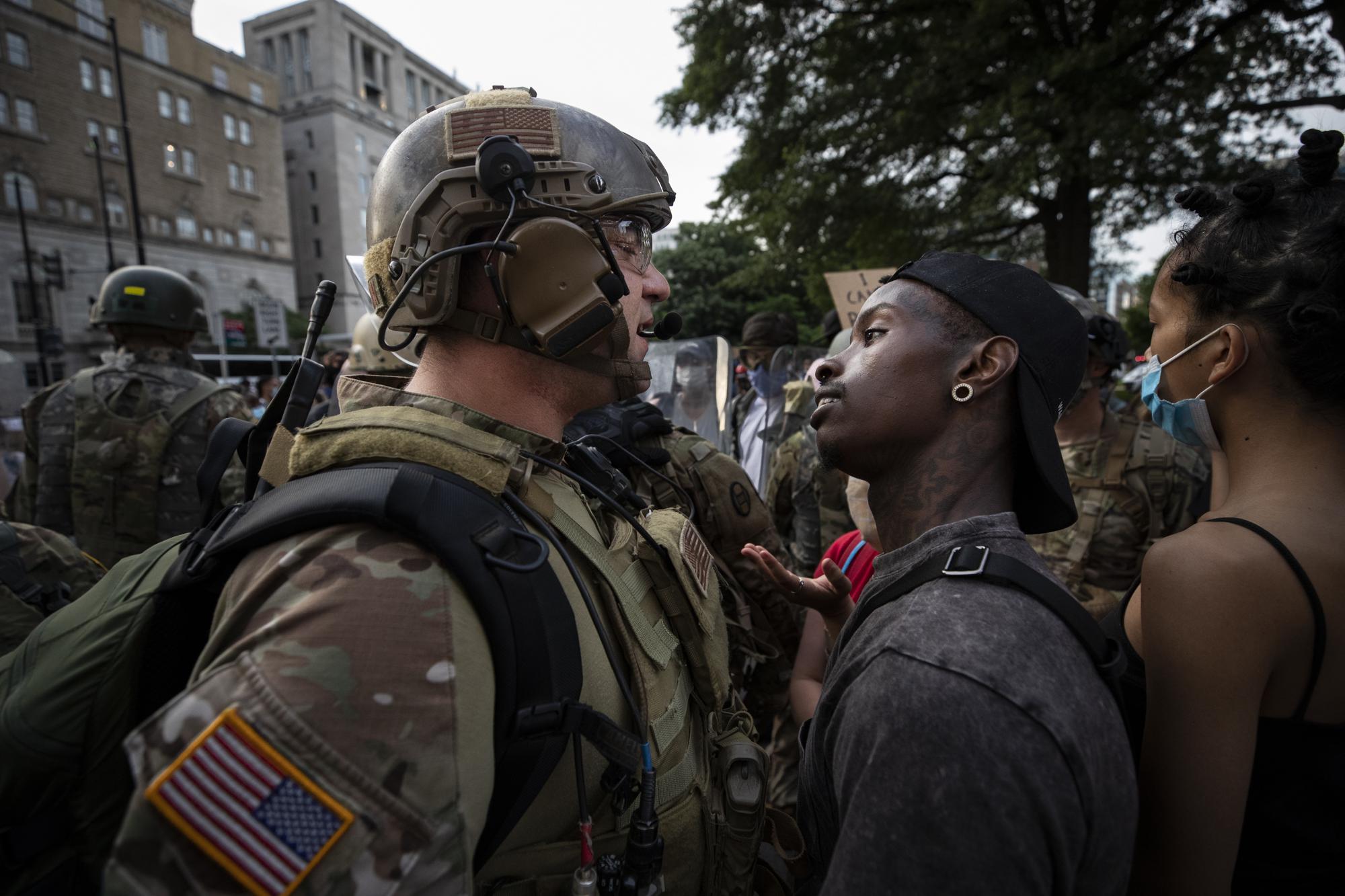
    FILE - In this June 3, 2020, file photo, a demonstrator stares at a National Guard soldier as protests continue over the death of George Floyd, near the White House in Washington, D.C. Reports of hateful and violent speech on Facebook poured in on the night of May 28 after President Donald Trump hit send on a social media post warning that looters who joined protests following Floyd's death last year would be shot, according to internal Facebook documents shared with The Associated Press. (AP Photo/Alex Brandon, File)
    In this June 3, 2020, file photo, a demonstrator stares at a National Guard soldier as protests continue over the death of George Floyd, near the White House in Washington, D.C. (AP Photo/Alex Brandon, File)

    “However, after Trump’s post on May 28, situations really escalated across the country,” according to the memo, published on June 5 of last year.

    The internal analysis shows a five-fold increase in violence reports on Facebook, while complaints of hate speech tripled in the days following Trump’s post. Reports of false news on the platform doubled. Reshares of Trump’s message generated a “substantial amount of hateful and violent comments,” many of which Facebook worked to remove. Some of those comments included calls to “start shooting these thugs” and “f—- the white.”

    By June 2, “we can see clearly that the entire country was basically ‘on fire,’” a Facebook employee wrote of the increase in hate speech and violence reports in the June 5 memo.

    Facebook says it’s impossible to separate how many of the hate speech reports were driven by Trump’s post itself or the controversy over Floyd’s death.

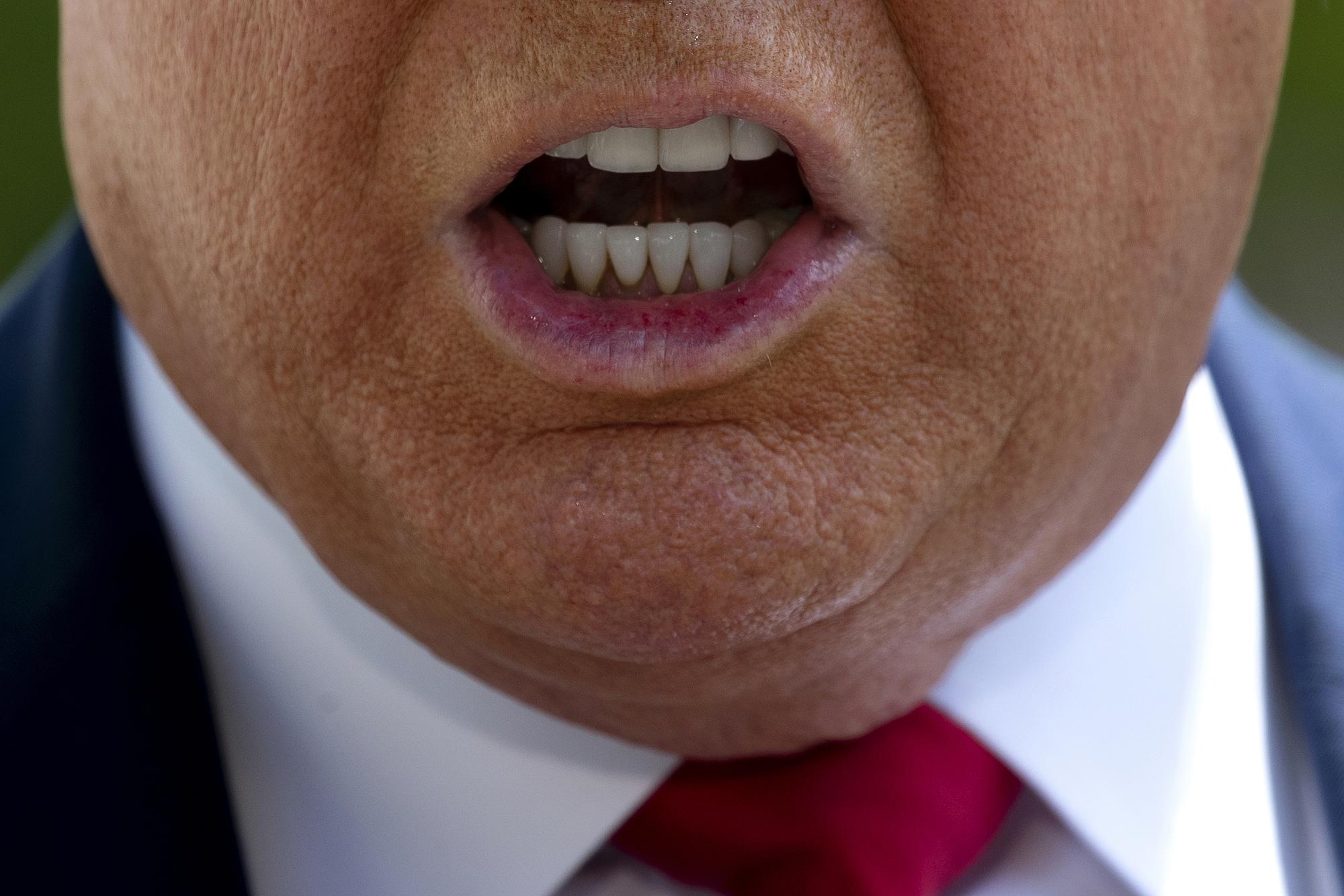
    FILE - In this May 30, 2020, file photo, President Donald Trump speaks with members of the press on the South Lawn of the White House, in Washington. Reports of hateful and violent speech on Facebook poured in on the night of May 28 after President Donald Trump hit send on a social media post warning that looters who joined protests following Floyd's death last year would be shot, according to internal Facebook documents shared with The Associated Press. (AP Photo/Patrick Semansky, File)
    In this May 30, 2020, file photo, President Donald Trump speaks with members of the press on the South Lawn of the White House, in Washington. (AP Photo/Patrick Semansky, File)

    “This spike in user reports resulted from a critical moment in history for the racial justice movement — not from a single Donald Trump post about it,” a Facebook spokesperson said in a statement. “Facebook often reflects what’s happening in society and the only way to prevent spikes in user reports during these moments is to not allow them to be discussed on our platform at all, which is something we would never do.”

    But the internal findings also raise questions about public statements Facebook CEO Mark Zuckerberg made last year as he defended his decision to leave Trump’s post untouched.

    On May 29, for example, Zuckerberg said the company looked closely to see if Trump’s words broke any of its policies and concluded that they did not. Zuckerberg also said he left the post up because it warned people of Trump’s plan to deploy troops.

    FILE - In this May 28, 2020, file photo, protesters and residents watch as police in riot gear walk down a residential street, in St. Paul, Minn. Reports of hateful and violent speech on Facebook poured in on the night of May 28 after President Donald Trump hit send on a social media post warning that looters who joined protests following Floyd's death last year would be shot, according to internal Facebook documents shared with The Associated Press. (AP Photo/John Minchillo, File)
    In this May 28, 2020, file photo, protesters and residents watch as police in riot gear walk down a residential street, in St. Paul, Minn. (AP Photo/John Minchillo, File)

    “I know many people are upset that we’ve left the President’s posts up, but our position is that we should enable as much expression as possible unless it will cause imminent risk of specific harms or dangers spelled out in clear policies,” Zuckerberg wrote on his Facebookaccount the night of May 29, as protests erupted around the country.

    Yet, Facebook’s own automated enforcement controls determined the post likely did break the rules.

    “Our violence and incitement classifier was almost 90% certain that this (Trump) post violated Facebook’s … policy,” the June 5 analysis reads.

    That contradicts conversations Zuckerberg had with civil rights leaders last year to quell concerns that Trump’s post was a specific threat to Black people protesting Floyd’s death, said Rashad Robinson, the president of Color of Change, a civil rights advocacy group. The group also spearheaded a boycott of Facebook in the weeks following Trump’s post.

    “To be clear, I had a direct argument with Zuckerberg days after that post where he gaslit me and he specifically pushed back on any notion that this violated their rules,” Robinson said in an interview with the AP last week.

    FILE - In this April 11, 2018, file photo, Facebook CEO Mark Zuckerberg takes a drink of water as he testifies before a House Energy and Commerce hearing on Capitol Hill in Washington. Reports of hateful and violent speech on Facebook poured in on the night of May 28 after President Donald Trump hit send on a social media post warning that looters who joined protests following Floyd's death last year would be shot, according to internal Facebook documents shared with The Associated Press. (AP Photo/Andrew Harnik, File)
    In this April 11, 2018, file photo, Facebook CEO Mark Zuckerberg takes a drink of water as he testifies before a House Energy and Commerce hearing on Capitol Hill in Washington. (AP Photo/Andrew Harnik, File)

    A Facebook spokesperson said that its internal controls do not always correctly predict when a post has violated rules and that human review, which was done in the case of Trump’s post, is more accurate.

    To curb the ex-president’s ability to stoke hateful reactions on its platform, Facebook employees suggested last year that the company limit reshares on similar posts that may violate Facebook’s rules in the future.

    But Trump continued to use his Facebook account, which more than 32 million follow, to fire up his supporters throughout much of the remainder of his presidency. In the days leading up to a deadly siege in Washington on Jan. 6, Trump regularly promoted false claims that widespread voter fraud caused him to lose the White House, spurring hundreds of his fans to storm the U.S. Capitol and demand the results of a fair election be overturned.

    It wasn’t until after the Capitol riot, and as Trump was on his way out of the White House, that Facebook pulled him off the platform in January, announcing his account would be suspended until at least 2023.

    There’s a reason Facebook waited so long to take any action, said Jennifer Mercieca, a professor at Texas A&M University who closely studied the former president’s rhetoric.

    “Facebook really benefited from Trump and Trump’s ability to draw attention and engagement through outrage,” Mercieca said. “They wanted Trump to keep going on.”

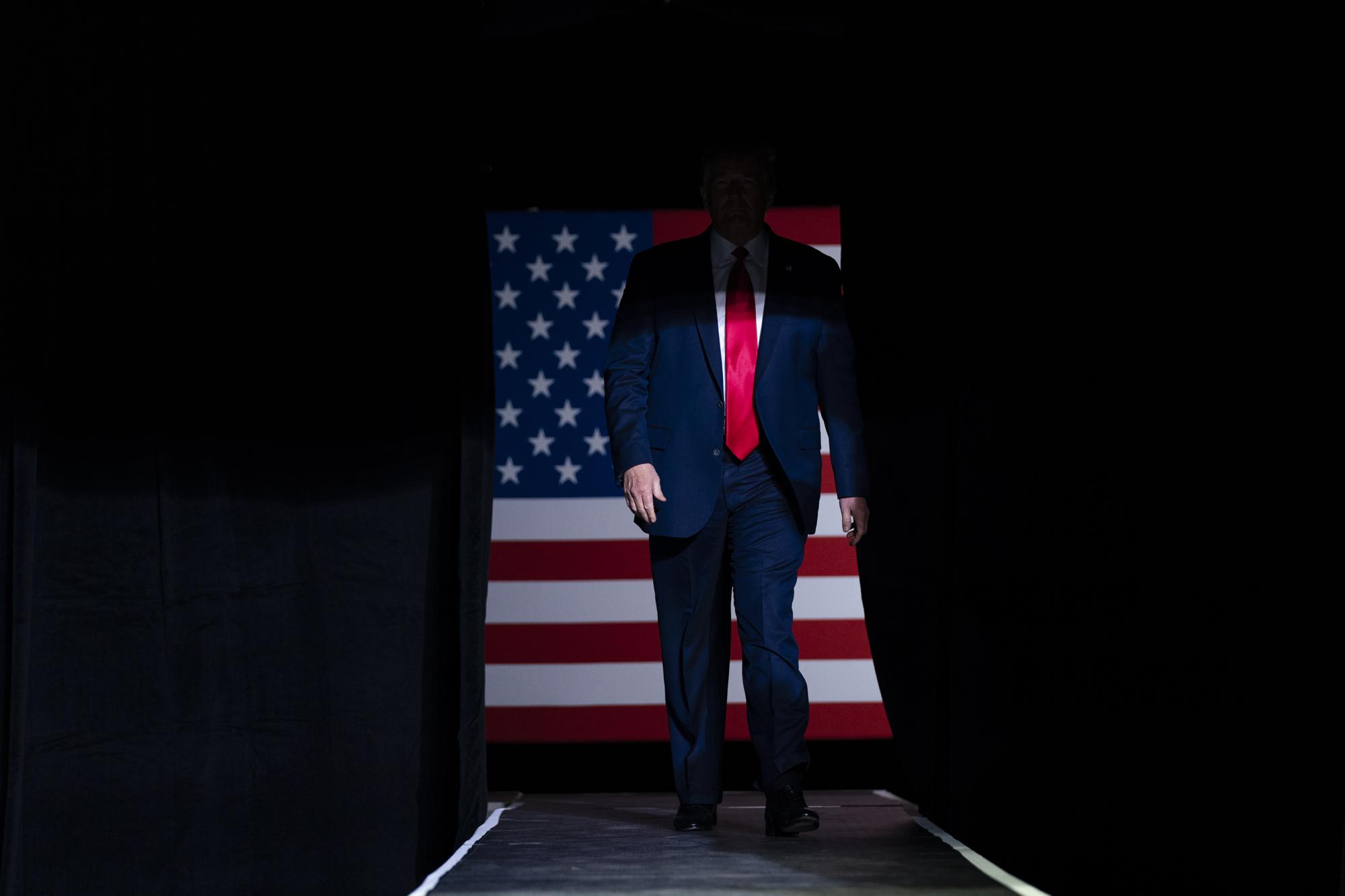
    FILE - In this June 20, 2020, file photo, President Donald Trump arrives on stage to speak at a campaign rally at the BOK Center, in Tulsa, Okla. Reports of hateful and violent speech on Facebook poured in on the night of May 28 after President Donald Trump hit send on a social media post warning that looters who joined protests following Floyd's death last year would be shot, according to internal Facebook documents shared with The Associated Press. (AP Photo/Evan Vucci, File)
    In this June 20, 2020, file photo, President Donald Trump arrives on stage to speak at a campaign rally at the BOK Center, in Tulsa, Okla. (AP Photo/Evan Vucci, File)
  • Trump To Launch New Social Media Plartform Truth Social To Rival Twitter And Facebook

    Trump To Launch New Social Media Plartform Truth Social To Rival Twitter And Facebook

    Former US President Donald Trump has announced plans to launch a new social media network, called TRUTH Social.

    He said the platform would “stand up to the tyranny of big tech”, accusing them of silencing opposing voices in the US.

    Trump Media & Technology Group (TMTG), which he chairs, also intends to launch a subscription video-on-demand service.

    Mr Trump was banned or suspended from social networks like Twitter and Facebook after crowds of his supporters stormed the US Capitol in January.

    He and his advisers have since hinted that they were planning to create a rival social media site.

    Earlier this year, he launched From the Desk of Donald J Trump, which was often referred to as a blog.

    The website was permanently shut down less than a month after it launched. His senior aide Jason Miller said it was “just auxiliary to the broader efforts we have and are working on”.

    An early version of his latest venture, TRUTH Social, will be open to invited guests next month, and will have a “nationwide rollout” within the first three months of 2022, according to a statement by TMTG.

    “We live in a world where the Taliban has a huge presence on Twitter, yet your favourite American President has been silenced,” wrote Mr Trump.

    “Everyone asks me why doesn’t someone stand up to Big Tech? Well, we will be soon!” he added.-BBC.

  • Facebook Plans To Change Its Name

    Facebook Plans To Change Its Name

    Social media giant Facebook is planning to rebrand the company with a new name next week, the Verge reported on Tuesday, citing a source with direct knowledge of the matter.

    Facebook chief executive officer Mark Zuckerberg plans to talk about the name change at the company’s annual Connect conference on 28 October, but it could be unveiled sooner, the Verge report said.

    Similar to how Google rebranded under the Alphabet umbrella, the rebrand would likely position Facebook’s social media app as one of many products under a parent company, which will also oversee groups like Instagram, WhatsApp, Oculus and more, the report added.

    It has come at a time Facebook faces significant pressure following revelations from whistleblower France Haugen, who told US Congress the company had put “astronomical profits before people” and that it harms children and is destabilising democracies. Haugen has been behind the leak of a number of documents to the Wall Street Journal, including showing internal research revealing 30% of teenage girls felt Instagram made dissatisfaction with their body worse.

    Earlier this month Facebook, WhatsApp and Instagram also went out for five hours after routine maintenance went wrong, disrupting all of Facebook’s services including its own internal communications and physical security services.

    “For more than five hours Facebook wasn’t used to deepen divides, destabilise democracies and make young girls and women feel bad about their bodies,” Haugen told Congress.

  • Apple unveils new MacBook Pro, chip, AirPods, HomePod

    Apple unveils new MacBook Pro, chip, AirPods, HomePod

    US tech company Apple unveiled Monday new product models that include MacBook Pro, M1 chip, AirPods, HomePod, and software.

    The new MacBook Pro is powered by the all-new M1 Pro and M1 Max – the first pro chips designed for the Mac, California-based firm said in a statement.

    Available in 14- and 16-inch models, MacBook Pro has Liquid Retina XDR display, a 1080p FaceTime HD camera, while Apple argued it has the best audio system in a notebook.

    Designed for developers, photographers, filmmakers, 3D artists, scientists, and music producers, the new models will start from $1,999 and will be available on Oct. 26.

    The company has also updated its Final Cut Pro software for professional video editors and its professional music creation software Logic Pro that allows users to mix and export songs in Dolby Atmos.

    Apple said in another statement that the new M1 Pro and M1 Max chips are the most powerful the Silicon Valley firm has ever built.

    M1 Pro and M1 Max delivers up to 70% faster CPU performance than the traditional M1 chip, while the GPU in M1 Pro is up to two times faster than M1, and M1 Max is up to four times faster than M1, it added.

    The 3rd generation of AirPods comes with a new design and feature extended battery life that has up to six hours of listening time, and up to 30 hours with its charging case. New AirPods will be in stores as of Oct. 26 for a price tag of $179.

    “Users can enjoy spatial audio featuring Dolby Atmos in Apple Music, movies, and tv shows, along with dynamic head tracking, across Apple devices. The new AirPods are resistant to sweat and water, and feature a force sensor for easy and intuitive control of music and phone calls,” another statement said.

    Apple’s smart speaker HomePod mini now has three more colors – yellow, orange and blue along with existing colors of white and space gray – and it has smart home capabilities, built-in privacy and security features, and Siri intelligence.

    HomePod mini’s new colors will hit the shelves for $99 next month, and it will have seamless integration across its products and services.

    Apple Music Voice Plan, a new subscription for Apple Music and designed around Siri, will cost $4.99 per month, giving access to a catalog of 90 million songs, personalized mixes, genre stations, and Apple Music Radio.

  • Facebook, Instagram, WhatsApp reconnecting after nearly six-hour outage

    Facebook, Instagram, WhatsApp reconnecting after nearly six-hour outage

    Oct 4 (Reuters) – Facebook, Instagram and WhatsApp at least partially reconnected to the global internet late on Monday afternoon Eastern time, nearly six hours into an outage that paralyzed the social media platform.

    Facebook and its WhatsApp and Instagram apps went dark at around noon Eastern time (1600 GMT), in what website monitoring group Downdetector said was the largest such failure it had ever seen.

    The outage was the second blow to the social media giant in as many days after a whistleblower on Sunday accused the company of repeatedly prioritizing profit over clamping down on hate speech and misinformation.

    “To every small and large business, family, and individual who depends on us, I’m sorry,” Facebook Chief Technology Officer Mike Schroepfer tweeted, adding that it “may take some time to get to 100%.”

    Shares of Facebook, which has nearly 2 billion daily active users, fell 4.9% on Monday, their biggest daily drop since last November, amid a broader selloff in technology stocks. Shares rose about half a percent in after-hours trade following resumption of service.

    Security experts said the disruption could be the result of an internal mistake, though sabotage by an insider would be theoretically possible.

    Soon after the outage started, Facebook acknowledged users were having trouble accessing its apps but did not provide any specifics about the nature of the problem or say how many users were affected by the outage.

    The error message on Facebook’s webpage suggested an error in the Domain Name System (DNS), which allows web addresses to take users to their destinations. A similar outage at cloud company Akamai Technologies Inc  took down multiple websites in July.

    Several Facebook employees who declined to be named said that they believed that the outage was caused by an internal routing mistake to an internet domain that was compounded by the failures of internal communication tools and other resources that depend on that same domain in order to work.

    Facebook, which is the second largest digital advertising platform in the world, was losing about $545,000 in U.S. ad revenue per hour during the outage, according to estimates from ad measurement firm Standard Media Index.

    On Sunday, Frances Haugen, who worked as a product manager on the civic misinformation team at Facebook, revealed that she was the whistleblower who provided documents underpinning a Wall Street Journal investigation and a Senate hearing on Instagram’s harm to teen girls.

    Haugen was due to urge the U.S. Congress on Tuesday to regulate the company, which she plans to liken to tobacco companies that for decades denied that smoking damaged health, according to prepared testimony seen by Reuters.

  • ‘Facebook Is Tearing Our Societies Apart’ Former Employee And Whistleblower On TV Before Outage

    ‘Facebook Is Tearing Our Societies Apart’ Former Employee And Whistleblower On TV Before Outage

    Facebook is “tearing our societies apart,” a former employee has told US news show “60 Minutes.” The tech giant’s internal research showed the company knew of the harms it caused, but optimized for profits.

    In an explosive 60 Minutes interview that aired in the United States Sunday, data scientist Frances Haugen, a former employee in Facebook’s civic integrity unit, revealed that she was the source of internal documents and research showing the company knew of the harmful effects caused by its platforms.

    The revelations in the internal research documents featured in a series of articles last month in The Wall Street Journal.

    The company’s own findings include knowledge of the harms Instagram causedteen girls’ body image perceptions and a two-tier system of penalties for misuse of its platforms, one for celebrities and the other for the public.

    “I’ve seen a bunch of social networks and it was substantially worse at Facebook than what I had seen before,” Haugen told “60 Minutes.”

    “The version of Facebook that exists today is tearing our societies apart and causing ethnic violence around the world,” she added.

    Who is Frances Haugen?

    Frances Haugen is a data scientist from Iowa who spent two years at Facebook, from June 2019 until May of this year. Prior to that, she worked on algorithms at Google, Pinterest and Yelp.

    She told “60 Minutes” she was recruited to Facebook and specifically wanted to work on issues around misinformation.

    Haugen said the career move was inspired by the loss of a friend to online conspiracies, something she did not want anyone else to go through.

    Haugen became a whistleblower because “person after person after person has tackled this inside of Facebook and ground themselves into the ground.”

    “No one at Facebook is malevolent, but the incentives are misaligned,” she said.

    Who has Haugen shared Facebook internal documents with?

    In addition to reporters from The Wall Street Journal and “60 Minutes,” Haugen has met with members of the US Congress, including senators Richard Blumenthal of Connecticut and Marsha Blackburn of Tennessee.

    Earlier this month, Blumenthal tweeted that a Facebook whistleblower had approached his office and revealed “Facebook is using big tobacco’s playbook” by “hiding its own research on addiction and the toxic effects of its products.”

    Haugen has spoken with legislators in the UK, France, and the European Parliament as well.

    The New York Times reports she will testify before the US Congress Tuesday on the harm to young users caused by Facebook’s platforms and will appear before a parliamentary committee in the UK later this month.

    She has also gone to the Securities and Exchange Commission (SEC) in the US, alleging Facebook misled investors about the effectiveness of its strategies and algorithms to mitigate the negative effects of its platforms.

    Some of the documents she obtained have also been shared with attorneys general in California, Vermont, Tennessee, Massachusetts, and Nebraska.

    Sunday’s “60 Minutes” interview kicks off a publicity tour that will include the Web Summit, a tech conference in Lisbon and meetings with European lawmakers in Brussels this fall.

    How has Facebook responded?

    On Sunday, Facebook did not directly address Haugen’s assertions. However, it did dispatch Nick Clegg to CNN’s “Reliable Sources” program. Clegg is a former UK deputy prime minister and leader of the Liberal Democrats who now serves as a vice president for policy and global affairs at Facebook.

    On CNN, Clegg called allegations that ran in The Wall Street Journal last month “misleading” and asserted the company seeks to “mitigate the bad, reduce it and amplify the good,” the opposite of what Haugen clams defined her experience at the company.

    The show preempted Haugen’s “60 Minutes” interview by several hours Sunday.

    The New York Times reports Clegg also sent out a 1,500-word memo late last week to Facebook employees outlining what it believed would air on “60 Minutes”.

  • Facebook, Instagram, WhatsApp down in global outage

    Facebook, Instagram, WhatsApp down in global outage

    AP-Facebook and its Instagram and WhatsApp platforms were down in parts of the world on Monday.

    The company said it was “aware that some people are having trouble accessing Facebook app” and it was working on restoring access.

    The company did not say what might be causing the outage, which began around 11:45 ET. It is normal for websites and apps to suffer outages, though one on a global scale is rare. Users reported being unable to access Facebook in California, New York and Europe.

    Facebook is going through a major crisis after the whistleblower who was the source of The Wall Street Journal’s series of stories exposing the company’s awareness of internal research into the negative effects of its products and decisions went public on “60 Minutes” on Sunday.

    Frances Haugen was identified in a “60 Minutes” interview Sunday as the woman who anonymously filed complaints with federal law enforcement that the company’s own research shows how it magnifies hate and misinformation, leads to increased polarization and that Instagram, specifically, can harm teenage girls’ mental health.

    The Journal’s stories, called “The Facebook Files,” painted a picture of a company focused on growth and its own interests instead of the public good. Facebook has tried to play down the research. Nick Clegg, Clegg, the company’s vice president of policy and public affairs, wrote to Facebook employees in a memo Friday that “social media has had a big impact on society in recent years, and Facebook is often a place where much of this debate plays out.”

  • Netflix Offers Free Plan In Kenya To Entice New Subscribers

    Netflix Offers Free Plan In Kenya To Entice New Subscribers

    Netflix Inc on Monday began offering a free mobile plan with about one-quarter of its TV shows and movies in Kenya, a strategy aimed at sparking growth in a key African market, the company told Reuters.

    The free plan is available on Android mobile phones and will not have ads. It features Netflix movies and TV shows such as dramas “Money Heist” and “Bridgerton” and African series “Blood & Water,” plus some of the programming the company licenses from others.

    Netflix hopes the free plan will lead to users signing up for a paid option with more content.

    The world’s largest streaming video service is looking to add customers outside of more saturated markets such as the United States, where new subscriber signups have slowed at a time when competition for online audiences has intensified. read more

    Executives remain bullish on the long-term future, noting there are large markets where streaming television is just starting to take hold. To attract customers in Africa, Netflix is investing in locally made programming such as “Queen Sono” and “Jiva!” and has partnered with production studios in Nigeria.

    “If you’ve never watched Netflix before — and many people in Kenya haven’t — this is a great way to experience our service,” Cathy Conk, director of product innovation at Netflix, said in a blog post. “And if you like what you see, it’s easy to upgrade to one of our paid plans so you can enjoy our full catalog on your TV or laptop as well.”

    The free plan started on Monday and will roll out across Kenya in the coming days.

    The non-paying Netflix subscribers in Kenya will not be counted in the paid total the company reports each quarter, a spokesperson said.

    Netflix has experimented with free offers before. In 2020, it made some episodes of series such as “Stranger Things” and movies including “To All the Boys I’ve Loved Before” available around the world for no charge via web browsers.

    The free plan in Kenya is broader. It will look similar to paid Netflix profiles to give viewers a feel for the service, the spokesperson said. Shows that are not included in the free plan will be marked with a lock icon. Clicking on one of those titles will encourage the user sign up for a paid option.

    Anyone 18 or older in Kenya can enroll in the free plan and create up to five profiles. No payment information will be required.

    Some functions, such as the ability to download a show or movie, will not be available under the free plan.

    Netflix, which streams in more than 190 countries, has taken other steps to boost usage in Africa, including creation of a paid mobile-only plan and partnerships with local telecom operators to ease payments.

    The company reported 209 million paying customers worldwide at the end of June. New member pickups slowed in the first half of 2021 after a boom early in the COVID-19 pandemic.

    Africa currently is a relatively small market for streaming TV subscriptions. Digital TV Research projects Netflix will lead subscription video on demand services on the continent with 6.26 million paying customers in 2026, followed by Walt Disney Co’s (DIS.N) Disney+.-Reuters.

  • Apple introduces 4 new iPhone 13 models

    Apple introduces 4 new iPhone 13 models

    US tech firm Apple introduced Tuesday four new iPhone13 models at a virtual event held at its headquarters in Cupertino, California.

    The new models include iPhone 13 mini, iPhone 13 with Super Retina XDR display with A15 bionic chip, which Apple dubbed as the fastest CPU in any smartphone with up to 50% faster than its nearest competitor.

    Both supporting 5G, they have ceramic shield at front screen with water resistance, including dual-camera, coming with five new colors — pink, blue, midnight, starlight, and (PRODUCT)RED.

    The dual-camera gathers 47% more light for less noise and brighter results in photos and videos, said Apple. The two models have a cinematic mode to enable users to capture cinema-like moments in their videos, which are shoot in Dolby Vision HDR.

    While 5.4-inch iPhone 13 mini has 1.5 hours longer battery life than its predecessor, this is up to 2.5 longer for the 6.1-inch iPhone 13. They start at $699 and $799, respectively.

    The higher models, iPhone 13 Pro and iPhone 13 Pro Max, have three ultra-wide cameras with six times optical zoom range. Their specifications mostly speak to film makers.

    They come in four colors — graphite, gold, silver and blue. Their GPU provides 50% faster graphics performance than competitors, which Apple said is the leader in the sector.

    Their Super Retina XDR display comes in 6.1 inches and 6.7 inches. As for battery life, iPhone 13 Pro and iPhone 13 Pro Max last 1.5 and 2.5 longer, respectively, compared to their predecessors. They start at $999 and $1,099.

    For fitness users, Apple Watch Series 7 has nearly 20% larger screen area and 40% thinner edges than the previous model, and over 50% more screen area than Series 3. It will support Fitness+.

    Dubbed as the most durable Apple Watch ever built, Series 7 has resistance against cracks, dust and water. Powered with WatchOS 8 that senses cycling activity, it has an 18-hour battery life, while it charges 33% faster than its predecessor. It starts at $399.

    As for tablets, the new iPad carries A13 bionic chip with 20% faster CPU, GPU and neural engine than the previous one, which Apple said it is 3 times faster than Google’s Chromebook, and 6 times faster than the top-selling Android tablet. The new tablet supports the first-generation Apple Pencil. It is powered by iPadOS 15.

    The new iPad Mini, which comes in four different colors with 5G, has a liquid retina display with a screen size raised to 8.3 inches. It has a 40% jump in CPU performance compared to its previous model. It has a 12 MP rear camera and ability to record in 4K, while it also supports Apple Pencil.

    Both iPad models are built with a 100% recycled aluminum enclosure, according to Apple.

    Apple’s iPhone smartphones by far continue to be the largest revenue generator for the company with $39.57 billion net sales in the third fiscal quarter, up 49.8% from the same period of last year.

    Net sales of iPhone climbed to $153.1 billion for the nine months ending June — up 37.5% year-on-year, according to the company’s latest financial figures released on July 27.

  • NSA whistleblower Edward Snowden warns Apple program that scans iPhones for child porn will ultimately be used to spy on iPhone owners

    NSA whistleblower Edward Snowden warns Apple program that scans iPhones for child porn will ultimately be used to spy on iPhone owners

    NSA whistleblower Edward Snowden has issued a chilling warning about Apple’s plans to begin scanning photos of users, saying the proposal will give governments terrifying access to citizen’s private data.

    Snowden, a former computer intelligence consultant, who in 2013 leaked classified documents to show the scale of government snooping on U.S. citizens, condemned the new plans in strong terms, and says they set a precedent which will ultimately be abused by corrupt politicians to destroy individual privacy.

    He said that Apple had chosen a dangerous path with their scheme to access users’ photos, and that governments will manipulate the rule to give them greater access to data they claim they need access to – such as a phone owner’s presence at a protest.

    The Silicon Valley giant will scan all photos linked from iPhones to the Cloud for child pornography – with images cross-checked against a database from the National Center for Missing and Exploited Children.

    Apple say that any users who do not want their phones to be scanned can switch off the linkage to the Cloud. But many people do not realize their phones are synching with the Cloud – and Snowden said 85 per cent of iPhone users have their phones set up to synch to the Cloud.

    He also warned that Apple’s initial opt-out will inevitably be axed if its plans go ahead, meaning people’s phones will ultimately be the property of corporations and governments, and used to spy on their owners.

    The update was announced at the beginning of this month, and Apple said the latest changes will roll out this year as part of updates to its operating software for iPhones, Macs and Apple Watches.

    Edward Snowden, who leaked classified information in 2013 showing the extent of U.S. government spying on its own citizens, has warned about Apple’s plan to scan peoples’ photos
    All photos which are linked from your phone to the iCloud will be scanned, and if they match images on the child pornography database held by the National Center for Missing and Exploited Children then they will be flagged

    It marks a sea change for the company, which has long prided itself – and promoted itself – as a bastion of privacy protection in a world of increasing surveillance.

    Snowden is pictured in September 2019 promoting his book via video conference

    Apple was one of the first major companies to embrace ‘end-to-end’ encryption, in which messages are scrambled so that only their senders and recipients can read them. Law enforcement, however, has long pressured the company for access to that information in order to investigate crimes such as terrorism or child sexual exploitation.

    Snowden, 38, who has lived in Russia since leaking the classified information, said that Apple was opening Pandora’s Box.

    ‘If Apple demonstrates the capability and willingness to continuously, remotely search every phone for evidence of one particular type of crime, these are questions for which they will have no answer,’ he warned.

    ‘And yet an answer will come – and it will come from the worst lawmakers of the worst governments.

    ‘This is not a slippery slope. It’s a cliff.’

    Tim Cook, the CEO of Apple, has long prided himself on his company pushing back against government demands to hand over data from peoples’ phones. Snowden insists that Apple’s new decision will end that protection

    Snowden said that Apple’s proposal would make it simple for governments to clamp down on their citizens.

    ‘What happens when a party in India demands they start scanning for memes associated with a separatist movement?’ he wrote, on his newsletter.

    ‘What happens when the UK demands they scan for a library of terrorist imagery?

    Apple’s headquarters are pictured in Cupertino. The company insist that ordinary peoples’ photos will not be singled out, but Snowden is unconvinced

    ‘How long do we have left before the iPhone in your pocket begins quietly filing reports about encountering ‘extremist’ political material, or about your presence at a ‘civil disturbance’?’

    Snowden said that Apple was setting out ‘to erase the boundary dividing which devices work for you, and which devices work for them.’

    He added: ‘Once the precedent has been set that it is fit and proper for even a ‘pro-privacy’ company like Apple to make products that betray their users and owners, Apple itself will lose all control over how that precedent is applied.​​’​

    He pointed out that pedophiles would immediately disable the settings, which showed that rooting out sex offenders was not the real purpose of the new scheme.

    ‘As long as you keep that material off their servers, and so keep Apple out of the headlines, Apple doesn’t care,’ he said.

    ‘Apple’s new system, regardless of how anyone tries to justify it, will permanently redefine what belongs to you, and what belongs to them.’

    Source link.

  • Samsung Says It Has Secret In-Built Feature That Can Remotely, Permanently Switch Off Any Samsung TV If Stolen

    Samsung Says It Has Secret In-Built Feature That Can Remotely, Permanently Switch Off Any Samsung TV If Stolen

    Samsung has revealed its TVs can be remotely disabled if the company finds out the units have been stolen. The feature is called the “Television Block Function” and Samsung says it was recently activated in South Africa after a number of Samsung TVs were taken from a company warehouse during a wave of protests and unrest last month.

    Samsung says the technology is “already pre-loaded on all Samsung TV products” and “ensures that the television sets can only be used by the rightful owners with a valid proof of purchase.” It’s not clear, though, from Samsung’s description whether the feature is only intended to combat large-scale theft, or if it will ever be used to help individual consumers.

    For the TV Block Function to work, Samsung needs to know serial code of the stolen unit. When the set connects to the internet, it checks its serial code against a list on Samsung’s servers, and disables all TV functionality if it finds a match.

    The TV Block feature logo.

    Image: Samsung

    Blocking the TVs stolen in South Africa was presumably relatively easy. They’d been taken from Samsung’s own warehouse, where the company would be tracking its inventory. It’s possible that an average customer whose TV is stolen would be able to report its serial code to the company to have it remotely disabled, but it’s not clear if Samsung offers or plans to offer such a service. (We’ve reached out to the company to ask and will update this story if we hear back.)

    The company does say, though, that in the event that customers in South Africa have one of their TVs blocked by accident, they can have the block lifted by sending a proof of purchase to [email protected].

  • 5 Important Questions You Must Ask Prior to Any Social Media Campaign

    5 Important Questions You Must Ask Prior to Any Social Media Campaign

    Social media marketing is one of the most effective forms of online marketing. You can potentially reach thousands of customers with much less effort. However, that doesn’t mean you shouldn’t plan your social media campaigns. Planning is a key aspect of any business process. This holds true for online marketing and we look at 5 important questions you should ask before creating any social media marketing below!

    1. Who is my target customer?

    First, you must ask yourself, who is your target customer? Many businesses simply try to appeal to everyone. This isn’t the most effective way to market your products or services. Most businesses have a target customer. This could be identified by different aspects like age range, sex, household income, and geographical location.

    By understanding your target customer, you can create targeted social media marketing. As a result, it should be much more effective and attract people who are more likely to invest in your products.

    2. What do I want to achieve for this campaign?

    You must also be clear on exactly what you want to achieve. There is always room for improvement with marketing. But you must know how, why, and where you need to improve. This is something you cannot do effectively without goals.

    Before creating marketing, produce a list of realistic goals you want to achieve. Examples of goals could include growing your social media following by X new customers, gaining X new unique website visits, or gaining X new sales.

    3. Which platforms will I concentrate on?

    You must also decide which platforms to use. There is a large range of popular social websites available including Facebook, Instagram, Twitter, Pinterest, and Tik Tok, for example.

    It is tempting to simply produce marketing for each platform. However, this can be time-consuming and also costly. As a result, spend time deciding which platforms are likely to see the most success. For example, you may have a much larger audience on Instagram than you do on your Twitter account.

    4. What branding elements will I use?

    Branding is also something to consider for social media marketing. Ideally, your promotional material should include consistent branding elements.

    But which elements do you use? A business logo is a great example. You can create a logo for free using tools like LogoCreator, and most businesses incorporate their logo in social media marketing. But what about color schemes, fonts, and slogans? Decide which branding to use, and exactly which elements to include – this will help improve the cohesion of your online marketing.

    5. How long will this campaign run for?

    Lastly, you must also be certain of how long the social media marketing will run. Obviously, the posts will stay active indefinitely. However, there should be some cut-off where you create the next campaign.

    Also, having a clear end date ensures that you have a point at which you can review the effectiveness of your marketing. At the end of the run date, you should review your goals and see if you achieved them or not. You can then look at make improvements for future campaigns.

    Plan Your Social Media Campaigns Carefully for Maximum Success

    You will have far more success if you plan your social media campaigns in this manner. It is important to ask yourself questions, set goals, and monitor your progress. If you simply jump into social media marketing with no clear direction, you are more likely to flop. These five questions are an excellent starting point and should give you the basis from which to create a successful social media campaign.

  • Hackers steal nearly $100m in Japan crypto heist

    Hackers steal nearly $100m in Japan crypto heist

    Leading Japanese cryptocurrency exchange Liquid has been hit by hackers, with almost $100m (£73m) estimated to have been stolen.

    The company announced that some of its digital currency wallets have been “compromised.”

    It is the second major theft of cryptocurrencies to take place in recent days.

    Last week, digital token platform Poly Network was at the centre of a $600m heist.

    “We are sorry to announce that #LiquidGlobal warm wallets were compromised, we are moving assets into the cold wallet,” the company said on Twitter.

    So-called ‘warm’ or ‘hot’ digital wallets are usually based online and designed to allow users to access their cryptocurrencies more easily, while ‘cold’ wallets are offline and harder to access and therefore usually more secure.

    Blockchain analytics firm Elliptic said its analysis showed that around $97m in cryptocurrencies had been taken, with Bitcoin and Ethereum tokens amongst the haul.

    Liquid has said that it was tracing the movement of the stolen cryptocurrencies and working with other exchanges to freeze and recover the assets.

    Founded in 2014, Liquid operates in over 100 countries and serves millions of customers around the world.

    It is one of the world’s top 20 biggest cryptocurrency exchanges by daily trading volumes, according to CoinMarketCap data.

    Last week, $600m was stolen from blockchain site Poly Network after a hacker exploited a vulnerability in its system.

    “The amount of money you have hacked is one of the biggest in defi [decentralised finance] history,” Poly Network said.

    Since then the hacker, who goes under the name of Mr White Hat, has returned around $427m of the assets.

    Liquid is not the only Japanese cryptocurrency platform to be hit by a major heist.

    In 2014, Tokyo-based exchange MtGox collapsed after almost half a billion dollars of bitcoin went missing, while Coincheck was hacked in a $530m heist in 2018.

  • Cryptocurrency Hacker In $600M Heist Returns $260M In Funds

    Cryptocurrency Hacker In $600M Heist Returns $260M In Funds

    The hacker behind one of the largest cryptocurrency heists to date has returned almost half of the $600m (£433m) stolen assets.

    On Tuesday, the firm affected, Poly Network wrote a letter on Twitter, asking the individual to get in touch “to work out a solution”.

    The hacker then posted messages pledging to return funds, claiming to be “not very interested in money”.

    On Wednesday, Poly Network said it had received $260m back.

    The company, a blockchain platform which lets users swap different types of digital tokens, posted on Twitter that it had been sent back three cryptocurrencies, including $3.3m worth of Ethereum, $256m worth of Binance Smart Chain (BSC) and $1m worth of Polygon.

    A total of $269m in Ethereum tokens and $84m in Polygon tokens has yet to be recovered.

    A blockchain is a ledger, or log, of every single transaction made of a cryptocurrency, such as Bitcoin.

    The ledger is distributed to all the users in the network to verify all new transactions when they occur, instead of being held by any one single authority.

    Software flaws


    The hacker published a three-page-long Q&A session on one of the blockchains essentially in the form of a self-interview, according to Tom Robinson, co-founder of Elliptic, a London-based blockchain analytics and compliance firm.

    The hacker claimed to have always planned to return the tokens and said the heist was carried out to highlight vulnerabilities in Poly Network software.

    “I know it hurts when people are attacked, but shouldn’t they learn something from those hacks?” the hacker wrote in the notes embedded on the Ethereum blockchain.

    A person monitoring the price of various crypto-currencies on a tablet

    Getty Images

    The technology underpining all crypto-currencies is blockchain – a distributed log of every single transaction made of a digital currency, that is sent to all users on the network

    The hacker claimed to have spent all night looking for a vulnerability to exploit. They said they were worried that Poly Network would patch the security flaw quietly without telling anyone, so they decided to take millions of dollars in cryptocurrency tokens to make a point.

    But they stressed that they did not want to cause a “real panic [in] the crypto-world”, so they only took “important coins”, leaving behind Dogecoin, the cryptocurrency that started off as a joke.

    “Either they just intended to commit theft and steal the assets, or they were acting like a white hat hacker to expose a bug, to help Poly Network make themselves more strong and secure,” Mr Robinson, who routinely advises governments and law enforcement agencies about crypto-related crimes, told the BBC.

    He added that the nature of blockchain technology makes it hard for cyber-criminals to profit from stealing digital currencies, because everyone can see the money being moved across the network into the hackers’ wallets.

    “I wonder whether this hacker stole the funds, realised how much publicity and attention they were getting, realised wherever they moved the funds they would be watched, and decided to give it back,” said Mr Robinson.

    “The blockchain itself has operated here flawlessly, but the problem is on blockchains like Ethereum, you can write your own smart contracts. Various services have started offering this, including Poly Network.

    “So whenever a human being writes code, there’s a chance they will make a mistake.”

    How it works


    A man buying crypto-currencies on a mobile app

    Getty Images

    Despite the volatility in prices and frequent news of crypto-currency heists, more and more young people are buying and selling crypto-currencies online

    Poly Network’s platform works by facilitating movement between several blockchains when people trade one cryptocurrency for another, such as trading BSC for Ethereum.

    “The Poly Network is the thing that facilitates the movement between these chains – ultimately, it’s software, it’s code, and code always has imperfections and defects in it,” James Chappell, co-founder of London-based cyber-security firm Digital Shadows, told the BBC.

    “And that’s true of banks, or any financial system. Unfortunately, what seems to have happened here is a party has spotted a weakness in the implementation and exploited it to fool the network into transferring these tokens incorrectly.”

    Similar attacks have happened to several other services in the last 12 months. These include:

    • Yearn Finance, which had $11m stolen by hackers in February;
    • Alpha Finance, which had $37m stolen in the same month;
    • and Meerkat Finance, which was drained of $32m by hackers in March.

    After a rollercoaster 24 hours for the crypto community, it seems the hacker intends to return all or most of the stolen money.

    As the criminal posted online: “The pain suffered is temporary, but memorable.”

    The claim that it was all an elaborate way to force Poly Network to fix security failings is being treated with scepticism.

    Why the taunting and boasting online if the motive was honourable?

    There’s some suggestion that the net may have been closing in, as one cyber-security company says it was close to working out the identity of a suspect.

    It might have been the case that the hacker bit off way more than they could chew and got scared, so returned the money.

    Regardless, the authorities will still no doubt be working hard to find them.

    But what this story mostly points to is just how powerful hackers can be and how powerless the unregulated, decentralised cryptocurrency world is when someone swipes a large fortune from under its nose.

  • Apple To Scan U.S iPhones For Images Of Child Pornography

    Apple To Scan U.S iPhones For Images Of Child Pornography

    Apple unveiled plans to scan U.S. iPhones for images of child sexual abuse, drawing applause from child protection groups but raising concern among some security researchers that the system could be misused by governments looking to surveil their citizens.

    Apple said its messaging app will use on-device machine learning to warn about sensitive content without making private communications readable by the company. The tool Apple calls “neuralMatch” will detect known images of child sexual abuse without decrypting people’s messages. If it finds a match, the image will be reviewed by a human who can notify law enforcement if necessary.

    But researchers say the tool could be put to other purposes such as government surveillance of dissidents or protesters.

    Matthew Green of Johns Hopkins, a top cryptography researcher, was concerned that it could be used to frame innocent people by sending them harmless but malicious images designed designed to appear as matches for child porn, fooling Apple’s algorithm and alerting law enforcement — essentially framing people. “Researchers have been able to do this pretty easily,” he said.

    Tech companies including Microsoft, Google, Facebook and others have for years been sharing “hash lists” of known images of child sexual abuse. Apple has also been scanning user files stored in its iCloud service, which is not as securely encrypted as its messages, for such images.

    Some say this technology could leave the company vulnerable to political pressure in authoritarian states such as China. “What happens when the Chinese government says, ‘Here is a list of files that we want you to scan for,’” Green said. “Does Apple say no? I hope they say no, but their technology won’t say no.”

    The company has been under pressure from governments and law enforcement to allow for surveillance of encrypted data. Coming up with the security measures required Apple to perform a delicate balancing act between cracking down on the exploitation of children while keeping its high-profile commitment to protecting the privacy of its users.

    Apple believes it pulled off that feat with technology that it developed in consultation with several prominent cryptographers, including Stanford University professor Dan Boneh, whose work in the field has won a Turing Award, often called technology’s version of the Nobel Prize.

    The computer scientist who more than a decade ago invented PhotoDNA, the technology used by law enforcement to identify child pornography online, acknowledged the potential for abuse of Apple’s system but said it was far outweighed by the imperative of battling child sexual abuse.

    “It possible? Of course. But is it something that I’m concerned about? No,” said Hany Farid, a researcher at the University of California at Berkeley, who argues that plenty of other programs designed to secure devices from various threats haven’t seen “this type of mission creep.” For example, WhatsApp provides users with end-to-end encryption to protect their privacy, but employs a system for detecting malware and warning users not to click on harmful links.

    Apple was one of the first major companies to embrace “end-to-end” encryption, in which messages are scrambled so that only their senders and recipients can read them. Law enforcement, however, has long pressured for access to that information in order to investigate crimes such as terrorism or child sexual exploitation.

    “Apple’s expanded protection for children is a game changer,” John Clark, the president and CEO of the National Center for Missing and Exploited Children, said in a statement. “With so many people using Apple products, these new safety measures have lifesaving potential for children who are being enticed online and whose horrific images are being circulated in child sexual abuse material.”

    Julia Cordua, the CEO of Thorn, said that Apple’s technology balances “the need for privacy with digital safety for children.” Thorn, a nonprofit founded by Demi Moore and Ashton Kutcher, uses technology to help protect children from sexual abuse by identifying victims and working with tech platforms.

  • Court Save Safaricom From Paying Innovator Sh209M In Mpesa 1 Tap ‘Stolen Idea’ Suit

    Court Save Safaricom From Paying Innovator Sh209M In Mpesa 1 Tap ‘Stolen Idea’ Suit

    An innovator has lost a bid to stop Safaricom PLC from further launching a mobile application he claims to have been his idea.

    Justice Grace Nzioka dismissed the case by Jonathan Murangiri Gikabu who wanted to block Safaricom from further launching the Mpesa I Tap service or exploiting the said concerning the information about the innovation.

    “I find the Plaintiff has not proved its case as required under the law and I decline to grant the orders sought,” ruled Judge.

    The judge found that find that in as much as there may be a possibility that Safaricom PLc may have incorporated some of his components in its product, there was need to provide proof.

    “It is not a matter of perception or morality. Of course, it may be unprofessional to do so or morally wrong. But from the legal point of view, the Plaintiff bore the burden to prove the same,” said Judge Nzioka.

    Murangiri had sought for an award of a total of Sh209 million.

    “First and foremost although, these amounts include a sum of Kshs 9.4 million incurred on the innovation, that being a specially damage claim should have been pleaded. It was not. However, an award of damages is based on proved liability,” the Judge said.

    Murangiri had sought to restrain the telecommunications company from further launching Mpesa I Tap service or otherwise exploiting the innovation.

    He further sought an inquiry as to damages for breach of confidence or alternatively, an account of all profits made by Safaricom from use of the said confidential information or innovation.

    “An order of appointment of a Receiver to collect and receive all the profits made by the defendant from the use of the confidential information or innovation of the plaintiff and an order for giving of proper directions for that purpose,” Murangiri urged the court.

    He also sought the court to order for payments of all sums found to be due to him plus interests.

    He argued that on or about September 2011, he started working on building blocks of NFC Mobile Payment System for Non-Smartphone, while working on an application for the 14th Round of Grand Challenges Exploration under the topic, “Enable Universal Acceptance of Mobile Payment, by the Bill and Melinda Gates Foundation.

    After evaluation, the application was successful and phase one (1) was funded by the Foundation, through Equity Group Foundation and later by the University of Nairobi.

    Experiments on the innovation, he said began from May 1, 2015 to October 31, 2016.

    According to Murangiri, as he prepared the application for the grant in October 2014, he shared the innovation with Safaricom PLc through an email dated October 21, 2014, on condition that the company would treat the same in confidence and in good faith.

    He argued that he communicated the confidential information through a proposal which Safaricom received and acknowledged and the information was communicated to Safaricom for the purpose of negotiating an agreement between the parties, for creation of the said innovation.

    “As such, the Defendant was not supposed to use it for any other purpose other than the intended, nor disclose it to a third party, without his prior consent and pursuant to the aforesaid, the practice in the Industry is such that, revelation of the Confidential information to the Safaricom carried with it the core duty of loyalty and fidelity, whereupon the it owed him a fiduciary duty not to misuse that confidential information,” he said.

    However, in breach thereof, on or about May 10,2017, Safaricom unlawfully made use of the information by launching an innovation; “NFC Mobile Payment System for Non-smart phones, in the guise of “MPesa I Tap” and unlawfully made profits there from and the retention of the profits amounts to unjust enrichment on the part of the company.

    “As such the Safaricom is liable to account to him, for all profits received by virtue of the usage of the confidential information, as he has suffered loss and damage due to the unlawful action of company.

    Safaricom denied liability by arguing that, Near Field Communication Technology (NFC), is an open source of information in public domain, and cannot be attributed to the Plaintiffs innovation and the technology has been used by among others Card Planet, Buy-more and Beba Pay, which was discontinued on March 15, 2015.

    Further, since 2012, the company has explored the NFC a technology through a product known as; “My 1963”, which was implemented as a mode of cashless fare payment card for public transport in Kenya and as soon as Lipa na MPesa was launched, a pilot project thereof was conducted involving; 1,500 employees who used the card to pay for their meals at the Safaricom’s cafeteria.

    “That, the Defendant then, rolled out, the MPesa 1 Tap, extending the growth of Mpesa from inception on March 6, 2007 and the MPesa 1 Tap, reduced in number the steps required to make, a Lipa na MPesa from; 8 to 2, adding speed and convenience,” company told the court.

    Safaricom argued that the MPesa 1 Tap solution contains a proprietary and innovative authentication process that, has no link whatsoever, to Murangiri or alleged innovation. The company further denied receiving any confidential information from him.

    The company also argued that that, the only proper channel for sending proposals to the Defendant is through a platform known as “Zindua Cafe” where registered users submit ideas, applications and prototypes for possible development.

    As such, the email he sent constitutes an unsolicited information that could not create an obligation of confidence to the Murangiri.

  • Tricks Used By Cybercriminals To Hack Your WhatsApp In Seconds

    Tricks Used By Cybercriminals To Hack Your WhatsApp In Seconds

    OF the many chatting platforms avalaible, WhatsApp is one of the safest you can use.

    However, users still need to be vigilant to avoid hackers, especially those pushing a prolific verification code scam.

    You should watch out for this verification code scam
    You should watch out for this verification code scamCredit: Reuters

    How the WhatsApp verification code scam works

    Cybercriminals try to gain access to WhatsApp verification codes because they give them the power to take control of accounts in seconds.

    The old scam involves a message that’s seemingly from your friend and it continues to rear its ugly head.

    There’s even been police warnings about it in the past.

    The cybercrime involves a hacker taking control of one of your contact’s WhatsApp accounts and messaging you pretending to be them.

    The hacker will message pretending to be your friend around the same time you get a text or email from WhatsApp with a verification code that the hacker has requested by pretending to be you.

    This code is only given when you try and make changes to your account.

    The hacker – posing as your friend – will pretend they’ve accidentally asked for the verification code to be sent to your number and will ask you to send it over.

    How to protect your WhatsApp

    You should never share your WhatsApp six-digit verification code with anyone.

    If you do, a hacker could use it to take over your account.

    You’ll no longer have access to your account and the hacker can try and scam your friends and read your messages.

    If you do get a suspicious message from a friend, try ringing them to see if you can talk to them in person and verify what’s going on.

    It’s also advisable to turn on two-step verification so your WhatsApp is also protected by a PIN.

    Open WhatsApp, go to Settings, then click “Two-Step Verification”.

    The click “Enable” and enter a PIN of your choice.

    WhatsApp will occasionally ask for this PIN when you use the app to double check it is you.

    This is useful if your phone is hacked or if someone knows the password to your handset but not your WhatsApp PIN.

    Then PIN will also be required to add contacts.

  • How Forkbombo, Kenya’s most Lethal Hackers Group was formed by a DCI Officer and how it has since mutated in Africa.

    How Forkbombo, Kenya’s most Lethal Hackers Group was formed by a DCI Officer and how it has since mutated in Africa.

    A cyber threat group – Forkbombo that caused chaos in the financial sector due to coordinated heists was taken down in Kigali late 2019.

    This group flourished for several years after the main Cyber Cartel was taken down in 2017, with the third in command assuming Operational Command, after he unsuccessfully was unable to attain a Political statue during 2017 nominations, thus quickly reverting to crime, and organizing this threat group with use of Cut-Outs across its organized crime operations, such that even the Money Mules didn’t know each other and could not have access to the hackers’ deployed to run target penetrations.

    There have been several other cases of hacking in the past, with estimates of over 2 billion shillings being lost through black hat operations annually. Some investigations have led to arrests though no convictions have been made so far.

    In most cases, the suspects find their way out through cash bails and out of court settlements. The hackers formed a syndicate, one which has continued to cause havoc. As a team, they have managed to stay a step ahead, beating the security agencies and cyber forensic specialists. Banks have kept the attacks secret on purpose.

    Forkbombo was given this name because during 2016 to 2017, they used [email protected] to receive keylogger data after infecting a machine with the keylogger variant that they wrote in-house. Known to few, is that the mastermind behind the the group was actually a DCI officer who colluded with hackers group he was assigned to investigate and put on record. He decided to preach water and drink wine.

    In the emergence of tremendous cyber security hitch – hacking incidences in Kenya in 2010, the Directorate of Criminal Investigations (DCI) received many reports of companies and individuals who had lost money or crucial information to hackers.  in the financial sphere.

    The reports were becoming overwhelming to DCI, which had few experts in the field of cyber crime technology to resolve the cases.However, one officer was exceptional, Mr Calvin Otieno Ogalo. He, among other officers, was tasked to investigate and resolve the cases as soon as possible to minimize the backlog and serve justice to the victims and most importantly track and arrest the hackers.

    According to reports, Mr Ogalo was so good that by 2012 he had concluded almost all his investigations and had names of the best cybercriminals in the country. However, instead of bringing them to book as was required of him, he instead organised them into a lethal cybercrime gang that would hack institutions and individuals seamlessly, stealing either money or crucial information.

    He was discovered later, which led to his silence and unceremonious exit from the DCI as a crimebuster in 2013. Nothing much about his exit or the gang he had formed was reported then – kept as a secret to control public outrage.

    In his gang that later would be named Forkbombo was Mr Alex Mutungi Mutuku, one of the best hackers in the country. Others included Reuben Kirogothi Mwangi, Eric Dickson Njagi, Godfrey Gachiri, Erickson Macharia Kinyua and Stanley Kimeu Mutua.

    Mr Ogalo roped in the services of insiders in targeted institutions and on top of it former Kenya Revenue Authority officers Edward Kiprop Langat, David Wambugu, Albert Komen and James Mwaniki. Also in the gang were Henry Achoka, Duncan Bokela and Martin Murathe.

    Investigations by cybersecurity group OnNet Africa found an email associated with the hackers in almost every hacking incidence, [email protected].

    One of the group’s major hits was in 2013 when they infiltrated the Judiciary’s system and requested National Treasury to approve Ksh80 million payment to several fictitious companies. The payments would be flagged by CFC Bank (now Stanbic) which called Judiciary’s chief of finance Mr Benedict Omollo, but the money was already gone. Later, Mr Achoka, Mr Bokela, Mr Mwangi and Mr Murathe of the Forkbombo group would be arrested and convicted seven years later, in January 2020.

    One of the masterminds of the heist, Mr Mwangi, is currently serving a jail term in Rwanda alongside seven other Kenyans after attempting to Equity Bank in Kigali.

    The Judiciary heist was neither the first nor the last, as the group would target other institutions, sometimes succeeding and other times being arrested. To them, being arrested was part of their job and they would pay cash bail and get back to work. For instance, in 2014, Mr Mutuku and Mr Stanley Kimeu Mutua were arrested after hacking into NIC Bank and stealing crucial information and Ksh2.88 million. In this incident, they were demanding a total of 200 bitcoins (equivalent to Ksh6.2 million then) in exchange for the information. The duo were released on Ksh700,000 cash bail.

    In three months’ time, Mr Mutuku was accused of infiltrating the Safaricom system and stealing airtime worth Ksh3.6 million. Most probably he found a loophole in the Safaricom system, and a month later, it is alleged that Mutuku tricked the system to recharge his phone number with Ksh20,000 airtime.

    Forkbombo is believed to have stolen at least Ksh400 million between 2013 and 2017. though the amount could be higher than that. It is believed that Forkbombo hacked and stole at least Ksh50 million from the Kenya Police Sacco in 2017.

    The Kenya Police Sacco heist was so easy for them, and now they decided to loot KRA, through the help of two American nationals, Larry Peckham II and Denise Huitron, who were in constant communication with Mr Ogalo and even visited the country at one time.

    In the heist where the taxman is said to have lost at least Ksh3.9 billion, Mr Edward Kiprop Langat (former KRA employee) is said to have been used to plant a laptop in the KRA servers. Other suspects of the heist are Mr Mutuku, Mr Langat, Mr Wambugu, Lucy Katilo Wamwandu, Kenneth Opege Riaga, James Mwaniki, Gilbert Kiptala Kipkechem and Joseph Kirai Mwangi.

    Forkbombo, through Mr Mwangi recruited more suspected hackers including Dedan Muchoki Muriuki, Samuel Wachira Nyuguto, Damaris Njeri Kamau and Steve Maina Wambugu. Also a Ugandan and at least three Rwandans were recruited even as the group sought to create a hacking software, according to intelligence reports.

    In 2016, Forkbombo is believed to have merged with another group of hackers, Grapzone, which had since 2013 been targeting supermarkets.

    In another group is – SilentsCards, a home grown cyber cartel which sprung from Forkbombo Group which terrorised local banks in 2016 and 2017 before being quelled by a multi-agency team of experts from Kenya Revenue Authority, Banking Fraud Unit and Cyber Crime Unit.

    According to Poland based cybersecurity firm OnNet, the SilentCards started robberies late 2017, inheriting the old version key logger used by Forkbombo and perfected it for collection of key logger data in a targeted environment. 

    Report shows that that just like Forkbombo group, SilentCards also targeted information servers, copy and evaluate audit reports to plan future attacks. After collecting as many credentials as they could, those hackers moved Sh400 million in batches, crediting fictitious accounts, then accessed either via VISA/MasterCard overseas or with use of Mobile Money Transfers.

    Unlike Forkbombo which has several money mules, SilentCards relies a lot on foreigners for quick transactions outside the country. Those hackers are known to specialize in python scripts to create quick tools for exploitation phase of an environment.

    They are also known to use opensource tools like Empire, Metasploit, DeathStar, Bloodhound, CrackMapExec, Aesshell, XmultiShell, CHAOS and Katoolin.

    It is believed that SilentCards joined with  upshot GrapZone late last year to regroup into Forkbombo.

    According to a report by Group iB, one of the top global providers of cyber security solutions, Kenya is emerging as one of the thriving hubs for cyber crime in the world. “Currently, only five groups pose a real threat to the financial sector; Cobalt, Silence, MoneyTaker (Russian), Lazarus (North Korea), and SilentCards (a new group from Kenya),” explained the security firm in its 2019 High-tech Crimes report. 

    Group iB has been conducting threat analysis for the last 17 years and says SilentCards is known for attacks on ATMs and card processing systems, and has operated under the radar of global security analysts until 2018.

    This group led by a man named Rueben also known as Ben, operationalized use of hackers from other threat groups with use of Grapzone’s leadership for the toughest targets around East Africa. With his leadership, the group started to expand to Central Africa, attempting to beat SilentCards threat-group in expansion around the area.

    One of the exceptions OnNet CTI analysts noted with this group, was use of financiers who joined and injected money into the group in order to get dividends as if they were directors. Obliquely, Forkbombo group operated like a company or rather a cooperate entity.

    With Forkbombo gone, OnNet collected intelligence on several groups as they broke up and mutated in 2019 than observed before in East African Cyber Threat Intelligence.

    The newest group which we observed breaking out of SilentCards is called “The Consultants.” At the top of their target list are Government Financial Systems.

    As these groups grow and mutate, resilient prevention capabilities are required to stop and evict them. 

    The Forkbombo cybercrime gang

    Senior members of the Forkbombo group are still behind bars, while they still have charges in other countries around East Africa for several cyber heists conducted over the years.