Haiti President Jovenel Moise was assassinated at his home early Wednesday morning by a group of armed individuals, interim Prime Minister Claude Joseph announced.
Joseph said he was now in charge of the country.
Moise’s injured wife was in the hospital, according to Joseph, who urged the public to remain calm, and insisted the police and army would ensure the population’s safety.
“The president was assassinated at his home by foreigners who spoke English and Spanish,” Joseph said.
Moise had been ruling Haiti, the poorest country in the Americas, by decree, after legislative elections due in 2018 were delayed in the wake of disputes, including on when his own term ends.
In addition to the political crisis, kidnappings for ransom have surged in recent months, further reflecting the growing influence of armed gangs in the Caribbean nation.
Haiti also faces chronic poverty and recurrent natural disasters.
The president faced steep opposition from swathes of the population that deemed his mandate illegitimate, and he churned through a series of seven prime ministers in four year. Most recently, Joseph was supposed to be replaced this week after only three months in the post.
In addition to presidential, legislative and local elections, Haiti was due to have a constitutional referendum in September after it was twice postponed due to the coronavirus pandemic.
Supported by Moise, the text of the constitutional reform, aimed at strengthening the executive branch, has been overwhelmingly rejected by the opposition and many civil society organizations.
The constitution currently in force was written in 1987 after the fall of the Duvalier dictatorship and declares that “any popular consultation aimed at modifying the Constitution by referendum is formally prohibited.”
VATICAN CITY, July 4 (Reuters) – Pope Francis was admitted to Rome’s Gemelli hospital on Sunday for scheduled intestinal surgery, the Vatican said, the first time he has been in hospital since his election in 2013.
Spokesman Matteo Bruni said the pope, 84, was due to undergo the surgery later on Sunday for an intestinal condition that tends to affect older people and can cause abdominal pain.
The pope appeared to be in fine health several hours earlier when he addressed thousands of people in St. Peter’s Square for his Sunday blessing and announced a trip to Slovakia and Budapest for September read more .
The sprawling Catholic-run Gemelli hospital and medical school in the northern part of Rome traditionally treats popes and a part of its 10th floor is permanently reserved for them.
Francis is suffering from symptomatic diverticular stenosis of the colon, a condition where sac-like pouches protrude from the muscular layer of the colon, leading it to become narrow.
In addition to causing pain, the condition can lead to bloating, inflammation, and difficulty in bowel movement.
Francis is sometimes short of breath because a part of one of his lungs was removed following an illness when he was a young man in his native Argentina.
He also suffers from sciatica, which causes pain that radiates from the lower back along the sciatic nerve to the legs.
The condition, for which he receives regular physiotherapy, forced him to miss several events at the beginning of this year and has led him on occasions to walk with difficulty.
Last year, a bad cold kept him from taking part in a week-long Lenten retreat with senior aides south of Rome.
In 2014, a year after he was elected pope, Francis was forced to cancel several engagements because of what was believed to be a stomach ailment.
Former Minneapolis police officer Derek Chauvin was sentenced on Friday to 22.5 years for the murder of George Floyd, a death that touched off international outrage.
Chauvin showed no reaction as the verdict was announced by Judge Peter Cahill.
Reaction outside the courthouse, where about a hundred people gathered was muted at first, then turned a little more hostile. Chauvin could have been sentenced to as many as 40 years in prison and the prosecution had requested 30 years.
“I thought it was going to be 40,” said Ashley Dorelus between sobs. “I thought they were going to give us a little bit of hope.” Dorelus said she flew from her home in California for a month to watch the trial, even though no spectators were allowed.
The sentencing was, she said, “white privilege at its finest.”
Floyd family attorney Benjamin Crump said the sentence was “historic”, the longest prison sentence ever for a Minnesota police officer, and that it would bring the nation “one step closer to healing by delivering closure and accountability.”
The sentencing was emotional at times.
George Floyd’s seven-year-old daughter, in a videotaped interview, spoke of missing her father and the games they played together.
Floyd’s brother Philonise spoke tearfully in court of having nightmares while watching endless replays of the infamous cellphone video that showed Floyd pleading for air under Chauvin’s neck.
Another Floyd brother, Terrence, sighed and looked directly at Chauvin.
“Why did you do it? Why did you stay there on his neck?” he demanded.
The answer did not come.
Chauvin, not wanting to influence federal civil rights charges he was facing, only spoke briefly during the sentencing to offer his condolences to the Floyd family.
“I do want to give my condolences to the Floyd family,” said Chauvin.
He also said there would be other information eventually coming out that would be of interest to the Floyd family.
In a surprise, Chauvin’s mother Carolyn Pawlenty testified to her son’s character, calling him a “good man with a big heart”.
Outside the courthouse, her testimony, played on a loudspeaker, was greeted with groans and cat-calls.
Repeatedly dubbed the happiest nation on the planet with world-beating living standards, Finland should be deluged by people wanting to relocate, but in fact it faces an acute workforce shortage. “It’s now widely acknowledged that we need a spectacular number of people to come to the country,” recruiter Saku Tihverainen from agency Talented Solutions said.
Workers are needed “to help cover the cost of the greying generation,” the recruiter explained. While many Western countries are battling weak population growth, few are feeling the effects as sharply as Finland.
With 39.2 over-65s per 100 working-age people, it is second only to Japan in the extent of its ageing population, according to the UN, which forecasts that by 2030 the “old age dependency ratio” will rise to 47.5.
The government has warned that the nation of 5.5 million needs to practically double immigration levels to 20,000-30,000 a year to maintain public services and plug a looming pensions deficit.
Finland might seem like an attractive destination on paper, scoring high in international comparisons for quality of life, freedom and gender equality, with little corruption, crime and pollution. But anti-immigrant sentiment and a reluctance to employ outsiders are also widespread in Western Europe’s most homogenous society, and the opposition far-right Finns Party regularly draws substantial support during elections.
Tipping point
After years of inertia, businesses and government “are now at the tipping point and are recognising the problem” posed by a greying population, said Charles Mathies, a research fellow at the Academy of Finland.
Mathies is one of the experts consulted by the government’s “Talent Boost” programme, now in its fourth year, which aims to make the country more attractive internationally, in part through local recruitment schemes.
Those targeted include health workers from Spain, metalworkers from Slovakia, and IT and maritime experts from Russia, India and Southeast Asia. But previous such efforts have petered out.
In 2013, five of the eight Spanish nurses recruited to the western town of Vaasa left after a few months, citing Finland’s exorbitant prices, cold weather and notoriously complex language.
Finland has nonetheless seen net immigration for much of the last decade, with around 15,000 more people arriving than leaving in 2019. But many of those quitting the country are higher-educated people, official statistics show.
Faced with the OECD’s largest skilled worker shortage, some Finnish startups are creating a joint careers site to better bag overseas talent. “As you can imagine, this is a slow burner,” Shaun Rudden from food delivery firm Wolt said in an email, adding that “We try to make the relocation process as painless as possible.”
Systemic problem
Startups “have told me that they can get anyone in the world to come and work for them in Helsinki, as long as he or she is single,” the capital’s mayor, Jan Vapaavuori, said said. But “their spouses still have huge problems getting a decent job.”
Many foreigners complain of a widespread reluctance to recognise overseas experience or qualifications, as well as prejudice against non-Finnish applicants.
Ahmed (who requested his name be changed for professional reasons) is a 42-year-old Brit with many years’ experience in building digital products for multinational, household-name companies.
Yet six months of networking and applying for jobs in Helsinki, where he was trying to move for family reasons, proved fruitless. “One recruiter even refused to shake my hand, that was a standout moment,” he said.
“There was never a shortage of jobs going, just a shortage of mindset,” said Ahmed, who during his search in Finland received offers from major companies in Norway, the UK and Germany, and eventually began commuting weekly from Helsinki to Dusseldorf.
Recruiter Saku Tihverainen said shortages are pushing more companies to loosen their insistence on only employing native Finnish workers. “And yet, a lot of the Finnish companies and organisations are very adamant about using Finnish, and very fluent Finnish at that,” he said.
Changing priorities
For Helsinki mayor Jan Vaaavuori, four years of Finland being voted the world’s happiest country in a UN ranking have “not yet helped as much as we could have hoped.” “If you stop someone in the street in Paris or London or Rome or New York, I still don’t think most people know about us,” he mused.
Mayor Vapaavuori, whose four-year term ends this summer, has turned increasingly to international PR firms to help raise the city’s profile. He is optimistic about Finland’s ability to attract talent from Asia in future, and believes people’s priorities will have changed once international mobility ramps up again post-coronavirus.
Helsinki’s strengths, being “safe, functional, reliable, predictable — those values have gained in importance,” he said, adding: “Actually I think our position after the pandemic is better than it was before.”
A Kenyan national pleaded guilty today in connection with her role in a fraud conspiracy involving romance scams targeting individuals in the United States.
Florence Mwende Musau, 36, a Kenyan national previously residing in Canton, pleaded guilty to conspiracy to commit wire and bank fraud. U.S. District Court Judge Allison D. Burroughs scheduled sentencing for Oct. 14, 2021.
On March 25, 2021, Musau and five others were charged in connection with their roles in online scams that are alleged to have collectively defrauded victims of more than $4 million.
According to the charging documents, Musau participated in a series of romance scams designed to defraud victims into sending money to bank accounts controlled by her and others. Romance scams occur when a criminal adopts a fake online identity to gain a victim’s affection and trust. The scammer then uses the illusion of a romantic or close relationship to manipulate and/or steal from the victim. To carry out the schemes, Musau used fake passports in the names of numerous aliases to open bank accounts in and around Boston to collect and launder the proceeds of the romance scams. She then executed large cash withdrawals from those accounts, often multiple times on a single day and generally structured in amounts less than $10,000, in an effort to evade detection and currency transaction reporting requirements.
The charge of conspiracy to commit wire and bank fraud provide for a sentence of up to 30 years in prison, five years of supervised release, a fine of up to $1 million or twice the gross gain or loss, whichever is greater, restitution, and forfeiture. Sentences are imposed by a federal district court judge based upon the U.S. Sentencing Guidelines and other statutory factors.
Acting United States Attorney Nathaniel R. Mendell; Joseph R. Bonavolonta, Special Agent in Charge of the Federal Bureau of Investigation, Boston Division; William S. Walker, Acting Special Agent in Charge of Homeland Security Investigations in Boston; Joshua McCallister, Acting Inspector in Charge of the U.S. Postal Inspection Service, Boston Division; and Jonathan Davidson, Special Agent in Charge of the U.S. Department of State’s Diplomatic Security Service made the announcement today. Assistant U.S. Attorney Ian Stearns of Mendell’s Securities, Financial & Cyber Fraud Unit is prosecuting the case.
A Kenyan national working in Qatar, who was arrested in the capital Doha earlier this month, has been charged with receiving payment to spread disinformation in the country.
The 28-year-old Malcolm Bidali, who works as a security guard, was arrested from his accommodation on May 5 and “placed under investigation for violating Qatar’s security laws and regulations”, Qatar’s Government Communication Office (GCO) said earlier this month.
On Saturday, the GCO confirmed that Bidali was “formally charged with offences related to payments received by a foreign agent for the creation and distribution of disinformation within the State of Qatar”.
“Following a thorough investigation by the authorities, the case of Mr Malcolm Bidali has been transferred to Qatar Public Prosecution,” the statement added. “Mr Badali is receiving legal advice and representation ahead of the court date, which has not yet been set.”
Blogging under a pseudonym, Noah, Bidali wrote about labour rights issues, including long working hours, issues with wages, working conditions and unsuitable accommodation and conditions at his workplace.
Just days before his arrest, Bidali, who moved to Qatar in 2016, made an online presentation to civil society groups on the state of migrant workers in Qatar, giving his experience working as a security guard there.
He was also the target of a phishing attack. According to @amnesty's analysis, a link tweeted to him led to a suspicious URL capable of recording the IP address and other data about the person who clicked on it. This may have been used to identify or locate him. #WhereIsMalcolm
Qatar’s official National Human Rights Committee (NHRC) said authorities gave unrestricted access to Bidali and “he was being treated properly”.
The NHRC added staff from the Kenyan embassy visited him and he had contacts with his family and the International Labour Organisation (ILO).
The ILO officials turned down Al Jazeera’s request for comment but added that “a statement is forthcoming”.
The ambassador of Kenya to Qatar, Paddy Ahenda, told Al Jazeera he was unable to comment on the charges but added he will be meeting Bidali soon.
Rights groups have voiced concern that his detention may be in reprisal for human rights work.
A spokesperson for Migrant-Rights.Org, where Bidali used to blog about life as a migrant worker in Qatar, told Al Jazeera the organisation connected with Bidali last year and “he was keen to help other workers in distress, especially during the pandemic”.
On Friday, rights groups, including Amnesty International, said in a statement that Bidali told his mother in a May 20 phone call that he was being held in solitary confinement and had no access to a lawyer.
He wanted nothing more than to have his grievances heard, to amplify the experiences of other migrants, and even to work with the government and related stakeholders to uphold Qatar’s commitments to protecting migrant worker rights.
In a Twitter post on Saturday, Migrant-Rights.Org said Bidali “wanted nothing more than to have his grievances heard, to amplify the experiences of other migrants, and even to work with the government and related stakeholders to uphold Qatar’s commitments to protecting migrant worker rights”.
“It’s critical to underscore that none of @Noaharticulates blog posts and initiatives can be considered ‘disinformation’. The content of his advocacy was always nuanced and multi-layered, with the sole intent of improving conditions in Qatar – not maligning the country,” it added.
Qatar’s treatment of migrant workers and its human rights record have been under the spotlight since it was awarded the hosting of football’s 2022 FIFA World Cup.
However, the country has carried out several labour reforms in the run-up to the mega event that takes place in November and December next year.
In August 2020, Qatar announced landmark changes to the labour law, including scrapping the need for a no-objection certificate. Earlier this year, a new minimum wage law was also introduced.
Qatar’s labour ministry has maintained it welcomes workers lodging their complaints.
British Prime Minister Boris Johnson has married Carrie Symonds in a secret ceremony on Saturday, according to local media reports.
The pair tied the knot in Westminster Cathedral with a limited number of guests, including close family members and friends.
The Sun reported that the ceremony was planned for six months under strict secrecy.
Thirty guests were invited to the ceremony as the current COVID-19 regulations do not allow a higher number, The Mail on Sunday reported.
The couple had announced their engagement in February 2020 and they have had a son, Wilfred, in April.
The couple would celebrate again with family and friends next summer, according to a Downing Street spokesman.
The marriage is Johnson’s third. Johnson married Allegra Mostyn-Owen in 1987 but the marriage came to an end over claims that he had an affair with childhood friend Marina Wheeler. Johnson later married Wheeler in 1993, but the couple divorced in 2020. Johnson has four children from this marriage.
Qatari authorities should immediately disclose any charges against blogger Malcolm Bidali or release him, and not try to silence critical reporting on the country’s labor rights record ahead of the 2022 World Cup, the Committee to Protect Journalists said today.
In the night of May 4 to 5, Qatari state security officers arrested Bidali, a Kenyan national who blogs about labor issues in Qatar for the advocacy group Migrant Rights, from his home in a dorm for migrant workers and took him to an undisclosed location for questioning, according to news reports and a joint statement by Migrant Rights and several human rights groups.
Qatari authorities officials told The Guardian and the independent Qatari publication Doha News that a Kenyan national had been taken into custody and was under investigation for unspecified violations of security laws.
CPJ could not immediately determine where Bidali is being held, or whether any charges had been filed in his case. CPJ emailed Qatar’s Government Communications Office for comment, but did not receive any response.
“We are alarmed by the detention of blogger Malcolm Bidali without any reason disclosed, especially given Qatari authorities’ record of trying to shut down reporting on labor rights ahead of the country’s hosting of the World Cup next year,” said CPJ Senior Middle East and North Africa Researcher Justin Shilad. “Authorities should explain why they are holding Bidali or release him immediately and unconditionally, and ensure that respect for press freedom is an ironclad commitment, not an empty promise.”
Bidali has lived in Qatar for three years and works as a security guard, and contributes to Migrant Rights under a pen name, according to the group’s statement. In his recent writing under the name “Noah,” Bidali covered alleged labor rights violations, wages, and migrant workers’ living conditions. He also posts on similar topics on his Twitter and Instagram accounts, which were both last updated on May 4.
According to the Migrant Rights statement, Bidali gave a presentation about his experience as a migrant worker in Qatar to a group of civil society and labor organizations one week before his arrest. The Associated Press reported that Bidali clicked on a suspicious internet link around the time of that presentation, potentially exposing him to hacking software.
Qatari authorities have repeatedlyarrested journalists covering labor issues, particularly those covering alleged abuses in connection with construction for the 2022 World Cup, as CPJ has documented.
SEATTLE (AP) — Bill and Melinda Gates said Monday that they are divorcing but would keep working together at the Bill and Melinda Gates Foundation, one of the largest charitable foundations in the world.
In identical tweets, the Microsoft co-founder and his wife said they had made the decision to end their marriage of 27 years.
“We have raised three incredible children and built a foundation that works all over the world to enable all people to lead healthy, productive lives,” they said in a statement. “We ask for space and privacy for our family as we begin to navigate this new life.”
Bill Gates was formerly the world’s richest person and his fortune is estimated at well over $100 billion. How the couple end up settling their estate and any impact on the foundation will be closely watched, especially after another high-profile Seattle-area billionaire couple recently ended their marriage.
Amazon CEO Jeff Bezos and MacKenzie Bezos finalized their divorce in 2019. MacKenzie Scott has since remarried and now focuses on her own philanthropy after receiving a 4% stake in Amazon, worth more than $36 billion.
The Gateses were married in 1994 in Hawaii. They met after she began working at Microsoft as a product manager in 1987.
In her 2019 memoir, “The Moment of Lift,” Melinda Gates wrote about her childhood, life and private struggles as the wife of a public icon and stay-at-home mom with three kids. She won Bill Gates’ heart after meeting at a work dinner, sharing a mutual love of puzzles and beating him at a math game.
She also detailed the ways they navigated imbalances in their marriage and parenting journey and noted how working together at the foundation made their relationship better.
“Bill and I are equal partners,” Melinda Gates said in a 2019 interview with The Associated Press. “Men and women should be equal at work.”
The Seattle-based Bill and Melinda Gates Foundation is the most influential private foundation in the world, with an endowment worth nearly $50 billion. It has focused on global health and development and U.S. education issues since incorporating in 2000.
While both are global figures, Melinda Gates has increasingly built her profile as a champion of women and girls. The former tech business executive launched her private Pivotal Ventures investment and incubation company in 2015 and recently partnered with Scott for a newly announced equity challenge.
David Callahan, founder of the Insider Philanthropy website and author of “The Givers: Wealth, Power, and Philanthropy in a New Gilded Age” says it’s too early to know how the divorce will affect the Gates foundation and the wider philanthropic community.
Although the couple say they will continue to work together at their foundation, Callahan suggests Melinda Gates could still pursue her own philanthropic work.
“You can imagine two separate tracks where they’re both working together at the foundation, and each is pursuing their own independent philanthropy outside the foundation,” Callahan said.
He said the possibility of Melinda Gates opening another philanthropic foundation would have a dramatic impact.
“Nobody knows what the terms are of their divorce agreement. But if Melinda Gates ends up with just some portion of that wealth and turns to creating her own foundation, it would be among one of the biggest foundations probably in America,” Callahan said.
As the public face of the foundation’s COVID-19 grants and advocacy work, Bill Gates has come under fire for being a staunch supporter of intellectual property rights for vaccine makers. While the tech icon says protecting the shots’ recipes will ensure incentives for research and development, critics claim that mentality hampers supply in favor of drug company profits.
Last year, Bill Gates said he was stepping down from Microsoft’s board to focus on philanthropy.
He was Microsoft’s CEO until 2000 and since then has gradually scaled back his involvement in the company he started with Paul Allen in 1975. He transitioned out of a day-to-day role in Microsoft in 2008 and served as chairman of the board until 2014.
With parts of the world slowly but surely easing physical distance guidelines, it seems that a lot more people are getting frisky at home.
Condom manufacturer Durex has shared that their sales have risen since lockdown restrictions loosened—no pun intended. They reported a “double-digit” hike for the first quarter of 2021 as compared to numbers this time last year.
“Looser ‘stay at home’ restrictions in China, compared to the first quarter of 2020, have for example, helped drive strong growth in our sexual wellbeing category,” Durex said in a statement.
Durex’s parent company, Reckitt Benckiser, also reported that numbers are expected to grow in the coming months as more countries like the US and England are following through with their COVID-19 response plans.
“Our Sexual Wellbeing segment improved in the second half of the year as social distancing restrictions related to COVID-19 eased,” Reckitt CEO Laxman Narasimhan share via their annual report.
Condom sales hit a low last year from what Laxman calls a “manifestation of anxiety” brought by the pandemic.
This is definitely the case in Kenya with President Uhuru having lifted the lockdown on Saturday and eased restrictions. Kenyans bring Kenyans will be hitting the roads literally.
WASHINGTON (AP) — President Joe Biden declared Wednesday night that “America is rising anew” as he called for an expansion of federal programs to drive the economy past the pandemic and broadly extend the social safety net on a scale not seen in decades.
In his first address to Congress, he pointed optimistically to the nation’s emergence from the coronavirus scourge as a moment for America to prove that its democracy can still work and maintain primacy in the world.
Speaking in highly personal terms while demanding massive structural changes, the president marked his first 100 days in office by proposing a $1.8 trillion investment in children, families and education to help rebuild an economy devastated by the virus and compete with rising global competitors.
His speech represented both an audacious vision and a considerable gamble. He is governing with the most slender of majorities in Congress, and even some in his own party have blanched at the price tag of his proposals.
At the same time, the speech highlighted Biden’s fundamental belief in the power of government as a force for good, even at a time when it is so often the object of scorn.
“I can report to the nation: America is on the move again,” he said. “Turning peril into possibility. Crisis into opportunity. Setback into strength.”
While the ceremonial setting of the Capitol was the same as usual, the visual images were unlike any previous presidential address. Members of Congress wore masks and were seated apart because of pandemic restrictions. Outside the grounds were still surrounded by fencing after insurrectionists in January protesting Biden’s election stormed to the doors of the House chamber where he gave his address.
The nationally televised ritual raised the stakes for his ability to sell his plans to voters of both parties, even if Republican lawmakers prove resistant. The president is following the speech by hitting the road to push his plans, beginning in Georgia on Thursday and then on to Pennsylvania and Virginia in the days ahead.
“America is ready for takeoff. We are working again. Dreaming again. Discovering again. Leading the world again. We have shown each other and the world: There is no quit in America,” Biden said.
This year’s scene at the front of the House chamber also had a historic look: For the first time, a female vice president, Kamala Harris, was seated behind the chief executive. And she was next to another woman, House Speaker Nancy Pelosi.
The first ovation came as Biden greeted “Madam Vice President.” He added, “No president has ever said those words from this podium, and it’s about time.”
The chamber was so sparsely populated that individual claps could be heard echoing off the walls.
Yet Biden said, “I have never been more confident or more optimistic about America. We have stared into an abyss of insurrection and autocracy — of pandemic and pain — and ‘We the People’ did not flinch.”
At times, the president plainly made his case for democracy itself.
Biden demanded that the government take care of its own as a powerful symbol to the world of an America willing to forcefully follow its ideals and people. He confronted an issue rarely faced by an American president, namely that in order to compete with autocracies like China, the nation needs “to prove that democracy still works” after his predecessor’s baseless claims of election fraud and the ensuing attack on the U.S. Capitol.
“Can our democracy overcome the lies, anger, hate and fears that have pulled us apart?” he asked. “America’s adversaries – the autocrats of the world – are betting it can’t. They believe we are too full of anger and division and rage. They look at the images of the mob that assaulted this Capitol as proof that the sun is setting on American democracy. They are wrong. And we have to prove them wrong.”
Biden repeatedly hammered home that his plans would put Americans back to work, restoring the millions of jobs lost to the virus. He laid out an extensive proposal for universal preschool, two years of free community college, $225 billion for child care and monthly payments of at least $250 to parents. His ideas target frailties that were uncovered by the pandemic, and he argues that economic growth will best come from taxing the rich to help the middle class and the poor.
Biden’s speech also provided an update on combating the COVID-19 crisis he was elected to tame, showcasing hundreds of millions of vaccinations and relief checks delivered to help offset the devastation wrought by a virus that has killed more than 573,000 people in the United States. He also championed his $2.3 trillion infrastructure plan, a staggering figure to be financed by higher taxes on corporations.
His appeals were often emotive and personal, talking about Americans needing food and rental assistance. He also spoke to members of Congress as a peer as much as a president, singling out Sen. Mitch McConnell, the Republicans’ leader, to praise him and speaking as one at a professional homecoming.
The GOP members in the chamber largely stayed silent, even refusing to clap for seemingly universal goals like reducing childhood poverty. Sen. Tim Scott of South Carolina said, in the Republicans’ designated response, that Biden was more rhetoric than action.
“Our president seems like a good man,” Scott said. “But our nation is starving for more than empty platitudes.”
The president spoke against a backdrop of the weakening but still lethal pandemic, staggering unemployment and a roiling debate about police violence against Blacks. He also used his address to touch on the broader national reckoning over race in America, urging legislation be passed by the anniversary of George Floyd’s death next month, and to call on Congress to act on the thorny issues of prescription drug pricing, gun control and modernizing the nation’s immigration system.
In his first three months in office, Biden has signed a $1.9 trillion COVID-19 relief bill — passed without a single GOP vote — and has shepherded direct payments of $1,400 per person to more than 160 million households. Hundreds of billions of dollars in aid will soon arrive for state and local governments, enough money that overall U.S. growth this year could eclipse 6% — a level not seen since 1984. Administration officials are betting that it will be enough to bring back all 8.4 million jobs lost to the pandemic by next year.
A significant amount proposed just Wednesday would ensure that eligible families receive at least $250 monthly per child through 2025, extending the enhanced tax credit that was part of Biden’s COVID-19 aid. There would be more than $400 billion for subsidized child care and free preschool for all 3- and 4-year-olds.
Another combined $425 billion would go to permanently reduce health insurance premiums for people who receive coverage through the Affordable Care Act, as well a national paid family and medical leave program. Further spending would be directed toward Pell Grants, historically Black and tribal institutions and to allow people to attend community college tuition-free for two years.
Funding all of this would be a series of tax increases on the wealthy that would raise about $1.5 trillion over a decade. Republican lawmakers in Congress so far have balked at the price tags of Biden’s plans, complicating the chances of passage in a deeply divided Washington.
Those who organize provocations against Russia will come to regret it as they have regretted little else, warned Russian President Vladimir Putin on Wednesday.
Addressing the Federal Assembly, Putin said “the meaning and content” of Russia’s policy in the international arena is “to ensure peace and security for the well-being of our citizens, for the stable development of the country.”
But he added pointedly: “Russia has its own interests, which we defend and will stand for within the framework of international law, as do other states of the world. And if someone refuses to understand this obvious thing, does not want to conduct dialogue, chooses a selfish and arrogant tone, Russia will always find a way to defend its position.”
Putin’s remarks came as Western powers raised alarms over some 150,000 Russian troops amassing at Ukraine’s eastern borders, some six years after annexing the country’s Crimean peninsula, a move Russia is still sanctioned for.
In the modern world, Putin argued, everyone “got used to the practice of politically motivated, illegal sanctions, rough attempts to force will on others.”
And now such practices are “being reborn into something more dangerous,” he said – the practice of organizing state coups and political assassinations.
“However, even such blatant actions are not met with disapproval in the so-called collective West. No one notices it, everyone pretends that nothing is happening at all.”
‘They are picking on Russia’
“You can treat Presidents [Viktor] Yanukovich, [Nicolas] Maduro, and [Alexander] Lukashenko as you like, but the practice of political assassinations goes beyond all boundaries,” Putin said, citing former Ukrainian leader Yanukovich – ousted in 2014 – as well as the current leaders of Venezuela and Belarus, both of whose legitimacy has been questioned.
Attacks on Russia continue, with some countries having adopted a habit of picking on Russia “for any reason, and most often without any reason at all,” said Putin.
Putin stressed that in the face of this, Russia’s actions remain “restrained, even modest,” responding not only to unfriendly moves but even to “outright rudeness.”
“We want to have good relations with all participants of international communication. But we see what is happening in real life – they are picking on Russia,” said Putin.
He said Russia wants to have good relations “including with those (countries) with whom relations have not been developing recently, to put it mildly.”
“But if someone sees our good intentions as indifference or weakness and intends to finally burn or even blow up bridges, he should know that Russia’s response will be asymmetric, fast, and tough,” he warned.
“The organizers of any provocation that threatens the fundamental interests of our security will regret their actions as they have not regretted anything for a long time.”
At the same time, Russia and its leadership have “enough patience, responsibility, professionalism, self-confidence and common sense” to make any decision, he argued.
“But I hope that no one will think of crossing the so-called red line in relation to Russia. And where it will take place – we will determine in each specific case ourselves,” said Putin.
Amnesty International has a culture of white privilege with incidents of overt racism including senior staff using the N-word and micro-aggressive behaviour such as the touching of black colleagues’ hair, according to an internal review into its secretariat.
It came as eight current and former employees of Amnesty International UK (AIUK) described their own experiences of racial discrimination and issued a statement calling on senior figures to stand down.
One of the whistleblowers, Katherine Odukoya, said: “We joined Amnesty hoping to campaign against human rights abuses but were instead let down through realising that the organisation actually helped perpetuate them.”
Representatives of both arms of the UK-based human rights organisation apologised and pledged to make changes, with the director of AIUK citing “the uncomfortable fact that we have not been good enough”.
• Senior staff using the N-word and P-word, with colleagues labelled over-sensitive if they complained.
• Systemic bias including the capability of black staff being questioned consistently and without justification, and minority ethnic staff feeling disempowered and sidelined on projects.
• A lack of awareness or sensitivity to religious practices resulting in problematic comments and behaviour.
• Aggressive and dismissive behaviour, particularly over email and often directed towards staff in offices in the global south.
In June last year the international board of Amnesty International sent an email to staff addressing the Black Lives Matter movement and racism. Citing the killing of George Floyd, it said racism was encoded into the “very organisational model” of the human rights body, which had been shaped by the “colonial power dynamics and borders” that were “fresh” at the time of its founding in 1961.
It continued: “Despite some notable and hard-won changes in recent years, control and influence over our resources, decision-making … has remained overwhelmingly in the hands of … people from the white majority Global North.”
It said there had been bias and insensitivity in the way some people were treated at the international secretariat – the arm of the organisation which sets policy and hires researchers from hubs across the world, with headquarters in London.
The board went on to inform staff that an independent review would take place. Over the next few months, workplace experts from the consultancy Howlett Brown conducted a “temperature check”. They were given access to staff surveys and carried out six focus groups made up of 51 staff including two exclusively attended by black staff.
Published in October 2020 but not press released, the 46-page internal report by Howlett Brown, focused on Amnesty’s international secretariat, summarised: “Remarks (in the focus groups) were consistently shared that the external face of Amnesty (International Secretariat) is very different to its internal face.” The experts recommended that to resolve issues there would need to be a recognition of the “systemic privileges that exist”.
A statement released alongside the report by the Amnesty International coalition leadership team said it was “sobered” by the findings, adding: “It is a timely reminder that discrimination, racism and anti-Black racism exist in our organisation. It has highlighted both the extent and systematic nature of racism and indicates we must address white privilege wherever it exists.”
Separately, staff at AIUK, which is also based in London but has a separate employment structure from the international secretariat, made claims of racial discrimination, telling the Guardian there were similarities between their experiences and the culture at the international secretariat.
They described feeling “dehumanised” over their race and ethnicity over a number of years, with some reporting official grievances.
In a joint statement, two current and six former employees of AIUK called for the director, senior management team and board to resign, claiming the leadership “knowingly upheld racism and actively harmed staff from ethnic minority backgrounds”.
Odukoya, who worked within the campaigns and community organising teams at AIUK, said that as a black woman she was constantly mentally exhausted navigating an environment that was “hostile to blackness”. “There’s a hegemonic white middle-class culture that seemed to be protected and reproduced. White privilege was pervasive,” she said.
Odukoya described colleagues at AIUK commenting on her hair and requesting to touch it, making negative references to her “urban” accent and referring to her as the “black girl”.
In 2019 she raised a grievance concerning racial and gender discrimination, alleging that she had been manipulated into working above her pay grade without the correct remuneration. AIUK did not uphold the claim but reached a settlement with Odukoya in May last year.
Kieran Aldred, who worked for Amnesty International UK until 2018, said minority ethnic staff were overlooked for promotions. Photograph: David Levene/The Guardian
Kieran Aldred, who worked for AIUK as an advocacy officer for three years until 2018 and is now head of policy at the gay rights charity Stonewall, alleged along with the other current and former employees that AIUK’s leadership was actively harmful to staff from minority ethnic backgrounds.
Aldred, 31, claimed that minority ethnic staff were overlooked for promotions, with pay reviews consistently favouring high-earning white senior leaders. He said the leadership had exonerated themselves of wrongdoing.
“Working for AIUK destroyed my self-confidence, my belief in my capabilities. I didn’t think I was skilled enough to do my job, that any organisation would ever hire me, let alone promote me, and I suffered from ongoing depression and anxiety,” said Aldred.
Kate Allen, the director of AIUK, apologised, saying these were serious and challenging concerns and, although she could not discuss individual cases, the allegations of discrimination would be taken seriously and investigated. “We know that institutional racism exists in the UK and, like any other organisation, we aren’t immune to this very real problem,” she said.
“We recognise that we have not done enough to ensure that our organisation is a truly inclusive one where everyone receives the same level of respect and opportunity, is valued equally and is able to be heard. We are reckoning with the uncomfortable fact that we have not been good enough and from this, we understand that we must change to become better.”
In response to the Howlett Brown report, Allen said the international secretariat had also taken significant measures to act on its findings. While the report did not look at AIUK, Allen recognised that it must also adapt, and had undertaken a review of its structure and governance in relation to racism.
Amnesty International said it wholeheartedly apologised to any staff who experienced discrimination. It said the accounts detailed in the Howlett Brown report were “unacceptable” and it acknowledged that across many levels there was not full equality. It said that allegations of racist language had been dealt with in line with its human resources policies and following the report it had committed to actively tackling the root causes of the issues identified.
… we have a small favour to ask. Millions turn to the Guardian every day for vital, independent, quality journalism. Readers in 180 countries around the world now support us financially.
Now is the time to support a free press and truth-seeking journalism. With no shareholders or billionaire owner, we are free from political or commercial influence. We can investigate, challenge and expose those in power, and report without fear or favour.
And because we believe everyone deserves access to trustworthy, fact-led news and analysis, we keep Guardian reporting open for all readers, regardless of where they live or what they can afford to pay.
We rely on readers’ generosity to power our work and protect our independence. Every contribution, however big or small, makes a difference for our future.
MINNEAPOLIS (AP) — Former Minneapolis Officer Derek Chauvin was convicted Tuesday of murder and manslaughter for pinning George Floyd to the pavement with his knee on the Black man’s neck in a case that triggered worldwide protests, violence and a furious reexamination of racism and policing in the U.S.
Chauvin, 45, was immediately led away with his hands cuffed behind his back and could be sent to prison for decades.
The verdict — guilty as charged on all counts, in a relatively swift, across-the-board victory for Floyd’s supporters — set off jubilation mixed with sorrow across the city and around the nation. Hundreds of people poured into the streets of Minneapolis, some running through traffic with banners. Drivers blared their horns in celebration.
“Today, we are able to breathe again,” Floyd’s younger brother Philonise said at a joyous family news conference where tears streamed down his face as he likened Floyd to the 1955 Mississippi lynching victim Emmett Till, except that this time there were cameras around to show the world what happened.
The jury of six whites and six Black or multiracial people came back with its verdict after about 10 hours of deliberations over two days. The now-fired white officer was found guilty of second-degree unintentional murder, third-degree murder and second-degree manslaughter.
Chauvin’s face was obscured by a COVID-19 mask, and little reaction could be seen beyond his eyes darting around the courtroom. His bail was immediately revoked. Sentencing will be in two months; the most serious charge carries up to 40 years in prison.
Defense attorney Eric Nelson followed Chauvin out of the courtroom without comment.
President Joe Biden welcomed the verdict, saying Floyd’s death was “a murder in full light of day, and it ripped the blinders off for the whole world” to see systemic racism.
But he warned: “It’s not enough. We can’t stop here. We’re going to deliver real change and reform. We can and we must do more to reduce the likelihood that tragedies like this will ever happen again.”
The jury’s decision was hailed around the country as justice by other political and civic leaders and celebrities, including former President Barack Obama, Oprah Winfrey and California Gov. Gavin Newsom, a white man, who said on Twitter that Floyd “would still be alive if he looked like me. That must change.”
Lisa Robinson of Washington, reacts on Tuesday, April 20, 2021, in Washington, as the guilty verdict in Minneapolis, in the murder trial against former Minneapolis police officer Derek Chauvin.
At a park next to the Minneapolis courthouse, a hush fell over a crowd of about 300 as they listened to the verdict on their cellphones. Then a great roar went up, with many people hugging, some shedding tears.
At the intersection where Floyd was pinned down, a crowd chanted, “One down, three to go!” — a reference to the three other fired Minneapolis officers facing trial in August on charges of aiding and abetting murder in Floyd’s death.
Janay Henry, who lives nearby, said she felt grateful and relieved.
“I feel grounded. I can feel my feet on the concrete,” she said, adding that she was looking forward to the “next case with joy and optimism and strength.”
Jamee Haggard, who brought her biracial 4-year-old daughter to the intersection, said: “There’s some form of justice that’s coming.”
The verdict was read in a courthouse ringed with concrete barriers and razor wire and patrolled by National Guard troops, in a city on edge against another round of unrest — not just because of the Chauvin case but because of the deadly police shooting of a young Black man, Daunte Wright, in a Minneapolis suburb April 11.
The jurors’ identities were kept secret and will not be released until the judge decides it is safe to do so.
It is unusual for police officers to be prosecuted for killing someone on the job. And convictions are extraordinarily rare.
Out of the thousands of deadly police shootings in the U.S. since 2005, fewer than 140 officers have been charged with murder or manslaughter, according to data maintained by Phil Stinson, a criminologist at Bowling Green State University. Before Tuesday, only seven were convicted of murder.
Juries often give police officers the benefit of the doubt when they claim they had to make split-second, life-or-death decisions. But that was not an argument Chauvin could easily make.
Floyd, 46, died May 25 after being arrested on suspicion of passing a counterfeit $20 bill for a pack of cigarettes at a corner market. He panicked, pleaded that he was claustrophobic and struggled with police when they tried to put him in a squad car. They put him on the ground instead.
The centerpiece of the case was the excruciating bystander video of Floyd gasping repeatedly, “I can’t breathe” and onlookers yelling at Chauvin to stop as the officer pressed his knee on or close to Floyd’s neck for what authorities say was 9 1/2 minutes,including several minutes after Floyd’s breathing had stopped and he had no pulse.
Prosecutors played the footage at the earliest opportunity, during opening statements, and told the jury: “Believe your eyes.” From there it was shown over and over, analyzed one frame at a time by witnesses on both sides.
In the wake of Floyd’s death, demonstrations and scattered violence broke out in Minneapolis, around the country and beyond. The furor also led to the removal of Confederate statues and other offensive symbols such as Aunt Jemima.
In the months that followed, numerous states and cities restricted the use of force by police, revamped disciplinary systems or subjected police departments to closer oversight.
The “Blue Wall of Silence” that often protects police accused of wrongdoing crumbled after Floyd’s death. The Minneapolis police chief quickly called it “murder” and fired all four officers, and the city reached a staggering $27 million settlement with Floyd’s family as jury selection was underway.
Police-procedure experts and law enforcement veterans inside and outside the Minneapolis department, including the chief, testified for the prosecution that Chauvin used excessive force and went against his training.
Medical experts for the prosecution said Floyd died of asphyxia, or lack of oxygen, because his breathing was constricted by the way he was held down on his stomach, his hands cuffed behind him, a knee on his neck and his face jammed against the ground.
Chauvin’s attorney called a police use-of-force expert and a forensic pathologist to try to make the case that Chauvin acted reasonably against a struggling suspect and that Floyd died because of a heart condition and his illegal drug use. Floyd had high blood pressure and narrowed arteries, and fentanyl and methamphetamine were found in his system.
Under the law, police have certain leeway to use force and are judged according to whether their actions were “reasonable” under the circumstances.
The defense also tried to make the case that Chauvin and the other officers were hindered in their duties by what they perceived as a growing, hostile crowd.
Chauvin did not testify, and all that the jury or the public ever heard by way of an explanation from him came from a police body-camera video after an ambulance had taken the 6-foot-4, 223-pound Floyd away. Chauvin told a bystander: “We gotta control this guy ’cause he’s a sizable guy … and it looks like he’s probably on something.”
The prosecution’s case also included tearful testimony from onlookers who said the police kept them back when they protested what was happening.
Eighteen-year-old Darnella Frazier, who shot the crucial video, said Chauvin gave the bystanders a “cold” and “heartless” stare. She and others said they felt a sense of helplessness and lingering guilt from witnessing Floyd’s slow-motion death.
“It’s been nights I stayed up, apologizing and apologizing to George Floyd for not doing more, and not physically interacting and not saving his life,” she testified.
INTERPOL and the United States’s Homeland Security Investigations (HSI) have joined forces to warn the public against purchasing alleged COVID-19 vaccines and treatments online.
With criminal groups producing, distributing and selling fake vaccines, the risks to the public are clear: these can include buying a product which not only does not protect against COVID-19, but poses a serious health hazard if ingested or injected. Such products are not tested, regulated or safety-checked.
3/3
Legitimate vaccines are not for sale. They are strictly administered and distributed by national healthcare regulators.
Anyone buying these products online also runs the risk of potentially giving their money to organized criminals.
Crime wave
“From the very beginning of the pandemic, criminals have preyed on people’s fears in order to make fast cash. Fake vaccines are the latest in these scams, which is why INTERPOL and HSI are warning the public to be extra vigilant,” said INTERPOL Secretary General Jürgen Stock.
“Anyone ordering a vaccine online rather than obtaining it from their national provider, will be buying a fake product.”
“The networks behind these crimes have global ambitions. No country or region can fight this type of crime alone. INTERPOL is assisting law enforcement around the world to both identify criminal networks and to dismantle them,” added Secretary General Stock.
Following a global alert issued by INTERPOL in late 2020 the world police body recently announced the first internationally linked arrests and seizures in connection with fake vaccines after criminal networks were disrupted in China and South Africa.
INTERPOL has also been receiving additional information on fake vaccine distribution and scam attempts targeting health bodies, including nursing homes.
“Counterfeit vaccines threaten the health of consumers who are duped by nefarious actors seeking to exploit the pandemic situation for financial gain. HSI and its law enforcement partners will vigorously investigate and seek prosecution for criminals taking advantage of the public’s quest for COVID-19 vaccinations and those who endanger the lives of the very people the vaccines are intended to protect,” said HSI Assistant Director, and Director of the National Intellectual Property Rights Coordination Center, Steve Francis.
“HSI will continue to work with INTERPOL to coordinate investigations targeting every level of the transnational criminal organizations trafficking in counterfeit COVID-19 vaccines,” added Mr Francis.
Online scams
An emerging trend has seen cybercriminals set up illicit websites claiming to be legitimate national and/or world organizations offering pre-orders for vaccines against the COVID-19 virus. These websites offer payments in Bitcoins and other payment processing methods.
Using trademark logos of major pharmaceutical companies producing approved COVID-19 vaccines, the fake websites are suspected of being used to conduct phishing attacks and/or dupe victims into giving charitable donations.
In addition to opening up their computer to cyberattacks when attempting to purchase alleged COVID-19 vaccines online, people also run the risk of having their identity stolen.
In December 2020, HSI seized two websites purporting to be those of biotechnology companies developing treatments for the COVID-19 virus. Instead they appeared to have been used to collect the personal information of individuals visiting the sites, in order to use the information for criminal purposes, including fraud, phishing attacks, and/or deployment of malware.
Ransomware attacks have also been conducted against hospitals, laboratories, local governments and other targets, remotely blocking computer systems and demanding a payment to release them.
Given the need for a global response against these types of cyber-enabled fraud and financial crime, INTERPOL created the Global Financial Crime Task Force (IGFCTF) in 2020 with member countries in order to enhance international cooperation and innovation with public and private sector partners.
US President Joe Biden implored Congress on Tuesday to enact new gun control laws, including an assault rifle ban, after the US suffered its second mass shooting in as many weeks.
A shooting at a supermarket in Colorado on Monday left 10 victims dead, including a police officer who was the first to respond to a call of shots fired.
Biden made particular mention of two bills that have cleared the Democratic-controlled House of Representatives earlier this month that seek to close loopholes in the US’s background check system for firearms purchases.
One bill seeks to end longstanding loopholes that allow people to buy firearms at gun shows and on the internet without first being subject to a background check, while another seeks to halt what is known as the “Charleston loophole.”
It currently allows a gun sale to proceed if the check has not been completed within three business days. The time-frame envisioned by the bill increases the number to 10 days.
The loophole’s name comes after Dylann Roof was able to buy a gun after the current time frame expired, ultimately using it to carry out a massacre at a Black church in Charleston, South Carolina in 2015 in which nine parishioners were killed.
Biden said the bills are “common sense steps that will save lives in the future,” urging lawmakers in the Senate to quickly pass the legislation and send them to his desk to be signed into law.
“This is not, and should not be, a partisan issue. This is an American issue. It will save lives, American lives, and we have to act,” said Biden.
He urged lawmakers to again ban assault rifles and high-capacity magazines after a 10-year ban expired in 2004.
“It was law for the longest time, and it brought down these mass killings. We should do it again,” the president said.
Biden’s plea comes after authorities in Colorado identified the suspect in Monday’s grocery store shooting as 21-year-old Ahmad Alissa. He has been charged with 10 counts of first-degree murder.
Authorities have not established a motive in the shootings, and Biden said he would not opine on the matter as “a great deal remains unknown.”
“Ten lives have been lost, and more families have been shattered by gun violence in the state of Colorado,” Biden said. “Less than a week after the horrific murders of eight people, and the assault on the AAPI community in Georgia, while the flag was still flying half-staff for the tragedy another American city has been scarred by gun violence, and resulting trauma.”
Biden was referring to last week’s shooting in the Atlanta, Georgia area that left eight dead, most of whom were from the Asian-American Pacific Islander community.
Billions of dollars in dirty money flowed through Danske Bank’s branch in Estonia, an explosive 2014 audit revealed. The original report had never been made public, until now.
On a warm Monday morning in June 2014, two auditors from Estonia’s financial regulator stepped into the Tallinn office of Danske Bank, armed with a single piece of graph paper handwritten with the names of 18 of its clients, and demanded to see their records.
At first glance, the customers on the list sounded boring. They were mostly obscure trading companies with generic names like Hilux Services and Polux Management. But the auditors — who had been tipped off by a police unit that tracks financial crime — didn’t have to dig too deep before things got very strange.
The companies were moving huge amounts of money through Danske Bank from Russia, Azerbaijan, and Ukraine, and justifying them with nonsensical contracts.
One company with no website or internet presence, started by a 21-year-old from Azerbaijan, received millions of dollars from Russian state arms company Rosoboronexport for no clear reason. Another company from Uzbekistan bought $2 million worth of “building materials” from the remote British Virgin Islands. A third company agreed to loan out $150 million, but inexplicably transferred $582 million instead.
After more than a month poring over Danske’s books, the auditors produced a damning report about the bank’s failure even to try to understand what its own clients were doing. But it was never made public, even after the goings-on at Danske Estonia sparked one of the biggest money laundering scandals of all time.
In 2017, a team from OCCRP and the Danish newspaper Berlingske revealed that billions of dollars in dirty money had been moved through the bank’s Estonian branch. Only then, three years after it had been produced, did Danske’s head office get around to translating the Estonian audit.
Now, a copy of the report has been obtained by Berlingske and shared with OCCRP. It describes in exacting detail how the bank breached at least 47 different anti-money-laundering regulations — and how employees at the Tallinn branch enabled this by systematically ignoring hundreds of bizarre transactions.
In parts, it reads like a point-by-point list of the techniques offshore companies and politically exposed people use to transfer huge sums of money without accounting for their origin — and of the bank’s failure to question them.
“Danske was a textbook case where the bank’s risk level and its risk management were not in balance,” Kilvar Kessler, the head of the Finantsinspektsioon, or Estonian Financial Supervision Authority (FSA), told OCCRP.
“Why weren’t they? Because the profit coming from the branch with the risk was so high. If there would have been adequate risk control in place, such income wouldn’t have been possible.”
After seeing the first draft of his auditors’ report, Kessler was appalled. He immediately called Danske Estonia’s CEO, Aivar Rehe, and asked for a meeting. Soon afterwards, they were sitting together at an upscale restaurant in Tallinn’s picturesque Old Town.
“What have you guys been doing here?” he asked Rehe in dismay.
The bank head responded that without its lucrative offshore unit, Danske wouldn’t have a profitable business in Estonia.
Kessler asked if the head office in Copenhagen knew what was going on in Tallinn.
“Of course they knew,” he remembers Rehe saying.
Rehe committed suicide in 2019 amid a money-laundering probe into operations at the bank. He was not a suspect in the case but had been sought as a witness.
Danske Bank declined to answer specific questions related to this story. A press officer for the bank, Stefan Singh Kailay, directed journalists to a previous statement in which the bank acknowledged that it should never have had its portfolio of offshore customers.
“It is also obvious that we were too slow to acknowledge the scale of the problems and get the portfolio closed down,” Kailay said.
Thousand-Dollar Paint Cans and Nonexistent Addresses
The heart of Danske’s dirty business in Estonia lay in what was known as the “non-resident banking unit,” a team of about a dozen bankers who catered exclusively to foreign customers in places like Azerbaijan and Russia.
Last year, OCCRP reported on how these bankers — known as “relationship managers” — actively helped their clients evade anti-money-laundering regulations by running offshore companies for them.
But even when they weren’t conspiring with their clients, the relationship managers were ignoring obvious signs of money laundering, the FSA audit found.
For example, they accepted documentation from clients written in Azerbaijani, even though nobody on the team spoke the language. (The bank’s official policy was to only accept documents in English, Estonian, or Russian.) When asked about this, the bank replied that one relationship manager, Oksana Lindmets, had “some knowledge” of Azerbaijani and supplemented this with Google Translate.
They also accepted documents signed by Stan Gorin, a Latvian who had become notorious for selling his identity as a nominee company director, even though at that point there were hundreds of media reports detailing how his name had been used for illegal businesses, from weapons trafficking to pyramid schemes.
Perhaps most importantly, the relationship managers did not appear to pay much attention to the contracts that justified their clients’ transfers of millions of dollars, even when they were clearly absurd.
One high-risk client, Milecome Enterprises LLP, bought 10,500 one-gallon paint cans for an average price of over $1,000 each. Another supposedly sold a batch of metal pipes for $500 million, which would have added up to 344,820 metric tons — an unlikely amount, given that a full shipping container can hold only around 28. Inexplicable trades, especially those involving round numbers, are a classic sign of money laundering.
Another company, Riverlane LLP, was registered barely a month before it became Danske’s client. It had no website and only about 15,500 British pounds in cash assets, and declared its address at a location in Azerbaijan that didn’t appear on Google Maps.
Despite this, it almost immediately started moving huge amounts of money through the bank, mostly to other shell companies on the back of dubious contracts for the sale of electronics, textiles, building materials, and metals.
Auditors pointed out that many of these documents were nearly identical in form and content. In many cases, the buyer agreed to pay in advance for goods that would only be delivered after a month or more. One contract was signed a year before Riverlane was founded, while another was for the sale of an object whose name, the auditors said, was just gibberish: “the EP 70 KVA Sanay Puntasi 50cm.”
Danske often did not even bother to collect contracts at all, or check whether the trades actually took place.
“Danske Bank has not put in enough effort to determine where and when the goods would be delivered to the carrier and, moreover, whether the goods were carried at all,” the auditors wrote. “[F]or example, how and by what means were 282,138 tonnes of wire rod or workbenches valued at $250 million transported, and [were] they were transported at all.”
In just a year and a half, 65.7 million euros and over $1 billion passed through Riverlane’s accounts, an average of around $2.5 million for every working day — even though Danske never appeared to know who its customer was.
Drumming Up Business Abroad
In addition to its Tallinn-based “relationship managers,” Danske hired eight people in cities including Moscow, St. Petersburg, Kyiv, and Baku, whose job it was to drum up business for the offshore unit.
The bank claimed that these workers served a narrow function: promoting Danske to clients in far-flung locales, writing market analyses, and providing addresses to send and receive mail.
But in practice, the auditors found, they played a much bigger and more nebulous role, helping their new clients do everything from creating offshore companies to filling out bank documents.
Some of these contract workers worked on the same premises as company formation agents . One of them, a woman in Moscow, even wrote on her LinkedIn profile that she was working for a formation agent called CPH Consulting ApS at the time she was hired by Danske.
Danske Bank only asked the contract workers to declare their financial interests once the on-site audit had already begun in 2014.
The ultimate line of defense against money laundering was supposed to be Danske Estonia’s Money Laundering Prevention Department, but auditors found they were not doing their jobs either. Instead of querying the relationship managers about large and unusual transactions, many interactions went like this, the audit report found:
Payment arrives in the customer’s account in the amount of at least $/€ 500,000 …
An employee of the Money Laundering Prevention Department sends a letter with the following content to the Relationship Manager: “Incoming payment to your customer. What is the economic activity and can the amount be credited to the account?” (Such correspondence is exchanged with Riverland LLP 25 times.)
Relationship Manager’s reply is [a] copy-paste of the customer overview in the customer folder …. Every time, the Relationship Manager respon[d]s with the sentence: “‘Please transfer the money to the account.”
An employee of the Money Laundering Prevention Department is satisfied with the answer every time and allows the amount to be credited to the account.
Each next time, the Relationship Manager’s reply is repeated or again copy-paste is made of the customer overview in the customer folder.
The auditors said they had no confidence in the anti-money-laundering workers’ “education, necessary abilities, personal qualities and other professional qualifications” — or in Danske’s ability to monitor the funds flowing through its accounts.
“Consequently,” they wrote, “Danske Bank will not be able to prevent the use of the financial system and economic space of the Republic of Estonia for money laundering and terrorist financing.”
“How Is It Possible to Understand Such Transactions?”
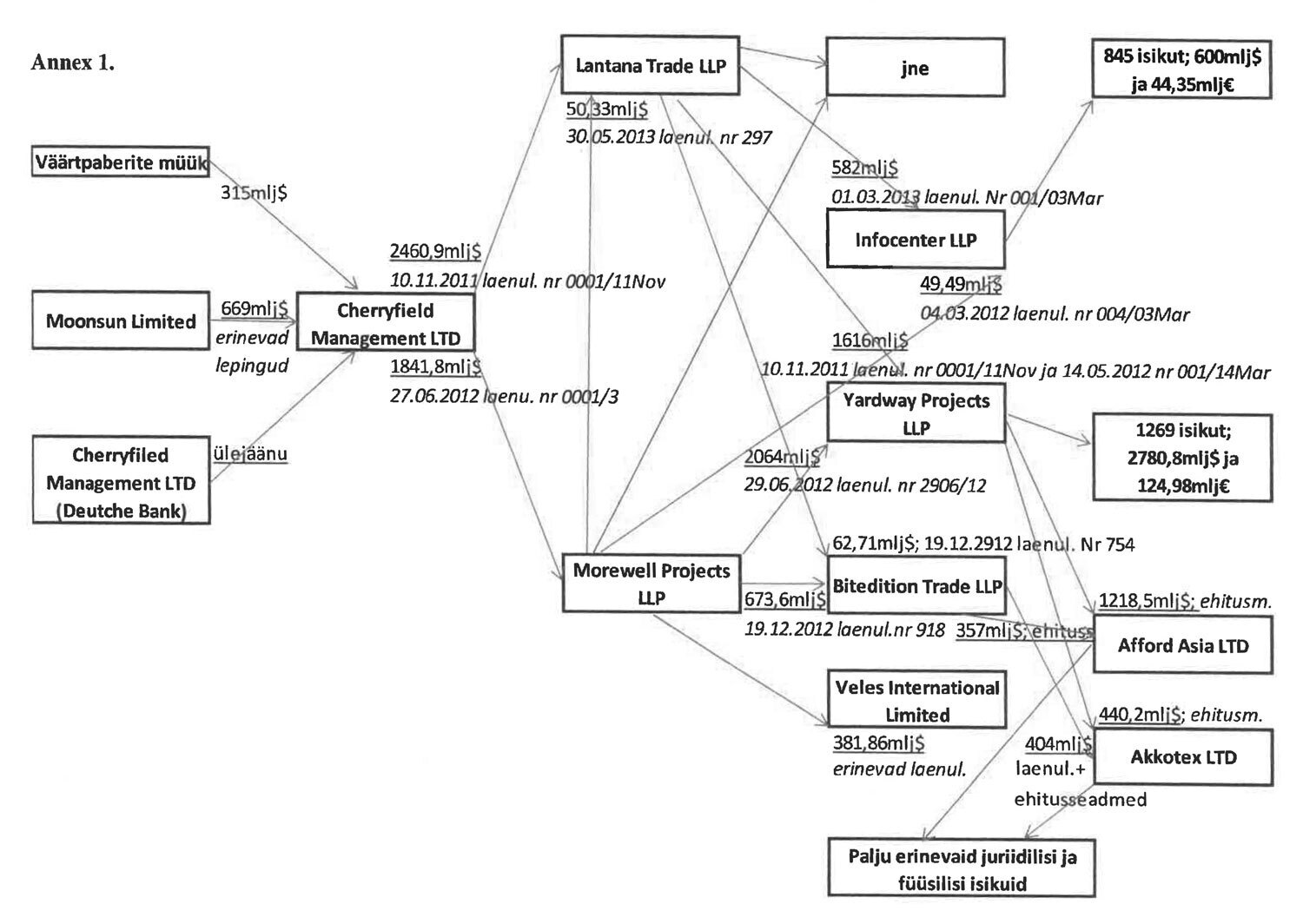
Perhaps the most egregious example of Danske’s failure to enforce anti-money-laundering regulations was the so-called “Lantana group” of customers: around 20 companies that were cycling huge amounts of money through Danske accounts in Estonia.
All were connected to a U.K.-registered firm called Lantana Trade LLP, which was later revealed to be closely connected to Igor Putin, the cousin of Russian President Vladimir Putin.
A diagram from the Estonian audit report showing transactions among the so-called “Lantana group” of companies.
Although most of the Lantana group companies had been created only a few months before they set up their business at Danske, the bankers quickly raised their transaction limits at the clients’ request.
Lantana Trade itself started with a limit of 2 million euros a day or 10 million euros a week in November 2011. Less than three months later, the limits had been raised to 7 million euros a day, and 30 million a week. By July the following year it had ballooned to 90 million per week.
During one period, Lantana’s “relationship manager,” Olga Tshetverikova, viewed the company’s accounts 17,558 times, or over 36 times every day, Danske Bank told the auditors. Despite this, neither she nor anyone else at the bank made efforts to flag Lantana’s large and unusual transactions, like the receipt of over $1.8 billion from a company in the group on the back of an unspecified “loan agreement,” the bulk of which it quickly loaned out to yet another company in the group.
“It is not common that the high risk customer … established [a] few months before establishing the relationship [with the bank], about who there is no information at all according to the Google search engine, who does not have a homepage and whose place of activity is often in apartment buildings … is able to generate such turnovers,” the auditors wrote.
By mid-2013, the volume of money being moved by the Lantana group had become so inexplicably high that it was impossible to ignore, even for the non-resident banking unit.
Danske “had a very bad feeling” about the situation, the bank’s head of international and private banking, Juri Kidjajev, told auditors the following summer.
“How is it possible to understand those transactions?” the bankers were asking themselves, according to Kidjajev.
At that point, by law, Danske should have fired these clients, blocked their accounts, and reported their suspicions to Estonia’s Financial Intelligence Unit, which would have triggered an investigation.
Instead, the bank tipped off the Lantana companies and suggested that they essentially fire themselves. This allowed the clients to walk away with all their funds intact — and Danske to avoid an investigation.
“By acting in the described manner, [the bank] gave the Customers belonging to the ‘Customer Group’ the possibility … to leave without any possible consequences,” the auditors wrote.
Kidjajev explained Danske’s actions by saying that the bank “only had a feeling” that money laundering was taking place, but no proof.
Credit: Andres Putting/Ekspress Meedia A sign on Danske Bank’s office in Tallinn, Estonia, is dismantled after a major money-laundering scandal led to the branch’s shuttering.
Big Transactions and Powerful Relatives
In March 2011, the bank accepted as a client an Uzbek man named Akbar Abdullaev, along with a company he had opened two months earlier, Britman Sales LLP.
Abdullaev’s personal banker had never met him — a violation of “Know Your Customer” guidelines that banks use to prevent criminal money from entering their systems. She had also apparently never bothered to Google him, or she would have found that he was a cousin of then-Uzbekistan President Islam Karimov and was widely considered a possible successor to the authoritarian leader, a relationship that should have subjected him to extra scrutiny.
Publicly available information connected Abdullaev to possible money laundering as early as 2012 , and he was arrested in his native country of Uzbekistan in October 2013. But despite this, he continued to be Danske’s client and even made two significant money transfers three months afterwards, including one in the amount of $10 million.
Danske Bank only started looking into his background in 2014, after the Estonian FSA started asking questions. A bank employee then identified him as a relative of Karimov and found “some negative information from [the] Internet about the customer,” the audit said. The bank asked him for additional data, but Abdullaev still hadn’t responded two months later.
(OCCRP sent questions to Abdullaev via a business partner but received no response.)
The auditors also found that Abdullaev had personally received dividend payments worth 20 million euros from his company, Britman Sales, though the bank hadn’t seen any justification for that figure.
Britman’s first listed address appeared on Google Maps as a point in the middle of an intersection. The company declared that it sold building materials and had around 5,600 British pounds in assets, and 1,500 pounds in liabilities.
Despite this, it moved over 63 million euros through its account at Danske Bank in under two years, often explaining the transactions as “loan agreements.” In one case, Britman sent 47.7 million euros to an obscure company with just one word of explanation: “own.”
Auditors were also not convinced that Britman’s contracts were genuine. Many were virtually identical, suggesting they had been copied and pasted in bulk.
On January 12, 2012, Britman signed an English-language contract to deliver 400,000 euros’ worth of building and finishing materials to a port in Finland, while the Russian-language version of the same document said the materials were worth 1 million dollars and would be delivered to Russia. Then, another nearly identical contract signed on the same day repeated these errors.
In another case, Britman earned $500,000 by selling 5,000 tons of cement, supposedly to a Slovakian company, and said it would deliver the load to an obscure railway station on the Russian-Latvian border. Danske did not ask even basic questions about this odd transaction.
“How and by what means were 5,000 tons of cement transported” to the railway station, the auditors wondered. And where did Britman get 5,000 tons of cement in the first place?
As for Abdullaev, the auditors pointed out that he was arrested in Uzbekistan in 2013, and there was no public indication he had ever been released. Despite that, he was signing contracts and making transactions through his Danske account in January 2014.
The auditors suggested that someone else had signed these documents in Abdullaev’s name.
“It is possible that this person was an employee of Danske Bank,” the audit said.
US President Joe Biden called Vladimir Putin a “killer” in a pre-taped interview, saying his Russian counterpart will pay a price for interference in US affairs.
Biden’s comments aired Wednesday, on the heels of a US intelligence report bolstering longstanding allegations that Putin was behind Moscow’s 2020 election interference, an accusation already rejected by Russia.
Asked by ABC News’ George Stephanopoulos whether he believes Putin is a “killer,” Biden replied: “I do.”
“The price he’s going to pay, you’ll see shortly,” he said, referring to the alleged election interference.
Biden also said that when he told Putin he believes the Russian leader has no soul, Putin replied: “We understand each other.”
The assessment marks a sharp break in former President Donald Trump’s warm relationship with Putin, as well as the view of the previous Republican president.
After a 2011 summit with Putin, then-President George W. Bush famously said: “I looked the man in the eye. I found him very straightforward and trustworthy – I was able to get a sense of his soul.”
The Vatican has asserted that the Catholic Church cannot bless same-sex unions as the God “does not and cannot bless sin.”
“The blessing of homosexual unions cannot be considered licit,” the Congregation for the Doctrine of the Faith (CDF) said in a statement on Monday, responding to question from pastors and the faithful.
“It is not licit to impart a blessing on relationships, or partnerships, even stable, that involve sexual activity outside of marriage, as is the case of the unions between persons of the same sex,” the Vatican’s top doctrinal office added.
Pope Francis also approved the publication of the statement.
The Vatican said that the decision does not constitute discrimination and does not specify a judgment on individuals.
Last October, in comments for a documentary, Francis endorsed legal same-sex unions under the law, but not within the church.
Catholic teaching disapproves of homosexual acts but stresses dignity and respect for gay people.
Bitcoin – which has more than tripled in value since the end of last year – has been powered on by well-known companies adopting it as a method of payment.
But some analysts said this latest surge came in part due to the huge US stimulus package approved this week.
Bitcoin’s total market value last month exceeded $1tn.
However, Bitcoin has a track record of wild price swings and has fallen sharply a number of times since it was created in 2009.
The recent spikes have been fuelled by big companies.
In February, Elon Musk revealed that his electric carmaker Tesla had bought $1.5bn worth of Bitcoin and would be accepting it as payment for its cars in future.
Mastercard also plans to accept certain cryptocurrencies as a form of payment while BlackRock, the world’s largest asset manager, is exploring ways it can use the digital currency.
The Covid-19 pandemic has also played its part in Bitcoin’s price rise, as more people go online for shopping, moving further away from physical coins and notes.
Critics argue Bitcoin is less of a currency and more of a speculative trading tool that is open to market manipulation.
There is also concern over its environmental impact, with huge amounts of energy needed to conduct transactions.