The family of George Floyd and the US city of Minneapolis have agreed Friday to a $27 million settlement to end a lawsuit against the city over his fatal arrest.
Ben Crump, the Floyd family’s attorney, hailed the agreement as the “largest pre-trial settlement in a civil rights wrongful death case in U.S. history.”
It “makes a statement that George Floyd’s life mattered and by extension that Black lives matter,” he said in a statement. “It sends a message that the unjust taking of a Black life will no longer be written off as trivial, unimportant, or unworthy of consequences.”
Floyd’s death in May 2020 prompted widespread calls for justice and renewed fervor and unrest regarding police-involved killings of Black men in the US.
“I can’t breathe,” his dying words, became a rallying cry for worldwide protests.
Former officer Derek Chauvin, who is white, is accused of killing Floyd during the fatal arrest. Disturbing bystander and police video shows Floyd pinned to the ground in handcuffs by Chauvin, his neck compressed by the officer’s knee for nearly nine minutes.
Floyd pleaded with the since-fired officer, telling him he cannot breathe, calling out to his mother and saying “everything hurts” with some of his final words before he appeared to lose consciousness. The officer continued to hold the position on Floyd’s neck.
The city of Minneapolis has since banned police from using chokeholds and neck restraints.
LONDON (AP) — Buckingham Palace issued a statement Tuesday, saying the family was saddened to learn of the challenges Harry and Meghan had faced in the past few years — and that they would address the issues privately.
The palace said the “issues raised, particularly that of race, are concerning,” and are taken very seriously.
“Harry, Meghan and Archie will always be much loved family members,” the statement said.
The statement is the first comment by the palace following Harry and Meghan’s two-hour interview with Oprah Winfrey in which they alleged that Meghan had experienced racism and callous treatment during her time in the royal family.
Prince Harry and Meghan’s allegations of ill treatment by Britain’s royal household are so serious that some observers say Buckingham Palace’s silence on the topic has only added to the furor surrounding their TV interview with Oprah Winfrey.
While the palace often tries to stay above controversy by remaining silent and riding out the storm, the Duke and Duchess of Sussex’s charges are so damaging to the royal family that it will have to respond publicly, says royal biographer Angela Levin.
But that response is likely being delayed by Queen Elizabeth II’s struggle to balance her sometimes-conflicting roles as monarch and grandmother, says Levin, author of “Harry, a Biography of a Prince.” Yet she says there’s little doubt that ultimately the 94-year-old monarch will make her decision based on what’s best for the 1,000-year-old institution she has led since 1952.
“The queen has a motto: Never complain, never explain,” Levin told The Associated Press. “And she’s stuck with this for four decades. But I think in this climate and 2021, everything goes everywhere. There’s so much social media that in this instance, she really can’t not say anything.”
The Times of London reported Tuesday that a palace statement had been delayed because the queen wanted more time. The newspaper didn’t cite a source for the information.
The interview, which aired Sunday night in the U.S. and a day later in Britain, has rocked the royal family and divided people around the world. While many say the allegations demonstrate the need for change inside a palace that hasn’t kept pace with the #MeToo and Black Lives Matter movements, others have criticized Harry and Meghan for dropping their bombshell while Harry’s 99-year-old grandfather, Prince Philip, remains hospitalized in London after a heart procedure.
During the two-hour interview, Meghan described feeling so isolated and miserable inside the royal family that she had suicidal thoughts, yet when she asked for mental health help from the palace’s human resources staff she was told she was not a paid employee. She also said a member of the royal family had expressed “concerns” to Harry about the color of her unborn child’s skin.
Winfrey later said Harry told her off camera that the family member was not Queen Elizabeth II or Prince Philip, sparking a flurry of speculation about who it could be.
Harry also revealed the stresses the couple endured had ruptured relations with his father, Prince Charles, heir to the British throne, and his brother, Prince William, illuminating the depth of the family divisions that led the couple to step away from royal duties and move to California last year.
So far there has been silence from the palace about the interview.
“I think that one of the major worries is you don’t want to throw oil on the flames to make it even worse,” Levin said.
Alastair Campbell, who advised the royal family how to respond to Princess Diana’s 1997 death in a car accident, suggested that Buckingham Palace should maintain that silence. Campbell, who also served as Prime Minister Tony Blair’s communications advisor, told the BBC that Diana’s death and the interview with Winfrey were very different situations.
“The death of Diana was a huge event — and following which they were all going to have to be involved in the funeral and in the response to what was happening in the country as a result of her death,″ he said. “Whereas this, I think, is a pretty extraordinary and a pretty explosive media frenzy, but that ultimately is what it is.″
“So I’m not sure I would advise them to do anything much beyond what they are doing — which is not very much,” he added.
Charles didn’t comment on the interview Tuesday during a visit to a vaccine clinic in London.
Harry’s father visited a church to see a temporary vaccine clinic in action and met with health care workers, church staff and people due to receive their vaccine jab. The visit was his first public appearance since the interview aired in the U.S. on Sunday night.
Maziya Marzook, a patient at the event, said “private matters didn’t come up at all” during Charles’ visit.
“He didn’t bring up anything,″ Marzook said. “He was more interested in how the vaccine was and how we feel.”
LONDON (Reuters) – Meghan, the wife of Prince Harry, accused the British royal family of racism, lying and pushing her to the brink of suicide, in an explosive televised interview that looks set to shake the monarchy to its core.
The 39-year-old, whose mother is Black and father is white, said she had been naive before she married into the family in 2018, but that she ended up having suicidal thoughts and considering self harm after pleading for help but getting none.
She added that her son Archie, now aged one, had been denied the title of prince because there were concerns within the royal family about how dark his skin might be.
“They didn’t want him to be a prince,” Meghan said in an interview with Oprah Winfrey aired on CBS late on Sunday.
She said there had been “conversations about how dark his skin might be when he’s born.”
Meghan declined to say who had aired such concerns, as did Harry, who said his family had cut them off financially and that his father Prince Charles, heir to the British throne, had let him down and refused to take his calls at one point.
Buckingham Palace has yet to comment publicly on the interview, which aired in the early hours of Monday morning in Britain.
Meghan cast the British royal family as uncaring and mendacious, and accused Kate – the wife of her husband’s brother Prince William – of making her cry before her wedding.
While the family including Prince Charles came in for open criticism, neither Harry nor Meghan attacked Queen Elizabeth directly.
Still, Meghan said she had been silenced by “the Firm” – which Elizabeth heads – and that her pleas for help while in distress at racist reporting and her predicament had fallen on deaf ears.
“I just didn’t want to be alive any more. And that was a very clear and real and frightening constant thought. And I remember how he (Harry) just cradled me,” Meghan said, wiping away tears.
‘REALLY LET DOWN‘
Harry and Meghan’s announcement in January, 2020, that they intended to step down from their royal roles plunged the family into crisis. Last month, Buckingham Palace confirmed the split would be permanent, as the couple looks to forge an independent life in the United States.
Harry, 36, said they had stepped back from royal duties because of a lack of understanding and that he was worried about history repeating itself – a reference to the 1997 death of his mother Diana.
“I feel really let down,” Harry said of his father. “My family literally cut me off financially.”
Harry denied blindsiding Queen Elizabeth, his grandmother, with his decision to shun life within the monarchy, but added that his father stopped taking his calls at one point.
“I had three conversations with my grandmother, and two conversations with my father before he stopped taking my calls. And then he said, can you put this all in writing?”
Their detractors say the couple want the glamour of their privileged positions without the dedication it requires or scrutiny it brings.
To their supporters, their treatment shows how an outdated British institution has lashed out against a modern, biracial woman, with undertones of racism.
LIES AND TEARS
There have also been allegations of bullying against Meghan which first appeared in The Times newspaper in the buildup to the couple’s appearance.
Buckingham Palace said it would investigate the claims, adding it was “very concerned.”
In response to the report, a spokeswoman for Meghan said she was “saddened by this latest attack on her character, particularly as someone who has been the target of bullying herself.”
Meghan told Winfrey that people within the royal institution not only failed to protect her against malicious claims but lied to protect others.
“It was only once we were married and everything started to really worsen that I came to understand that not only was I not being protected but that they were willing to lie to protect other members of the family,” Meghan said.
“There’s the family, and then there’s the people that are running the institution, those are two separate things and it’s important to be able to compartmentalise that because the queen, for example, has always been wonderful to me.”
Meghan denied a newspaper story that she had made Kate, Duchess of Cambridge, cry before the wedding and said it was a turning point in her relations with the media.
Asked if she made Kate cry, Meghan replied: “The reverse happened.
“A few days before the wedding she (Kate) was upset about something, pertaining to yes the issue was correct about the flower girl dresses, and it made me cry. And it really hurt my feelings.”
Meghan said she had not realised what she was marrying into when she joined the British monarchy.
“I will say I went into it naively, because I didn’t grow up knowing much about the royal family,” Meghan said.
She explained she was not being paid for the interview.
WASHINGTON (AP) — The Senate approved a sweeping pandemic relief package over Republican opposition on Saturday, moving President Joe Biden closer to a milestone political victory that would provide $1,400 checks for most American and direct billions of dollars to schools, state and local governments, and businesses.
The bill cleared by a party-line vote of 50-49 after a marathon overnight voting session and now heads back to the House for final passage, which could come early next week.
Democrats said their “American Rescue Plan” would help the country defeat the virus and nurse the economy back to health. Republicans criticized the $1.9 trillion package as more expensive than necessary. The measure follows five earlier virus bills totaling about $4 trillion that Congress has enacted since last spring.
A look at some highlights of the legislation:
AID TO THE UNEMPLOYED
Expanded unemployment benefits from the federal government would be extended through Sept. 6 at $300 a week. That’s on top of what beneficiaries are getting through their state unemployment insurance program. The first $10,200 of jobless benefits would be non-taxable for households with incomes under $150,000.
Additionally, the measures provides a 100% subsidy of COBRA health insurance premiums to ensure that the laid-off workers can remain on their employer health plans at no cost through the end of September.
MORE CHECKS
The legislation provides a direct payment of $1,400 for a single taxpayer, or $2,800 for a married couple that files jointly, plus $1,400 per dependent. Individuals earning up to $75,000 would get the full amount, as would married couples with incomes up to $150,000.
The size of the check would shrink for those making slightly more, with a hard cut-off at $80,000 for individuals and $160,000 for married couples.
Most Americans will be getting the full amount. The median household income was $68,703 in 2019, according to the U.S. Census Bureau.
MONEY FOR STATE AND LOCAL GOVERNMENTS
The legislation would send $350 billion to state and local governments and tribal governments for costs incurred up until the end of 2024. The bill also requires that small states get at least the amount they received under virus legislation that Congress passed last March.
Many communities have taken hits to their tax base during the pandemic, but the impact varies from state to state and from town to town. Critics say the funding is not appropriately targeted and is far more than necessary with billions of dollars allocated last spring to states and communities still unspent.
AID TO SCHOOLS
The bill calls for about $130 billion in additional help to schools for students in kindergarten through 12th grade. The money would be used to reduce class sizes and modify classrooms to enhance social distancing, install ventilation systems and purchase personal protective equipment. The money could also be used to increase the hiring of nurses and counselors and to provide summer school.
Spending for colleges and universities would be boosted by about $40 billion, with the money used to defray an institution’s pandemic-related expenses and to provide emergency aid to students to cover expenses such as food and housing and computer equipment.
AID TO BUSINESSES
A new program for restaurants and bars hurt by the pandemic would receive $25 billion. The grants provide up to $10 million per company with a limit of $5 million per physical location. The grants can be used to cover payroll, rent, utilities and other operational expenses.
The bill also provides $7.25 billion for the Paycheck Protection Program, a tiny fraction of what was allocated in previous legislation. The bill also allows more non-profits to apply for loans that are designed to help borrowers meet their payroll and operating costs and can potentially be forgiven.
TESTING AND VACCINES
The bill provides $46 billion to expand federal, state and local testing for COVID-19 and to enhance contract tracing capabilities with new investments to expand laboratory capacity and set up mobile testing units. It also contains about $14 billion to speed up the distribution and administration of COVID-19 vaccines across the country.
HEALTH CARE
Parts of the legislation advance longstanding Democratic priorities like increasing coverage under the Obama-era Affordable Care Act. Financial assistance for ACA premiums would become considerably more generous and a greater number of solid middle-class households would qualify. Though the sweetened subsidies last only through the end of 2022, they will lower the cost of coverage and are expected to boost the number of people enrolled.
The measure also dangles more money in front of a dozen states, mainly in the South, that have not yet taken up the Medicaid expansion that is available under the ACA to cover more low-income adults. Whether such a sweetener would be enough to start wearing down longstanding Republican opposition to Medicaid expansion is uncertain.
BIGGER TAX BREAKS FOR HOUSEHOLDS WITH AND WITHOUT KIDS
Under current law, most taxpayers can reduce their federal income tax bill by up to $2,000 per child. In a significant change, the bill would increase the tax break to $3,000 for every child age 6 to 17 and $3,600 for every child under the age of 6.
The legislation also calls for the payments to be delivered monthly instead of in a lump sum. If the secretary of the Treasury determines that isn’t feasible, then the payments are to be made as frequently as possible.
Families would get the full credit regardless of how little they make in a year, leading to criticism that the changes would serve as a disincentive to work. Add in the $1,400 checks and other items in the proposal, and the legislation would reduce the number of children living in poverty by more than half, according to the Center on Poverty and Social Policy at Columbia University.
The bill also significantly expands the Earned Income Tax Credit for 2021 by making it available to people without children. The credit for low and moderate-income adults would be worth $543 to $1,502, depending on income and filing status.
RENTAL AND HOMEOWNER ASSISTANCE
The bill provides about $30 billion to help low-income households and the unemployed afford rent and utilities, and to assist the homeless with vouchers and other support. States and tribes would receive an additional $10 billion for homeowners who are struggling with mortgage payments because of the pandemic.
A Democratic congressman filed a lawsuit on Friday against former president Donald Trump, his son Donald Jr, his lawyer Rudy Giuliani and a Republican lawmaker for allegedly inciting the January 6 attack on the US Capitol.
Trump, 74, and the other defendants waged a “campaign of lies and incendiary rhetoric” which led to the assault on Congress, Representative Eric Swalwell of California charged in the civil suit lodged in a US District Court in Washington.
Another Democratic congressman, Representative Bennie Thompson of Mississippi, filed a similar suit against Trump last month.
Both cite a little used law, the Ku Klux Klan Act, to make the case against the former president.
The 1871 Act was designed to prevent the white supremacist KKK from intimidating elected officials.
Trump, Donald Jr, Giuliani and Rep. Mo Brooks, a congressman from Alabama, all spoke at a rally which preceded the January 6 attack on Congress by Trump supporters seeking to block the certification of Democrat Joe Biden’s election victory.
“Unable to accept defeat, Donald Trump waged an all out war on a peaceful transition of power,” Swalwell said in a statement announcing the lawsuit.
“He lied to his followers again and again claiming the election was stolen,” the congressman said, “and finally called upon his supporters to descend on Washington DC to ‘stop the steal.’”
“The defendants assembled, inflamed and incited the mob, and as such are wholly responsible for the injury and destruction that followed,” Swalwell said.
The suit demanded unspecified monetary and punitive damages to be determined at a jury trial.
Swalwell was one of the impeachment managers for Trump’s trial in the Senate on the charge of inciting insurrection.
Trump was impeached by the Democratic-majority House of Representatives for his role in inciting the attack on the Capitol but acquitted by the Senate.
Thompson and the NAACP, a civil rights organization, filed suit against Trump, Giuliani and two right-wing groups, the Proud Boys and Oath Keepers, last month.
Jason Miller, a Trump spokesman, responded to the latest lawsuit in a statement to The Washington Post. “Eric Swalwell is a low-life with no credibility,” Miller said.
– Trump State Dept appointee arrested –
More than 300 people have been arrested so far for their role in the storming of the Capitol, which left at least five people dead.
Among the latest arrests was Federico Guillermo Klein, 42, a Trump appointee to a low-level State Department job.
Klein, who resigned from the State Department on January 19, a day before Trump left office, was arrested by the FBI on Thursday after a review of video of the Capitol attack.
In a criminal complaint obtained by The New York Times, an FBI special agent said Klein, wearing a red “Make America Great Again” hat, is seen assaulting police officers with a riot shield.
According to the complaint, Klein worked at the State Department since 2017 on Brazilian and other Latin American affairs and had a Top Secret clearance.
He is believed to be the first member of the former Trump administration to directly charged in connection with the ransacking of the Capitol.
Klein faces multiple charges including assaulting police officers, obstructing an official proceeding and disorderly conduct.
Despite public denials, well-known citizenship broker Henley & Partners helped disgraced financier Jho Low, who stands accused of stealing billions from Malaysian sovereign wealth fund 1MDB, obtain a passport from Cyprus.
Jho Taek Low had billions of dollars, but he was running out of places to put them.
By 2015, the Malaysian financier had become the face of the now-infamous 1MDB embezzlement scandal. His theft of billions from Malaysia’s sovereign wealth fund had been widely reported. So had the trail of splashy purchases he made around the world: a transparent grand piano for supermodel Miranda Kerr, a New York City penthouse once owned by Jay-Z, a $6-million emerald green soup can painted by Andy Warhol, an entire hotel in Beverly Hills.
Banks were increasingly wary of him. So were governments. He was under investigation by law enforcement in Singapore and Switzerland. U.S. authorities were closing in, too. He needed a safe refuge for both himself and his money.
To solve these problems, Low turned to the sunny eastern Mediterranean island of Cyprus, where, with a view to establishing a new financial foothold, he purchased citizenship in 2015 under the country’s controversial “golden passport” scheme.
Technically known as Citizenship By Investment, the program was meant to attract wealthy foreigners seeking European Union passports. But in the eyes of critics, its main effect was to make Cyprus a go-to destination for kleptocrats and criminals who want to pay their way into the bloc. It also proved lucrative for a small army of lawyers and financial service providers who greased the wheels.
The program was ditched last October after a damning investigation by Al Jazeera exposed local politicians offering to help a fictitious Chinese criminal get citizenship. The circumstances under which Low received his golden passport are under scrutiny by Cypriot authorities.
Now, an investigation by OCCRP and the Sarawak Report can reveal previously undisclosed details about how Low obtained Cypriot citizenship — and who helped him do it.
Though his connection to one of the world’s biggest thefts of public funds had already been widely exposed, he was able to hire London-based Henley & Partners, perhaps the world’s best-known passport brokerage firm, to provide him with citizenship services.
The company has repeatedly denied helping Low, while blaming local employees for any mistakes that were made. But invoices and other documents obtained by OCCRP show that Henley pocketed at least 710,000 euros for services it provided to him. The bulk of its earnings came from a 650,000-euro commission Low paid for his purchase of a luxury seaside villa.
Acquiring local real estate worth at least half a million euros was a requirement of the Cypriot visa program. This provided opportunities for citizenship firms like Henley to pad their earnings by serving the additional role of a real estate broker.
“In any major scandal there’s always a multitude of enablers that allow the movement of the money, and in doing so they allow the fraud to continue,” said Debra LaPrevotte, a former FBI special agent who was involved in the initial stages of the 1MDB investigation.
“Every single one of those people has some type of due diligence responsibility. Yet they ignore it, and by enabling the movement of this money they don’t see the secondary effect of this, that the billions that left Malaysia should have been helping the people of Malaysia.”
?A “Staggering” Amount of Stolen Money
In July 2016, the U.S. Justice Department filed a complaint alleging that over $3.5 billion had been misappropriated from 1Malaysia Development Berhad (1MDB), a fund created by the government of Malaysia to promote economic development, between 2009 and 2015. (That figure would later be revised upwards to $4.5 billion.) The money was stolen by high-level fund officials and their associates, then laundered through a series of complex transactions and fraudulent shell companies with bank accounts in Singapore, Switzerland, Luxembourg, and the United States.
The complaint named Low as the mastermind behind the theft. He was accused of laundering more than $400 million that had been diverted from the fund. Much of it ended up in the U.S. in the form of luxury real estate, jewelry, and iconic artworks, including a Monet and a Van Gogh. Stolen 1MDB money was also spent on gifts for some of Low’s famous friends, including Leonardo DiCaprio — who received the Oscar statuette Marlon Brando had won for “On The Waterfront.” Some of the money was also allegedly used to fund the production of “The Wolf of Wall Street.”
Low has denied any wrongdoing in the 1MDB affair, insisting he was just an intermediary and that the charges against him are politically motivated. His whereabouts are unknown, and two law firms representing him in the U.S. and U.K. did not respond to requests for comment.
Serving the Global Elite
In the world of citizenship for sale, service providers are key. These companies identify target nations, manage the required investments, and do everything else needed to help the world’s wealthiest people become “global citizens,” as their marketing language tends to phrase it.
And there is no service provider more sought after than Henley & Partners, a London-based consultancy that bills itself as “the global leader in residence and citizenship planning.”
While Henley boasts of its exclusive client list and high-level connections, it has emphatically denied any connection with Low. In November 2019, the company released a statement rejecting media reports that it had helped the Malaysian fugitive.
But documents obtained by OCCRP indicate that Henley did, in fact, play a role in brokering Low’s Cypriot citizenship –– and that it received a hefty commission for its services.
Low signed a contract with Henley on May 7, 2015, according to a copy of the document obtained by OCCRP. By that time, he was already emerging in the public eye as a key player in the 1MDB saga.
Less than four months later, he had a Cypriot passport in his hands after purchasing a 5-million-euro beachfront villa from a real estate firm partnered with Henley.
In a series of emails, Henley & Partners told OCCRP that it had rejected Low as a client “due to the contents of an external due diligence report that made it clear that he was a second-generation PEP [politically exposed person].”
“To be very clear, Jho Low was never a client of Henley & Partners,” the firm said in a three-page statement. “Henley & Partners was not mandated by Jho Low.”
The company continued to deny any relationship even after being presented with documentary evidence. “We can however understand a level of confusion from outside observers as to the nature of the relationship,” a spokesperson wrote.
Henley & Partners said that after rejecting Low, it referred him to FidesCorp Services Limited, a Cyprus-based accounting firm that also provides citizenship services. Henley & Partners wrote that it had “no interest” in FidesCorp and had an “ad hoc relationship” with the company, which it said provided “complementary and non-competitive services to a similar client base.”
In fact, the two companies have worked closely together for years, with the head of FidesCorp even helping Henley set up its Cyprus office.
Leaked emails and financial documents obtained by OCCRP indicate that FidesCorp played a role in arranging Low’s Cypriot affairs, but that the relationship with Low was initiated and led by Henley & Partners.
In this way, Henley appears to have used FidesCorp as a shield to avoid scrutiny over its relationship with Low, even as it earned hundreds of thousands of euros on commissions related to his purchase of a Cypriot passport, the documents show.
They also show that Henley & Partners worked with Low until at least late November 2016, by which time his close ties to the 1MDB fraud were widely known.
?Due Diligence Done?
Service providers such as Henley & Partners have a legal obligation to look into their clients’ backgrounds to make sure they are not facilitating money laundering.
If a client appears to be a PEP, or politically exposed person, they are supposed to be examined with even more scrutiny, since they’re at higher risk of being involved in corruption. The rules also apply to real estate agents.
In Low’s case, it would not have taken long to uncover troubling information about his wealth.
“As of February 2015 there was publicly available information and media articles connecting Jho Low with the 1MDB scandal,” LaPrevotte, the former FBI agent, told OCCRP. “Anybody doing any due diligence should have seen them.”
Henley & Partners did see them. The contract it signed with Low contains an attached profile from World-Check, a commercial database of high-risk individuals. The profile correctly identifies Low as a PEP for being a “close associate” of Najib Razak, Malaysia’s prime minister at the time, who has since been sentenced to jail for sending 1MDB funds to his personal bank accounts.
In the document, Low is described as the Chief Executive Officer of Jynwel Capital Limited, the Hong Kong financial services firm the U.S. Department of Justice says funneled money stolen from 1MDB.
One lengthy New York Times investigation cited in the profile detailed extensive concerns about Low’s lavish spending and opaque real estate deals, given his close ties to Razak.
“Speculation is brewing over where Low is getting his money from,” it quoted another news outlet as saying.
Maira Martini, a policy expert at Transparency International, said that if Henley saw Low as too high-risk for its citizenship brokering business, it should have avoided working on his behalf as a real estate broker, too.
“Did they also take into account the level of risk when supporting him to find a property in Cyprus?” she asked.
Leaked emails obtained by OCCRP show the company’s own employees actively working to help Low obtain citizenship.
In order to qualify, Low chose to pay a local developer $5 million euros to build him a villa on a prime plot of beachfront land in Ayia Napa, an eastern Cyprus resort town whose white-sand beaches and turquoise waters made it a prime destination for investors seeking passports.
In an email to Low on June 21, 2015, Yiannos Trisokkas, at the time Henley & Partners’ managing partner in Cyprus and chairman of the firm’s real estate committee, outlined the next steps.
“We have already instructed our exclusive local service provider and the companies are ready with the nominee services included as well,” he wrote. “Once the contract of sale is signed for the villa between the seller and the buyer (your company), then the nominee will be signing further to your written instructions.”
Trisokkas instructed Low to transfer 5,960,000 euros for the house to an escrow account in Cyprus that had been set up for him by FidesCorp on instructions by Henley & Partners.
That amount, he noted, did not include what Low would need to pay for “anything related to your citizenship application.” He asked Jennifer Lai, Henley’s head of business at the time, whether she had invoiced Low for the application.
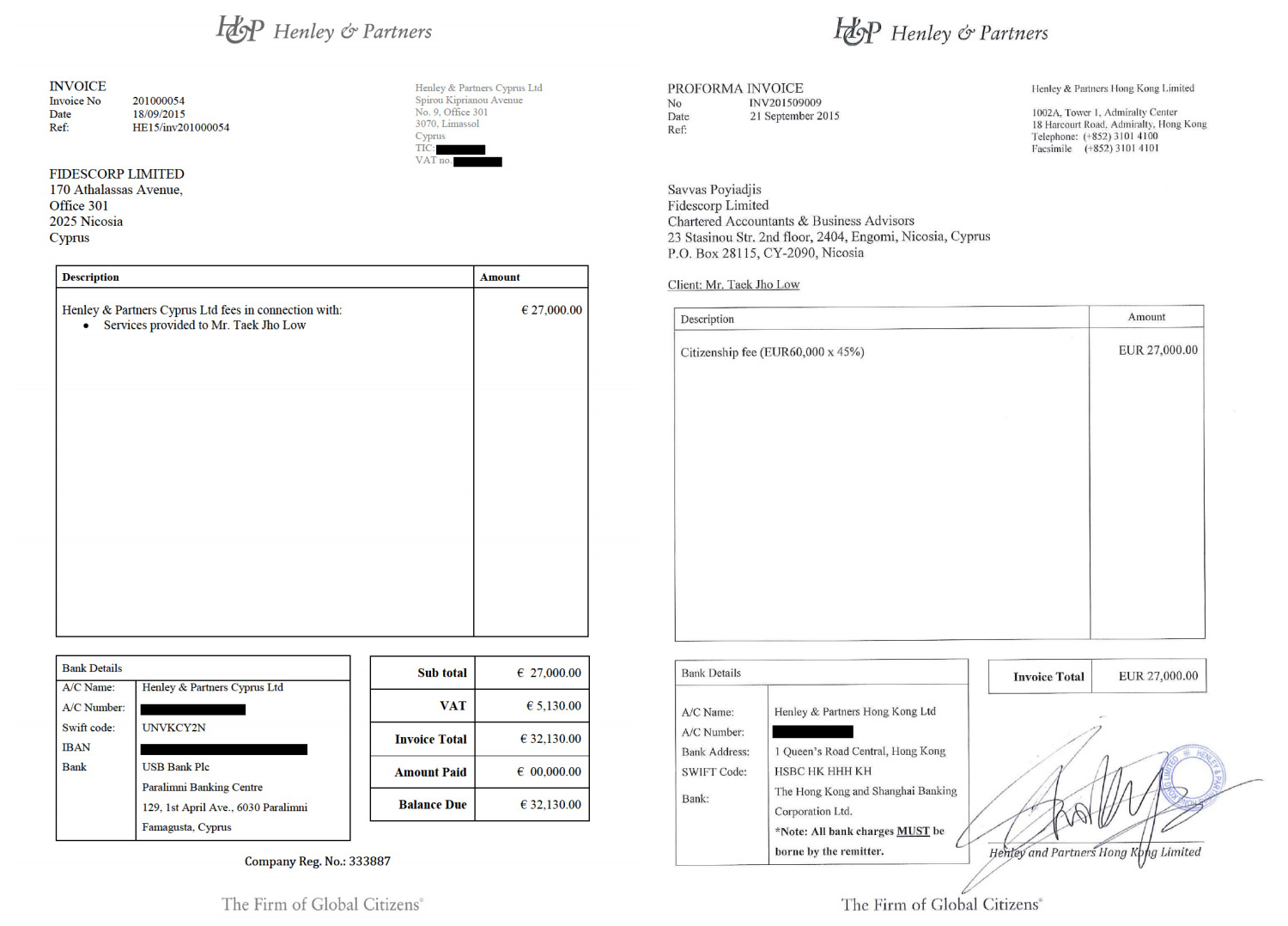
The next day, on June 22, FidesCorp invoiced Low 80,000 euros for “our fees and expenses in relation to professional services rendered.” Out of this sum, 60,000 euros were then sent to Henley — a payment the company described as a referral fee.
“Due to long standing contracts that were then in place, but are now amended, H&P was in the position to invoice Fidescorp for commission payment for the referral,” the company said.
Invoices issued by two of Henley’s subsidiaries, Henley & Partners Cyprus Limited and Henley & Partners Hong Kong Limited, to FidesCorp Limited. They show that, out of the 80,000-euro citizenship fee paid by Jho Low, Henley’s share was 60,000 euros.
Three days after Trisokkas’s June email, 5,960,000 euros were transferred from Low’s personal account at the Abu Dhabi State Fund-owned Falcon Private Bank to the client escrow account at Bank of Cyprus set up by FidesCorp, according to a report drafted by a Cypriot government investigative committee.
According to the report, Deutsche Bank acted as a correspondent bank in the transaction. A Deutsche Bank spokesperson said that “for legal reasons we cannot provide any information on potential or existing client relationships.” The Bank of Cyprus did not respond to a request for comment.
Henley’s assistance to Low did not stop there. Leaked emails show that in late November 2016, Low changed his mind about the purchase. He emailed Trisokkas to say he wanted to build his house on a larger plot than the one he initially acquired.
Trisokkas swiftly replied, offering a bigger beachfront plot in the same area that would have “more privacy,” before agreeing to scrap the old contract and sign a new one “under the same terms and conditions.” A new purchase agreement was signed seven months later, in June 2017.
Do you know more about this story?
Some of OCCRP’s most important journalism has come from anonymous or confidential tips.
If you know more about the issues we’ve covered here, or have documents or evidence of wrongdoing you’d like to get into the open, OCCRP can help.
“We remain entirely certain that this firm did nothing wrong,” Henley wrote in a statement to OCCRP, underlining the words for emphasis.
However, it admitted, “It may be that some individual staff members involved at the time did not act as one team or failed to adhere to the new procedures or did not exercise a sufficient level of judgment as to their interaction with real estate partners.”
The firm added that “all possibly involved and responsible persons are no longer with the firm today,” including Jennifer Lai and Yiannos Trisokkas.
“Henley and Partners in 2021 is not the Henley [and] Partners of 2010, or of 2015-17,” the company said. “There has been a series of significant changes both in terms of senior management and in terms of governance, structure and processes.”
Indeed, according to her LinkedIn profile, Lai left the company in September 2020, after spending nearly five years as a managing partner.
However, as of mid-January 2021, Trisokkas was still a director of Henley & Partners Cyprus Limited, according to corporate documents. His profile was removed from Henley’s website in early January, shortly after OCCRP sent Henley an email inquiring about its role in brokering Low’s citizenship.
FidesCorp declined to comment, citing client confidentiality. “In light of the fact that an investigation is currently in progress by the authorities of the Republic of Cyprus, we are obliged to refrain from making any statements,” the firm added.
A Mysterious Intermediary
The bulk of Henley & Partners’ earnings from Low came not from the “citizenship fee” he paid, but from a large commission a Henley subsidiary charged him on his purchase of the waterfront property.
This commission — 650,000 euros, or an unusually high 13 percent of the property’s sales price — was paid to Henley Estates Limited, a Maltese company that had been set up in 2010 by Andrew Taylor, a broker who worked with Henley on real estate deals for citizenship services. He was later hired, and by 2015 the company had been fully integrated into Henley & Partners.
On his LinkedIn page, Taylor listed himself as Henley & Partners’ vice-chairman until early January, when he removed the title shortly after OCCRP submitted questions to Henley & Partners about the Low deal.
Henley & Partners told OCCRP that because Henley Estates had started out as an independent company set up by Taylor, it had retained some of its old contacts and business practices. Henley Estates sometimes received payments for its work brokering property deals for local developers, but had never been paid by Low, the company said.
“Any engagement between Jho Low and H&P staff, if any, was a result of Henley’s long-standing position as an agent of multiple real estate developers,” the company wrote.
“At no point did any person or entity within the H&P Group structure, including Henley Estates, ever contract or receive income directly from Jho Low. They contracted and received income from long standing corporate and real estate partners.”
However, OCCRP has found that this is incorrect. According to a transfer receipt obtained by reporters, Low himself paid the 650,000-euro fee directly to Henley Estates, from the account in Cyprus set up for him by FidesCorp.
The deal was shrouded in secrecy and conducted with the help of multiple shell companies and nominee service providers — firms that offer “nominees” to act on behalf of other companies, to keep their true owners hidden.
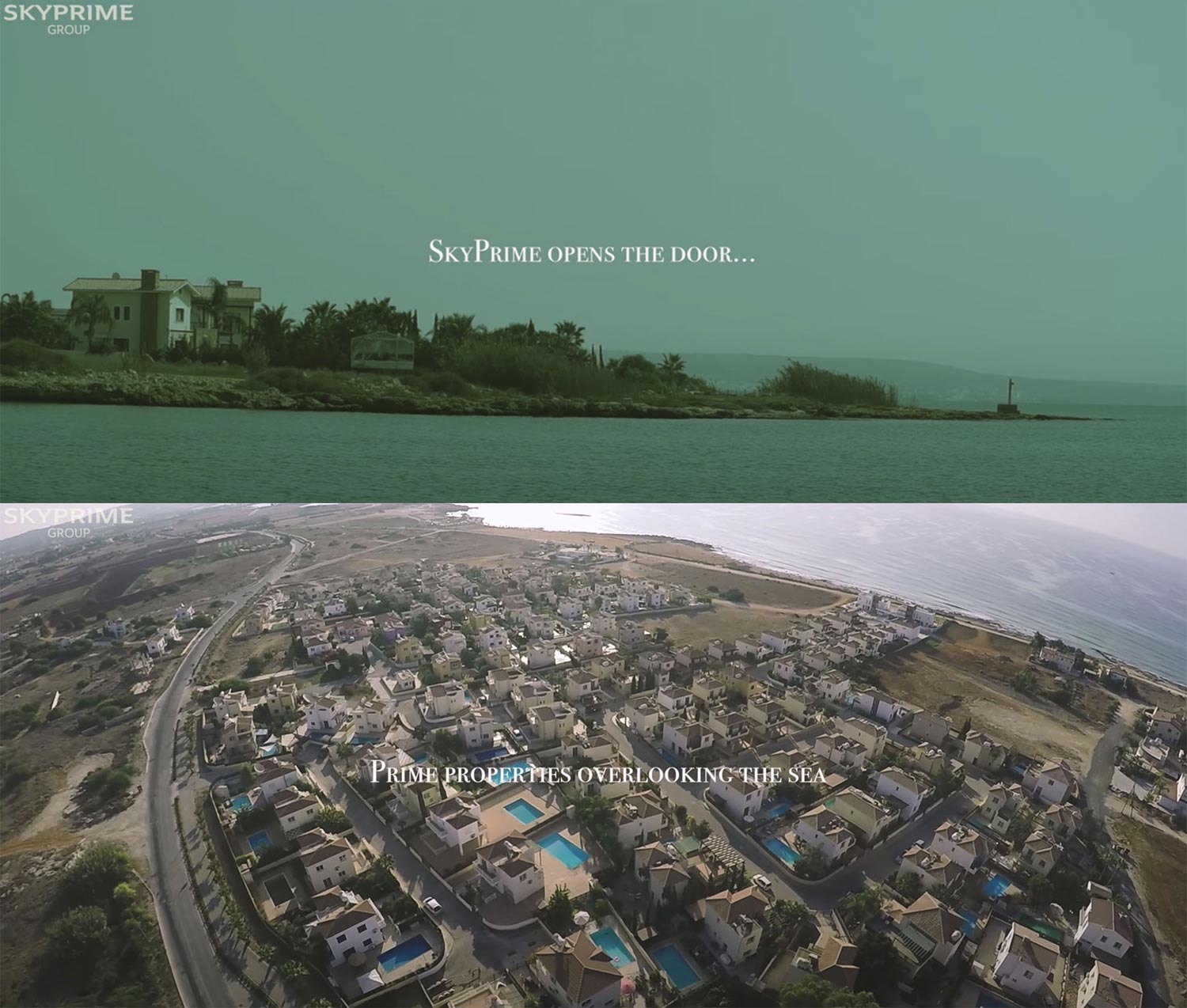
Credit: SkyPrime Screenshots from a SkyPrime promotional video for prospective buyers of second homes in Cyprus.
In short, the villa was sold by SkyPrime, a local real-estate developer with high-level connections, and a longtime partner of Henley in Cyprus. It advertises itself as catering to “high net worth individuals.”
However, parts of the transaction were processed through a shell company called Donnica Management Limited, which has no website or public presence and was registered in May 2015, the same month Low inked his contract with Henley. The company appears to have been set up for the sole purpose of facilitating the deal — and obscuring any connection to Low. It was Donnica, not SkyPrime, that received Low’s payment for the villa. And it was Donnica, not Low, that was invoiced by Henley & Partners for its commission fee.
Donnica and SkyPrime appear to be connected, since they have the same address, directors, and ultimate shareholder. But both companies have hidden their true owners behind a nominee service provider.
Nominees fill corporate posts to keep the true owners of companies secret. In this case, the nominee service provider concealing the owners of both Donnica and SkyPrime was run by a partner in the Cypriot law firm Tsitsios & Associates.
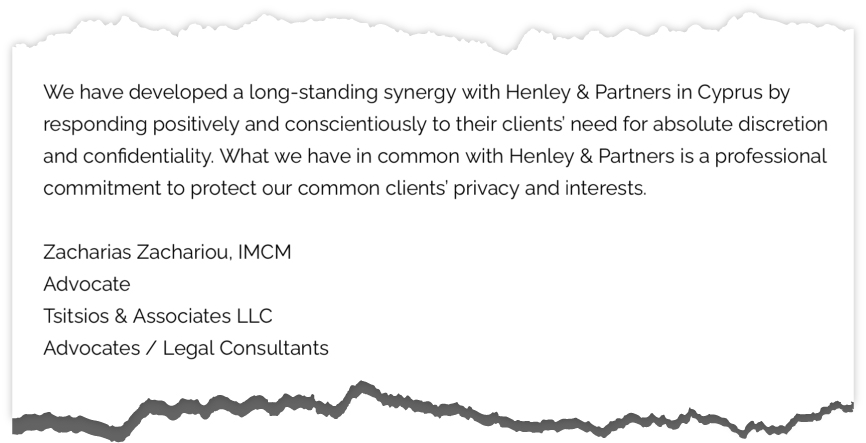
The law firm declined to comment on the Low case, but it has worked with Henley before, according to this internet post written by one of its associates, which boasts of the companies’ “long-standing synergy.”
A glowing online review written by an associate from Tsitsios & Associates, explaining that the two firms frequently worked together.
When confronted with evidence that it had received a large payment from Low, Henley maintained it had done nothing wrong, but conceded that the real estate transaction was “an example from which Henley & Partners should and did learn.”
Maira Martini, a policy expert on corrupt money flows at Transparency International, questioned the ethics of rejecting Low as a client, then profiting from selling him real estate.
“As a PEP and high-risk client, according to H&P’s own assessment, they should have undertaken enhanced due diligence and reported any suspicious transactions to authorities,” she said.
“Instead of that, they [not only] decided to refer the client to another firm in exchange for a fat commission for the citizenship application, but seem to have continued behind the scenes to assist Low to find a real estate property in Cyprus — for an even fatter commission.”
A 1MDB Enclave in Cyprus?
Low wasn’t the only person involved in the 1MDB scandal who was seeking E.U. citizenship. OCCRP has found that around the same time he applied for Cypriot citizenship, one of his closest 1MDB associates did too. His brother, who helped him funnel millions of dollars out of Malaysia, then applied in September 2015, as did another close aide. All three listed Cyprus addresses in the same area as Low’s villa.
?
Low’s brother and two associates who applied for Cypriot citizenship are all accused by the U.S. Justice Department of abetting his theft of Malaysian government funds.
They are:
Low Taek Szen — Low’s older brother and managing director of Jynwel Capital, his Hong-Kong-based financial vehicle. According to the U.S. Justice Department, he was the owner of a BSI Bank account in Singapore that was used to move millions of dollars.
Loo Ai Swan (a.k.a. Jasmine Ai Swan) — a Malaysian national who served as 1MDB’s general counsel in 2012 and 2013. She was identified by the U.S. Justice Department as the main point of contact between 1MDB and Goldman Sachs, which helped raise billions of dollars for the Malaysian fund. (Goldman admitted last year that its Malaysian office had ignored red flags and paid bribes to officials there).
Tan Kim Loong (aka Eric Tan) — reportedly one of Low’s closest aides. According to the U.S. Justice Department, he controlled the Singapore bank account through which part of the stolen funds was laundered.
Loo Ai Swan and Tan Kim Loong were named as key figures in the 2016 U.S. civil lawsuit seeking to reclaim assets bought with stolen 1MDB money. In December 2018, a Malaysian court reportedly issued warrants for their arrest. Their whereabouts are unknown.
Cypriot Interior Minister Nicos Nouris told OCCRP that none of the three was granted citizenship. He declined to comment on their property acquisitions, citing the ongoing investigation into Low’s citizenship.
?Would You Like to Buy a Bank?
Perhaps anticipating that he would soon lose access to the global banking system, Low turned to FidesCorp again in 2016 — this time to try to buy a bank of his own in his new country.
Documents obtained by the Sarawak Report and shared with OCCRP show that Low tried to purchase the Cypriot Development Bank, a small lender that would later be fined for violating anti-money laundering regulations.
Sheikh Jaber al-Mubarak al-Sabah, a member of Kuwait’s royal family who had become one of Low’s favorite fixers, embarked on negotiations to buy the bank on his behalf in June 2016, with FidesCorp as a broker.
In a letter, Sheikh Sabah mandated FidesCorp to negotiate “the acquisition of no less than 51% and up to 100% of the share capital of Cyprus Development Bank for the maximum bid amount of 80 million euros for 100% stake.” The document went on to say that this “be done in coordination with my advisors such as Mr Bashar Kiwan, Mr Low Taek Jho or Mr Hamad Al-Wazzan.”
According to people familiar with the events who spoke to OCCRP on condition of anonymity, when FidesCorp asked Sheikh Sabah to transfer the money for the purchase, he suddenly disappeared.
The reasons for this lack of follow-through are unknown. Perhaps another solution had been found: Later that summer, Sheikh Sabah was reportedly helping Low open offshore accounts at his own small bank in the Comoro Islands. Cyprus Development Bank told OCCRP that it had never received the proposal from Low and had no relationship with him.
By 2019, Low was one of the most famous fugitives in the world. But this didn’t prevent his Cypriot service providers from lending a helping hand yet again.
That May, his girlfriend, Jesselynn Chuan Teik Ying, applied for a Cypriot passport, with FidesCorp acting as her agent.
Ying was not as lucky as Low. By the time she applied, her boyfriend’s citizenship application had become public knowledge, sparking widespread anger and prompting the government to launch an investigation into how a man accused of stealing billions had bought his way into Cyprus.
Her application was withdrawn around the same time the scandal broke.
In October 2019, Low struck a 700-million-dollar deal with the U.S. Department of Justice. He agreed to forfeit assets including high-end real estate in the U.S. and the U.K., and return tens of millions of dollars in investments he had allegedly made with funds misappropriated from the 1MDB.
His whereabouts, as well as those of Low Taek Szen, Loo Ai Swan, Tan Kim Loong, and Jesselynn Chuan Teik Ying, remain unknown. The government of Cyprus announced in October that it would begin the process of revoking Low’s passport, but at the moment his citizenship status is unclear.
New York prosecutors investigating former president Donald Trump’s finances have received his tax returns following a marathon legal battle, a spokesman said Thursday.
“Our office obtained the records on Monday,” Danny Frost, a spokesman for Manhattan District Attorney Cyrus Vance, told AFP.
Vance’s office obtained the returns after the Supreme Court on Monday rejected a last-ditch bid by Trump’s lawyers to block the release of the records.
The prosecutor is investigating hush payments made to two women who allege they had affairs with Trump and possible fraud.
Vance, a Democrat, fought for over a year to obtain the eight years of returns.
He issued a subpoena to Trump’s accountants Mazars USA in August 2019 ordering the company to furnish documents stretching back to 2011.
Vance’s probe was initially focused on payments made before the 2016 presidential election to two women who claim they had affairs with Trump, including porn star Stormy Daniels.
But the state-level investigation is also now examining possible allegations of tax evasion, and insurance and bank fraud.
Trump, who left the White House last month, called the investigation “a continuation of the greatest political witch hunt in the history of our country.”
US presidents are not required by law to release details of their personal finances but every US leader since Richard Nixon has done so. Trump repeatedly said he would release them pending an audit but ultimately broke with the tradition.
Vance’s investigators have interviewed Trump’s former personal lawyer Michael Cohen, who received a three-year prison term after admitting making hush payments to the two women. The ex-lawyer had testified to Congress that Trump and his company artificially inflated and devalued the worth of their assets to both obtain bank loans and reduce their taxes.
If Trump were charged and convicted he could face a possible jail term. Unlike federal offenses, state crimes are not subject to presidential pardons.
Investigators also recently interviewed employees of Deutsche Bank, which has long backed the former president and the Trump Organization, US media reported. They spoke to staff at Trump’s insurance broker Aon, too.
Vance’s investigation is taking place behind closed doors in front of a Grand Jury.
It is unclear if and when it will lead to a prosecution, which would be the first of a former US president.
In July, the Supreme Court rejected Trump’s argument that as a sitting president he was immune from prosecution.
Trump’s lawyers then challenged the scope of the requested documents, saying it was too broad.
WASHINGTON (AP) — By the thousands, U.S. service members are refusing or putting off the COVID-19 vaccine as frustrated commanders scramble to knock down internet rumors and find the right pitch that will persuade troops to get the shot.
Some Army units are seeing as few as one-third agree to the vaccine. Military leaders searching for answers believe they have identified one potential convincer: an imminent deployment. Navy sailors on ships heading out to sea last week, for example, were choosing to take the shot at rates exceeding 80% to 90%.
Air Force Maj. Gen. Jeff Taliaferro, vice director of operations for the Joint Staff, told Congress on Wednesday that “very early data” suggests that just up to two-thirds of the service members offered the vaccine have accepted.
That’s higher than the rate for the general population, which a recent survey by the Kaiser Family Foundation put at roughly 50%. But the significant number of forces declining the vaccine is especially worrisome because troops often live, work and fight closely together in environments where social distancing and wearing masks, at times, are difficult.
The military’s resistance also comes as troops are deploying to administer shots at vaccination centers around the country and as leaders look to American forces to set an example for the nation.
“We’re still struggling with what is the messaging and how do we influence people to opt in for the vaccine,” said Brig. Gen. Edward Bailey, the surgeon for Army Forces Command. He said that in some units just 30% have agreed to take the vaccine, while others are between 50% and 70%. Forces Command oversees major Army units, encompassing about 750,000 Army, Reserve and National Guard soldiers at 15 bases.
At Fort Bragg, North Carolina, where several thousand troops are preparing for future deployments, the vaccine acceptance rate is about 60%, Bailey said. That’s “not as high as we would hope for front-line personnel,” he said.
Bailey has heard all the excuses.
“I think the most amusing one I heard was, ‘The Army always tells me what to do, they gave me a choice, so I said no’,” he said.
Service leaders have vigorously campaignedfor the vaccine. They have held town halls, written messages to the force, distributed scientific data, posted videos, and even put out photos of leaders getting vaccinated.
For weeks, the Pentagon insisted it did not know how many troops were declining the vaccine. On Wednesday they provided few details on their early data.
Officials from individual military services, however, said in interviews with The Associated Press that refusal rates vary widely, depending on a service member’s age, unit, location, deployment status and other intangibles.
The variations make it harder for leaders to identify which arguments for the vaccine are most persuasive. The Food and Drug Administration has allowed emergency use of the vaccine, so it’s voluntary. But Defense Department officials say they hope that soon may change.
“We cannot make it mandatory yet,” Vice Adm. Andrew Lewis, commander of the Navy’s 2nd Fleet, said last week. “I can tell you we’re probably going to make it mandatory as soon as we can, just like we do with the flu vaccine.”
About 40 Marines gathered recently in a California conference room for an information session from medical staff. One officer, who was not authorized to publicly discuss private conversations and spoke on condition of anonymity, said Marines are more comfortable posing questions about the vaccine in smaller groups.
The officer said one Marine, citing a widely circulated and false conspiracy theory, said: “I heard that this thing is actually a tracking device.” The medical staff, said the officer, quickly debunked that theory, and pointed to the Marine’s cellphone, noting that it’s an effective tracker.
Other frequent questions revolved around possible side effects or health concerns, including for pregnant women. Army, Navy and Air Force officials say they hear much the same.
The Marine Corps is a relatively small service and troops are generally younger. Similar to the general population, younger service members are more likely to decline or ask to wait. In many cases, military commanders said, younger troops say they have had the coronavirus or known others who had it, and concluded it was not bad.
“What they’re not seeing is that 20-year-olds who’ve actually gotten very sick, have been hospitalized or die, or the folks who appear to be fine but then it turns out they’ve developed pulmonary and cardiac abnormalities,” Bailey said.
One ray of hope has been deployments.
Lewis, based in Norfolk, Virginia, said last week that sailors on the USS Dwight D. Eisenhower, which is operating in the Atlantic, agreed to get the shot at a rate of about 80%. Sailors on the USS Iwo Jima and Marines in the 24th Marine Expeditionary Unit, who also are deploying, had rates of more than 90%.
Bailey said the Army is seeing opportunities to reduce the two-week quarantine period for units deploying to Europe if service members are largely vaccinated and the host nation agrees. U.S. Army Europe may cut the quarantine time to five days if 70% of the unit is vaccinated, and that incentive could work, he said.
The acceptance numbers drop off among those who are not deploying, military officials said.
Gen. James McConville, the Army’s chief of staff, used his own experience to encourage troops to be vaccinated. “When they asked me how it felt, I said it was a lot less painful than some of the meetings I go to in the Pentagon.”
Col. Jody Dugai, commander of the Bayne-Jones Army Community Hospital at Fort Polk, Louisiana, said that so far conversations at the squad level, with eight to 10 peers, have been successful, and that getting more information helps.
At the Joint Readiness Training Center at Fort Polk, Brig. Gen. David Doyle, has a dual challenge. As base commander, he must persuade the nearly 7,500 soldiers on base to get the shot and he needs to ensure that the thousands of troops that cycle in and out for training exercises are safe.
Doyle said the acceptance rate on his base is between 30% and 40%, and that most often it’s the younger troops who decline.
“They tell me they don’t have high confidence in the vaccine because they believe it was done too quickly,” he said. Top health officials have attested to the safety and effectiveness of the vaccine.
Doyle said it appears peers are often more influential than leaders in persuading troops — a sentiment echoed by Bailey, the Army Forces Command surgeon.
“We’re trying to figure out who the influencers are,” Bailey said. “Is it a squad leader or platoon sergeant in the Army? I think it probably is. Someone who is more of their age and interacts with them more on a regular basis versus the general officer who takes his picture and says, ‘I got the shot.’″
WASHINGTON, February 18, 2021—World Bank Group President David Malpass today announced the appointment of Makhtar Diop as Managing Director and Executive Vice President to head the International Finance Corporation (IFC), an arm of the World Bank Group that advances economic development and improves the lives of people by encouraging growth of the private sector in developing countries.
“Makhtar Diop has deep development and finance experience and a career of energetic leadership and service to developing countries in both public and private sectors,” said Malpass. “Makhtar’s skills at IFC will help the World Bank Group continue our rapid response to the global crisis and help build a green, resilient, inclusive recovery. We need business climates and thriving businesses that attract investment, create jobs and foster the scaling up of low carbon electricity and transportation, clean water, infrastructure, digital services, and the wide range of development success that are key to our mission of poverty reduction and shared prosperity.”
Mr. Diop’s key responsibilities will be to deepen and energize IFC’s 3.0 strategy of proactively creating markets and mobilizing private capital at significant scale; deliver on the IFC capital package policy commitments including increased climate and gender investments and support for FCV countries facing fragility, conflict and violence. He will also strengthen the linkages between IFC, the World Bank, and MIGA, as the World Bank Group accelerates efforts aimed at boosting good development outcomes in client countries. The IFC 3.0 strategy seeks to help countries create markets and mobilize private capital, including through broadening upstream engagement by getting involved earlier in the project development cycle to create the conditions needed for private sector solutions and investment opportunities. It also aims to expand IFC’s impact in the poorest and most fragile countries, with a goal to more than triple IFC’s annual own-account investments.
The World Bank names longtime vice president Makhtar Diop to head the International Finance Corp., making him the first African to lead the development lender’s arm for the private sector.
Diop, a Senegalese national and former Minister of Economy and Finance, is currently serving as the World Bank’s Vice President for Infrastructure, where he leads the Bank’s global efforts to build effective infrastructure in developing and emerging markets that supports inclusive and sustainable growth. In this role Diop oversees the Bank’s critical work across energy and transport sectors, digital development, and our efforts to bring more quality infrastructure services to communities through public-private partnerships.
Prior to his current appointment, Diop served for six years as the World Bank’s Vice President for the Africa Region, where he oversaw a major expansion of our work in Africa and the delivery of a record-breaking $70 billion in commitments. A passionate advocate for Africa and sustainable development globally, Diop led efforts aimed at increasing access to affordable and sustainable energy and promoting an enabling environment for innovation and technology adoption.
Diop served twice as a World Bank Country Director — for Brazil and for Kenya, Eritrea, and Somalia. He has a strong grasp of the public/private sector interface, started his career in the banking sector, and has first-hand experience in leading structural reforms in support of the private sector, including in his position as the Minister of Economy and Finance of Senegal. Diop worked as an economist in the International Monetary Fund. And he served as the World Bank Director for Finance, Private Sector & Infrastructure in the Latin America and Caribbean region.
A recognized opinion leader in development, Makhtar has been named one of the 100 most influential Africans in the world. In 2015, he received the prestigious Regents’ Lectureship Award from the University of California, Berkeley. He holds advanced degrees in economics and finance.
Former US President Donald Trump has indicated he will continue to be in American political life, according to three different interviews he gave on Wednesday.
Trump left the White House last month amid Capitol riot, for which he was blamed for inciting. Although he went down in history as the only US president that was impeached twice by the House of Representatives, the Senate acquitted him.
After the Jan. 6 riot in Capitol building, Trump’s Twitter account was suspended indefinitely. While the social media service provider was his foremost choice of communication with the masses, he said he “won’t be back on Twitter,” adding that he is considering building his own social media network.
“… on Twitter, it’s become very boring and millions of people are leaving. They’re leaving it because it’s not the same, and I can understand that,” he told conservative American news and opinion website Newsmax.
The riot came amid Trump refusing his loss in the Nov. 3 presidential election, and repeatedly saying “Stop the Steal” on Twitter, media outlets, and in Washington, D.C. on Jan. 6 when Congress convened to approve President-elect Joe Biden’s win.
“I think we won substantially … you would have had riots going all over the place if that happened to a Democrat,” he said.
Trump stressed his popularity among Republican voters by pointing out a recent poll released Tuesday.
A massive 59% of Republicans said they wanted Trump to play a major role in their party going forward, which is up 18 percentage points since the day after the Capitol riot, according to the poll by Politico and Morning Consult.
The latest level, however, is down from 68% of Republicans had before the election, indicating that Trump is more in touch with the party’s rank-and-file than congressional Republicans, according to a poll released Nov. 24 by the same institutions.
In that poll, 54% of Republicans had also said they would vote for Trump if the 2024 presidential primary was held today.
“Too early to say — but I see a lot of great polls out there,” he said about whether he would run for 2024 election.
Trump also spoke with Fox News and the One America News Network (OANN) in phone interviews to talk about the conservative radio host Rush Limbaugh who passed away on Wednesday.
About the election, he said “Rush felt we won and he was quite angry about it,” before he was asked about his future, saying “we have a lot to talk about.”
Trump told OANN that his political movement “is very strong and it’s getting stronger.”
Facebook on Thursday blocked users in Australia from viewing or sharing news content on the platform, pushing back against a proposed law that will force tech giants to pay for news content.
Facebook said in a statement that publishers and users in Australia will not be able to access local or international news.
“The proposed law fundamentally misunderstands the relationship between our platform and publishers who use it to share news content,” said William Easton, head of Facebook Australia and New Zealand.
“It has left us facing a stark choice: attempt to comply with a law that ignores the realities of this relationship, or stop allowing news content on our services in Australia. With a heavy heart, we are choosing the latter.”
Several government health and emergency pages were also temporarily blocked but were soon restored as Facebook said the move was a mistake.
“In fact, and as we have made clear to the Australian government for many months, the value exchange between Facebook and publishers runs in favor of the publishers — which is the reverse of what the legislation would require the arbitrator to assume,” Easton said.
The statement noted that Facebook generated some 5.1 billion free referrals in 2020 that earned Australian publishers about 407 million Australian dollars (over $315 million).
The Australian government has responded to the move with a vow to not back down.
Communications Minister Paul Fletcher said the government will push ahead with the plan to enforce payment rules on tech giants, which was first announced last April.
“Facebook needs to think very carefully about what this means for its reputation and standing,” he told public broadcaster ABC News.
However, Treasurer Josh Frydenberg said there have been discussions with Facebook on a “pathway forward.”
“This morning, I had a constructive discussion with Mark Zuckerberg from Facebook. He raised a few remaining issues with the Government’s news media bargaining code and we agreed to continue our conversation to try to find a pathway forward,” he said on Twitter.
Facebook’s action is also seen as a split from Google, which was also opposed to the proposed regulation – even threatening to cancel its services in the country – but has instead opted to sign agreements with news outlets.
After being acquitted in the second impeachment trial, US former President Donald Trump on Tuesday (local time) called his former ally and Senate Minority Leader Mitch McConnell “a dour, sullen, and unsmiling political hack”.
Trump’s response comes days after McConnell had voted to acquit Trump during the latter’s impeachment trial. “Mitch is a dour, sullen, and unsmiling political hack, and if Republican Senators are going to stay with him, they will not win again,” he said.
“He (McConnell) will never do what needs to be done, or what is right for our Country. Where necessary and appropriate, I will back primary rivals who espouse Making America Great Again and our policy of America First. We want brilliant, strong, thoughtful, and compassionate leadership,” he added.
Recently, McConnell, who had worked together with the former President for four years, had targetted Trump over the Capitol riot that took place on January 6.
“January 6th was a disgrace. American citizens attacked their own government. They used terrorism to try to stop a specific piece of democratic business they did not like,” he had said.
“They did this because they had been fed wild falsehoods by the most powerful man on Earth — because he was angry he’d lost an election.”
On January 6, a group of Trump’s loyalists stormed the US Capitol building, clashing with the police, damaging property, seizing the inauguration stage and occupying the rotunda.
The unrest took place after Trump urged his supporters to protest what he claims is a stolen presidential election. The outgoing President has since been blocked on all major social networks at least until after he is out of office.
Five people — four protesters and a police officer — were killed in the riots. The last time the Capitol was stormed was when British troops marched into Washington and set fire to the building in 1814. The deadly attack prompted the House Democrats to move to impeach Trump. The Senate trial that ended this weekend acquitted Trump.
A daughter of Dubai’s powerful ruler who tried to flee the country in 2018 only to be detained by commandos in a boat off India has re-emerged in new videos published Tuesday, saying she doesn’t know if she’s “going to survive this situation.”
The videos released by the BBC show Sheikha Latifa bint Mohammed Al Maktoum at a “jail villa,” apparently located in the skyscraper-studded city-state in the United Arab Emirates. Her father, Sheikh Mohammed bin Rashid Al Maktoum, also serves as the prime minister and vice president in the hereditarily ruled UAE.
“I’m a hostage,” the sheikha says in one video. “This villa has been converted into jail.
“I can’t even go outside to get any fresh air,” she also said.
The government’s Dubai Media Office did not immediately respond to a request for comment from The Associated Press.
The BBC said Sheikha Latifa recorded the videos in a bathroom at the villa over months on a phone she secretly received about a year after her capture.
“I don’t know when I’ll be released and what the conditions will be like when I’m released,” she says in a video. “Every day I am worried about my safety and my life.”
In 2019, Latifa began to send secret messages to her friends, via a smuggled phone
The videos, part of an episode of BBC’s “Panorama” investigative series being broadcast Tuesday, also include an interview with Mary Robinson, a former president of Ireland and U.N. High Commissioner for Human Rights. Robinson appeared in photos with Latifa published by Emirati officials after the sheikha’s return to Dubai in 2018.
Robinson told the BBC that she had been misled by Emirati authorities who told her Latifa was a troubled young woman safe in the care of her family.
“I was particularly tricked when the photographs went public,” Robinson told the BBC. “That was a total surprise…. I was absolutely stunned.”
The dramatic would-be sea escape and its aftermath intruded into the carefully controlled image maintained by the family of Sheikh Mohammed, who is believed to have several dozen children from multiple wives. Some of his sons and daughters figure prominently in local media and online, but others are rarely seen. Sheikha Latifa was widely known for her love of skydiving prior to 2018.
Sheikh Mohammed’s family life again became a public matter in 2020. Then, a British judge ruled the sheikh had conducted a campaign of fear and intimidation against his estranged wife and ordered the abduction of two of his daughters, one of them Sheikha Latifa. The ruling came in a custody battle between Sheikh Mohammed and estranged wife Princess Haya, daughter of the late King Hussein of Jordan.
Sheikh Mohammed is the founder of the successful Godolphin horse-racing stable and on friendly terms with Britain’s Queen Elizabeth II. In 2019, he received a trophy from the queen after one of his horses won a race at Royal Ascot.