Category: Sci & Tech

  • Facebook And WhatsApp Group Admins Will Be Required To Get License From The Government

    Facebook And WhatsApp Group Admins Will Be Required To Get License From The Government

    Are you a group admin on Facebook or whatsApp? You might soon be required to obtain clearance from the Communication Authority (CA). Before setting up groups on WhatsApp and Facebook group admins will be required to apply for licences from the CA if a Bill sponsored by Malava MP Malulu Injendi gets passed.

    The Bill which is  headed to Parliament this week also proposes that users and group administrators who allow offending content on their social media platforms be jailed. Should the Bill pass, social media group administrators will be required to inform the CA their intent to form any groups and shall be responsible for the contents posted and discussion on the platform they control. This means taking full responsibility of whatever information is posted in that group, with or without the admins approval.

    “A social media user shall ensure that any content published, written or shared through the social media platform does not degrade or intimidate a recipient of the content,” reads part of The Kenya Information and Communication (Amendment) Bill, 2019.

    The group administrators will be tasked with kicking out those who post offending content, they shall also be required to carry out due diligence to ensure that all its users “are of age of majority.”

    The Bill will put a huge burden of a fine not exceeding two hundred thousand shillings for administrators whose groups are found to be allowing offending content. “Any person who contravenes the provision of this section commits an offence and shall be liable upon conviction to a fine not exceeding two hundred thousand shillings, or to an imprisonment of a term not exceeding one year,” the bill states.

    To establish a group on both those platforms, the Bill proposes that one must have a physical address and data showing all its members.

  • Twitter Bans And Suspends Fake News Accounts

    Twitter Bans And Suspends Fake News Accounts

    In yet another series of twitter purges and suspensions, Jack Dosier’s platform has permanently cleared off thousands of accounts from its platform for spreading misinformation, fake news, anti-government messages, and pro-propaganda war.

    According to twitter’s official blog, the purge affected pro-Saudi accounts coming from Egypt and the United Arab Emirates directed at Qatar and Yemen as well as others from China seeking to sow discord among protesters in Hong Kong.

    Twitter has also flagged off additional fake accounts in Spain and Ecuador. Ths move comes after a series of actions by social media giants such as Facebook and now Twitter cracking down on manipulation, often by state-controlled entities disguising their identities.

    Last month, Facebook removed fake accounts based in Egypt, Saudi Arabia and the UAE for posting misinformation about Middle East hotspots and others involved in coordinated inauthentic behaviour focused on Hong Kong.

    Twitter removed 273 accounts working in concert in a multi-faceted information operation to target Saudi rivals Qatar and Iran among other countries, as well as amplify pro-Saudi government messaging. These accounts were created and managed DotDev, a technology company based in the UAE and Egypt.

    “We have removed a network of 273 accounts originating in the United Arab Emirates (UAE) and Egypt. These accounts were interconnected in their goals and tactics: a multi-faceted information operation primarily targeting Qatar, and other countries such as Iran. It also amplified messaging supportive of the Saudi government. We also found evidence that these accounts were created and managed by DotDev, a private technology company operating in the UAE and Egypt. We have permanently suspended DotDev, and all accounts associated with them, from our service.” Reads part of Twitter statement on their blog. 

    Saudi Arabia, along with the UAE, Bahrain, and Egypt, has enforced an economic boycott of Qatar since June 2017, accusing the Gulf nation of links to extremist groups and being too close to Iran. Twitter also notably shut down the account of Saudi royal court adviser Saud al-Qahtani.

    The close confidant of Prince Mohammed bin Salman, who ran Riyadh’s media center and managed an electronic army unabashedly defending its image, was implicated in the killing of Washington Post columnist Jamal Khashoggi in October 2018 but was never formally charged.

    Twitter also suspended a separate group of 4,258 accounts operating from the UAE, with messaging mainly targeting Qatar and Yemen.

    “Additionally, we suspended a separate group of 4,248 accounts operating uniquely from the UAE, mainly directed at Qatar and Yemen. These accounts were often employing false personae and tweeting about regional issues, such as the Yemeni Civil War and the Houthi Movement.” Twitter said.

    Six accounts linked to Saudi Arabia’s state-run media were also flagged by Twitter for being engaged in coordinated efforts to amplify messaging that was beneficial to the Saudi government.

    “Our investigations also detected a small group of six accounts linked to Saudi Arabia’s state-run media apparatus which were engaged in coordinated efforts to amplify messaging that was beneficial to the Saudi government. While active, the accounts in this set presented themselves as independent journalistic outlets while tweeting narratives favourable to the Saudi government.  Separately, we have also permanently suspended the Twitter account of Saud al-Qahtani for violations of our platform manipulation policies. This account is not included in the archives disclosed today.” Twitter said.

    This follows the identification in August of more than 200,000 fake accounts in China engaged in fuelling public discord in Hong Kong. Twitter and Facebook are both banned in mainland China. Hong Kong has seen months of unrest as citizens protest what they say is an erosion of freedoms under Beijing’s tightening grip. While Beijing has not intervened directly, its powerful media machine has steadily ramped up a war of words.

    “In August, we disclosed that we had identified a network of more than 200,000 fake accounts based in the PRC which were attempting to sow discord about the protest movement in Hong Kong. Today, we are publishing additional datasets relating to 4,301 accounts which were most active in this information operation to further public awareness and understanding. ” Twitter said. 

    Twitter said it removed 259 accounts operated by the conservative Partido Popular that were active for a relatively short period and consisted primarily of fake accounts engaging in spamming or retweet behaviour to increase engagement.

    “We have removed 259 accounts we identified as falsely boosting public sentiment online in Spain. Operated by Partido Popular, these accounts were active for a relatively short period, and consisted primarily of fake accounts engaging in spamming or retweet behaviour to increase engagement.” Twitter posted. 

  • Facebook Suspends Data Mining Apps

    Facebook Suspends Data Mining Apps

    The world App giant Facebook has purged tens of thousands of apps involved in data mining from its platform. According to facebook insiders, the decision was arrived at after the company being slapped with thousands of privacy glitch summons and legal suits.

    Facebook co-founder Mark Elliot Zuckerberg, an American technology entrepreneur, and philanthropist stated that the removals come as part of an ongoing investigation into how developers use data, which the company started after the Cambridge Analytica scandal in March 2018.

    The Cambridge Analytica scandal, which uncovered how information from millions of Facebook profiles was used to influence opinion during Kenyan elections, Brexit and the 2016 US election, resulted in political fallout, investigations and a record fine of $5bn imposed against Facebook by the Federal Trade Commission in July 2019.

    Under that agreement Facebook will also be held to a new set of requirements to bring oversight to app developers, requiring them to comply with policies and undergo annual certifications. The news also reveals that the platform is home to more problematic apps than previously thought.

    “App developers remain a vital part of the Facebook ecosystem.  They help to make our world more social and more engaging. But people need to know we’re protecting their privacy.” Facebook said. 

    Facebook said on its official blog on Friday that tens of thousands of apps Facebook that have been removed come from just 400 developers, and millions more have been investigated. The review is ongoing and comes from hundreds of contributors, including attorneys, external investigators, data scientists, engineers, policy specialists, and teams within Facebook.

    “We promised then that we would review all of the apps that had access to large amounts of information before we changed our platform policies in 2014. It has involved hundreds of people: attorneys, external investigators, data scientists, engineers, policy specialists, platform partners and other teams across the company. Our review helps us to better understand patterns of abuse in order to root out bad actors among developers.”  Ime Archibong Facebook’s VP of Product Partnerships said.

    According to the blog, Facebook banned an app called myPersonality that refused to comply with the company’s audit and reportedly shared information with researchers and companies with only limited protections in place.

    They, Facebook, also took legal action against the data analytics company Rankwave, filing a lawsuit in California after the South Korean firm failed to comply with its investigation.

    Facebook also filed legal action against companies LionMobi and JediMobi, companies that used apps to infect users phones with malware to generate profit and against two Ukrainian men for using quiz apps to scrape user data from Facebook.

    The increased scrutiny comes after the record FTC fine and as dozens of US states have announced they will launch antitrust and privacy investigations into Google and Facebook. Several presidential candidates have also called for Facebook to be broken up.

    “In a few cases, we have banned apps completely. That can happen for any number of reasons including inappropriately sharing data obtained from us, making data publicly available without protecting people’s identity or something else that was in clear violation of our policies. We have not confirmed other instances of misuse to date other than those we have already notified the public about, but our investigation is not yet complete. We have been in touch with regulators and policymakers on these issues. We’ll continue working with them as our investigation continues.” Facebook said.

    The company said it is far from finished investigating and that it has expanded the team dedicated to investigating these violations, restricted the APIs used to connect to Facebook and set more specific policies around developing on Facebook.

    “As each month goes by, we have incorporated what we learned and re-examined the ways that developers can build using our platforms. We’ve also improved the ways we investigate and enforce against potential policy violations that we find. We have clarified that we can suspend or revoke a developer’s access to any API that it has not used in the past 90 days. And we will not allow apps on Facebook that request a disproportionate amount of information from users relative to the value they provide.” Ime Archibong Facebook’s VP of Product Partnerships said.

  • China’s First Robot Police Officer

    China’s First Robot Police Officer

    In Kenya, Police officers are known popularly as AFANDE! A phrase shortened from  “A Fine Day Sir”, and China being the world’s fastest tech innovators have now launched their first-ever robotic patrol Police officer RPO, named WALI.

    According to China Police, Wali is powered with advanced 5G technology and high-definition cameras, the smart robot has a facial recognition system and can transmit real-time 360-degree street views back to police stations.

    Image may contain: 2 people, people standing and outdoor
    Shanghai’s first robot police officer patrols the streets

    As it strolls along the popular shopping district, Wali is intelligent enough to know when the streets get crowded and to remind people to take care of their belongings.

    With further system updates, the smart robot is expected to connect passersby with police officers via real-time video calls in the future and provide people in need with assistance 24/7.

    Shanghai’s first robot police officer Wali attracted many curious passersby on the busy Nanjing Road since its debut. And Has also attracted a couple of critics as well, just like you’ll expect any tech innovation to have the I’s and Nay’s.

    Image may contain: one or more people, people standing and outdoor


    Image may contain: 1 person, dancing, standing and outdoor

    Some of the Chinese said that this will make their Police more lazy as they will only be sitting in the Stations and overfeeding with very less first-hand deep surveillance left to the tech cop, Wali.

    This got me thinking, If they introduce this in Nairobi and they leave her alone in the streets, a town where apparently, crooks walk away with sh72Million without firing a bullet and according to DCI, the same heist masterminds had no clue how to use the cash, will she patrol and send the information to the Traffic headquarters along Thika road or she will be the most sought after Police machine because street smarts will walk away with her?

    Image may contain: one or more people, camera and outdoor


  • Report Shows Kenyan Internet Economy Is Worth Sh10B With 40K Kenyans Employed Online

    Report Shows Kenyan Internet Economy Is Worth Sh10B With 40K Kenyans Employed Online

    In a fast growing digital world, Governments, businesses and individuals must adapt to this new reality and over the last decade, Kenya has  not been left behind. The country has grown into a digital state unlocking immense possibilities. Kenya is one of the world leaders in driving financial inclusion through the use of digital finance solutions such as M-PESA, Mula, PesaLink and Pesapal.

    A report now shows the Kenyan Internet economy as at 2019 is $109 million and employing a total of 36,573 Kenyans. The main online employers being online ride hailing ($ 45 million) and online professional work platforms ($55 million). Online rentals and blue-collar matchmaking platforms account for $5 million and $3 million respectively.

    “New industries are being created a variety of new products and services, both for the Kenyan and the increasingly accessible global market. The adoption of new technologies is also creating well-paying jobs for professionals of diverse backgrounds, translating into
    improvement in quality of life, increased connectedness and other auxiliary benefits to citizens.” Joe Mucheru Cabinet Secretary, Ministry of Information, Communications and Technology

    The online gig economy (a labour market characterized by the prevalence of short-term contracts or freelance work as opposed to permanent jobs) has gradually grown in Kenya, transforming how Kenyans access work and is slowly transitioning young Kenyans towards more accessible, competitive and consistent job opportunities. With unemployment rates standing at 26.4 percent, and the Kenyan government’s inability to provide employment opportunities, Kenyans are opting to look for these opportunities online.

    however, the report shows that online gig work in the country is still limited to urban areas even after efforts to introduce youth in rural areas to digital skills and work. Poor network coverage or connectivity quality, poor information and low awareness and trust in online work continue to limit penetration in these rural communities.

    The report Youth Impact Labs by Mercy Corps expects the countries internet economy to grow by 33 percent over the next five years, to around  $345 million (Ksh34 B) in 2023. The sector is also expected to be employing almost 100,00 Kenyans, representing a growth rate of 27 percent.
    Key growth ‘sectors’ in terms of earnings will include ride hailing platforms (37 percent average annual growth) and blue-collar matchmaking platforms (63 percent average annual growth) which present the highest income growth opportunities for gig workers.

  • Kenya Rolls Out First Malaria Vaccine In Homa Bay

    Kenya Rolls Out First Malaria Vaccine In Homa Bay

    From Today, the world’s first malaria vaccine is being rolled out in parts of Kenya in a routine vaccination schedule, and more than 300,000 children are expected to receive the vaccine over the next three years according to the ministry of health.

    From WHO records, Malaria kills more than 400,000 people globally each year- mostly children. Global Health Correspondent Tulip Mazumdar reports have also backed up the reports.

    Malaria is a top killer of children under five throughout African, and the vaccine is critically important to its efforts to combat the disease because other measures such as mosquito nets have not proven adequate, the director-general of Kenya’s health ministry, Wekesa Masasabi, told media.

    “We still have an incidence of 27per cent (malaria infection) for children under five,” Masasabi said before Friday’s launch of the vaccine in the western county of Homa Bay.

    The Homa Bay program was the government’s first step toward creating awareness of the new vaccine, according to the director-general of Kenya’s health ministry, Wekesa Masasabi.

    African nations Ghana and Malawi launched their pilot programs of the vaccine earlier this year. Kenya plans to roll out the vaccine to eight of its 47 counties over the next two years, Masasabi said.

    Malaria can be eradicated within a generation, global health experts said in a major report last weekend that was commissioned by The Lancet medical journal. The Lancet report contradicted the conclusions last month of a malaria review by the World Health Organization, and its experts urged the WHO not to shy away from this goal of epic proportions.

  • Athletes’ Speed Will Be Tracked Using Colorful Overlays In Tokyo 2020 Olympics

    Athletes’ Speed Will Be Tracked Using Colorful Overlays In Tokyo 2020 Olympics

    Colorful augmented overlays will be used to track athletes’ speed during the Olympics in Tokyo in 2020.

    In a video released by Intel, overlays that will identify the top runners names and speeds were previewed. In the video a color trail appears behind the athletes seemingly changing with their speeds at different points along the track were previewed.

    The tehnology called 3DAT, or 3D Athlete Tracking works in “near real time,” relying on AI and computer vision, allowing broadcasters to add it live Intel says.

    Yiannis Exarchos the executive director of Olympic Channel Services, says the tech will do so much more, sed to help viewers understand different phases of sprinting events during the track and field competition.

    The tech is also capable of understanding the “form and motion of athletes,” and Exarchos says this will all result in new “insights” into the Olympic competitions for viewers.

  • All You Need To Know About Nokia’s 2019 Flip Phone, Nokia 6.2, 7.2 And Their Release Dates Kenya

    All You Need To Know About Nokia’s 2019 Flip Phone, Nokia 6.2, 7.2 And Their Release Dates Kenya

    HMD Global, the home of Nokia phones, has announced five new Nokia phones, including the much anticipated Nokia 6.2 and 7.2. During IFA 2019  Juho Sarvikas, Chief Product Officer showcased the  Nokia 6.2 and Nokia 7.2 and also flagged 5G for its 2020 range.

    The company had said that the price of Nokia 6.2 will start at $220 (around Ksh22,827), whereas the Nokia 7.2 will cost users $330 (around Ksh34,240) or more depending on the variant. HMD Global had also announced that both Nokia smartphones were ready for Android 10 and will receive guaranteed monthly security updates for three years and OS upgrades for two years under Nokias android one program.

    What You Need To Know About The Nokia 6.2

    • 6.3-inch FHD+
    • 48MP (12MP pixel binned) triple camera with ZEISS optics
    • 8MP front camera
    • Qualcomm Snapdragon 636, 3/4GB RAM, 32/64/128/ microSD to 512GB
    • Wi-FI AC and BT 5.0/aptX
    • 3500mAh battery 5V/2A charge
    • Android 9 pie with updates for two years


    Nokia 6.2
    Nokia 6.2

    What You Need To Know About The Nokia 7.2

    •  6.3″ FullHD+ LCD, PureDisplay, waterdrop notch, HDR10 screen
    • Main camera: 48MP, 1/2.0″ Quad Pixel sensor, f/1.79. Ultra-wide: 8MP, f/2.2, 118-degree FoV. Depth sensor: 5MP. Zeiss optics, LED flash
    • 20MP, Quad Pixel sensor, f/2.0 front camera
    • Qualcomm Snapdragon 660, 4/6GB RAM, 64/128/microSD to 512GB
    • Wi-FI AC and BT 5.0/aptX
    • 3500mAh battery 5V/2A charge
    • Android 9 pie with updates for two years

    Nokia is set to list the new phones on the official Nokia Kenya website later this month

    During the launch, for perhaps the most interesting phone, Nokia announced the Nokia 2720 Flip – reimagined with 4G. “compact and tactile but transformed in usability thanks to the integrated AI technology. The Nokia 2720 Flip features a familiar flip-phone design, combining simplicity and reliability in a durable device. It comes with an emergency button as well as an ICE (In Case of Emergency) information menu.”

    What You Need To Know About The Nokia 2720 flip

    • Clamshell/flip phone. Closed: 54.5×104.8×18.7mm, open: 54.5×192.7×11.6mm; Black, Grey color schemes.
    • Screen: Main (inner): 2.8″ QVGA LCD. Secondary (outer): 1.3″ 240x240px.
    •  Qualcomm 205 (28nm): Dual-core 1.1GHz CPU.
    •  512MB RAM, 4GB storage, microSD slot (up to 32GB).
    •  KaiOS.
    • 2MP, LED flash.
    • 1,500mAh.
    • MicroUSB, 3.5mm jack, Bluetooth 4.0, GPS, Wi-Fi b/g/n, LTE Cat.4.


    Nokia also released the Nokia 800 tough, Nokia 110 and True Wireless Nokia Power Earbuds

  • Apple Unveils The New Set Of iPhones

    Apple Unveils The New Set Of iPhones

    The successor to the iPhone XR and XS and XS Max which had a 99% customer satisfaction combined according to Tim Cook, Apple’s iPhone 11, iPhone 11 Pro and Pro Max have been unveiled late Tuesday during its annual launch event.

    What’s new in the new iPhone 11

    • The phone is available in six colors, including yellow, purple, and Product RED
    • We’re getting the A13 Bionic with the iPhone 11, the fastest chipset from Apple yet – the ‘fastest CPU ever in a smartphone’
    • Faster Face ID unlocking
    • more water and dust-resistant than ever before.
    • Wi-Fi 6 support
    • Dual camera system with a 12-megapixel lenses: wide and ultra-wide (switch by tapping on the screen)
    • Camera night mode
    • 2x optical zoom
    • New portrait lighting in monochrome
    • 12-megapixel front-facing camera (up from 7-megapixels)
    • 4K video for both front and rear cameras, with slow-motion video for the selfie camera
    • Starts at $699

    The phone features a dual-camera system with 12 MP wide and ultra-wide lenses.  The primary camera which is 26 mm wide has an f/1.8 aperture and includes a six-element lens and optical image stabilization while the secondary 13 mm ultra-wide, five-element lens features an f/2.4 aperture and a 120-degree field of view. Together, they’ll be useful for a wide range of use cases, from tight spaces to broad sweeping landscapes Apple has stated.

    iPhone 11 camera
    the square shape back that houses two cameras on the iPhone 11

    The iPhone 11 has a wider 12MP TrueDepth Camera, but when rotating to landscape it will automatically go to 12MP from 7MP to get more people in with the wider-angle lens.

    The camera features a Night Mode that will switch on automatically when it’s dark enough. The iPhone 11 also has a new portrait effect called High Key Mono. videos can now be captured faster with a feature called QuickTake. When the shutter button is held the iPhone 11 will start recording a clip.

    On the front, you still get the same notch on the previous devices at the top.

    What’s New in the iPhone 11 Pro and Pro Max

    • Two sizes: 5.8- and 6.5-inch OLED displays
    • Super Retina XDR display supports HDR 10 with Dolby Vision and Dolby Atmos
    • Three rear cameras with 4x optical zoom
    • 4 hours more battery life (Pro) and 5 hours longer battery life (Pro Max)
    • Colors: Midnight green, space grey, silver, gold
    • The iPhone 11 Pro will start at $999, and the iPhone 11 Pro Max at $1099


    The iPhone 11 Pro is better at low-power battery work, bringing upto more than four hours more battery than the iPhone XS. And the iPhone 11 Pro Max lasts  five hours longer, For charging Apple will finally include an 18W faster adapter in the box for faster charging.

    The iPhone 11 pro houses 3 cameras at the back

    There’s three 12MP sensors on the back of the iphone 11 pro, with a range of apertures to help get the best light levels. There’s an optical telephoto lens that jumps in 2x, or the Ultra-wide goes 2x back from the main sensor. A lot more vision here.

    The cameras offer Deep Fusion which allows photos shot on the iPhone 11 Pro to use machine learning to shoot nine images before you press the shutter, selecting things 24 million pixels, one at a time, and making sure the output is absolutely perfect.

    Apple has also released a new version of the Apple Watch, a new iPad and its streaming service Apple TV plus for $4.99 per month which starts Nov. 1. They also launched a new gaming service, Apple Arcade, priced at $5 a month.

    Keep it Kenya Insights for live updates 

  • YouTube Fined Sh17Billion For Breaching Children Privacy

    YouTube Fined Sh17Billion For Breaching Children Privacy

    YouTube has been slapped with a fine of $170 million an equivalent of Ksh.17 billion over allegations of collecting personal information about children. YouTube was accused of tracking viewers of children’s channels using cookies without parental consent.

    The Google-owned giant video sharing platform which is also under the parent company Alphabet Inc, has been accused of breaching children privacy by using the cookies tracked to deliver billions in targeted advertisements to those viewers.

    Federal Trade Commission (FTC) announced the fine on Wednesday, that will reportedly see about $34 million (Ksh.3.4 billion) of the amount sent to the New York attorney general’s office.

    “YouTube touted its popularity with children to prospective corporate clients. Yet when it came to complying with, the federal law banning collecting data on children, the company refused to acknowledge that portions of its platform were clearly directed to kids,” FTC Chairman Joe Simons said in a statement.

    “Google and YouTube knowingly and illegally monitored, tracked, and served targeted ads to young children just to keep advertising dollars rolling in,” said New York Attorney General Letitia James.

    The fine was in accordance with a law banning the collection of information about children under 13 years old which was first introduced in 1998 before later being revised in 2013 to include cookies.

    Responding in a statement posted on its blog, YouTube said it would:

    “limit data collection and use on videos made for kids only to what is needed to support the operation of the service.”

    Image result for youtube for kids

    The video streaming service has also been forced to introduce YouTube Kids for children according to their age brackets and where disturbing videos would be excluded.

  • EPL, Humphrey Kariuki And Betting Amongst Top Searches On Google In Kenya For The Month

    EPL, Humphrey Kariuki And Betting Amongst Top Searches On Google In Kenya For The Month

    Appearing as the most searched item on Google by Kenyans is the English Premier League. Kenyans have been looking up the new season of the EPL 2019/20 the most this August. People went online to find more details about their players, team standings and results.

    Betting which has suffered a major blow in the country after the government suspended most of the huge betting companies licences was first runners up.

    Kenyans were also curious to know more about Benga musician John Ng’ang’a aka De’Mathews road accident which took place on Thika Rd August 18th.

    Billionaire Humphrey Kariuki former employee at CBK who is on the spot on allegations of evading taxes of more than $30 million and smuggling substandard ethanol products into the country also made the list.

    As guessed Kenyans also inquired about Mobi loans. Topping the list of phrases searched was “How to Pay Tala loan”. Other phrases include “How to check Fuliza limit” and “How to pay NHIF via M-Pesa”

    Other terms that made to the top 10 trending searches include “Wendi Waeni and Joe Mwangi”, “David Luiz”, “Amazon Fires”, “Jimmy Gait” and “Wizard of OZ”.

    Top 10 August General Searches

    1. EPL – English Premier League
    2. Betting
    3. John De’Mathew
    4. Wendy Waeni
    5. David Luiz
    6. Humphrey Kariuki
    7. Amazon Fires
    8. Jimmy Gait
    9. Wizard of Oz
    10. Joe Mwangi

    Top 10 “How to” Searches

    1. How to pay Tala loan
    2. How to check fuliza limit
    3. How to pay NHIF via Mpesa
    4. How to track a lost phone
    5. How to hack wifi
    6. How to make money online
    7. How to make pancakes
    8. How to cook spaghetti
    9. How to play chess
    10. How to know he loves you


  • YouTube Deletes 100K Videos And 17K Channels Over Hate Speech

    YouTube Deletes 100K Videos And 17K Channels Over Hate Speech

    Google-owned  YouTube has purged over 100,000 videos, 17,000 channels and at least 500 million comments from their platform over hate speech in the past three months.

    According to the video-sharing platform, the content that violates its policies was removed in order to protect and promote a vibrant community, while also preserving free expression. YouTube emphasized that the hate speech update is only one fundamental shift among its new policies that have been in development since 2018 and that were launched in June.

    “We spent months carefully developing the policy and working with our teams to create the necessary trainings and tools required to enforce it. The policy was launched in early June, and as our teams review and remove more content in line with the new policy, our machine detection will improve in tandem.” Youtube said in a blog post.

    Among the content that the platform removed included child sexual abuse images (CSAI) as well as terrorist recruitment videos. The giant video platform added that nearly  30,000 of the over 100,000 videos that have since been removed generated only 3% of views; a feat that has been made possible by automated flagging systems.

    “We’re determined to continue reducing exposure to videos that violate our policies. That’s why, across Google, we’ve tasked over 10,000 people with detecting, reviewing, and removing content that violates our guidelines,” added YouTube.

  • Facebook To Hide Like Counts

    Facebook To Hide Like Counts

    Facebook is at it again and this time around the App’s giant is working on an upgrade that will be removing the like counts and, probably like button from all user accounts and pages.

    Thumbs up or as it is popularly known LIKE has been a universally recognized sign of approval for Facebook posts which has been so integral to the service’s experience pretty much since its inception, for both good and ill.

    As time as gone on, more attention has been paid to the effect that chasing likes and addiction to social media has on peoples’ health, which is why Facebook-owned Instagram has been experimenting with hiding like counts on posts from everyone but the user.

    Facebook, meanwhile, is reportedly wrestling internally with the similarities of that very question. According to  App researcher Jane Manchun Wong (@wongmjane on Twitter) who is constantly drilling down into app code to discover unannounced features being tested, has disclosed that Facebook is considering an Instagram-like test that would hide like counts on a post from the user’s followers.

    Wong stated this on her blog after sharing the same on her twitter account:

    Currently, with this unreleased feature, the like/reaction count is hidden from anyone other than the creator of the post, just like how it works on Instagram. The list of people who liked/reacted will still be accessible, but the amount will be hidden.

    Along these lines, Facebook has confirmed to the media that it is indeed considering this test but has not gotten underway with it yet.

    “By hiding the like/reaction counts from anyone other than the post creator, users might feel less anxious about the perceived popularity of their content. It has been shown in multiple papers that social media use may influence mental health, including leading to depression and anxiety.” Jane wrote on her blog

    “It takes time to develop, observe, research and release experimental features like this. Experimental features could come and go. But I am certain hiding the public like counts will be beneficial to the digital wellbeing of a large chunk of users.” She added

  • Twitter Founder and CEO Jack Dorsey’s Account Hacked

    Twitter Founder and CEO Jack Dorsey’s Account Hacked

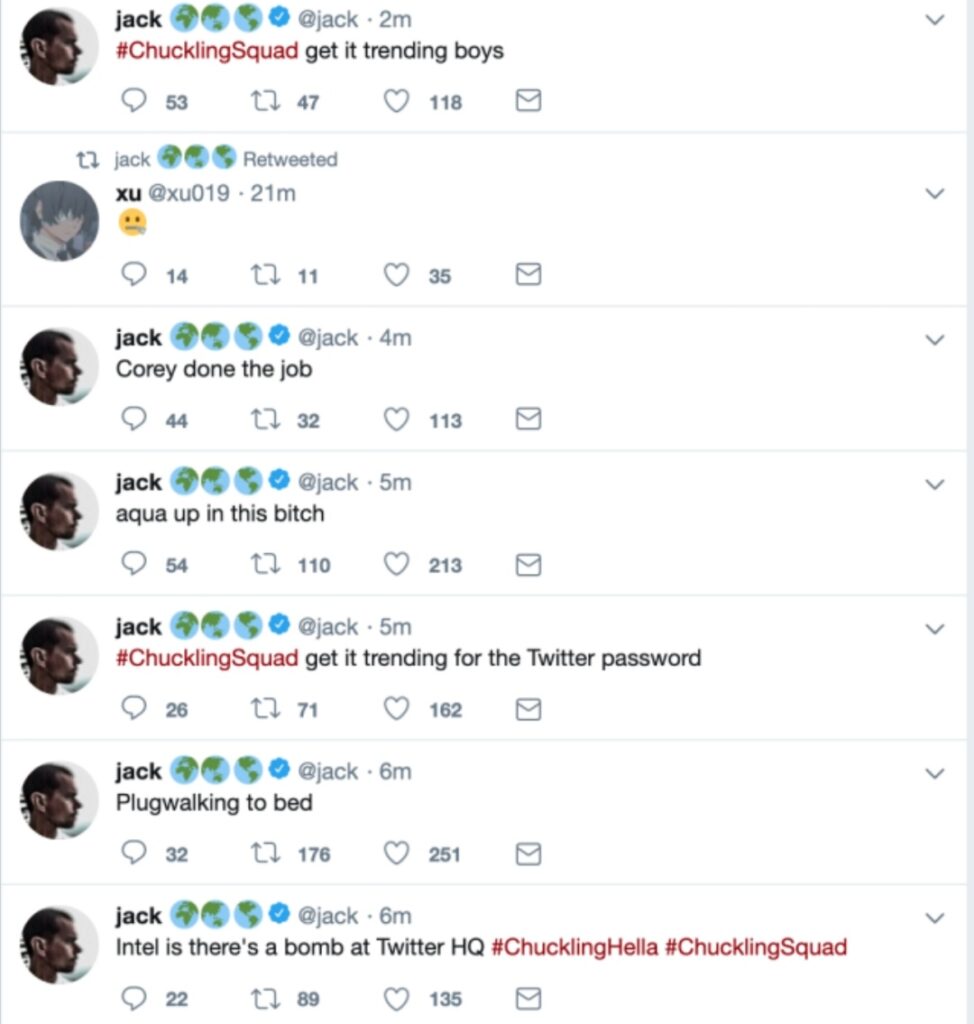
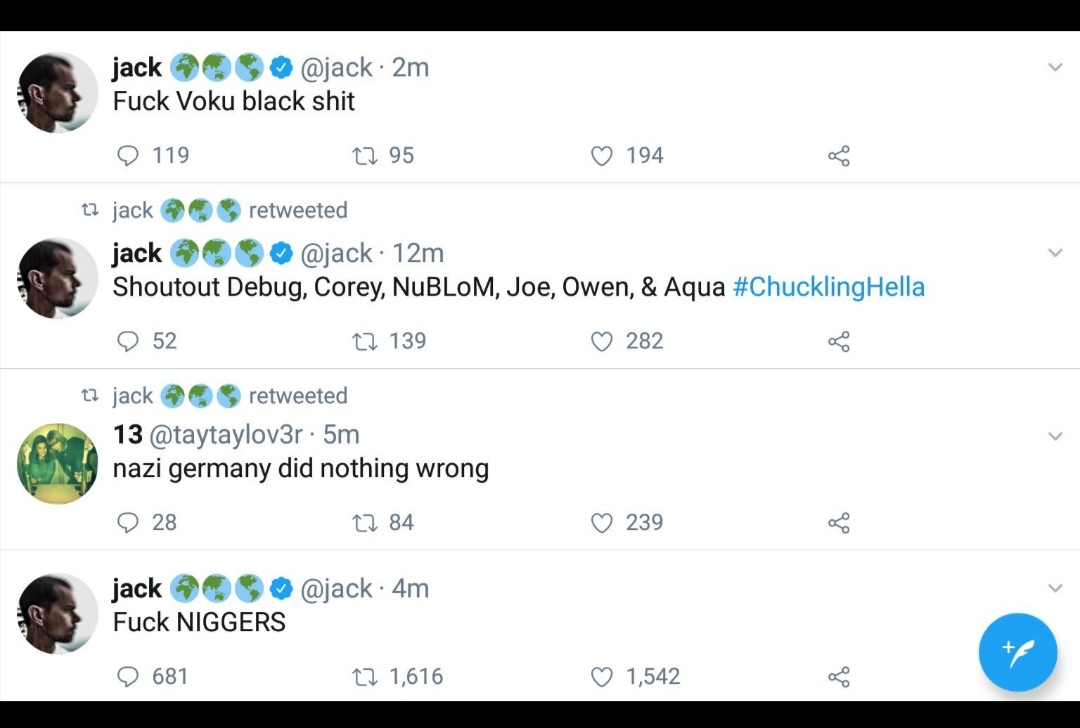
    Yesterday afternoon Twitter CEO Jack Dorsey’s Twitter account was hacked by a group that calls itself the Chuckle Squad.

    Chuckle Squad Used Jack’s account to tweet racial slurs, antisemitic messages and at least one catastrophic denial from Dorsey’s account.

    Some offensive tweets were up for about 10 minutes, though not long after the hack began, those tweets were already being deleted, and they’re all gone now. Here are some screenshots of those tweets

    Roughly an hour and a half after the hack, Twitter tweeted that the account is now secure, and there is no indication that Twitter’s systems have been compromised.

    https://twitter.com/TwitterComms/status/1167528672523210752?s=19

    Later, Twitter pointed the blame at Dorsey’s cell carrier, saying that the phone number associated with the account was compromised due to security oversight by the mobile provider, which apparently allowed the hackers to send the tweets using text messages.

    https://twitter.com/TwitterComms/status/1167591003143847936?s=19

    The phone number associated with the account was compromised due to a security oversight by the mobile provider. This allowed an unauthorized person to compose and send tweets via text message from the phone number. That issue is now resolved.

    Twitter however said that they have settled the issue and all other accounts are safe and were not affected .

    https://twitter.com/TwitterComms/status/1167548246618587137?s=19


    https://twitter.com/Hooray/status/1167525255600058371?s=19


    View image on TwitterView image on TwitterView image on Twitter
    Today’s hack appears to be from the same group that attacked a number of YouTube celebrities last week on Twitter, including Gay beauty vlogger James Charles, Shane Dawson, and comedian King Bach. The hackers also allegedly gained access to the late Desmond “Etika” Amofah’s Gmail account, as seen by screenshots collected in their Discord server.
  • Why iPhones Run Faster Than Android With Higher RAM

    Why iPhones Run Faster Than Android With Higher RAM

    In a world where Android users Rival IOS users for superiority one of the major points Android users tend to gloat about is the amount of RAM their devices carry. Samsung’s flagship smartphone the Samsung S10 plus offers about 8GB of RAM while Apple’s iPhone XS Max offers 4GB of RAM. To give you an idea of how excessive 8GB of RAM is most modern laptops don’t even come with that much.

    So why do iPhones get less amount of RAM and still perform the same (if not better) than Android phones with more amounts of RAM? it all has to do with the fundamental difference in the way iOS and Android handle apps. According to Glyn Williams over on Quora, iOS devices run better than Android devices with twice the RAM because Android apps use Java, and need all the extra RAM to do garbage collection.

    Java

    From the very beginning, Android was designed to support many different processor types, many different manufacturers, and many different hardware configurations. Normally, software written for one kind of system can’t just run on another; it has to be “ported” over, which often involves rewriting the incompatible bits.

    To get around this, Android apps have always run on the Java platform. Java is nifty because of its virtual machine: you can write an app once in Java, and then the virtual machine “translates” that code at runtime to work on whatever system it’s on instead of rewriting and recompiling the code yourself. The Java virtual machine is complex and requires a lot of RAM, not just to manage the actual processes of the virtual machine itself, but also to hold the original Java code for whatever app is being executed

    Garbage Collection

    What’s garbage collection? It’s a process that triggers the recycling of memory once an Android app is done using it. Usually, this works pretty well on systems that have a lot of free RAM, but once you get a lot of different apps running, things start getting dicey. A large part of Android (and Android apps) are generally written in Java because it is the official language for Android development. Due to how Java is configured, memory released by apps that are not in use anymore has to be recycled back to the device via the garbage collection process. Unused memory (garbage) has to be cleaned and recycled to the system so it can be used by other apps. Garbage collection is super effective for the smooth running of Android device but the problem is that the process itself needs sufficient amount of RAM.

    According to Williams, Android’s garbage collectors work best when Android apps have 4 to 8 times as much memory as is actually needed in order to perform the garbage collection process. Once you stop having that amount of free memory available, performance starts suffering.

    IOS

    Apple exerts a lot more control over the entire iOS ecosystem. If you want to use iOS, then you only have one option for a phone: the iPhone. Apps for the Apple store are created using Apple’s tools only because Apple knows the exact specifications of every single device that will ever run its operating system, thus can make design decisions accordingly. additionally all IOS apps are compiled to native code, and that code is executed directly on the hardware. No need for a virtual machine means significantly less RAM used overall.

    IOS therefore needs less RAM to run more smoothly than Android does since it was designed to avoid garbage collection from scratch therefore only needing the memory it’s using. What a radical idea, huh?

    Source – Quora

  • Google Has Warned that Kenya Risks International Trade Wars With Digital Tax Proposal

    Google Has Warned that Kenya Risks International Trade Wars With Digital Tax Proposal

    American technology giant Google has warned that Kenya will risk trade wars with other countries should it impose the proposed tax on digital transactions.

    Google East Africa Public Policy and Government Relations Lead Michael Murungi said yesterday the proposal defies international tax policies whereby such companies pay the bulk of their corporate taxes in the countries where the product and services are created rather than consumed. “The risk with this is as we see happening in France after its decision to impose a unilateral tax on international firms on digital platforms ,” he said.

    France began to tax big multinational tech companies, defying US President Donald Trump’s suggestion that he might impose tariffs on  imported French wine.

    “France is now in the midst of a trade dispute with the US Treasury because of that tax which was seen as targeting Google and other multinational firms based in the US,” he told the House Finance committee.

    He spoke in Nairobi when he presented the firm’s memorandum on the Finance Bill, 2019 to the National Assembly’s Departmental Committee on Finance and National Planning. “If we pass this law as it is proposed, it will mean that we will be asked to pay a rate of tax that is equivalent to the current income tax rate which is at 33 per cent. If every country does that, we are going to have a run to the bottom,” said Murungi.

    Executive Director Content Development and Intellectual Property Trust Alex Gakuru said that the tax would criminalize the use of the Internet and erode gains made in the country.

    “There is no universal consensus on what is a digital marketplace. Now here we are passing an Act creating VAT and also income tax on a digital marketplace,” said Gakuru

    The Government had proposed a law through the Finance Bill 2019 that will see online business slapped with an income tax. The ICT ministry said it was the final stages of developing a framework that would be used to tax the foreign services. The proposed policy framework would ensure that foreign advertisements that air in the Kenyan market were subjected to taxation

  • What You Need To Know About The Upcoming iPhone Pro

    What You Need To Know About The Upcoming iPhone Pro

    According to a Bloomberg Report Apple is planning to release a bevy of new products including three new iPhone models in September. Apple Inc. plans to unveil three new iPhones next month, including two new “Pro” models and a successor to the iPhone XR, The “Pro” models are meant to replace the iPhone XS and iPhone XS Max.

    Over the last few months rumors and concept renders of the upcoming iPhone 11 have floated the internet with no real confirmation from Apple, however according to new reports here’s some details on what to expect in the the so-called iPhone Pro.

    The first thing that will stand out on the new Pro iPhones will be a new camera system on the back with a third sensor for capturing ultra-wide-angle photos and videos which is a first for Apple. The new triple-lens sensors will reportedly capture three images simultaneously and use new artificial intelligence software to automatically correct the combined photo.


    A render of the alleged triple-lens design

    iPhones are widely known for their dependable cameras with most digital creators making short skits using the phones camera from vine days. well, the new Pro will have significantly upgraded video recording capabilities, getting them closer to professional video cameras. Apple has developed a feature that allow users to retouch, apply effects, alter colors, re-frame and crop video as it is being recorded live on the device.

    Earlier this year Samsung Electronics Co. rolled out Wireless PowerShare for its Galaxy handsets. Basically, this means the newest galaxy handsets can charge up almost any other smartphone or other devices that support the Qi wireless charging standard. Apple seem to have jumped on the bandwagon and according to the report a reverse wireless charging system that users can power-up their latest AirPods in the optional wireless-charging case by leaving it on the back of the new Pro phones is in the works.

    All the new models are expected to include a new multi-angle Face ID sensor, enabling users to unlock their device even if it’s laying flat on a table.Apple is said to be bringing faster A13 processors to each of the three iPhones, which is likely to power improved computer vision and augmented reality capabilities.

    Apple has dramatically enhanced water resistance for the new models, which could allow them to be submerged under water far longer than the current iPhones.

    The new models will  also have new OLED displays that lack the pressure-sensitive 3D Touch technology. Apple is replacing this with Haptic Touch, which essentially mirrors 3D Touch’s functionality with a long press, as it did with the iPhone XR last year.

    Unfortunately the new Pro iPhones will still not be able to support the fifth generation cellular network technology 5G. Outside of a new matte-colored finish, the Pro phones will also look broadly similar to last year’s models.

    Aside from iPhones, the company is also likely to release refreshed iPads and MacBook Pros in the fall. It’s also working on updated versions of AirPods and the HomePod smart speaker.

    We still don’t know when Apple will officially announce its new iPhones, but a detail-laden report like this is a good sign that won’t be too far off.

  • Uber Prices To Go Up

    Uber Prices To Go Up

    Starting on Monday, regular Uber users will see a significant hike in fares the company has revealed, citing high operating costs. The fare will go up by an average of about 26 percent for the UberX taxis and 13 percent for ChapChap users which is Uber’s version of a budget option. This is a major win for the drivers who have been pushing for the fare increase.

    The digital taxi operators came to the decision to increase fares after the drivers complained they were barely making profits with increased fuel and vehicle maintenance costs. In a notice to its partners, Uber said it will increase ChapChap and UberX rates in the latest price review that will see driver earnings rise significantly. “From Monday, 26 August 2019, Uber will be introducing changes to Uber ChapChap and UberX. These changes have been informed by your continued feedback and many months of thorough reviews on the growth and sustainability of your earnings opportunity,” said Uber in a notice sent to drivers and partners on Tuesday.

    Riders requesting UberX will pay Sh 11 more per kilometer to Sh 38 and a shilling extra per minute charge, with those requesting the ChapChap option paying Sh 22, which is Sh 4 higher per kilometer and an addition Sh 8 extra per kilometre after the trip exceeds 11 kilometers.

    The fare hike by Uber comes just weeks after its biggest rival, Bolt (Formerly Taxify), removed the budget fares option known as Bolt Go, effectively raising charges for its users.

  • This Is How To Ensure Your Phone Battery Lasts Longer

    This Is How To Ensure Your Phone Battery Lasts Longer

    The battery life on a smartphone is key to heavy users when buying a new gadget, however, as batteries age, they gradually lose their ability to hold charge. There are a few ways you can get more onscreen time by minimizing battery drainage, I compiled a list of some of them down below.

    Using your phone’s battery saver

    The first one which is a pretty basic one is to make use of the battery saver which is already provided on the phone.  It is an easy-to-use feature that restricts your phone’s capabilities in order to extract the most possible battery life.

    On iPhone, it’s called low power mode.

    Decreasing the brightness

    It’s no secret that dimming the display on your smartphone is going to prolong the battery life. If you’re a power user, lowering the brightness setting can get you a good two hours of extra battery life

    Dark mode

    Google recently confirmed that dark mode saves you power on android, same as on Ios night mode apps can prolong battery life on smartphones with OLED screens. This is because the individual pixels have to do less work on dark areas of the screen, and they use practically no juice at all when displaying true black. Most apps have dark mode options, you might want to consider turning them on.

    Updating your phones software

    Keeping your phones software upto date may seem like a lot of work, In a few cases people have accused updates of slowing down their smartphones. Updates have a lot of advantages with one of them being getting the most battery life possible.  You can see if you need to update your phone by navigating to the Settings – system -system updates depending on your smartphone.

    Limit background battery use

    The more apps there are on your phone, the more power your phone uses to keep them running in the background. In most smartphones you should have a page dedicated to battery usage, typically found by navigating to the battery section of your Settings app. Many apps run and refresh in the background while you’re using different software. You can choose to allow specific apps to do this, set it so all apps can do this, or prevent specific apps from doing this. If a particular app is using a lot of battery life, you could also choose to uninstall it completely.

    If you’re desperate to save your phone’s battery life, turn on airplane mode, then manually re-activate Wi-Fi and connect to a wireless network. In general, connecting to the internet over Wi-Fi uses less battery power than with cellular networks

    In some cases, too much ofnotifications from apps like WhatsApp can drain your battery life. If you have a very active group chat, for example, or if you subscribe to a lot of feeds, then you should consider turning off the sound and vibration for these apps.

    Turn your location services off

    Some apps like Google Maps require you to turn on location services to display your surroundings and give you directions. But location services chip away at your battery life very quickly and you should turn it on only for as long as you need to.

  • Video: Google Rolls Out Google Go On Android

    Video: Google Rolls Out Google Go On Android

    World’s leading tech giant Google has launched its Google Go services to all Android users worldwide. The service was only being offered to Android Go users in select countries.

    Google calls it lightweight and at just a little more than 7MB, it truly is a tiny little helper.

    Google Go was first released in 2017, is essentially a compact, but powered-up, search engine. It was Initially designed for people less familiar with navigating the internet, its small size and stripped-back features are useful for phones with less storage and data or for people living in areas with a dodgy internet connection. According to Google, the app will save up to 40 percent of device data.

    It also has all the features of the Google Lens, with real-time translating, voice-activated searching as well as making Google read the text out loud.
    https://www.youtube.com/watch?v=F2brcDqKTHI&t=4s

    Google Go was initially being marketed only in countries with spotty connection but Google has now released it worldwide. Considering how inconsistent the internet can even be in Australia, we’re here for it.

    “We know that people everywhere can sometimes struggle with spotty connections, phone storage, and reading or translating text,” Google’s blog read.

    Google Go: A lighter, faster way to search https://youtu.be/zJrswiLvGc4 via @YouTube