Category: Sci & Tech

  • Facebook To Replace News Algorithms With Professional Journalists

    Facebook To Replace News Algorithms With Professional Journalists

    Facebook Inc will now rely on professional journalists that the company plans to hire instead of relying solely on algorithms to deliver trending news n what the company terms as a positive step to shake up the media industry.

    On Tuesday, the social media giant said that it would build a small team of journalists to select the top national news of the day to ensure they’re highlighting the right stories.

    According to Facebook, stories will appear in a section called the “news tab,” which the media giant has separated from the traditional news feed that displays updates and content from users’ friends and relatives.

    “In theory, I see this as a really positive development. It is something quite promising,” Danna Young, a communications professor at the University of Delaware, told media.

    Facebook’s journalists will be curating stories from news sites and won’t be editing headlines or writing content, the California-based company has less to change according to experts even though Facebook has consistently said it does not want to be considered a media organization that makes major editorial decisions.


    “It’s not transformative because it’s not going to change necessarily the behavior of individuals who are referencing stories on their feeds. That’s where the power comes from  individuals you know and trust putting their tacit stamp of approval on stories by sharing them,” Danna Young said

    News Tab will be Facebook’s first news feature using human moderators since it shut down its hapless  “trending topics” section last year after they were accused of suppressing stories about conservative issues.

    Facebook, however, says that the Articles that have not been deemed as top news stories will still be collated using algorithms based on the user’s history, such as pages they follow, publications they subscribe to and news they have already interacted with.

    “Our goal with the news tab is to provide a personalized, highly relevant experience for people,” Facebook head of news partnerships Campbell Brown told media.

    The comes at a time when Facebook has embarked on a series of initiatives to boost journalism, with traditional media organizations accusing it of benefitting financially from their hard work.

    Internet platforms are dominating the internet advertising space making it difficult for established news organizations to transition what were very profitable print advertisements online. Facebook announced in January that it will invest $300 million over three years to support journalism, particularly local news organizations.

    It has also funded fact-checking projects around the world, including Africa Check that has incorporated Kiswahili and other 13 African languages in a move to curb the spread of fake news.

    According to Facebook insiders, the company will pay some publishers to license news content for the tab but Mathew Ingram, who writes about digital media for the Columbia Journalism Review, doesn’t expect that to trickle down to hard-up organizations that need it the most.

    “The companies they are going to choose are ones already doing well I assume. It might give them a little extra cash but I don’t see it driving a huge amount of traffic,” Mathew Ingram said

    Print journalism in the US is in free-fall as social media overtakes newspapers as the main news source for Americans.

    “The death of local news has such destructive effects for democrac.sty. It’s a complex issue that Facebook alone cannot fix,” said Young.

    “Facebook is not a journalism company and so before working for Facebook I would want to see their commitment to ethical, robust journalism,” Said the 30-year-old Stephen Groves, who recently earned a master’s in journalism at New York University

    When Buzzfeed cut 200 jobs in January, 29-year-old Emily Tamkin was let go from a position she had held for just a few months.

    “I’m personally not cheered by the fact that Facebook is swooping in and hiring journalists. If that’s the silver lining then we have a very big cloud here,” Ms. Tamkin said

  • Tala Gets Sh11Bn More

    Tala Gets Sh11Bn More

    Leading mobile lending company Tala on Wednesday announced a Sh11 billion investment to support the company launch a bunch of new products and grow its operations across the world.

    The five-year-old startup is being financed by RPS Ventures, with GGV Capital and previous investors IVP, Revolution Growth, Lowercase Capital, Data Collective VC, ThomVest Ventures and PayPal Ventures also participating in a new financing round.

    Tala general manger in East Africa Ivan Mbowa said the new round of funding will enable online micro-lender to reach more customers.

    Tala approves loans within minutes and disburses the money to customers via mobile payment platforms. The startup has lent over $1 billion to more than 4 million customers to date up from $300 million to 1.3 million customers the previous year claims Shivani Siroya the founder of the app.

    This means the company can offer more loans than ever to Kenyans while charging 5-15% interest and fees in a startup meant to deliver financial access, choice and control to undeserved people. The company also forwards negative credit history and rankings to the local credit bureaus when the loan is defaulted.

    The company boasts over 2.5 million customers in Kenya. “Kenya is at the heart of Tala’s operations around the world. Kenya was our first home, and today it remains our largest office and customer base. We are thankful every day for the loyalty and trust of our Kenyan customers,” Mr Mbowa said.

    Just recently a study conducted by The Financial Sector Deepening (FSD) survey, which has the backing of the Central Bank of Kenya (CBK) shows that about 20% of Kenyans are loan defaulters. One in every five Kenyans has a loan which they have not paid, the study concluded. The most affected being unemployed and low income employed youths, farmers and the elderly.

    With the added Funds mobile-based digital lender Tala which has gained wide popularity in recent years and advanced billions of shillings to the private borrowers, the household debt burden will only skyrocket.

    The study also revealed about 6.5 million Kenyans are digital borrowers with 31 percent taking the cash to try their luck in sports betting and gambling.


  • Apple TV+ Streaming Services To Be Launched In November

    Apple TV+ Streaming Services To Be Launched In November

    Earlier in March this year, Apple announced its plans to launch a streaming service called Apple TV+. And, according to a report by Bloomberg, the streaming services will be launch in November and will have a monthly fee of $9.99.

    According to the report, Apple will also roll out a one-month free trial. Initially, Apple had announced 14 shows during the Apple TV+ unveil; it will launch some of them on day one, and add more shows from that roster later.

    A report published by US-based media stated that World tech giant Apple company has already spent over $6 billion to produce its original shows.

    Here’s a fresh new trailer for one of Apple‘s upcoming shows, ‘The Morning Show,’ a drama series starring Jennifer Aniston, Reese Witherspoon, and Steve Carrell:

    https://youtu.be/eA7D4_qU9jo

    Apple‘s innovations come, rather always get rolled out at a higher if you compare it to the base plan of its competitors. Take, for instance,  Amazon Prime Video offers its streaming for $8.99 per month if you pay for an annual subscription, while Netflix’s basic standard definition plan starts at $9 per month.

    Dinsey’s upcoming service will launch at $6.99 per month, and if you pay $13 per month, it’ll throw in ESPN+ and Hulu subscriptions too. The streaming market is heating up, and Apple will have to invest heavily in original content and licensing to lure viewers away from its competition. Another thing the company could do is bundle all its online services and serve them up for cheap to keep customers locked in – Apple Music, iCloud, and Apple TV+, the upcoming Apple Arcade, and Apple News+. Apple Prime anyone?

  • Safaricom Rolls Out VoLTE

    Safaricom Rolls Out VoLTE

    You can now send and receive voice calls on Safaricoms VoLTE service. This enables calls to be made over 4G networks as opposed to normal calls which use the popular 3G network.

    VoLTE is a HD voice calling Service over 4G LTE rather than 2G/3G network present used. By using VoLTE users can make calls more faster than 2G/3G connections. It has an added advantages of Security and Quality of services.

    So what are the benefits of VoLTE?

    1. High-definition voice
    2. Rich Communications Services or RCS- RCS services include things like video calling, file transferring, real time language translation, video voicemail and instant messaging without third party apps. VoLTE is that it lets you launch these services directly from the phone’s native dialer.
    3. Enjoy Multitasking.-Having the flexibility of calling while browsing simultaneously

    Safaricom had announced the Voice over LTE service in early July 2019 but went silent, however, it seems the telco experienced a few huddles before rolling out the sevice to the public.

    Quietly Safaricom seems to have rolled out the service for users with LTE enabled sim cards. However there is a catch, the service doesn’t work on all smartphones. Below are a list of the Smartphones that support VoLTE.

    The supported Samsung devices are: A2 Core, A10, A20, A30, A50, A70, A80, S10/S10+, S10e, Note10, Note10+, Note9, S9/S9+, Note8, S7, S7 Edge, A9 (2018), A7 (2018), A8+, A6+, J8, J6+, J6, J4+, J4

    Huawei devices include : P30 Pro, P30, P30 Lite, P20 Pro, P20, P20 Lite, Mate 20 Pro, Mate 20, Mate 10 Pro, Mate 10, Y5 Lite, Y5 (2019), Y6 (2019), Y7(2019), Y9 (2019), Y9 Prime (2019)

    HMD Global devices are the Nokia: 1, 1 Plus, 2.1, 3.1, 3.1 Plus, 3.2, 4.1, 4.1 Plus, 4.2, 5, 5.1, 5.1 Plus, 6, 6.1, 6.1 Plus, 7 Plus, 7.1, 8, 8.1, 9 Pureview

    The Tecno camon 11 and Phantom 9, iTel A32 and the infinix S4 can also make calls over VoLTE

    If your device is on the list, then you can proceed to activate VoLTE on your SIM card using the simple steps below:

    1. First Enable VoLTE option from your phone’s settings: Network & Internet – Mobile Network – Activate Enhanced 4G LTE Mode (or VoLTE depending on your phone)
    2. Then Dial *100*12#
    3. Select option 3 then Enable VoLTE for your SIM card
    4. You will receive a pop-up notification that VoLTE has been enabled for your SIM

    The VoLTE icon should now appear on your status bar next to your network icon

    VoLTE calls DO NOT use a data connection to make calls. They are billed with the normal tariffs as 3G calls. It also only works in areas with Safaricom 4G network.

    Visit https://www.safaricom.co.ke/volte/ for more info

  • Tech Vulnerability: Hackers Now Able To Spy On Private Conversation Via Bluetooth Connections

    Tech Vulnerability: Hackers Now Able To Spy On Private Conversation Via Bluetooth Connections

    Everyone with a smartphone rather a device that is Bluetooth enabled has or is using the software as the most convenient mode of connecting and controlling devices at a range or some sharing files and documents.

    However, according to a recent tech report, a vulnerability known as the KNOB (Key Negotiation of Bluetooth) attack has been found in Bluetooth connections by coders.

    According to the tech experts and coders report, all the Bluetooth compliant devices can be affected by the vulnerability, which allows attackers to spy on a victim’s personal conversations.  In the newfound glitch, hackers can easily exploit the vulnerability and manipulate the data present on the compromised device.

    “While establishing a functional Bluetooth connection, both the devices rely upon an encryption key. Therefore,
    in order to execute the attack, hackers exploit the vulnerability in the Bluetooth standard and weaken this encryption of Bluetooth devices instead of breaking it straightaway.” reads part of the report.

    The attacker gets in the way while the devices are setting up the encryption key and resorts to brute force attack for breaking the new key with less number of digits and manipulates both the devices to employ the new encryption key.

    A Report by Mashable states that the vulnerability affects almost all the devices namely, Apple, Qualcomm, and Intel. However, giant companies like Apple, Microsoft, Cisco, Google, Blackberry, Broadcom and Chicony have already issued a patch to fix the glitch.

    “We found and exploited a severe vulnerability in the Bluetooth specification that allows an attacker to break the security mechanisms of Bluetooth for any standard-compliant device. As a result, an attacker is able to listen, or change the content of, nearby Bluetooth communication, even between devices that have previously been successfully paired.” The group of researchers from the Singapore University of Technology and Design, University of Oxford, and CISPA Helmholtz Center for Information Security, who found this vulnerability said 

  • Video: Whistle-Blower Exposes Google’s Political Inequity And US Election Manipulation

    Video: Whistle-Blower Exposes Google’s Political Inequity And US Election Manipulation

    An investigative Journalism group Project Veritas has posted hoards of more than 950 documents from Google insider  Zachary Vorhies, who has gone public with allegations of election manipulation and political bias against the Tech giant.

    According to Project Veritas, whistleblower Zachary Vorhies stated that he has come forward because he saw something ill-lit and iniquitous going on with google after he realized that they were going to not only tamper with the US elections but use that tampering with the elections to essentially overthrow the United States.

    Video courtesy of Project Veritas

    Vorhies told Project Veritas that:

    “I gave the documents to Project Veritas, I had been collecting the documents for over a year. And the reason why I collected these documents was that I saw something dark and nefarious going on with the company and I realized that there were going to not only tamper with the elections but use that tampering with the elections to essentially overthrow the United States.”

    According to Project Veritas, which in June this year, had leaked a number of internal Google documents exposing Google’s algorithmic unfairness in search rankings, now Vorhies is claiming that the documents he shared were widely available to Google employees

    “These documents were available to every single employee within the company that was full-time. And so as a fulltime employee at the company, I just searched for some keywords and these documents started to pop up. And so once I started finding one document and started finding keywords for other documents and I would enter that in and continue this cycle until I had a treasure trove and archive of documents that clearly spelled out the system, what they’re attempting to do in very clear language.”

    In the documents provided by Vorhies to project Veritas, they contain a number of files of concern for conservatives, one of which is called ‘news blacklist site for Google Now’ which Vorhies alleges that is a shadowban that restricts News feeds from some websites on Android Google products.

    According to the whistleblower, the list includes a number of both conservative and leftist websites including newsbusters.org and mediamatters.org who were added to the list because of a high user block rate.

    Another document titled  ‘Fringe ranking/classifier: Defining channel quality’ compiled a ranking of various news sites by Google’s level of trustworthiness.

    In yet another document titled ‘Fake news & other fringes: Trashy recap’ stated that videos on Google’s platforms are rated by multiple human raters. Another internal document labeled “coffee beans”  shows alleged Google employees discussing diversity hiring practices at the firm.

    Another internal discussion thread appears to show Google employees discussing how best to change the translation of President Trump’s infamous “covfefe” tweet.

    According to Project Veritas, Vorhies told them that he hopes more Google workers come forward to discuss the practices of big tech firms.

    “My message to those that are on the fence is I released the documents. They can go in, they can see everything that Google is doing and then they can see the scale of it. Because I think that there’s a lot of engineers that have a hint that things are wrong, but they don’t understand the colossal scale that it’s at. And so for those people, I say, look at the documents, take the pulse of America, see what’s happening and come and tell the world you know what you already know to be true.”

    View the full leaked documents at Project Veritas here.

  • How Porn Sites Are Spying And Selling Your Private Data

    How Porn Sites Are Spying And Selling Your Private Data

    Porn sites have joined other known data-mining companies and new research has revealed that 93% of 22,484 adult websites that were analyzed were leaking users data to online advertisers and web analytics providers.

    According to the research, the list of companies that sell users data, browsing habits and sexual preferences includes Google, Oracle, Facebook, Cloudflare, and advertisers who are only active in the adult industry.

    The research team selected the sites they used for their analysis by scanning the Alexa Top 1 Million list for sites that used the term “porn” in their title or metadata. They identified 22,484 websites, and then analyzed their source code, and looked for the presence of a privacy policy. Inside privacy policies, researchers looked for wording that may indicate if the website is sharing user data with third parties, confirming their source code scans.

    “We successfully extracted privacy policies for 3,856 sites, 17% of the total,” said the research team, consisting of Elena Maris from Microsoft, Timothy Libert from Carnegie Melon University, and Jennifer Henrichsen from the University of Pennsylvania.

    “Policies have an average word count of 1,750 and take seven minutes to read. The policies were written such that one might need a two-year college education to understand them.” The researchers said.

    According to the researchers, only 11% of third-parties that were seen tracking users on an adult web page were also listed in a site’s privacy policy, indicating that a lot of users are being tracked and their data stored without disclosure to users.

    In a nutshell, some porn sites, which are less than 2%, set up a privacy policy but majority of the porn streaming sites deployed various trackers in the site’s source code and used tech that was silently collecting data about users’ behavior.

    Per the research team, Google-related scripts were found on 74% of the 22,484 adult sites, followed by exoClick (40%), Oracle (24%), JuicyAds (11%), and Facebook (10%).porn-top-10-trackers.png

    “Our results indicate tracking is endemic on pornography websites. 93% of pages leak user data to a third-party; the pages that leak data do so to an average of seven domains; 79% have a third-party cookie (often used for tracking); of the pages with cookies, there is an average of nine cookies; and only 17% of sites are encrypted, allowing network adversaries to potentially intercept login and password details.” The research said.

    according to further details of the research seen by Kenya Insights, There were way over 230 companies that were data mining porn sites users private information and behaviors with a few known big players who aggregated most of the data.

    “Thee majority of non-pornography companies in the top ten are based in the U.S., while the majority of pornography-specific companies are based in Europe. One reason may be differing cultural and commercial norms towards sexual content. In the U.S., many advertising and video hosting platforms forbid ‘adult’ content. Thus, Google refuses to host porn, but has no limits on observing the porn consumption of users, often without their knowledge,” researchers said.

    But according to researchers, recording the URL of a page a user accessed on adult sites is normal tracking behavior for any analytics provider, but the structure of which, some adult sites’ URLs would reveal the nature of the material the user was viewing caused problems.

    Porn sites have set users private date open such that any third-party observer analyzing these URLs would learn the sexual preferences or viewing habits that users would most likely want to be kept private, and not associated with advertising profiles. Researchers said that almost 45% of adult sites used URL structures that exposed users’ sexual preferences.

    I don’t think that porn users data will be safe even if they invest into an ad blocker or any similar technology that ensures the user’s privacy while navigating the web, especially if they want to keep their porn viewing habits private. If the sites still fetch your data in incognito browsing mode then nothing will stop them from fishing and selling your data even if you leave your browser’s local history clean.

  • Facebook Adds Kiswahili To Its Fact Checking Programme To Curb Fake News

    Facebook Adds Kiswahili To Its Fact Checking Programme To Curb Fake News

    Kiswahili and other nine African languages have been added to Facebook’s third-party fact-checking after the company partnered with Africa Check and will include 10 African languages.

    Facebook uses the Third-Party-Fact-Checking program to help its algorithms assess the accuracy of news on the Facebook community and also, seek to reduce the spread of misinformation/fake news.

    Africa Check is an independent fact-checking organization that was launched in 2018 and they are collaborating with Facebook to add the following languages to Facebook’s 3rd-Party program:

    • Yoruba and Igbo, adding to Hausa which was already supported in Nigeria
    • Kiswahili in Kenya
    • Wolof in Senegal
    • AfrikaansZuluSetswanaSothoNorthern Sotho and Southern Ndebele in South Africa

    “We continue to make significant investments in our efforts to fight the spread of false news on our platform, whilst building supportive, safe, informed and inclusive communities. Our third-party fact-checking programme is just one of many ways we are doing this, and with the expansion of local language coverage, this will help in further improving the quality of information people see on Facebook. We know there is still more to do, and we’re committed to this.” Noko Makgato who is the Executive Director of Africa Check

    Facebook will be fact-checking alongside the verification of images and videos of all local articles. If any of Facebook’s partners in the program identifies a story as false, that story will feed will be censored and suppressed to significantly reduce its distribution.

    “We’re thrilled to be expanding the arsenal of the languages we cover in our work on Facebook’s third-party fact-checking programme. In countries as linguistically diverse as Nigeria, South Africa, Kenya, and Senegal, fact-checking in local languages is vital. Not only does it let us fact-check more content on Facebook, but it also means we’ll be reaching more people across Africa with verified, credible information.” Noko Makgato said. 

  • Facebook Is Working On Dark Mode For Android And Apple Operating Systems

    Facebook Is Working On Dark Mode For Android And Apple Operating Systems

    Dark mode fans and on this case, Facebookers will soon be able to use the App in the new and latest upgrades in there most preferred Dark mode in this era when dark mode wave is still rising.

    All, well, almost all of Google Apps just like Slack, Twitter, Reddit…have some form of dark mode either for its apps or web platforms. Facebook wants a piece of that dark mode pie too for its main app.

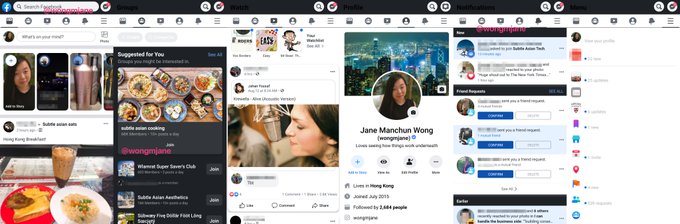
    Facebook had already worked on the dark mode version on its Messenger but are now testing dark mode for its Android app. This recent discovery was made by reverse engineering expert and reliable Facebook unreleased updates and upgrades leaker Jane Wong who tweeted that Facebook has begun working on this feature.

    Just like Microsoft, Facebook is preparing its apps for the system-wide dark mode that is set to come with the next Android and iOS versions that will be officially launched a few months to come.

    “Only the Groups tab is looking good for the demo at the moment” She said

    View image on Twitter
    screen shorts courtesy of Jane Wong
    But the feature is definitely going to be launched officially in a few days to come
  • Europe’s Data Regulator Raises Privacy Alarm Over Amazon’s Alexa AI Voice Recording Assistant

    Europe’s Data Regulator Raises Privacy Alarm Over Amazon’s Alexa AI Voice Recording Assistant

    Everyone wants to be safe, rather, do their things safely and most importantly, in the much-expected privacy without even a shred of interference from anyone and in this case, without exposing your private data, business, recordings or activities to third parties and data miners or even worse, cybercriminals.

    Amazon’s lead data regulator in Europe, Luxembourg’s National Commission for Data Protection, has raised privacy concerns about its use of manual human reviews of Alexa AI voice assistant recordings.

    According to sources speaking to media, LNCDP stated that they won’t rather cannot comment further about this case as they are bound by the obligation of professional secrecy.

    Amazon’s Alexa voice AI, which is embedded in a wide array of hardware — from the company’s own brand Echo  smart speaker line to an assortment of third party devices (such as this talkative refrigerator or this oddball table lamp) — listens pervasively for a trigger word which activates a recording function, enabling it to stream audio data to the cloud for processing and storage.

    However, trigger-word activated voice AIs have been shown to be prone to accidental activation. While a device may be being used in a multi-person household. So there’s always a risk of these devices recording any audio in their vicinity, not just intentional voice queries.

    In a nutshell, the AIs’ inability to distinguish between intentional interactions and stuff they overhear means they are natively prone to eavesdropping — hence the major privacy concerns. These concerns have been dialed up by recent revelations that tech giants — including Amazon, Apple, and Google  — use human workers to manually review a proportion of audio snippets captured by their voice AIs, typically for quality purposes. Such as to try to improve the performance of voice recognition across different accents or environments. But that means actual humans are listening to what might be highly sensitive personal data.

    Earlier this week Amazon quietly added an option to the settings of the Alexa smartphone app to allow users to opt-out of their audio snippets being added to a pool that may be manually reviewed by people doing quality control work for Amazon — having not previously informed Alexa users of its human review program. The policy shift followed rising attention on the privacy of voice AI users —, especially in Europe.

    Last month thousands of recordings of users of Google’s AI assistant were leaked to the Belgian media which was able to identify some of the people in the clips.

    A data protection watchdog in Germany subsequently ordered Google to halt manual reviews of audio snippets. Google responded by suspending human reviews across Europe. While its lead data watchdog in Europe, the Irish DPC, told us the media that they are examining the issue.

    Apple recently, also,  suspended human reviews of Siri snippets — doing so globally, in its case — after a contractor raised privacy concerns in the UK press over what Apple contractors are privy to when reviewing Siri audio.

    The Hamburg data protection agency which intervened to halt human reviews of Google Assistant snippets urged its fellow EU privacy watchdogs to prioritize checks on other providers of language assistance systems and implement appropriate measures naming both Apple and Amazon.

    In the case of Amazon, scrutiny from European watchdogs looks to be fast dialling up. At the time of writing it is the only one of the three tech giants not to have suspended human reviews of voice AI snippets, either regionally or globally.

    In their response to changes made, Amazon said this in a statement sent to the media;

    We take customer privacy seriously and continuously review our practices and procedures. For Alexa, we already offer customers the ability to opt-out of having their voice recordings used to help develop new Alexa features. The voice recordings from customers who use this opt-out are also excluded from our supervised learning workflows that involve manual review of an extremely small sample of Alexa requests. We’ll also be updating information we provide to customers to make our practices more clear.

    Everyone should worry about their privacy and more importantly their data, as the great scholar once said, “a cheap fish is always caught carelessly” Don’t be caught up

  • Apple Will Pay You $1 Million If You Can Hack An iPhone

    Apple Will Pay You $1 Million If You Can Hack An iPhone

    Branded the most secure smartphone on the market. Apples iPhones that run iOS are almost impossible to hack. Apple actually believes they are more safe and secure than ever and have therefore massively increased the amount it’s offering hackers for finding vulnerabilities on the OS upto $1 million.

    They previously only offered $200,000 and only to selected invite-only company bug bounty program that was launched in 2016. The new program is however open to all researchers.

    Reported by Forbes.com, the full $1 million will go to researchers who can find a hack of the kernel—the core of iOS—with zero clicks required by the iPhone owner. Another $500,000 will be given to those who can find a “network attack requiring no user interaction.” There’s also a 50% bonus for hackers who can find weaknesses in software before it’s released.

    Apple could be increasing those rewards in the face of an increasingly profitable private market where hackers sell the same information to governments for vast sums or to catch up with the demands of the market like Zerodium who offer upto $2m to a person who can do the same.

    Users took to social media and forums after the information was released to voice their opinions. “Is not Apple’s move mostly a PR stunt? Standard people will read “The iPhone is so secure that Apple is willing to pays $1M for somebody that find a security vulnerability.” one user remarked.

    So do you think you are up-to the task to take on Apples offer and gain full control of an iPhone remotely, without the user touching anything?

  • Huawei Unveils It’s Own OS HarmonyOS To Compete Android After Trump’s Ban

    Huawei Unveils It’s Own OS HarmonyOS To Compete Android After Trump’s Ban

    Huawei has finally officially announced HarmonyOS. The operating system it was rumored to be developing to replace its reliance on Android. In China the software will be known as HongmengOS.

    In the city of Dongguan, China early Friday, August 9, 2019, Huawei finally took the wraps off its long-rumored, first-party operating system. The OS, called Harmony OS, has been in development for several years

    The company says the operating system can be used in everything from smartphones to smart speakers and internet-of-things devices like sensors.

    Harmony OS is microkernel-based, like Google’s in-development Fuchsia OS. Huawei says this allows for flexible deployment on various devices, improving security in all scenarios. Developers will be able to use Huawei’s ARK Compiler to compile code from multiple languages like C/C++, Java, and Kotlin for Harmony OS. Huawei will be providing an SDK to support app development across multiple device types, including televisions, car kits, smartphones, smartwatches, and more. Harmony OS will not allow for root access, which Huawei says is a security risk on Android and other Linux-based operating systems. Huawei boasts an EAL 5+ certification level for the new OS. Finally, Huawei will be open-sourcing Harmony OS in the future.

    The software is primarily aimed at IoT products (such as smart displays, wearables, smart speakers and cars) instead of smartphones,

    The Chinese tech giant said the OS will be open-sourced with its own ARK compiler. It will also support existing Android apps

    Yu stated that when Huawei can no longer access Google’s Android ecosystem, it can deploy Harmony OS “at any time.” Until then, Huawei will continue to support Android.

    Earlier this week, Chinese media reported the company is set to release a phone based on HarmonyOS by the end of this year

    This comes after the chinese tech giant was denied business In the US, in May, Google banned Huawei from using Android, following the latter’s inclusion in the US entity list. Later, Huawei accelerated its efforts to develop this OS as an alternative to Android.

  • Safaricom Holds Sh3.38B In Unclaimed Bonga Points

    Safaricom Holds Sh3.38B In Unclaimed Bonga Points

    For the first time since 2016 Kenya’s largest Telecommunication provider Safaricom has revealed they now hold sh3.85 billion in unredeemed bonga points.

    The loyalty awards which accumulate as tied-up revenue for the telco has dropped in March 2019 pointing to increased redeeming by customers.

    The loyalty rewards scheme was introduced in 2017, customers accumulate points then redeem them once the points reach a constant amount specified for different products.

    Just like airtime purchased by the customers, the points are accounted for as deferred income in the telecommunications books until the customer uses (redeems) them for airtime, sms or other merchandise

    The unclaimed loyalty awards had risen up-to sh4 billion by March 2018. The points are accumulated by buying airtime with a customer earning one point for every Sh10 used.

    The telco has stated the drop comes after they decided to extend redemption options to other products by partnering with other companies like redeeming air tickets, shopping, fueling.e.t.c rather than restricting the redemption to its own products, the company has also credited aggressive marketing as an additional reason.

    “Customers now have more options and last financial year we did a lot more in publicizing these options,” said Safaricom.

  • Twitter Inc’s New Feature Update That Will Let You Snooze Push Notifications For 12 Hours

    Twitter Inc’s New Feature Update That Will Let You Snooze Push Notifications For 12 Hours

    A coder has discovered that Twitter Inc is testing a new update feature that will mute all push notifications for a certain period of time. The experimental feature was discovered by Jane Manchun Wong.

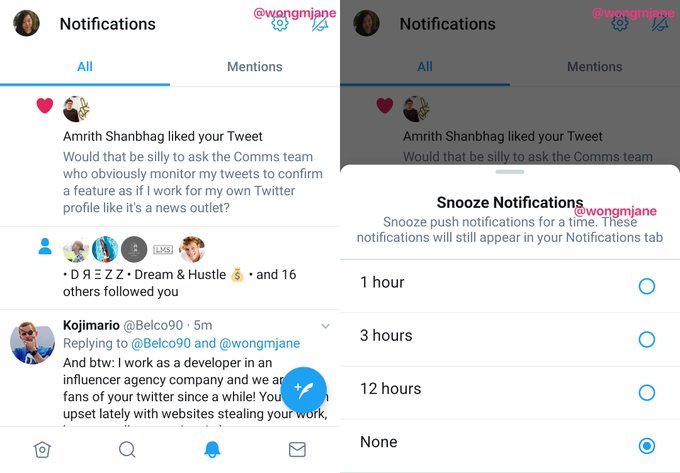
    Wong found the feature by looking at the code underneath the social network’s Android app. Wong found a built-in bell-shaped snooze button at the top right corner of the notifications tab — tapping it brings up the Snooze Notifications panel that lets you mute push notifications for up to 12 hours. Just tap it again to un-snooze or to change the snooze duration.

    View image on Twitter
    According to Wong, the current  ‘Snooze’ feature is shown as a “bell” button on top of the Twitter app’s Notifications tab. By tapping the button, the app will provide a bottom sheet of various length of Snooze durations. During the snooze, you will not receive push notifications from Twitter. The notifications will still appear in your Notifications tab, as indicated. You could always tap the  button to unsnooze or adjust the duration.

    Wong had also, previously spotted Twitter tested an option to moderate replies. And this ‘Snooze Notifications’ feature is no exception.

  • United States AT$T Communications Rolls Out 5+ Network Coverage

    United States AT$T Communications Rolls Out 5+ Network Coverage

    AT&T Inc an American multinational amalgam holding company which has its headquarters at Whitacre Tower in Downtown Dallas, Texas United States has, today turned on its 5G+ in New York City, but it still isn’t making its speedy new network available to regular consumers.

     AT$T is the world’s largest telecommunications company, the largest provider of mobile telephone services, and the largest provider of fixed telephone services in the United States through AT&T Communications.

    AT&T’s new millimeter-wave network, or what they are calling  AT&T 5G+, will be available in parts of New York City, though parts may be a bit of a stretch. In its release, AT&T acknowledged that the service will be in limited areas initially the company’s spokesperson told international media that the new service will be available first in parts near and around East Village, Greenwich Village, and Gramercy Park in the US.

    AT&T has multiple versions of 5G, with 5G+ denoting its super-fast but limited range millimeter-wave flavor. AT$T states that the “sub-6” spectrum  covers wider areas but at slower speeds which it will simply call “5G.” Both of those forms of actual 5G are different than 5GE, the rebranding of AT&T’s improved but existing 4G network that is currently available across the country.

    “As a densely-populated, global business and entertainment hub, New York City stands to benefit greatly from having access to 5G, and we’ve been eager to introduce the service here,” said Amy Kramer, president of AT&T’s New York region.

    “While our initial availability in NYC is a limited introduction at launch, we’re committed to working closely with the City to extend coverage to more neighborhoods throughout the five boroughs,” Kramer added.

    Even though AT$T has rolled out a limited range, New York City becomes the twenty-first city where AT&T has deployed 5G. This has extended the company’s early lead in the 5G race over Verizon which has nine cities, T-Mobile has six and Sprint controls five cities.

    It still remains unclear to AT&T users rather everyone else will start accessing 5G. But reliable sources state that the company plans to deploy a nationwide, United states, 5G network on its wider-ranging “sub-6” spectrum in the “first half of 2020.”

  • Facebook Upgrades WhatsApp’s Multi-platform Feature To Enable The Messaging App Work On Multiple Accounts

    Facebook Upgrades WhatsApp’s Multi-platform Feature To Enable The Messaging App Work On Multiple Accounts

    Facebook has now confirmed that they were working on a new multi-platform feature.  The feature has now been confirmed and WhatsApp users will be able to access the popular messaging app on their multiple devices simultaneously.

    This is according to WhatsApp tipster WABetaInfo, which stated that it’s “no longer a rumor, it’s confirmed”. Confirming that Whats App users will be able to use our WhatsApp account across multiple devices. It includes WhatsApp for Windows (UWP, when available), so you can use WhatsApp on your PC if your phone has no connection. iPhone/Android and iPadOS included.”

    WABetaInfor had also revealed that WhatsApp messenger is working on a new desktop client based on the Universal Windows Platform (UWP). According to Facebook, the new software will allow one to use the messaging service even when their phone’s not connected to the internet. but that’s not immediately clear when the UWP app will be rolled out to users.

    Right now your WhatsApp account is linked to your phone number, and in order to sign into WhatsApp on a device, you need to be logged out on all or any other devices. Many people have been wondering why WhatsApp restricts users from using multiple devices considering that Telegram allows it and still manages to deliver messages securely using end-to-end-encryption on both devices.

    Facebook’s other apps, Instagram and Messenger are both able to run on multiple devices simultaneously something that makes even less sense is when the same Facebook company makes an exception to the rule by allowing users to run WhatsApp Web from a browser while still logged in on their phones.

    WhatsApp’s web version of its popular messaging app was released back in 2015, but in order to use it, one needs to have their phone connected to the Internet. Users also have to authenticate their accounts on computers by scanning a QR code on the web client through the built-in camera functionality within the WhatsApp application on their phone.

    There was no technical reason why it couldn’t be done, this is the era where everyone using multiple devices in their daily workflow. Logically, allowing whats App users to use the App on multiple devices simultaneously is a very big step from Facebook and the update is definitely, without a doubt going to boost app users.

    The upgrade has been introduced at the right time where everyone wants apps and in this case, WhatsApp is able to access WhatsApp on their Phones, Phablets, Tablets, and PCs without having to rely on a browser-based solution. The incorporation of the multi-platform feature on WhatsApp will be the best upgrade from Facebook.

    On top of the multi-platform feature and the UWP app, WhatsApp messenger is separately working on several other features such as WhatsApp Payment which possibly could be one of the biggest features of the Facebook-owned messaging platform. This feature will enable users to perform payment transactions within the app.

    Another feature getting tested as well is the Quick Edit Media Shortcut, which would allow users to edit media files that have been shared on the messaging app. It can be used to edit media files quickly that are shared on both individual and group chats.

    According to reports, WhatsApp is set to launch a voice message preview feature for iOS. How will it work; WhatsApp will send push notifications for voice messages along with a preview tool. This means that iPhone users can open the voice message directly from the notification panel. At present, users on iPhones and Android devices need to open the chat to listen to the voice messages.

    WhatsApp also recently started rolling out the ‘Frequently Forwarded’ feature in a move to curb down fake news on its platform. The new feature marks messages that are sent multiple times as “forwarded many times.”

  • Instagram Meme Users Purged Losing More Than 500 Million Followers

    Instagram Meme Users Purged Losing More Than 500 Million Followers

    Instagram influencers have woken up to another purge that has seen their accounts shut down and deactivated.

    According to Facebook spokesperson, the accounts were disabled following multiple violations of platform policies among them attempted abuse of internal processes.

    One affected Istagram influencer Declan Mortimer 17, claimed that his account generated up to 20million a year through adverts to his former more than 11 million followers.

    Declan said his account deactivated because of Facebook’s massive meme page purge.

    On the Night of Friday 26th, Instagram executed yet another purge terminating more than 30 accounts influential accounts with similar meme-like content citing policy violations.

    For those who don’t know, a meme is an amusing rather interesting item, such as a captioned picture or video that is spread virally online through social media.

    Meme page owners have stated that the termination of their Instagram accounts is heartbreaking and a financial blow to them.

    According to Caige, the One 18-year-old whose account “@autist” was deactivated on Thursday said he had already made more than 3million this year alone.

    Another affected user stated the action as endgame for influencers. Heavily followed Instagram meme users faced the biggest loss within a few seconds. This includes @Finest.Investions who had more than 13 million followers.

    https://twitter.com/spicymp4/status/1154918331348115456?s=19

    A hashtag #memepurge has been trending with users cskking Facebook, instagram owner, to look into the matter.

    According to sources talking to media, meme pages are being deactivated because they were reaching out to users who also violate Instagram policy by selling verification services, retrieving disabled user names and reinstating banned accounts through a private program that is only supposed to be available for members of the media.

    Facebook confirmed that Instagram shuts down accounts that violate the company’s terms of use.

    According to facebook, Violations results in termination if ones accounts include;
    1. Trying to buy, sell or transfer any aspect of an account (including the username) or use login credentials of other users.

    2. Sharing sensitive personal information, names, bank account details, addresses.

    3. Transferring funds or sending money through Instagram or Facebook accounts.

  • Instagram Won’t Be Showing The Number Of Likes One Gets On Their Photos

    Instagram Won’t Be Showing The Number Of Likes One Gets On Their Photos

    Instagram has just announced that they’re running a test that would make the likes one gets on their photos invisible.

    The company began testing this in Canada in a move to help reduce pressure to rack up the likes on the platform. Likes, which appear as hearts on Instagram, are often used as a measure of popularity.

    The test removes the total number of likes on photos and videos, but the owner of the account will still be able to see them. Likes will not appear on the main feed, profiles or permalink pages.

    For some users, not getting enough likes can impact their self-esteem. According to a recent report by the Royal Society for Public Health in the United Kingdom, Instagram is the most detrimental social networking app for young people’s mental health.

    Many users have used the app as a validation. In Kenya, according to latest social media survey, it’s the third most used network after WhatsApp and Facebook.

  • Twitter Is Currently Down

    Twitter Is Currently Down

    Twitter went down on Thursday across major parts of the world including the US and the UK as users reported being unable to access the platform on web and mobile devices.

    The site began experiencing major issues at 2:46pm EST, with problems being reported from users attempting to access Twitter through its website, iPhone or iPad app and via Android devices, according to DownDetector.com, a site that monitors outages on social media.

    Facebook, Instagram and other popular social media platforms appeared to be working at the time Twitter went down on Thursday afternoon.

    More follows…

  • Huawei Is Launching It’s Own Powerful OS To Replace The US Android Following Ban

    Huawei Is Launching It’s Own Powerful OS To Replace The US Android Following Ban

    (Reuters) – China’s Huawei is in the process of potentially launching its “Hongmeng” operating system (OS) to replace the U.S. Android OS, an executive said on Thursday, after Reuters reported that the company has applied to trademark the OS in various countries.

    Data from a U.N. body showed that Huawei Technologies Co Ltd is aiming to trademark the OS in at least nine countries and Europe, in a sign it may be deploying a back-up plan in key markets as U.S. sanctions threaten its business model.

    President Donald Trump’s administration last month put Huawei on a blacklist that barred it from doing business with U.S. tech companies such as Alphabet Inc, whose Android OS is used in Huawei’s phones.

    Andrew Williamson, vice president of Huawei’s public affairs and communications, said Hongmeng was moving forward.

    “Huawei is in the process of potentially launching a replacement,” Williamson said in an interview in Mexico City. “Presumably we’ll be trying to put trademarks.”

    A senior U.S. official on Thursday said Huawei’s clients should be asking themselves if the Chinese firm can meet its commitments given its dependence on U.S. companies.

    Huawei, the world’s biggest maker of telecoms network gear, has filed for a Hongmeng trademark in countries such as Cambodia, Canada, South Korea and New Zealand, data from the U.N. World Intellectual Property Organization (WIPO) shows. It also filed an application in Peru on May 27, according to the country’s anti-trust agency Indecopi.

    Huawei has a back-up OS in case it is cut off from U.S.-made software, Richard Yu, chief executive of the company’s consumer division, told German newspaper Die Welt in an interview earlier this year.

    The U.S. official, meeting with officials in Europe to warn against buying Huawei equipment for next-generation mobile networks, said only time would tell if Huawei could diversify.

    “It is a fair question to ask if one decides to go with Huawei and Huawei continues to be on our entity list, will Huawei be able to actually deliver what it promises any particular client,” Jonathan Fritz, the U.S. State Department’s director for international communications policy, told reporters in Brussels.

    The company, also the world’s second-largest maker of smartphones, has not yet revealed details about its OS.

    The applications to trademark the OS show that Huawei wants to use Hongmeng for gadgets ranging from smartphones and portable computers to robots and car televisions.

    At home, Huawei applied for a Hongmeng trademark in August last year and received a nod last month, according to a filing on China’s intellectual property administration’s website.

    CONSUMER CONCERNS

    According to WIPO data, the earliest Huawei applications to trademark the Hongmeng OS outside China were made on May 14 to the European Union Intellectual Property Office and South Korea, or right after the United States flagged it would stick Huawei on an export blacklist.

    Huawei has come under mounting scrutiny for over a year, led by U.S. allegations that “back doors” in its routers, switches and other gear could allow China to spy on U.S. communications.

    The company has denied its products pose a security threat.

    However, consumers have been spooked by how matters have escalated, with many looking to offload their devices on worries they would be cut off from Android updates in the wake of the U.S. blacklist.

    Huawei’s hopes to become the world’s top-selling smartphone maker in the fourth quarter this year have now been delayed, a senior Huawei executive said this week.

    Peru’s Indecopi has said it needs more information from Huawei before it can register a trademark for Hongmeng. Peru has some 5.5 million Huawei phone users. The agency did not give details on the documents it had sought, but said Huawei had up to nine months to respond.