Category: Sci & Tech

  • Twitter To Halt Removal Of Inactive Accounts And Instead Create A Way To Memorialize Deceased Users Accounts

    Twitter To Halt Removal Of Inactive Accounts And Instead Create A Way To Memorialize Deceased Users Accounts

    A day ago, Kenya Insights run a story that popular Social Media platform Twitter would delete accounts which had been inactive for more than six months, Twitter has since decided to halt the process due to customer feedback.

    After the initial announcement, people immediately raised the possibility of losing access to the old accounts of friends, partners, family members, celebrities, and other influential Twitter users who’ve died.

    In a series of tweets, Twitter Support has clarified they have always had an inactive account policy that was not implemented. “This impacts accounts in the EU only, for now. We’ve always had an inactive account policy but we haven’t enforced it consistently. We’re starting with the EU in part due to local privacy regulations (eg, GDPR).”

    The decision to halt the process came after a user,  Adam. reached out and asked Twitter to stop removing accounts before considering the possibility of memorialising deceased peoples accounts. In a heartfelt tweet, Adam explained how his late partners tweets reminded him of his partner’s thoughts, memories and feelings.

    Responding to the tweet, Twitter support acknowledged the impact deleting accounts would make and decided to first find a way to memorialize the accounts of the deceased.

    https://twitter.com/TwitterSupport/status/1199777313933496320?s=20

    More updates to follow.

  • Twitter Plans To Delete Inactive Accounts And Free Up Usernames In December

    Twitter Plans To Delete Inactive Accounts And Free Up Usernames In December

    A number of users who have Twitter accounts but don’t use them have reportedly been receiving warnings from the Jack Dorsey founded social media platform to sign in by December 11th, or their account will be history and its username will be up for grabs again. The alert is being sent out to any account that hasn’t signed in for more than six months.

    “As part of our commitment to serve the public conversation, we’re working to clean up inactive accounts to present more accurate, credible information people can trust across Twitter. Part of this effort is encouraging people to actively log-in and use Twitter when they register an account, as stated in our inactive accounts policy,” a spokesperson told The Verge.

    The company explained the clean-up as part of an effort to “present more accurate, credible information” that people can rely on. While it didn’t elaborate on what that meant, this could help you find the users and tweets you’re looking for instead of having to wade through a sea of quickly-abandoned accounts.

    Twitter hasn’t yet said exactly when recouped usernames will be made available to existing users. The fine print on the inactive account policy page still notes that the service does not “generally accept requests for usernames that seem inactive.”

    Have a username you’re keeping an eye out for?

  • DStv To Launch Standalone Streaming Only Service

    DStv To Launch Standalone Streaming Only Service

    DStv users may be saying goodbye to the old dish and decoder and welcoming a new, more laid-back streaming offering as MultiChoice Group is looking to launch its standalone streaming product by the end of its financial year in March 2020 according to new reports. The company offers their well known DStv satellite service and they have a huge presence in Africa.

    MultiChoice already offers DStv Now which is a service that DStv customers can catch up with content from DStv on the go, the service can be accessed on a computer or on mobile. The catch, however, is you have to have a decoder and dish to connect your account with DStv now since the service requires a direct-to-home link to a satellite dish.

    According to TechCentral, Connected Video CEO of MultiChoice Niclas Ekdahl says the company has made significant progress in developing the dishless offering — which will use customers’ broadband connections rather than satellite for delivery — and will soon open it to external testers.

    The launch of the streaming-only offering will be a significant shift for a company that launched as a satellite direct-to-home (DTH) pay-television operator 24 years ago. Users will now enjoy a more streaming-friendly approach since the new service will offer a more on-demand viewing capability, this means viewers get to watch what they want, when they want, instead of simply watching what is already scheduled to show on the usual DStv and DStv Now offering.

    Multichoice plans maybe to just improve on the already available DStv now. Making DStv Now a standalone service could go a long way as the company looks to penetrate this new streaming market. The company already has Showmax which the company has revealed recorded a 19% year on year increase in average hours watched. This kind of growth is what MultiChoice is looking to capitalize on give competitors like Netflix a run for their money.

  • Russian Parliament Plans To Ban Apple Products From Next Year

    Russian Parliament Plans To Ban Apple Products From Next Year

    According to a report by BBC, the Russian Parliament has passed new legislation for electronics that run apps to have pre-installed Russian software.

    According to new the bill, electronics such as smartphones, computers, and smart TVs must be sold with locally-made Russian software pre-installed. This means apart from the first-party software, the devices should have Russian alternatives pre-installed in order to qualify for their sale to avoid being banned in the country.

    The new law will be effective from July 2020. This might lead to a ban on not only Apple iPhones but also other products with foreign software. Inside the Russian parliament Photo|Al Jazeera

    The European Union has a similar law which has made Android OEMs to let users select their choice of apps while setting up the device. In this case, Apple, Samsung, and other major electronics manufacturers may choose not to sell their devices in the Russian Federation instead of having to install varied software.

    As the Kremlin prepares to roll out the list of every gadget that will need to be updated, it is not physically possible to install Russian-made software on all devices. A move the Federal Government says will attract manufacturers from the Russian market.

    “When we buy complex electronic devices, they already have individual applications, mostly Western ones, pre-installed on them. Naturally, when a person sees them… they might think that there are no domestic alternatives available. And if alongside pre-installed applications, we will also offer the Russian ones to users, then they will have a right to choose.” Oleg Nikolayev, one of the co-authors of the legislation said.

    According to the Association of Trading Companies and Manufacturers of Electrical Household and Computer Equipment (RATEK), it is not possible for many worldwide companies to install Russian-made software which means they will be forced to exit the market.

    Apple’s iOS operating system is a closed system, it isn’t likely that the iPhone would be offered with unknown Russian software pre-loaded. Russia has slapped the smartphone giants off their markets.

    Statcounter data report released early last month indicates that Samsung has the largest smartphone market share in Russia with 22.04 percent. China’s Huawei has a 15.99 percent market dominance then Apple’s iPhone with a market share of 15.83 percent.

    This is coming at a time when the Kremlin had passed another controversial law. Two weeks ago, they legislated an Internet Law which enabled officials with the power to restrict internet traffic creating an internet firewall like the one in China.

  • UK Firms To Light Up Kenya With Repurposed Lithium-ion batteries

    UK Firms To Light Up Kenya With Repurposed Lithium-ion batteries

    A United Kingdom based start-up is rolling out 4,000 batteries to Kenya in a bid to power people’s homes with cheap and clean energy. Birmingham-based reusable battery developer Aceleron will bring thousands of its alternative ­lithium-ion batteries to the country.

    Through a partnership with the Shell Foundation and BBOXX, an off-grid solar company based in London, the batteries will be fitted into ­individual homes to power people’s ­televisions, fridges and lighting. Currently in the country, a number of homes in rural areas still use kerosene lamps at night, risking potential hazards such as fires, poisoning and explosions.

    The project will run until 2021 and involves Aceleron converting waste lithium-ion battery cells made by fuels producer Total Access to Energy Solutions (TATES) ’  into repairable and affordable and reusable batteries designed to provide clean power to more than 800 people in off-grid communities across Kenya, Benin, Rwanda and Libya.

    The Sh6,683,923 (£51,000) project is delivering second life batteries at Sh4581 ($45) per unit – just Sh661 ($6.5) a year over each battery’s 7 year lifespan. In comparison, acid batteries in Kenya cost about Sh1200 $12 a year and last 3 years. This makes the new reusable batteries affordable enough to help off-the-grid rural communities.

    According to Dr Amrit Chandan, chief executive of Aceleron, The programme will also offer training. A local workforce will therefore be able to service and repair batteries on site instead of disposing them. The team has already assessed 5000 waste batteries, of which 4500 were usable and then produced 150 second life battery packs.

    “Our circular-economy approach delivers lithium-ion batteries that work better, last longer and are cheaper. We are making clean power an option for off-grid Kenyans, making a real impact to their lives by giving access to clean electricity while also reducing carbon emissions,” Dr Amrit Chandan, chief executive of Aceleron says.

    President Uhuru Kenyatta had committed the country to be entirely powered by renewable energy by 2020 and more than 70% of electricity is already delivered by renewable sources which is more than three times the global average. However, the transformational benefits of access to clean power have not spread to the majority of Kenyans, with more than 80% of people still off-grid.

    “Bringing affordable and clean power to off-grid communities is powerful – it enables education, grows livelihoods and builds economies,” Dr Amrit says.

    With Kenya Power (KP)  profits dropping for the third consecutive year , Taxpayers are being forced to carry the burden to keep Kenya Power afloat, whenever consumers pay their monthly bill or buys prepaid units, they have to pay for fuel, foreign exchange adjustment and inflation adjustment, which are in addition to paying for the energy consumed. in addition the consumer has to contend with paying 16 per cent VAT and a host of levies for regulators, including the Energy and Petroleum Regulatory Authority, the Water Regulatory Management Authority and the Rural Electrification and Renewable Energy Corporation. Thus the big question, would you move from KP and opt for the ­lithium-ion batteries?

  • Facebook-Owned WhatsApp Admits A Spy Video Bugs On Its Old Versions

    Facebook-Owned WhatsApp Admits A Spy Video Bugs On Its Old Versions

    The Facebook-owned Whats App posted a security advisory about the bug, named CVE-2019-11931, which affects earlier versions of the app on both Android and iOS devices. They quoted India’s Computer Emergency Response Team that issued a warning over a malicious video allegedly intended to remotely access WhatsApp accounts.

    The security agency issued the advisory after the Indian government said it is empowered to “intercept, monitor or decrypt… any information generated, transmitted, received, or stored” on the phones or devices of its citizens.

    According to The Independentthe video allows hackers to access people’s messages when they share the MP4 file with their contacts.

    “These users were instead targeted with spyware developed by controversial Israeli technology firm NSO Group,” The Independent quoted a spokesperson.

    WhatsApp confirmed the warning, however, they refuted claims linking the hacking attempts to a shared video file.

    “We make public reports on potential issues we have fixed consistently with industry best practices. In this instance, there is no reason to believe that users were impacted.”

    Last month, WhatsApp revealed that around 1,400 activists and journalists were targeted with spyware developed by controversial Israeli software firm NSO Group.

    The same bug was also installed in the messenger’s video calling system in May this year.

    “In May we stopped an attack where an advanced cyber actor exploited our video calling to install malware on user devices. There’s a possibility this phone number was impacted, and we want to make sure you know how to keep your mobile phone secure,” the message stated.

    WhatsApp users are being urged to update to the latest version of the app due to fears that spy agencies are snooping on people through a major security vulnerability.


  • Billionaire Strive Masiyiwa On Using Digital Technologies To Grow Businesses and Nations

    Billionaire Strive Masiyiwa On Using Digital Technologies To Grow Businesses and Nations

    The first Dollar Billionaire in Zimbabwe, 58-year-old Strive Masiyiwa who, according to FORBES estimates has a net worth of $2.8 billion, has said that Digital technologies present opportunities for developing nations to build new industries and deliver better services.

    Earlier this week, Pathways for Prosperity released a report( that we have highlighted in this article) ascertaining that only 30 per cent amongst 80 per cent of people in developing countries who live under a cellular network have ever used the internet.

    Speaking during the launch of the report, Billionaire Strive Masiyiwa, who’s also the Econet’s founder said that;

    “Digital technologies offer powerful tools to grow businesses and nations, enabling entrepreneurs to access markets and gives governments innovative ways to deliver better services.”

    In the report titled The Digital Roadmap: how developing countries can get ahead— 26 recommendable steps on how nations can use to harness new technologies to deliver development to their citizens are highlighted.

    Here is the report courtesy of Pathways for Prosperity.

    Key Findings

    This is a critical moment in history. Some countries will prosper in a new global digital economy, but countries that are not ready will risk being left behind.

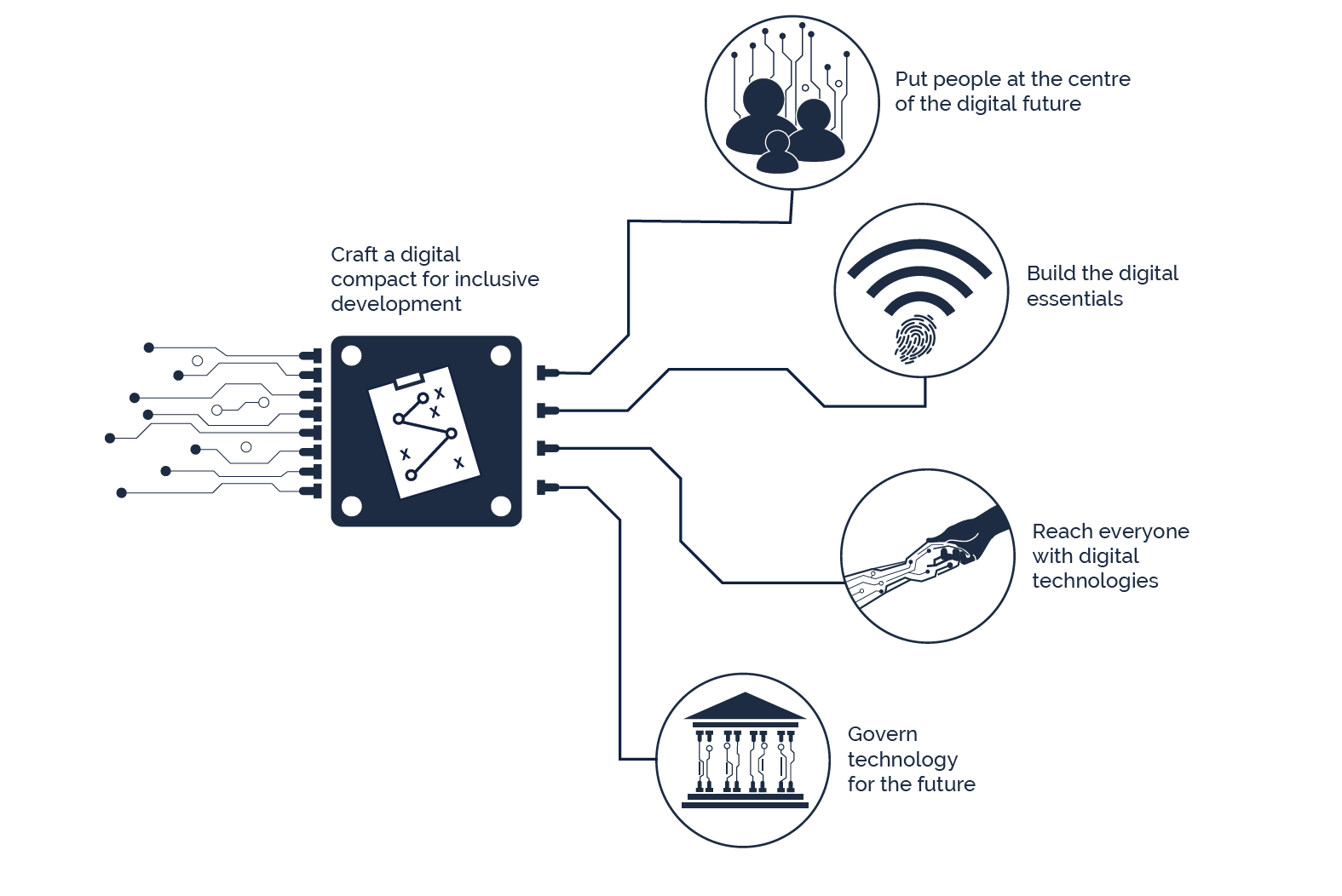
    Countries have the agency to act now. The Digital Roadmap identifies five priority areas for countries to create their own digital future.

    Technology will not guarantee success, no matter how innovative it is. Just as important as new technology is the social and economic environment in which technology is used.

    Technology will almost always be a force for growth, but technology is not automatically a force for inclusion. Without a ddeliberate effort to include everyone, digital technologies can end up entrenching existing inequality.

    Government, civil society and the private sector should come together to craft a shared national vision. Everyone has a role to play in major economic transformation.

    With new digital technologies come opportunities for low and middle-income countries to diversify their economies, create new jobs, transform agriculture, and improve health and education. But digital technologies can also entrench exclusion and disrupt peoples’ livelihoods. This report, based on two years of research and analysis, is underpinned by learning and extensive engagement with policymakers, entrepreneurs, civil society and academics from around the world.

    Five priorities to get ahead in the digital age

    visual outline of digital roadmap chapters 

    The Digital Roadmap presents an overarching vision for a globally connected world that both delivers on the opportunities presented by technology and limits downside risks. Importantly, it also sets out how this vision can be achieved.

    Craft a Digital Compact for Inclusive Development

    Embracing country-wide digital change will be disruptive. Navigating it requires coordinated action. Reconfiguring an economy will result in some resistance. The best way to achieve buy-in, and to balance trade-offs, is through dialogue: the private sector and civil society in its broadest sense (including community leaders, academia, trade unions, NGOs, and faith groups). The political economy of upheaval is difficult, but change can be managed with discussions that are inclusive of multiple groups. These dialogues should result in a national digital compact: a shared vision of the future to which everyone commits. The Pathways Commission has supported three countries – Ethiopia, Mongolia and South Africa – as they each developed country-wide digital strategies, using the Digital Economy Kit.

    Put People at the Centre of the Digital Future

    Rapid technological affects peoples’ lives. Failure to put people at the centre of social and economic change can lead to social unrest. The pace and intensity of change means it’s all the more important that people are at the centre of the digital future – not the technology. This requires equipping people to benefit from opportunities, while also protecting them from the potential harms of the digital age. Governments should take responsibility for ensuring that vocational education is truly useful for workers and for business in the digital age. The private sector needs to be involved in keeping curricula up to date.

    Build the Digital Essentials

    Digital products and services cannot be created in a vacuum – essential components need to be in place: physical infrastructure, foundational digital systems (such as digital identification and mobile money), and capital to invest in innovation. These are the basic ingredients needed for existing firms to adopt more productive technologies, and for digital entrepreneurs to build and innovate. Having reliable infrastructure and interoperable systems means that firms and service providers can focus on their core business, without having to build an enabling environment from scratch.

    Reach Everyone with Digital Technologies

    If technology is to be a force for development for everyone, it must reach everyone. Just over half of the world’s population is connected to a digital life; for the rest, digital opportunities don’t mean much. Without digital connections, people can’t participate in digital work platforms, benefit from new technologies in education, or engage with government services online. Women, people with lower levels of education, and people in poverty are usually those who lack digital access. Reaching everyone requires looking beyond current business models. The private sector needs to design for inclusion, ensuring the poorest and most marginalised consumers, to ensure they are not left even further behind.

    Govern Technology for the Future

    The unprecedented pace of change and the of new risks in the digital era (such as algorithmic bias, cybersecurity, and threats to privacy) are creating headaches for even the most well-resourced countries. For developing countries, the challenges are even bigger. Digital technologies fundamentally shape what people do and how they do it: freelancers may face algorithms that determine chances to get hired. Banks might face a financial system with heightened risk from new, non-bank deposit holders. These issues and many others require new and adaptive approaches to decision-making. Emerging global norms will need to consider the needs of developing countries.

    The Pathways for Prosperity Commission works to create conversations and to encourage the co-design of country-level solutions aimed at making frontier technologies work. The commission’s efforts are aimed at helping the world’s poorest and most marginalised men and women.

    Pathways Commission reports that it has piloted the Digital Economy Toolkit in Ethiopia, Mongolia, and South Africa as a foundation for their national digital strategies. The panellists at the launch insisted on training on 21st-century skills to accommodate Africa’s growing labour force. According to research, it is estimated that by 2030, the labour force will grow by 285 million.

    The billionaires also urged the governments to develop a ‘National Digital Compact’ to guide digital transformation and navigate the impacts that technologies are having on their societies and economies.

    In Kenya for instance, such a move will mean empowering citizens with digital skills, giving them access to digital platforms, and providing a social safety net for those whose livelihoods are disrupted by technological change. Not imposing useless social media tax or registering social media users so that the government can dictate what Netizens have, are and will be doing on their independent platforms.


    *Additional reporting by Pathways for Prosperity*

  • Netflix To Partner With Nickelodeon In The Battle Against Disney+

    Netflix To Partner With Nickelodeon In The Battle Against Disney+

    Yesterday, Netflix, the streaming giant that it has partnered with Nickelodeon on a multi-year content deal to produce new original animated movies and series based both on the Nickelodeon library of characters as well as all-new IP – for kids and families around the world.

    This marks an expansion of the existing relationship between the companies, which has already brought several popular titles to Netflix, including animated specials Rocko’s Modern Life: Static Cling and Invader Zim: Enter the Florpus. Also forthcoming are specials based on The Loud House and Rise of the Teenage Mutant Ninja Turtles.

    “Nickelodeon has generated scores of characters that kids love, and we look forward to telling wholly original stories that re-imagine and expand on the worlds they inhabit. We’re thrilled to continue collaborating with Brian Robbins, Ramsey Naito, and the creative team at Nickelodeon in new ways as we look to find fresh voices and bring bold stories to our global audience on Netflix.” said Netflix vice president of original animation, Melissa Cobb.

    Nickelodeon’s next step forward is to keep expanding beyond linear platforms, and our broader content partnership with Netflix is a key path toward that goal. The Nickelodeon Animation Studio is home to the world-class artists and storytellers behind some of the most iconic characters and shows ever made, and our head of Animation, Ramsey Naito, has been building on that legacy over the past year by ramping up development and production exponentially.  The ideas and work at our Studio are flowing, and we can’t wait to work with Melissa and the Netflix team on a premium slate of original animated content for kids and families around the world.” said Brian Robbins, President, Nickelodeon.

    The upcoming 2019 animated Netflix slate includes family animated feature film Klaus from Sergio Pablos (streaming November 15), kids animated series Dino Girl Gauko from Japan (streaming November 22), adult animated film I Lost My Body from Jérémy Clapin (streaming November 29), and Fast & Furious Spy Racers from DreamWorks (streaming December 26), among others.

    “Nickelodeon has generated scores of characters that kids love, and we look forward to telling wholly original stories that re-imagine and expand on the worlds they inhabit. We’re thrilled to continue collaborating with Brian Robbins, Ramsey Naito, and the creative team at Nickelodeon in new ways as we look to find fresh voices and bring bold stories to our global audience on Netflix.” Melissa Cobb, Netflix vice president of original animation, said in a statement.

    Netflix needs to step up or see dust as Disney+, a service that’s positioned itself to dominate the kid-friendly services arena and not only does Disney+ house Marvel, Pixar, Star Wars, and National Geographic, it also owns Hulu. For Netflix to take on Disney+ head-on, it’s going to need more than Nickelodeon offshoots.

    Netflix must also note that they have been losing subscribers and pivot away from quantity over quality. There is an upsurge in the streaming services industry with major competitors like Apple TV coming in to sway away their customers from already struggling Netflixbase.


  • Here’s Why WhatsApp Is Banning Users For Life

    Here’s Why WhatsApp Is Banning Users For Life

    According to emerging reports, WhatsApp is now banning users that are part of a group with suspicious names for life. The permanent ban will include everyone in the group including the Group Admins.

    Reddit users are reporting that they’ve experienced this ban when they jokingly re-named their WhatsApp group to something illegal to test the theory.

    The Facebook-owned company is making these attempts in order to keep its users safe in these modern times when phishing or malware attacks have become quite common in this technology era.

    A report on popular WhatsApp news website, WapBetaInfo states, “The first report was found on Reddit, where the user Mowe11 published a post about his WhatsApp ban. He explained that a guy that was a participant of his group changed his university’s name group to something illegal, determining the ban for the entire group. He has also confirmed that all members got banned and that it was the 3rd time that a user did that. Another user from Reddit, FranciscoAlfaro, was in a group of his school, has about 100 participants. When he woke up, all members were mysteriously banned with no apparent reason.”

    WhatsApp has also recently changed the way of adding members to a group. It has introduced a group invite feature that lets one decide who will add them to groups.

  • Elon Musk’s Space X Launches 60 More Starlink Satellites

    Elon Musk’s Space X Launches 60 More Starlink Satellites

    Space X, a private space company that is owned by American billionaire Elon Musk has added 60 more satellites to its goal of nearly 45,000 for a global internet network called Starlink.

    Soace X what to have internet connectivity everywhere on earth. In May this year, the company launched 60 satellites that are in orbit right now and 60 more were launched to space from Cape Canaveral Air Force Station in Florida on Monday.

    The second Starlink deployment from SpaceX’s Flacon 9 rocket (a 1.2 million-pound spacecraft) was a success.

    SpaceX plans to launch monthly Starlink missions in 2020. Just last month, SpaceX applied for 30,000 more satellites, which you can add onto the 12,000 the U.S. Federal Communications Commission already approved.

    Once the entire constellation is in low Earth orbit by 2027, or possibly later, it’s expected to offer high-speed internet to anywhere on Earth. Last month SpaceX CEO Elon Musk supposedly sent a tweet using the Starlink network.

    When the company launched its first set of Starlink internet satellites in May, professional astronomers worried that the super bright satellites would interfere with scientific observations and amateur appreciation of the stars.

    “That first few nights, it was like, ‘Holy shit, the stars were super bright. That is a wake up call” Jonathan McDowell, an astrophysicist at the Harvard-Smithsonian Center for Astrophysics, told Space.com.

    https://twitter.com/alexwitze/status/1193890882740609025?s=19

    Here is a YouTube courtesy video.

    SpaceX and its leader, Elon Musk, reassured astronomers that once the satellites settled into place, they would stop masquerading as the stars they are named for.


  • Is Flying A Drone Really Illegal In Kenya? Netizens React

    Is Flying A Drone Really Illegal In Kenya? Netizens React

    A light research on Google will show that flying a drone in Kenya is illegal. “According to Kenya’s national aviation authority, the Kenya Civil Aviation Authority (KCAA), drones are banned in Kenya” UAVCoach.com, a website for everything drones from training to news reads.

    Prohibiting the use of the remotely controlled aircrafts, KCAA has now issued a stern warning to anybody who might be thinking of flying a drone in the countries airspace, if caught persons will now risk a fine of Sh100,000 or a year in prison.

    There has never been ‘Law’ in Kenya concerning drone usage, does that mean it’s illegal? When something is not legislated, is it illegal?

    The country came close to legalising drone usage back in 2017/18 when KCAA published the drone regulations, -this were rules which outlined guidelines to be taken into consideration in the use of the remotely controlled aircrafts- but awaited Parliament to ratify them before taking effect.

    Evidently, the house annulled the Kenya Civil Aviation (Remote Piloted Aircraft Systems Regulations, 2017) after finding ‘fault’ with several provisions. Reading through the regulations I can tell you nothing proposed on there was thinking about the young and ambitious young Kenyan who wants to get into photography and videography anyway.

    In March this year, KCAA published a revised set of regulations which were again annulled by Parliament. Hundreds of drones have since been confiscated at Jomo Kenyatta International Airport after being imported.

    Fees

    Operating a drone in Kenya under the proposed regulations would have seen Kenyans part with huge chunks of money to get permits for the aircrafts, for instance, KCAA Director General Gilbert Kibe had said users would be charged registration and licence fees which varied between $600 (Sh60,000) and $2,300 (Sh232,000) depending on the purpose of use, that was maybe, just maybe reasonable, however, a quick look at social media shows that some Kenyans who have tried bringing in drones were being asked to cough upto Ksh 1 million for permits.

    “Mine was impounded at Customs. A very small one which cost me $200 but govt needs a license worth $10,000. Now i am sure someone has taken it home.” Another Twitter user @ClayNgambwa Writes.

    This then raises the one question, how many people who can afford these hefty permits actually own them? Is flying a drone in Kenya illegal or is it a privilege?

    Taking to popular social media app Twitter, Kenyans have voiced their concerns over the limitations young photographers and videographers are facing in the country.

    Unmanned Aerial Vehicles (UAVs) can be put to various uses in the country, from photography to filming to surveying and 3D mapping. Young Kenyans using them vary from small time photography enthusiasts, professional pilots, to engineers building their own airframes and navigation systems from scratch.

    The tight squeeze on young creatives necks in the country needs to stop. In a country where redundancies are now a norm, threats of hefty fines and imprisonment is far from the solution, write up regulations and draw up reasonable permits. The Mpigs should do their job for once. Young people should have a place to seek refuge, let people create their own jobs in this already growing ‘smart’ era.

  • Scientist Discover A New HIV-1 Group M Virus Subtype

    Scientist Discover A New HIV-1 Group M Virus Subtype

    Abbott Laboratories, an American medical Devices and Health Care Company with headquarters in Abbott Park, Illinois, United States’s team of scientists and researchers have identified a new subtype of HIV, dubbed HIV-1 Group M, subtype L.

    Image result for abbott"

    In a publication by the Journal of Acquired Immune Deficiency Syndromes (JAIDS), the findings show the role next-generation genome sequencing is playing in helping researchers stay one step ahead of mutating viruses and averting new pandemics.

    Since the beginning of the global AIDS pandemic, 75 million people have been infected, despite formidable challenges, the global health community has been tirelessly working on the goal to end HIV pandemic over the past few decades. Their efforts are becoming feasible as the records indicate that 37.9 million people today are currently living with the lethal virus.

    “In an increasingly connected world, we can no longer think of viruses being contained in one location. This discovery reminds us that to end the HIV pandemic, we must continue to outthink this continuously changing virus and use the latest advancements in technology and resources to monitor its evolution,” said Carole McArthur, Ph.D., M.D., a professor in the departments of oral and craniofacial sciences, University of Missouri — Kansas City, and one of the study authors.

    This research marks the first time a new subtype of “Group M” HIV virus has been identified since guidelines for classifying new strains of HIV were established in the year 2000.

    Group M viruses, which are traced back to the Democratic Republic of Congo (DRC) in Sub-Saharan Africa, are responsible for the global HIV pandemic.

    To determine whether an unusual virus is, in fact, a new HIV subtype, three cases must be discovered independently.

    The first two samples of this subtype were discovered in DRC in the 1980s and the 1990s. The third, collected in 2001, was difficult to sequence at that time because of the amount of virus in the sample and the existing technology.

    Today, next-generation sequencing technology allows researchers to build an entire genome at higher speeds and lower costs. In order to utilize this technology, Abbott scientists developed and applied new techniques to help narrow in on the virus portion of the sample to fully sequence and complete the genome.

    “Identifying new viruses such as this one is like searching for a needle in a haystack. By advancing our techniques and using next-generation sequencing technology, we are pulling the needle out with a magnet. This scientific discovery can help us ensure we are stopping new pandemics in their tracks,” said Mary Rodgers, Ph.D., a principal scientist and head of the Global Viral Surveillance Program, Diagnostics, Abbott, and one of the study authors.

    Abbott, the leader in blood screening and infectious disease testing created its Global Viral Surveillance Program 25 years ago to monitor HIV and hepatitis viruses and identify mutations to ensure the company’s diagnostic tests remain up to date.

    The US-based Abbott in partnership with global blood centers, hospitals, and Academic Institutions has collected over 78,000 samples of HIV+ and Hepatitis Viruses from 45 countries.

    Abbott has also identified and characterized more than 5,000 strains and published 125 research papers, all that has been tapped to be useful in helping the scientific community learn more about these pernicious viruses.

  • How To Stop People From Adding You To Annoying WhatsApp Groups

    How To Stop People From Adding You To Annoying WhatsApp Groups

    Many a times I’ve heard people complain about having no control over the groups their WhatsApp contacts add them to, whether it’s that cringy old highschool group or an annoying meme group that is unrealistically ever active.

    Well, WhatsApp has now has rolled out new ways for users to stop people adding them to group chats without their permission. “Today, we’re introducing a new privacy setting and invite system to help you decide who can add you to groups.”

    ‘As people turn to groups for important conversations, users have asked for more control over their experience,’ a WhatsApp spokesperson said.

    Here’s how to go about it;

    • Head over to WhatsApp settings section of the app, then Account > Privacy > Groups.
    • There, you’ll find three options – Everyone, My Contacts, or My Contacts Except.

    My Contacts means only users you have in your contacts book can add you to a group which to be honest is like the default selection right now anyway. My Contacts Except lets you pinpoint particular users who you know to be very guilty of adding you to these groups.

    “In those cases, an admin who can’t add you to a group will be prompted to send a private invite through an individual chat, giving you the choice of joining the group… You’ll have three days to accept the invite before it expires.”

    The update is available from today on both iOS and Android.

  • Investigations Reveal How Social Media Apps Are Used To Buy Domestic Workers

    Investigations Reveal How Social Media Apps Are Used To Buy Domestic Workers

    A BBC Africa Eye report has revealed how maids are being sold in a booming black market through some apps on the Google and Apple stores. The Silicon Valley’s Online Slave Market alleges that Google and Apple have been approving and providing apps used to promote human trafficking and modern slavery.

    “What they are doing is promoting an online slave market,” Urmila Bhoola, the UN special rapporteur on contemporary forms of slavery stated. “If Google, Apple, Facebook or any other companies are hosting apps like these, they have to be held accountable.”

    Some of the trade is being carried out on Facebook-owned Instagram, where posts have been promoted via algorithm-boosted hashtags, and sales negotiated via private Direct Messages. The hashtags used to popularize the slave apps include ‘#maidsfortransfer

    Through the undercover investigation, the team found that children as young as 16 years old were being offered for sale in Kuwait on a popular commodity app called 4Sale. The cost of buying the girl was about Ksh.392,502; according to the BBC, she was being sold alongside things like second hand cars, lawnmowers and TVs. The BBC undercover team spoke to upto 57 app users and visited more than a dozen people who were trying to sell them their domestic worker via the app.

    The sellers almost all advised the undercover agents to confiscate the women’s passports, confine them to the house, deny them any time off and give them little or no access to a phone. “The team spoke to 57 app users and were invited to meet women being offered for sale by more than 15 Kuwaitis on apps available on Google Play and the Apple App Store, and through adverts posted via Instagram, and they were encouraged by sellers to keep wages low, confiscate the workers’ passports, deny them the right to a day off or holiday, and restrict the movement and communication of the domestic worker outside the household,” BBC reports.

    The 4Sale app allowed you to filter by race, with different price brackets clearly on offer, according to category. “African worker, clean and smiley,” said one listing. The BBC team learned how domestic workers were used as a commodity. “You will find someone buying a maid for 600 KD (Sh200,000), and selling her on for 1,000 KD (Sh330,000),” a seller told them.

    The report further alludes that the online slave market is not just happening in Kuwait. “In Saudi Arabia, the investigation found hundreds of women being sold on Haraj, another popular commodity app. There were hundreds more on Instagram, which is owned by Facebook.”

    After being alerted to the issue, Facebook said it had banned one of the hashtags involved. Google and Apple said they were working with app developers to prevent illegal activity. Google told the BBC that they are deeply troubled by the allegations, as this type of activity had no place on Google Play while Apple said that they strictly prohibit the solicitation or promotion of illegal behavior, including human trafficking and child exploitation in the App Store and across every part of their business.“We take any accusations or claims around this behavior very seriously,” they stated.

    Kuwaiti authorities say they have officially summoned the owners of several social media accounts used to sell domestic workers as slaves.

    A spot check by Kenya Insights shows an app going by the same name based in Kuwait is still up in the Google and Apple stores.

    Watch the full investigation here.

  • If You’re Using An Android Phone, Delete These Dangerous Apps

    If You’re Using An Android Phone, Delete These Dangerous Apps

    Android is one of the most popular mobile OS in the world. It boasts of being the most flexible and capable in features customization. However to attain this level of open sourcing, android has to forego a lot of security measures unlike its rival iOS.

    Google desperately needs to curb the spread of Android malware. In September alone, researchers uncovered a total of 172 infected apps on the Playstore. Does Google play protect even work?

    ESET researchers have now uncovered 42 apps containing adware, which they say have been downloaded more than 8 million times since they first debuted in July 2018.

    You might want to check if you have installed any of these apps and uninstall immediately. These apps look normal but act sneakily. Once an unsuspecting user installs an adware-infected app, the app will serve full-screen ads on the device’s display at semi-random intervals.

    In a detailed Blog of how the adware works, Lukas Stefanko, a researcher at ESET, explained: “This trick – posing as a part of a legitimate Google service – may help avoid scrutiny. Some detection mechanisms and sandboxes may whitelist such package names, in an effort to prevent wasting resources.”

    Stefanko named 21 of the apps in question and detailed the package names of the other 21 in a blog post.

    Below is a list of the 21 apps;

    1. Smart Gallery
    2. SaveInsta
    3. Minilite for Facebook
    4. Freed Radio FM Online
    5. Free Video Downloader
    6. Free Social Video Downloader
    7. File downloader
    8. Water drink Reminder
    9. Smart Notes for You
    10. DU Recorder
    11. Tank classic
    12. Heroes Jump
    13. Solucionario
    14. Ringtone Maker
    15. Video downloader
    16. Ringtone Maker Pro
    17. Basketball Perfect Shot
    18. Hike Top+
    19. MP4 video downloader
    20. Flat Music Player
    21. Free Top Video Downloader

    Google has now removed these apps from the Google Play Store, after ESET reported the issue and you might want to do the same from your android devices.

  • Facebook Rebrands Its Company Logos

    Facebook Rebrands Its Company Logos

    App giant Facebook Inc yesterday unveiled a new logo for the company to distinguish it from the apps that they own.

    The social media company said it would start using the new brand within its products and marketing materials, and would update the Facebook for Business website over the coming weeks.

    “Over the coming weeks, we will start using the new brand within our products and marketing materials, including a new company website,” Facebook’s CMO Antonio Lucio said.

    The company has been rebranding since the Cambridge Analytica scandal. For instance, in June, the company began including from Facebook within its owned apps;Messenger, Instagram and WhatsApp.


    “This brand change is a way to better communicate our ownership structure to the people and businesses who use our services to connect, share, build community and grow their audiences.” Facebook’s CMO Antonio Lucio said.

  • Video And Photos Of Japanese Robotic Buddhist Priests

    Video And Photos Of Japanese Robotic Buddhist Priests

    Technology is evolving very fast and sooner or later, everything on Earth if not yet ready, will be runned by Technology.

    In Japan, Kyoto Temple unveiled an android Buddhist deity to help people. Android Kannon named ‘Minder’ is the main preacher at Kodaiji Temple as from February 23, 2019.

    Photo by The Asahi Shimbun via Getty Images)
     ‘Minder’ is displayed at Kodaiji Temple on February 23, in Kyoto, Japan. (Photo by The Asahi Shimbun via Getty Images)

    The Sh10 Billion project to assemble the android was a collaboration between the Zen temple and Hiroshi Ishiguro, Professor of intelligent robotics at Osaka University.

    Minder being displayed at Kodaiji Temple on February 23, 2019 in Kyoto, Japan. Photo|The Asahi Shimbun via Getty Images

    Here’s a video report was done by DW news agency and shared on their official Youtube account.

    This was unveiled after Japanese company Nisseieco Co. Ltd. unveiled another robot priest programmed to help with tasks at Buddhist temples, including the reading of Buddhist scripture during funeral ceremonies.

    According to a report by Business Insider, the humanoid robot named “Pepper,” was designed by Japanese telecommunications company Softbank, was seen in action wearing a Buddhist robe chanting sutras at Japan’s largest funeral and cemetery expo.

    Michio Inamura, the company’s executive adviser, said the robot would be able to fulfil religious duties that are increasingly neglected in society, as donations to, as well as people affiliated with temples is in decline in the country.

    Is the technology also venturing into the human-dominated religion? Where are Christian and Muslims learned minds? Can Tech embody the spiritual foundation of religion?


  • Eight Kenyans Arrested In Rwanda Over Attempted Theft On Equity Bank

    Rwanda Investigation Bureau has nabbed an organized gang of eight Kenyans, Three Rwandese and one Ugandan over a cyber fraud attempt on Equity bank in Rwanda.

    RIB said that the gang was nabbed while in the process of hacking into the bank system to drain money from clients’ accounts.

    In September, Kenya insights published a series of well-informed and researched articles from the Chief editor of Kenya Insights highlighting back to back in-depth details of how and what 3 Kenyans are going through in Rwanda, the Rwandese Department of Justice has finally done the much-anticipated worry of  jailing the Kenyan entrepreneur and investor Charle Kinuthia two years in the prison over an alleged training scam in Rwanda.

    In Our recent articles that highlighted when internationally renowned motivational speaker and business strategist Dr. Charles Kinuthia aka Coach Ck touched down in Rwanda with his team for a Wealth Fitness Conference, he thought it was going to be an exceptional event like one of the many other successful events he’s held across the world, in twenty-seven countries.

    However, things would take an unexpected turn quickly, as it has. He and two of his employees, all Kenyans are still currently being held in inhumane conditions in Mageragere Prison, 30 km outside of Kigali, Rwanda. It has been verified that when Coach Ck first arrived at the prison, he was stripped of his clothes, beaten and forced to crawl in trenches full of sewer water and still continues to be mistreated while in custody.

    Kenyans are losing it and the fraudulent nature of a few crooks in the foreign nations has since seen innocent and law-abiding Kenyans in Rwanda and other States face equal treatment as the criminal minds. Also, foreign States are judging all Kenyans like cartels and fraudsters since almost if not all of our institutions and leadership structures are scandal-ridden and led by known fraudsters.

  • Twitter CEO Jack Dorsey Bans All Political Ads From His App

    Twitter CEO Jack Dorsey Bans All Political Ads From His App

    Twitter founder and CEO has announced that all paid political advertisements will be banned from the platform as soon as next month.

    Announcing this, Twitter founder and CEO took the declaration to his social media.

    From November 22,  major Political campaigns around the world such as the U.K. election, are expected to be hardest hit even as Dorsey maintained that

    Jack also states that online political campaigns or ads have introduced unparalleled risks such as unchecked misleading information and deep fakes at an alarming rate.

    Dorsey requested for enhanced political ad regulation and transparency saying that regulators need to think past the present day to ensure a level playing field.

    The move by Twitter to ban political ads from its platform has left world leading APP Facebook on the spotlight. Mark Zuckerberg-led company has been facing backlash after a move to exempt politicians from fact-checking by third parties. Jack’s fans have also hoped that Facebook will follow the footsteps of Jack.

    https://twitter.com/Marmel/status/1189638511516733440?s=19


  • Over 45,000 Android Devices Infected By Unremovable Malware

    Over 45,000 Android Devices Infected By Unremovable Malware

    Android users who are fans of sideloading apps have a new malware to worry about. xHelper, first spotted in March is a new kind of malware that is capable of reinstalling itself even after being manually removed and has reportedly infected over 45,000 android devices.

    The Trojan which has affected users in India, the US, Russia has since shot up to the top 10 list of most detected mobile malware, with cybersecurity firm Symantec and Malwarebytes observing what they call “a surge in detections” of the malicious Android malware that can hide itself from users, download additional malicious apps, and display advertisements.

    “In the past month alone, there was an average of 131 devices infected each day, and an average of 2,400 devices persistently infected throughout the month,” Symantec has said

    Uninstalling the app, soft and hard factory resets also do not work. In some cases, users said that even when they removed the xHelper service and then disabled the “Install apps from unknown sources” option, the setting kept turning itself back on, and the device was reinfected in a matter of minutes after being cleaned.

    The apps primary source is not known but cybersecurity firm Symantec believe the infection is possibly downloaded by users from unknown sources. MalwareBytes researchers, on the other hand, believe it’s being spread via shady game websites that tricks unsuspecting users into downloading apps from untrusted third-party sources.

    xHelper takes its stealth behavior to new heights by not creating an app icon or a shortcut icon on the home screen launcher. The only indicator is a listing in the app info section of the infected phone’s settings.

    The good news is that the trojan doesn’t carry out destructive operations. According to both Malwarebytes and Symantec, for most of its operational lifespan, the trojan has only shown intrusive popup ads and notification spam.