Category: Economy

  • “We’re Overproducing Graduates,” Public Health PS Defends Government Plan To Export Healthcare Workers

    “We’re Overproducing Graduates,” Public Health PS Defends Government Plan To Export Healthcare Workers

    The Principal Secretary of the State Department for Public Health Mary Muthoni has defended the government’s plan to export qualified health professionals to other Countries which she said will ease unemployment in the Country.

    Muthoni said the plan seeks to accommodate and offer a lifeline to thousands of graduating health professionals’ especially nurses from local colleges and universities.

    The PS said each year over 20,000 well-trained nurses graduate from the Kenya Medical Training Colleges and other local institutions in the Country with only a handful of them employed locally.

    In addition, the PS said current data has necessitated the move to enter into a Memorandum of Understanding with foreign countries to export qualified personnel.

    So far, Kenya has signed an MOU on health partnership with the United Kingdom [UK] which will see a total of 20,000 nurses sent to UK hospitals by 2025 highlighting local nurses’ competitive edge.

    Consequently, the government last year signed a bilateral labor agreement with the Kingdom of Saudi Arabia which seeks to regulate the export of skilled workforce to the Gulf Nation where 2500 nurses are set to benefit.

    Muthoni dismissed the Council of Governors’ concerns over the high number of health professionals leaving the Country noting that the country has more qualified nurses than those absorbed and the move will not jeopardize local healthcare services.

    “The government strives to ensure that the range of trained healthcare professionals are compatible and adhere to both local and international health standards while discharging their duties,” said the PS.

    Speaking in Naivasha during a stakeholder meeting to develop the Quality of Care Bill [2024], Muthoni said the government is committed to overhauling the healthcare system to address the existing gaps in affording and accessing quality healthcare services.

    The PS said the bill which touches on the core mandate of the Social Health Insurance Act [SHIA] will address the underlying quality of healthcare services, products offered, and personnel.

    In addition, the bill which will come into force in the next three months will see the fixing of flagged dilapidated health and diagnostic equipment and the deployment of qualified personnel which will help lower the mortality rate in local facilities.

    Muthoni said Ministry of Health officials are currently holding public participation forums on the Social Health Insurance General regulations across the Country before it’s rolled out in the coming months.

    Under the Social Health Insurance Act, of 2023, the government seeks an overhaul of the current National Health Insurance Fund that has previously been plagued by corruption claims worth billions of shillings.

    The SHI Act establishes three new funds which include Primary Healthcare Fund, Chronic and Critical Illness Fund as well as Social Health Insurance Emergency Fund all geared towards easing access and financing of healthcare to every citizen.

    The government has proposed a cap of 2.75 percent cut of an employee’s gross salary and a minimum contribution of Sh300 for low-income earners to fund and accelerate the rollout of the noble initiative.

    To ensure every citizen boards the Universal Health Coverage train, the government will cater for medical bills for the most vulnerable members of society including the elderly.

    “The successful implementation of this initiative seeks to provide affordable, available, and quality healthcare services for all citizens,” said the PS.

  • Who Is Delaying The Appointment Of The Second CBK’s Deputy Governor

    Who Is Delaying The Appointment Of The Second CBK’s Deputy Governor

    Questions surround the delay in the appointment of the second deputy governor of the Central Bank of Kenya (CBK) as required by law following the appointment of Susan Koech on March 10, 2023.

    Adding to the controversy, the Auditor-General Nancy Gathungu has also raised a red flag over the delay in appointment of the occupant of office that has now been vacant for close to one year.

    The CBK had for years operated in breach of the law requiring the regulator to have two deputy governors until the appointment of Susan Koech on March 10, 2023.

    The compliance with the law was, however, short-lived after Sheila M’Mbijjewe retired from her position on June 17, 2023.

    “As at the time of audit in September 2023, the Bank continued operating with one Deputy Governor,” the Auditor-General pointed out.

    The country also briefly had two deputy governors in 2015 when Ms M’Mbijjewe served together with Haron Sirima, who quit the CBK in October 2015.

    The CBK Act, states that “There shall be two deputy governors who shall be appointed by the President through a transparent and competitive process and with the approval of Parliament.”

    In a report on the CBK for the financial year ending June 2023, Ms Gathungu raised concern that “There was no amendment to the Central Bank of Kenya Act to provide for a reduction in the number of Deputy Governors.”

    Speculations

    There have been speculations about the delay both from within the CBK’s corridors and political spheres as to why an appropriate candidate has not been found to co-work with Ms Koech despite the vacancy having been advertised ages ago.

    This had not missed the media eye rife with speculation that a new entrant would water down the assumed influence of some occupants at CBK.

    In a gossip column published in the Nation a few weeks ago, it’s claimed the recruitment of the new deputy had allegedly been halted over what seems like the fear of rivalry.

    Is a deputy boss at a State agency influencing the delay in appointment of a co-deputy? It’s emerging that almost six months after the position was advertised,shortlisting of candidates stalled at the behest of the powerful forces within government. The key agency that has regulatory powers is required to have one CEO and two deputies. Howev-er,since the current deputy feels that the other is likely to take some powers; the third party agency that was required to conduct the recruitment was instructed to keep off the matter for now. It’s just a matter of time before those who had applied for the vacant position make their frustrations known according to insiders in government.”

    Newspaper cut.

    The appointment of Ms Koech was to fix the  double legal hitch at the banking regulator.

    The hiring of the second deputy governor partially corrected the legal breach that had been repeatedly raised by the Auditor-General.

    The law enacted in 2015 demands that the executive team at the CBK be composed of the governor and two deputies.

    Former President Uhuru Kenyatta ignored calls for the CBK to have two deputy governors during his nearly 10-year tenure.

    With one of the second deputy governor position yet to be filled, the open question that remains beyond the speculations is who is hindering the recruitment and why, a legal breach still remains unsolved with one position  being empty.

  • Kenya Secures Sh350B From Japan To Finance Key Projects

    Kenya Secures Sh350B From Japan To Finance Key Projects

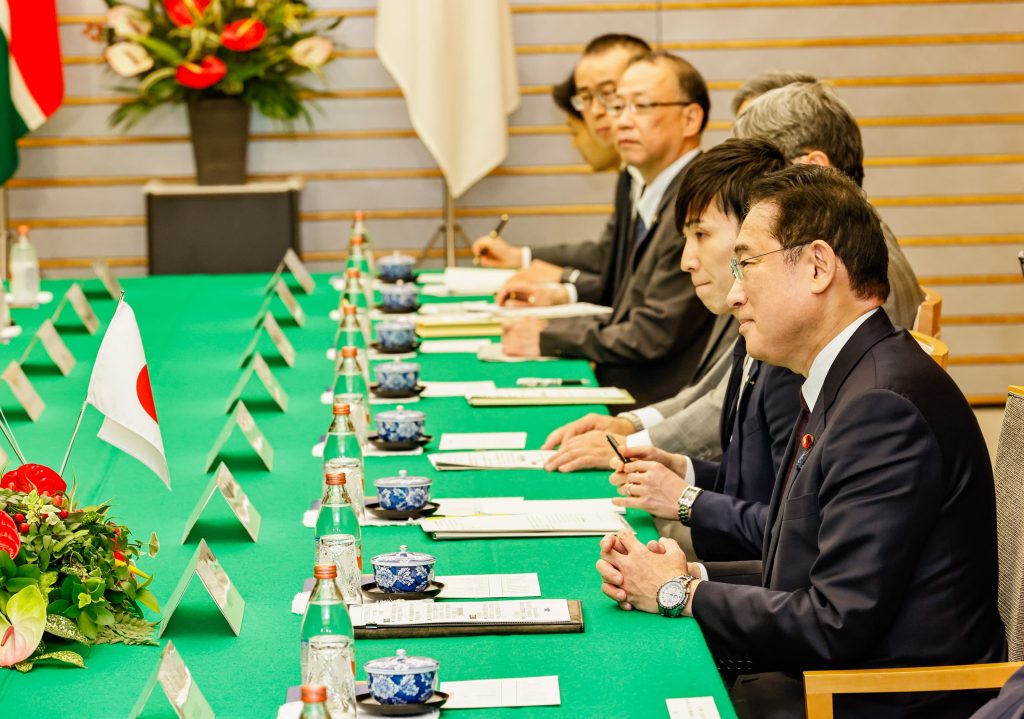
    Financial agreements worth KSh350 billion have been signed during President William Ruto’s visit to Japan.

    These agreements will support projects and programmes in sectors that are aimed at turning around the economic fortunes of the country.

    The largest projects to benefit are the Dongo Kundu Infrastructure Ecosystem and the Mombasa Gateway Bridge at the Coast at Ksh260 billion.

    President Ruto and Prime Minister Fumio Kushida also agreed that Kenya will issue a Ksh40 billion Samurai bond in Japan to finance energy and infrastructure projects.

    A Samurai bond is a yen-denominated bond issued in Tokyo by a non-Japanese company. The bond is, however, subject to Japanese regulations.

    Kenya also secured Ksh30 billion from the Japan Bank for International Cooperation to purchase heavy machinery and mechanised assets.

    The Olkaria Geothermal Development Project will get KSh15 billion. Japan will also provide KSh1 billion for the ⁠production of medical oxygen for various hospitals.

    Through the United Nations, Kenya will receive Ksh320 million humanitarian aid ⁠for those affected by the recent El Nino-related floods.

    Other agreements include MoUs on cooperation in the ICT, health, finance and security sectors.

    He said the MoU will include enhancing the capacity of the Kenya Medical Research Institute (KEMRI) to build on its pandemic management potential at a cost of Ksh3 billion.

    To strengthen the partnership between the two countries in defence, an agreement on Defence Cooperation was also signed. This makes Kenya ⁠the first African country to sign a defence pact with Japan.

    The President acknowledged Japan’s support for the completion of Phase II of the Mwea Irrigation Scheme and the National Rice Masterplan.

    President Ruto witnessed the signing of the bilateral agreements on Thursday after holding talks with Prime Minister Kishida of Japan.

  • President William Ruto to Officiate The 2nd Canada-Africa Business Conference

    President William Ruto to Officiate The 2nd Canada-Africa Business Conference

    The Canada-Africa Chamber of Business is thrilled to announce that His Excellency President (Dr.) William Samoei Ruto will officiate the second Canada-Africa Business Conference scheduled for 19th – 20th February 2024 in Nairobi. The event will also welcome Maninder Sidhu, Parliamentary Secretary to the Minister of Export Promotion, International Trade and Economic Development, in collaboration with the High Commission of Canada in Kenya.

    In partnership with the Kenya Private Sector Alliance (KEPSA) and the High Commission of Canada, the Canada-Africa Business Conference is set to bring together industry leaders for a day-long program at the prestigious Muthaiga Country Club and a VIP Reception on 19th February 2024. The program will be followed by a second day of site visits in Nairobi on 20th February.

    The conference is open to all corporate members of The Canada-Africa Chamber of Business, along with invited guests and sponsors. Sectors to be represented include infrastructure, energy, financing for Canada-Africa projects, and FinTech, with additional sector focus areas under development. The overarching theme will underscore Canada’s role as a trusted partner across African markets, emphasizing Kenya’s pivotal position as a key gateway to the East Africa region and the continent.

    “We eagerly anticipate sharing program updates as we confirm the participation of leading decision-makers,” said Deepak Dave, Program Chair for the event.

    Garreth Bloor, President of the Canada-Africa Chamber, expressed confidence in the success of the event, stating, “Our previous engagements in Kenya have always been an incredible success, and this is a testament – in no small part – to the key role of Kenya and KEPSA in Canada-Africa trade and investment.”

    Ms. Carole Kariuki, Chief Executive Officer of KEPSA, conveyed enthusiasm about the collaboration, stating, “We are excited to collaborate with the Canada-Africa Chamber of Business and look forward to the forum that will promote trade and investment between Canada and our great continent of Africa. This forum aims to widen the scope of available opportunities in medical care, infrastructure, energy, FinTech, and project financing.”

    All conference attendees are invited to join an evening reception on Monday, 19th February, following the day’s program. Christopher Thornley, the Canadian High Commissioner to Kenya, has graciously extended this invitation to all delegates of the 2nd Canada-Africa Business Conference.

  • Narok Governor On The Spot For Spending Billions On Wasted Projects

    Narok Governor On The Spot For Spending Billions On Wasted Projects

    Narok Governor Patrick ole Ntutu is on the spot for spending billions of shillings on stalled and abandoned projects in the past year.

    This even as the Controller of BudgetController of Budget (CoB) Margaret Nyakang’o revealed that the county government recorded the high- est development expenditure in the first quarter of the current fiscal year.

    According to the report, Narok splashed Sh1.3 billion, representing 30 per cent of their annual development budget, be- tween July and September 2023 alone.

    However, an oversight tour across the country laid bare the extent of shoddy workmanship and behind schedule proj- ects raising questions on whether residents got value for money in the process and in the period under review.

    For instance, at Sakutiek Health Centre in Narok North constituency, serving a population of 10,000, has only three clini- cal officers who also double as maternity officials.

    The facility lacks gloves for its maternity services with patients forced to buy while there is no reliable electricity at the ma- ternity wing with the power backup taken away during renovations.

    The maternity is also in deplorable state as the planned renovations did not pro- ceed apart from painting of the walls and changing the roofs.
    “Services have now stopped at the ma- ternity during power outages with medics having to use touches. Critical equipment like the steriliser and the resuscitator have broken down. If not for donor support, this hospital would be grounded,” said an officers at the hospital who sought anonymity for fear of reprisal.

    “We made a request for pharmaceuti- cals worth Sh300,000 but received medicine worth only Sh100,000 although records show we received drugs worth the former amount,” added the medic.

    The devolved unit had set aside Sh4 million for renovation but only few things have been done. The health centre often flooding when it rains.
    In another project at Nchurra Dispen- sary, the contractor has not been seen on site for the past seven months.

    The residents said the contractor was at the site for just a month before leaving saying he was giving the structural work he had done time to cure.
    Oversight tour. “Narok has used more development money with nothing to show for it. We want to ensure all the projects are com- pleted. I will make sure the governor is accountable by explaining why most of the projects are either incomplete or the contractors have left site,” said area senator Ledama ole Kina while spearheading the oversight tour.

    Continuing the ugly trend, the county government spent Sh3.5 million on a proposed dispensary at Entinki Primary School but the building is in deplorable state with the project stalled, after the con- tractor abandoned the site.

    Senator Kina said the idea was to have a hospital there to save residents from walk- ing long distances with patients because the next health centre at Sakutiek, is more than 10km away but that has not been achieved. “The contractors have pleaded with us not to expose them because they are afraid they will not be paid if the truth comes out,” he said.

    The contractors said they have not been paid even after raising their certificates leading to many abandoning the projects.

    In Mara ward for instance, a pre-primary school classroom collapsed just after completion due to poor workmanship with the county having paid Sh1.4 million to the contractor.

    According to Mara ward rep Chepkwony Kipng’eno, the roof of the building been blown away by wind, pointing that the contractor could have done shoddy job.

    In Melelo ward, Narok West, Ntutu’s administration had spent Sh18 million on the Rongena-Motony Road which is impassable despite the contractor having been paid most of the monies for the 6km stretch.

    Health officer

    In Melili ward, Narok North, a Sh4 mil- lion Enaibor-ajijik hospital has been aban- doned despite the contractor having been paid for two certificates raised.

    The contractor, Divine Construction Ltd has been paid Sh1 million but has not been at the site in the last two months. Bees are camping in some rooms at the hospital, which were to be renovated.

    During the visit, there was no single health officer at the facility with a Health official busy attending to his farm nearby.

    “I am at my farm because there is no medicine here. Patients visit but there is little we can do. The last time the con- tractor was here was in July last year. Four men and a lady sharing a two-bedroomed house. There is no reliable water while the toilets are broken,” said the officer.

  • Kisumu County Rolls Out Roll Out Cashless Revenue Collection System

    Kisumu County Rolls Out Roll Out Cashless Revenue Collection System

    Kisumu County Government has partnered with the mobile telco Safaricom to unveil a new Integrated County Revenue Management System (ICRMS) to offer a one-stop platform for residents to access and pay for various county services.

    Governor Prof Anyang Nyong’o remarked that the bold decision to embrace the new, integrated, and automated system would not only enhance accessibility and transparency but also tremendously boost its Own Source Resource (OSR) collection regime.

    “With this innovative approach, and if well managed, we hope to collect the county potential target of Sh2.2 billion and build on that next year. We have co-created this platform with Safaricom to provide a seamless and user-friendly experience for Kisumu residents and county officials to contribute to the overall efficiency of revenue management,” Prof Nyong’o said during the launch at the City Hall.

    He added that the new revenue collection system is purely cashless and it has been made available on several channels to support seamless revenue collection, including the Safaricom App, Mobile App, and WhatsApp platforms.

    While thanking the Kisumu County Revenue Board and Safaricom for their tedious work of putting the new system in place, Prof. Nyong’o noted that the revenue collectors have undergone adequate training on how to use and monitor the new platforms.

    He expressed his satisfaction with the real-time verification of transactions and payments which has been made possible using secure unique identifiers including QR codes.

    In addition, the system ensures Real-time reporting of all revenue transactions across all departments in the county.

    The County boss also revealed that they were also introducing the Ushuru Centre; which is both a contact and call center from where the county revenue staff would be able to assist and resolve issues related to revenue from the citizens.

    “The system has GIS Data Integration Capability which is intended to help the County Government Map all its revenue sources and resources to ensure enhanced service delivery and to make revenue collection easy and more organized, especially for the structured revenue streams,” he assured.

    Notably, the smartphones being used are installed with new technology and capability to be used by the officers for revenue collection, and they can both work online and offline. The system passed the credibility tests upon undergoing the pilot testing for the Unstructured Revenue Streams which began on December 18, 2023.

    The already rolled-out streams include; Markets, Town Parking, Bus Park, Cess, and Stock Rings, among others. Mooted plans are also underway to include in the new system the Unified Business Permit, Advertisements, Plan Approvals, and Rates.

    Safaricom’s Chief Enterprise Business Officer Cynthia Kropac pointed out that the ICRMS would address the county’s challenges in optimizing revenue collection, administration, and reporting.

    “The innovative platform will support various revenue services, including parking, cess, markets, advertising, property rates, and approvals, among other revenue services reducing queues and wait times at the county offices,” she affirmed.

    Kropac emphasized that the ICRMS is designed to enhance citizen satisfaction by providing convenient payment options for services where residents could pay through various channels, including USSD (*427#), WhatsApp, the MyKisumu App, and a web self-service portal.

    “The system which is Kenyan-made and locally-made ensures real-time integration with payment channels like MPESA and banks for accurate reporting and reconciliation of transactions. This will enable enhanced visibility and control are provided through dashboards accessible to executives, enabling effective monitoring of revenue performance and operations,” she said.

    “At Safaricom, we are committed to leveraging our technological capabilities to drive positive change in communities across Kenya. The implementation of the ICRMS system in Kisumu County reflects our commitment to driving digital transformation for efficient service delivery, making services more accessible and convenient for all, and furthering our mission to connect, empower, and improve the lives of Kenyans,” said Kropac.

    The ICRMS also incorporates transparency features, providing real-time updates on revenue collection and usage and fostering accountability and trust between citizens and the county government. Its implementation is aligned with Safaricom and #39’s broader mission to empower businesses and government entities through digital solutions.

    Pointedly, the ICRMS utilizes Safaricom and #39’s technological expertise to streamline and modernize revenue collection processes, facilitating convenient payment for county services through multiple channels, thus enhancing accessibility and transparency.

    Kropac further revealed that to enable end-to-end support, the East Africa Device Assembly Kenya Limited has come on board to provide smartphones required to run the revenue application used by dedicated revenue collectors. The devices are managed securely to ensure they are purpose-fit to run the revenue collection services effectively.

    Prof Nyong’o informed that public sensitization is currently ongoing and he urged the county staff to remain disciplined and committed to the successful implementation of this great innovation.

    “I want to appeal to everyone involved in revenue collection using this new system- from the revenue Board, the County Treasury and the actual collectors to ensure we meet our targets because it is now or never. I also want to appeal to our cherished taxpayers to support us by promptly paying their taxes and reporting any of our officers trying to manipulate the system. On our part as the executive, we assure you of secure, clean, and environmentally friendly trading spaces,” Nyong’o urged.

  • IMF Approves Sh150B Further Loan For Kenya

    IMF Approves Sh150B Further Loan For Kenya

    The International Monetary Fund (IMF) on Wednesday approved a $941 million (Ksh.150 billion) lending boost to Kenya, with an immediate disbursement of $624.5 million (Ksh.99.6 billion), offering some relief to the East African country as it battles financial pressures.

    The disbursement under the Extended Fund Facility (EFF) and Extended Credit Facility (ECF) programs will also be topped by a release of $60.2 million under the Resilience and Sustainability Facility (RSF) arrangement.

    The executive board sign-off brings the IMF’s total funding commitment to Kenya under all three facilities to more than $4.4 billion.

    “Kenya’s growth remained resilient in the face of increasing external and domestic challenges. The EFF/ECF and RSF arrangements continue to support the authorities’ efforts to sustain macroeconomic stability,” the IMF said in a statement on Wednesday.

    Kenya is grappling with acute liquidity challenges amid uncertainty over its ability to access funding from financial markets before a $2 billion Eurobond matures in June.

    The government has said that, together with expected funds from the World Bank and regional banks like the African Export-Import Bank and Trade & Development Bank, the IMF funds will help Kenya to pay the looming foreign debt maturity without running down its hard currency reserves.

    Kenya’s balance of payments and financial positions have also been strained by the legacy of the COVID-19 pandemic and frequent climate change-induced droughts, according to the IMF, while its shilling currency has weakened.

    Advertisement · Scroll to continue
    The approval of the new IMF money followed a staff-level agreement reached with Kenyan officials in November, with slight differences in dollar values due to currency fluctuations in the IMF Special Drawing Rights unit of account.- (Reuters).
  • Starbucks Sued For Deceptive Marketing

    Starbucks Sued For Deceptive Marketing

    Starbucks is being sued by a consumer advocacy group alleging that the global coffee chain falsely and deceptively advertises the “committed to 100% ethical sourcing” claim on its coffee and tea products.

    The lawsuit, filed by the National Consumers League in a Washington, DC court, alleges that Starbucks misrepresents to consumers that it is “committed to 100% ethical coffee sourcing” and to “100% ethically sourced tea” even as it continues to source coffee beans and tea leaves from cooperatives and farms that “have committed documented, severe human rights and labor abuses, including the use of child labor and forced labor as well as rampant and egregious sexual harassment and assault.”

    “On every bag of coffee and on every box of K cups sitting on our grocery store shelves, Starbucks is telling consumers a lie,” Sally Greenberg, CEO of consumer advocacy group National Consumers League, said. “The facts are clear. There are significant human rights and labor abuses across Starbucks’ supply chain,” she said.

    The goal of the lawsuit is to protect consumers nationwide, who may “unknowingly be buying unethically sourced coffee or tea” from the brand and be paying a a premium for those products, according to the consumer league.

    “Consumers have a right to know exactly what they’re paying for,” Greenberg said in a news release.

    Supply chain criticism

    Greenberg alleged “well-documented instances” for years in the retailer’s supply chain of “slavery-like conditions,” child labor, human trafficking and other exploitative working conditions on farms and co-ops where Starbucks sources its coffee and tea.

    She referenced an incident dating back to 2022 when a Brazilian labor prosecutor issued a complaint against Starbucks’ largest Brazilian supplier, “citing working conditions analogous to slavery, including illegally trafficking more than 30 migrant workers.”

    The lawsuit, however, cites investigative reportsin Brazil this year about workers at a Starbucks’ certified coffee supplier who allegedly were victims of wage theft by their employer, in violation of Brazilian law.

    A separate investigative report from the BBC in February 2023 looked into alleged gender-based violence and sexual harassment at a Kenyan tea plantation, which the report said supplied to Starbucks at the time.

    Greenberg said her group is seeking to restrict Starbucks from further engaging in deceptive advertising and to run a corrective advertising campaign.

    ”Starbucks must reform its sourcing practices to ensure that workers on the farms and cooperatives that supply its coffee and tea products are treated fairly and in accordance with the law,” she said.

  • The Mess At Kenya’s Savings And Credit Cooperative organisations

    The Mess At Kenya’s Savings And Credit Cooperative organisations

    All things seem bright and glittering at Kenya’s saving and credit cooperatives (Saccos).

    Splashed adverts and advertorials in the mainstream media and a barrage of commercials in numerous social media channels of testimonials by, for instance, happy members who have acquired prime property at affordable rates courtesy of their ingenious savings and credit organisations conjures an image of a thriving sector.

    Behind that veil of unrivalled success, however, are heartrending tales of individual members whose financials have been messed up irreversibly due to, mainly, unscrupulous management regimes at the Saccos, and archaic financial regulations that most saving and credit organisations have stuck with from time immemorial.

    This has created ground for deceit resulting to broken hearts, failed dreams and shattered careers. If you are a member of a Sacco in Kenya, you must have heard of, if it is yet to happen to you, a scenario where members have had to endure the pain of paying up a loan for a colleague or friend they had guaranteed.

    It cuts across all savings and credit organizations irrespective of the Sacco’s parent organization. It has happened at Saccos for lawyers and judges and the police despite the fact that they are the overseers of the law.

    Ordinarily, it has always been out of unforeseeable circumstances like loss of one’s job rendering them completely unable to service their loans. However, there have been cases in the past, though rear and far apart, where someone you have guaranteed a loan at your Sacco would blatantly ignore their financial obligations to the Sacco even as they thrive in their lives, leaving you with the burden, as their guarantor, of paying their loans.

    Saccos sometimes leave the principle owners of the loans in tough circumstances. They are seemingly more concerned with the guarantors and it doesn’t matter whether as a guarantor, your financial status is worse than the person you guaranteed.

    Unfortunately, members of savings and credit organizations end up exploiting this situation big time. Rates of intentional loan defaults are at their highest and at crises levels at some Saccos.

    A spot check in Nairobi City Schools reveals a sad situation with teachers, particularly in private schools, having been lured into enrolling with Saccos and getting extended loans and allowed to guarantee colleagues left, right and centre without proper briefing on the financial import of their decisions. At Riara Group of Schools, for example, it is a crisis.

    Speaking to a former teacher at the school whose name we cannot reveal, staff at the school, both teaching and nonteaching are mired in loans at the Mwalimu National Savings and Credit Cooperative Organisation (Mwalimu National) to the extent that if an intervention does not suffice in the near future, suicide might be looming large on the horizon.

    The school, like many across the country, has a memorandum of understanding (MoU) with Mwalimu National for check off loans for their staff. When the Sacco was invited to market their services at the inception of the MoU to members of staff, it was, as usual, laced with a lot of sweeteners and incentives, the former teacher offers.

    Loan offers were given to the new members at will, with a grace period of up to three months. Many, if not all members of staff joined the ring and took loans and guaranteed colleagues. It became a network. As much as it may be true that in private schools, staff are always on the move, scavenging for greener pasture, it did not take long before the loan crisis began unravelling.

    With over 80% of staff at the institution’s two schools including head teachers waist deep in the pit of loans and guarantees, it would only take one member to default to trigger the crumbling of the web. Those who have been at the institution longer say a senior teacher at the school set a bad example in the past after he left for greener pasture in the United States of America. He left without settling his debt with the Sacco leaving his colleagues with a heavy burden of settling his loan. He has since passed on and the victims of his bad faith believe that his treachery had something to do with his untimely death.

    Since then, members of staff at the two schools have made a game out of betraying each other as far as defaulting on loan payment is concerned. Recently a member of staff at one of the schools scuttled her investment plans when she received a letter from Mwalimu National to the effect that a former colleague she had guaranteed had defaulted and she was to pay the over Sh250, 000 she had guaranteed.

    “I will not even bother calling her. Ever since she resigned, I have been expecting this letter even as I hoped it will never come,” she said as she mulled over plans to cancel a land buying agreement she had recently entered into.

    “It is the trend at our school,” she says. “Colleagues are defaulting on purpose. Some leave for better paying jobs in the city and blatantly refuse to pay. Colleagues are getting near negative pays courtesy of paying defaulters loans.”

    Other cases at the school are pure fraud, exploiting loopholes in the loan processing procedures at Mwalimu National, our informer who has since resigned at Riara School said, “a colleague would approach you with a loan application form that reads Sh30, 000 only for him to add an extra zero and change it to Sh300, 000 after you have guaranteed him. Mwalimu National only communicates through messages. Teachers switch off their phones while in class. Most would switch on their phones late evening after duty. In such a case, messages that were on cue all day would trickle in quick succession and chances to miss out on some are high. Those keen on defaulting on loans and defrauding their colleagues would take their chances, with high success rates.”

    By the time he was leaving the school, and he wasn’t the first to leave on account of servicing numerous loans of defaulters, he was paying up loans for four colleagues who had left the school. Some of those colleagues were doing better than when they were at Riara School.

    “I ever followed a colleague to his new school, an international school that paid much better than Riara. I had a discussion with his bosses on whether his pay could be deducted to go towards settling his loan at Mwalimu National and they blatantly told me they could only effect that with the teacher’s consent. He refused and that was the end of the story,” he narrates.

    He says it is an emotive topic that no one at Riara wants to talk about. Teachers are bitter. The school has also suffered the brunt, especially with the hemorrhage of teaching staff, mostly running away from obligations of paying for loans they only guaranteed, and low morale of those still around.

    Our informer talks of one particular lady teacher who was doing financially well, driving own car, a flourishing family, but who is now on her knees, with a near negative salary. She has since sold her car and every other property she owned. “She was so good hearted. She guaranteed many colleagues who let her down and now almost all her pay is going into servicing those loans. It is sad.”

    When he was about to leave, our informer says, one lady colleague who had guaranteed him pleaded with him not to leave her the burden of paying off his loan. She was already crumbling under the heavy burden of more than two other loans that colleagues had defaulted on.

    “I felt it. I could not afford to do that to her and two other colleagues. I went to Mwalimu National and pleaded with them to allow me clear my loan despite the fact colleagues I had guaranteed had defaulted. They refused. Anything I paid would go to clearing those other loans first. I had to be smarter to get out of this without hurting my colleagues. I applied for another loan to which they agreed to allow me clear the first one before I could be advanced another after one month from the date I would have cleared my earlier loan. I ran around, got money and cleared and left Riara School altogether,” he narrates.

    He also wondered why, with such a vicious cycle, the Sacco cannot just bend its regulations and allow everyone to just clear their own loans. He added that private schools hardly give their staff advances when they are in difficult situations or for development purposes hence the heavy reliance on Saccos.

    Mwalimu National’s chief manager customer care, marketing and research, Mr Jairus Ounza in response to our interview queries reiterated that Sacco business is indeed modeled on loan guaranteeing, which is based on very close relationships, often at the workplace. Unfortunately, he declined to comment on the default rates of members on account that policy does not allow them discuss confidential financial information.

    “Cases on loan default (at Mwalimu National) are extremely minimal and currently stand 2.3% of total loan portfolio of close to Sh40billion against regulatory threshold of 5%. As a policy, we do not discuss members’ confidential financial information. However, non-performing loans are properly disclosed in our financial reports, in which there is nothing to indicate the nature of crisis your letter alleges. Given the foregoing, I will treat your allegations of teachers being “mired in unsustainable loans” as baseless rumours,” reads part of Mr Ounza’s response.

    But, how big and devastating can 2.3% of Sh40 billion be if it is concentrated in a small portion of the entire sector?

    Private school teachers, unlike their counterparts under Teachers Service Commission, are not public officers. As such, they are not strictly watched under the Public Officer Ethics Act, or Leadership and Integrity Act that put financial probity of a public officer under scrutiny. A teacher seeking employment at a private school would not be asked to provide his or her Credit Reference Bureau (CRB) report. If anything, Saccos are not yet under the ambit of the CRBs. It is time they follow rules and regulations just like banks.

    It would be suicidal to merely look aside and say, as Mr Ounza does in his response to our interview questions that “the qualification criteria and procedure for loan application and guaranteeing are known to all our members and indeed are matters of public knowledge,” insinuating that what is happening to these teachers is none of Mwalimu National’s business.

    This story merely scratches the surface. It is a mere tip of the iceberg. What is beneath the surface would indeed scatter the Titanic. It is our hope that a stakeholder would pick it up, going forward, with the aim of finding the extent to which this has rocked individuals and to also remodel Sacco business to curb the mess out.

  • Unaccounted For Millions To Mount Kenya University And Other Private Universities Triggers Heated Debate In Parliament After Auditor General’s Alarming Report

    Unaccounted For Millions To Mount Kenya University And Other Private Universities Triggers Heated Debate In Parliament After Auditor General’s Alarming Report

    The leader of majority in parliament Kimani Ichungwa recently sparked a debate in parliament about what he termed as takeover by cartels in education education.

    The legislator raised concerns over imbalance in allocation and funds by the government between the public and private universities. He particularly criticized the allocation of Sh730 million to Mount Kenya University which is a private institution while other public universities like Karatina, Egerton are facing financial difficulties and and the verge of closure.

    He claims allocations made to some of the private universities cannot even be accounted for as they’re fraudulently gobbled away.

    Ichungwa’s lamentations comes at a time when the Auditor General Nancy Gathungu report for 2021/22 financial year, Sh3.4 billion disbursed to private universities could not be accounted for.

    The report flagged anomalies including failure by five universities to provide documents despite receiving funds, lack of supporting schedules of students benefitting, duplicated schedules of payment as well as payment of tuition fees to non-existence students.

    “The statement of receipts and payments reflects Sh85,016,468,678 in respect of transfers to other Government units which as disclosed in Note 6 to the financial statements includes Sh3,374,791,603 in respect of transfers to private universities. In the circumstances, the accuracy, completeness and regularity of transfers to other government units could not be confirmed,” reads the report

    According to the report, despite the department disbursing Sh265.3 million to five universities, no acknowledgment letters and receipts from the universities were provided to confirm receipt of the funds.

    And while another amount of Sh198.5 million was disbursed to three universities, they only confirmed receiving Sh183.3 million, resulting in un-reconciled and unexplained variance of Sh15.2 million.

    The report also noted that an amount of Sh22.6 million was disbursed to 13 universities for 404 students but analysis of the supporting schedules revealed that these students had been duplicated in the schedules, resulting in an overpayment of the entire amount totaling Sh22.6 million.

    “A transfer to private universities of Sh136,295,811 was made for 3,357 students who had graduated by November, 2021 and, therefore, Management may have disbursed funds for students who had already completed studies and exited the universities.”

    In addition, the report reveals that an amount of Sh376.99 million was disbursed for a total of 8,964 students who were not active in the period July, 2021 to June, 2022 as they had not registered to sit for the scheduled exams in their respective universities while an amount of Sh337.2 million was disbursed for a total of 7,828 students who had been in the universities for more than four years which is the normal period undertaken for most undergraduate programmes.

    According to the report, the management may have disbursed funds for students who had deferred or quit the universities as well as paid tuition fees to non-existent students in private universities.

    The report comes hardly months after MPs directed Gathungu to carry out a special audit of all funds sent to 31 private universities that have been receiving exchequer funding.

    Of the 30 universities among the top beneficiaries include Mount Kenya that gets Sh552.3 million for 12,479 students, Kabarak, Sh357.9 million for 7,715 students, Catholic University of East Africa Sh196.9 million for 4,685 students, Kenya College of Accountancy  gets Sh223.9 billion for 5,142 students, university of Eastern African Baraton Sh183 billion for 4222 students and Zetech University Sh115.4 million for 2,836 students.

    According to documents from Universities Fund in the 2017/18 Financial Year, private universities received Sh1.6 billion as grants for 18,587 students, in 2018/19FY they received Sh1.98 billion for 29,729 students, in 2019/20 FY they received Sh2.5 billion for 43,676 students while in the 2020/21 Financial Year they received Sh2.7 billion.

    In the last four years, private campuses have received grants worth Sh8.7 billion from the government at the expense of public universities.

    MKU is also a major beneficiary of the previous regime where in 2021, it cut a deal with the Teachers Service Commission (TSC) to offer professional courses for teachers.

    This was after the teacher’s employer enforced that the refresher courses will be a requirement for teachers to enable them to renew their practising certificate every five years.

    Mount Kenya University Vice Chancellor Prof. Deogratius Jaganyi holding a copy of the contract signed with Teachers Service Commission.

    In this state-private sector deal, the institution stood to earn billions. It’s unclear how the process of choosing the suitable institutions were done and of it was an open process.

    Nancy Gathungu, the auditor-general, in the report faults the state department of education for directly financing universities, contrary to legislation that requires that financial allocations be done through the fund.

    Lately, there have been claims within the corridors of higher education that universities get funding directly from the state based on their managements’ capability to lobby for allocations.

    But, the Universities Act (2012) established the fund and mandated it to finance universities. Section 53 (3) spells out the functions of the fund.

    However, Gathungu says in the report: “The fund has only been advising the State Department for University Education on [how] to allocate and disburse to the public universities.”

    Gathungu is, therefore, concerned that the fund is not discharging its lawful mandate: “In the circumstances, it has not been possible to confirm whether the fund has been carrying out its mandate required by the Universities Act, 2012.”

    In the report, Gathungu says that a review of the records showed that the fund has not been allocating funds to universities as required by the law.

    The fund, in its operations, adopted the 2016 Differential Unit Cost (DUC) principles for distribution of funds to universities. This has been deployed since 2017-18 in the allocation of funds to universities.

    The DUC operates on the basis of the cost to an institution to teach one academic programme per student per year. DUC lumps specific programmes in terms of their cost into 18 clusters, ranging from the lowest that is KSh144,000 (US$1,260) for humanities and the highest being KSh720,000 for dentistry.

    However, universities in the past four years have been advocating for the revision of the DUC to do away with disparity between public and private universities.

    Investigations by relevant agencies will unearth and determine the extent of alleged fraud and address the loopholes.

    Additional reporting by the people.

  • KCB Launches Talent Offensive Against NCBA in Response to Safaricom’s Influence

    KCB Launches Talent Offensive Against NCBA in Response to Safaricom’s Influence

    John Okulo has been appointed as the director for corporate banking at KCB Bank Kenya, effective June 5. Telco giant Safaricom triggered a talent war in February, leading to this appointment.

    Mr. Okulo, a seasoned banker with 24 years of experience, previously served in a similar position at NCBA Bank.

    Annastacia Kimtai, the managing director at KCB Bank Kenya, expressed excitement about having John on board to drive the growth of their corporate banking franchise and contribute to the country’s growth agenda.

    Esther Masese Waititu, who held the position since 2021, has been replaced by Mr. Okulo. Esther joined Safaricom in February 2023 as the chief financial services officer.

    Ms. Waititu’s departure from KCB sparked a talent battle, resulting in the lender recruiting Mr. Okulo. He has been with CBA since July 2011 and continued his tenure after the merger with NIC to create NCBA in 2019.

    KCB
    John Okulo, the new director for corporate banking at KCB Group

    Mr. Okulo has an extensive background in the banking industry, having held various leadership positions.

    Previously, he served as the chief commercial officer at Commercial Bank of Africa (CBA), where he successfully managed the commercial operations of the bank.

    He also held the position of managing director at NC Bank Uganda and head of corporate and investment banking at Stanbic Bank Uganda.

    With a Master of Science in Economics from the University of Gdansk, Poland, Mr. Okulo has acquired a solid educational foundation. Additionally, he holds multiple global and local certifications, further enhancing his expertise in the field.

    In 1997, Mr. Okulo embarked on his banking career as a management trainee at Standard Chartered Bank Kenya. This early experience laid the foundation for his future success and growth in the industry.

    Currently, Mr. Okulo has joined the corporate banking division of KCB. This division specializes in providing a comprehensive range of financial products and services tailored to the needs of mid-to-large-sized corporates and public sector entities.

    To strengthen their technical and financial leadership, KCB has restructured its corporate banking division into sectoral lines. These sectors include manufacturing, industrials, infrastructure and energy, financial services, and the public sector.

    By aligning their services in this manner, KCB aims to drive excellence and specialization in each sector, better catering to the unique requirements of their clients.

  • Kenya Airways’ Debt Load Raises Concerns Among Potential Investors

    Kenya Airways’ Debt Load Raises Concerns Among Potential Investors

    Kenya Airways (KQ), the national carrier of Kenya, has been struggling to find buyers for its proposed equity stake sale. However, potential investors are expressing uneasiness over the airline’s heavy debt burden, which has become the biggest hurdle in the search for buyers.

    The airline’s precarious financial situation has raised concerns about its long-term sustainability and profitability.

    In this article, we explore the challenges posed by Kenya Airways’ debt load and the implications it has for the airline’s efforts to attract investors.

    Kenya Airways

    Kenya Airways Debt Burden

    Kenya Airways has been grappling with a substantial debt load for several years. The airline’s liabilities have been mounting due to factors such as fleet expansion, operational inefficiencies, high fuel costs, and increased competition.

    As of the knowledge cutoff in September 2021, the airline’s total debt stood at approximately $2 billion. Such a massive debt burden has a significant impact on the airline’s financial health and investor confidence.

    Implications for Investors

    Potential investors considering the equity stake sale of Kenya Airways are wary of the airline’s debt load for several reasons.

    Firstly, the debt burden limits the airline’s ability to invest in growth initiatives, modernize its fleet, and improve operational efficiency.

    These factors are crucial for any investor looking to generate a return on their investment in the long run.

    Secondly, the heavy debt load raises concerns about the airline’s ability to service its debt obligations, which include interest payments and principal repayments.

    If Kenya Airways is unable to meet these financial commitments, it could lead to defaults and further deteriorate its financial standing.

    This creates uncertainty for potential investors who are looking for stable and predictable returns.

    Furthermore, the debt burden affects the airline’s creditworthiness and access to financing options.

    Kenya Airways may face challenges in securing additional loans or favorable interest rates, which could hamper its ability to fund operations and future expansion plans.

    This adds another layer of risk for potential investors who seek a financially stable and sustainable investment opportunity.

    The Way Forward For Kenya Airways

    Addressing the heavy debt burden is essential for Kenya Airways to attract potential investors and improve its financial outlook.

    The airline has undertaken several measures to reduce costs, increase operational efficiency, and explore partnerships to alleviate its financial strain. However, these efforts may not be sufficient to alleviate the concerns of potential investors.

    To enhance its appeal to investors, Kenya Airways needs a comprehensive debt restructuring plan that includes renegotiating terms with creditors, exploring debt-for-equity swaps, and implementing cost-saving measures throughout its operations.

    Such initiatives would not only reduce the airline’s debt burden but also demonstrate its commitment to long-term financial sustainability.

    Moreover, the Kenyan government, as the majority shareholder, has a vital role to play in supporting the national carrier.

    It should provide a conducive regulatory environment, offer financial assistance, and facilitate strategic partnerships that can help revive Kenya Airways and make it an attractive investment opportunity.

    Conclusion

    Kenya Airways’ heavy debt load presents a significant challenge in its quest to attract potential investors through an equity stake sale.

    The debt burden restricts the airline’s ability to invest in growth, raises concerns about its financial stability, and adds uncertainty for investors seeking predictable returns.

    To overcome these obstacles, Kenya Airways must get rid of cartels and undertake comprehensive debt restructuring measures while receiving support from the government and exploring strategic partnerships.

    Only through such concerted efforts can the national carrier regain investor confidence and chart a sustainable path for the future.

  • George Soros Passes the Torch: $25 Billion Wealth Transitioned to Son Alex

    George Soros Passes the Torch: $25 Billion Wealth Transitioned to Son Alex

    George Soros, a renowned billionaire investor and philanthropist with a net worth of $6.7 billion, has announced his decision to pass on a substantial portion of his wealth to his son, Alex Soros.

    This monumental transition involves a transfer of $25 billion, an inheritance that will undoubtedly have significant implications for both the Soros family and the causes they champion.

    As one of the top 400 richest people in the world, George Soros has made a profound impact on global finance, politics, and social justice.

    This article explores the implications of this wealth transition and the potential influence of Alex Soros in continuing his father’s legacy.

    George Soros
    Billionaire George Soros

    George Soros: A Legacy of Influence

    At the age of 92, George Soros has amassed an extraordinary fortune throughout his career as a hedge fund manager, investor, and philanthropist.

    Born in Hungary, Soros survived Nazi occupation during World War II and later emigrated to the United Kingdom.

    He built his wealth through astute investments, most notably with his Quantum Fund, and gained global recognition for his financial prowess.

    However, Soros is not only known for his financial success; his philanthropic efforts have earned him admiration and controversy in equal measure.

    Through his Open Society Foundations, Soros has supported democracy, human rights, and social justice causes worldwide.

    His contributions have been particularly significant in Eastern Europe, where he has played an instrumental role in promoting democratic values and supporting civil society organizations.

    Alex Soros: Continuing the Legacy

    George Soros
    Philanthropist Alexander Soros

    With George Soros passing on a considerable sum of his wealth to his son, Alex Soros is poised to play a pivotal role in shaping the family’s philanthropic endeavors and continuing his father’s legacy.

    While Alex’s exact plans for the inheritance remain unknown, it is anticipated that he will follow in his father’s footsteps by championing social justice causes and supporting organizations that strive to bring about positive change.

    Alex Soros, an accomplished philanthropist in his own right, has been actively involved in the Open Society Foundations for years.

    As the founder of the Alexander Soros Foundation, he has demonstrated a commitment to fostering social justice, promoting civil rights, and combating inequality.

    With his father’s wealth now at his disposal, Alex has the potential to magnify the impact of his philanthropic initiatives and address pressing global challenges.

    Implications of the Wealth Transition

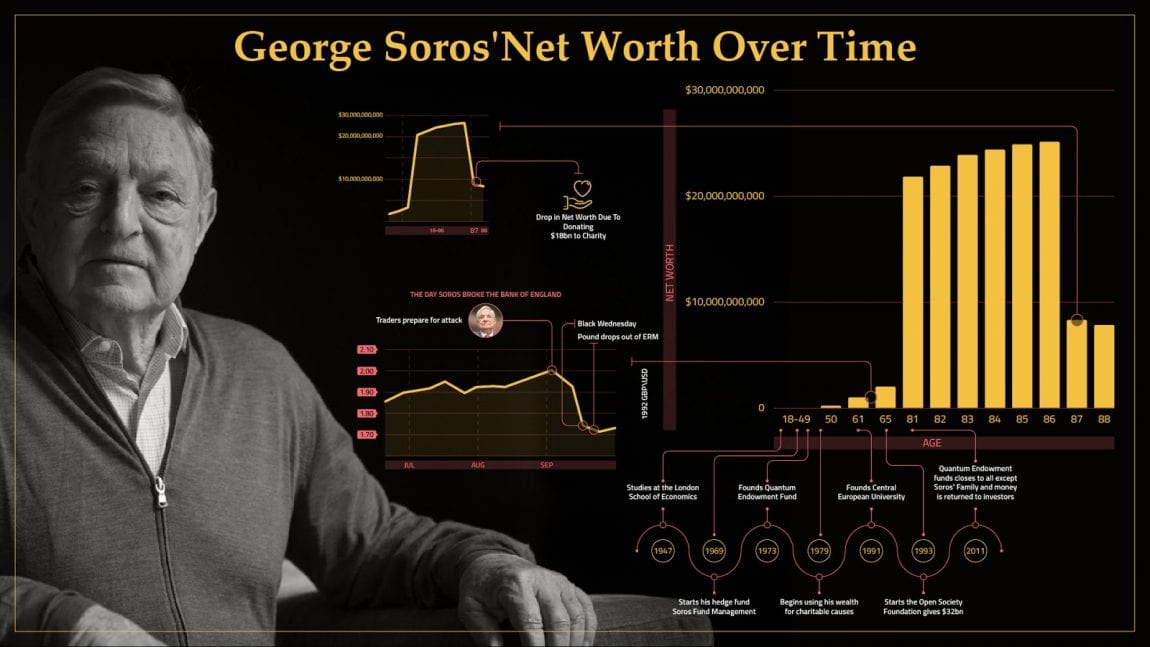
    George Soros' Net Worth Over Time - AskTraders.com
    Image: AskTraders.Com

    The transfer of $25 billion from George Soros to Alex Soros raises pertinent questions about the concentration of wealth and the responsibilities of the ultra-wealthy.

    Some may argue that such large transfers perpetuate wealth inequality, emphasizing the need for systemic change to address the root causes of economic disparity.

    On the other hand, supporters of philanthropy see this transition as an opportunity for Alex Soros to carry on his father’s philanthropic legacy and make a significant difference in the world.

    It is worth noting that philanthropy has the power to effect positive change in society when applied thoughtfully and strategically.

    The Soros family’s longstanding dedication to supporting social justice causes indicates a genuine commitment to creating a more equitable world.

    As Alex Soros takes the reins, his influence and decisions will shape the future impact of the family’s wealth.

    Conclusion

    George Soros’ decision to pass on a substantial portion of his $25 billion fortune to his son, Alex Soros, marks a significant transition in the family’s philanthropic efforts. George Soros has left an indelible mark on the world through his financial success and commitment to social justice causes.

    As Alex Soros inherits this immense wealth, he carries the responsibility of continuing his father’s legacy and making a positive impact on society.

    Whether he chooses to uphold and expand upon the family’s philanthropic endeavors or charts his own path, the world will keenly observe the influence of the Soros family in shaping a more equitable future.


  • Selective Tax Wars By KRA Bad For Business, Pushing Investors Away

    Selective Tax Wars By KRA Bad For Business, Pushing Investors Away

    In a bid to spur investments, the Kenyan government extended a blanket tax waiver so that businesses merge and increase their operating capacities. Among the beneficiaries of the blanket waivers was NCBA.

    The sum total of the revocation of the tax exemption meant that NCBA bank was to pay KRA in excess of Sh900 million including interest.

    The value of the CBA shares was not quoted during the sealing of the merger deal but market players estimated the value of 53 per cent stake at Sh35 billion.

    This was based on the book value of Sh65 billion at the time the deal was closed, translating to a stamp duty charge of over Sh350 million.

    The Sh900 million KRA is now laying claim to includes interest accrued over the five-year period since the merger was sealed on June 19, 2019.

    During that time, former Treasury CS Ukur Yatani in a letter dated June 21, 2019 said approval had been granted to exempt from Capital Gains Tax the instruments executed in the transfer of shares and the transfer of assets and liabilities relating to the merger of NCI Group PLC and Commercial Bank of Africa Limited.

    This was based on provisions of the Eight Schedule of the Income Tax Act which allowed the merger to be exempted from CGT.

    “By a copy of this letter, the Group Managing Director of NCBA is advised that the approval for exemption of the Capital Gains Tax that was payable on the transfer of shares and the transfer of assets and liabilities relating to the merger of NIC Group and CBA Group has been revoked,” the CS wrote to the acting Commissioner General at the Kenya Revenue Authority.

    “… as well as the letter communicating the approval dated June 21, 2019, and should liaise with Kenya Revenue Authority on this matter.”

    The tax waiver followed legal channels and is legally binding for NIC Bank and CBA bank that merged to form NCBA Bank. Other businesses also benefitted from this merger tax relief.

    True to the plan, the mergers have seen increased businesses, more employment opportunities and more taxes paid to KRA.

    At the time of the merger, the financial institutions that formed NCBA had a total of 26,000 shareholders. According to Bank’s CEO Mr. John Gachora, the same year that the 350 million shillings waiver was awarded, the lender paid 4.4 billion shillings in taxes to the Kenya Revenue Authority.

    In 2021, NCBA paid 6.7 billion shillings in taxes and for the 2022 financial year, the lender will be paying at least 14.3 billion shillings to the taxman.

    However, the government, driven by personal agenda, has now backtracked on its own undertaking. The Treasury last month walked back on its June 19, 2019, decision that approved exemption from Capital Gains Tax (CGT) in the transaction that merged the two lenders through a transfer of shares and assets, forming the current NCBA Bank one of Kenya’s biggest lenders.

    Alarmingly, only NCBA is being targeted in this game of selective witch-hunt. Safaricom also had a tax waiver in the Huawei-CCTV deal.

    It must be remembered that the government is an institution and not the elected leaders of the day who come and go. A government stands for continuity and stability.

    The High Court has meanwhile temporarily protected NCBA from paying taxes on the transaction as the matter goes through hearings and eventually to a determination.

    “That I am satisfied that the application has met the test for grant of conservatory orders at this ex parte stage. Accordingly, prayer 2 of the application is hereby granted,” Lady Justice Mugure Thande ordered in a ruling issued on Thursday.

    If KRA punishes businesses, who will pay taxes to it? How will it collect taxes?

    In 2021 Justice Weldon Korir warned Kenya Revenue Authority to stop killing local companies in the guise of collecting taxes.

    The judge ruled that the taxman has become a monster in itself by killing local businesses over alleged failure to pay taxes which in turn affect thousands of families whose bread winners are rendered jobless once the companies are shut down.

    According to the judge, KRA itself will soon run bankrupt and fail to meet its tax collection targets if it continues with the trend of closing businesses which are supposed to remit the tax.

    “When KRA proceeds to kill businesses in the guise of collecting taxes, it becomes an undertaker and will itself eventually die since its survival depends on the existence of income generating businesses from which it can collect taxes,” ruled Korir.

    The vindictive action by the new regime and KRA is sending a dangerous message to investors on Kenya’s business environment and raising questions whether government policies and agreements are binding or not.

    Such a decision is not only seeing more investors flee the country but is locking out new investors from coming in because they are unsure if government approvals and agreements will stand the test of time going by the precedence being set in the NCBA case

    As a result of the precedence being set, businesses and investors are in constant fear of legally binding decisions by the government being rescinded overnight when office holders in positions such as KRA, Treasury, and Trade are replaced.

    CMC Motors Group announced the sacking of 169 employees after three vehicle brands; Ford, Suzuki, and Mazda, terminated their distribution contracts with the firm.

    The global franchises cited a slowdown in the passenger vehicle segment.

    “As a result of the termination of these distributorship contracts, CMC Group is re-organizing its business to place great focus on the agricultural sector. This will result in a reduction in the number of roles and the resources required to execute the remaining functions. This means that it will become necessary to declare 169 employees redundant,” said CMC.

    Following the termination of the distributorship contracts with the three-vehicle brands, CMC will no longer represent them in Kenya.

    In January British currency printing firm De La Rue announced its exit from the Kenyan market due to economic climate. They had a tax impasse with KRA and opted out.

    The examples of multinationals having issues with unfavorable tax conditions are many.

    This attack on NCBA will not stop at that, it is paving the way for many other businesses to witness increased cases of selective policy shifts and default in business agreements. The end result will be endless court cases, business shutdowns and job losses.

    We’ve seen such vindictive behavior elsewhere and ended badly. Idi Amin used such selective strategies in Uganda and we all know how Uganda’s economy crumbled. Amin summarily decreed the expulsion of Uganda’s “Asian” (that is, Indian and Pakistani) community.

    The Economic War was fought by government officials who overhauled, all at once, whole sections of public life. It was a regulatory war, pursued by authorities who sought to control prices and supervise the conduct of business. It was a war in which a great many Ugandans were unwittingly made into enemies of state.

    The inhumanity of the Economic War was much more widely experienced than anniversary events marking the “Asian expulsion” can acknowledge.

    Robert Mugabe used the same selective methods and we all know how Zimbabwe’s economy crumbled. Government should facilitate and support businesses. Not frustrate and apply selective laws as is being seen in the NCBA case.

    It beats logic why the government would launch an attack on business at a time when Kenya dearly needs and requires investors from locals as well as foreigners.

    If GOK will revoke the tax exemption for CBA & NIC, then all exemptions should be revoked for that entire period. All firms that got the exemptions must be under that same hammer. You shouldn’t revoke an exemption that was done within the law selectively. If it’s a review, review for all companies, and if it is about revoking tax waivers, revoke for all.

    It’s not a matter of paying. It’s the principle. The protection of this principle is KEY because it has the potential for a really negative domino effect if done otherwise to our investment sector. The amount in question is Sh900M. In context, the bank paid Sh14B in taxes and Sh7B to shareholders last year.

    Business success equals manageable risk appetite, whereas we can’t woo investors only to find a retrogressive and vindictive regime akin to Idi Amin which led to the capital flight in UG and paralyzed the economy.

    If investors aren’t confident of trading in a country, the consequence is failure. Ask yourself; Why have the Government bonds failed superbly? Why are investors wary? Why has CMC closed shop and some 150 odd direct employees purged? Why has Delarue closed if not because on unfavorable business environment?

    EABL Woes

    At the same time, High Court in Nairobi has barred Kenya Revenue Authority from pursuing Kenya Breweries Limited (KBL) in an Sh 8.2 billion tax battle triggered by Treasury Cabinet Secretary Ndungu’s revisit of tax waivers by the former administration.

    Justice Mugure Thande temporarily froze the implementation of the Ndung’u directive until the case is heard and determined.

    KBL sued Ndung’u in a battle over Sh 8.2 billion tax abandoned by the previous government on Senator Keg beer.

    KBL, a subsidiary of East Africa Breweries Limited (EABL) states in its case filed before the High Court that Ndung’u has illegally revisited the waiver that happened 19 years ago.

    In 2004, the then Finance Minister David Mwiraria reached out to KBL, with a request that the firm develops a low-cost clean alternative to illicit brew.

    The headache was that men and women were dying in hideouts while consuming killer brews.

    According to Kamau, KBL procured a manufacturing plant worth Sh 1 billion and introduced Senator Keg in 2004.

    In order to ensure that the product was available to low-income earners, the government opted to give an excise duty remission for alcohol manufacturers who used local raw materials for the production of affordable and safe alcohol.

    However, between 2015 and 2016 the government changed the remission rate from 50 percent to 90 percent.  It again changed in 2017 to 80 percent.

    Following the changes, the court heard that KRA demanded Sh 22 billion from KBL. This resulted in a battle before the Tax Appeals Tribunal.

    The government must ensure a conducive business environment unless it is comfortable losing all major business players to neighbouring countries like Rwanda. Tanzania is already poised to takeover as the regional’s economic powerhouse. A number of companies have also been opting for Ethiopia to Kenya.

  • How Tourism Fund Was Looted To Its Knees.

    How Tourism Fund Was Looted To Its Knees.

    What was believed to be a jackpot case for Ethics and Anti-Corruption Commission has evaporated into thin air. Panic once gripped the Tourism Fund following irregular payments in the acquisition Kenya Utalii College Coast branch and a Sh3 billion paid as a consultancy services in the Ronald Ngala Utalii College in Kilifi County.

    Former Tourism CS Najib Balala, former PS Safina Kwekwe, Kenya Tourism Fund CEO David Mwangi recorded statements on irregular  payments relating to Ronald Ngala Utalii College. Also under the probe in November 23 2012 was Catering Development Levy Trust which advertised the tender for establishment of Ronald Ngala Utalii College Coast branch and a firm that won the tender. The tender was awarded to Mulji Devraj and Bros vide tender committee No TH/6/2013-13 held on April 11 2013 at a contract sum of Sh 8.9 billion, Nilesh Halai and a director of Mulji Brothers featured prominently in the scandal.

    The patriarchs of the family construction firm is Harji Keshra Halai (Haribhai) and wife Rambai Harji Halai. The family is based in Mombasa. Members of the family are Mahedra Halai, Hitendra Halai and Joyata Halai. Grandchildren in the construction firm are Shushil, Krishna, Jilna, Mithul, Krupaal, Harshil, Malini, Mehul, Jinali Annol, and Anya.

    The audit report said the award of the contract was fraudulent because, Mulji Devraj and Bros was the third lowest Sh 8,961,370,998 bidder  being Sh627,615,756 above the lowest bidder at a bid price of Sh8,333,755,242, there was no justifiable reasons to have exposed the public money to risk of incurring a loss of approximately Sh627 million by awarding the third lowest bidder,” reads the report.

    The consultancy aspect of the contract was awarded to Baseline Architect ltd at a cost of Sh556.8 million. In what could well be described as managed fraud, the report said, “Notwithstanding over design of the project, circumvention of the financial management laws and regulations, diversion from the project approved by the cabinet among others, the following enumerated payments made to both consultants and the contractors appear ineligible.”

    The Tourism Fund investigation by EACC was under inquiry file number EACC/MLD/FI/INQ/4/2021. Kenya Tourism Fund fraudulently paid Sh8.5billion more to acquire the college in which it emerged that Balala and Kwekwe allegedly demanded kickbacks from various firms to fasttrack payments during last months of former President Uhuru Kenyatta’s tenure.

    Initial report showed that the cost of acquiring the college was inflated to Sh10.4 billion against the initial projected cost of Sh1.95 billion.

    Suspicious accounts were used to ripoff the the funds, one such account was the defunct Catering and Tourism Development Levy Trustee bank account at a local bank.

    Although this body ceased to exist, the bank accounts are still active and are shown to have received Sh435 million in January 16 and another Sh64million in February 16 2020 to 2021. This payment from the National Treasury was to pay contractors. The irregular transfer of the project from Utalii College to Tourism Fund was done by then CA Balala through gazette notice dated April 9 2010. However, records at Tourism Fund under investigations show Sh1.2 billion only was received.

    Documents at EACC desk showed that a consultant billed Sh556.8 but was surprisingly paid 817.9million. The probe established that Sh261.1 was paid extra to the consulting firm. The said money was shared among the top Tourism Fund managers in the scam, ministry officials at the National Treasury.

    During financial year 2014/2015, National Treasury suspiciously made payment to Ministry of Tourism of Sh811.4 million for Ronald Ngala Utalii project, the ministry went ahead to further release Sh311.4 million to the fund insisting as a part of pay remainder owed to contractors, yet no contract between the ministry and the said contractors existed.

    The Attorney General’s advice to the Ministry of Tourism reads: “We refer to your letter Ref no. OP/CAB.1/18A and dated November 3 2009. We have perused the copy of the letter Ref MT.A/4/5/3 and dated November 26 2009 and the attached draft Legal Notice to establish a training institution that is body corporate under section 29(1) of the Hotels and Restaurant Act (Cap 494). We would like to advise you that establishment of the institution by the minister under section 29(1) of the act would inconsistent with the Act.”

    There are instances where the ministry of Tourism refused to transfer all the money for the project as released by the Treasury to the fund for payment of contractors. Baseline senior partner is Morris Njue. The firm was at one point barred by the court from demanding Sh1.4 billion from National Hospital Insurance Fund.

    Insiders said, at one time, a bank transfer of Sh5million dated January 7 2020 was made from KCB Revenue Account to Equity Operations account but surprisingly , the amount was not reflected or received in the Equity Operations Account. The management also failed to act on Treasury’s Circular Ref: No. AG.416/3 Vol (19) dated June 24 2020.

    Furthermore, the top managers deliberately delayed to pay Ronald Ngala Utalii Complex contractors on time as per the contract requirements leading to imposition of penalties and interests amounting to Sh1,520,489,236 out of which Sh516,166,749 was outstanding as at June 30 2020.

    Also in a controversial scam outside the Ronald Ngala contract was signed on Feb 12 2018 between the fund a local company for the implementation and commissioning of an integrated Revenue Management System for Sh144,503,960.27 for a period not exceeding eight months that was to end on October 12 2018.

    In a contract dated October 1 2019, it was varied by Sh28,900,972 and extended the contract further by five months. The consultant was to provide seamless integration to the clients’ financial systems through its application protocal, interference, Jambo pay online payments which supports multipayment interface to be defined namely; mobile banking and debit cards and agency cash collection.

    What has emerged in the the above online project is that in April 2021, the fund had started paying for the maintenance services even though the project was 70pc complete. The fund entered into a contract with a local company for installation, supply and configuration of a contract centre. The contract was dated February 12 2020 for a contract sum of Sh34,631,976 and be completed in three months. Sh6,627,843 was paid to the contractor despite work not done.

    The Fund also contracted a law firm to process a title deed for Kenya Utalii College from a law firm. As per the letter Re TF/CONF/10/158 dated December 17 2019, the firm, had successfully obtained certified deed plan for land Ref 5 of 35/5.

    However, a valid title deed in the name Kenya Utalii Collge was yet to be obtained due to change of user approval which had taken a long time. The total amount payable was Sh11,492,655 which was paid in full on Feb 19 2020. However, in April 2021, the law firm had not obtained the title for the college despited being paid in full.

    Top managers Faces behind the Fund during the looting spree were Cherutoi then acting Director of Corporate services, Erick Kiplagat Director of Levy services, Charles Okeyo Director Strategy and resource mobilisation, Eden Odhiambo supply chain manager, Emily Wagema  Corporate communication and marketing , Patricia Ondeng Legal Services, James Njogu Risk and Internal audit manager, Abraham Kiptum head of Human Capital Adan Adad and Information and Technology Isaiah Rutto

  • Shock Of Rabai Reaping Huge Profits From Kenyans While Producing Little Power

    Shock Of Rabai Reaping Huge Profits From Kenyans While Producing Little Power

    Senate committee probing the high cost of electricity was shocked to learn that Rabai Power, one of Kenya’s major Independent Power Producers (IPP), is reaping huge profits to the tune of Sh7.36 billion annually for producing only 90 megawatts of power. The Senate Energy Committee chaired by Nyeri lawmaker Wahome Wamatinga took the officials of Rabai to task why they are producing little power but reaping huge profits.

    This is after Rabai Power General manager Zablon Okwoku revealed that his facility had signed a contract with Kenya Power to generate power for 20 years with the contract ending in 2030. Okwoku noted that the power plant is powered by Heavy Fuel Oils (HFO), which is the component significantly spiking the cost of electricity paid by consumers.

    “The component taking the bulk of unit cost of kilowatt power is the fuel component. It is beyond the control of the generator. The cost takes into consideration the landing costs. The taxes take almost 45 per cent of the operations cost,” he said.

    Rabai Power plant officials were taken to task on whether they can reduce the cost of power generated for the sake of suffering Kenyans but they referred to the high taxes and high cost of fuel.

    Terms of costing

    “The charges for electricity in this country are very exorbitant. Can you convince us that you are fair in terms of costing as per agreement?” Danson Mungatana, Tana River Senator. Majority Whip Boni Khalwale (Kakamega) wondered why Rabai Power that enjoys 30 per cent of the market share and the annual figures at Sh7.36 billion are not willing to offer any remedy to the high cost of power.

    “In view of the high cost of power generated. If it is not profiteering, what mitigation measures have you put in place to reduce carbon emission and do you intend to exploit emerging producing power that uses renewable energy?” he posed.

    But Okwoku maintained that lowering the cost of production of power will only be dependent on lowering of fuel charge and other taxes by the government.

    “The biggest component of the cost is the fuel charge. This is beyond the generator. The taxes alone consume up to 45 per cent of cost,” he said.

    He noted that the contract between Rabai Power and Kenya Power will end in 2030, adding that once the term expires, the investors will then seek for extension or termination. “Our work was in constructing, testing and commissioning the facility. This is a property of KPLC. KPLC is paying for the facility by repaying the loan. Once the term expires, we shall transfer the facility to KPLC,” he said. He went on: “Among the thermal power plants in the country, Rabai is the most efficient, reliable, thermal plant in the country and is cheaper than most KenGen Thermal power plants.”

    According to Okwoku, the Rabai power plant runs on five engines on HFO, adding that they can generate some steam from five boilers up to about 6.5MW which he claimed now make them end up using less fuel and producing more.

    Local investor

    Asked whether the shareholders have any local investors, Okwoku said that the company shareholding included investments from Denmark, Japan, France and Germany. “Hon Chairman it is very difficult to know if there is any connection with any local investor. This is because when you check you find that the investor is from Denmark, Japan, France and Germany. If you go further, you find that the name of the company that made the investment is listed in the stock exchange of those countries,” Okwoku charged.

    William Kisang (Elgeyo Marakwet)  asked why fuel charges are paid in dollars and capacity charge is paid in Euros.

  • Riddle Of Sh300M Fake Kenya Power Metres

    Riddle Of Sh300M Fake Kenya Power Metres

    There was an explosive controversy between Kenya Power technical staff and engineers over the quality and accuracy of 60,000 electricity metres that were recently imported from China at an estimated cost of Sh300 million, The Weekly Review can reveal.
    It is an episode that raises several pertinent questions, especially with regard to consumer pro- tection. When different teams of technical staff and engineers arrive at different conclusions about the technical integrity of electricity metres, who between the two teams of technical staff and engineers should the con- sumer believe? Where is the assurance to the ordinary consumer that the metre is not faulty?

    These questions are pertinent because Kenya Power itself re- cently made pleadings at the High Court, where it disclosed that it had been facing an unprecedentedly large number of cases of metre failure. In the court battle, the utility firm was pitted against a cartel of Chinese manufacturers and local entities that assemble the gadget from kits imported from China.

    Indeed, procurement of metres and transformers has been rid- dled with accusations of corrup- tion. Over-ambitious connection targets spawned unfettered purchase of Chinese metres, whose quality was questionable. In 2018, two managing directors of Kenya Power and 19 procurement staff were arraigned in court to face prosecution for procuring low-quality metres and trans- formers and for outsourcing line construction and other related services to non-qualified,unregis- tered firms.

    The details of the latest controversy are as follows: Last year, KPLC awarded a contract to Hexing Electricals Ltd of Hangzhou, China, to supply it with metres. The Chinese company successfully performed and delivered on January 27. As is customary, a three-person acceptance com- mittee was appointed and tasked to conduct laboratory tests on the metres. The members of the team were James Ndegwa, Nancy Wairimu Mungai and John
    Kinyua. Testing of the metres at KPLC’s lab commenced immediately after delivery while inspec- tion was conducted on February 3.
    As it turned out, this techni- cal team rejected the metres after finding that the ‘customer in- terface unit’ (CIU) and ‘measuring control unit’were not functioning properly. With this development, the expectation was that the metres would be rejected.
    It did not happen. Instead, the General Manager for Sup- ply Chain and Logistics, Dr John Ng’eno,appointed a new four-person team to conduct separate tests on the metres. The new technical team consisted of Peter Wanyonyi, Benson Dianga, Patricia Nthenya and Vincent Hassauna. In a surprising twist, it arrived at the conclusion that ‘the metres can be accepted and issued for use in metering customers’.

    Still, a closer scrutiny of the rec- ommendations of this second team shows clearly that their acceptance and endorsement of the metres from China was qualified. They said: “The monitoring of these metres should start soon after they are deployed for confir- mation if behaviour is consistent with the samples we tested.”

    The team also recommended that laboratory tests were not enough, suggesting that future tests for functionality features whose testing conditions cannot be fully simulated in the laboratory be authenticated by additional tests on site before they are ac- cepted.This second recommendation flies in the face of reason because KPLC in 2019 went to the rooftop to announce how it had invested hundreds of millions of shillings in a new laboratory. The company touted the facility as the only accredited lab for testing en- ergy metres in East and Central Africa.

    In yet another twist, the KPLC management decided to disregard and ignore the findings of the four-person technical team that had rejected the metres from China as of low quality. Even more intriguing and in order to disguise the fact that a disagreement had emerged between technical teams over the integrity of the Chinesemetres,themanagement decided to create a third acceptance committee, this time putting the two teams together.

    Clearly,it was an arbitrary move made to give the impression and pretence that the technical integ- rity of the Chinese metres had been agreed upon by the majority and that differences of opinion arising from laboratory tests can be hidden by arbitrarily harmonising the findings.

    This saga begs the following question: Whose responsibility is it to independently monitor accuracy of data and the proper functioning of metres? Whose job is it to ensure that the consumer is protected from faulty electricity metres? In a sense, it does not surprise that the metres from Chi- na turned out to have quality and technical integrity issues.

    It has emerged that Hexing Electricals was allowed by KPLC to cir- cumvent a key quality test and procedure right from the beginning,at the manufacturing stage. The Weekly Review has seen correspondence showing that KPLC wrote a letter to the Chinese company taking the unprecedented decision of granting a waiver for Factory Acceptance Tests. “We have granted you approval to manufacture metres and to invite a technical team from KPLC to conduct factory acceptance tests.

    However, due to acute shortage of metres, we are waiving the requirement for factory acceptance tests to shorten delivery times,” said a letter by Dr Ng’eno dated December 19,2022.

    Factory acceptance testing helps
    verify that newly manufactured and packaged equipment is of the required quality. Long-standing vulnerabilities in the supply chains of metres, transformers and poles has been identified as one of the reasons why KPLC is in financial straits.

    An internal audit conducted in July 2021 could not even reconcile rudimentary data on the number of metres purchased, the number of installed metres that were not vending and metres that were recorded as faulty. Many ex-Kenya Power staffers who had been engaged by the company as contractors were found to be holding huge stockpiles of pre-paid metres, which they were selling directly to post-paid customers.

    Many pre-paid metres could not be found in locations where they were validated within the ERPsystem,whileillegalconnec- tions were found to have genuine Kenya Power metres that had been validated in the company’s ERPsystem. This messy situation spawned a bigger problem,namely excessive buying of metres. The total loss of control over supply chains of this critical product was happening in the context of entry into the space of plants assembling Chinese metres that are co-owned by the Chinese and politically inf luential locals.

    Over time, Kenya Power had become dangerously dependent on a little cartel of metre suppliers. Until the group lodged a case at the appeals tribunal under the name‘The Energy Metres and Assemblers Esso- ciation’, it had not become appar- ent that what was at play was an official cartel.

    Last year, the company was engaged in an explosive legal dis- pute, with the petitioners pushing it to relax new stiffer rules on the quality of metres. The petitioners are arguing that the new rules amount to discrimination and are meant to lock local assemblers out of the lucrative con- tracts for metres.

    On its part, Kenya Power has maintained that it has been experiencing an unprecedented level of metre failures from gadgets purchased from the Chinese
    and their influential local patrons. Kenya Power suspended 59 senior staff in its supply chain division to pave the way for a forensic audit into their dealings and the company’s procurement systems. Many months later, the suspended staff were all allowed to resume duty.

    (Weekly Review)

  • How Sh42B Kenya Pipeline Deal Was Stopped

    How Sh42B Kenya Pipeline Deal Was Stopped

    WEEKLY REVIEW: It’s a gripping tale about the lengths to which greedy elites will go to squeeze money out of cash-rich parastatals, especially in the build- up to a general election when they are surrounded by uncertainty and prospects of im- minent regime change.

    The Weekly Review has seen documents showing how towards the end of the regime of former President Uhuru Kenyatta the Na- tional Treasury crafted a bizarre scheme to ir- regularly raise a whopping Sh42 billion from the state-owned Kenya Pipeline Company.

    In a nutshell,the transaction was structured as follows: You force a parastatal that you own 100 per cent to borrow billions from a syndi- cate of banks to purchase another asset that you also own 100 per cent, and in the process, raise billions of shillings for the exchequer. Indeed, KPC was being forced by the Nation- al Treasury, its shareholder, into buying the Changamwe-based Kenya Petroleum Oil Re- fineries Ltd, whose facilities have been under its management under a lease arrangement since March 2017.

    Documents seen by The Weekly Review show that stakes had been so high that former National Treasury Cabinet Secretary, Ukur Yatani, personally took charge of the transaction and would at some stages personally at- tend board meetings of KPC as he strenuously and laboriously scrambled to unlock the irreg- ular transaction by forcing a board resolution. Cabinet Secretaries rarely attend board meet- ings of parastatals.

    This was clearly an irregular transaction in many ways. Consider the following: You buy non-revenue generating assets that you al- ready own with borrowed money, and dump a huge liability with third-party banks on the books of KPC,a company you owned at the beginning of the transaction.
    But even more controversial was the valuation the National Treasury was scrambling to force through a resolution of the KPC board. According to correspondence in our possession, the Sh42 billion valuation that the Na- tional Treasury was hurriedly forcing through was conducted by the Ministry of Lands and Housing. It begs the question: Where is transparency in a transaction where the government is buying an asset it already owns on the basis of a valuation conducted by itself? Where is arm’s length and how do you buy an asset at a price you have decided by yourself ?

    We have seen correspondence showing that the CEO of KPC, Dr Irungu Macharia, wrote to the National Treasury informing the company’s sole shareholder that in the corporation’s own assessment,the assets deemed useful from a business perspective were valued at a figure much lower than the government’s Sh42 billion valuation.
    KPC insisted on a valuation of Sh19 billion for KPRL’s assets that it deemed useful for its business.
    But the clearest indication that the trans- action that the National Treasury was trying to force on KPC was dodgy and bizarre was to emerge in a report by the financial services advisory group, PricewaterhouseCoopers Ltd (PWC), a copy of which has been seen by The Weekly Review.

    In brief, PWC’s assessment of the transaction was as follows: This asset is yours and KPC can get it for free by transferring the shares at a paper con value. PWC’s conclusion was sensational, considering that the National Treasury was almost succeeding in forcing KPC to take up a loan of US$400 million to pay for the as- sets of KPRL.
    PWC’s valuation of land, buildings, tanks and pipe works, and a captive power plant also came to a mere Sh17.9 billion, which was a much lower figure when compared with the government’s valuation of Sh42 billion.

    What comes through from the correspond- ence is that the National Treasury was adamant about proceeding with the Sh42 billion valuation. Indeed, the National Treasury ap- proval for KPC to borrow the large amount had been given as far back as December 1, 2021.“The purpose of this letter is to grant you approval to borrow Sh42.6 billion and to refinance the existing facility,”said Yatani in a letter to KPC.

    Is it not the height of irony that the Nation-
    al Treasury was planning to saddle KPC with this massive dollar loan despite the fact that the company was at that time still in the mid- dle of servicing a massive US$350 million loan it had borrowed in 2015 to construct a 20-inch diameter pipeline from Mombasa to Nairo- bi? As the pressure on KPC to borrow the mon- ey mounted, the company wrote to Standard Chartered Bank of the UK  the mandated lead arranger in the existing dollar loan  to ask for the money.“We are seeking to refinance the existing facility,whichstandsatabalance of US$149.9 million as at December 2021, as well as raise additional funding of Sh42.6 bil- lion to be utilised for acquisition of the KPRL facility,”said the company in a letter dated De- cember 17,2021.

    What saved KPC from this dodgy transac- tion that was going to saddle the company with massive loans? Clearly, the change of the regime following the advent of President William Ruto’s administration in 2022 was a major factor.Pockets of resistance against the deal from within the board of the company were also an important contributory factor. Doc- uments show how the board at one point in- sisted that the borrowing of the money be delayed until thorough due diligence of KPRL and a comprehensive business case for the ac- quisition had been conducted.

    The board also insisted on an independent report by the PWC report on the best take-over options. As it turned out, term sheets from the financiers and lenders did not come through until January,2021.
    The lenders also spelt out conditions that in- cluded appointment of an independent trans- actions adviser. The procurement of an inde- pendent adviser did not happen until April 2022. With the General Election approaching in a few months and a change of regime imminent, the National Treasury found itself without the political muscle to push through the unpopular and dodgy transaction.

    KPRL has 45 tanks with a total storage capacity of 484 million litres, out of which 254 million litres is reserved for refined products while the remaining 233 million litres is reserved for crude oil. The thinking was that these facilities would provide additional storage capacity for KPC,which would unlock supply chain bottlenecks in Mombasa and save oil marketing firms millions of dollars paid on demurrage charges to shipping companies.
    KPRL also has about 370 acres of underutilised land at the port which KPC intended to use to construct storage facilities,including for LPG.

  • State’s Move To Stop Placing Students In Private Universities Spells Doom For MKU

    State’s Move To Stop Placing Students In Private Universities Spells Doom For MKU

    At least 31 private universities are staring at a bleak future after Members of Parliament (MPs) banned the placement of government-sponsored students to the institutions.

    This is after the parliament approved a report of the Budget and Appropriation Committee on the 2023-24 Budget Policy Statement, which spells out priority expenditures for the government, and directed the Kenya Universities and College Placement Services (KUCCPS) to stop placing government sponsored students to private universities.

    The statement shows the government has terminated exchequer funding for private universities beginning the next Financial Year. KUCCPS is the only institution mandated by law to place Form Four graduates in universities and colleges.

    One of the biggest casualties of the move is Mount Kenya University that has been the biggest beneficiary of the plan.

    Of the 30 universities among the top beneficiaries include Mount Kenya that gets Sh552.3 million for 12,479 students, Kabarak, Sh357.9 million for 7,715 students, Catholic University of East Africa Sh196.9 million for 4,685 students, Kenya College of Accountancy  gets Sh223.9 billion for 5,142 students, university of Eastern African Baraton Sh183 billion for 4222 students and Zetech University Sh115.4 million for 2,836 students.

    According to documents from Universities Fund in the 2017/18 Financial Year, private universities received Sh1.6 billion as grants for 18,587 students, in 2018/19FY they received Sh1.98 billion for 29,729 students, in 2019/20 FY they received Sh2.5 billion for 43,676 students while in the 2020/21 Financial Year they received Sh2.7 billion.

    In the last four years, private campuses have received grants worth Sh8.7 billion from the government at the expense of public universities.

    MKU and TSC Deal

    MKU is also a major beneficiary of the previous regime where in 2021, it cut a deal with the Teachers Service Commission (TSC) to offer professional courses for teachers.

    This was after the teacher’s employer enforced that the refresher courses will be a requirement for teachers to enable them to renew their practising certificate every five years.

    Mount Kenya University Vice Chancellor Prof. Deogratius Jaganyi holding a copy of the contract signed with Teachers Service Commission.

    In this state-private sector deal, the institution stood to earn billions. It’s unclear how the process of choosing the suitable institutions were done and of it was an open process. The institution is associated with Simon Gicharu who was recently implicated in a botched land deal.

  • Controversial UAE Firm DP World Seeks To Develop Dongo Kundu SEZ

    Controversial UAE Firm DP World Seeks To Develop Dongo Kundu SEZ

    After failing to reach an agreement to develop three commercial ports with the Kenyatta administration, Emirati firm Dubai Port World (DP World) has now expressed interest in developing the Dongo Kundu Special Economic Zone (SEZ) in Mombasa.

    Last year, DP World sought concession licences to run and operate various infrastructure components in Mombasa, Lamu and Kisumu ports. The company is the latest to express an interest in developing a section of the Dongo Kundu SEZ.

    Kenya Ports Authority (KPA) said the project has attracted interest from many companies as it works around the clock to deliver within the project one year.

    Acting KPA Managing Director John Mwangemi recently met with a delegation from DP World led by Head of Project Portfolio Group Planning and Project Management Haism Ezz Elarab.

    The team, according to KPA, is conducting a feasibility study on the motor vehicle import business for local, transit and transhipment markets.

    DP World came into the limelight early last year after retired President Uhuru Kenyatta’s administration engaged it to upgrade facilities at Mombasa, Lamu and Kisumu ports.

    According to documents dated January 2022, Kenya was considering signing a concession agreement with DP World to undertake the development, operation, management and expansion of transport logistics services in the country on various components.

    If the agreement was implemented, DP World would have been given the power to run at least four berths at the port of Mombasa, the three Lamu Port completed berths and three special economic zones. But in July the same year, the government tore up the deal. During the campaigns, then Deputy President William Rutoaccused his boss, Mr Kenyatta, of trying to sell the port to foreign entities.

    The Dongo Kundu SEZ project includes the creation of a free trade zone, a free port, a logistics hub, and an industrial zone. The project is part of Kenya’s industrialisation plan, spanning 10 years and is boosted by the revised draft SEZ Regulations (2019) that offer incentives to companies operating in the zone.

    Controversies

    In February, 2006, an announcement by DP World that it was taking over management of six US ports in a $3.7 billion (Sh436 billion) deal kicked up controversy in Congress, mainly on security considerations. Under pressure and public scrutiny, Dubai Ports dropped the deal.

    In 2012, Djibouti filed an arbitration case in London against DP World, claiming that the firm bribed an official to secure concession to run Dolareh – the largest container terminal in Africa.

    Though Djibouti lost, the case revealed insights into dealings between corrupt elites and global concession operators.

    Dubai World has displayed dubious tactics since first expressing interest in a port concession in Kenya in 2006.

    Political fortunes

    American economic historian Fred Cooper described the African state as the “gate keeper” where elites are perpetually fighting to earn corruptly acquired money through control of ports, customs centres and other interfaces between their countries and the rest of the world.

    The DP World saga appears to be the latest in the scramble by corrupt elites to control the gate. The scramble has assumed global dimensions in Kenya in the past one year.

    International ports and transport logistics operators are involved in battles over ownership and control of port concessions or control over profitable projects involving development and building storage and logistics facilities along main transport corridors. It is a vicious fight where only players enjoying patronage of powerful godfathers succeed.

    Public litigation actors have already at the behest of a global shipping group lodged a legal battle where they have injuncted a plan by the government to shift control and ownership of the Japanese-built ultra-modern second container terminal to a consortium compromising the state-owned Kenya National Shipping Lines (KNSL) and Portuguese player – Mediterranean Shipping Lines (MSL).

    The timing of the case, come just as the government had concluded plans to hand over management of the terminal to an entity effectively under the control of MSL, and would appear to suggest shipping lines opposed to this deal have calculated that they would rather have the deal postponed until after the August elections.

    Political undercurrents

    They hedged their bets on the possibility that the new government( Ruto’s) would be inclined to block the deal.

    Dubai Ports first entered the Kenyan fray in 2014 when the government floated an international competitive tender to concession the second container terminal in Mombasa.

    Port operators from China, Japan, Singapore, Netherlands and several other countries participated in the tender.

    The Chinese group, PSA International, which had partnered with local firm, Multiple Hauliers, had the highest marks, with DP World emerging second.

    The process was then cancelled amid political undercurrents. Having lost in the open tender, DP World devised another approach.

    In October 2016, the UAE quietly signed a bilateral agreement where it committed to lend Kenya $275 million (Sh32.4 billion) for expansion of the second container terminal on condition that Kenya allowed DP World to take control of the terminal.

    Two months later, the UAE ambassador wrote to the National Treasury.

    What happened next is still difficult to decipher. It seems political fortunes of DP World and its backers took a nosedive. Transferring the second terminal to DP World no longer enjoyed the support of the political elite.

    In August 2018, the Cabinet decided to transfer the operations and management to the State-owned and almost moribund KSNL in a deal that included a new shareholding arrangement between that parastatal with MSL.

    Effectively, the power and control of the terminal had been transferred to the Portuguese firm.