Category: Economy

  • BAC Report —tops UoN among other Varsities with Over Ksh19bn Unpaid bills.

    BAC Report —tops UoN among other Varsities with Over Ksh19bn Unpaid bills.

    According to the Latest report tabled by Budget and Appropriations Committee — failure of Public varsities to remit statutory deductions such as pay-as-you-earn (PAYE) have accumulated pending bills worth Sh19 billion. University of Nairobi (UoN) tops the list with Sh5.5 billion in unpaid statutory dues.

    The Jomo Kenyatta University of Agriculture Technology (JKUAT) and the Technical University of Kenya come in second having not remitted Sh3.5 billion each, while Kenyatta University has a pending bill of Sh2.7 billion in unremitted statutory deductions.

    The Budget and Appropriations Committee (BAC) said Egerton University has not remitted Sh2 billion while Moi University has Sh1.3 billion in pending bills. Critical statutory deductions such as PAYE tax, National Social Security Fund (NSSF), National Hospital Insurance Fund (NHIF), Higher Education Loans Board (Helb), pension and sacco deductions went unpaid, the report reveals.

    In May last year, the Retirement Benefits Authority (RBA) warned six public universities that they risk assets seizures after they failed to remit deductions then estimated at Sh5 billion to build workers’ retirement funds.

    The RBA said the State-run institutions of higher learning could lose assets such as land and homes to pension schemes. The authority said the universities would cede the properties if they lack funds to clear the arrears.

    University cash flows have been hit hard after lower entry grade cut student population, adversely affecting the lucrative parallel degree courses in which students paid fees based on market rates.

    This has prompted many universities to delay statutory deductions such as pension, which will see thousands of retirees take home smaller retirement benefits as they miss out on the investment incomes.

    The RBA reckons it has opened talks with some vice-chancellors to work on a remedial plan to clear the arrears, which it said must be cleared within six years as per the law. In October 2018, the RBA put into use the amendments to the RBA Act in which employers face a penalty of five percent of the unremitted contributions or Sh20,000, whichever is higher.

    Education ministry data shows that universities did not remit Sh4.58 billion to the pension schemes as of June 2017.

    The University of Nairobi had arrears of Sh1.3 billion while JKUAT owed Sh1.09 billion. The University of Nairobi sank into a Sh1.4 billion loss last year after overshooting its budget and failing to raise projected revenue, a report by the Auditor-General revealed. The report showed that the university was unable to meet financial obligations worth Sh2 billion in the year to June 2018.

    Staff income tax deductions in the form of PAYE of Sh282.7 million was unpaid as well as Sh3.4 million contributions to NSSF. The UoN failed to remit Sh10.8 million to the NHIF, Sh1.52 billion pension contributions, Sh204.1 million Chuna Sacco dues and Helb deductions amounting to Sh828,387.

  • Kenya Airways  eyes September to resume passengers flight

    Kenya Airways eyes September to resume passengers flight

    President Uhuru Kenyatta took a cautious approach to the pandemic, warning that relaxing measures such as curfews and containment of certain counties by just 20 percent would lead to 200,000 infections and 30,000 deaths by December.

    The airline stopped international flights after a State order on March 22. The order effectively cut off Kenya Airways’ flow of new revenues at a time it had no cash reserves.

    Kenya Airways (KQ) passenger flights to resume earliest in September but with a low capacity, ending over five months of lost revenue due to Covid-19 pandemic.

    The airline sees this as the best-case scenario, but cautions that the ultimate length of suspension of the passenger flight business is still uncertain.

    There is reasonable expectation that the flights could resume in the third quarter of the year with business expected to have started at very low capacity and a gradual ramp-up, influenced by gradual lifting of travel bans, uncertain passenger confidence and health safety measures,” KQ says in its latest annual report.

    The airline says that discussions with key industry stakeholders are on in relation to safe return to passenger routes. It is expected that the airline will be able to cover its variable costs on resumption.

    The resumption is expected to happen within the period of the moratoriums already being negotiated with lenders and lessors and thereby allowing the airline to grow back its revenue base and gradually cover its fixed costs,” says the airline.

    Kenya Airways has been operating only cargo flights for essentials such as medicine but this has not been enough to sustain business given that it was already in a loss territory pre-coronavirus.

    Chief Executive Officer Allan Kilavuka had unsuccessfully applied for a bailout from the National Treasury to help meet maintenance costs of grounded planes, pay salaries and settle utility bills like security, water and electricity.

  • Tension In Ernst & Young as it sends home 42 top managers

    Tension In Ernst & Young as it sends home 42 top managers

    After the South African office of the audit and advisory firm signalled its intention to lay off 42 senior and long-serving managers in the Nairobi office — tension and trouble has been brewing with many unanswered questions.

    CEO of Ernst & Young (EY) Gitahi Gachahi

    According to Business Daily, The firm‘s outgoing CEO, Gitahi Gachahi said that the firm has been performing well financially, raising questions about the motivation of the head office to lay off the workers.

    “The redundancy decision could not have been informed by sub-optimal performance or profit dilution,“ said Mr Gachahi, questioning the wisdom of the decision.

    Ernst & Young is one of the world‘s four biggest audit firms and the Kenyan office falls under its Eastern cluster, which includes Ethiopia, Kenya, Uganda, Tanzania and Rwanda. Sources at the company said some of the regional offices do not have sufficient staff, making the redundancy notices all the more questionable.

    “We refer to the meeting held with your service line leader on 2nd June, 2020 and the letter notifying you of the firm‘s decision to terminate your contract of employment on account of redundancy issued on the same date,“ says a letter sent to one of the affected staff. Acccording to the letter, the contracts for the affected staff would be terminated on July 2.

    You will be issued with a letter of termination of your contract of employment on that date,“ the letter says.

    Worry

    The workers are worried that if they are rendered jobless during the Covid-19 pandemic period, they will be unable to secure jobs in other institutions given that companies are scaling down operations to cut costs and preserve their cash reserves even as Ernst & Young remains in a strong financial position on account of the deals it has signed in Kenya in the recent past.

    They also protested that they were not consulted on whether they could be put on lower pay as has happened in other organisations.

    “Other leaders have engaged their people, agreeing to reduce salaries by an agreed percentage until the situation stabilises,“ said one employee. “Unfortunately, the ugly face of capitalism gains an upper hand even as the world is faced with such a catastrophe.“

    Unanswered questions

    The employee also questioned why the South Africa office was using performance reviews for the last three years yet the industry practice is to use the current year to make decisions affecting staff. This, he said, raised questions over whether the jobs would be given to foreigners once Kenyans had been sent home.

    And according to Mr Gachahi, the decision to send the workers home at this time amounts to a back-handed compliment.

    “This is particularly painful when there is no compelling economic reason for such a drastic action,“ he said.

    In its letter to the affected staff, signed by Talent Leader Polly Mwangi, the company acknowledged the difficult times would make the layoffs particularly painful and has offered counselling services.

  • #BudgetKe​2020/21: Biggest losers and winners

    #BudgetKe​2020/21: Biggest losers and winners

    It’s a budget of pain for liquor makers, retirees, importers, and online businesses to prop up the Sh1.6 trillion tax burden in the new financial year.

    Also on the hit list are electric accumulators, helicopters, tractors, clean cooking stoves and cooking gas after the government had a change of heart and introduced a 14 per cent value added tax (VAT) on liquefied petroleum gas (LPG) and other items.

    Companies, including those making losses, have not been spared either.

    “On one hand, the proposal reduces the beers which are subject to excise duty while increasing the spirits subject to excise duty. Given that the excise duty on spirits is higher, the changes will increase the excise duty collections,” audit firm KPMG says in its assessment of the implications of the new measures.

    The National Treasury has also proposed to subject the income of Home Ownership Savings Plans (HOSPs) to tax.

    This proposal will go after financial institutions, fund managers, investment banks and building societies that have homeownership deposits.

    The implication will be to reduce income available for distribution to depositors as interest, undermining their ability to purchase homes.

    With a budget deficit of Sh835 billion, Treasury Cabinet Secretary Ukur Yatani had very little good news for millions of Kenyans rendered jobless by the Covid-19 pandemic.

    Treasury will also now tax bonuses, overtime and retirement benefits.

    From now, retirees will pay taxes on income from the National Social Security Fund (NSSF).

    This will reduce benefits available to pensioners.

    Treasury has also disallowed the expenses for companies seeking to list on the bourse.

    This is expected to increase the tax bill of firms looking to list or float shares at the Nairobi Securities Exchange (NSE).

    Club membership subscriptions and fees to clubs and trade associations will also be taxed.

    Mr Yatani has also slapped a 1.5 per cent digital service tax on online transactions as the government moves to get a piece of the action in the growing e-commerce, which has seen a greater uptake due to the current stay-at-home restrictions.

    “With the fast advancement in technology, many business transactions are increasingly being carried out through digital platforms,” the CS said.

    This tax is expected to hit the youth most, many of whom have resorted to online businesses.

    “Due to the nature of the transactions, it is sometimes difficult to tax the income derived through such platforms effectively. It is therefore necessary to provide a framework that will facilitate taxation of such income,” the minister said in his budget statement yesterday.

    The Treasury also handed a double blow to loss-making companies. Such firms were exempted from taxes.

    He said some companies continue to declare losses year after year, thus not contributing to the exchequer in terms of tax revenue.

    “These companies enjoy facilities like infrastructure, whose cost of construction and maintenance is serviced by the government through revenues contributed by patriotic taxpayers,” he said.

    Mr Yatani proposes to introduce a minimum tax that will be payable by companies at one per cent of their gross turnover.

    It will be a bad financial year for companies given that they have already declared profit warnings due to the Covid-19 pandemic.

    The CS said the new tax measures would generate about Sh38.9 billion.

    He also proposed to introduce VAT on previously exempted concessions on specialised equipment for the development and generating solar and wind energy, and inputs or raw materials supplied to solar equipment manufacturers.

    The Treasury chief has reintroduced VAT on plant, machinery and equipment used in the construction of plastic recycling plants.

    He said manufacturing is a major pillar in the “Big Four” agenda and that the government intends to increase contribution of the sector to the gross domestic product from about eight to 15 per cent by 2022.

    Treasury says it has proposed at the regional level measures aimed at promoting local manufacturing. The minister added that the Treasury would ensure locally manufactured products are competitive.

    The customs measures will be effective from July 1.

    To protect local manufacturers of iron and steel products from competition, the Treasury retained the rate of import duty at 35 per cent for another financial year.

    The rate of import duty on paper and paperboard products has also been maintained at 25 per cent to protect local manufacturers.

    Manufacturers of diapers are winners in this budget.

    “Inputs for making baby diapers will be imported duty-free under the East African Community Duty Remission Scheme,” he said.

    Inputs for producing new clothing and apparel, including fashion and design, will also be imported duty-free.

    Telecommunication innovators are the other winners in Mr Yatani’s maiden budget statement.

    Inputs for the assembly or manufacture of mobile phones will be shipped into the country duty-free.

    The local leather and footwear industry also has something to smile about. Import duty has been retained at 25 per cent to discourage cheap imports, he said.

    To protect local producers of electrical parts and accessories, the government has increased the rate of import duty to 35 from 25 per cent on such products.

    The EAC has also struck a deal granting duty remission on raw materials and inputs for the manufacture of masks, sanitiser, ventilators, overalls, face shields and other Covid-19 personal protective equipment.

    “This will enhance measures aimed at containing the pandemic in addition to encouraging the production of such items locally,” Mr Yatani said.

    The EAC also exempted from import duty supplies for diagnosis, prevention, treatment and management of epidemics, pandemics and health hazards.

    Landlords making less than Sh15 million annually will surrender 10 per cent of their income to the government. The Treasury raised the ceiling from Sh10 million in a bid to encourage landlords to pay taxes.

    Kenya introduced a simplified monthly rental income tax in 2016 to enhance tax compliance among landlords.

    Mr Yatani said the Sh10 million per annum threshold has had a positive impact on tax compliance, peompting the decision to raise the threshold to Sh15 million.

    Farmers will have something to smile about after the government exempted maize or corn seeds from VAT.

    Ambulance services have been exempted from VAT. This is in addition to medical, nursing and dental services which are exempt from VAT.

    To encourage tax cheats to come out of hiding, Treasury has introduced a voluntary disclosure programme.

    This, Mr Yatani said, will allow Kenyans who in the last five years may have inadvertently made omissions in their tax returns to voluntarily disclose such omission.

    “The programme will run for three years. In order to encourage uptake of this plan, I propose to grant relief for penalties and interest in respect of what has been disclosed after payment of the principal tax,” he said.

    Other winners are the Kenya Defence Forces (KDF) and the National Police Service, which will now no longer pay import declaration fees and the railway development levy.

    “These charges reduce budgetary allocations of these institutions,” the CS added.

    The exemption will apply to all goods, including materials, supplies, equipment, machines and vehicles imported for official use by security agencies.

    In preparation to start collecting levies on new roads, the government has amended the Public Roads Toll Act.

    It enables individuals to enter into an agreement with the government to collect toll on roads built and managed under such deals.

    Mr Yatani has also introduced a 2.5 per cent additional duty in respect of goods entered for home use from export processing zone enterprises.

    It is in addition to custom duties applicable to the removal of products from the EPZs for home use.

    Kenya will spend Sh2.7 trillion in the new financial year.

    However, this number does not capture in full debt repayments.

    If these are factored in, the budget expands to Sh3.2 trillion.

    Treasury always understates the actual size of the budget by leaving out debt redemptions on the grounds that they are not an actual cost as the loans are rolled over.

    The government instead only accounts for interest on the loans.

    In summary, the government will spend Sh1.82 trillion to run its operations.

    This will include Sh1.1 trillion for recurrent expenditure, while the development budget for the Executive has been allocated Sh632.8 billion.

    The Judiciary will get Sh18 billion. From this, the recurrent budget will receive Sh15.3 billion while the remaining is expected to go to development.

    Parliament will receive Sh37.7 billion, with salaries taking Sh35.7 billion, while development will receive the remaining Sh2 billion.

  • #BudgetKe2020/21: Raila Odinga allocated 50million as President Uhuru and His Deputy share 41.2million Monthly budget.

    #BudgetKe2020/21: Raila Odinga allocated 50million as President Uhuru and His Deputy share 41.2million Monthly budget.

    President Uhuru Kenyatta and Deputy President William Ruto are expected to share a Ksh.41.2 million slice of the budget as salaries and allowances over the next fiscal year.

    According to remuneration data contained in the National Treasury budget books, basic salaries to the two constitutional offices are estimated at Ksh.24.7 million while the balance makes for allowances.

    Allocations for the Deputy President Services office meanwhile total Ksh.1.8 billion out of a total Ksh.7.2 billion vote to the Presidency to include Ksh.176.9 million as development expenditure and Ksh.751 million as compensation to employees.

    Former President Mwai Kibaki is meanwhile expected to receive a greater individual slice of the cake including a Ksh.22.6 million share as basic salary and Ksh.902,880 in allowances.

    The Former President is further in line for a Ksh.34.4 million monthly pension.

    Retired deputy presidents and other state officials including former Prime Minister Raila Odinga are set to receive a Ksh.50 million monthly pay out.

    Total pensions to retired civil servants including members of parliament and the military are expected to round off to Ksh.119.2 million.

  • Tenants Required To Give Landlords Documents To Prove COVID-19 Has Affected Their Income For Rent Exemption

    Tenants Required To Give Landlords Documents To Prove COVID-19 Has Affected Their Income For Rent Exemption

    Landlords now want full access to information on where tenants work among other supporting documents to prove loss of income if they are to allow them to continue staying in their premises. This is aimed at weeding out tenants who use the Covid-19 pandemic as an excuse to delay rent payments – especially for residential houses – yet have steady paychecks. Ephraim Murigo, the Urban Tenants Association of Kenya secretary general, said they have formed a team to investigate tenants’ claims of loss of income. The lobby has also advised the government to set up a committee in counties to counter-check those who have registered their inability to pay rent.

    “We want to avoid the situation where tenants have taken advantage of the pandemic not to pay rent yet they are able,” he said. “Is it fair that a tenant whose rent is Sh15,000 to say he is unable to pay yet he drives a big car every day. It is good to check if what we are doing to our landlords is fair,” Murigo said. “Where does this tenant work? Do we have information that he has been affected? We need to have a team to investigate so that we don’t classify all tenants as vulnerable,” he added. The demands follow a recent report by the Kenya National Bureau of Statistics (KNBS) showing that 30 per cent of Kenyan households were unable to pay their April rent on time while less than 10 per cent of landlords were yet to offer rent relief. KNBS attributed the failure to pay April rent to reduced income or earnings, temporary loss of job, and delay in income.

    Up to a million Kenyans have lost their jobs between January and March, with the unemployment rate standing at 13.7 per cent as of March this year, from a rate of 12.4 per cent in December 2019 according to KNBS data. Mr Murigo, who was speaking at a virtual forum on KTN News on Tuesday night said tenants employed by the government were getting their salaries and had no reason to delay rent. He promised to bear with those in the hospitality industry – where thousands of jobs have been lost. The lobby boss noted that tenants should now be able to demonstrate in writing why they can’t pay rent and asked landlords to also determine payment ability from track records pre-Covid 19 and be judged with rent distress history.“Landlords should consider the experiences of various tenants and see if, before the coronavirus, they were paying properly without delays,” he said.

    “More than 40 per cent of the Kenyan tenants are unable to pay rent today and this leaves the landlord wondering what to do. We need to build a systematic way of dealing with Covid-19 … we believe with time, thing will run properly,” Murigo said. Sakina Hassanali, HassConsult head of development consulting, said landlords were still lenient through rent reliefs and deferring payments. He urged parties to strike a balance. “Landlords are doing as much as possible to be lenient, they know that replacing a tenant is not always the better option,” she said. “Others cases, especially in commercial properties are deferring payments so when businesses go back online again can backtrack payments”Some landlords, especially in low-income areas, have resorted to crude methods including removing doors and roofs in attempts to recover rent arrears.

    Henry Ochieng, Kenya Association of Residents Alliance chief executive, concurred with Murigo, noting that the Covid-19 pandemic would have a negative impact on the real estate sector. “We are looking at a situation where we are going to have a depressed sector because the various parties involved are not able to meet their obligations,” he said. Ms Hassanali was optimistic that there would be “stabilisation” for pricey long-term properties that are insulated from short-term economic shocks while rentals would be greatly affected. The panellists rooted for “urgent measures” to address the rent crisis. “Unless something is done, more people will have difficulties paying rent. Tenants are now at the mercy of landlords. We should balance protecting landlords from revenue loss and tenants from homelessness,” Ochieng said. In a Bill meant to cushion Kenyans during the coronavirus pandemic, Nairobi Senator Johnson Sakaja’s proposed measures on how tenants and landlords will strike rent agreements.

    Mr Murigo, however, observed that the 14 per cent Value Added Tax for rental tax for the commercial property should have been cut to less than ten per cent to enable landlords to give rent relief. “These rental taxes come from tenants. The government should have slashed it to even less than 10 per cent,” he said. The panelists also railed against the high rental prices in some areas especially Nairobi estates, terming it “skewed.” Some landlords have taken advantage of the huge demand for houses in some areas and overcharge rent. The capital city’s land prices also remain high.The rent crisis has also brought up the struggle for home ownership among many working-class Kenyans. Owning a house is very expensive. The country’s mortgages remain expensive with Central Bank of Kenya (CBK) data showing that default on mortgages increased by 41 per cent in the year to December 2018 to Sh38.1 billion from Sh27.3 billion in 2017. Real estate sector analysts, however, want the financial industry to re-look at mortgage offerings which in developed countries help a majority of people own homes. The cost of servicing the mortgages is high and is accessible to very few people with less than 30,000 mortgage homes in Kenya, according to official data.Off-plan housing, a novel idea of home ownership, has been loaded with tales of con schemes shattering many Kenyans’ dreams of owning houses.

  • Top 10 Ministries That Will Gobble Up 70% of the 2020/2021 National Budget.

    Top 10 Ministries That Will Gobble Up 70% of the 2020/2021 National Budget.

    An analysis of the 2020/21 budget, which is expected to be read on Thursday this week by Treasury Cabinet Secretary Ukur Yatani, shows that TSC is among just 10 key dockets that account for more than two thirds of the Sh1.8 trillion budget the national government set aside.

    Though a huge sum of the money will go towards the payment of salaries for over 320,0000 tutors across the country, it puts TSC chief executive Nancy Macharia in the spotlight as one of the accounting officers in the country with the biggest budget.

    This is after the agency that manages the human resource in the education sector was allocated Sh266 billion in the new budget. It also cements education as being a top priority of the successive governments in Kenya.

    In the new financial year, TSC plans to hire 4,920 primary school teachers as well as recruit an additional 4,300 intern teachers. For secondary schools, the commission will recruit an extra 5,000 teachers and a similar number of interns.

    The TSC budget has been one of the fastest growing in Kenya. The commission was allocated Sh193.9 billion in 2016/17, Sh218.3 billion in 2017/18 and Sh241.1 billion in 2018/19. But the actual expenditure for the same period was Sh190.8 billion, Sh217.6 billion and Sh240.8 billion respectively.

    In the same period, the commission registered 142,518 teachers; appraised 94 per cent of teachers, trained 92,000 teachers in Competency Based Curriculum (CBC), digitised 142,015 teacher files, implemented two modules of HMRIS as well as developed online services T-Pay (TMIS), TPAD and PC Porta.

    The TSC is mandated to register trained teachers, recruit and employ registered teachers, assign teachers employed by the commission for service in any public school or institution, promote and transfer teachers and exercise disciplinary control.

    TSC lists unplanned opening of new schools requiring additional teachers, increased enrolment in schools stretching existing teacher establishment and increased cases of litigations where teachers are challenging its decisions in court as some of its main challenges.

    Others include inadequate ICT infrastructure, office space, equipment and insufficient funds to undertake some of its programmes.

    The commission says the major outputs to be provided in the period 2020/21 to 2022/23 include improvement of teaching services by reducing the teacher-pupil ratio through additional recruitment, biometric registration of teachers, training teachers on CBC and digitisation of records for efficient and effective service delivery.

    It also hopes to improve the quality of the teaching services through teacher professional development modules and creation of structures at county level to improve service delivery capacity at that level according to its key deliverables captured in the budget books.

    2nd

    Infrastructure Cabinet Secretary James Macharia is the second most powerful official under whose watch billions of taxpayers’ money will be spent.

    This is after his ministry came second in the pecking order, having been allocated a staggering Sh189.5 billion in the new budget. Mr Macharia said his main priority for this new financial year would be roads.

    This is “because roads have a very big impact on the lives of Kenyans. We are opening up roads into rural areas,” Mr Macharia said in an interview with the Nation. His docket also overseas the Transport department, which has been allocated Sh47.9 billion as well as the Housing and Urban Development department, which will receive a total of Sh17 billion.

    In total, the amount of money under his watch adds up to Sh254.5 billion. Though he has several principal secretaries under him who are the accounting officers of the various departments, the overall direction of the ministry and policy guidance rests on his shoulders.

    The budget document notes that during the 2020/21-2022/23, the State Department of Infrastructure plans to build approximately 5,424 kilometres of roads and rehabilitate a further 836 kilometres through the low volume seal and annuity programmes.

    Several ongoing and new projects meant to facilitate and promote regional trade and spur economic activities will be undertaken,” the budget document reads in part.

    Consequently, the department will prioritise building of roads under the Mombasa Port Area Development Project and South Sudan Eastern Africa Transport, Trade and Development Facilitation Project.

    The department also plans to maintain 103,062 kilometres of roads through the Road Maintenance Levy Fund.

    3rd

    The third most powerful man from a budget allocation perspective is Dr Fred Matiang’i, whose mandate at the helm of the Interior and Citizen Services ministry has been expanding over the past three years. In the 2020/21 budget, the Interior ministry has been allocated Sh131.6 billion, ahead of the National Treasury.

    His mandate includes coordination of national government functions at the county level, internal security, national cohesion and integration, development of the training of security personnel policy, border management (marine and terrestrial) as well as coordination of disaster and emergency response.

    The ministry also oversees the national crime research and management, government chemist services, public benefits organisations, registration of births and deaths, registration of persons and the development of the National Integrated Identity Management System (Niims).

    It also provides oversight on the national primary data registers for citizens and foreign nationals, the Integrated Population Registration Systems (IPRS), betting, lotteries and gaming, among others.

    4th

    The National Treasury comes fourth in line, beating the Defence ministry by a small margin. The ministry, headed by Ukur Yatani, whose mandate includes the preparation of the national budget, will spend Sh116.9 billion.

    5th

    Prof George Magoha. The Treasury has allocated Sh113 billion for university education.

    Given that his mandate cuts across the early and basic education all through to tertiary education, he may rank as the topmost spender if you add up allocations of Sh100.7 billion for early learning and basic education, Sh24.9  billion for vocational and technical training as well as the Sh150 million for post-training and skills development.

    In total, Prof Magoha will oversee departments with a total budget allocation of Sh239.1 billion.

    Cumulatively, if you include the TSC, the education sector will get a staggering Sh505.2 billion to keep learners all the way from primary schools to university and technical training institutions in school in the next financial year.

    The Health ministry, currently headed by Mutahi Kagwe comes in seventh with Sh111.7 billion after Parliament reduced its budget by about Sh3 bilion.

    The Water, Sanitation and Irrigation docket, headed by Sicily Kariuki will get Sh77.7 billion, while Charles Keter’s Energy ministry completes the list of the top 10 spenders with Sh72.4 billion.

    The Executive has about 63 different vote heads that will spend the Sh1.8 trillion in the 2020/21 financial year. But just 10 of them gobble up 70 per cent of this budget, leaving the remaining 53 agencies to share 30 per cent.

    In total, Kenya will spend up to Sh2.7 trillion in the new financial year, in one of the most ambitious expenditure plans yet. If the full amounts in rolling debt redemption is added to this, then the budget will swell to over Sh3.2 trillion.

    Recurrent expenditure in total will add up to Sh1.8 trillion, while development expenditure, including foreign financed projects and conditional transfers to county governments, is estimated at Sh584.9 billion.

    To break down the budget, the national executive will take the lion’s share of the billions at Sh1.82 trillion. The second biggest expenditure item will be the Consolidated Fund Services (CFS), whose expenses primarily relate to public debt, pensions and salaries of constitutional offices and are mandatory expenses that form a first charge to the CFS.

    In the new budget, the CFS expenditures are projected to amount to Sh1.04 trillion, according to the budget committee report, and will consume 55 per cent of the projected revenue for the 2020/21 financial year.

    Public debt servicing is estimated at Sh904.7 billion.

    “Interest payments account for 51 per cent of total debt service payments. Interestingly, the committee has established that the cost of debt financing actually consumes more financial resources than development expenditure, for which the debt is obtained,” the budget team says in its report.

    The counties are expected to receive Sh369.8 billion in the new budget, while Parliament and the Judiciary will get Sh37.7 billion and Sh18 billion, respectively.


  • KRA under the radar of East African Court of Justice.

    KRA under the radar of East African Court of Justice.

    Application

    Tanzania wants the East African court to prohibit KRA from taxing its imports to Kenya.

    “It is therefore in the interest of justice to the nature and urgency of the application, and to avoid irreparable injustice being occasioned on Tanzania, this honourable court issues order to prohibit, restrain, and injunct the Government of Kenya … from continued implementation of the impugned decision at the exparte stage,” the application states.

    Tanzanian glass manufacturer Kioo Company Ltd has taken the Kenya Revenue Authority to the East African Court of Justice following the introduction of a 25 per cent excise duty imposed on imported glass.

    Based in Dar es Salaam, Kioo is one of the largest manufacturers of container glass used for packaging of soft drinks, beer, alcohol and food in East and Central Africa.

    The company exports almost 60 per cent of its products outside Tanzania, after meeting its local requirement.

    In the application, Kioo claims Kenya recently enacted the Business Laws (Amendment) Act 2020, which amended Kenya Excise Duty Act 2015 by introducing excise duty on imported glass at a rate of 25 per cent with effect from March 18, 2020.

    They say the introduction of excise duty, excluding glass bottles for packaging pharmaceutical products, is a breach of the Customs protocol.
    Represented by the firm Anjarwalla & Khanna, and Kenya’s Attorney General Paul Kihara is the respondent.

    They want EACJ to ensure Tanzania’s rights under the EAC Treaty are not violated, the enacted excise duty is removed, and that Kenya is fined for their actions.

    Under the Kenyan Excise Duty Act there are no exemptions granted to goods imported from the EAC partner states as the Act defines importation “as bringing or causing goods to be brought into Kenya from a foreign country, a special economic zone or an export processing zone”.

    Tanzania accused Kenya of providing “preferential treatment of domestic products vis-à-vis similar products originating from other EAC Partner States” in violation the EAC Customs Union.

    Tanzania is concerned that KIOO, is losing its competitive edge by paying duty at a rate of 25 per cent on its imported inputs, which should have ordinarily attracted zero per cent or 10 per cent duty as per the EAC Common External Tariff (CET).

    CET guarantees zero per cent tax on raw materials, 10 per cent for intermediate goods and 25 per cent for finished goods.

    Tanzania further claims that the 25 per cent duty on its glass bottles into Kenya is being incurred by her customers in Kenya, thereby making the business uncompetitive. This likely to squeeze out Tanzania and her neighbours out of the Kenyan market.

    “The result is that the price of glass bottles exported into Kenya by Tanzania has become more expensive than locally manufactured glass in Kenya and therefore Kenyan companies have reduced their demands /imports from Tanzania. In the current economic hardship caused by Covid-19, the Kenyan companies are likely to stop importing glass from Tanzania and any other glass bottle manufacturers within the EAC Partner states,” the lawyers say.

    They claim the move is also likely to render more than 600 workers at Kioo jobless.

    Even after Tanzanian President encouraged his Citizens to hike prices when trading with Kenyans the ball is bouncing back hard on their faces


  • One Of Kenya’s Top Most Racist Hotels, Giraffe Manor, Opens Doors For Local Tourists

    One Of Kenya’s Top Most Racist Hotels, Giraffe Manor, Opens Doors For Local Tourists

    Giraffe Manor, one of the most exclusive hotels in the elusive Karen estate, has hosted global celebrities including Ellen Degeneres amongst many. Considered an exotic destination, the hotel has been a dream for many tourists who travel far to enjoy the ambiance and the exclusivity of indulging and feeding the friendly giraffes.

    Coronavirus came and the whole dynamic changed. Manor initially, didn’t have friendly packages for the locals infact, it appears like it was engineered for the white population. Personally, as a black person, I have horrible experiences that will only make the next piece not today.

    American celebrity, Brother Nature at Giraffe Manor.

    Unsurprisingly, the hotel that previously shunned the locals, is now opening doors for the locals given the fact that no more tourists are flying into the country due to the coronavirus. But not everyone is having it.

    As one aggrieved celebrity writes, “Dear Giraffe Manor Management. You are cancelled & we don’t need to be welcomed into Giraffe Manor, only now that you need KENYANS because all your white rich guests can’t travel into your establishment because of the Corona. My friend @smilesbeckwith [a travel consultant and owner of a travel company] tried to book a stay with you, last year between Sept and Oct, we called your establishment to inquire if we could stay a night – there was no space available because you were booked out, completely understandable. But when we requested to come have breakfast and just see the giraffes we were slapped with an exorbitant rate [over 600 USD] which included a driver, chauffeur, airport transfer and a vehicle BUT when we requested to pay only for the breakfast and to see giraffes and not have to pay for the car and airport transfer because we are Kenyans and commuting from the city, your bookings department refused and said that we had to pay the full amount because it is your policy. For the longest time, your policy has been to have these type of pricing that only benefit non-Kenyans and tourists coming from outside Kenya. I wonder why all over sudden you are welcoming Kenyans into your establishment. Is it because you now need us for your business to survive? You would not have invited us had it not been for the fact that your business, just like all others, is suffering because of the Covid restrictions. No thanks, I don’t want to come to your establishment and urge all Kenyans to cancel and boycott your establishment that has made it terribly difficult for Kenyans to access. You obviously have the right to run your property the way you deem fit and even have policies that benefit your business structure, just don’t include Kenyans now only because you need us and you wouldn’t have had it that way earlier. YOUR OWN POST SHOWS THAT YOU WERE NOT OPEN TO ALL KENYANS BEFORE! WHY “NOW OPEN TO KENYANS.” #BoycottgiraffeManor Instead Go to Nairobi National Park, Maasai Mara and especially Samburu national reserve and all conservancies/parks in Kenya to see Giraffes and you don’t have to pay an arm and a leg for it. After all, this is our heritage.”

    Ellen Degeneres and her wife Portia de Rossi at the racist Giraffe Manor hotel.

    Many Kenyans have been airing their stories on the opening of Giraffe Manor.

    https://twitter.com/kellygitahi/status/1269565077482622977?s=21

    https://twitter.com/itswamzy/status/1269574639979843590?s=21

    https://twitter.com/kellygitahi/status/1269564158397288448?s=21

    As the world join hands against systemic racism, Kenya is not new to the discrimination and Giraffe Manor is just one of the many establishments they’ve capitalized on the existing norms and blew up. Now that everyone is seeking relevance and pushing to fit into the tiny business world, it’s all unsurprising and it’s prudent not to overlook the past.

  • The Cost Of Kenya’s Mitumba Ban

    The Cost Of Kenya’s Mitumba Ban

    By Nzekwe Henry

    Counting the cost of the mitumba ban

    With 25 outlets and up to 300 employees on its payroll, Think Twice Second-Hand Clothes shops (or “T2” as regulars call it) is a popular spot for second-hand clothes (also known as “mitumba”) in Kenya.

    Although not nearly as popular as the bubbly Gikomba market in Nairobi which is the turf of some 65,000 mitumba traders, T2 does have a reputation as a wholesaler and retailer of second-hand clothes, shoes, carpets, mats, bags, toys, and home textiles like curtains and beddings — all on the cheap and of decent quality too.

    But come the next few days, T2 will likely be no more. According to the company, the closure of all of its branches and the laying off of all of its employees is imminent. The reason? A pronouncement from the Kenya Bureau of Standards (KEBS) dated 31 March 2020.

    A little over two months ago, the KEBS issued a ban on the importation of second-hand clothes and shoes based on the presumption that those imported second-hand items are a COVID-19 risk. It was a precautionary move.

    Although there is currently no scientific evidence that the coronavirus can survive in second-hand clothes (or any other type of goods) imported from anywhere in the world, KEBS opted to take no chances.

    Despite calls from interest groups urging a reversal — including one from an organisation which arguedthat the decision was made “under the false pretenses that the virus can be transmitted through used footwear and textiles” — the ban remains in place indefinitely.

    The result? Numerous businesses going under and a staggering number of people staring down the barrel having seen their source of livelihood get yanked away.

    How much of a big deal is the mitumba business?

    T2 released a communique stating that, with immediate effect, all of its 25 outlets in Kenya are shutting down, and the company’s over 300 employees are to be laid off.

    The company said it has been forced to go down that road because of the ban. It also warned that the approximately 700,000 Kenyans who make a living directly from trading second-hand clothes and shoes are being deprived of their livelihood.

    Furthermore, T2 stated in its impassioned message that the ban was effectively a slap on the face of 80 percent of Kenya’s population which it claims are repeat buyers of second-hand wears. If those numbers are anywhere near accurate, then someone should probably be listening.

    Alongside other African countries like Ghana, Tanzania, Benin, and Uganda, Kenya is among the world’s biggest market for second-hand clothes. In fact, by itself, East Africa imports over USD 150 Mn worth of used clothes and shoes, largely from the US and Europe.

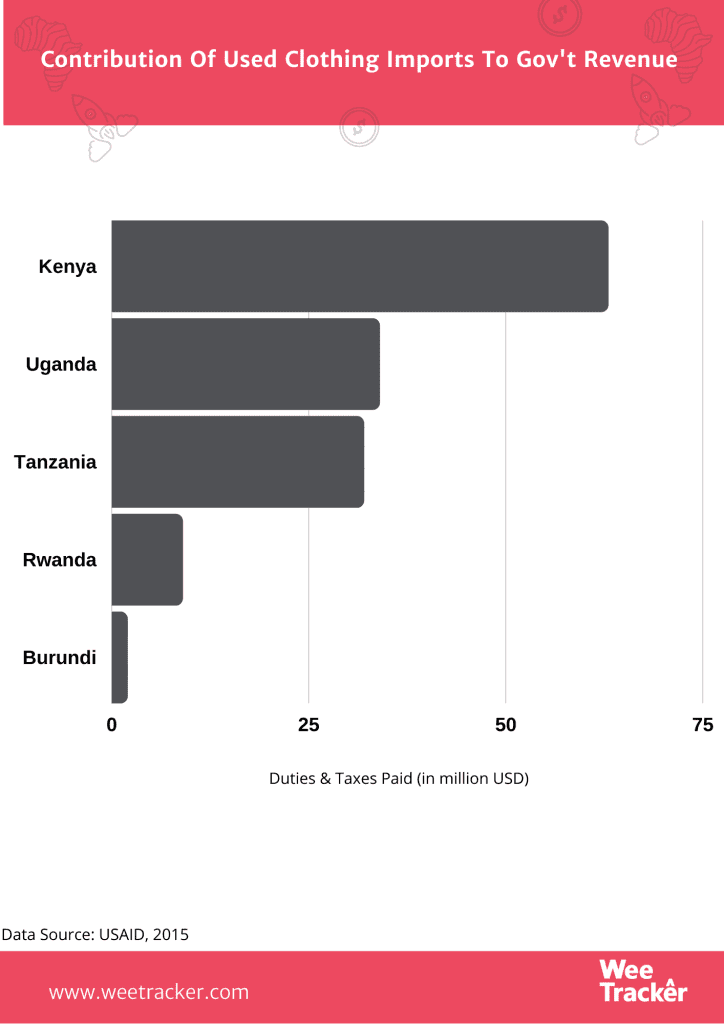
    In 2017, USAID estimated that the industry employed 355,000 people and generated USD 230 Mn in government revenue. An additional 1.4 million people in the East Africa Community bloc are estimated to be directly or indirectly making a living from the trade of second-hand clothes and shoes.

    Inside Kenya’s mitumba business

    Second-hand clothes typically come from the United States and Europe where they are discarded as worthless at charity shops or thrift stores and then shipped thousands of miles to another continent.

    Kenya’s used clothing and footwear are mainly imported from the US, the UK, and China — all COVID-19 hotspots in their own right. Kenya is the biggest market for second-hand clothing in East Africa. One can buy used wears for as low as KES 10.00 (USD 0.094) and a small mitumba business can be funded with as little as KES 1 K (USD 9.40).

    According to a 2014 report by Reuters, charity or thrift shops in the West sift donated items, often keeping just a quarter of the items. The rest are sold to exporters for up to 90 U.S. cents per kilogram, then wrapped in 45kg bales and packed in containers – a standard 40-foot container holds about 550 bales, equivalent to about 25 tonnes of clothes.

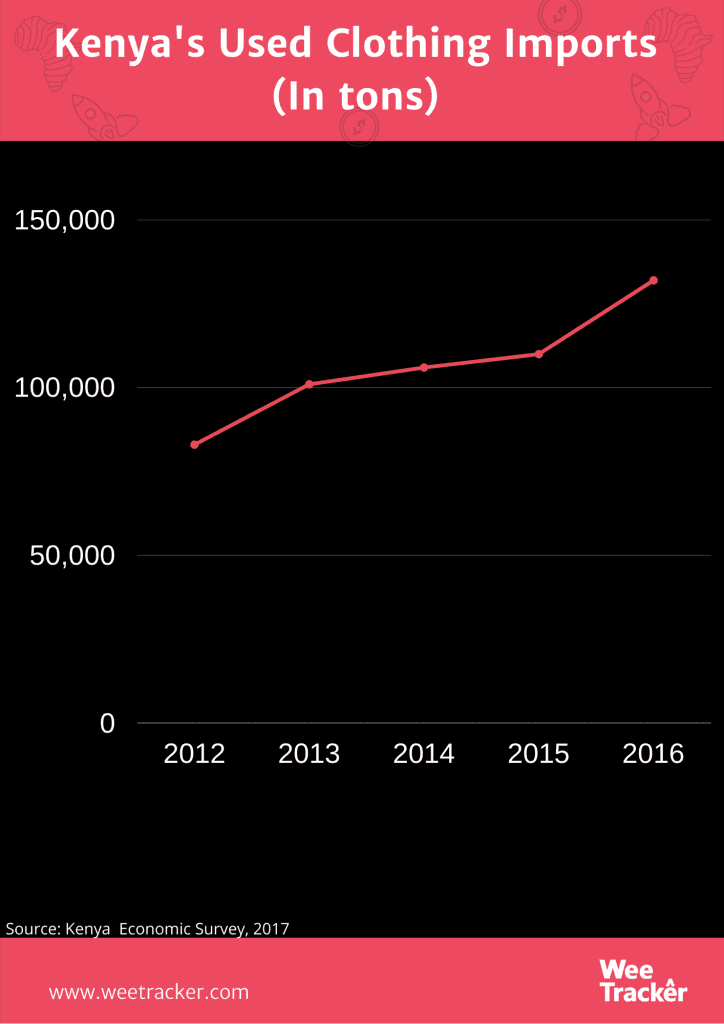
    Such containers end up in ships sailing to countries like Kenya where they find a vibrant market. Data from the Kenya National Bureau of Statistics (KNBS) says Kenya imported 177,160 tonnes of mitumba in 2019, valued at about KES 17 Bn (USD 159.8 Mn), and Kenyans spent KES 11.96 Bn (USD 112.4 Mn) in the first six months of 2019 on second-hand wears.

    Apart from Kenya’s largest mitumba trading area, Gikomba market, there are a dozen or so other smaller mitumba markets in Nairobi and similar markets around the country.

    Due to its informal nature, it is difficult to pin down precise numbers but there are indications that the mitumba business employs hundreds of thousands of Kenyans.

    The business also proves a decent source of revenue for the Kenyan government. As of 2014, customs agents at Kenya’s Mombasa port reportedly raked in duties of KES 1.2 Mn (USD 11.2 K) or more per container.

    At the market, Nairobi City County profits by charging a fee of KES 50.00 (USD 0.47) each day from informal hawkers. Bigger shacks or shops pay between KES 4 K (USD 37.61) to KES 15 K (USD 141.03) a year. Gikomba market has over 10,000 stalls.

    The state statistics agency said imports amounted to 100,000 tonnes worth about USD 90 Mn in 2013 alone. According to a Reuters estimate, at least 4,000 containers laden with second-hand clothes and shoes arrive in Kenya every year and the potential duties amount to KES 4.8 Bn (USD 45 Mn at current rates) annually.

    Between COVID-19 and second-hand wears

    The Secondary Materials and Recycled Textiles Association (SMART) recently urged the Kenyan government to reverse its recent COVID-19-enforced ban on the import of used garments and shoes, stating that all available research on the novel coronavirus shows they do not pose a threat to people who wear such garments or footwear.

    Kenya has now registered over 2,000 COVID-19 infections since the outbreak of the pandemic. As of March 31 when KEBS placed a temporary ban on the importation of used wears as a precaution, there were only 59 cases. Is the bureau’s call justified? Well, the mitumba traders’ answer is “no” for sure.

    In imploring the authorities to overturn the ban, the SMART made a decent argument.

    Although numerous studies including those published in the New England Journal of Medicine and The Lancet have shown that COVID-19 may be detectable on hard, non-porous surfaces like plastics and metals for hours and potentially up to 2-3 days, they also say the virus is even less likely to survive on soft, porous surfaces like textiles including rugs, carpets, shoes, and clothing, whether they might be new or used, the SMART emphasized.

    Further, the group argued that guidelines issued by the US Centre for Disease Control and Prevention (CDC), state that one can easily eliminate whatever small risk might be present on soft, porous surfaces like clothes by laundering the textile according to manufacturer instructions in warm water.

    Besides citing examples in frontline medical personnel and hospitals reusing PPEs and medical work clothes after treatment, it noted that used clothing shipped overseas “is typically in transit for weeks, if not months at a time–far longer than the virus has ever been shown to survive on even the most hospitable non-porous hard surfaces.”

    Also, the communique from T2, which was seen by WeeTracker, claims that second-hand clothes imported into Kenya are routinely treated, fumigated, and transported for a period of weeks under varying temperatures and conditions.

    “All shipments are issued with a Certificate of Conformity by leading international inspection companies such as SGS, under close supervision by KEBS,” a part of the company’s statement reads.

    Still, the KEBS is showing no sign of shifting ground anytime soon, and if the idea is to keep the ban in place until COVID-19 becomes past tense, the impact of the mitumba trade disruption could be quite devastating.

  • Coronavirus: Sweden Didn’t Lockdown But The Economy Seems To Be Taking A Hard Hit Nonetheless

    Coronavirus: Sweden Didn’t Lockdown But The Economy Seems To Be Taking A Hard Hit Nonetheless

    Stockholm (AFP) – Unlike most countries, Sweden never locked down during the coronavirus pandemic, largely keeping businesses operating, but the economy appears to be taking a hard hit nonetheless.

    Under the Scandinavian country’s controversial approach to the virus, cafes, bars, restaurants and most businesses remained open, as did schools for under-16s, with people urged to follow social distancing and hygiene guidelines.

    Whatever hope there may have been that this policy would soften the economic blow now seems dashed.

    “As in most of the world, there will be a record decline for the Swedish economy in Q2,” SEB bank economist Olle Holmgren said.

    – ‘A long time’ –

    A rebound was likely in the latter part of the year, but “we expect it to take a long time before the situation normalises,” he told AFP.

    To be fair, Swedish officials insist their strategy was always aimed at public health, and never specifically at saving the economy.

    The idea was to make sure hospitals could keep pace with the outbreak and protect the elderly and at-risk groups.

    Sweden has succeeded at the former, but admitted failure at the latter, with more than three-quarters of virus deaths occurring among nursing home residents and those receiving care at home.

    “When we have decided what measures to take to stop the virus from spreading, we have not had any economic considerations. We have followed the advice of our (public health) experts on this issue,” Finance Minister Magdalena Andersson told reporters in late May.

    Still, authorities acknowledge that keeping businesses open was also part of a broader public health consideration, as high unemployment and a weak economy typically lead to poorer public health.

    Sweden, a country of 10.3 million, had reported 4,639 COVID-19 deaths as of Friday.

    That gives it one of the world’s highest virus mortality rates, with 459.3 deaths per million inhabitants — four times more than neighbouring Denmark and 10 times more than Norway, which both imposed stricter confinement measures.

    At first Sweden’s export-heavy economy seemed to be doing okay, with GDP actually growing by 0.1 percent in the first quarter.

    But now the country is expected to follow the same path as most of Europe, with its economy shrinking for the full-year 2020 and unemployment soaring.

    – GDP down, unemployment up –

    In April, the government predicted GDP would contract by four percent in 2020, compared to its January forecast of 1.1 percent growth.

    While the European Commission has forecast a Swedish contraction of 6.1 percent (compared to -6.5 percent for Germany and -7.7 percent for the eurozone), the outlook presented by the Swedish central bank is even more dire — it anticipates a GDP decline of up to 10 percent.

    Some economists see Swedish growth rebounding as early as the second half of 2020, but the finance minister has warned things could get worse before they get better.

    Before the crisis, Sweden’s labour market was in good shape, with strong job creation and a declining unemployment rate.

    Now, the government expects a jobless rate of nine percent for 2020 and 2021, compared to 6.8 percent in 2019.

    It sees growth of 3.5 percent in 2021.

    – Export-based economy –

    Sweden’s sharp downturn is largely explained by its dependence on exports, which account for around 50 percent of GDP.

    “70 percent of Swedish exports go to the EU. Shutdowns in Germany, the UK and so on are expected to hit Swedish exports considerably,” the government said.

    In March, some of the country’s biggest companies, such as automaker Volvo Cars and truckmaker Scania, halted production in Sweden.

    This was not because of local restrictions, but because of problems with supply chains in Europe and the rest of the world. Their activities have since resumed.

    Meanwhile, consumption plunged by 24.8 percent between March 11 and April 5, according to a study conducted by four University of Copenhagen economists.

    “Sweden is paying the same price (as Denmark) for the coronavirus pandemic. The explanation is that when you are in a galloping crisis, consumers pull the emergency brake, whether restaurants are closed or not,” Niels Johannesen, one of the four economists, told Swedish daily Helsingborgs Dagblad.

    The government in mid-March announced measures worth nearly $32 billion to help businesses.

    Since then, more money has been allocated and new measures have been added, including a reduction of employers’ contributions.

    “Given the state of government finances there is room for more expansionary fiscal policy ahead,” Olle Holmgren promised.

  • Government Cancels KSh. 362 Million Bachuma Livestock Export Zone Contract

    Government Cancels KSh. 362 Million Bachuma Livestock Export Zone Contract

    The government has terminated a multi-million-shilling contract awarded for construction of the 15,000-acre Bachuma Livestock Export Processing Zone (LEPZ) in Voi sub-county in Taita-Taveta County after the contractor consistently failed to meet the set deadlines for completion of the project.
    The Cabinet Secretary for Agriculture, Livestock, Fisheries and Cooperatives Peter Munya said the contractor had already been issued with a default notice over the project.

    The CS was speaking at Bachuma in Voi on Wednesday during a verification tour to assess the status of the long-delayed project that started in early 2015.

    A visibly upset Munya said the contractor had not done any single work since last year in June despite funds being released for the project. “There is no excuse at all on what this project should be as it is,” he said.

    He rubbished the contractor’s claims that part of the reason for project delays was the Covid-19 pandemic.

    “The pandemic started in March. We are talking about works not done from as far way back as June 2019. What have you been doing?” asked the CS.
    The CS was accompanied by Principal Secretary for Livestock Harry Kimutai, Head of Presidential Delivery Unit Andrew Wakahiu and several senior officers from the ministry.

    The CS further said severe action will be taken against government officials who supervised the project stating they were also to blame for not putting pressure on the contractor.

    “We had our own officer who was to make sure the project was completed on time. Action will also be taken against such people,” he said.

    The contractor and the works officer were whisked away by police for questioning.

    Bachuma’s LEPZ is one of Jubilee Government flagship projects that has gobbled millions of shillings but remains incomplete to date. Once completed, the project is expected to bolster Kenya’s strategic position as a player in the global livestock market.

    According to the work documents, the project was designed in two phases. The first phase was contracted for Sh 114 million and started on March 2015. It was expected to be completed on May 2019 but remains 95 percent complete. Already, the contractor has pocketed Sh 98.4 million for works done.

    The second phase was contracted at Sh 257.1 million. The project started on April 2016 and was expected to end in November 2019. Already, the contractor has been paid Sh 131.6 million with the project being classified as 50 percent complete.
    Mr. Munya said it was very disappointing that time was lost since June last year yet the government had paid the contractor.

    “We have just confirmed what our reports have been saying. We have authorized the contractor and his team to stop working because there is no need to pretend there is anything going on here,” he said.
    The termination of the contract signals the government’s intention to crack down on rogue contractors who are blamed for delaying vital projects.

    Since the project inception, top government officials including former agriculture CS’s Willy Bett and Mwangi Kiunjuri have toured the facility to check on the progress. During the visits, the contractor was put on the spot for the inordinate delay which was adversely affecting Kenya’s entry into the world livestock market.

    In what is a pointer to the huge significance and interest the government has on the project, President Uhuru Kenyatta personally toured the facility in 2018 on a discreet visit. He was accompanied by the former Chief of Defense Forces Samson Mwathethe.

    Currently, the project works are on 200-acres where the most critical infrastructure will be installed. They include quarantine zones, screening sections, loading bays, incinerators, laboratories and staff houses.

    Munya said the livestock potential in Kenya was enormous. He pointed out that the value of cattle without their by-products like leather could easily top over sh100 billion.

    “This is the kind of money for the country we are talking about. When such strategic facilities remain incomplete due to laxity of people involved, the country losses a lot,” he said.

    Bachuma LEPZ will process all livestock intended for the export market. This, experts, say will enhance quality and ensure that Kenya consistently meets the international standards for export beef. The project’s proximity to the port of Mombasa, Nairobi-Mombasa Highway and the SGR is also a big boost for ease of movement for the animals.
    Initially, the 200-acre will hold between 7,000 and 9,000 herds of cattle. When complete, the 15,000-acres will hold 100,000 herds of cattle for export.

  • Kenya Tops Angola as Sub-Saharan Africa’s No. 3 Economy

    Kenya Tops Angola as Sub-Saharan Africa’s No. 3 Economy

    According to Bloomberg, Kenya surpassed Angola as sub-Saharan Africa’s third-largest economy in dollar terms, according to International Monetary Fund estimates.

    Angola has contracted every year since 2016 as oil output declined, and the kwanza was devalued in 2019 while Kenya’s shilling held steady.

    The coronavirus pandemic and restrictions to limit its spread will probably see Angola’s gross domestic product contract 1.4% in 2020, while Kenya’s is projected to grow by 1%, according to the IMF.

    Kenya now is behind Nigeria at the top and South Africa.

  • Kenya’s Debt Rises To Sh6.28 Trillion

    Kenya’s Debt Rises To Sh6.28 Trillion

    Kenya’s debt rose by 15 percent to Sh6.28 trillion in the three months to March, from similar period last year, documents tabled before Parliament show.

    The quarterly economic and budgetary report shows that the Jubilee administration signed 13 loan deals in the period occasioning the Sh864.4 billion rise in total public debt from Sh5.42 trillion as at March last year.

    The report shows that eight of the loans were signed with bilateral lenders while five were from multilaterals as the government increased its borrowing to fund development.

    Foreign loans account for 51.1 percent of the total debt or Sh3.21 trillion while the value of the domestic loans that attract lower interest rate stands at Sh3.07 trillion.

    Some of the projects to be funded by the loans include the bridge linking Mombasa Island to mainland Mombasa, construction of the Thwake Dam and expansion of the Nairobi water and sanitation project.

    “The increase in public debt is attributed to external loan disbursements and the uptake of domestic debt during the period,” Treasury Secretary Ukur Yatani says in the report.

    The Jubilee administration borrowed Sh47.7 billion from Japan International Corporation Agency (JICA) to fund construction of the gate bridge linking Mombasa Island to Mombasa mainland and Sh22.3 billion from the African Development Bank to fund construction of the Thwake dam in Makueni.

    A further Sh11.6 billion was borrowed from French development agency, Agence Française de développement (AFD) to finance the Nairobi water and sanitation project.

    Kenya last month borrowed Sh107 billion ($1 billion) from the World Bank and Sh78.4 billion ($739 million) from the IMF to plug budget deficit and cushion the economy from the fallout caused by the Covid-19 pandemic, further increasing the country’s debt.

    The sharp rise in debt portfolio is set to exert more pressure on the country’s revenues that are already under-performing due to economic disruptions, job losses and salary cuts occasioned by the pandemic.

    Official data shows that Kenya needs to pay Sh441 billion in interest on loans in the year ending this June, an amount that will rise to Sh475.9 billion in the 2020/21 period and Sh483 billion by 2021/22.

    The IMF has warned that the country risks sliding into debt distress due to borrowing.

    In a report, the Fund said Kenya uses nearly half of its tax collection to service interest on loans with the debt ratio rising to 57 percent of Gross Domestic Product (GDP), the highest in the East African Community except Burundi.- Business Daily.

  • Greed And Corruption: Owners Of Marked Parklands Mega Building Sitting On Riverbed Defies Orders And Goes Ahead With Construction

    Greed And Corruption: Owners Of Marked Parklands Mega Building Sitting On Riverbed Defies Orders And Goes Ahead With Construction

    Corruption in City Hall has left nature in the city destroyed and ugly buildings financed by money launderers go up. There has been a total disregard for standardized development control. With a corrupt system, anyone with money has been able to bribe authorities and put up anything in the name of investment. We’re left with a poorly organized town with uncoordinated structures.

    Thats not it all, destroying nature, the city has been left not only polluted but dangerously erected buildings that eventually have ended up in the lose of lives.

    Last year, the Nairobi Governor staged a Demolition of structures built on riparian land in Nairobi with the multi-agency team. Many buildings from Kileleshwa to Ukay Mall to South End mall to Taj Mall were many of the multi billion structures that were flattened.

    There were many other buildings that were earmarked for demolitions but nobody knows what became of the stories. Grand Manor Hotel which stood between the US embassy and UN offices in Gigiri took time but was recently flattened.

    Theres is one dangerous building that’s sitting on a riparian land in Parklands overlooking Muthaiga. The mega building which goes many storeys up was one marked for demolition during the crackdown. The developers briefly stopped the construction when the fire was raging but they seem to ha e come back and the building is almost finished.

    Previously, this was impenetrable Forest, giving adjacent hospitals, Getrude and Aga Khan a breath of fresh air to the patients.

    It beats all odds as to how such a structure would be approved on such a place which is a mini valley. Kenya Insights obtained something of the photos from way back when it was coming up just to illustrate how dangerously this building is sitting.

    The big question now is, what changed after the authorities had determined that the building was illegally put up and marked for demolition. Could this have been yet another case of authorities compromised to look away as a public space is swallowed up by greedy developers?

    Is NMS Badi aware of such illegally put up structures and what measures they’re putting in place to protect the environment.

    This should go beyond the surface, there’s the need to scratch beyond. How for instance did Nema and city planners approve such a structure on such a place? It’s in our hope that Badi’s new command will be business unusual and that rogue developers need to be dealt with. This building amongst others in the town that have defied all the orders need to be flattened just like the others were. Lives must be protected before it’s too late, we’ve had way too many cases before.

  • Beer Prices Are Going Up Once Again

    Beer Prices Are Going Up Once Again

    The National Treasury has slashed the cancellation of excise duty on beer made from sorghum, millet, cassava or any other agricultural produce in Kenya to 60 percent.

    The trim can be seen from a previous 80 percent rate and the move will see an increase in consumer costs for beer manufactured from locally sourced raw materials.

    “Regulation 2 of the Excise Duty (Remission of Excise Duty) Regulations, 2017 is amended by deleting the words “eighty per cent” appearing in paragraph (1) and substituting therefor the words “sixty per cent,”’ Treasury Cabinet secretary Ukur Yatani said in a notice.

    The price of content will skyrocket since most of them are actually made out of these products such as keg, which is manufactured from sorghum.

    Manufactured beer must have at least 75 percent content of sorghum, millet, cassava or any other agricultural products grown in Kenya excluding sugar and barley.

    The beer in subject will also be packed in a pressurized container of at least 30 litres while the beer must not sell for more than Ksh.100 per litre.

    The manufacturers through their lobby, the Alcohol Beverages Association of Kenya (ABAK), say persistent tax hikes leave legitimate players in the industry facing uncertainty in their investments and business planning.

    Early this year the Treasury clarified that not every manufacturer would benefit from the duty remission but only those whose alcoholic plants amount to an investment of no less than Sh5 billion.

    The remission would be for five years from the date of commencement of operations of the manufacturer.

    Treasury has further proposed to change the excise duty coverage for alcoholic beverages through the 2020, Finance Bill which seeks to reduce beers which are subject to excise duty while increasing the number of spirits subject to the duty by virtue of alcohol content.

  • Can’t Pay Won’t Pay, Villa Care Kenya MD Ojijo Refuses To Pay Employees Despite Making Money, Uses Coronavirus As An Excuse

    Can’t Pay Won’t Pay, Villa Care Kenya MD Ojijo Refuses To Pay Employees Despite Making Money, Uses Coronavirus As An Excuse

    Employees of Villa Care Limited are going through it all, just like many other companies, staff of the group were also affected the MD Daniel Ojijo sent them on a compulsory leave citing coronavirus.

    Even the though the property management company wasn’t badly hit, they took advantage and got rid of their hardworking workers.

    Disgruntled with how poorly the management has been handling and responding to their plea, helpless staff sent Kenya Insights letter below;

    We have not been paid since February and the boss is happy to take advantage of the CoronaVirus situation to avoid paying us a salary for work done in Feb and March.

    He has already made most of us redundant – the whole of April using coronavirus as the excuse not to pay their Feb+Mar salaries.

    They gave us a letter, but we all know it is a lie if we weren’t paid in Feb and his practice is always to pay half salary at a time. we will not be paid! and he will use corona as the perfect cover

    The company has money but the guy is too greedy, he simply is not keen on settling salaries. We all have more debts than the Kenyan Government and he still demands some members work, with no pay.

    Can the Government come in and help us with this? everyone who complains gets fired and we have nowhere else to turn to. is it possible you help highlight our plight?

    How can we be sent on Mandatory unpaid Leave for the month of April, with no pay for February and March.

    Covid19 has not affected our industry yet in terms of rents to be collected.
    Covid19 was not an issue in February and March 2019, why have we not been paid?

    The boss transmitted KRA, NHIF etc for the whole company, to keep KRA happy, but we are unpaid and hungry.

    We need your help before the government announces any shutdowns, we need your help for the government to be involved in saving us, from this evil and cruelty,

    He is a billionaire, he can afford a good life, but it should not be at the expense of his employees. Many of us cannot even afford to buy food. Now we are at home with this letter attached promising that we will have our pay for Feb and March combined.

    We spoke to the team at the office and the accounts, and they confirm this is a lie,

    We all know he is waiting on Coronavirus Shutdown so that he doesn’t pay our salaries and can take advantage to fire us with no terminal dues, using April as the cut off month.

    HELP US PLEASE.

    Other interesting stories

    A lot is going wrong, but allow this to be the first in a series of posts regarding the company and its illegal HR practices.

    For starters, the previous and current HR manager is a fellow who harasses women employees for sex and men for money in exchange for favour at work.

    The last HR manager was relieved of duty due to sexual harassment of junior employees, the current is no better, but he is being protected by the system.

    The last team to report cases of sexual harassment were all systematically fired from the company one by one, under the pretense of performance. Rather than face the issue, the victims were punished.

    There’s more rot in this company than is known and more will soon come out. Most of us know that we might not be employed here anymore as he will look for new cheaper employees.

    Everyone once fired, claiming their service and terminal dues is a mess, some are still waiting two months later.

    This guy is too greedy and is ruining the lives of his employees.

    This same matter was previously raised by Activist Boniface Mwangi on his Twitter Facebook where yet another employee blew the lid;

    Comments that followed under the post painted unfriendly picture of the firm, “‪The bark doesn’t stop there: there’s also the batch that is employed and still not paid, months later. They are constantly reminded how lucky they are to have a job during “these” times. Any one who asks for their pay is simply asked if they want to leave because the company can’t work with such a disgruntled and ungrateful employee.‬” Wrote Winnie.

    “VillaCare is a terrible company. They rip off their tenants. It was only a matter of time before their unethical practices backfired on their staff. If you see their sign on a property, avoid it like COVID.” Harun Johnson wrote.

    Many of the workers on forced leave and those working yet not paid are crying foul. Big question is the company making money? Kenya Insights can confirm this from our own follow ups that they’re not only receiving money from clients but also making huge deposits.

    Ojijo is simply using Coronavirus as an excuse not to pay poor workers who cannot even afford to hire a lawyer unless they get a pro bono to help them out. It is really unethical for the company to keep getting money yet refusing to pay their staff. Labor laws shields workers from exploitation and such are the cases of private world mistreating their staff and need to be shielded.

    In an email, another outraged staff wrote, “This guy anataka pesa kutoka Kwa tenants but he won’t pay his staff. He wants to disconnect water and power
    He is pushing for 7m in Payments to pay pending salaries. All companies that sent their staff on unpaid leave, paid their staff by the last day.”

    Morale of the staff generally depends with the working environment, an encouraging management motivates the staff. Even if the MD doesn’t plan to rehire the staff sent on forced leave, courtesy and responsible management would require he pays them. The amount causing all this is lunch money for the lavish MD. People are getting hit with the virus effects and the best he can do is pay them because he’s making money.

    Also some of these clients used by property management companies need to do their follow up to ensure the welfare of the ground people responsible for the management of their companies is well taken care of. Villa Care is not an isolated case but it’s a popular one. Companies too need to do their full due diligence before awarding contracts to any firm to ensure they respect labor laws and above all respect the basic human rights.

    Finally, Ojijo pay your workers.

  • 17.5bn Pension Pay Cut For Kenyan Retirees – A Big Blow.

    17.5bn Pension Pay Cut For Kenyan Retirees – A Big Blow.

    The Treasury has revised downwards its pension payment plan by Sh17.5 billion in yet another blow to retirees already grappling with delays in the processing of their benefits.

    Expenditure on pensions and gratuities is now estimated at Sh86.99 billion from Sh104.89 billion that the Treasury had initially budgeted, latest exchequer statistics covering 10 months through April 2020 show.

    Retirees’ payroll, however, still hit a record Sh71.84 billion between July 2019 and April 2020, a growth of 36.44 percent or Sh19.19 billion, compared to the same period a year ago largely because of a rapidly ageing workforce in the public service.

    Pension payments have continued to pile pressure on taxpayers despite a knee-jerk policy decision nine years ago to raise the retirement age in public service from 55 to 60.

    Processing of the benefits to the senior citizens for their service to the nation had lagged the Treasury’s target by Sh14.21 billion in the first nine months of the current fiscal year through March before the full-year goal was cut in April.

    Treasury secretary Ukur Yatani had said in February “the shortfall…was due to slower than targeted processing of pension payments”.

    Part of the pension build-up has been blamed on the Finance ministry’s failure to implement necessary reforms, including starting the long-delayed contributory pension scheme despite the law having been enacted in 2012.

    Civil servants, unlike workers in the private sector, do not contribute to their pension and their benefits are paid straight from taxes.

    Mr Yatani had earlier in the year pledged to gazette May 1 as the commencement date for the contributory Public Service Superannuation Scheme by enforcing the Public Service Superannuation Scheme (PSSS) Act 2012.

    But this has been affected by the increased focus on the fight against the spread of the coronavirus pandemic, which has drained state resources.

    Under the retirement scheme, civil servants will contribute 7.5 percent of their salary, with the government matching every worker’s monthly contribution at the rate of 15 percent of the pensionable salary.

    “A member may also make voluntary addition to their contributions towards their retirement benefits in the PSSS,” Mr Yatani said in Budget Policy Statement.

    “The government is also mandated to take out and maintain a life insurance policy that has disability benefits in favour of every member of the scheme. The policies must be worth a minimum of five times the member’s annual pensionable emoluments.”

    {Business Daily}


  • Run Down To The Brink Of Bankruptcy, The Fall Of Kenya Airways

    Run Down To The Brink Of Bankruptcy, The Fall Of Kenya Airways

    By Payton Mathau

    For years now, Kenya’s national carrier, Kenya Airways (KQ) profit-and-loss account has been, worryingly, sliding south, with the executives blaming several factors like the cost of fuel, the dropping number of passengers and, more recently, the Ebola outbreak in most parts of West Africa that forced them to suspend flights to these destinations for some time.

    The airline’s chief executive Mbuvi Ngunze, in a recent opinion in the mass circulating weekly newspaper, the Sunday Nation, even blamed that slide on “intense competition and more recently the threat of terrorism…that have adversely impacted global travel. There is also political instability, natural disasters and an increasingly tight regulatory environment,” he wrote.

    The list of excuses has been endless, and even includes the industrial actions by pilots and other cadre of staff.

    Even in the face of the worrying loss-making by the country’s flagship carrier, the executives have remained upbeat, at least on the surface, that KQ has made several positive strides.

    In November 2014, the airline posted a half-year loss of Sh10 billion. This was not isolated because in June 2013, the company had also posted Sh7.9 billion loss for the financial year ending in March 2013.

    “Over the last decade, KQ worked hard to successfully shed the image of an ailing airline dependent on government lifeline. Since it was privatised in the late 1990s, the airline grew rapidly, lifted by strong fundamentals and embracing a culture of competitiveness and innovation. Before the current challenges, KQ was one of the most profitable airlines even earning the “Most Respected Company in East Africa” accolade,” Ngunze’s opinion article in the Sunday Nation read.

    But investigations by Nairobi Law Monthlyhave revealed that the breathtaking extent of loss-making at KQ was perpetrated by the high and mighty, who, even at the moment, are angling to kick out Dutch airline KLM as a major shareholder in favour of the an airline from the Gulf States.

    Many may recall that the Dutch airline KLM, which is now being strenuously pushed out in favour of Etihad, is the one that had stabilised KQ, and their code-sharing framework has not only had positive returns for KQ but also opened for it most of the European routes.

    The investigations uncovered that the genesis of the extreme turbulence KQ is experiencing could be traced back to Anglo Leasing-type deals when top management and senior government officials formed special purpose vehicles (SPVs) to fleece the carrier.

    Majority of these SPVs were incorporated in tax havens like the Cayman Islands, and through a complex web of transactions were buying and selling, or leasing to KQ aircraft at mind-boggling fees.

    As such, the SPVs have, in essence, have continued to strangle the national carrier in a complex web that KQ cannot and will not easily get out from, unless something more radical happens.

    Media blackmail

    Most of these SPVs were incorporated during the former CEO Titus Naikuni’s era, and Ngunze, who took over from Naikuni, was a high-ranking official at KQ.

    Kenya’s local media attempt’s at disclosing these deals have been met with specific threats to journalists as well as the KQ executives withdrawing their adverts, at least until they play along.

    In the early and mid-2000’s, KQ wanted to buy a new fleet of Embraer, the Brazilian-manufactured mid-range, aircraft, but could not make the down payment for the planes to the manufacturer. It thus borrowed money from some financiers to make the down payment.

    In order to borrow the funds for the down payment, KQ transferred the purchase agreement for the fleet of planes to a new company that would become a borrower proxy for KQ.

    According to the documents in possession of NLM, the borrower was Amboseli Limited, a special purpose company that was registered in the Cayman Islands. Amboseli Ltd was structured so that should it go into bankruptcy then KQ was to be at arm’s length – thus the phrase Bankruptcy Remote Orphan (BRO).

    An orphan structure is a financing term referring to a company whose shares are held by a trustee on a non-charitable purpose trust. The company is said to be an “orphan” as it is not beneficially owned by anyone. Orphan structures are usually used in offshore structures to ensure that the assets and liabilities of the subject company (in this case Amboseli Ltd) are treated as “off-balance-sheet” with respect to the sponsor of the structure (in this case Kenya Airways).

    Other reasons for creating an orphan structure are to avoid or minimise regulation which might otherwise apply to a structure, and to ensure that the company is “bankruptcy remote” from companies in the same group as the sponsor. Orphan structures are relatively common features of securitisation vehicles, where the asset backed bonds are issued by the orphan company (Amboseli Limited).

    Shares in Amboseli Limited were to be held in trust for the benefit of whoever is putting up the money for the aircraft purchase. The trustee of all the shares in Amboseli Ltd was yet another special purpose vehicle called Walkers SPV (special purpose vehicle).

    In the agreement, Amboseli Ltd was to use the purchase agreement signed by KQ with the manufacturer of the Embraer aircraft to approach unidentified lenders who would advance the funds necessary for payment and delivery of each plane until the fleet is bought entirely.

    The terms of this agreement was that KQ would pay to Amboseli Ltd the sum of Manufacturers price plus Amboseli Limited’s “running costs” plus interest owed to the lenders engaged by Amboseli Ltd.

    KQ was to repay Amboseli Ltd in instalments in the course of 12 years, according to March 2014 annual report, and each instalment is called a borrower’s contribution.

    The borrower’s contribution is due from KQ whenever Amboseli Ltd is due to make an interest payment on the loan. In each instalment KQ pays the sum of: The interest due to be paid to the lender by Amboseli Ltd plus Amboseli Ltd’s running costs.

    On the delivery date of the aircraft, KQ was to pay Amboseli Ltd the Balance of the purchase price. This means Amboseli Ltd would, on the same delivery date, pay the balance of the purchase price to the manufacturer, plus repay the lender for the particular aircraft.

    In the structure, KQ would only take delivery, not title (the real proof of ownership), of each delivered aircraft. Amboseli Ltd was to deliver the title to another company called Samburu Limited “to whom the Delivery Facility is made by the long term lenders.”

    From the chart in the documents in possession of NLM, the immediate questions were (1) where is Samburu Limited placed on the chart? (2) Who is the facilitating agent referred to on page 1 (paragraph c) of the document?

    As at March 31, 2014, the KQ had 47 aircraft, either owned or on operating leases, according to KQ’s annual report. These comprised five Boeing 777 wide body jets, one Boeing 787, six Boeing 767 wide body jets, 13 Boeing 737 narrow body jets, 20 Embraer regional jets and two Boeing 737 freighters; formerly passenger aircraft, one converted to a freighter during the year, while the other had been converted the previous year.

    Our attempts to get Ngunze, KQ’s CEO, who is officially the company spokesman, to respond to the specific questions were rebuffed, in a response couched to avoid at all any discussions on them.

    “The right process for enquiries into KQ is Wanjiku Mugo, copied, in who is our Corporate Communications Manager. Perusing your questions, it is clear to me that you have not had sight of our annual report where we make disclosures on financing transactions. Kindly refer to the attached on pg (pages) 115, Note 29. This may then inform the questions you have,” said Ngunze, in an e-mail also copied to the company secretary Teodosia Osir, delegating the role of the official company spokesman to his junior.

    From a cursory look, Note 29 answered nothing, at least not the questions we had sent to KQ for their response about the incorporation of the SPVs in the Cayman Island, ownership structures of the lenders and facilitating agents and the net effect of these special purpose companies to KQ.

    Meanwhile, Wanjiku Mugo, who had been delegated to respond to communicate with us, remained cagey, only directing us to the link to the same document Ngunze had pointed at.

    “Thank you for your inquiry. I see Mbuvi (Ngunze) responded to you on where you could find comprehensive answers to your questions. Please refer to our annual reports that are available on our website,” Wanjiku Mugo said.

    Behind the scenes, the KQ management sought to thwart the publication of the exposé, unsuccessfully. When that hit a snag, Ngunze, in an unsolicited opinion article in the Sunday Nation, perhaps to dampen NLM’s queries, sought to challenge “A lot of untruths and innuendos (that) have recently been peddled in the media and other circles regarding Kenya Airways.”

    Meanwhile, KQ’s expansion strategy, Project Mawingu, in the recent past has been the acquisition of the B787-8 Dreamliners, currently Boeing’s flagship product. The national carrier was to borrow, through a similar but complex web a sum of $1 billion (Sh95.4 billion) to purchase the nine Dreamliners.

    In the recent past, perhaps saddled by the debts to some of the interest-bearing loans and borrowings from lenders, which according to the 2014 annual report include Swara Aircraft Financing Limited, Barclays Bank PLC, Ndovu Aircraft Financing Limited, Nyati Aircraft Financing Ltd, Kifaru Aircraft Financing Ltd, Chui Aircraft Financing Ltd, Tsavo Financing LLC and Aberdare Ltd, KQ appears to have ditched buying the expensive Dreamliners. The Dreamliners price averages $225 million (Sh21.5 billion) for a single aircraft.

    Instead, KQ announced that it would be leasing the aircraft from AWAS Aviation Ltd who is to buy them and then lease out to KQ. The decision to abandon purchasing the Dreamliners came after KQ had acquired seven of the nine it had planned to purchase.

    Though AWAS Aviation Ltd is an Ireland firm, information that NLM has exclusively obtained indicates that its ownership structure has many Kenyan interests. In fact, one famous political family in the country, NLM established, could be holding significant interests in not only the firm but most of the KQ’s lenders.

    In March 2014 annual report, KQ also paid to its lenders a staggering Sh89 million up from Sh62 million in 2013. The lenders, the annual report indicates, are Barclays PLC, Citibank NA, Citi/JP Morgan and Afrexim for aircraft loans. Meanwhile, Cooperative Bank financed engine purchases, and KQ also has in its books short term facilities. The tenor of the borrowings range from one to 24 years since 2005, with interest rates of between 3.41 per cent and 6.59 per cent annually.

    “The loans were obtained for the purpose of funding aircraft acquisition, aircraft spare engines and for pre-delivery payments for ordered aircraft. For the purpose of holding collateral for the financiers, the aircraft are registered in the name of special entities whose equity is held by the security trustees on behalf of the respective financiers. The legal title is to be transferred to Kenya Airways Limited once the loans are fully repaid,” the annual report states.

    For now, it seems KQ is in deep turbulence – like Mumias Sugar Company which is seeking Sh5 billion from the government to stay afloat after years of mismanagement – and the carrier may be forced to make an emergency landing. That emergency landing may come very soon and could even jeopardise its intention to fly to new destinations, including the United States.