Category: Development

  • Investor Questions Over Ol Karia Shutdown Disrupt Peace At KenGen

    Investor Questions Over Ol Karia Shutdown Disrupt Peace At KenGen

    The management of the Kenya Electricity Generating Company (KenGen) is in a panic over questionable undertakings at the Ol Karia Geothermal plant.

    Investors and financiers have been asking for answers over the shutdown of the Ol karia plant.

    In March, explosive posts by a Twitter user calling out the energy producer for being involved in enabling high electricity costs were hushed under an army of public relations articles.

    “According to EPRA data published in the Kenya Gazette, the Olkaria 1 Unit IV and V produced 60,754,334 units in December. In January it produced 425 units and in February it produced just 6 units. How does a power plant move from producing 60 million units to 6 units?”, a post on Twitter read.

    KenGen then tried to suppress the issue by claiming, without evidence, that energy plants at Ol karia were fully operational. According to sources, KenGen was openly lying.

    Some Kenyans noticed a change in their electricity billing in February.

    “My electricity bill tripled from nowhere, yet I had not added any appliances to the ones I have. It is unexplainable”, a lady wrote to us.

    KenGen has been on a project launching spree, which means, the cost of electricity must come down. It sure did but then the company engaged in some unconventional behaviour by agreeing to switch off Ol Kariageothermal plants to starve the country of cheap electricity and benefit the management and Independent Power Producers that supply KPLC with power.

    Investors such as the World Bank and others have poured billions into KenGen for green energy initiatives. They noted this and have been frantically trying to get more information from management but all that is being shown them are links to new stories.

    Presently, KenGen plans to invest Kshs.230 billion in new plants by 2026.

    When Ol Karia is criticised, KenGen spews a new milestone about the plant. For example, in the new revelations about switching off the plants, the energy firm announced the completion of Ol Karia 1 Unit 6.

    Further inquiry into the incident prompted the firm to announce that the unit is about to start pumping electricity to the National Grid.

    Furthermore, in the expansion of Geothermal power, KenGen has faced allegations of land grabbing.

    The sale of the LR 8398/2 land for Sh505 million was in 2020 termed irregular by the Nakuru County Government committee report, which was formed to look into the land purchase.

    The committee’s report showed that KenGen failed to adhere to procurement rules and obtained the land without the knowledge of the members.

    The fraudulent land acquisition lies squarely on three KenGen senior managers namely, Jennifer Oduor, Jane Mbogo and Cornelius Letei.

    Sacco members claimed that the Sh500 million land sale deal between the SACCO and KenGen was “shrouded in secrecy and dishonesty” because their leaders did not consult them.

    The case has moved back and forth and is still unresolved to date.

    When KenGen is contacted, they shift the blame to IPPs.

    As Kenyans seek employment in the state corporation, unscrupulous managers, who are supposed to be answering to criminal charges, block them.

    “Some of us have stagnated in positions for years because we have no one to push us though we work hard to make sure the company achieves its targets”, one complained.

    Much as the company has done much in terms of growing its portfolio and putting us in the global map in so far as growth in clean energy is considered, the rot in its recruitment processes leaves a lot to be desired. There’s too much Tribalism and nepotism.

  • DCI Summons Two Chinese Contractors For Frustrating Presidential Flagship Projects

    DCI Summons Two Chinese Contractors For Frustrating Presidential Flagship Projects

    Two Chinese construction firms undertaking national government water flagship projects in Siaya County have been ordered to appear before the Directorate of Criminal Investigations (DCI) for undermining government efforts to provide the locals with clean and potable water.


    Nyanza Regional Commissioner Magu Mutindika, who led a team of the regional development implementation and coordination committee on a tour of the county said the chief executive officers of M/s Shanxi Geological Engineering Exploration Institute and M/s Zhongmei Engineering Group Limited will have to explain why they have persistently ignored instructions from government officials to perform their contractual obligations despite the extension of the contracts on several occasions.

    The regional commissioner lamented that the multi-million shilling presidential projects; the Siaya – Bondo water project’s last-mile connectivity and Ugunja – Sega – Ukwala water project, are supposed to be commissioned by President Uhuru Kenyatta before leaving the office adding that the government will not allow anyone to frustrate their completion.

    He said that the management of the two firms has been evading government officials whenever they are taken to task to have the projects completed within the agreed time frame.

    In the case of the Siaya – Bondo water project’s last-mile connectivity, the regional commissioner lamented that the contractor was supposed to have laid 80 kilometres of pipes and connected 3,000 households with water by the end of December last year.

    “He has not achieved the target and has only managed 1,200 households and has persistently ignored instructions from the resident engineer,” lamented Mutindika.

    Mutindika, who was flanked by senior Presidential Delivery Unit directors, Jared Buoga, Tuta and Sylvance Osele further accused M/s Zhongmei Engineering Group Limited of lying that the government owed him money.

    “The contractor claims that there is non-payment which is not true. The issue is lack of capacity on the part of the contractor,” said the regional commissioner.

    He ordered the management of the Lake Victoria Waterworks Development Agency and the Central Rift Valley Waterworks Development Agency to post officials in the two projects who will oversee operations to ensure that they are completed by the end of June 2022 to await commissioning.

    The Siaya – Bondo last mile connectivity project will cost Ksh 265 million when complete while the Ugunja – Sega – Ukwala water project will cost a whopping one billion shillings.

    Both projects are funded by the Africa Development Bank.

  • Letter To Prince William From Kericho

    Letter To Prince William From Kericho

                                            The Duke of Cambridge
    Clarence House
    London
    SW1A 1BA

    4 May 2022

    Dear Prince William,

    RE: Recognition of Colonial Crimes in Kericho, Kenya

    We are writing to you at a time when you are eagerly preparing for the Queen’s Platinum Jubilee. Kenya clearly is a special place for you and your family. You proposed to your wife there and when your Grandmother became Queen, she was visiting Kenya – which at the time was one of the colonies – on a royal tour. It is most telling however that at the same time in Kericho county, only a few hundred kilometres from where the Queen was staying, our families and ancestors were being violently pushed off the land we had always lived on.

    It was the British colonial forces that did this so that tea could be planted on the very fertile ground where we were born. We are turning to you now 70 years later as a group of over 100,000 victims from Kericho whose suffering as a result of this period has been entirely ignored by your family and successive British Governments. We are urging you at this historic time to stand on the side of justice and to recognise the grave violations we have endured for decades.

    Our people were violently evicted from their homes to make space for the very lucrative tea plantations that still exist today. Many men and women were raped, arbitrarily detained, and in some cases killed whilst trying to resist the evictions. All were displaced and humiliated, and none have been compensated. The trauma of having our ancestral land stolen from us and the degradation to which we were subjected affected not only those of us directly removed from the land, but also all our family members for generations to come.

    The pain of our colonial past has been inherited in many forms and is exacerbated by the ongoing economic hardships of losing such precious land to profit-hungry corporations. But this is also your colonial past and, where we inherited the pain, you inherited the profit.

    Despite our immense suffering under British rule, the British Government has refused to acknowledge this fact or meet any of us, let alone apologise. Which is why we are now appealing to you.

    In September 2019, our British and Kenyan legal representatives submitted an official complaint to the UN Special Rapporteur on the Promotion of Truth, Justice, Reparation and Guarantees of Non-Recurrence. After investigating the complaint and hearing from the many of us victims directly, the UN Special Rapporteur sent his report and recommendations to the UK Government. It confirmed the responsibility of the British Government to remedy the extensive crimes inflicted on our people by way of a full public apology and appropriate reparations.

    Yet, still there has been no response from the British Government. We are deeply disappointed. The Government has merely stated that it has already expressed regret in relation to certain victims of the Mau Mau uprising in Kenya, and that it would not enter into any process with the Kericho victims. We are clearly different victims whose land was forcibly taken away. The provision of reparations to one discrete group of victims plainly does not address our grievances as a separate and distinct group of victims.

    We do not want this to become a bitter dispute – we just want the wrongs committed against us to be recognised. An apology and a discussion about reparations would be the start to achieve justice. Many of our group are very elderly so the urgency of this is paramount. We cannot let another victim of this time pass away still longing for their dignity to be restored.

    As you prepare to celebrate your Grandmother’s Platinum Jubilee, our own elderly family members remember the pain of having their homes and land taken away from them at the same time. We have very little to celebrate. We are asking that you therefore do the right thing and support our quest for justice by making a public statement of recognition of what we suffered as well as an apology and an arrangement for appropriate reparations. It will be in all of our best interests to move forward in this way to a worthy and prosperous future together.

    We thank you for your consideration of our appeal to you. We look forward finally to closing this painful chapter of history and starting afresh with mutual respect, grace and dignity. We await your response.

    Yours sincerely,

    Joel Kimutai Bosek, Advocate

    ______________________________

    For and on behalf of the Victims of abuse by British colonial forces and land theft in Kericho county, Kenya

    Address:

    J.K Bosek and Company Advocates

    NSSF Building

    Ground Floor, Block

    P.O Box 49482-00100

    Nairobi

  • Kenyan Family Whose Land Was Grabbed By British Imperial Forces Appeals To Prince William For Help

    Kenyan Family Whose Land Was Grabbed By British Imperial Forces Appeals To Prince William For Help

    A letter delivered to Prince William’s household in London today seeks justice for a notorious land grab in East Africa.

    It comes from a group of Kenyans whose ancestral land was stolen by British imperial forces. They are calling on the royal family to apologise and make reparations.

    The move follows a wave of protests against royal tours of the Caribbean where campaigners have demanded Britain’s monarchy address the legacy of slavery.

    For decades from 1902, half a million people from the Kipsigis and Talai indigenous groups were violently evicted from the Kericho region of western Kenya.

    “Many men and women were raped, arbitrarily detained, and in some cases killed whilst trying to resist the evictions,” an advocate for the victims, Joel Kimutai Bosek, wrote in a letter to the Duke of Cambridge.

    Foreign settlers seized their highly fertile land and turned it into tea plantations, some of which are now owned by British beverage brands including PG Tips.

    The victims were deported to arid areas of Kenya and prevented from returning home. They were still being kept in squalid conditions on “native reserves” in 1952 when Queen Elizabeth ascended to the throne while in Kenya on a royal tour.

    Kibore Cheruiyot Ngasura, left, was evicted from Kericho in 1934 and deported to an island on Lake Victoria. (Photo: Tony Karumba / AFP via Getty)

    After Kenya became independent in 1963, Britain’s monarchy showed favour to colonial families that remained in the country. Prince William spent his gap year in central Kenya on a farm run by the descendants of white settlers and later proposed to his wife there.

    ‘Entirely ignored’

    In the letter, the Queen’s grandson is told that the “suffering as a result of this period has been entirely ignored by your family and successive British Governments. We are urging you at this historic time to stand on the side of justice and to recognise the grave violations we have endured for decades.”

    On behalf of the victims, their Nairobi-based lawyer wrote: “The pain of our colonial past has been inherited in many forms and is exacerbated by the ongoing economic hardships of losing such precious land to profit-hungry corporations. But this is also your colonial past and, where we inherited the pain, you inherited the profit.”

    He added: “Despite our immense suffering under British rule, the British government has refused to acknowledge this fact or meet any of us, let alone apologise. Which is why we are now appealing to you.”

    Last year, six UN special rapporteurs wrote to the British government expressing concern “at the alleged lack of reparation provided to victims for the gross violations suffered at the time of the events; as well for the harm suffered by victims and their descendants in the succeeding decades as a result of the loss of property.”

    UK authorities did not respond directly to the specific details of the Kericho case, instead claiming to have addressed colonial-era grievances through a settlement awarded to victims of the Mau Mau uprising that occurred in another part of Kenya.

    “We are clearly different victims whose land was forcibly taken away,” today’s letter notes. “The provision of reparations to one discrete group of victims plainly does not address our grievances as a separate and distinct group of victims.”

    From left to right: Joel Kimutai Bosek - Kenyan lawyer representing victims, Governor Paul Chepkwony - Governor of Kericho County, Dominic Rono - Speaker of the Assembly, Kericho County. (Photo: Provided)
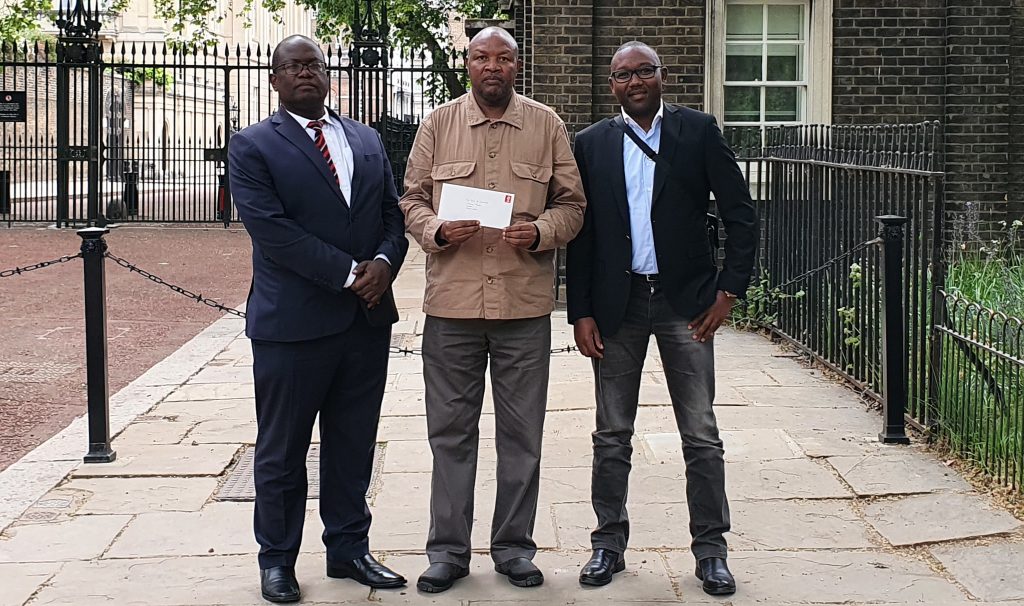
    From left: Lawyer Joel Kimutai Bosek, Kericho county governor Paul Chepkwony and Kericho assembly speaker Dominic Rono deliver the letter to Clarence House, London. (Photo: Supplied)

    Platinum jubilee

    The letter comes at a delicate time for the royal family, when the palace wants to focus on marking the Queen’s 70th year on the throne.

    “As you prepare to celebrate your grandmother’s Platinum Jubilee, our own elderly family members remember the pain of having their homes and land taken away from them at the same time,” the Kericho campaigners said to Prince William. “We have very little to celebrate.”

    “We are asking that you therefore do the right thing and support our quest for justice by making a public statement of recognition of what we suffered as well as an apology and an arrangement for appropriate reparations.”

    Prince William has met Kenya’s president on multiple occasions, including as recently as November.

    He is heavily involved in conservation efforts in Africa – an activity which can often benefit old colonial landowners – and is patron of Fauna and Flora International, formerly the Society for the Preservation of the Wild Fauna of the Empire.

    Professor Philip Murphy, an expert in imperial history at the University of London, told Declassified: “Colonial legacy issues are increasingly the focus for protests and calls for reparations. This is changing the whole dynamic of the interactions between the Windsors and the Commonwealth.

    “In the past there was an assumption that royal visits and Commonwealth patronages were an essential part of British ‘soft power’ despite their often blatant imperial overtones. Following developments like the Black Lives Matter Movement and the Windrush scandal, however, these imperial echoes are provoking pushback from a variety of quarters.” -Declassified (UK publication).

  • State Recovers Millions From Businessman Who Stole From Mandera County

    State Recovers Millions From Businessman Who Stole From Mandera County

    A Mandera businessman has lost Sh43.5 million, fund suspected to have been stolen from Mandera County government through fictitious contracts after the High Court Anti-Corruption Court ruled that the funds were proceeds of crime.

    Anti-Corruption High Court Judge Esther Maina said Ali Abdi Ibrahim failed to explain the source of the millions yet there was evidence that much of it was from the county government.

    “That Sh. 39,647,426 held in Equity Bank Mandera Branch Account in the name of Ali Abdi Ibrahim is proceeds of Crime and hereby forfeited to the state and Sh. 3,857,943 in Equity Bank Mandera Branch Account in the name of Ali Abdi Ibrahim is proceeds of Crime and hereby forfeited to the state”, Judge Maina ruled.

    The court ordered that the millions in the said accounts shall be transferred to the Assets Recovery Agency at Kenya Commercial Bank KICC branch.

    The High Court Anti-Corruption Judge said that she was not persuaded that an order of forfeiture is a violation of Ibrahim’s right to property guaranteed in Article 49 of the Constitution and that the investigations were carried out by a police officer is also in my view immaterial.

    “Accordingly, the application dated July 23,2020 succeeds, and I enter judgement for the application against the Ali Abdi Ibrahim”, said the Judge in her decision.

    An analysis by Assets Recovery Agency (ARA) showed that two of the accounts held at Equity Bank, Mandera branch, belonging to Ibrahim, received a total of Sh124,750,000 from the various companies, which were being investigated.

    The funds were later withdrawn or transferred to other accounts in a scheme of money laundering.

    The accounts were frozen in April 2020. ARA flagged them down saying they suspect that the man was laundering money.

    Court issued orders freezing about Sh43.5 million belonging to Ali, suspected to be funds stolen from Mandera county government.

    Justice Daniel Ogembo who was handling the case then issued the orders following an application by Assets Recovery Agency (ARA). The agency filed the application suspecting that the funds were paid by companies being investigated for receiving fraudulent payments from the Mandera county government.

    An analysis by ARA showed that two of the accounts held at Equity Bank, Mandera branch, belonging to Ali Abdi Ibrahim, received a total of Sh124,750,000 from the various companies under investigations. The funds were later withdrawn or transferred to other accounts in a scheme of money laundering.

    Between 2014 and 2020, Ibrahim allegedly made suspicious cash withdrawals and transfers in split transactions to evade the reporting threshold.

    Justice Ogembo granted the orders stopping the withdrawal or transfer of the funds in the two accounts, pending the hearing of the case. One of the accounts hold Sh39.6 million while the other has Sh3.8 million.

    “The bank accounts received suspicious huge cash deposits in Kenya shillings and the funds are suspected to be stolen and or fraudulently acquired from Mandera County Government by the Respondent, his agents or representatives and deceitfully deposited and transferred from the above accounts,” reads an affidavit of Fredrick Musyoki

    The officer said investigations revealed that the cash deposits were unlawfully acquired hence proceeds of crime or that there are reasonable grounds to believe that the accounts are used as conduits of money laundering.

    The officer had on March 20 obtained an order from a magistrate to investigate the two accounts. Musyoki said he later discovered that the payments were made by about seven companies being investigated for receiving funds from Mandera county government.

  • NMS DG Badi On The Spot Over Public Land Grabbing To Private Developers

    NMS DG Badi On The Spot Over Public Land Grabbing To Private Developers

    Nairobi Metropolitan Services Director-General Mohamed Badi funds himself in the hot seat following alleged illegal public land allocations to private developers.

    A fact-finding mission of the Senate’s Committee on Devolution and Intergovernmental relations in Pangani and Eastleigh areas of the capital city last week following public outcry, left legislators with more questions than answers.

    The Senators have since summoned Director-General Mohamed Badi and other senior government officials over their alleged involvement in the transfer of public land to private entities.

    They also asked President Uhuru Kenyatta to call for an audit of the NMS before its term ends to establish its involvement in the numerous land disputes that have arisen during its tenure.

    The senators, led by committee chairperson and Homa Bay Senator Moses Kajwang were shocked to find that two staff quarters allocated to doctors working at Pumwani Maternity Hospital had been converted to a garage and a parking yard.

    Barely a hundred metres from the two illegally occupied houses, another plot, said to belong to a police station, now has a petrol station.

    The police were also accused by residents of being used by powerful businessmen to facilitate the eviction of the rightful owners of the land.

    As such, the committee summoned Inspector-General of Police Hillary Mutyambai to account for the police’s actions. Other officers summoned included the land surveyor as well as the Lands chief officer.

    The site visit hit a little snag when NMS failed to show up yet it possessed crucial documents including the survey plans, and title deeds that were to guide the exercise.

    The Senate also wants answers on how a public land where Parklands Highridge Clinic is now grabbed.

    A private developer Elmi Afrah Properties is currently putting up apartments in what used to be a public land. This particular parcel has been fought by regimes from grabbing. At one point, Raila Odinga, James Orengo and City Hall’s Philip Kisia had to personally intervene to stop it from being grabbed by the land grabbers.

    Ironically, DG Badi in July 2020 had stopped the construction claiming that the land was public land.

    Nairobi Metropolitan Services director general Mohamed Badi and county officials at the construction site in Parklands on July 13, 2020.

    Workers at the construction site along Nairobi’s 3rd Parklands Avenue fled when NMS director general Mohammed Badi arrived dressed in military gear to reclaim the land.

    Badi, accompanied by area MCA Jayendra Malde, Westlands MP Timothy Wanyonyi and police arrived at the site and stopped construction works.

    The foundations for the building had already been done and work on concrete pillars was ongoing for proposed high-rise flats.

    “All construction that is going on has been stopped. Anybody coming here should be arrested and prosecuted,” Badi told journalists at the site.

    Reports indicate the Highridge clinic had been constructed at the site before unknown entities demolished it, secured ownership documents and started developing it.

    Badi said the Nairobi Metropolitan Services would repossess land in other areas which have been grabbed. Badi said construction of a public hospital will begin at the site soon.

    What changed between then and today nobody knows, what’s clear is the construction of the modern apartments is ongoing.

    Badi and his administration has more questions to answer on a matter that is now raising more eyebrows as most of the recently grabbed public land are allocated to members of one ethnic group. Whether he’ll honor the summons is a matter of time and a good opportunity to dig deeper and unearth the answers.

    Corruption and impunity has in the past seen public land grabbed by corrupt investors who with oiling well equally corrupt state officials, grab and get away with their crimes. Former Governor of Nairobi Mike Sonko was in many instances seen to be publicly fighting the land cartels and in many occasions personally showed up to stop illegal takeovers.

  • Teachers Have Given Birth To 80,000 Babies In Five Years

    Teachers Have Given Birth To 80,000 Babies In Five Years

    About 80,000 babies have been born under the teachers’ multibillion-shilling medical scheme in the last five years.

    The teachers are entitled to a maternity cover of between Sh100,000 and Sh200,000 annually. Maternity cover was previously capped at Sh75,000.

    A status report of the cover also reveals details of childbearing visits and the number of births per county.

    Details of the cover also show that in cases where female teachers have fully exhausted their maternity cover, they have another pool of between Sh15,000 and Sh40,000 to draw from.

    “For the past six years, we have seen some 117,000 maternity visitations and birth across all our facilities,” said Minet Kenya Chief Executive, Sammy Muthui.

    The Teachers Service Commission (TSC) contracted Minet on July 1, 2015, to manage the medical scheme.

    Finer details in the report reveal that Uasin Gishu County leads in the number of births, with 12,251 children born since the scheme was rolled out.

    Nakuru County is second with 6,991 births as Nairobi ranks third with some 6,396 babies born.

    Bungoma County is fourth with 4,988 births as Kiambu closed the top five counties with 3,783 births.

    Other counties that have had higher births registered are Meru with 3,402, Kisumu with 2,975, Kwale (2,128), Kisii (2,119) and Embu closing the top 10 category with 2,070 births.

    Counties with the least births are Turkana with no baby born since the scheme’s inception, West Pokot has five births and Elgeyo Marakwet has seven babies born under the scheme.

    Nyandarua County has only had eight new births, Samburu 14, Wajir (88), Isiolo (100), Marsabit (174), Baringo (257) and Kirinyaga with 260.

    Among the Coast counties, Lamu has had 266 births, and Taita Taveta 278.

    Overall, the report reveals that a total of 74,595 babies have been born under the cover since 2016.

    During the first year, 2016/2017, the report shows that a total of 22,226 babies were born nationally.

    In the second year of implementation of the scheme, 16,930 babies were born during the 2017/18 year.

    And in 2018/19, the report shows that 13,532 babies were born. Another 11,157 babies were born in 2019/2020. And under 2020/21, some 10,750 babies have been born.

    “Previously, teachers earned a monthly medical allowance of between Sh954 and Sh4,412. Clearly, this was not adequate to give teachers better healthcare,” said Macharia.

    Under the enhanced cover, inpatient cover ranges between Sh750,000 and Sh2.5 million.

    The outpatient cover is now capped at between Sh100,000 and Sh375,000 across job groups. Other improved benefits are under optical cover, for which teachers and their dependents have a total of Sh45,000.

    Dental cover is presently capped at a flat rate of Sh35,000. The scheme also offers overseas treatment and transport costs for the accompanying person.

    The report shows that since the medical cover was rolled out, female beneficiaries have visited hospitals 117,000 times for maternity services.

    During the first year, only 3,968 maternity visits were recorded across the facilities. The visitations went up to 13,169 in 2017.

    In 2018, data shows that some 24,186 maternity cases were registered. A slight drop was noted in 2019 and 2020 when only 19,331 and 16,353 maternity cases were registered.

    The cases again went up to 39,503 this year, signalling a major leap in maternity cases under the care.

    “As we continue to roll out wellness programmes, we have noted that teachers are getting healthier and many are getting more comfortable to sire babies,” said Muthui.

    The wellness programme includes any activity designed to support better health and to improve health outcomes for all beneficiaries.

    “These programmes include medical screenings that aim to prevent chronic conditions; activities that also promote emotional and psychological well-being and stress management,” said Muthui.

    Overall, since 2016, teachers and their dependents have visited hospitals to seek medical care 12 million times.

    These visits include inpatient, outpatient, dental and optical treatment, and maternity and delivery benefits.

  • KETRACO On The Spot For Delayed Completion Of Sh120 Billion Kenya-Ethiopia Electricity Transmission Line

    KETRACO On The Spot For Delayed Completion Of Sh120 Billion Kenya-Ethiopia Electricity Transmission Line

    Timelines initially set by the the Kenya Electricity Transmission Company (KETRACO) for the completion of the Sh120 billion Kenya-Ethiopia electricity transmission line now appears to have been delayed.

    Already, the Ethiopian government is said to have petitioned the parliamentary committee on energy, seeking an immediate intervention following delays on the mega infrastructural project.

    Ethiopia says that they have already completed their part of their deal, solely putting the blame on Kenya for the delay.

    Failure to compensate farmers in Maraigushu, Naivasha who have been affected by the transmission line is said to be the main cause for the delay.

    The Energy committee is now calling on the National Land Commission (NLC) to conduct a fresh evaluation on several disputed pieces of land which KETRACO was supposed to compensate affected families.

    The committee chairperson David Gikaria said that the first evaluation was conducted in 2013 accusing KETRACO of delaying payments. A liaison committee was also expected to be formed to address the matte.

    “We handed over our recommendation to the implementation committee in parliament and we are shocked that KETRACO which got the Sh8B compensation funds has not done its part,”Said Gikaria who further noted that, “We were in Ethiopia last month and the Minister of Energy was complaining about failure by Kenya to complete its part of the project thus affecting planned evacuation of electricity,”

    Several farmers have accused the electricity transmission agency of using ‘force’ to evict them from the farm without following the proper compensation channels.

    “Some of the farmers have been arrested while demanding their rightful dues and currently the prices of land in this area have changed and hence the need for revaluation,” Said Naivasha East MCA Stanley Karanja.

    KETRACO is said to have erected huge masts in farms despite not compensating land owners.

    “Already half of our land has been affected by the power line but KETRACO has refused to hear our cries and hence the continued suffering,” Said  Mary Wanja, farmer in the area.

  • State Takes Over Operations Of KPLC Orders Forensic Audit

    State Takes Over Operations Of KPLC Orders Forensic Audit

    The Government has directed Kenya Power to immediately suspend ongoing and pending negotiations with independent power producers.

    Interior CS Dr. Fred Matiang’i said the Company should also prioritize a review of existing agreements in a drive to lower cost of electricity in the country.

    Matiang’i, said the decision was in line with the recommendations of the Presidential Task Force on the Review of PPAs entered into by KPLC following widespread concerns of high electricity bills.

    “We are all concerned about the cost of power. Our bills are too high, and we have taken tough decisions to deal with challenges in this sector with the focus being the bringing down of the cost of power,” he said.

    The CS was speaking after a meeting the KPLC Board, the company’s senior management team, and officials from the Ministry of Energy.

    He revealed that the Government has declared KPLC a “Special Project” and an inter-ministerial team has been set up to audit and oversight the power-distributor urgently.

    “We are going to do a forensic audit of some of our systems and procedures at KPLC. We are working jointly at an inter-ministerial level to reduce the system losses including the theft of power. We will address all challenges that result in passing unnecessary costs to consumers.” He said,

    The multi-agency team comprising of the DCI, Financial Reporting Center (FRC), Assets Recovery Authority and other investigative agencies will be assembled to investigate alarming system losses within KPLC, procurement practices, insider trading, conflict of interests and suspect transactions involving KPLC staff and others.

    “For a while, KPLC has been running at a loss, with all indicators pointing to ineffective Power Purchase Agreements (PPAs) that have left the company heavily indebted while ironically paying for excesses energy it does not need in take-or-pay arrangements blamed on poor negotiations and vested interests,” He said.

    Matiang’i said besides high fixed capacity charges amounting to Kshs 47 billion, the PPAs are bound by Commercial Operation Dates (CODs) that are not aligned with the company’s power demand. This has often resulted in excess power generation even when the demand is low.

    In the 2019/2020 Financial year, KPLC posted a loss before tax of Kshs 7 billion. Its negative working capital position for the fourth consecutive year has also raised substantial doubt about its ability to sustain operations.

    The system losses stood at 23.47 percent, exceeding the 19.99 percent limit approved by the Energy and Petroleum Authority (EPRA). This is attributed to lack of internal control measures put in place to mitigate losses including governance.

    The company’s obligations to pay for goods and services that were acquired from suppliers were also not met with a long outstanding balance of Kshs 1.3 billion resulting to discontentment of financiers and suppliers.

    The CS SAID the company did not submit to the Unclaimed Financial Assets Authority Kshs 1.2 billion of deposit refunds to consumers, unidentified receipts, unpaid customer electricity deposits, unpaid wayleaves compensation, and unclaimed dividends and stale cheques as required by the Unclaimed Financial Assets Act 2011.

    Dr. Matiang’i exuded confidence that the proposed changes will yield the much-desired results and assured Kenyans that the unit cost of electricity billed to clients will soon go down.

    He was accompanied by Principal Secretaries, Gordon Kihalangwa and Julius Muya, KPLC Board Chair Vivian Yeda, and Ag. KPLC Managing Director Rosemary Oduor

  • Kisumu Airport To Get Sh157M Facelift Ahead Of Africities Summit

    Kisumu Airport To Get Sh157M Facelift Ahead Of Africities Summit

    Kenya Airports Authority (KAA) plans to rehabilitate the old airport and passenger terminal at Kisumu International Airport in preparation for 9th Edition of Africities Summit scheduled to take place next year April.

    The funding was obtained from the Ministry of Transport and Infrastructure through requisition by the County Government of Kisumu.

    The government agency has set aside sh157 million for rehabilitation of the passenger terminal including fixing floors, walling, ceiling, air conditioning, electrical and other auxiliary works.

    According to KAA projects and engineering services General manager, Fred Odawo the rehabilitation work should be ready before April next year.

    “In order to be ready for the summit, Kisumu City needs to enhance several infrastructural installations. Part of the projects involves the rehabilitation of the old airport apron,” said Mr Odawo.

    He said they will construct a parking space about one thousand square metres from materials milled from the old apron.

    The projects will enable the airport to accommodate one million passengers annually from the current 500,000.

    “Apart from the expansion of the passenger terminal, we will be working on the pavements, the apron and the taxiway, where the old airport used to be,” he said.

    In a recent interview, KAA’s marketing manager Jimmy Kibati said funds will also be used to develop a parking garage for vehicles, as well as office space.

    “We lack office space in Kisumu International Airport. Basic procurement processes have already commenced, it will be complete by the time Africities Summit begins,” he said.

    He hinted that a number of international airlines have already applied for direct international flights to Kisumu International Airport.

    “International airlines such as Qatar Airways and Ethiopian Airlines showed interest to have direct flights to Kisumu International Airport. It is because of the cargo facility coming,” said Mr Kibati.

  • State In Talks To Revive Controversy-Ridden Sh56bn JKIA Terminal Project

    State In Talks To Revive Controversy-Ridden Sh56bn JKIA Terminal Project

    The Kenya Airports Authority (KAA) is holding talks with a Chinese company with a view to reviving works on the second runway at the Jomo Kenyatta International Airport in Nairobi.

    Known as Greenfield Terminal, the Sh56 billion project was cancelled in March 2016 barely two years after a ground-breaking ceremony that was held on May 23, 2014.

    At the time of cancellation, a down payment of Sh4.3 billion had been made to ACEG-CATIC JV, which was to undertake construction of the Greenfield Terminal.

    A total of Sh75 million was spent on ground-breaking, while Sh129.9 million was paid to consultant, Louise Berger. PwC received Sh7 million for securing the financier of the project.

    Following the termination of the contract, ACEG-CATIC JV wrote to KAA demanding to be paid a total of Sh17.6 billion for breach of contract.

    The Chinese company wanted KAA to pay Sh2 billion for the preparation of bill of quantities, Sh2.4 billion in additional costs, and Sh708.2 million value added tax charged by KRA.

    The contractor demanded an additional Sh5.6 billion, which included the balance of the contract for the bill of quantities, value added tax, and interest and penalties.

    KAA on its part demanded back the Sh4.3 billion that had been paid to ACEG-CATIC JV, forcing the contractor to sue. The matter is still pending in court.

    On Wednesday, KAA managing director Alex Gitari told the National Assembly Public Investments Committee that plans were underway to revive the Greenfield Terminal project and that KAA was in talks with the contractor to resolve the matter.

    “A team has been set aside to engage the contractor in negotiations on how the matter should be settled,” he said.

    The Greenfield Terminal tender was cancelled due to Kenya’s purportedly failure to raise 15% of the project cost, which would have unlocked the remaining 85% budget that was to be provided by a consortium of local and foreign banks.

    The KAA was to meet 15% of the required cost, which is about Sh8.4 billion, while the balance of Sh48 billion was to come from other lenders, including the China Exim Bank, Africa Development Bank (AfDB), American Consortium AAE and Standard Bank Group.

    Mooted during the Kibaki government as part of Vision 2030, the 178,000 square metres terminal would have given JKIA an extra handling capacity of 20 million passengers a year.

    The facility would have included 50 international check-in counters, eight air bridges for aircraft to dock, 45 aircraft parking stands, and an additional runaway.

  • Nairobi Expressway Project Falls Behind Schedule

    Nairobi Expressway Project Falls Behind Schedule

    Construction of the Nairobi Expressway is taking longer than expected, with officials now expecting the project to be operational in June 2022, and not February as initially planned.

    The Kenya National Highways Authority (KeNHA) on Wednesday said the 27-km highway is 57% complete with the heavy works having been accomplished.

    “Between now and December 2021, we are likely to see all the heavy works involving deep excavation, diversions completed,” KeNHA chairman Wangai Ndirangu said on Wednesday.

    “For the period between January 2022 and June 2022, we will proceed to install the infrastructure that will allow us to operate the road furniture, marking, and the tolling booths.”

    KeNHA did not give details on the causes of the delay.

    The Nairobi Expressway, which has been underway since mid-last year, begins at Mlolongo, connects Jomo Kenyatta International Airport to the CBD, and then terminates at James Gichuru in Westlands.

    The project follows the signing of a deal between the Kenyan government and China Road and Bridge Corporation (CRBC) to have the latter undertake the venture as a concessionaire.

    CRBC will build the road on a public-private partnership (PPP) basis, with a concession period of 30 years after which the project will be handed back to the government.

    CRBC, which is expected to invest its own money, will recoup its investment from toll fees paid by motorists using the expressway. There will be 10 tolling stations along the route.

    “Project investors will recoup their costs through modest pay-as-you-use fees at designated toll stations. The expressway is expected to serve at least 25,000 vehicles per day,” the President’s Delivery Unit said in statement last year.

    According to the road design, the first 15.5km is being constructed at grade, while the last 11.2km will be constructed as an elevated road.

    The section between Eastern Bypass and Southern Bypass will be a six-lane dual carriageway, while Mlolongo to Eastern Bypass, and Southern Bypass to James Gichuru will be four-lane dual carriageway.

    The elevated highway will begin near Ole Sereni Hotel and run through the CBD along Uhuru highway up to James Gichuru junction. Haile Selassie Road, Kenyatta Avenue and University Way will pass below the elevated road.

    The Nairobi Expressway, which is part of KeNHA’s plan to improve the thoroughfare from JKIA to Rironi, is being built at a cost of Sh62.2 billion.

    It comes less than three years after the government said it had abandoned its pursuit for the elevated highway that was initially estimated to cost Sh38 billion.

    A section of Nairobi residents had earlier expressed concerns about the negative visual impairment the double decker road would have created.

    At the same time, business owners and landlords alongside the highway had also expressed concerns that, if erected, the road would lower their property values.

    These concerns were then believed to be among the key reasons as to why KeNHA had opted to pursue alternatives for easing congestion on the busy road.

    “The stretch around Uhuru Park will not have an overpass, so as not to cause visual intrusion. Motorists should have an unobstructed view of the surrounding greenery,” a KeNHA official said in February 2018.

    The Authority said it would instead set up a 43.5km toll road from JKIA to Rironi at a cost of Sh59 billion, funded by the World Bank and the African Development Bank.

    These plans have since been abandoned and the government is now keen to implement the double decker highway project against professional advice by various stakeholders.

    Previously seen as a means to decongest cities, elevated highways are today viewed as infrastructure mistakes of the 20th century and are now facing the axe in many countries.

  • AG Fights Quest for Disclosure of Sh450 Billion SGR Contract With China

    AG Fights Quest for Disclosure of Sh450 Billion SGR Contract With China

    If Attorney General Kihara Kariuki has his way, Kenyans will never know details of the multi-billion shilling Standard Gauge Railway agreement signed with Chinese contractors.

    Mr Kariuki wants a petition filed by two activists before the Mombasa High Court seeking disclosure of details of the Sh450 billion contract dismissed, terming it a frivolous case.

    The AG says that Ms Wanjiru Gikonyo and Khelef Khalifa have not exhausted all avenues of dispute resolution available to them, and that the petition was not properly before court.

    Mr Khalifa had, in letters dated December 16 2019 and May 13 this year, written to the AG and Principal Secretaries in the Ministries of Transport and the National Treasury requesting details of the agreement between the Kenyan government and all service providers or third parties involved in operation of the SGR.

    He also requested for all contracts for carrying out feasibility studies relating to the construction, operation and servicing of the SGR and all documents relating to expression of interest for the financing, construction, management and servicing of the railway.

    In his grounds of opposition, however, the AG argues that the petition is frivolous and an abuse of the court process for not providing any proof of the existence of the request for information.

    “Lack of the request for information infers that the petitioner did not follow up the matter exhaustively and should not be granted audience by the court,” argues the AG.

    The AG says that the petitioners have not availed any documentation in support of the petition thus it (petition) is defective with no foundational basis.

    “The existence of the request for information is at the centre of the petition and its non-existence renders the petition incurably defectively, there is no petition without request for information alluded,” argues Mr Kariuki.

    According to the AG, should the court not strike out the petition, it will occasion misuse of the court’s time and resources.

    “The lack of request for information infers that the petitioner did not follow up the matter exhaustively and should not be granted audience by the court,” argues the AG.

    Public documents

    The petitioners want all contracts, agreements and studies related to the construction and operations of the SGR made public, arguing that keeping the documents confidential violates the law and discourage transparency in governance.

    They argue that documents related to the project and its financing have never been made public despite it being the most expensive project undertaken by the government.

    “SGR is the largest, capital-intensive infrastructure project ever constructed in the country, but despite this extraordinary expenditure of public funds, the project has been undertaken with controversy and secrecy from its inception,” argue the petitioners.

    According to the petitioners, fundamental information about the project’s financing, tendering process and construction has not been released to the public.

    Loan repayments

    The petitioners argue that the National Treasury began loans repayments for the project in January 2019 to the tune of Sh74 billion to date, and increased to Sh111 billion after a second loan became due in January this year.

    “Further, the SGR is operated by Africa Star Railway Company Ltd, a private company, which is paid operating costs in excess of Sh1 billion per month,” argue the petitioners.

    The petitioners argue that according to government statistics, the SGR has operated at a financial loss since its inception.

    “Thus its operations are not generating funds to help pay back the loans that financed its construction, it is not publicly known what the consequences of a default in loan repayment would be, according to the agreement between Kenya and China,” argue the petitioners.

    Get the latest in African news delivered straight to your inbox

    Mr Khalifa and Ms Gikonyo argue that they are concerned that such a heavy capital-intensive project with wide-ranging impact on public resources and citizens’ livelihoods was undertaken with no public participation and insufficient information on the implications on the public purse and other assets.

    Apart from the AG, the petitioners have sued Principal Secretaries in the Ministry of Transport and the National Treasury.

    They want a declaration issued that failure by the respondents to provide information sought and also to publicise it on the basis of the request by Mr Khalifa is a violation of the right to access to information.

    The petitioners also want an order issued compelling the respondents to provide at their (respondents’) costs, information sought by Mr Khalifa in his letters to them.

    Source link.

  • Mama Ibado Charity donates sanitary towels to keep girls in School

    Mama Ibado Charity donates sanitary towels to keep girls in School

    Mama Ibado Charity has today donated sanitary pads and under garments to more than 300 vulnerable girls in Kakamega County to keep them in school.

    The Charity organization whose operations are located in Kakamega and Isiolo, said its latest donation will ensure that the girl child continues to stay in school. It is evident that young girls have been victims of absenteeism and potential school drop outs. As a result, they are unable to commit to their studies and focus on building a better future.

    “Most girls of school going age in the region come from poor homes. This is a major reason that contributes to a number of girls missing school for at least four days a month each month due to their menstrual cycle, thus leading to higher rates of girls’ drop out,” said MIC Executive Vice President, Mariam Ahmed.

    Poverty levels in the region has forced many to use newspapers, rags, tissue papers, pieces of old clothes and leaves which are unhygienic alternatives to managing their menstrual flow.

    “We want to change this by ensuring we reach more girls from various schools in the country and change their wellbeing by giving them back their dignity,” said Ms. Ahmed.

    Through our partnership with Kakamega Forest Heritage Foundation, under a project dubbed, Pads for Success, the schools benefiting from the sanitary towel donation are: Holy Cross Injira, Lugala Primary and Secondary.

    Each girl will receive one year supply of sanitary pads pack that contains a year’s supply of sanitary towels, 4 pairs of undergarments and a health education booklet.

    “Our goal is to ensure that Mama Ibado Charity plays a role in ending period poverty among the girl child. We need to live in a world that no girl misses school during her menses. I call upon like-minded individuals and organizations to join this movement of empowering the girl child, said MIC Founder, Ahmed Jibril.

    MIC has donated sanitary towels to various schools in Kakamega County for the last 3 years. Plans are underway to increase reach to other counties.

  • Why Lobby Group Stopped Appointment Of Ambassador Mwangemi As New KPA Boss

    Why Lobby Group Stopped Appointment Of Ambassador Mwangemi As New KPA Boss

    The Kenya Ports Authority has suffered a blow after a court temporarily suspended the appointment of John Mwangemi as acting managing director.

    Justice Byram Ongaya of the Employment and Labour Relations Court in Mombasa issued the orders on Wednesday, effectively creating a leadership vacuum in the parastatal.

    The judge also certified as urgent the case that was filed by the Commission for Human Rights and Justice (CHRJ).

    Through its executive director Julius Ogogoh, the lobby group wants the appointment permanently annulled, arguing that it was made in secret and therefore violated the required recruitment process as provided for under the KPA Act and the Public Service Commission Act.

    He argues that under the KPA Act, the CS is supposed to make such an appointment in consultation with KPA’s board of directors.

    He also argues that the board, which was supposed to have consulted with Treasury Secretary Ukur Yatani before the appointment could be made, is not properly constituted.

    The term of the board chairperson and three other board members expired on June 5 this year.

    “He neither applied nor was shortlisted in the previous recruitment exercise that was done. The persons interviewed and shortlisted for appointment were rejected by Dr Yatani, who has arbitrarily and capriciously and secretively appointed Mr Mwangemi,” the petitioner said.

    Mr Ogogoh argues that the secretive appointment of Mr Mwangemi deprived the other qualified and eligible applicants and the greater Kenya public of an opportunity to serve.

    He said Kenyans were also denied their legitimate expectation of an open and fair recruitment process, and the right and opportunity to participate in the hiring process by applying for the position.

    Mr Mwangemi was appointed acting MD on July 1. He replaced Rashid Salim, who is on a three-month terminal leave ahead of his retirement in September.

    Mr Salim held the position in an acting capacity for more than one year following the abrupt resignation of Daniel Manduku over graft claims on March 28 last year.

    Political interference, vested interests and boardroom wars have derailed the hiring of a substantive chief.

    The names of nominees submitted to Dr Yatani after the last interviews were rejected for failing to meet the requirements.

  • Omtatah Wants Mumias Sugar Revival Frozen

    Omtatah Wants Mumias Sugar Revival Frozen

    An activist has moved to court seeking temporarily suspend a directive by Senate to Mumias Sugar Company receiver manager Ponangipalli Venkata Ramana Rao from inviting bids from investors to salvage the troubled miller.

    “The matter is extremely urgent since the on June 9, 2021 or thereabouts, the Senate’s Agriculture Committee looking into the affairs of troubled Mumias Sugar Company (the Company) directed the 1st Respondent, the Receiver Manager, to within 14 days re-advertise the bid to salvage the troubled Mumias Sugar Company,” Okiya Omtatah said in a petition.

    According to Omtatah, the Senate got involved after it emerged that the Receiver Manager was engaged in a secretive bidding process to purportedly identify a strategic investor for the Company.

    In the petition, Omtatah says it is only when Rao was summoned to the Senate that he disclosed that he had invited eight investors.

    The companies include Catalysis Group of Russia, Sarrai Group of Uganda, Kruman Associates (France), Kibos Sugar and Devki Group, which are both from Kenya, Premier JV (India), Third Gate Capital Management and Godavari Enterprises, India.

    It has also emerged that none of the eight bidders he secretly invited to bid had the capacity to revive the company, leading to fears that a plan was underway to dispose the company off to Rao’s cronies for a song.

    Omtatah says that the fears that the Receiver Manager is conflicted were further reinforced by the fact that, while he was the receiver manager at Kwale Sugar Company he sold scrap metal to the purported lead bidder, Devki Steel Millers Ltd.

    He also claimed the receiver manager took over the Company to ostensibly “protect its assets and to the best extent maintain its operations,” yet the company was processing ethanol, from molasses bought mainly from the neighbouring Butali and Busia sugar companies.

    In the court documents, Omtatah says that instead of reviving the company, Rao has mismanaged the ethanol operations and shut them down in March 2021, thus halting all manufacturing operations at the company.

    Also, without proper planning, he ploughed 677 hectares of the Nucleus Estate but failed to plant sugarcane on some 307 HA, letting the effort go to waste.

    He adds that he is aggrieved that close to two years after taking over in 2021, the receiver manager has not published a general statement of affairs on the assets and liabilities of the company as at the time he took over and made known the efforts he has taken to protect the assets of the company and the interests of investors (including farmers), creditors, and other parties.

    He also said Rao has not published periodic reports on what he has done to reduce the KCB Group debt that is responsible for the receivership or published a general statement of affairs on the current state of the assets and liabilities of the company.

    He reiterates that he is aggrieved that the receiver manager has been on site for close to two years with nothing positive to show for it.

    “To make matters worse, he has neglected many assets of Mumias Sugar Company, including the Nucleus Estate and machinery, resulting in the company making huge losses due to the deterioration of the assets,” he adds

    Omtatah also points out that the neglected assets, especially the nucleus estate which has been left to grow wild, pose a danger to the public.

    “Whereas when a company is put in receivership certain rights of its owners are extinguished, and the appointed receiver takes control of the asset and works solely in the interests of the secured creditor, and the receiver may either liquidate the business or revive it, the case of Mumias different.

    “The company was set up to implement the Mumias Sugar Scheme to benefit sugarcane farmers in western Kenya and its environs and the general public,” he adds.

    He adds that because of the Government’s 20 percent shareholding in the company, and the fact that the company sits on land being acquired for the public purpose of setting up a sugar factory to serve sugarcane farmers and to support the economy of the wider western Kenya region, a public interest arises in how the receiver manager is running the company given the fact that the ‘public’ land is idle, and is not being put to the purpose for which it was ‘acquired’.

    “It is clear that the receiver manager who has been on site for some two years now has failed in his mission to protect the Company’s assets and to the best extent maintain its operations. Instead, he has completely shut down the company and is en route to nailing the last nail in the coffin of Mumias Sugar Scheme,” he said.

  • Senate Recommends Selling Of Kemsa Medical Items

    Senate Recommends Selling Of Kemsa Medical Items

    A report by the Senate’s Standing Committee on Health is now recommending the disposing off, of medical items bought by Kenya Medical Supplies Authority (KEMSA) to fight COVID-19 to prevent an imminent massive loss to the agency.

    The projected loss to KEMSA if the goods are to be sold now will be about Ksh.2.9 billion and the report warns that the figure could decrease with time as the market prices continues to reduce.

    In its probe, the committee further established that the products purchased by KEMSA for purposes of containing the COVID-19 pandemic cost the taxpayer Ksh.7.6 billion, with the bulk of it worth Ksh.5.9 billion still lying in the State agency’s warehouses; only health products worth Ksh.1.8 billion having being sold.

    KEMSA, however, has already paid some suppliers Ksh.4.7 billion and still owes other suppliers Ksh.7.6 billion.

    The report further recommended for investigation of  Dr. Jonah Manjari (former KEMSA CEO), Charles Juma (former Procurement Director), Eliud Muriithi (former Commercial Director), Fredrick Wanyonyi (former Director, Legal Services), Edward Njoroge Njuguna (former Operations Director) and Waiganjo Karanja (Director, Finance & Strategy).

    Meanwhile, Nairobi County government has set aside Kshs 374.9 million to clear an outstanding debt owed to KEMSA.

    The move is aimed at ending a three-year debt row between the County government and authority, which has resulted in the shortage of drugs at some health facilities within the country’s capital.

    The last payment done by City Hall to Kemsa was to the tune of Ksh166.93 million in January 2020, after months of back and forth between the two entities.

    Nairobi County Assembly Budget and Appropriation committee chairperson Robert Mbatia said the payment of the entire debt will ensure drugs are supplied to all health facilities, with health functions now under the Nairobi Metropolitan Services (NMS).

  • State To Pump Sh200M More On Scandal Ridden Stalled Utalii College Project

    State To Pump Sh200M More On Scandal Ridden Stalled Utalii College Project

    The State will spend Sh200 million more on construction of the controversial Ronald Ngala Utalii College despite setting up a team to review its financial soundness and viability.

    The Treasury has factored the money in the Ministry of Education budget for the financial year starting July 1.

    Ronald Ngala Utalii College is at the centre of investigations by National Assembly’s Public Investments Committee over exaggerated costs.

    A special audit report questioned the circumstances that led to the escalation of the project cost, from its original Sh1.9 billion cost to Sh8.9 billion before it was scaled down to Sh4.9 billion.

    The contract for the main works was awarded to the third lowest prequalified bidder, Mulji Devraj & Brothers Ltd at Sh8,961,370,998 and signed on May 14, 2013.

    In February, Tourism Cabinet Secretary (CS) Najib Balala appointed a taskforce to look into the investment so far pumped into the development of the Kenya Utalii College’s coast branch.

    The six-member team on re-engineering of the Kenya Utalii College will make recommendations to the CS on institutional reforms on the Kilifi-based institution.

    The taskforce chaired by Tourism Chief Administrative Secretary Joseph Boinett will look into the mandate of Kenya Utalii College, sustainability of its operations as well as financing and sources of the funds.

    The team will also consider the application of college investments and assets, governance and management models as well as transition mechanisms.

    While setting up the taskforce, Mr Balala directed the team to conduct its work expeditiously and submit its report to the Cabinet Secretary within 30 days of the date of its appointment.

    Members of the taskforce include Krishna Unni, Barnabas Wamoto, Shazmin Manji, Mehdi Morad and Lina Ayako.

    The appointment of the taskforce came amid revelations that the Kenya Utalii College is broke after posting Sh410.5 million loss in the year to June 2017.

    Former Auditor-General Edward Ouko in a report to Parliament cited the management for failing to comply with the loan agreement signed between the college and the government of Kenya for a loan of Sh140 million.

    Source: BD.

  • Sh47M Clinic In Wajir Wasting Away 11 Years After Completion

    Sh47M Clinic In Wajir Wasting Away 11 Years After Completion

    A Kshs. 47 million heath centre project in Sabuli town, Wajir South constituency is wasting away 11 years after completion.

    The contractor Aden Yusuf said after winning the contract back in 2009, the project was complete the following year but only received 40% of the total payment to date.

    Yusuf stated that his bid to seek intervention from the Ministry of Health and the county government have not been successful 11 years later.

    We need our money because it’s our right, and the residents require services from the health facility. I want to urge health Cabinet Secretary to help us to get our money and open this clinic to serve the residents here,” said Yusuf.

    The residents are forced to walk 75kms to receive basic healthcare services and treatment in Habasweyn while the clinic lies idle.

    They urged the Health CS Mutahi Kagwe to intervene and open the clinic for it to benefit residents of Wajir County.

    Most of the rooms in the clinic are filled with cobwebs and dust while the metals have started rusting.

    This as the compound remains deserted because since the completion of the works in 2010, the clinic has never been opened for use.

    It is sad that we have to take our daughters and wives that far especially for antenatal services,” a resident added.

  • Sh87M Grant For Farmers In Nyamira Lying Idle For 2 Years In Accounts Unutilized

    Sh87M Grant For Farmers In Nyamira Lying Idle For 2 Years In Accounts Unutilized

    The Nyamira County Government is under pressure to explain why they have not utilised Sh87 million grant to boost the agriculture sector for the last two years.

    Members of County Assembly (MCAs) are now demanding answers regarding the funds that had been allocated to support farmers.

    County Assembly Speaker Moffat Teya sought an explanation from the Executive through the Assembly’s Finance Committee on why farmers were suffering when money was lying idle in a bank account.

    “We need to know why the monies are lying idle in the bank account for two years. The executive in charge of Finance and Planning is required to appear before the committee on Finance to give details on this matter within 14 days,” Speaker Teya said during the Thursday session.

    Assembly members now want the executive to explain why the money had not been put to use and demanded that the Finance department ensures the money was utilised.

    The money was given as a grant to the county government for the financial year 2018/2019 under the Devolution Support Programme.

    This is not unusual story from the counties, if we’re to borrow from text book scripts of how county officials are fleecing coffers, this money is not lying idle but in a bank somewhere generating profits.

    How does this kind of theft happen? Counties receive money from the treasury directly to the county’s bank accounts, officials cut deals with bank executives to keep the money for sometime to accrue interest. So it’s good business for the bank, they have cash to loan and maintain their financial flows, crooked county officials on the other hand smile all the way to the bank for their cut off the profits made.

    So if Nyamira County officials are serious, if investigative officials are serious, one of the areas they can possibly find their answers is the bank account where the money is being held. It’s an immoral matrimony that banks have wuth County officials nowadays.

    EACC has in the past said in a report that Nyamira is the County with most graft claims they’ve received despite being one of the poorest in the region yet with the highest potential for agriculture.

    Members of the county executive committee, chief officers, directors and enforcement officers have been on the watch-list for amassing wealth through corrupt deals.

    Reports indicate some of the officers h