Author: Nicholas Olambo

  • George Soros Passes the Torch: $25 Billion Wealth Transitioned to Son Alex

    George Soros Passes the Torch: $25 Billion Wealth Transitioned to Son Alex

    George Soros, a renowned billionaire investor and philanthropist with a net worth of $6.7 billion, has announced his decision to pass on a substantial portion of his wealth to his son, Alex Soros.

    This monumental transition involves a transfer of $25 billion, an inheritance that will undoubtedly have significant implications for both the Soros family and the causes they champion.

    As one of the top 400 richest people in the world, George Soros has made a profound impact on global finance, politics, and social justice.

    This article explores the implications of this wealth transition and the potential influence of Alex Soros in continuing his father’s legacy.

    George Soros
    Billionaire George Soros

    George Soros: A Legacy of Influence

    At the age of 92, George Soros has amassed an extraordinary fortune throughout his career as a hedge fund manager, investor, and philanthropist.

    Born in Hungary, Soros survived Nazi occupation during World War II and later emigrated to the United Kingdom.

    He built his wealth through astute investments, most notably with his Quantum Fund, and gained global recognition for his financial prowess.

    However, Soros is not only known for his financial success; his philanthropic efforts have earned him admiration and controversy in equal measure.

    Through his Open Society Foundations, Soros has supported democracy, human rights, and social justice causes worldwide.

    His contributions have been particularly significant in Eastern Europe, where he has played an instrumental role in promoting democratic values and supporting civil society organizations.

    Alex Soros: Continuing the Legacy

    George Soros
    Philanthropist Alexander Soros

    With George Soros passing on a considerable sum of his wealth to his son, Alex Soros is poised to play a pivotal role in shaping the family’s philanthropic endeavors and continuing his father’s legacy.

    While Alex’s exact plans for the inheritance remain unknown, it is anticipated that he will follow in his father’s footsteps by championing social justice causes and supporting organizations that strive to bring about positive change.

    Alex Soros, an accomplished philanthropist in his own right, has been actively involved in the Open Society Foundations for years.

    As the founder of the Alexander Soros Foundation, he has demonstrated a commitment to fostering social justice, promoting civil rights, and combating inequality.

    With his father’s wealth now at his disposal, Alex has the potential to magnify the impact of his philanthropic initiatives and address pressing global challenges.

    Implications of the Wealth Transition
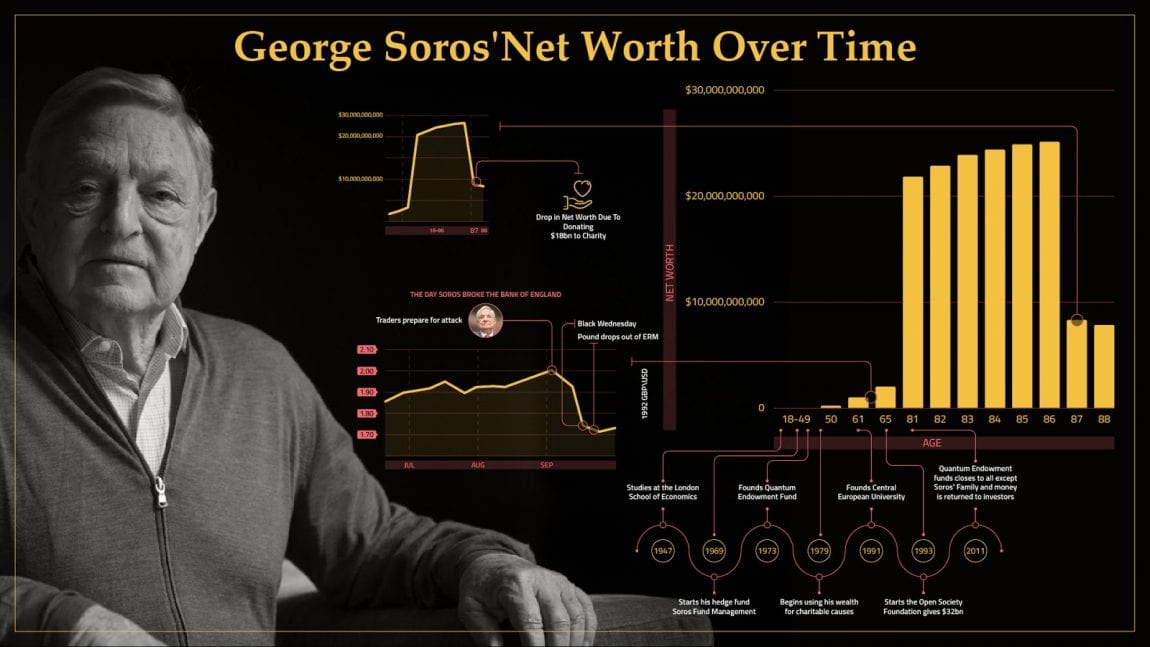
    George Soros' Net Worth Over Time - AskTraders.com
    Image: AskTraders.Com

    The transfer of $25 billion from George Soros to Alex Soros raises pertinent questions about the concentration of wealth and the responsibilities of the ultra-wealthy.

    Some may argue that such large transfers perpetuate wealth inequality, emphasizing the need for systemic change to address the root causes of economic disparity.

    On the other hand, supporters of philanthropy see this transition as an opportunity for Alex Soros to carry on his father’s philanthropic legacy and make a significant difference in the world.

    It is worth noting that philanthropy has the power to effect positive change in society when applied thoughtfully and strategically.

    The Soros family’s longstanding dedication to supporting social justice causes indicates a genuine commitment to creating a more equitable world.

    As Alex Soros takes the reins, his influence and decisions will shape the future impact of the family’s wealth.

    Conclusion

    George Soros’ decision to pass on a substantial portion of his $25 billion fortune to his son, Alex Soros, marks a significant transition in the family’s philanthropic efforts. George Soros has left an indelible mark on the world through his financial success and commitment to social justice causes.

    As Alex Soros inherits this immense wealth, he carries the responsibility of continuing his father’s legacy and making a positive impact on society.

    Whether he chooses to uphold and expand upon the family’s philanthropic endeavors or charts his own path, the world will keenly observe the influence of the Soros family in shaping a more equitable future.


  • Tedd Josiah Urges Blogger Nyakundi To Push For African Social Media Platform

    Tedd Josiah Urges Blogger Nyakundi To Push For African Social Media Platform

    Kenyan music producer and fashion designer Tedd Josiah is urging Africans to build their own social media platforms, citing unnecessary censorship on popular platforms like Twitter.

    Josiah believes that having an African-owned social media platform would give Africans more control over the content they produce and consume, while also providing a platform for the continent’s unique cultures and perspectives.

    In recent years, social media platforms like Twitter and Facebook have come under fire for their sometimes heavy-handed approach to content moderation.

    Critics have argued that these platforms are not transparent enough in their decision-making processes and that they often remove content or ban users without clear justification.

    This has led some users to look for alternative platforms that offer more freedom of expression.

    Josiah argues that Africa needs its own social media platforms because it can’t rely on platforms like Twitter to be fair and unbiased.

    He points out that Twitter has been accused of censorship in the past, particularly when it comes to political speech.

    For example, in October 2020, Twitter suspended the account of Nigerian politician Adamu Garba after he tweeted in support of police brutality against protesters in his country.

    Josiah also believes that African-owned social media platforms would help promote African culture and creativity.

    He notes that many African artists and musicians struggle to get their work seen and heard on global platforms dominated by Western content.

    By creating their own platforms, Africans could ensure that their voices are heard and their stories are told.

    Of course, building a new social media platform from scratch is no small feat. It would require significant investment and technical expertise.

    However, Josiah believes that it is achievable with the right support and resources.

    He suggests that governments and private investors should collaborate to fund African-led social media projects, with an emphasis on transparency and accountability.

    As Josiah puts it, “Africa needs to tell its own stories, in its own way, and on its own terms. We can’t just rely on others to do it for us.

    Building our own social media platforms is one way to take control of our narrative and showcase our unique perspectives to the world.”


    In conclusion, Tedd Josiah’s call for Africans to build their own social media platforms is an important one.

    While it may not be easy, it is a necessary step towards promoting African creativity and ensuring that African voices are heard in the global conversation.

    With the right support and investment, African-led social media could be a powerful tool for change and progress on the continent.

    Tedd Josiah, the ‘Unbwogable’ hitmaker, is actively promoting his new brand of bags, Jokajok. He is primarily using social media to market and sell his products both in Africa and around the world.

    Through his social media presence, Tedd Josiah is effectively showcasing the unique features and benefits of his bags to potential customers.

    He is also engaging with his followers, answering their questions, and providing excellent customer service.

    By leveraging the power of social media marketing, Tedd Josiah has successfully generated a buzz around his brand and attracted a growing number of customers.

    His innovative approach to selling bags has allowed him to reach a wider audience and establish himself as a prominent player in the industry.

    Josiah has asked Cyprian Nyakundi to lead the charge in creating an African social media platform. Nyakundi is a well-known blogger with a large following throughout East Africa.

    Nyakundi has been actively working towards his goal of creating a social media platform for Africans. He has been urging other bloggers to join him in this venture, emphasizing the importance of having a platform that is not controlled by Western powers.

    Nyakundi believes that an African-run social media platform would allow for a more authentic representation of African perspectives and narratives.

    He sees this as an opportunity to challenge the dominant Western narrative and empower people from across the continent to tell their own stories.

    By mobilizing fellow bloggers, Nyakundi hopes to bring together a community of like-minded individuals who are committed to creating a platform that represents the diversity and richness of Africa’s cultures and traditions.


  • It’s All Genge Growth As Jua Cali Drops ‘Utu Uzima’ Album

    It’s All Genge Growth As Jua Cali Drops ‘Utu Uzima’ Album

    The King of Genge has dropped his fifth studio album ‘Utu Uzima’ which a classic blend of vintage and newskul sound. From writing, production and performance, one cannot fail to acknowledge that rapper Jua Cali has presented serious growth that matches the title of the project.

    The title literally translates to growth or maturity and it’s justified in all the tracks. Jua has featured a number of newskul artists in this project but he has kept it fresh in all the collaborations and maintained his genge touch at the same time.

    ‘Vile Iko’ which features Crystal Kagehi Asige is classic. This track, dedicated to rapper’s daughter is a call on the girl child to put in work in whatever they do, especially in education to face the unpredictable future.

    He chose to work with Senator Asige, a classical singer who killed the chorus and laced the entire song with amazing adlibs. The former Sol Generation signee was actually the perfect artist to collaborate with on this one.

    Hon. Asige is currently serving as a nominated senator, representing Persons Living With Disabilities (PLWDs) under the Orange Democratic Movement (ODM) flagship.

    Her position on top of her lyrical and vocal prowess makes her a great inspiration to girls across the African continent.

    And not in any specific order, the album also features ‘Habibi’ produced by Tee Hits. Jua Cali brought out his lyrical and crazy rhyming ability by creatively giving shout outs to prominent Kenyan women from entertainment, sports, media, corporate and politics.

    It is also important to note that most of the tracks in this album are produced by Tee Hits, something that nears the newfound chemistry between rapper Nas and producer Hit Boy.

    ‘Paradise’ for instance, which features singer Kaleche Africana is a good blend of oldskul sound with urban vibe. Kaleche was magical on the chorus and Jua_Cali approached the verses as a grown and collected King of the sub-genre.

    ‘Utu Uzima’ is paying homage to genge and JuaCali’s musical growth and all the tracks are representing the title because they all capture the rapper’s undeniable growth.

    And JuaCali’s prolificity is just as impressive as the quality of his work. He was crowned the best male Kenyan artist in 2007 when he won Pearl of Africa Music Awards (PAM Awards) alongside other accolades including; Kisima Music Awards – Best Male Artist & Boomba Male (2007), 2007 Chaguo La Teeniez Awards (CHAT Awards) – Best Male & Celebrity of the Year and 2006 Kisima Music Awards – Boomba Male (2006).

    The rapper has stayed on the listeners’ radar for long, churning out singles and albums but one can’t struggle to note that each album is arguably better than the one that came before.

    Unlike most of his peers, Jua Cali has been collaborating with new cats in the game with a promise to drop an album. ‘Utu Uzima’ it is, and the album is promising to be one of 2023’s best musical projects.

  • What If Ruto Drops Gachagua For Mudavadi In 2027?

    What If Ruto Drops Gachagua For Mudavadi In 2027?

    What willl be left of the Deputy President Rigathi Gachagua after his tendency to court controversy and moves to to portray himself as an individual who is unafraid to speak his mind ends?

    Gachagua has been in office for only five months since his inauguration but he has made a million statements that have elicited fury for being unbecoming of his high position. His corruption cases have been dropped and Sh200 million frozen by the retired regime given back to him.

    But he still remains unbowed by the criticism and accusations of reducing the stature of the Office of the Deputy President to a tribal corridor. Gachagua still thinks he is unapologetic and resolute in his mission to speak the truth.

    He recently sparked outrage after he said the Kenya Kwanza government will only prioritize those who supported it in the 2022 General Election amid a sustained onslaught by allies of the previous regime.

    “This government is a company that has shares. There are owners who have the majority of shares, and those with just a few, while others do not have any, therefore those who voted for us and supported us must enjoy the benefits first,” Gachagua said.

    Many Kenyans wonder if he will survive re-election in 2027 and be President William Ruto’s running mate again amid fears that he may be dropped for Prime Cabinet Secretary Musalia Mudavadi who is more presidential, reserved and from the Luhya community which is also rich in votes.

    Political Analyst Javas Bigambo argues that Gachagua’s chances of being part of the ticket will largely depend on how he will balance politics and delivery of services to Kenyans.

    But Gachagua believes that he has consolidated enough backing from his Mount Kenya backyard to negotiate with big boys on the political table and make a comeback in 2027.

    “He is trying to reduce the space that Ruto was operating in liberally in Mt. Kenya because he knows he is too busy with state management,” Bigambo argued.

    President William Ruto and PCS Musalia Mudavadi sharing light momemnts during a past event [p/courtesy]
    It must be noted that President Ruto has never depended on any form of “political crutches” when pursuing his dream while Gachagua’s ascension to being the countries second in command came as a surprise to many in the run up to the August 2022 General Election.

    President Ruto sympathized with him after the current Interior Cabinet Secretary Kithure Kindiki bowed out of the race despite making the best cut of a running mate material.

    The former Mathira MP has kept an animated profile since becoming the DP as he keeps on veering off from the persona of what is required of a Deputy President to being a crooked street politician.

    Although President Ruto has never shown any signs of being uncomfortable with his deputy’s style of politics, chances are hight that he might drop him as he gets into his legacy term.

    And Gachagua must be sensing that his crooked method might not work till 2027. Reliable sources reveal that President Ruto has funded the office of PCS Mudavadi well and might pick him over Gachagua as he defends his seat in the coming polls and eventually endorse the former ANC leader to succeed him in 2032.

    DP Gachagua has now treats Mudavadi as his sworn enemy as he funds idling politicians like the former Kakamega Senator Cleophas Malala to scuttle Mudavadi’s influence in Western region in attempts to consolidate his power ahead of 2027 general elections.

    His newfound political friendship with Malala has led to the return of the famous Cleo Malala Super Cup that has increased its coverage to include a total of five counties from the wider Luhya region.

    The DP believes that outspoken Malala is the best person to push for his interests in the vote rich Mulembe Nation as recruits a team of Jubilee politicians from Mt. Kenya region to fight his wars and reduce Mudavadi’s chances.

    Political pundits like Mutahi Ngunyi believe that President Ruto is most likely to settle on Mudavadi as his running mate during his 2027 reelection bid. This is one reality that has hit Gachagua hard and he is now desperately fumbling with his possible plan B should the president abandon him.

    The beef between Gachagua and Mudavadi traces back to days before the last general elections when Gachagua acted wild at the prospect of Ruto considering Mudavadi as his running mate. He instisted that the position had to be filled by a person from Mt. Kenya.

    Gachagua got the DP position but Ruto has made him angrier by assigning Mudavadi more roles to overpower the DP in Kenya Kwanza Alliance administration.

  • Omogi: How Regime Changes Impact The War On Corruption

    Omogi: How Regime Changes Impact The War On Corruption

    The form of dishonesty or criminal offense undertaken by individuals entrusted in a position of authority, in order to acquire illicit wealth or abuse power for selfish interest is corruption. The vice involves many activities including bribery and embezzlement of public funds.

    In many cases, unscrupulous businessmen bribe government officials especially in the procurement department to take shorter time in to have their contracts approved and lock out genuine competitors.

    But the vice is not only widespread in developing countries like Kenya where the people and the economy are the worst hit, it is also common in kleptocracies, oligarchies, mafia and narco-states.

    Data from 2022 Corruption Index (CPI) shows that many countries have failed to stop the vice as it ranks 180 countries and territories across the globe by their perceived corruptions levels in public sector.

    Scoring on a scale of 0 (highly corrupt) to 100 (very clear), the study reveals that the global average has remained the same for more than a decade at just 43 out 100. Meaning, more than two-thirds have scored below 50, while 26 countries have dropped to lowest scores and 155 countries have either declined since 2012 or made zero significance against corruption.

    Kenya for instance is ranked at position 123 with a score of 32 as the index reveals a serious stagnation across the globe despite each country facing its unique challenges. Even countries in top scoring region, European Union and Western Europe have been stagnant for more than a decade or declined over the past five years.

    But countries with low scores especially from Sub Saharan Africa, Central Asia, Americas and Eastern Europe haven’t been abled to make significant progress due to restrictions and attacks on civic space and basic freedom space which heavily threatens security and stability, democracy and human rights.

    Corruption is rife in public sector especially the National Police Services which is the most bribery-prone institution in Kenya. Recent research has found that 75% of Kenyans believe that most or all police officers are corrupt, and one-in-two Kenyans who have interacted with the police have admitted to bribing them.

    The police force frequently engages in corruption crimes such as false imprisonment, fabrication of charges and abuse of human rights to extort bribes, but are rarely arrested or prosecuted.

    Many leaders are also focused on economic recovery and not fighting corruption which is slowing economic growth through slashing of human capital and spending on education and healthcare.

    In Kenya, corruption is deeply rooted in all almost every sector of the economy with all political outfits yearning for power promising to tackle it head-on to revamp the struggling economy.

    “Leaders can fight corruption and promote peace all at once. Governments must open up space to include the public in decision making – from activists, business owners to marginalized communities and young people. In democratic societies, the people raise their voices to help root out corruption and demand a safer world for all”. Daniel Eriksson, Chief Executive Officer, Transparency International.

    Leaders of previous Kenyan governments have admitted that the country is losing one-third of its budget to the vice. A senior official from the National Treasury once told a parliamentary committee that the country is losing more than $4bn every year.

    There are several reports of top government officials diverting huge sums meant for development projects and education to their personal pockets. And as things stand, many citizens are not surprised by the news of the losses, but by the fact regimes led by different officials embrace corruption by pocketing through kickbacks and bending of procurement regulations.

    Taking 10% of any awarded government tender or inflating project costs are the commonest tricks of dipping into government coffers. Corruption has been reported in all successive regimes with efforts by anti-corruption commission causing ripples in government quarters as sleuths struggle to prosecute corrupt state officers.

    It has resulted to unemployment, high levels of poverty, increased insecurity, kidnappings, cultism and cattle rustling. The regime of the day has emphasized its commitment to de-politicize and remove weaponization of the criminal justice system in its war against graft. It argues that the move will allow the relevant institutions to freely exercise the independence given to them by the Constitution.

    A section of politicians allied to the new administration accused a retired regime of subjectively and wrongfully targeting them with graft charges in the run up to the last general elections.

    But as the as war to defeat corruption rages, the country has also witnessed the Office of the Director of Public Prosecution [ODPP] withdrawing high profile graft cases facing top state officials.

    Critics and opposition politicians questioned the move, independence of the ODPP and the timing of the withdrawals while others have defended the move, arguing that some cases were fabricated by the former regimes for political reasons.

    Some legal experts also argue that withdrawals could be a pointer to the fact that the ODPP was not working independently while prosecuting the cases but was acting under duress from political forces in the past regimes.

    A survey conducted in 2017 showed that 67% of Kenyans do not believe that the government is putting enough effort to curb corruption. The respondents rated the anti-corruption performance of the previous regime as average, while the judiciary and legislative service were rated as poor.

    The current regime has pledged to allow the relevant institutions to freely exercise the independence given to them by the Constitution to prosecute corruption and economic crimes.


    Cyprine Omogi is Education Expert and Anti-Corruption Crusader.

  • How Kikuyus Dominate Appointments In Top State Departments

    How Kikuyus Dominate Appointments In Top State Departments

    The head of Public Service Mr. Felix Koskei has been challenged to ensure equitable distribution of jobs across all government ministries and parastatals among all the 42 tribes in Kenya to reflect the true face of country.

    This comes after revelations that Members of Mount Kenya mainly from the Kikuyu community, dominate most of the lucrative State jobs as they occupy plum positions in the departments of accounts, procurement and human resources.

    The other 41 tribes are left to grapple and occupy lesser positions in the key departments that make up 21 ministries in the administration of President William  Ruto.

    Data from the ministries reveal that in accounts department, 55% of those holding key positions in the ministries are from the Kikuyu community, while in procurement and human resources departments, the same favored community holds 34% and 57% as its heads in government ministries.

    The deputy CEO at the Public Service Commission, Jane Chege, is the one who assisting civil servants from her community to ascend to the top positions in the key departments in the government. Most of these senior officers who benefited from Chege’s ‘generosity’ have been accused of bullying a section of junior officers under them.

    Some of the said senior officers even threaten their juniors with transfer, demotion or sack if they do not heed to their sexual demands or instructions to aide corrupt activities.

    Chege influences the posting of her kinsmen to the most lucrative positions in government ministries and departments where most of them overstay and loot from public coffers while non-Kikuyu officers are transferred frequently.

    Below is a list of some of the HR directors in some ministries in the government from the Kikuyu community who call shots.

    1. Foreign Affairs – Mr Gitu
    2. Treasury -Susan Mucheru
    3. Interior- Mr Giuthua
    4. Infrastructure- Joyce Gichomo
    5. Environment – Rosemary Wamoto
    6. Immigration -Christine Nyambura
    7. Labour – Owen Mwaniki
    8. CBC- Rosebell Wainaina
    9. Asal-Ann Kareithi
    10. Youth- Zipporah Mutahi
    11. Housing and Urban Development -Susan Wangare
    12. Shipping and Maritime – Rosemary Gichoi
    13. Correctional Services – Mary Mugure
    14. Broadcasting and Telecommunications- Miriam Gitau
    15. Devolution -Leonard Ngotho
    16. Maritime Academy-Francis Muraya (on contract)
    17. KNBS- Ann Mburu 19. Petroleum-Alice Maina
    18. Water-Carol Mugwe 21. East Africa -Macharia Kibe
    19. ICT and Digital Economy -James Muriuki
    20. Training and Development-David Njoroge
    21. Mining-Agnes Njer

    Kenya Insights has also learnt that most of these officers were teachers before they were appointed by PSC to boost capacity in ministries and state departments in the civil service to enhance training and development (HRD) between 2005 and 2012.

    The same is the case across other cadres (technical), whereby it is only one community that dominates the most lucrative ministries and departments. Most members of kikuyu community are posted to key ministries and departments as an avenue of corruption.

  • Mudavadi, Wetangula camps in silent wars over Luhya kingship

    Mudavadi, Wetangula camps in silent wars over Luhya kingship

    Prime Cabinet Secretary Hon. Musalia Mudavadi struggles to be Luhya’s kingpin ahead of the 2027 general elections amid a looming showdown between him and the National Assembly speaker Moses Wetang’ula in supremacy battles in the Mulembe nation.

    Already, vocal political players in his Vihiga backyard and ANC Party are feeling betrayed and are trooping towards Wetangulas Ford-Kenya. They are accusing Mudavadi of sticking in bed with Luhya elders who served during the reign of former later President Daniel Moi who are misleading him.

    He has held consultative meetings with a section of Luhya leaders in Busia as part of his wider plan to take control of Luhya politics, but the fact that his ANC party is now under the leadership of one sleeping Lamu Governor Issa Timmamy is doing him more harm than good.

    The former VP was hosted by Busia governor Paul Otuoma, a move that angered some of his ANC allies like Sakwa Bunyasi whom Otuoma defeated in last year’s governor race.

    Mudavadi is also targeting many ODM faces in Western Kenya on his side to stage a decisive onslaught against Wetang’ula.

    But constitutionally, the speaker of the national assembly is the third in command after the president and his deputy, though Mudavadi feels that his prime cabinet secretary position makes him the third in command.

    He led another meeting where he prevailed upon Luhya politicians to back him for the presidency in 2032, but it was given a wide berth by politicians allied to Wetangula as he appealed to the region to rally together and guarantee President William Ruto an easy win in 2027.

    Busia is ODMs political stronghold but Mudavadi cut links with ODM to team with Ruto in the run-up to the August 9 general election. It was during the Busia meeting that he was crowned the chairman of the Western council of elders.

    Wetangulalater joined him in the meeting where they also met five elected governors including host Otuoma, Bungoma’s Kenneth Lusaka, Kakamega’s Fernandez Barasa and Wilber Ottichilo from Vihiga but battlelines for the Mulembe nation have already been drawn and are being fanned by their allies.

    The Wetang’ula camp insists the national assembly speaker is the senior most, while Mudavadi camp accuses Wetang’ula of not fearing to be impartial as the speaker of the national assembly by playing active politics and also not relinquishing his seat as Ford-K leader the way the PCS did by resigning as Amani ANC party leader.

    The speaker’s allies also argue that Mudavadi was nominated to his position through Ruto’s Executive Order while Wetang’ula had been first elected as Bungoma senator and was still brave enough to resign to run for the national assembly speaker seat, which he eventually won against Kenneth Marende.

    Mudavadi got his current position on a silver platter while Wetang’ula struggled and also made sure his successor Wafula Wakoli triumphed in the subsequent by-election.

    The former ANC leader has not run for any elective position since 2013, when he came a distant third in the presidential election. He also has not held any elective post since 2002, when he served as vice president for two only months.

  • PR stunts mark the launch of Ruto’s Hustler Fund

    PR stunts mark the launch of Ruto’s Hustler Fund

    President William Ruto has launched Hustler’s Fund, one of his key flagship projects he promised voters during the last campaigns. Hustler’s fund is expected to provide 500 times cheaper loans to Kenyans with a daily interest rate of 0.002 per cent.

    President Ruto said the fund has four categories of loans including personal finance, microloan, SMEs and start-ups. Personal loan ranges from Ksh500 and Ksh50,000, and should be repaid within 14 days, but SMEs and start-ups can access loans of up to Ksh250,000.

    Loan limits will be determined by one’s credit scores, with the duration taken to service a loan playing a major factor in processing future loans.
    The event held at the Green Park Bus Terminus in Nairobi marked the day that Kenya Kwanza administration fulfilled one of its biggest campaign pledges and it was also filled with PR Stunts and drama.
    /courtesy

    Deputy President Rigathi Gachagua was a lead actor when he bought a shirt for Sh50,000 from a trader who was planted as one of the props at the launching venue.

    The DP was called to the podium and asked to purchase a shirt which he took then the Master of Ceremony told him to pay Sh50,000 for.

    The outspoken Trade Secretary Mr. Moses Kuria also bought a shirt at Sh60,000 while President Ruto purchased maize from a ‘hustler.’

    The Hustler Fund aims to lift ordinary Kenyans to have easy access to affordable credit to grow their businesses. The government is also using it as way of creating jobs, strengthening the economy and empowering investors both domestically and internationally.

    Disbursement of the Sh50 billion annual Hustlers’ Fund kitty will start on Thursday.  The fund which will be available for individuals, groups, small enterprises and co-operatives will be offered at a one-digit interest rate of 8% per annum.

    President described the fund as one that will give Kenyans blacklisted by money lending apps and M-Swari, a second chance to access loans. He also added that it will be cheaper, compared to what other lenders are currently offering.

    Crafters of the fund describe it as an initiative meant to improve financial access to responsible finance for personal, micro, small, and medium-sized enterprises (MSMEs) in the country.


  • Inside Kuria-Linturi feud over GMO maize

    Inside Kuria-Linturi feud over GMO maize

    The supremacy battle between Trade & Industry CS Moses Kuria and Agriculture CS Mithika Linturi goes way beyond the importation of GMO maize where exploitative businessmen allied to the Kenya Kwanza government are set to benefit to selfish interests.

    Kuria has a bizarre love for controversies with his loose tongue and has this time round he over-stepped his boundaries by engaging Linturi in an open war over the importation of maize.

    CS Linturi says the decision on importation of the controversial GMO maize lies with his office. He clarified that it is his ministry (Agriculture) that is mandated with import decisions after establishing the deficit that the country is facing in order to determine the number of bags to be shipped into the country.

    “I am not aware of what Kuria said… I am the custodian of statistics on how much food we require in this country and what we consume every day. Right now my technical people have worked on all the deficit in terms of maize, beans and rice,” said Linturi.

    Linturi made his remarks after Kuria claimed that the country will  import 10 million bags of GMO maize to bridge the local deficit and reduce the price of flour that has now risen to Sh213 for a two-kilogramme packet.

    The Agriculture CS promised to make a comprehensive statement regarding food situation in the country and what needs to be done before the week ends.

    His beef with Kuria is coming out in public just days after a group of MPs from both Azimio and the ruling coalition of Kenya Kwanza raised questions over the firms set to benefit from the importation.

    The MPs argued that Kenyan farmers risk incurring major losses as the market will be flooded by cheap imported maize amid claims that powerful individuals have already lined up to cash in at the expense of local farmers.

    The feud between CS Kuria and Linturi is informed with greed as both of them are fighting to oversee the importation to pocket kickbacks or to use proxy firms to cash in.

    The MPs also challenged Kenya Kwanza government to provide information on how the firms were identified as they claimed that the administration is being blackmailed by foreign powers that are looking for a market for their multinational companies.

    Kenya’s Prime Cabinet Secretary, H.E Musalia Mudavadi [p/courtesy]
    MPs allied to Opposition Chief Raila Odinga have also criticized the importation as they termed the decision “insincere and incoherent with the promises President Ruto made during the campaign period.

    “Why has there been no effort to get ordinary maize from other parts of the world or was importation of GMOs part of the pre-election deal between President William Ruto and foreign backers?” Hon Opiyo Wandayi posed.

    Opposition politicians argue that the current famine situation is being used as an excuse in a plot by highly placed government officials to defraud the country.

    Linturi has been named in many scandals including a case where he forged signatures  to secure a Sh530 million bank loan using properties belonging to his estranged wife, Marianne Kitany.

    And Moses Kuria in 2021 told BBC that  he pocketed $1000 bribe to back former Kipipiri Mp Amos Kimunya appointment as the Majority Leader in the National Assembly.

    The battle between Kuria and Linturi over who should oversee the importation of the maize forced Prime Cabinet Secretary H.E Musalia Mudavadi to weigh in as he clarified that the decision on imports is a mandate of the Ministry of Agriculture.

    “The issue of importation of maize should be guided by a survey by the Ministry of Agriculture to find out if there is a deficit of the grains… it is agriculture docket that will issue an importation order looking at the food situation in the country,” said Mudavadi.


  • Kenya Kwanza turning guns on Azimio friendly journalists

    Kenya Kwanza turning guns on Azimio friendly journalists

    Royal Media Services (RMS) has been in panic mode since President William Ruto was sworn in with broadcast’s owners finding themselves holding the short end of the stick.

    RMS owner, Dr. S.K. Macharia has taken a low profile as he pays the cost of backing Azimio La Umoja One Kenya Alliance presidential candidate Raila Odinga in the last elections.

    President Ruto’s Kenya Kwanza administration is tightening its noose on RMS management and exerting pressure to have its top journalists who were perceived as pro-Raila and anti-Ruto during the campaigns kicked out.

    The government’s prime targets are editorial director Linus Kaikai, news anchor and talk-show host Yvonne Okwara and reporter Stephen Letoo who were anti-Ruto in the run-up to the last general elections.

    Ruto administration is determined to have the three fired from Citizen TV as one of the toughest conditions it has set to Royal Media Services to bag advertising and other deals from the government.

    RMS is already feeling the heat with reliable sources reporting that advertisements from the State and related agencies are on a serious decline.

    Dr. Macharia was recently forced to plead with RMS advertisers in efforts to retain them and expand their numbers.

    “We are delighted to break bread with our clients as we endeavor to offer the best partnerships and collaborations.” RMS stated in a breakfast meeting.

    But Linus Kaikai and Yvonne Okwara have specifically been earmarked for their roles in promoting Azimio’s agenda and suppressing the coverage for Dr Ruto/ Kenya Kwanza Alliance in the newsroom.
    And Yvonne is also being targeted for how she handled Ruto during the presidential debate which was boycotted by Raila Odinga.

    The regime of the day argues that though Ruto debated against himself after Odinga’s boycot, Yvonne Okwara who was among the journalists picked to manager the interview “unfairly” treated Ruto by asking him tough questions that left him contradicting himself.

    Kaikai got the powers to frustrate Ruto’s covering after he was made RMS’s Editorial Director in March 2022 following Joe Ageyo’s exit Citizen TV. His position gave him in sweeping powers over election coverage and he openly favored Azimio over Kenya Kwanza especially through ‘Newsgang’, a programme which he used to critique Ruto.

    But cornered RMS is now left with fewer options given that government is the biggest advertiser and reliable revenue stream. Dr. Macharia will be forced to axe Kakai, Okwara and go the Nation Media Group direction.

    NMG has bended to Ruto’s demand by making editorial changes which saw Mutuma Mathiu being dropped from the position of editor-in-chief and Bernard Mwinzi from managing daily news.

    The regime’s tough stance on media signals tough times ahead for big media in Kenya, with experts seeing attempts of arm-twisting by the government, a move which is expected to constrain freedom of expression.


  • Bryant’s rookie jersey to fetch Sh580m

    Bryant’s rookie jersey to fetch Sh580m

    The purple and gold jersey worn by Los Angeles Lakers legend Kobe Bryant during his rookie season 25 years ago will hit the auction block next month where it is estimated to fetch between $3 million and $5 million.

    Bryant premiered in the NBA league as a teenager in 1996 and the number eight jersey has been “resolution photomatched” to four games in the beginning of his career including two playoff games.

    The jersey has also been matched to the basket ball legend’s 1997 Skybox Z-Force trading card, where he can be seen wearing it on the back of the card.

    “In SCP’s opinion, this spectacular specimen from the legendary Laker’s rookie campaign could set a new price record for a game worn basketball jersey,” the auction house said.

    “The current record is $3.69 million (Sh452m) for another Kobe rookie jersey. However, that example was worn solely in the regular season, whereas this magnificent jersey was worn in the Mamba’s first-ever playoffs.” SCP Auctions said.

    Bryant jumped into the league straight from high school and went on to win five NBA championships in his 20 seasons with the LA Lakers.

    Bidding on the jersey belonging to the Hall of Famer begins May 18 and ends on June 4.

    The legendary Bryant perished on January 26, 2020 after a helicopter carrying him, his 13-year-old daughter Gianna and seven others crashed in Calabasas, California, roughly 30 miles north of Los Angeles. Everyone on board died with Bryant’s death sending shockwaves through the entire sporting world.

    Bryant featured for the Los Angeles Lakers from 1996 until 2016, winning five NBA Championships and the 2008 Most Valuable Player award while making the All-Star team in 18 of his 20 seasons.

    He established himself as one of the greatest players in the NBA history with his clutch shooting, capable defending, work ethic, and longevity.

    Bryant died while heading to his daughter Gianna’s basketball game at his Mamba Sports Academy in Thousand Oaks, California.

  • Kingi-Mwathathe war ripping PAA party apart

    Kingi-Mwathathe war ripping PAA party apart

    The fallout between Kilifi governor Amason Kingi and former Chief of Defence Forces General Samson Mwathethe is causing turbulence in Pamoja African Alliance (PAA) party. Mwathethe who enjoys strong links between the party officials and State House has left the party over lack of honesty in operations.

    PAA wrote to the Registrar of Political Parties Anne Nderitu seeking to withdraw from the Azimio La Umoja-One Kenya Coalition. The Kingi led party claimed that it is kept in the dark over the agreement it signed with Azimio Coalition.

    “We confirm that PAA vide its letter dated April 25, to the Registrar of Political Parties is seeking to withdraw from the Azimio La Umoja One Kenya Coalition party,” Governor Kingi posted on Twitter.

    Other officials of the Kilifi based political party also told the media that they had not seen the agreement it had signed with the coalition.

    Former Chief of Defence Forces General Samson Mwathathe [p/courtesy]
    But reports are also rife that Deputy President Dr. William Ruto is using former Malindi MP Lucas Maitha, an official of PAA to poach the party from Azimio at a good fee.

    Ruto taking over the party will leave the likes of George Kithi with serious political injuries. He is eyeing the Kilifi gubernatorial seat where he will face off with UDA’s Aisha Jumwa.

    Kithi will definitely be forced to shelve his bid in favour of Jumwa who is Ruto’s sidekick and a powerful political force.

    PAA officials are desperate to make a killing and will not care if the  party candidates win or lose since they have already pocketed their nomination fees.

    Kingi party will be the second from the Coastal region to be swallowed by DP Ruto after he bought Kadu Asili, a brief case party which has no political impact.

    But a section of supporters and candidates vying for various positions are opposed to the hawking move and have threatened to take a legal action.

    They argue that they were attracted to the party because of its affiliation to Azimio la Umoja coalition whose presidential candidate is ODM leader Raila Odinga.

    Kingi fell out with Odinga and in early 2021 when he publicly lectured the ODM leader to let coastal people to form and run political parties that carry their ambitions.

    That lecture sealed his departure from ODM and dented his long political relationship with Raila Odinga and even his stay in Azimio was expected to be rocky.


  • Luhya Leaders In ODM Blocked Wanyonyi’s bid

    Luhya Leaders In ODM Blocked Wanyonyi’s bid

    Westlands MP Tim Wanyonyi during a CDF functions on Sunday explained that he bolted out of the Nairobi gubernatorial race because ODM leader Raila Odinga had received Jubilee backing for presidency and therefore they had to relinquish the Nairobi seat.

    Wanyonyi had been touted as the best candidate to occupy Nairobi seat but his ambition was shot down after negotiations with the Jubilee party which will field Polycarp Igathe.

    “Because of the arrangement of parties to work together, it comes along with its challenges. And it is due to those challenges that it was agreed that because ODM had been given the presidency, we had to relinquish the Nairobi Governor’s seat for Jubilee,” Wanyonyi said.

    But what’s not known to many is that Wanyonyi’s bid had been shot down by ODM leaders from his own Luhya backyard. A section of Luhya leaders identifying themselves as ‘Mulembe Grass root Leaders’ drawn from the ODM party had in January stated that Nairobi was their only bargaining for power.

    That was never the case when it came to negotiations. The group led by Vincent Shimoli and drawn from Nairobi’s 85 wards had endorsed Hon. Tim Wanyonyi as their candidate but never backed him during the Azimio negotiations.

    In fact, those who loudly shot down Wanyonyi’s bid are Luhya leaders who have been in bed with Jubilee even way before the handshake between President Uhuru Kenyatta and ODM leader Raila Odinga.

    So Wanyonyi did not step down but was pushed down by his own people led by former Nairobi County Assembly Speaker Beatrice Elachi who is conveniently in ODM under the instructions of her spin masters who are Jubilee big wigs.

    Prior to her nomination as the Chief Administrative Secretary (CAS) in the Ministry of Public Service and Gender, Elachi spent all her precious time abusing ODM leadership and Simba Arati.

    Dogoret North parliamentary aspirant Beatrice Elachi. She opposed Wanyonyi’s gubernatorial bid [p/courtesy]
    But in the run up to ODM party primaries, she became a sweetheart begging Tim Wanyonyi and SG Edwin Sifuna to help her secure the party ticket to run for Dogoreti North Constituency seat.

    She is a Judas who has no right and moral authority to talk about Luhyas and on behalf of Hon Tim Wanyonyi. The former Jubilee nominated senator has never supported any course that favors the Mulembe nation.

    Elachi is part of a pack of vindictive and dreadful wolves which include top Luhya leaders in ODM who are not happy with Wanyonyi’s fast and stable rise in politics.

    The cabal of Luhya leaders who feel that Wanyonyi is becoming a threat in ODM succession matrix coerced Odinga to throw him, under the bus.

    Because Wanyonyi as the governor of Nairobi would definitely lead to emergence of a new crop of Luhya leaders who would take from the likes of Wycliffe Oparanya who is retiring as Kakamega governor.

    In a nut shell, Luhya leaders in ODM chose to stifle democracy by sacrificing Hon. Tim Wanyonyi, a person living with disability, loyal member and supporter ODM to support of a political novice.


  • Is Sakaja conveniently Luhya for political advancements?

    Is Sakaja conveniently Luhya for political advancements?

    As candidates race to capture the Nairobi gubernatorial seat in the coming August polls, ethnicity remains a factor that will play a huge role as it is the norm in Kenyan politics.

    The Luhya community for instance feels that it is their chance to occupy the City Hall after backing their Luo neighbors in the two previous polls.

    In early 2022, a group of individuals identifying themselves as ‘Mulembe Grass root Leaders’ demanded that the Nairobi governor seat be preserved for them.

    They argued that the presidential seat is heading to Luo Nyanza and the deputy president position heading to the Mt Kenya region and so the Nairobi seat was their only bargaining power.

    But not only the distribution of positions, Luhyas also have numbers to front for the coveted seat in Nairobi and their candidate can attract other ethnic groups that vote alongside Luos like the Kisiis, Kambas and others tribes from the coastal region who reside and vote in the country’s capital.

    This has led to many politicians eyeing the seat to front themselves as Luhyas though the seat can go to any Kenyan not necessarily a Luhya.

    Nairobi Senator Johnson Sakaja is man rumored to be Teso, Luhya, Saboati, Kalenjin, Luo and many more but for political reasons and for his quest to clinch the Naiorbi seat, the man says he is a Luhya.

    Sakaja began positioning himself as a Luhya eyeing the Nairobi seat when he maintained walking around ANC leader Musalia Mudavadi in every political gathering to identify with the Mulembe nation.

    But the young senator is always and silent when Luhyas are under attack or in need of a political voice to defend them.

    He was a no show during a mass lay off of City Hall employees where a majority of those affected were from the Luhya community.  City Hall cartels kicked them out on a lazy belief that they were illegally awarded jobs when Beatrice Elach was the Speaker of Nairobi County Assembly but they went through a competitive process.

    Majority of the staffers at the City Hall are from the Kikuyu community followed by Kenya-Somali which ought to have been the targets.

    Westlands MP Tim Wanyonyi and Nairobi Senator Johnson Sakaja [p/courtesy]
    Sakaja who sits at the senate and ‘was not a Luhya’ then, remained silent when he was expected to raise his voice as a way of playing his oversight role to defend the people he expects to vote for him in the August 9 polls.

    He chose to sit on the fence despite being fully aware that auditing firm, Powerhouse Coopers (PWC) was hired to formulate strategies to streamline City Hall and kick out ghost workers when Elachi came to power.

    Elachi succeeded Alex Magelo who was the speaker Abdi Guyo was the Majoity Leader and Jacob Ngwele the clerk, meaning there were more Somalis, Maasai and Kambas in high ranking positions than Luhyas.

    PWC found out that many Luhyas had been overlooked due to their political incorrectness and advised that they be promoted.

    But the move angered cartels and Guyo who Sakaja had no nerves to take on as they directed for the demotion of Luhyas despite them being promoted by Public Service Commission (PSC) based on merits.

    They approached Sakaja for assistance since the matter had turned into case of nepotism but the self professed Super Senator kicked them out of his office.

    May be he was not a Luhya then or he feared that he could also be exposed since he has been involved in mega scandals including Kenya Medical Supplies Authority (KEMSA) where tenders were awarded to politically connected individuals.

    Sakaja who is flying UDA gubernatorial flag in Nairobi was part of the Sh.7.8 billion PPE scandal at the State Agency. He was reported by the then procurement director Charles Juma who was grilled by Public Investments Committee.

    The UDA politician also came under scrutiny in the run up to 2017 elections after his transcripts were shared online showing that his academic grades oscillated between Es and Ds.

    He was eyeing the gubernatorial seat then but after being deconstructed by exiled Kenyan lawyer Dr. Miguna Miguna who was also eyeing the same seat, Sakaja shelved his ambitions and went for the senatorial seat. He is back and eyeing the gubernatorial seat as a Luhya.

    He will face off with Jubilee’s Polycarp Igathe who was endorsed by President Uhuru Kenyatta and ODM leader Raila Odinga. Before Igathe’s endorsement, the race had shaped up to be a battle between Sakaja and ODM’s Tim Wanyonyi who was coerced to shelve his bid and back Igathe.

    Wanyonyi who belongs to the Luhya extract was expected to give Sakaja a run for his money given his long political experience in Nairobi and a track record that speaks volumes.

    Sakaja who remains desperate for Luhya support was quick to pose with the Westlands MP for a photo to woo the Luhya nation just moments after Wanyonyi dropped his bid.


  • Is Mombasa ready for internationally sanctioned governor?

    Is Mombasa ready for internationally sanctioned governor?

    Former Nairobi governor Mike Mbuvi Sonko is in the race to become the next governor of Mombasa County after he was handed a direct ticket by Wiper Democratic Movement.

    Sonko had initially hinted at reclaiming his Nairobi seat which he lost through impeachment on December 3 2020 before he recently shifted his political base to Mombasa.

    He will face off with ODM’s Abdulswamad Shariff Nassir and UDA’s Hassan Omar to take over from governor Hassan Joho whose term expires in August.

    But the embattled Sonko is swimming in controversies and facing many corruption cases in court. In early March 2022, US authorities banned him and his immediate family members from travelling to the US over corruption scandals related to bribery and abuse of office.

    Is that the man who is good for Mombasa, port city which is also a tourism destination and foreign exchanger earner for Kenya?

    Already two people have filed a petition seeking to bar Sonko from being cleared by Independent and Electoral and Boundary Commission (IEBC) to contest for the Mombasa top seat.

    Ndoro Kaguya and George Odhiambo filed the petition before the Mombasa High Court seeking conservatory orders stopping IEBC from clearing Sonko to run in Mombasa.

    Sonko whose choice to contest the Mombasa seat reignites the debate on exclusive upcountry vote also boasts that he had many options to reclaim the Nairobi seat before settling for Mombasa.

    Deputy President Dr. William RUTO had approached him to run for the Nairobi top seat on an UDA ticket but he opted for the Wiper ticket in Mombasa due to his close ties, and respect for the party leader Kalonzo Musyoka.

    Sonko said that Kalonzo told him to go for the Mombasa seat because Nairobi has many interests and Azimio bosses had already drawn their plan for the capital.

    Mike Sonko (L) and Wiper leader Kalonzo Musyoka (p/courtesy)

    But Sonko’s entry into Mombasa race has opened a new war front with governor Joho. His quest has rattled the governor’s camp and forced them back to the drawing board to scheme for a counter strategy.

    Joho who doubles as ODM deputy party leader fears that Sonko’s unexpected move is likely to affect not only the governor position, but all other elective seats which have been under the grip of ODM since 2013.

    Sonko and Wiper are complicating Joho’s succession plan which was headed for smooth sailing after Mombasa businessman Suleiman Shahbal was instructed by ODM leader Raila Odinga to step aside in favour of Mvita MP Abdulswamad Nassir.

    The outgoing Mombasa governor has been dismissive of the other governor contenders including UDA’s Hassan Omar whom he said could not garner more that 5,000 votes but not Sonko.

    Sonko is different, he enjoys grassroots support among common voters across the board which has potential to change the narrative ahead of August polls but the focus should remain on his tainted image.

    Is he fit to be the next governor of Mombasa, the second largest city and economic in Kenya?

    The controversial politician is a self confessed convict who escaped jail. In fact ODM leaders have criticized Wiper party and Kalonzo for going against anticorruption norms to clear Sonko to contest for Mombasa governor despite having been impeached and facing a series of criminal cases in court.

    Kenya Insights can authoritatively report that Joho is also reaching out to “deep state” operatives to tame the former Nairobi governor by bringing up his criminal cases to keep him busy in the courts.

    Other than criminal cases, Sonko demonstrated his wanting incompetency in Nairobi forcing him to transfer key functions of Health, Transport, Public Works and Auxilliary services to Major General Mohamad Badi led Nairobi Metropolitan Services.

    Everything possible should done to protect the people of Mombasa from electing popular politicians who have no understanding of their job descriptions and capacity to carry out their mandate. Sonko is not the man.


  • Kalonzo’s spoiler role in ODM strongholds

    Kalonzo’s spoiler role in ODM strongholds

    Wiper Democratic Movment handed Former Nairobi Governor Mike Sonko a direct nomination ticket to vie for the Mombasa County governorship in the August General Election.

    Sonko was handed the ticket by Wiper leader Kalonzo Musyoka in a small ceremony held in Nairobi almost two weeks after the Musyoka-led party cleared Sonko and submitted his name to the Independent Electoral and Boundaries Commission (IEBC).

    After his entry into the Mombasa race race, the controversial politician was expected to face off with Kisauni MP Ali Mbogo in nominations but Kalonzo managed to broker a deal that will have Mbogo deputize Sonko.

    TThe move now sets stage for Sonko to battle it out against Mvita MP Abdulswamad Sharif  Nassir (ODM) and former Mombasa Senator Hassan Omar (UDA) who are both eyeing the top seat in the port city.

    Sonko-Mbogo ticket is considerebly strong since Mbogo comes from the Mijikenda community which is the largest in the ccoastal region. He is also the sitting in MP in Kisauni which is th most populous constituency in Mombasa County.

    Wiper Leader Hon. Kalonzo Musyoka [p/courtesy]
    The battle to succceed outgoing governor Hassan Joho has seen many aspirants scrambling for Mijikenda community vote which is distributed across the six sub-counties ahead of the August polls.

    Sonko who has had a stint as the resideent of Mombasa began by endearing himself to the community by meeting its elders.

    According to 2017 IEBC register, Mombasa  County has a total of 580,223 registered voters with slightly over 50% of these voters coming from the Mijikenda community concentrated especially in Kisauni and Likoni sub counties and sections of Mvita.

    Experts argue that the Mijikenda factor despit the poverty levels still remains crucial for anyone seeking to be the next governor and like any previous races; Kenyan-Arab aspirants will also have to scramble for Mijikenda running mates.

    Even ODM’s Abdulswamad Sharrif Nassir who will fly the Orange Democratic Movement (ODM) flag and considered a descendant of the Arab Swahili, a community regarded as wealthy with urban influence is most likey to choose a Mijikendda as his running matte to win the vote.

    Both Sonko and Abdulswamad are in Azimio La Umoja coalition and one would have expected Kalonzo to shelve his party’s interests in a plac considered ODM stronghold but he is hellbent to play a spoiler card.

    He is not campaigning for the Azimio presidential candidate Raila Odinga but fielding candidates in regions where vote splitting may disadvantage ODM and favor UDA candidate.

    Kalonzo believes that pairing with Mijikenda gives him enough guts to take on ODM in Mombasa. Both Kalonzo and Sonko are from the Kamba community whi boasts of good numericcal figures in Mombasa.

    The Kamba community is the second largest vote bloc in Mombasa county. They had initially expressed their will to throw their weight behind businessman Suleiman Shahbal who later ditched Wiper for ODM after alledging that Joho gave them a raw deal.

    They claim that the incumbent who was elected on an ODM ticket has neglected them for close to a decade by ignoring their kins in county xecutive jobs.

    But Kalonzo’s meddling and interferance in ODM strongholds has also been witnessed in Nairobi.

    The former VP had intially reached a deal to have Wiper’s Prof. Philip Kaloki deputize Jubilee aspirant Richard Ngatia. This was despite Ngatia being tainted with looting scandals, fake degree papers and ODM having the favorite to ascend to City’s top sat in Westlands MP Tim Wanyaonyi.

    Azimio has since settled to have Jubilee’s Polycarp Igathe go for the governor deputized by ODM’s Tim Wanyonyi and Wiperman Philip Kaloki has been promised the County Assembly speaker position.


  • Why Tim Wanyonyi is Nairobi’s safest hand

    Why Tim Wanyonyi is Nairobi’s safest hand

    Westland MP Hon. Tim Wanyonyi Wetang’ula unveiled his ambitions to become the next governor of Nairobi on November 14 2021 with his bid receiving a boost after he was endorsed by ODM supremo Raila Odinga in January 2022.

    Wanyonyi launched his bid for the Nairobi top seat under the Orange Democratic Movement (ODM) ticket and has maintained spirited campaigns to inherit the seat from Anne Kananu in August.

    “Fellow residents of Nairobi, I speak not from mere theory but from a firm knowledge and understanding of the affairs of Nairobi. Having served in Nairobi County for a total of fifteen years, I am well aware of what residents of Nairobi require and I will fix it!” Wanyonyi said.

    He’s banking on his untainted image and proper use of CDF funds as legacies to propel him to the helm at City Hall. Wanyonyi is promising to transform Nairobi to realize its full potential as the region’s business hub with increased use of ICT in service delivery.

    Wanyonyi who has been active in Nairobi for over 15 years serving as a Councillor and MP, has vowed to transform the Kenya’s capital into a smart city if he wins the August 9 polls.

    He will face Nairobi Senator Johnson Sakaja who will fly UDA’s flag, Tycoon Richard Ngatia who is expected to run on a Jubilee Party ticket, Agnes  Kagure and other questionable characters who have announced their quest for the seat.

    Hon. Wanyonyi has called for peaceful and issue-based politics ahead of the August 9 polls as he castigated politicians engaging in confrontational politics and urged them to seek solutions to challenges facing Nairobi residents.

    “Instead of engaging in dirty politics and attacking our competitors, we should be telling our constituents what we can do for them,” said Wanyonyi.

    He has recieved the backing of more than 30 Nairobi MCAs including Imara Daima’s Kennedy Obuya who called on ODM party leadership to throw its weight behind the Westland’s lawmaker. Karen MCA David Mberia also added that they will rally their support behind Wanyonyi’s candidature not because of coercion but because of his track record which speaks volumes.

    Controversial businessman Richard Ngatia [p/courtesy]
    So far the debate there is heated as to whether Azimio La Umoja coalition should settle on one candidate between Wanyonyi and Ngatia.l with latest entrant Polycarp Igathe complicating the matrix.

    Wanyonyi believes he is the man because Ngatia is a controversial figure whose name has been in the mad for years. He is the man behind a controversial firm that got over Sh1 billion contracts for Covid-19 medical supplies at the centre of the Sh63 billion medical kits scandal.

    Kenyan senate said the said the deal was conceived like a criminal enterprise with a damming report by the Senate showing that Ngatia’s Megascope Healthcare Ltd was part of the rip-off and should be investigated by the Ethics and Anti- Corruption Commission (EACC).

    Ngatia who doubles as the president of the Kenya National Chamber of Commerce and Industry also has the authenticity of his degree certificate under scrutiny.

    Serious questions began surrounding the education credential’s of President Uhuru Kenyatta’s affluent after UK officials disowned his purported university degree which is obligatory for all candidates seeking the governor position.

    Agnes Kagure, Nairobi gubernatorial aspirant [p/courtesy]
    The British Commissioner of Education the Director-General answerable for Higher and Further Education Paul Kett stated that there is no single university in the United Kingdom that has ever admitted Richard Ngatia.

    “To the best of our knowledge, we would wish to state as follows; there is no University within the territory of the United Kingdom that has ever admitted Mr. Richard Ngatia, or any other student from Kenya by that name, as student in the UK.” Kett stated.

    Wanyonyi who is a lawyer by profession will also face off with Agnes Kagure, a dreaded fraudster who has many land cases including Sh500 million land grab scandal in Karen.

    But with rumors doing rounds that there are ongoing consultations to coerce Wanyonyi to back another candidate, the Westlands MP has affirmed his resolve to the ballot.

    He has refuted claims that he will drop his bid of becoming the city’s administrator to become the running mate to Ngatia of the Jubilee party under the Azimio la Umoja ticket.

    Wanyonyi who also enjoys the backing of Ida Odinga the spouse to Raila, remains ODM’s front candidate and enthusiasts are vowing to stand up with him. On matters integrity, he stands out from the rest of his competitors many of whom are battling corruption cases in different fields.

    When Nairobians voted in Evans Kidero as the first governor, many weren’t aware of his dark past as a corporate fraud who sunk Mumias Sugar, later, the reality became, Kidero ended up being one of the most corrupt governors in the first dispensation of devolution. Since leaving office, the former governor who’s conspicuously scheming to occupy Homa Bay gubernatorial seat, has been spending most of his days in abs out of court battling corruption cases that he engineered in his tenure.

    Nairobi is at a point of making a choice and going through the options of better leadership, there’s an obvious safe hand.

  • What if Uhuru deploys military to handle post poll chaos?

    What if Uhuru deploys military to handle post poll chaos?

    With the 2022 political wars now changing tact from verbal attacks to ‘near deployment’ of the most sophisticated weapons either side may possess, August 9 polls remain a battle between President Uhuru Kenyatta and his deputy, Dr. William Ruto.

    The trading of political salvos has heightened since President Kenyatta made it public that he is backing the Opposition Chief Raila Odinga in the 2022 presidential race. Kenyatta is backing the man he beat in both 2013 and 2017 presidential polls but not his deputy William Ruto who backed him (Kenyatta) in those polls.

    Ruto is feeling played and he is in the race to win it against Raila Odinga who he accuses of being President Uhuru’s project. Even pundits belittle their war as a mere imitation of a common scene in dirty politics but it is war and power is at play.

    President Kenyatta has power in hands to make bold moves with it. He started with a hard hitting purge targeted on Ruto allies in the Cabinet, State Corporations, in the two parliaments and Jubilee Party where he kicked them out.

    He has painted the picture perfectly that he can play smooth or even extend military. For instance, Nairobi County which was under Mike Mbuvi Sonko, a corrupt Ruto ally was put under the military man. Sonko was first made irrelevant when his tasks were transferred to Major General Mohamed Badi of Nairobi Metropolitan Services (MNS).

    NMS Director, Major General Mohamed Badi [P/Courtesy]
    Kenyatta’s preference for the military guys has seen him deploy numbers of them in civilian functions so a lot can be expected. Deputy President is alleging that there is a ‘Deep State’ or System that can crash a small man’s dreams but he won’t allow them to steal his vote.

    Ruto must be tough enough to resist anything outside the ordinary politics’ because he is facing an incumbent who has many options to respond to a disputed vote.

    If Ruto’s backyard revolts in protest of the vote then Kenyatta who has suffered many legal setbacks in the run up to the coming polls will have to flex muscles. BBI was seen as his sinister way to amend the constitution, water down presidency and to allow Kenyatta, Moi and Odinga families have a firmer hand on the next government.

    Analysts also argue that Rift Valley may choose to disrupt peace and shutting the busy Nairobi-Busia road that connects the larger Western region, Uganda major parts of East Africa.

    A move like that may result into a serious territorial problem that may go beyond the reach of police thus pushing the president to deploy military he says are effective and his preference for a neat job.

    While speaking to CNN in October 2018, Uhuru emphatically stated that he will not extend his term beyond 2022 but is now backing Odinga and his opponents are accusing him of planning to plant his successor.

    And Ruto alleging that the state may be planning to rig the August vote in favor of Odinga is also a sign that no side will take a loss with humility. Kenya lost more than 1500 lives during the violence that followed the 2007 polls and the president who prefers the military for a neat job may rely on the same.

    In the wise words of Carl von Clausewitz, “War is the continuation of politics by other means”. Whether the military is labeled with that scarlet word ‘political’ is not a concern but restoring law and order.

    Studies have shown that arguments of whether military should be apolitical is confusing and counterproductive. Military has itself become a very intensely political institution especially in regimes where Commanders in Chief ruthlessly muzzle their opponents.

    In May 2020, President Kenyatta picked a new team seen as the one he would prefer to take power when he retires after the August polls. The president made the move after making General Robert Kibochi the military boss. He created history by becoming the first non-infantry to be appointed to that position.

    The Chief of Defense forces who has roots from Nakuru and Nyandarua counties will oversee the 2022 power transition together with Lt Gen Levi Franklin Mghalu (Vice-chief of Defence Forces), Kenya Army Commander Lt-Gen Walter Kopoitan Raria, Kenya Navy Commander Major-General Jimson Mutai and Kenya Air force Commander Francis Ogolla.

    It’s four months to elections and already there are sharp rifts between the supporters of Ruto’s Kenya Kwanza Alliance and the President’s Azimio La Umoja Coalition. This also presents the August poll as a test to Kibochi, the first non-infantry man who made it to the military top against all odds.

    Previous presidents preferred infantry men who are regarded as anchors of any land forces where it’s one of the teeth fighting units. Kenya Army produced Daudi Tonje, Jeremiah Kianga, Jackson Mulinge, Joseph Ndolo and Benard Penfold.

    Others like General Samson Mwathathe and Joseph Karangi who are the only rare fete like Kabochi came were from Kenya Navy. Kibochi was picked for his extensive and great professionalism otherwise he would have retired.

    He is also the first Chief of Staff at the Eastern Africa Standby Force who served with United Nations as Commander of the Kenyan contingent in the United Nations Mission in Sierra Leone in 200-2001.

    Right now his role includes working alongside other State agencies in safeguarding the country’s security and serving as regime protection.

  • Uhuru dumping is the peculiar thing with 2022 politics

    Uhuru dumping is the peculiar thing with 2022 politics

    The race to 2022 elections began taking shape after the infamous handshake between President Uhuru Kenyatta and the opposition chief Hon. Raila Odinga. Events that followed the handshake exposed Uhuru’s betrayal of his deputy, Dr. William Ruto whom he had promised to back upon expiry of his term.

    Jubilee purge was the core of it all where the president directed that all politicians allied to his deputy be kicked from party leadership and parliamentary committees. The purge went on further with futile attempts to even kick out Ruto from the DP position or to push him resign but they only succeeded in uprooting him as the deputy leader of the ruling Jubilee party.

    Ruto’s position was taken by little known Jimmy Angwenyi months after he had moved on and formed United Democratic Alliance (UDA Party) where he is the boss and has beaten Jubilee in many by-elections.

    But despite the onslaughts targeting Ruto allied politicians and raw abuse of power where police and bodies like Kenya Revenue Authority and Ethics and Anti Corruption Commissions have been used to intimidate UDA politicians, the DP’s camp has interestingly attracted the president’s foot soldiers.

    Speaker of the National Assembly Justin Muturi is the latest top leader from the President’s backyard to join Kenya Kwanza Alliance where Ruto is a top presidential contender.

    Muturi who recently joined Senate Speaker Kenneth Lusaka in Kenya Kwanza had received the president’s backing prior to his coronation as Mt. Kenya Spokesperson in May last year.

    His coronation was touted as a cultural event but had a huge impact on power and succession politics in the President Uhuru’s turf. The endorsement as GEMA spokesman boosted his political ambitions and he has carried it all to the Deputy President’s camp where he can negotiate for a running mate position.

    It gave him all the guts to cast his political net beyond his Mt Kenya East region and try to forge the next direction for politics in the entire Mt. Kenya region.

    “The idea is to be able to reach out to everybody and bring in as much as possible through persuasion, consultation and discussion. I am capable of carrying out the responsibilities elders will bestow on me” Muturi said.

    And more interestingly, even Kirinyaga Governor Anne Waiguru who was initially opposed to Muturi’s endorsement as the regions kingpin had shifted her allegiance from President Uhuru Kenyatta whom she dump for DP William Ruto.

    They have tried to intimidate Waiguru through attempts to revive her corruption cases but with no success. She told off the president in one of the dailies that she has moved on and is comfortable in UDA, leaving Azimio old guards to settle for washed out politicians like Martha Karua and Kitui’s Charity Ngilu who is likely to lose her gubernatorial seat.

    But even prominent politicians from the President’s home county of Kiambu have dumped him for William Ruto. Hon. Moses Kuria of Gatundu South is in Kenya Kwanza, Kiambu Women rep Gathoni wa Muchomba dumped Uhuru’s Jubilee Party for DP’s UDA, former Kiambu governors Ferdinand Waititu and William Kabogo are all in Ruto’s camp. Kiambu speaker and more than twenty MCAs have also expressed their support for UDA and Ruto’s bid.

    The situation is the same in neighboring Murang’a County where Senator Irungu Kang’ata who is poised to be the next governor is dining with Ruto. The vocal Kandara MP Alice Wahome is with Ruto and so is Hon. Ndindi Nyoro of Kiharu Constituency.

    Nyeri Governor Kahiga Mutahi, Nyeri County Assembly Speaker and a host of MCAs have publicly expressed their support for DP’s UDA party and his bid for presidency in the August polls.

    A top Kenya Kwanza principal and ANC Party Leader H.E Musalia Mudavadi has joked that Uhuru will one day wake up and find that his bodyguards have deserted him.


  • Experts question KRA’s plan for 50pc tax appeal deposit

    Experts question KRA’s plan for 50pc tax appeal deposit

    Tax experts have poked holes on the proposal by Kenya Revenue Autority (KRA) that will require firms and individuals to deposit half of tax demands before escalating the dispute from the appeals tribunal to the High Court.

    They raised constitutional questions arguing that passing the proposed changes to the Tax Appeals Tribunal Act will deny taxpayers who are unable to raise 50% of the disputed taxes the right of appeal, which is against Section 50 of the Constitution.

    At the moment it is upon the courts to determine whether KRA’s demands for security are justifiable before they set the amount to be used as a deposit or bank guarantee.

    The proposed changes were by backed by Treasury Cabinet Secretary Ukur Yatani who said the proposals were aimed at encouraging out-of-court settlements to ensure quick resolution of cases in a bid to unlock billions of shillings tied in legal processes for years.

    “If I don’t have that amount of money, it means I cannot even appeal and, under the law, I have to appeal within 30 days ….So if I don’t appeal within 30 days, I no longer have that right of appeal, and from a constitutional perspective, that’s a very bad provision.” said Robert Waruiru, an associate director for KPMG Advisory Services.

    If the proposal sails through then Kenya will join countries as Ghana where the deposit is 30% of the assets assessed before the appeal and Tanzania where there’s no option to object the High court.

    KRA’s Deputy Commissioner for corporate policy Maurice Oray, who sits at the budget committee also defended the proposal arguing that it resulted from analysis of trends in tax arbitration processes that take as long as 20 years and therefore will save for the government and taxpayers.

    “It looks a bit punitive, but let us look deeper into the issue. At the end of it, the interest (on disputed taxes) is capped and so the government cannot collect more than 100% what’s payable,” Oray said.

    KRA’s Tax Dispute Resolution (ADR) mechanism, which must be concluded within three months, is the first layer of resolving disputes arising from tax audits before they are escalated to the Tax Appeals Tribunal and to the courts.

    Kenya used to have the same provisions under the VAT Act as well as Customs and Excise Act where the deposit was 30% of disputed taxes.

    The proposal further suggests that taxpayers will be refunded the deposit within 30 days if they win the appeal.