Author: Kenya West

  • Nairobi MCAs Want Cooperative Bank Mortgage and Car Loan Account Probed Over Alleged Multimillion Fraud

    Nairobi MCAs Want Cooperative Bank Mortgage and Car Loan Account Probed Over Alleged Multimillion Fraud

    Members of Nairobi County Assembly are sensing a foul play in the assembly’s car loan and mortgage scheme accounts that have been non operational for over an year.

    Raising the point ODM’s and Kilimani MCA Moses Ogeto said the accounts have been closed without satisfactory explanation. “I wish to request for a statement from the Chairpersons of the Public Accounts Committee and the Loans and Mortgage Committee regarding the closure of Assembly Mortgage and Car Loan Account.” Said Ogeto.

    Ogeto further went to reveal that he had information that the scheme was being used by certain unmentioned individuals to mint money from the MCAs. “ The assembly passed the Public Finance Management Act, Nairobi City County Car Loan and Mortgage Fund Regulations of 2017. However, there are allegations that this scheme which was intended to improve the general welfare of the Members and staff has been diverted to serve particular interests of some individuals.”

    Under the scheme, every ward representative is entitled to a Sh3 million mortgage and Sh2 million car loan in accordance with a 2014 presidential directive.

    The MCAs now want to know particularly why the initial account for the scheme was closed and a new one opened in the same Co-Op Bank. Key issues raised; The justification that led to the opening of the new Co-operative Bank Account No.0011141232417504 and the signatories thereof; the amount currently in the said account and the  for closure of the Mortgage and Car Loan accounts.

    The MCAs also want to know Whether Cooperative Bank Account has been observing prevailing Treasury bill rate from 4th April 2016 to date.

    Hon. Mary Mwami who’s in the loan’s committee asked for three weeks to report back to the house with the bank’s statement but Mr. Ogeto couldn’t take it, “this statement is about treasury prevailing rates which has never been exercised.” “This account you can just walk to Cooperative Bank and you get the statement and we know how much they have been depositing and how much has not been deposited to this account.” He concluded.

    The investigations they believe is going to unearth and answer underlying questions.

    According to a city hall source talking to Kenya Insights the web goes deep and could shock many. “This thing goes back to the days when Ole Magelo speaker was still the speaker, thorough investigations will reveal the phases of people in this scheme going up to the treasury, CBK and City Hall cartels, bank managers and fund management firms.”

    This is not the first time the car mortgage scandal is coming to the surface.

    In June 2018, journalists were barred from covering a meeting on the car loans for Members of the County Assembly.

    County Assembly Clerk Jacob Ngwele was being grilled by the assembly’s watchdog committee over the irregular transfer of Sh45 million meant for the ward representatives’ car loans.

    This happened as detectives from the Directorate of Criminal Investigations (DCI) raided City Hall in search of documents to shed more light on the matter. The sleuths were also probing double payment of contracts, unexplained expenditures and ‘unscrupulous’ deals.

    Journalists were asked to leave the chambers immediately the clerk arrived for questioning by Public Accounts Committee chairman Wilfred Odalo. Committee clerks were also asked to step outside. The secrecy of the deal had all indications of a lot to hide from the public.

    Nairobi County Assembly Clerk Jacob Ngwele.

    According to a special report by Auditor General Edward Ouko on the Nairobi Assembly’s car loan scheme fund, Sh45 million was irregularly transferred to five other accounts for unexplained purposes

    “A review of the funds cashbook revealed that the money was irregularly transferred in 2016-2017 from the fund account to various accounts without approval of the county executive committee member for finance. Consequently, the county assembly was in breach of law,” read the report in part.

    Ouko went ahead to clarify that the red flag was raised since the activity was contrary to Section 116 of the Public Finance Management Act 2012.

    In response to the queries, Ngwele submitted that the fund started operations in  June 2014 with an initial amount of Sh254 million. A further Sh40 million was received in the period under reporting.

    Cornered Ngwele admitted he irregularly reallocated Sh42 million meant for MCAs car loans.

    His excuse was least satisfactory, Ngwele told the Public Accounts Committee that he used the money to pay MCAs’ salaries and imprests.

    “I breached financial procedures. Treasury delayed releasing cash meant for salaries so I used the cash set aside for car loans to pay MCAs. However, after receiving the money from the Exchequer, I deposited it back to the loans fund account,” said Ngwele.

    Nominated MCA Sylvia Moseiya questioned why the office of the clerk took long to deposit the money back to the loans account.

    “We need measures to ensure the clerk does not do what he did again,” said Moseiya.

    Of interest was the fact that he transferred the money from the loans fund account to the operations account without approval of finance executive as required by law.

    The Auditor General faulted Ngwele for failing to write to the then finance executive Gregory Mwakanongo for approval before he moved the money.

    “We agree that the money was returned but was there approval? You might not have committed an illegality but you definitely committed an irregularity by going against the PFM Act,” the Auditor General noted in his report.

    Our City Hall source also allege that Co-Op bank made Ngwele the mandatory signatory to the account. “These are very serious allegations that the bank must be brought to book for if indeed it can be ascertained because it is illegal.” “Ask yourself why they closed the account and opened this one in question? Let the bank give all the statements back to the original account and see what you’ll find out.” Source talking to Kenya Insights on condition of anonymity continued.

    We’re told Ngwele allegedly traded with a notorious fund management firm to tunes of millions where money in injected to the firm, trades, profits made then initial capital injected back to the holding account but Kenya Insights can’t independently verify this.

    Investigations should therefore be able to reveal who the key players in this scheme are, how much they benefited from, where they invested and possibly recover the money back to the public since that would be clear theft. Authorities should also determine if the bank worked within the recommended guidelines and if any policy was breached then a ruthless punishment should be meted as well.

    Coincidentally, suspended county clerk Ngwele who was appointed under questionable circumstances has since been reinstated by the court.

    The report is set to be tabled in two weeks. Kenya Insights will update you on any development.

  • DLA Piper Africa, IKM Advocates Put Under EACC Probe Over Sh144M They Received From MES Scandal

    DLA Piper Africa, IKM Advocates Put Under EACC Probe Over Sh144M They Received From MES Scandal

    Kenyans are now accustomed to corruption cases that never seem to end, each and everyday the headlines are splashed with prints of billions lost. Billion has even lost its value in Kenyans faces who’ve been numbed by corruption.

    A parliamentary investigation has concluded that the Sh63 billion leasing of medical equipment for counties was a “criminal enterprise” designed to enrich a few individuals but fell short of naming those responsible.

    Senators recommended all public officers found culpable of illegalities in the Managed Equipment Service (MES) procurement, which they said was done “in the furtherance of the adverse commercial interests” at the expense of Kenyans be prosecuted and barred from holding public office.

    The report by the Senate ad-hoc Committee said that, although the programme had a noble goal to help the public access quality healthcare, the persons involved “from start to finish implemented the project in a manner that violated the very constitution and the sacred principles it was originally conceived under.”

    According to the report tabled in the House Tuesday, the project signed at State House Nairobi in 2015 had a pre-determined outcome as the suppliers of the multi-million equipment were well known by Ministry of Health officials even before tenders were advertised.

    The Ministry of Health went on a buying spree despite a needs assessment confirming that counties lacked adequate capacity to absorb the equipment.

    Some of the equipment was either overpriced, substandard, delivered late, or not delivered at all and the committee recommends that private firms as well as individuals found culpable of illegal acts in procurement should be barred from doing business with both levels of government.

    “As a matter of fact, the committee has established that the MES project was a criminal enterprise shrouded in opaque procurement processes and that the Ministry of Health relied on a faulty tool to justify a pre-determined outcome in relation to the award of tenders that likely resulted to impudent use of public Finance Management Act that forbids wasteful expenditure,” reads the report.

    “The MES project is the only project where conditional grants meant for county governments and appropriated under the County Allocation of Revenue Acts are unconstitutionally paid directly to the Ministry of Health instead of being deposited in the respective County Revenue Funds contrary to Article 207 of the Constitution,” the report further reads.

    To amend this, the Committee recommends that money meant for the project should be deposited to the County Revenue Fund as required by the Constitution.

    The tenders of the project were awarded to Shenzhen Mindary Bio Medical electronics Co.Ltd, Esteem Industries,M/S Sysmex Europe, GMBH, Bellco S.R.L, Philips Medical Systems Nederland BV, GE East Africa Services Limited.

    Behind the tendering lay a heap of controversies and consultants dragged into the mud.

    IMK Advocates

    IKM Advocates were brought in to provide legal advice on the optimal MES procurement approach (PPP vs. PPDA). IKM would then recommend a PPDA that would ultimately cost more than the original PPP.

    The law firm headed by CS Paul Muite and managing partner Mr James Kamau told the parliamentary committee that MoH appointed their firm for the provision of legal transaction advisory services from a panel of prequalified law firms with the approval of the Office of the Attorney General and Department of Justice (OAG & DOJ). As per their testimony, their services were lawfully singlesourced under section 32 of the Public Procurement and Disposal Act, 2005 (now repealed) which was the applicable law at the time.

    In retaliation, the committee observed in a Special Audit of the MoH Accounts for the FY 2015/2016, the Auditor General had raised queries regarding the unprocedural manner in which the MoH single advisory services from IKM Advocates under the MES Project. With regard to the direct procurement of IKM Advocates for MES legal transaction advisory services, the Committee observed that the MoH failed to satisfy the legal requirements set out in section 74 of the PPDA Act 2005 (now repealed) by failing to demonstrate that IKM Advocates were the only persons capable of providing legal transaction advisory services under the MES Project, and that there lacked reasonable alternatives.

    The Committee observed that the direct procurement of IKM Advocates contravened section 74 (3) of the PPDA 2005 (now repealed), as the procurement of the MES equipment was not so urgent as to render competitive procurement methods for legal advisory services impractical.

    IKM Advocates admitted to having had ‘informal’ engagements with the MoH in respect of the MES Project prior to the execution of their service level agreement or approval of the AG. According to IKM, these engagements were aimed at understanding the MES project and the services that they were required to provide.

    According to IKM Advocates, their initial scope of work entailed the following; advising on the optimal procurement structure for the MES Project; drafting, negotiating, amending and finalizing the MES Contract including all related schedules; drafting, negotiating, amending and finalizing the intergovernmental agreement to be concluded between MoH and each County government, including all related schedules.

    According to IKM Advocates, their role in the procurement processes in the MES Project was confined to drafting the template MES Contract whic h was attached to the tender documents. The firm submitted that the MoH conducted the entire tendering process, and that they were not in any way involved in the identification, evaluation or selection of the MES bidders. Further, IKM Advocates submitted that they had not had any contact with any of the successful bidders prior to the tenders being awarded.

    According to IKM Advocates, the final commercial close MES contracts were signed d contracturing a signing ceremony at State House on 6th February 2015 with the approval of the Attorney General (OAG) & Department of Justice(OAJ). According to their testimony, they were not made aware of any objections raised by the OAG & DOJ in respect of the contracts.

    IKM Advocates, received a total of KShs. 48,881,063.90 (excluding taxes) from the MoH. The cost was cumulative and included payment for services rendered to the MoH during their informal engagements.

    However, on 23rd April, 2015, the OAG & DOJ granted approval for the extension of the mandate of IKM Advocates for additional scope services such as;

    -providing guidance to the contractors on preparation of their technical schedules and collating and contractualization of the same upon receipt and approval by MoH;

    -review of and negotiating further mark-ups and comments to the MES Contracts submitted by the contractors so as to arrive at Financial Close MES Contracts;

    -review of contractor term sheets and financial solutions and negotiation on the same and finalization as part of the Financial Close MES Contracts;

    IKM Advocates testified that their extended mandate was funded as a ‘donation’ by the five MES contractors on a pro-rata basis, as follows:

    • Shenzen Mindray Biomedical Electronics Co (China): USD 75,000.00 (equivalent to KShs. 7,575,000.00 at KShs. 101 to the USD);
    • Esteem Industries Inc. (India): USD 50,000.00 (equivalent to KShs. 5,050,000.00 at KSHs. 101 to the USD);
    • Bellco SRL(Italy): USD 50,000.00 (equivalent to KShs. 5,050,000.00 at KSHs. 101 to the USD);
    • Philips Medical Systems Nederland BV USD 170,000.00 (equivalent to KShs. 17,170,000.00 at KSHs. 101 to the USD);
    • GE East Africa Services Ltd USD 600,000.00 (equivalent to KShs. 60,600,000.00 at KSHs. 101 to the USD);

    Unprocedural Engagement of IKM Advocates by the MoH

    The committee observed that Contrary to the provisions of AGs’ circular dated 3rd May, 2010 (Ref.AG/1/2010) which required all client ministries to consult and seek a pproval of the AG before retaining the services of private advocates, the MoH irregularly engaged the services of IKM Advocates prior to the approval of the AG, or the execution of a service level agreement.

    Services rendered by IKM Advocates during this ‘ informal’ engagement period were highly consequential and included a legal opinion that presumably informed the decision by the MoH to vary the legal framework of the entire project from a PPP to a procurement model; and, draft contracts that were attached to the MES tender documents. The MoH paid IKM Advocates KShs. 48,881,063.90 (excluding tax) being the cumulative cost for services rendered. Contrary to the law, according to submissions by IKM Advocates, the payment included the cost of services rendere d during its ‘informal’ engagement with the ‘MoH’.

    Conflict of Interest

    The Committee observed that while IKM Advocates denied having had any relationship or contact with the successful bidders, by their own admission, GE and IKM Advocates had had a existing client advocate relationship from 2010 at the time of its engagement as legal transaction advisors to the MES Project. The Committee further observed that according to the testimony of IKM Advocates, at the time of their engagement, the MoH was aware that they were on GEs’ panel of lawyers. However, neither the firm, nor the MoH declared this conflict of interest to the OAG & DOJ.

    A conflict of interest between the two entities was subsequently demonstrated by the fact that IKM Advocates sub sequently went on to draft Government Letters of Support for GE East Africa Services Ltd (and Philips Medical Systems Nederland B.V.) that were manifestly different from the other MES contractors.

    IKM Advocates further exhibited bias in favour of GE by pursuing the issuance of an enforceability opinion from the OAG & DOJ in the exclusive interests of the GE contract.

    Further to the above, the Committee finds that despite having participated in the preparation and drafting of the tender documents which exp ressly limited the eligibility of bidders to original equipment manufacturers, IKM Advocates omitted to advise the MoH that GE were not in fact original equipment manufacturers and that they therefore did not qualify to participate in the tender.

    Based on the foregoing, the Committee came to the irresistible conclusion that, in fact, the very coming of IKM Advocates into the MES Project may have been solicited or otherwise influenced by GE.

    Unethical Conduct by IKM Advocates

    The Committee observed that IKM Advocates acted unethically by accepting ‘donations’ amounting to USD 945,000.00 (KShs. 95,445,000 at KShs. 101 to the USD) from parties that they were supposed to be acting against i.e. the MES Contractors.

    Further to this, the Committee observed that the aforementioned ‘donations’ collected by IKM Advocates from the five MES contractors was almost double the KShs. 48,881,063.90 it had received from the MoH on whose behalf it was supposed to have been acting.

    The Committee noted that according to their own testimony, and as per their terms of reference, IKM Advocates played a role in “ … drafting, negotiating, amending and finalizing the intergovernmental agreement to be concluded between MoH and each County government, incl uding all related schedules”.

    In the face of the findings of irregularities in the conduct of the IKM Advocates, the committee has made the following recommendations:

    1. The EACC and other investigatory and prosecution agencies are also urged to investigate the process of procuring the legal consultants entire conceptualization and implementation process.
    2. Further, the EACC is urged to investigat who advised the MoH in the e the circumstances under which contractors to the MES project made donations that went towards legal fees to IKM Advocates and to report its findings to the Senate within 60 days; and, further, to investigate how the contractors raised money to IKM Advocates who were MOH Advocates in the transaction and whom was the money billed.
    3. The committee further urged EACC to investigate and establish whether the consultancy fees were billed against the counties.

    Cummulatively, IKM Advocates received Sh144,326,063 from the scandalous deal.

  • Exposed: How SportPesa Conspired With A UK Firm In A Multi-Billion Tax Evasion Scheme

    Exposed: How SportPesa Conspired With A UK Firm In A Multi-Billion Tax Evasion Scheme

    Betting powerhouse SportPesa has been sucking revenues out of its lucrative Kenyan market by paying billions of shillings to a software development company it owns in the UK – an arrangement that has significantly reduced its tax bills.

    An investigation by Finance Uncovered and the Daily Nation has found that the British company, SPS Sportsoft, has been providing software services to SportPesa’s Kenyan operation, Pevans East Africa, which some experts believe is a staggering mark-up of more than 400 per cent since 2017.

    According to its annual statements, SPS billed Pevans £42 million (Sh5.5 billion) for “IT and services” over two years alone.

    Yet its UK costs were so low that its total pre-tax profits in that time were £33 million (Sh4.3 billion), a profit margin of 77per cent.

    The arrangement could have reduced SportPesa’s profitability in Kenya, where the firm would be taxed at 30 per cent, and shifted the revenues to the UK, where corporation tax is just 19 per cent.

    At the same time, SPS has also relied on the provisions of a 43-year old ‘double taxation’ treaty between the UK and Kenya to massively reduce its British tax bill.

    It has enabled SportPesa to build a profits reserve in the UK of £22 million (Sh2.8 billion), according to its 2018 accounts – its most recent filing – a nest egg that could be used to invest in its business or to pay dividends to the firm’s shareholders.

    SportPesa said it had a “revenue share” arrangement between its UK and Kenyan companies and that it was standard practice for the online betting industry. The company said it abided by all legal and accounting principles.

    But tax experts have raised questions about the pricing arrangement.

    An official at the Kenya Revenue Authority (KRA) said after reviewing SPS Sportsoft’s financial statements, there appeared to be clear “overcharging”.

    SportPesa’s business activities are fully compliant with all tax and legal frameworks in the countries and regions in which we operate.”

    A SportPesa spokesperson said: “It is factually incorrect to suggest that Pevans East Africa has been overcharged by SPS Sportsoft. SPS Sportsoft’s software development and operational costs are in line with industry norms.”

    “SportPesa’s business activities are fully compliant with all tax and legal frameworks in the countries and regions in which we operate.”

    SportPesa lost its Kenya betting licence last July before it announced it was withdrawing from the country last September in response to what it called “the hostile taxation and operating environment in the country”.

    Since being founded by Bulgarian investors in 2014, SportPesa has recorded phenomenal growth by tapping into a craze for online betting among Kenyans and the ease of micro-payments through mobile money services.

    Having established a dominant position in Kenya, in 2017 it signalled its global ambitions by signing a major shirt sponsorship deal with English Premier League club Everton FC.

    It also opened a new European headquarters in the iconic Liver Building on Liverpool’s waterfront. To facilitate its UK operations, SportPesa created a new corporate structure with the main entity being SPS Sportsoft, which now employs 70 people.

    SPS is owned by SportPesa Global Holdings Ltd, another UK company, which collects all the profits recorded in the UK, and which in turn is largely owned by the same shareholders as Pevans.

    From Africa to Europe

    The SportPesa bosses decided that SPS would provide software services to Pevans, allowing it to transfer money from Africa to Europe. The funding for this European set-up would come almost entirely from Kenyan gamblers.

    But tax experts who have reviewed the companies’ accounts believe there are concerns about the level of profits being recorded in the UK. Determining precisely what SPS does to earn its revenues is key.

    According to SPS’s website, the company is a “growing global technology and entertainment group focused on sport and entertainment news”.

    Its annual accounts say SPS “provides IT and services related to the procurement of associated IT” for customers. These were exclusively its own sister companies, principally Pevans East Africa in Kenya.

    In the 21 months to December 2018, 97 per cent of its £43.5 million (Sh5.7 billion) revenue was derived from Pevans.

    After Finance Uncovered posed a series of questions to SportPesa, it engaged one of the world’s biggest corporate advisory firms, FTI Consulting, to help provide answers. Finance Uncovered was told: “Gaming software platforms are typically provided on a software as a service (SaaS) basis.

    “Competitive platform provision from established, reliable global providers is in revenue share terms and varies in the ranges between 15 per cent and 50 per cent revenue share contribution. “This revenue share is in line with industry best practice within the lowest possible limits to ensure compliance with the transfer pricing principles in both the UK and Kenya.”

    This suggests that whenever punters in Kenya place a bet, they access a software driven gaming platform, which SportPesa says has, at least in part, been developed or is overseen by SPS in the UK.

    As a reward for this service, a significant percentage of that bet could be allocated to the British company.

    SportPesa declined to say how and where the gaming platform was provided in the hugely successful period before it created the UK company in 2017.

    The issue of ‘transfer pricing’ is crucial in the fight to ensure multinational companies pay fair levels of tax.

    Many multinationals have in the past been able to legally manipulate the prices they charge their own companies in different countries to shift profits out of higher tax jurisdictions.

    When they do this, companies are meant to set a “comparable” or realistic price for intra-group trading abiding by a so-called “arm’s length principle”.

    Finance Uncovered asked SportPesa to provide more details of its internal charging mechanism. But it declined to comment.

    If SPS had developed its own proprietary software, it would be possible to see this recorded as an intellectual property (IP) asset on its balance sheet.

    But its filed accounts for 2017 and 2018 do not show any such asset. This suggests it is buying software from elsewhere before possibly managing or adapting it in some way and then reselling it to Pevans in Kenya for an extraordinary mark-up.

    Finance Uncovered also approached some of the world’s leading accountancy and consulting companies, including KPMG and Deloitte, for expert insight into how such transfer pricing mechanisms might operate in the online betting industry.

    None were willing to help.

    A SportPesa spokesman said: “Payments to SPS Sportsoft by its sister companies are governed by transfer pricing policies, which have been reviewed by the relevant tax authorities.”

    A betting executive with experience in both the UK and African markets said there was some sense in SportPesa’s explanation.

    He said: “Most betting operators I know use a platform built by somebody else, and will pay them a licence fee for doing so. Licence fees are done on a revenue share basis, and most deals I have seen would be in the 20-30 per cent revenue share range.”

    But asked whether one company in a betting group would normally source software at low cost on behalf of another company in the same group and then charge a 400 per cent mark-up on it, the executive said such practice was questionable.

    Fair tax campaigner Richard Murphy, visiting professor of accounting at Sheffield University Management School, reviewed SPS’s financial statements for this article. He said: “Software as a service requires substantial upfront investment of effort and risk, for which a developer would expect a return of maybe 20-25 per cent. But it doesn’t look like that’s the case here because the UK software company started up after the Kenyan operation began.

    “This does not look like a software developer or even owner in that case; it looks more like a software reseller at an extraordinary mark-up of 400 per cent or so.

    More cheaply

    “That is way beyond the normal boundaries of possibility for software as a service. It poses the simple question as to why this software could not have been bought vastly more cheaply by the operating companies in Kenya? “

    Tommaso Faccio, who spent eight years as a transfer pricing adviser at Ernst & Young and then Deloitte in the UK, also reviewed the SPS accounts.

    He said: “If SPS has developed its own unique software product in the UK or acquired it from a third party with a significant investment, then I would agree that a 15 per cent revenue share agreement could be appropriate. But as the company does not have any intangible assets such as IP recorded in its 2018 accounts, it could be simply buying software services from someone else and reselling it. In that case, a ‘cost-plus’ deal, with a 15-20 per cent mark-up on its UK costs, makes much more sense. Otherwise, why would the Kenyan company pay tens of millions of pounds a year to SPS as revenue share when it could just buy the software services directly?”

    The analysis of the SPS accounts also revealed a further twist.

    Despite recording £33 million (Sh4.3 billion) in pre-tax profits in the UK since 2017, the company has paid just £658,000 (Sh85.5 million) in corporation tax to the British exchequer, Her Majesty’s Revenue and Customs.

    Although its tax bill from HMRC was £6.4 million (Sh858 million) for the period, it was able to offset almost all of that by making use of the 1977 Double Taxation Treaty between the UK and Kenya.

    Such treaties are common and were designed to help companies legally avoid paying taxes on the same revenue streams in different countries. In SportPesa’s case, every time Pevans in Kenya pays SPS in the UK, KRA charges a 15 per cent withholding tax.

    Pevans then pays that to KRA, and SPS is then able to present a ‘tax paid’ certificate to HMRC.

    The amount of withholding tax paid is deducted from the HMRC bill. In 2018, the bill from HMRC was £2.9 million (Sh377 million). SPS then presented certificates from Kenya showing £3.1 million (Sh403 million) paid in withholding tax. That meant SPS actually received a small tax credit from HMRC.

    It also meant SPS’s post-tax profits were £11.9 million (Sh1.5 billion), almost all of which was then transferred to SportPesa’s UK holding company in the form of dividends.

    A SportPesa spokesman said: “No director or shareholder of SportPesa or its affiliate companies has to date received dividends in their individual capacity from SPS Sportsoft or from SportPesa Global Holdings. Inter-company dividends declared and paid by SPS Sportsoft have been re-invested into various sections of the business to drive growth.”

    On tax, they said: “SportPesa’s business activities are fully compliant with all tax and legal frameworks in the countries and regions in which we operate. SportPesa paid USD63 million in taxes to the KRA in 2018 – which was equivalent to 32 per cent of its revenues that year. SportPesa, in the same year, was awarded the Top Taxpayer and Compliance Award by the KRA.” They did not provide a breakdown of what taxes make up these headline tax amounts.

    Mr Jason Braganza, a Kenyan development economist and tax programme director with the pro-bono legal charity International Lawyers Project, said SportPesa was benefiting from a double taxation treaty written in 1977, well before the rise of the digital economy and the more complex transactions it poses.

    He said: “It is in need of reviewing and updating to conform to the international standards. “Online transactions and the treatment of digital services for digital economy activity provide significant loopholes for multinational companies.

    “It is a timely reminder for developing countries to review and renegotiate their tax treaties with developed countries.”

    A KRA spokesperson said due to ongoing court disputes with SportPesa on separate matters, they could not comment.

    A spokesperson for the HMRC said they did not comment on individual companies.

    The 2019 financial statements for SPS and SportPesa Global are due to be released publicly in the UK at the end of this year.

    Financials for Pevans have never been released because the company is under no obligation in Kenya to do so. It declined to share them with the Daily Nation and Finance Uncovered.

     * Lionel Faull is chief reporter for Finance Uncovered. This article was developed with the support of the Money Trail Project and first published on Nation Africa.

  • Deep Dive: Donald Trump’s Long History of Lawsuits

    Deep Dive: Donald Trump’s Long History of Lawsuits

    The Greatest Hits | Real Estate | Business | Entertainment | Politics | Key Takeaways

    There’s a common saying about lawsuits: the only real winners are the lawyers. That’s because almost all legal battles are lengthy and painful for the wallets, reputations, and mental well-beings of everyone involved.

    In this context, lawsuits are considered by many people to be dramatic and emotional affairs, as demonstrated by popular films on the subject such as Philadelphia and Erin Brockovich. However, the reality is that litigation is rarely as interesting as portrayed in the movies; the vast majority of lawsuits are boring, miserable, and inconsequential for all but a handful of people.

    Despite the overwhelming negativity that comes from lawsuits, they’ve only become a more and more popular practice in America. This can be seen in the consistent growth of working lawyersin the country since the late 1800’s, the growing salaries of legal professionals, and in the increased spending on litigation by large companies in recent years. Aside from business lawsuits and federal lawsuits, legal action among individuals in civil court has also been on the rise over the past 30 years: from around 460,000 cases in 1990 to over 650,000 in 2018, according to data from United States Courts.

    Whether it’s big business, entertainment, politics, or individual grievances, litigation has long been considered one of America’s favorite pastimes. What better way to demonstrate this long-standing trend than by looking at the extensive legal history of the most powerful man in the country?

    Aside from business lawsuits and federal lawsuits, legal action among individuals in civil court has also been on the rise over the past 30 years: from around 460,000 cases in 1990 to over 650,000 in 2018

    TRUMP’S LAWSUITS: THE GREATEST HITS

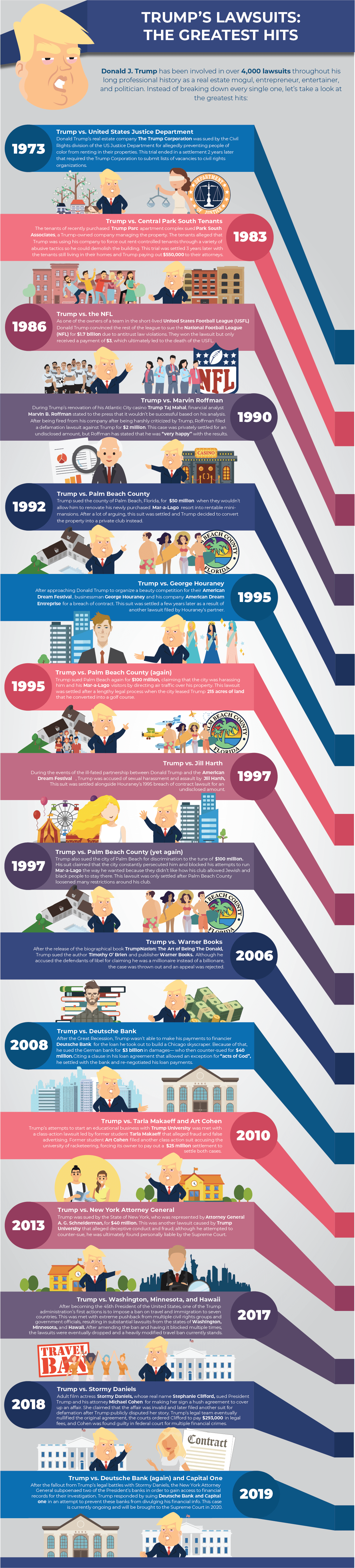
    Donald J. Trump, the 45th President of the United States, has been involved in over 4,000 legal battles in some capacity. From his beginnings in the real estate and gambling industries during the 70’s and 80’s, to his entrepreneurial and entertainment ventures in the 90’s and early 2000’s, all the way to his baffling transition into politics in the 2010’s, Trump has been fighting courthouse battles every step of the way.

    Before going any further, here’s a quick disclaimer: this piece is meant to be educational and is not a politically motivated attack on the President. Whether or not Trump has committed any wrongdoings — or is culpable for any wrongdoings — is not the point of this piece. Instead, the goal here is to use his history to understand the reality of lawsuits and how they typically occur in different American industries.

    Also, this article won’t discuss all 4,000+ lawsuits in which he’s been involved— that’s just not possible! Instead, let’s take a look at some of Trump’s highest profile cases with the greatest educational value.

    Keep reading to take a look at our breakdown of Donald Trump’s most significant and infamous cases!

    Trump Lawsuits - An Illustrated History of Over 4000 Lawsuits

    TRUMPS’ REAL ESTATE LAWSUITS

    Trump Real Estate Lawsuits

    Before becoming an entertainment mogul and politician, Donald Trump began his career in 1968 at his father’s New York-based real estate company. He became the company’s president 3 years later, naming it The Trump Organization. In his time as president of his business, he supervised many real estate bids, purchases, and projects— many of which involved lengthy legal battles at the federal, state, and civil level.

    Here are some of the noteworthy cases Trump fought as a real estate mogul:

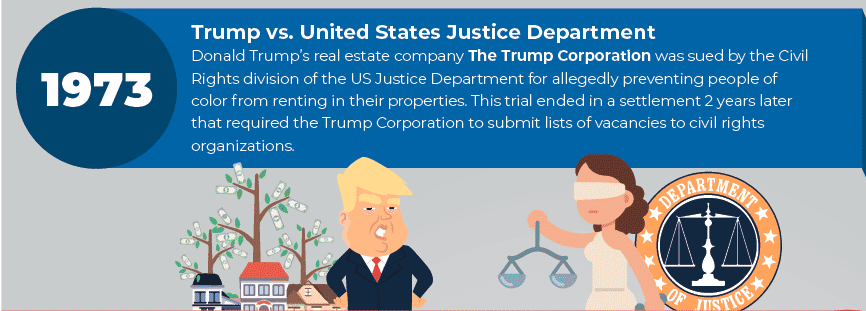
    1973 – 1975: United States v. Fred C. Trump, Donald J. Trump & Trump Management, Inc.

    Lawsuit Against Trump By US Justice Department

    During the 70’s, the primary business projects of the Trump Organization involved constructing and renovating hotels, skyscrapers, and apartments in New York City. Actions that were allegedly performed at some of these properties resulted in a civil rights case against Trump, his father, and their business, with the United States Justice Department Civil Rights Division as the prosecution.

    This particular lawsuit was filed in federal court instead of state or civil court. This is due to the fact that it involved accusations of violating civil rights law, making it a federal issue. In particular, the plaintiff claimed the Trump Organization violated The Fair Housing Act of 1968, which prohibits “landlords and real estate companies” from “[making] housing unavailable to persons” based on factors such as their race, religion, disabilities, and similar criteria.

    According to an article in the New York Timesfrom the year in which the suit was filed, the U.S Justice Department claimed that the Trump Organization violated The Fair Housing Act because they “required different rental terms and conditions because of race,” in addition to “[misrepresenting] to blacks that apartments were not available.” According to official court documents, Trump denied any discriminationand his lawyer Roy Cohn moved to dismiss the case due to a lack of substantial evidence. Furthermore, he also filed a counterclaim based on damage to Trump’s reputation due to the above New York Times article, requesting $100 million from the U.S. government in damages.

    Winner: Draw

    This case was settled two years later. As part of the settlement, the Trump Organization was required to submit lists of apartment vacancies to local civil rights organization the New York Urban League. According to another New York Times article, the goal of this action was to enable the league to “provide qualified applicants for every fifth vacancy in those Trump buildings where blacks… occupy fewer than 10 percent of the apartments.” Since this settlement didn’t imply any guilt on the part of Trump or his business but did require his company to take action to encourage more diverse tenants, it can essentially be considered a draw.

    1982 – 1986: Tenants of 100 Central Park South v. Donald J. Trump & Park South Associates

    Trump Lawsuit vs. Central Park South Tenants

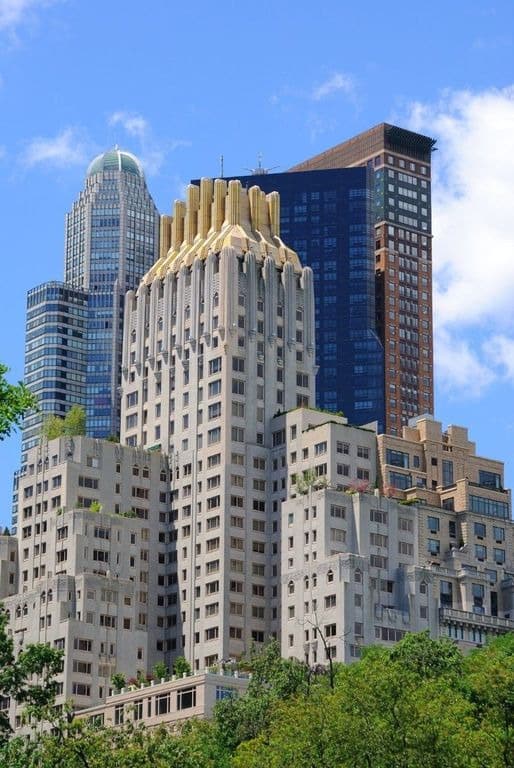
    One of the many New York real estate business ventures that built Trump’s reputation involved a 14-story apartment complex at 100 Central Park South. Now renamed Trump Parc East, this used to be a rent-controlled property, which meant there were many tenants living there who paid far below the average rental costs for that area. Naturally, this isn’t an ideal situation for a landlord to be in— especially if they’re interested in renovating the entire property to increase its value, as Trump was.

    Lawsuit Against Trump Involving Parc East

    Image Source: Zillow

    CNNMoney outlines the lengthy legal battle that ensued over this conflict of interest based on researching the 2,895 different court documents involved in the case. Starting with his purchase of the property in 1981, tenants allege that Trump did everything in his power to force rent-controlled tenants to move. A 1985 New York Times article outlines some of the different tactics the 60-odd tenants claimed Trump engaged in, which included:

    • Threatening to demolish the property
    • Suing individual tenants in civil court
    • Limiting important services like water and heat
    • Neglecting to fix issues with plumbing and water damage
    • Hiring spies to gather tenants’ personal information
    • “Engaging in a psychological tug-of-war to wear the tenants down”

    One of Trump’s alleged schemes to vacate tenants is outlined in another New York Times article from 1983. Dripping with sarcasm, this piece describes how Trump planned on temporarily filling vacant apartments with New York’s homeless— seemingly in the hopes of scaring away the other tenants. However, the Human Resources Administration rejected his Machiavellian offer, saying that it “left [them] with an uncomfortable feeling.” This bizarre episode was also included in the tenants’ legal complaints.

    Winner: Tenants

    Although Trump would claim victory in his autobiography and in future conversations about the affair, it appears plain as day that the tenants were the real winners. As a 1986 New York Timesarticle describes it, a settlement was reached between both parties that ended all litigation. The tenants were allowed to continue living in the building with their controlled rent, and Trump would instead be renovating the existing structure instead of demolishing it. Trump also ended up paying out $550,000 to the tenants’ attorneys. Obviously, this sum isn’t a big deal to a billionaire; however, it’s a concession that can definitely be seen as an admission of defeat.

    1992 – 1997: Donald J. Trump & Mar-a-Lago Club, Inc. v. Palm Beach County

    Trump Against Palm Beach Lawsuit

    Although Trump’s tumultuous real estate career is largely defined by his New York-based projects, his 1985 acquisition of the historical Mar-a-Lago resort in Palm Beach, Florida is equally significant to his East Coast efforts with regards to his legacy. Since obtaining this property, many lawsuits were filed by Trump against the city in the 1990’s, showcasing his trademark business strategy of weaponized litigation.

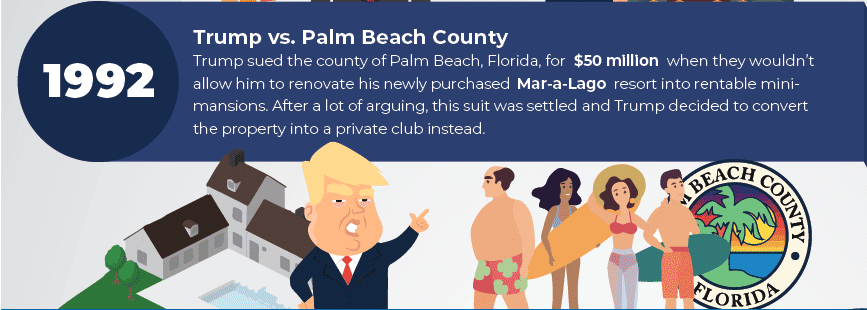
    The lawfare began in 1992, when Trump decided he was going to convert the property into private mansions in order to rent them out and repay his exorbitant debts. This move was blocked by Palm Beach County, since they viewed the property as a longstanding historical landmark. As outlined in an article from The Palm Beach Post that year, Trump’s response was to file a $50 million lawsuit accusing the county of “conflicts of interest, private meetings, special-interest lobbying and biased board members.”

    Another suit was filed in 1995 by Trump accusing the county of harassing Mar-a-Lago visitors by directing air traffic over the property at low altitudes. An article from the Sun Sentinelchronicles this specific legal battle, which included an accusation from Trump that a judgemental county airport director was “seeking revenge by attacking Mar-a-Lago from the air.”

    Trump’s reason for believing that Palm Beach County was constantly persecuting him and his club was brought up in yet another lawsuit filed in 1997. An archived article from the Wall Street Journal that same year describes how he filed a discrimination suit for $100 million which claims the Mar-a-Lago was persecuted “because it is open to Jews and African Americans.”

    Winner: Trump

    After consulting with lawyer Paul Rampell, Trump settled his 1992 lawsuit by converting the Mar-a-Lago into “a private club that is open to everyone.” Although this sounds like an oxymoron, what it meant in practice was that Trump could freely attract wealthy individuals to join his club that didn’t fit in with the rest of the Palm Beach crowd. His 1995 air traffic lawsuit was settled after convincing the county to lease him 215 acres of barren land in exchange, which became a lucrative private golf club. Finally, the 1997 discrimination lawsuit resulted in most of the county’s restrictions being lifted, allowing him to run his private club as he saw fit.

    Ultimately, all of these lawsuits directed at Palm Beach County in the 90’s resulted in victories for Trump, even if the suits themselves ended in settlement deals. As a 2016 Vanity Fair articlerecounted, these lawsuits served a cunning purpose— to completely transform Palm Beach society in order to better suit his personal and professional ambitions. In fact, Trump went on to implement a similar strategy in 2002 when purchasing and renovating a golf course in Rancho Palos Verdes, California.

    Ultimately, all of these lawsuits directed at Palm Beach County in the 90’s resulted in victories for Trump, even if the suits themselves ended in settlement deals.

    TRUMP’S BUSINESS LAWSUITS

    Donald Trump in Atlantic City Lawsuit

    Donald Trump was able to build enough momentum from his real estate career to branch out into many different business ventures. This transition began with his acquisition of several casinos in Atlantic City, New Jersey, over the 1980’s and 1990’s. From there, he also explored entrepreneurial opportunities in food, education, and entertainment (more on that later).

    Here are just a few of the most interesting gambling, entrepreneurship, and other business-related lawsuits fought by Trump:

    1990 – 1991: Marvin B. Roffman v. Donald J. Trump & Trump Organization, Inc.

    Marvin Roffman Lawsuit Against Trump

    In addition to his numerous real estate projects in New York and Florida, Trump dabbled in several gaming-related projects in New Jersey by purchasing and renovating several casinos located on the Atlantic City boardwalk. First it was the Trump Plaza Hotel and Casino in 1986, followed by the Trump Marina, Trump Taj Mahal, and Trump World’s Fair in the late 80’s and early 90’s.

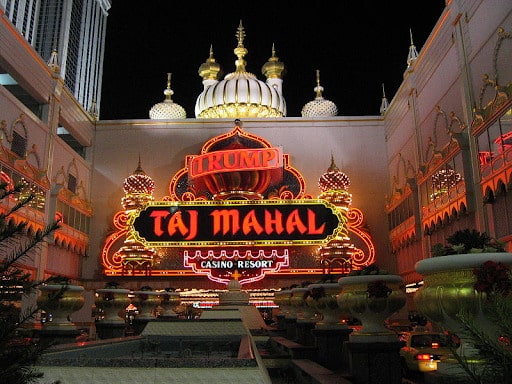
    Although all of Trump’s forays into casino ownership were disastrous and led to bankruptcy, the Trump Taj Mahal was notorious for the numerous legal battles centered around it. Even before purchasing the property, Trump had to fight talk show host Merv Griffin with multiple lawsuits just to obtain ownership, as described in a Los Angeles Times article from 1988.

    Trump Taj Mahal

    Photo taken by Jesper Rautelle Balle (CC BY 3.0)

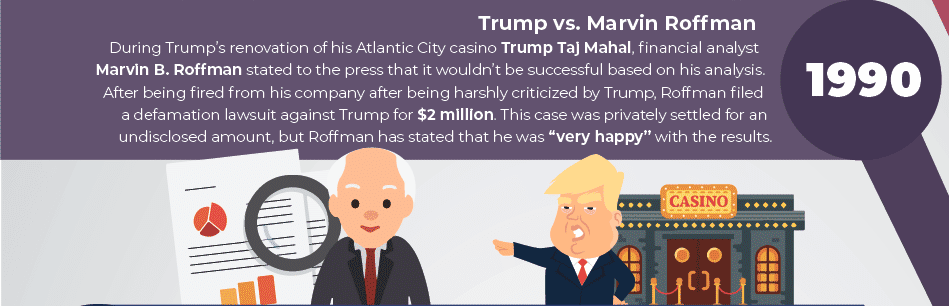
    However, the most notorious lawsuit relating to this doomed property involved financial analyst Marvin B. Roffman. According to a New York Times article from that time, he was fired from his position due to harsh criticism and multiple lawsuit threats from Trump. The reason for the real estate mogul’s ire was that Roffman had gone on record saying that the Trump Taj Mahal was bound to fail due to high operating costs and an imminent downturn in the market. After being constantly bad-mouthed by Trump in the press, Marvin Roffman decided to file a $2 million suit against Trump and his company for defamation in order to defend his professional reputation.

    Winner: Draw

    Ultimately, the defamation lawsuit ended in a settlement. Since this means that no official verdict was reached, Trump wasn’t proven to have engaged in libel or slander. However, the settlement also meant that he had to work out a satisfactory agreement with Roffman in exchange for clearing up his reputation. The specific details of this settlement are confidential; however, according to a statement given to the AP, Roffman was “extremely happy” with the results.

    As a New York Times article from 1991 describes, the financial advisor also received a payout of $750,000 from his former employer as ordered by an arbitration panel from the New York Stock Exchange. However, what’s most significant in this case is what happened over the next few years. Roffman’s initial comments that got him in so much trouble were proven to be accurate after the Trump Taj Mahal struggled to stay open and eventually went under. This ultimately solidified his reputation as a competent financial analyst, resulting in a draw for both parties.

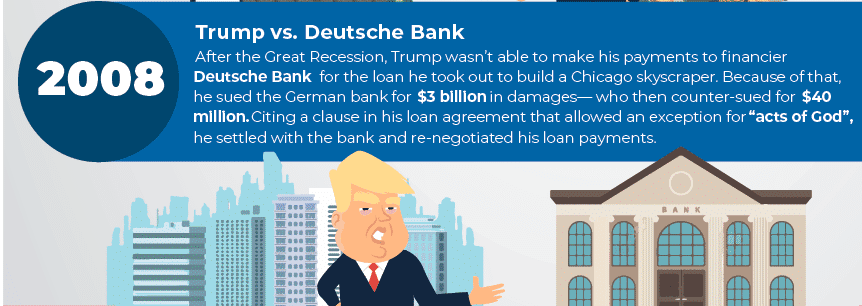
    2008 – 2009: Donald J. Trump v. Deutsche Bank

    Donald Trump vs. Deutsche Bank Lawsuit

    Trump’s bombastic and highly ambitious business strategies have undeniably led to some impressive victories, but it’s also led to many disastrous losses. In fact, it can be argued that Trump’s true strength in business isn’t finding great deals, but maneuvering his way out of the bad ones in order to avoid the consequences of failure. The best way to illustrate this point is through his lawsuit against a German bank in the late 2000’s.

    2008 saw the beginning of the Great Recession, a term now used to describe the worst global financial crisis since the Great Depression. One of the most significant factors that led to this recession was the bursting of the subprime mortgage bubble, which involved granting substantial high-risk loans to property owners with poor credit. Unsurprisingly, many of these lenders were unable to pay back their loans— which is precisely the situation Trump found himself in when he had to repay a $334 millionloan to Deutsche Bank for a Chicago skyscraper his company was in the process of building.

    When facing potential consequences for failing to pay back this loan, Trump decided to sue the bank for $3 billion in damages to his reputation and the project. A 2008 New York Times articleoutlined his justification for the lawsuit, which was mainly to attest that he shouldn’t be forced to repay the loan in the initially agreed-upon time period.

    Winner: Trump

    The crux of Trump’s argument outlined in his lawsuit was the presence of a force majeure clause, which is also commonly referred to as an “Act of God.” Force majeure is a common addition to many legal agreements that removes liability from either party to fulfill it if they are affected by events that are out of their control. And according to Trump, the 2008 financial crisis counted as such an act, rendering him no longer beholden to the original deal.

    As this archived article from the Wall Street Journal describes it, this initial lawsuit caused Deutsche Bank to file their own countersuit against Trump for $40 million. These dueling lawsuits opened up new negotiations regarding the loan, which led to both cases being settled out of court the next year. And while the bank did eventually get their money back, it was on terms that were much more favorable to Trump, making him the clear winner in this legal battle.

    Trump’s true strength in business isn’t finding great deals, but maneuvering his way out of the bad ones in order to avoid the consequences of failure.

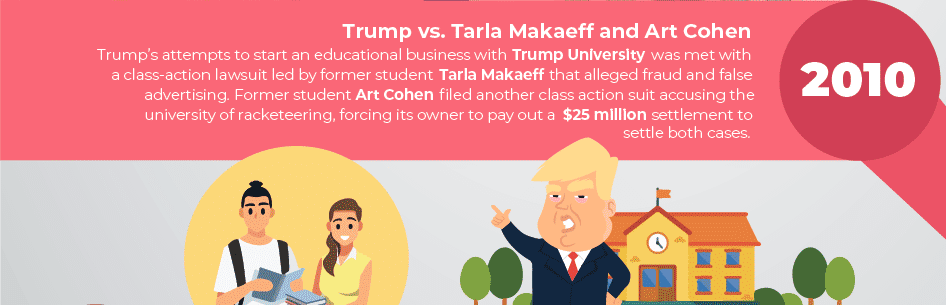
    2010 – 2016: Tarla Makaeff, Sonny Low, Art Cohen & New York v. Donald J. Trump, Michael Sexton & Trump University Lawsuits

    Trump University Lawsuit

    Over the decades, Trump would use his brand as a self-made billionaire to branch out into a variety of business deals and endorsements: some relevant to his experiences, and others not so much. However, when he attempted to leverage this brand into Trump University, he encountered a great deal of legal resistance— both from an individual and state level.

    In the beginning, this resistance took the form of letters sent by the New York State Department of Education and the Deputy Commissioner for Higher Education. According to a 2010 NY Daily News article, the reason for these departments’ objections was that Trump was misleading potential students by labeling his business as a ‘University,’ despite not having any official accreditation or offering any official college credits. To prevent these complaints from escalating into legal action, the business was renamed The Trump Entrepreneur Initiative. However, this action alone wasn’t enough to protect Trump and his for-profit educational institution from harsh litigation. 

    Trump University became the cause of three lawsuits over the next 6 years: 

    1. In 2010, a class-action lawsuit alleging fraud and false advertising was filed by former students Tarla Makaeff and Sonny Lowagainst Trump’s school.
    2. In California, a similar class-action lawsuit was filed directly against Trump by businessman Art Cohen three years later, alleging that his school’s “Live Events” were misleading and potentially involved in racketeering.
    3. Finally, Attorney General A.G. Schneidermanrepresented the State of New York in suing Trump and the school’s president Michael Sexton for $40 million in 2013, alleging “persistent fraudulent, illegal and deceptive conduct.”

    Winner: Plaintiffs

    From comments made by Trump and his legal team about his school and the judge presiding over his case, it appears that they had every intention of fighting these legal battles to the end. However, the events of the 2016 election would change these plans and force Trump to reach another settlement.

    Trump initially attempted to combat Schniederman’s $40 million suit with a complaint of misconduct in 2013. However, the complaint was thrown out and he was found personally liable by the Supreme Court one year later. This action strengthened the two class-action lawsuits, which eventually forced Trump to pay out $25 million in order to settle the cases before his presidential term.

    Much like many of the cases previously mentioned, the conclusion of these lawsuits meant that Trump was never officially found guilty of any wrongdoing. However, the closure of Trump University and the money he was forced to pay out are strong indicators of his defeat.

    Trump was never officially found guilty of any wrongdoing. However, the closure of Trump University and the money he was forced to pay out are strong indicators of his defeat.

    TRUMP’S ENTERTAINMENT LAWSUITS

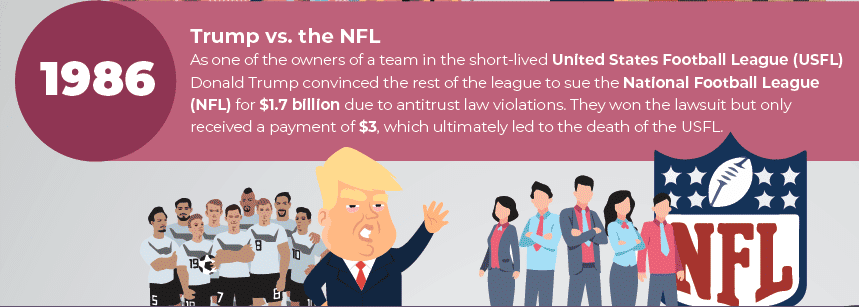
    Trump vs. NFL Lawsuit

    While the foundation of Trump’s empire is in his gargantuan real estate projects, his impact on pop culture and entertainment are equally significant to his current legacy— if not more so. Starting with the publishing of his pseudo-memoir Trump: The Art of the Deal in the late 1980’s, he’s also dabbled in beauty pageants, sports, and network television.

    Read the full article here.


  • 3 Exciting Smartphones to Keep an Eye Out For This Month

    3 Exciting Smartphones to Keep an Eye Out For This Month

    There was a time when pocket-sized computers constantly connected to a global network would’ve sounded like science fiction – and it wasn’t that long ago. In the 1990s, when cell phones and the internet became mainstream we couldn’t’ve imagined where we’ll be in 2020. Today, smartphones are as capable as desktop computers were in the mid-2000s, and the internet speeds they are capable of are also amazing. And their development seems never to stop.

    It seems that the biggest smartphone brands are continuously pumping out new models all year long. There are some that stand out – think Samsung’s Galaxy flagships and Apple’s iPhones – but there are more than enough models that deserve our attention that have nothing to do with these two giants. Here are three phones coming out in July 2020 that are worth your attention.

    Poco M2 Pro

    Xiaomi is a smartphone brand many people ignore – which is a surprise, considering that it’s the fourth-biggest manufacturer in the world. The Chinese smartphone maker has a whole range of handsets, covering everything from entry-level to flagships.

    Xiaomi has several sub-brands – one of them is Poco, the brand that was made famous by the Pocophone F1, released in 2018, that offered flagship-level performance and specs at an upper-mid-range price, and several other models ever since. This year’s Poco M2 Pro will be no exception from this rule.

    The Poco M2 Pro will be launched in India on July 7. It is said to be at least based on the Xiaomi Redmi Note 9 Pro, a phone released this May, with a Qualcomm Snapdragon 720G SoC, 6GB of RAM, quad-camera, and a 6.67” IPS LCD screen. Judging by the pricing policy of the previous models in the Poco range, its price tag will once again be in the upper-mid-range category.

    OnePlus Nord

    OnePlus may not be among the top smartphone makers in the world but its handsets are always attracting a lot of attention. Their latest upcoming model is called OnePlus Nord, and it is already sought-after, even though it wasn’t even launched yet: reportedly, the first 100 units have already been preordered.

    OnePlus Nord will come with the Snapdragon 765G chipset, uniting the speed of 5G that will allow you to check out the Betway soccer betting app at an unprecedented speed, and advanced AI capabilities to offer its users the best possible experiences while using it.

    OnePlus Nord will have two more rounds of limited preorders on July 8 and July 15, followed by the launch of the phone.

    Honor X10 Max

    Speaking of sub-brands, Honor – one of the sub-brand of the Chinese telecom giant Huawei – is preparing another big launch. And you should take it literally: the upcoming Honor X10 Max will have a huge, 7.09” screen. (By the time you read this, the phone will have likely been launched already).

    The phone will not only have a huge screen but also a huge, 5,000 mAh battery, up to 8GB of RAM, and up to 128GB of internal storage. It will be powered by the MediaTek Dimensity 800 SoC, which means that it will also support 5G. And all this at a pretty friendly price.

  • JSE-Listed ADvTECH Education Group’s Management Crisis Worries Makini And Crawford Schools Parents

    JSE-Listed ADvTECH Education Group’s Management Crisis Worries Makini And Crawford Schools Parents

    Kenya Insights has received complaints from parents of sister schools Crawford International and Makini Schools which are both owned by a South African firm, ADvTECH, a private education group.

    We’ve weighed on both cases and the complaints are synonymous with the firm’s management taking the punches for being too dismissive and not listening to parents who’re part of the school.

    Frustrated parents have reached to this writer in a bid to raise the matter as they’ve managed to compromise the mainstream media from highlighting their plights and fear that the schools could sink with their money.

    Crawford School sits in Kiambu’s Tatu City. It has its set of troubles between the management and parents and this will come later.

    Parents of Makini Schools in Nairobi are a worried lot given the precarious state of affairs at the institution under the leadership of South African investor Advtech.

    That Makini has enjoyed a rich education legacy in Kenya spanning 40 years cannot be gainsaid.

    As an academic giant, the school has produced top students in the Kenya Certificate of Primary Education (KCPE) over the years.

    Admired by Kenya’s middle and upper classes and some foreign expatriates for its discipline and as one of the few upmarket schools that offer the 8-4-4 system, the Makini brand has grown exponentially to the envy of its competitors.

    In the recent past, however, the institution has been embroiled in vicious take-over wars, acute leadership gaps, a cavalier attitude of new managers and a gradual shift of focus from academic excellence to profiteering, at whatever cost.

    So bad is the state of affairs at the school that the new owners, Johannesburg Stock Exchange (JSE) listed Advtech, have deployed a propaganda machinery to cover up serious financial shortcomings in their home country.

    The big question among parents is: Who will come to their rescue if the foreigners vanish?

    A summary of the genesis of Makini’s troubles is in order. All seemed well until May, 2018, when the original owners sold the school to a UK company—Scholes Ltd—with little information to the parents.

    Between late 2019 and early this year, the Scholes, apparently unable to run the school, sold it to Advtech. So, in less than two years the school ownership has changed hands three times.

    As worrisome as the change of management has been within this short period, parents are intrigued by calibre and high turnover of the top leadership of the school.

    A quick online search on the qualifications of the executive director, Martin Sharman, shows he has a wealth of experience in retail sales and zero experience in education matters.

    The communication director, Katya Nyangi, lacks the requisite professional qualifications in either communications, education or any relevant field and was previously supporting the previous owners with domestic errands.

    Sharma and  Nyangi, who are employees of Scholes and Makini, have single-handedly been running the show and issuing incongruent instructions with no regard to school heads, the new owners (Advtech) or parents’ concerns.

    Makini Schools.

    Currently the school is going through a serious crisis. Different levels of managers are making decisions, issuing contrasting instructions and pulling in different directions at the instigation of Advtech, Scholes (who never exited the scene) and Makini Schools. Interestingly, all the owners and top managers – Advtech and Scholes, including Mr Sharma— operate from outside the country.

    While the new owners are completely unknown to the parents, their financial standing and attitude towards parents raises more questions than answers.

    As of June 2019, Advtech was rated as highly indebted where its liabilities outweighed it assets by more than Sh36 billion.

    An article by the Wall Street Journal on Advtech’s balance sheet gives a stern warning that its debt obligations pose grave risks to its business.

    These fears over indebtedness have created an aura of pessimism and doubt among parents on Advtech’s capacity to run the school.

    Aware of its financial standing, the company recently rolled out an e-learning programme at school in the guise that it was free only for them to force parents to pay for it.

    Makini’s e-learning is the epitome of an “off-plan learning” model where parents are forced to pay Term Two (May –August) fees now, with a promise to give a proper education once actual learning resumes.

    Although, and in good faith, parents accepted Makini’s offer, they fear the faceless Advtech with their debts could run away with their money which averages about Sh1 billion a year.

    The parents are aware of pyramid schemes orchestrated by crafty and broke foreign companies such as CMC Di Ravenna that was contracted to construct the Kimwarer and Arror dams only for this to turn out to be a pyramid scheme.

    Makini parents are not ready to be part of the statistics.

    Efforts by the Parents to ameliorate the situation at the institution with the new owners has been futile and obstinately rejected.

    In their latest communications the company stated that it has no obligation to take into account parents’ concerns when levying new charges and that their decision was final.

    The dispute over second term fees at Makini School had also been intensified last month after the parents’ association committee asked members to withhold payments for e-learning.

    The parents-teachers association (PTA) committee had rejected demand for fees citing earlier reassurances by the private school that e-learning lessons would be provided to the pupils for free.

    Crawford International School.

    “Indeed, the school management has proceeded to unlawfully bill the parents for Term 2, 2020 much as the Ministry of Education has not promulgated the calendar dates for Term 2. This exhibits lack of sincerity, trust and truthfulness on their part. The school management has also obstinately continued to disregard the concerns raised by parents,” the PTA committee chairman, Nixon Bugo, said in an advisory to parents dated May 22.

    “In lieu of the foregoing, we strongly urge all our parents to continue being guided accordingly by the resolutions of the PTA of May 13. Kindly also note that the PTA shall keep you informed /updated on the next course of action as guided by the concerns and input from parents.”

    On the other side at Crawford, it’s the same problems only on a different soil. The school is currently embroiled in a fierce legal battle with the parents in fee tussle. According to parents talking to Kenya Insights, the court was their last resort after the management arrogantly dismissed them off over request to minimize the fee. Despite the coronavirus pandemic that has affected all sectors with over one million left jobless in Kenya, Advtech gave the parents a blind eye and that’s how the matter ended in court.

    With similar cases as with Makini, in court, there have been controversies surrounding the handling of the case with a private law firm (which consults for other private schools) was caught to be advising the AG office on how to handle the Crawford parents. A case which has sparked fears over the independence of the Attorney General’s office.

    We’ve also been told of allegations of racial discrimination at Crawford. However, there has been illegal and unceremonious dismissal of staff. We managed to talk to some of the staff who were dismissed without valid reasons only citing the common excuse of coronavirus.

    Poor services in government schools has opened doors for capitalists like Advtech no wonder they can run things as they wish. The company also owns multiple differentiated brands, including the well-known Abbotts College, Varsity College, Rosebank College, Trinity House and Crawford schools. They’ve also invested in Zambia where they own the university of Africa and are also expanding to Uganda where they target the upper middle class. It has however been struggling to maintain a stable position in the market.

  • Blacklisted Chinese Firm CRBC Behind Scandalous SGR Contract Now Awarded Sh1.5 B Tender To Build Likoni Floating Bridge

    Blacklisted Chinese Firm CRBC Behind Scandalous SGR Contract Now Awarded Sh1.5 B Tender To Build Likoni Floating Bridge

    The relationship between Kenya and obsession with Chinese firms when it comes to infrastructure projects is unexplainable but one that has been clouded with greed and plunder as will explain later on.

    African governments routinely award road construction contracts to Chinese and other foreign companies. China is in the midst of a global infrastructure spending spree known as the Belt and Road Initiative, which is intended to increase Beijing’s economic and diplomatic clout — but which is bringing rising criticism and scrutiny.

    China Road and Bridge Corporation (CRBC) has just been awarded a Sh1.5Bn contract to build the Likoni floating bridge. The construction is set to be completed within the next six months.

    The project, the Likoni Floating Bridge, will be a complimentary facility to the ferry services, says the Kenya National Highway Authority (KeNHA).

    The project is 660 metres, stretching from north to south in Likoni. The construction of the Likoni Floating Bridge will address the problem faced by the residents of Likoni in accessing Mombasa Island and vice versa, according to KenHA.

    Like many other, Coronavirus has become as a blessing in disguise for many. “The project is part of the government’s series of epidemic prevention and control measures” according to CRBC.

    Beside the awarding of the tender which like many other contracts with CRBC with the government always treated as big secret. Top of the concerns we should have is over competitive practices and lower wages, many of the jobs that come with such projects may not even go to workers in the slow-growing economy of the Mombasa people.

    Typically, Chinese state firms bring most of their own workers for construction projects, an often contentious practice. It is not clear if Kenyan  authorities even know how much the Chinese workers will be paid.

    If we’re to borrow a leaf from how CRBC ran the SGR then Chinese nationals will be the biggest beneficiaries as opposed to the locals during the construction.

    Details of this bridge contract is scanty but the apple doesn’t fall far from the tree, we revealed to details of the secret contract the the government of Kenya made with the CRBC where we unearthed greed and plunder by the Chinese.

    The GoK and CRBC pushed through with an unnecessary project which made no economic sense so as to grease the hands of leaders both in Kenya and China.

    The intellectuals argued that the Metre Gauge Railway (MGR), which the Lunatic Express runs on should’ve been upgraded at a far cheaper cost.

    What the SGR contract which has been seen by KenyaInsights says, the level of theft of Kenya money that had been loaned from China was unprecedented to say the least. The railways runs at a cost of Sh1 billion per month, which is unsustainable and losses are bound to accrue from its running. It is even better, ironically, to stop the trains than to run them.

    During its planning and construction, the contract reveals that the managers were the greediest of all greedy of the earth. China which prides itself with tough stance against corruption had allowed its staff abroad to engage in blatant abuse, disrespect and theft of resources. 

    Apart from the sensational reports that we’ve seen in some quarters, and the manner in which some people still believe that anyone raising issues with costs surrounding infrastructure projects especially SGR are anti-government or hates the Kikuyu government to be exact. No it is not.

    According to the contract, there are some information that was left out that was not covered by the mainstream media. The information reveals the level of theft of Kenya taxpayers money, the money was a loan taken in the name of Kenyan taxpayers signed by then Managing Director of Kenya Railways Nduva Muli.

    The claims of inflated costs of the SGR project was in January 2020 supported (not that he didn’t also reveal it in the past) by the African Union High Representative for Infrastructure Hon. Raila Odinga in a local TV station. During the interview Raila said that he and former President Mwai Kibaki in the coalition government had tendered the SGR project at a lower cost, but when President Uhuru Kenyatta and his deputy William Ruto took over in April 2013, they cancelled the contract and re-tendered a fresh at inflated costs. 

    “Before we left government with Mwai Kibaki, we awarded SGR tender to a company at USD2.5billion. But when jubilee came in in 2013, they canceled the tender and awarded it back to the same company but at USD4.5billion. Obvious inflation of figures”, Raila Odinga, told NTV Journalist Joseph Warungu.

    A lot of controversies surrounded the contract by the Chinese firm. The Environmental and Social Impact Assessment (ESIA) for the SGR project was carried by a Kenyan firm Africa Waste and Environment Management Centre (AWEMAC); the worst part in the report is that  only 217 people were interviewed as Key Informant for the public participation.

    The study was rushed and appears to be a formality on the part government of Kenya and their Chinese cronies. The project that had its cost revised upwards would go on and nothing could stop it.

    China Road and Bridge Corporation (CRBC), the contractor, in a bid to hide crucial information from the public made the Kenyan government sign confidentiality clauses in the controversial contract making it “sensitive and private”.

    By the end of this year, Kenya is expected to have repaid at least Sh50 billion of the exorbitant Chinese loan.

    The loan, whose interest is 3.6 percentage points above the six month average of London Inter-Bank Offered Rate (Libor) which serves as an international benchmark, is to be repaid in 15 years with a grace period of five years.

    The Likoni Bridge contract is small compared to the SGR but it’s still the same monkey in a different forest. The details will eventually emerge but by then the cronies will have already had their share.

    Lawyer, Ahmednasir Abdullahi, has been taking swipes at the Jubilee government over its thriving love affair with Chinese investors and loans, and a seemingly waning relationship with America and Europe countries.

    Ahmednasir had claimed the reason why Jubilee, led by President Uhuru Kenyatta, was increasingly obsessed with Chinese investors was because of bribes and kickback. According the senior counsel, popularly referred to as The Grand Mullah, whereas American and European companies were not willing to give bribes or kickbacks, their Chinese counterparts were going the extra mile to win government tenders.

    We can’t tell if kickbacks were given in this particular case but it’s not rocket science. CRBC has before been blacklisted by the World Bankblacklisted by the World Bank over fraudulent activities in other countries but Chinese firms have found a common interest and partners in Africa so all the dirt doesn’t seem to matter.

  • Independent Autopsy Of George Floyd Shows It Was A Homicide Different From The Official Findings

    Independent Autopsy Of George Floyd Shows It Was A Homicide Different From The Official Findings

    MINNEAPOLIS (AP) — A medical examiner on Monday classified George Floyd’s death as a homicide, saying his heart stopped as police restrained him and compressed his neck, in a widely seen video that has sparked protests across the nation.

    “Decedent experienced a cardiopulmonary arrest while being restrained by law enforcement officer(s),” the Hennepin County Medical Examiner’s Office said in a news release. Cause of death was listed as “cardiopulmonary arrest complicating law enforcement subdual, restraint and neck compression.”

    Under “other significant conditions” it said Floyd suffered from heart disease and hypertension, and listed fentanyl intoxication and recent methamphetamine use. Those factors were not listed under cause of death.

    A Minneapolis police officer was charged last week with third-degree murder in Floyd’s death, and three other officers were fired. Bystander video showed the officer, Derek Chauvin, holding his knee on Floyd’s neck despite the man’s cries that he can’t breathe until he eventually stopped moving.

    A separate autopsy commissioned for Floyd’s family also called his death a homicide. It concluded that that he died of asphyxiation due to neck and back compression, said the family’s attorney, Ben Crump, who called for the charge against Chauvin to be upgraded to first-degree murder and for three other officers to be charged. He didn’t say what the charges against the other officers should be.

    That autopsy, by a forensic pathologist who also examined Eric Garner’s body, found the compression cut off blood to Floyd’s brain, and that the pressure of other officers’ knees on his back made it impossible for him to breathe, Crump said.

    Both the medical examiner and the family’s experts differed from the description in last week’s criminal complaint against the officer of how Floyd died. The complaint, citing preliminary findings from the medical examiner, listed the effects of being restrained, along with underlying health issues and potential intoxicants in Floyd’s system. But it also said nothing was found “to support a diagnosis of traumatic asphyxia or strangulation.” Neither side has released its full autopsy report so far.

    The family’s autopsy found no evidence of heart disease and concluded he had been healthy.

    Floyd, a black man who was in handcuffs at the time, died after Chauvin, who is white, ignored bystander shouts to get off Floyd and Floyd’s cries that he couldn’t breathe. His death sparked days of protests in Minneapolis and around America.

    The complaint provided no details about intoxicants. In the 911 call that drew police, the caller described the man suspected of paying with counterfeit money as “awfully drunk and he’s not in control of himself.”

    Floyd’s family and attorneys, like the families of other black men killed by police, commissioned their own autopsy because they didn’t trust local authorities to produce an unbiased report.

    The family’s autopsy was done by Michael Baden and Allecia Wilson. Baden is the former chief medical examiner of New York City, and was hired to do an autopsy of Garner, a black man who died in 2014 after New York police placed him in a chokehold and he pleaded that he could not breathe.

    Baden also did an autopsy at the family’s request for Michael Brown, an 18-year-old shot by police in Ferguson, Missouri. He said Brown didn’t reveal signs of a struggle, casting doubt on a claim by police that a struggle between Brown and the officer led to the shooting.

    Dr. Judy Melinek, a forensic pathologist from the San Francisco Bay area who blogs about the subject and is not connected with the case, said the key difference between the medical examiner’s conclusions and those of Baden and Walker are the official finding of “significant” conditions for Floyd, including heart disease and drugs in his system.

    Baden and Wilson acknowledged on a conference call with reporters that they didn’t have access to the tissue samples that the medical examiner kept that might have given more information on his health. Nor did they have their own toxicology results yet.

    Melinek said it’s not unusual for different pathologists to reach different determinations, given that they may be looking at different information and that they’ve had different experiences and training.

    Under the law, a medical examiner determines the cause and manner of death, but it’s up to prosecutors to decide whether criminal charges are warranted. The term homicide means only that a person’s death was caused by another person.

    Chauvin, who was also charged with manslaughter, is being held in a state prison. The other three officers on scene, like Chauvin, were fired the day after the incident but have not been charged.

    The head of the Minneapolis police union said in a letter to members that the officers were fired without due process and labor attorneys are fighting for their jobs. Lt. Bob Kroll, the union president, also criticized city leadership, saying a lack of support is to blame for the days of sometimes violent protests.

    When asked to respond, Mayor Jacob Frey said Kroll’s opposition to reform and lack of empathy for the community has undermined trust in the police.

    Gov. Tim Walz announced Sunday that Attorney General Keith Ellison would take the lead in any prosecutions in Floyd’s death. Local civil rights activists have said Hennepin County Attorney Mike Freeman doesn’t have the trust of the black community. They have protested outside his house, and pressed him to charge the other three officers.

    Freeman remains on the case.

  • Pope Francis Warns Of The Dangers In Online Masses, Says Faith Via Media Consumption Is Not The Church

    Pope Francis Warns Of The Dangers In Online Masses, Says Faith Via Media Consumption Is Not The Church

    AGENCIES | Vatican – Pope Francis said the forced isolation devised to stop the pandemic was presenting the danger of people living the faith only for themselves — detached from the sacraments, the Church and the people of God.

    Online Masses and spiritual communion do not represent the Church, he said in his homily at his morning Mass in the chapel of his residence on 17 April. “This is the Church in a difficult situation that the Lord is allowing, but the ideal of the Church is always with the people and with the sacraments — always,” Pope Francis said.

    The pope began the Mass by praying for expectant mothers who may be anxious or worried about giving birth during the COVID-19 pandemic.

    Perhaps they are asking themselves, “What kind of world will my child live in?” he said. “Let us pray for them, that the Lord give them the courage to carry these children forth with the trust that it will certainly be a different world, but it will always be a world the Lord loves very much,” he said.

    In his homily, the pope reflected on serious concerns about the faithful not being able to come together as a community to celebrate Mass or to receive the sacraments because of government restrictions against people gathering in groups as part of efforts to stem the spread of the coronavirus.

    Masses, prayers and faith-based initiatives have been offered online, and the faithful have been encouraged to make an act of spiritual Communion given their lack of access to Holy Communion, but “this is not the Church,” the pope said.

    One’s relationship with Jesus “is intimate, it is personal, but it is in a community,” and this closeness to Christ without community, without the Eucharist, without the people of God assembled together and “without the sacraments is dangerous,” he said.

    It is dangerous, he said, because people could start living their relationship with God “for just myself, detached from the people of God.”

    As the Gospels show, Jesus’ disciples always lived their relationship with the Lord as a community — they gathered “at the table, a sign of community. It was always with the sacrament, with bread,” the pope said.

    “I am saying this because someone made me reflect on the danger of this moment we are living, this pandemic that has made all of us communicate, even in a religious sense, through the media, through means of communication,” he said.

    By broadcasting his morning Mass, for example, people are in communion, but they are not “together,” he said.

    The very small number of people present at his daily morning Mass will receive the Eucharist, he said, but not the people watching online who will only have “spiritual Communion”. “This is not the Church,” Pope Francis said.

    People are living this “familiarity with the Lord” apart from each other in order to “get out of the tunnel, not to stay in it.”

    Unnamed bishop ‘scolded’ the Pope over livestreamed Mass

    The pope said it was thanks to an unnamed bishop who “scolded him” and made him think more deeply about the danger of celebrating Mass without the presence and participation of the general public.

    He said the bishop wrote to him before Easter when it was announced Mass would be celebrated in an “empty” St Peter’s Basilica. He said the bishop questioned the decision and asked, when “St Peter’s is so big, why not put 30 people at least so people can be seen” in the congregation?

    The pope said that at first he didn’t understand what this bishop was trying to get at, but then they spoke and the bishop told him to be careful to not make the Church, the sacraments and the people of God something that is only experienced or distributed online.

    “The Church, the sacraments and the people of God are concrete,” the pope said. The faithful’s relationship with God must also stay concrete, as the apostles lived it, as a community and with the people of God, not lived in a selfish way as individuals or lived in a “viral” way that is spread only online.

    “May the Lord teach us this intimacy with him, this familiarity with him, but in the Church, with the sacraments, with the holy faithful people of God,” he said.

  • Who Finances The World Health Organization?

    Who Finances The World Health Organization?

    After accusing the World Health Organization of pro-China bias last month and suspending contributions, U.S. President Donald Trump went further this week, threatening to halt funding altogether if the body does not commit to reforms within 30 days.

    So who are the main sources of finance herefor the U.N. agency based in Geneva?

    Washington is the WHO’s largest funder and has been particularly supportive of programs such as polio eradication, HIV/AIDS and childhood immunization.

    For the current two-year period, ending in December 2021, the United States was due to contribute $553 million in combined membership fees and voluntary contributions, or 9% of the agency’s approved budget of $5.8 billion, according to the WHO.

    That’s nearly three times China’s $187.5 million share, WHO figures show.

    Other major contributors include Britain on $519 million, the Bill and Melinda Gates Foundation with $340.9 million, the European Commission with $269.8 million, Germany with $228.7 million, and Japan with $217.2 million, according to WHO figures.

  • World Bank Approves Sh107 Billion Soft Loan For Kenya

    World Bank Approves Sh107 Billion Soft Loan For Kenya

    The World Bank will lend Kenya’s government $1 billion in budget support, its biggest financing package yet for the East African economy, according to Treasury Secretary Ukur Yatani.

    “The fact that World Bank does not provide budget support to countries with weak macro framework is a testimony of the confidence levels of the bank in our new policy reforms,” Yatani said on Twitter.

    The lending comes on the heels of a $739 million International Monetary Fund loan announced earlier this month in emergency support. Kenya has confirmed 963 Covid-19 infections.

    Kenya has plans to spend 53.7 billion shillings ($503 million) on a stimulus package to support businesses hit by the pandemic, which the Treasury says won’t affect its budget deficit. The financing gap is seen narrowing to 7.3% of gross domestic product in 2020-21 from an estimated 8.2% in the year through June.

  • Study Shows 30 per cent Of Kenyans Couldn’t Afford To Pay Rent In April

    Study Shows 30 per cent Of Kenyans Couldn’t Afford To Pay Rent In April

    About one third of Kenyans/30.5 percent of Kenyans could not pay their monthly rent in April as the Covid-19 pandemic devastated monthly incomes.

    According to a survey by the Kenya National Bureau of Statistics (KNBS), 21.5 percent of Kenyans unable to meet the monthly obligation met the charge in a timely manner prior to the virus outbreak in the country.

    The main reason for the households’ inability to pay rent in April was by far reduced income/earnings at 52.9 percent and the temporary loss of jobs at 22.4 percent.

    Other reasons quoted for the inability include unemployment at 13.9 percent, and delay in receipt of income at 9.1 percent.

    Only 59.8 percent of Kenyans were able to meet their rental payments as per date agreed with landlords during the month.

    Part of Kenyans were however cushioned against the devastation in incomes with 8.7 percent of the surveyed households reporting a waiver/relief from landlords in the period.

    Moreover, Kenyans were dealt a further blow in disposable incomes as transport costs soared by 51.7 percent on most frequent routes with Migori County reporting the steepest rise in costs at 77.2 percent

  • Kenya Siphoned $3.1 Billion Of Foreign Aid Into Offshore Bank Accounts

    Kenya Siphoned $3.1 Billion Of Foreign Aid Into Offshore Bank Accounts

    Former World Bank chief economist and colleagues from two European universities have published a long-awaited research in which they show that global aid to poorest countries like Kenya, is instead being retransferred to offshore havens.

    The research was done by Penny Goldberg, a World Bank chief economist, who resigned two weeks ago from her job when the leaks about the research emerged. The other colleagues are — Jørgen Juel Andersen of BI Norwegian Business School and Niels Johannesen of the University of Copenhagen and CEBI. The final contributor to the research was the World Bank’s Bob Rijkers.

    The research titled “Elite Capture of Foreign Aid: Evidence from Offshore Bank Accounts”, was done for the World Bank, but then the findings proved too embarrassing for publication. The researchers were reportedly not allowed to share its contents. Penny Goldberg decided to leave her job, and the whole document is now published on her website.

    Kenya Insights reviewed the 46-page document and it gives grim reading. Reviewing data of 22 countries including Kenya, the team shows that aid granted by the World Bank is falling into the wrong hands.

    “After aid to a country increased, money departs for offshore havens,” reads the research in part.

    The other countries in the research are Rwanda, Uganda, Tanzania, Burundi, Zambia, Afghanistan, Armenia, Burkina Faso, Eritrea, Ethiopia, Ghana, Guinea-Bissau, Guyana, Kyrgyz-Republic, Madagascar, Malawi, Mali, Mauritania, Mozambique, Niger, Sao Tome and Principe, and Sierra Leone.

    The research document is rather complicated. The research used quarterly information on aid disbursements from the World Bank, to these 22 most aid-dependent countries, in combination with Bank for International Settlements banking statistics, which cover the flows between the country receiving the aid and havens such as Switzerland, Luxembourg, the Cayman Islands and Singapore, where secrecy and asset protection are paramount.

    For comparison, the research also looks at flows between the recipient country and Germany, France and Sweden — places not as vaunted for their banking secrecy. Scenarios that you would expect to lead to higher inflows and outflows, such as wars or financial crises, are excluded.

    For the case of each country, the research shows how much much money moved out from the state coffers, immediately it arrived from the World Bank.

    For Kenya’s case, the annual World Bank disbursement is 1.1% of GDP.

    The researchers shows that in their investigation, $1,277m exited Kenya and was deposited in offshore havens. During the same period, $1,784m left Kenya for non-offshore havens. This means $3.1b left Kenya in a very short period of time.

    For offshore deposits of money from Kenya, the researchers found a quarterly increase of 2.0% in deposits for offshore havens, but the deposits in non-offshore havens reduced by 0.4%.

    For Uganda, the researchers discovered the opposite from Rwanda. They found $73m was deposited in offshore havens, while $188m left Uganda for non-offshore regions.

    In Tanzania, the money leaving the country’s coffers to be hidden away, is exorbitant. During the period that the researchers investigated, $145m left Tanzania for offshore accounts. However, a whooping $437m was deposited in non-offshore havens.

    Here is compilation of how money is flowing out the sampled countries (courtesy document)

    For the smallest economy in the East African Community (EAC) region, Burundi, $103m was ferried out of the country to offshore accounts. At the same time, just $19m was swindled off to non-offshore regions.

    What is clear is that Kenyan elites prefer hiding most of their money in those deeply secret havens where no one will ask questions. While, Ugandans and Tanzanians are fine with stealing the World Bank cash and sending to places that dont tolerate spoils of theft from poor countries.

    There was a problem that the researchers admit in the paper. For instance, it was impossible for them to tell who exacy in terms of names, is moving the funds out of the country, with the statistics used, only counting the total flows per quarter between countries.

    While there have been different leaks over the years showing how money was flowing from poor countries to Switzerland, Luxembourg, the Cayman Islands and Singapore, it is the first time Rwanda has been highlighted. It is particularly shocking as the data comes from inside the World Bank, which has repeatedly given a clean bill of health for different aspects of Rwanda

  • INDEPTH: Secret SGR Contract Details Confirming Rip-off; Where did Sh25 Billion for Electric SGR Go?

    INDEPTH: Secret SGR Contract Details Confirming Rip-off; Where did Sh25 Billion for Electric SGR Go?

    On section 13, appendix A of the Standard Gauge Railway (SGR) contract titled “Supply and installation of the facilities. Locomotives and stocks for the Mombasa – Nairobi Standard Gauge Railway Project”, the exorbitant cost of the white elephant project are laid bare. The appendix A is titled Non-Binding Bill of Quantities.

    It is 44 pages of pure theft. Nonetheless, the rip-off in these pages were covered in the first article and as such, I’d like to move to another section and delve into the parts about the grass that costed Sh1 billion to show what the media left out.

    I will come back to Section 1, Appendix A later on, albeit briefly.

    As Kenyans are glued on combating Covid-19 pandemic which has killed exactly 50 Kenyans as per the time this article was published, many people are forgetting that neighboring countries constructed their equivalent of SGR at a lesser cost.

    The over Sh400 billion that Kenya has borrowed and used in all the routes of the SGR (Mombasa – Nairobi – Naivasha etc) was enough to construct a dual lane electric train system.

    Many people have forgotten that as the debate raged about a diesel vs electric trains, the ever PR-ready and greedy government went ahead and signed a $240 million (Sh24.4 billion) loan to electrify the SGR.

    The move was a costly afterthought meant to rival Tanzania and Ethiopia’s SGR.

    Ketraco managing director Fernandes Barasa.

    However, the blunder is that the money was channeled through an incompetent parastatal by the name Kenya Electricity Transmission Company Limited (Ketraco). 

    Fernandes Barasa-led parastatal had signed the contract with a Chinese-government owned multinational China Electric Power Equipment and Technology Company Limited (CET) two years ago and the works was supposed to begin.

    What happened?

    Mr Barasa wrote an opinion piece on a local daily saying that the project was viable but then Managing Director of Kenya Railways Corporation (KRC) Mr Atanas Maina had contradicted him stating that ‘the govt does not have the resources to transform the railway from diesel to electric’.

    Ketraco on its part had stated that they will use the money to build 14 substations between the cities of Mombasa and Nairobi on a transmission line with a transfer capacity of “1,500 megawatts (MW) which is 200MW shy of the current national demand of 1,700MW”. 

    In all these, no one could explain how Ethiopia had built its 750 Kilometre-long SGR line at a cost of $3.4 billion (Sh346 billion), whereas Kenya’s 472-kilometre-long line had gobbled Sh447 billion.

    Chop my money’

    Though most people have forgotten that SGR is a white elephant whose construction coupled with other blunders and mismanagement by the Jubilee regime now threatens to cost us important installations such as the port of Mombasa, kenyainsights.com would like to keep the conversation alive.

    Well, on Section 7, also titled Non-Binding Bill of Quantities, the first page shows the description of the entire page and their costing to be preliminary and supervisory/support services, site clearance and topsoil stripping, earthworks, protection work for railway and structure, culverts and drainage works, passage of traffic, temporary work and structure, bridge works, track laying work, and finally building of railway station, management office and subsidiary house.

    The total cost of these is given as over Sh201 billion.

    Generally, most of the Chinese employed to construct the SGR lived like kings, for example on provision of furnished houses for the employers (China Road and Bridge Corporation – CRBC) and senior staff, the taxpayer coughed up a whopping sh30 million. 

    KenyaInsights.com will now share a picture of the rest of the page for you to do your own calculations.

    In the second page on the continuation of preliminary and general supervisory/support services, Sh30 million has been set aside for the senior engineer to be ‘spent on’ an unspecified item ‘in whole or part.

    It is in this section that we get to see that indeed the engineer’s office was given Sh3.6 million for ‘mobile and telephone charges’. To make matters worse, a temporary accommodation for the engineer was allocated Sh7.6 million.

    How much is a simple event like a launch of SGR should cost? Answer, in this section, the contract shows that the budget was Sh20 million.

    In the Earthworks section, the famous cost of the billon shilling grass emerges; the exact amount is actually Sh1,090,704,240.

    The above section coupled with Section 13: Appendix A reveals the shocking theft that happened while constructing SGR. The claims of inflated costs are no longer claims as the ealier article and this one has shown.

    It is even imperative to remember that the African Union High Representative for Infrastructure Hon. Raila Odinga recently revealed in a TV interview that the coalition government under former President Mwai Kibaki and him had negotiated a lower cost that was revised upwards when UhuRuto came into power.

    “Before we left government with Mwai Kibaki, we awarded SGR tender to a company at USD2.5billion. But when jubilee came in in 2013, they canceled the tender and awarded it back to the same company but at USD4.5billion. Obvious inflation of figures”-Raila Odinga, said in an interview in January 2020.

    Environmental impact assessment and other blunders

    The Environmental and Social Impact Assessment (ESIA) for the SGR project was carried it by a Kenyan firm Africa Waste and Environment Management Centre (AWEMAC); the worst part in the report is that   only 217 people were interviewed as Key Informant for the public participation.

    The study was rushed and appears to be a formality on the part government of Kenya and their Chinese cronies. The project that had its cost revised upwards would go on and nothing could stop it.

    China Road and Bridge Corporation (CRBC), the contractor, in a bid to hide crucial information from the public made the Kenyan government sign confidentiality clauses in the controversial contract making it “sensitive and private”.

    By the end of this year, Kenya is expected to have repaid at least Sh50 billion of the exorbitant Chinese loan.

    The loan, whose interest is 3.6 percentage points above the six month average of London Inter-Bank Offered Rate (Libor) which serves as an international benchmark, is to be repaid in 15 years with a grace period of five years.

    “The railway has been sold as a commercially viable project, that is, it would pay for itself…I maintained that the railway could not pay, and that the debt would be paid from the public purse. This has now come to pass”. David Ndii repeated this statement that he made in 2014 in 2018 in a hard-hitting article titled, “SGR by the numbers: Some Unpleasant Arithmetic”-  David Ndii, Managing Director for Africa Economics

    The current one year Libor rate as of December 20, 2019 is two percent, a pointer that the loan comes with an interest rate of 5.6 percent.

    This is expensive compared to other concessional loans, especially from the World Bank. Kenya recently agreed a Sh75 billion loan with the World Bank whose interest and other charges stand at two percent annually—matching the Libor rate.

    Treasury data tabled in the National Assembly show that loan payments to Exim Bank of China will increase to Sh84.3 billion for the 2020/2021 and Sh111.4 billion in the 2021-22 financial years.

    SGR accounts for the largest share of Exim Bank of China loans to Kenya including the Sh150 billion used to build the Nairobi-Naivasha line which has failed to attract business.

    Ketraco chief executive Fernandes Barasa at a past function. PHOTO | FILE | NATION MEDIA GROUP

    In perspective

    The government has been forcing truckers out of jobs in order to make arm-twist businessmen to use the SGR. The issues surrounding the Inland Container Depot (ICD) in Nairobi has escalated and recently the Ministry of Transport announced that all cargo going to Western Kenya and the region must be offloaded at the newly built Naivasha ICD.

    However, it seems highly unlikely that SGR which runs at a cost of over Sh1 billion per month is going to break even, despite these maneuvers. 

    Even as SGR made losses this year, its costs of operations continue to rise.

    SGR which is run by China Communications Construction Company (CCCC) raked in sh13.5 billion against Sh18 billion per year.

    CCCC has also been accused of importing foreigners who are paid exorbitantly than Kenyans on an already strained train service.

    At this point in time, over 50,000 truck drivers and turnboys, according to the ESIA report, are staring at job losses. Jubilee govt, even going by the way they’ve behaved up to now, seems to have had no agenda for the people.

    Mombasa is said to be turning into a ghost town, thanks to the job losses.

    Finally, even as Kenyans continue to grapple with COVID-19, job losses, waning incomes, and corruption, questions about the money borrowed to finance electrification of SGR linger because, a year after the loan signing, Ketraco was caught up in a scandal that Sh14.2 billion is said to have been lost through fraudulent payments to landowners.


  • Museveni Says Ugandans Don’t Have To Pay Rent Until The Lockdown Is Over

    Museveni Says Ugandans Don’t Have To Pay Rent Until The Lockdown Is Over

    It remains the biggest headache mostly to the working class in urban areas who now are either jobless or surviving on a reduced pay, rent. While in Kenya there’s no clear cut on how to deal with the issue, in Uganda things are rather different.

    While extending the lockdown in the country for 14 more days, Museveni said the government will not tolerate banks and landlords demanding loan repayments and rent from people who are not working. “They don’t have to cancel the loans and rent, they will get paid when people start working all over again.” He said.

    While giving mitigation measures, the President ordered for everybody going into the public from now on will be required to wear a face mask, “because coronavirus can’t fly on its own. It travels from us through droplets, air from us. The mask on the nose and the mask stops the ride of the virus to travel through mucus.” He explained.

    He also said the risks are too high for students. “Most schools are day schools and students would need public transport, for boarding schools, the dormitories are crowded”. Says he’s more comfortable with students staying home for a term or even a year than risk them back.

    The President didn’t uplift the ban on public and private transport. Essential services allowed to bus their staff to and from home because they can be followed. Other essential workers that can’t be bussed are advised to cycle or walk. Face masks to become mandatory for all in public.

    Museveni said the last 45 days of the lockdown has enabled Uganda to be better prepared, with local factories now able to make enough masks, enough sanitizers. Very soon, Uganda will be exporting sanitizers to the rest of the world because there is enough waragi (alcohol).

    He ruled out stopping cross-border trucks. Saying such a move would mean Uganda is not fighting an intelligent war. He urged Ugandan women to keep away from truck drivers. “Avoid them so that the numbers are not so many and we’re able to concentrate on them.” He warned.

    A Ugandan student who sneaked in from a technical school in Bukoba, Tanzania and the two Burundian refugees and the boda boda rider who carried them have all tested positive for coronavirus.

    13 family members of the Ugandan student who returned from Bukoba, Tanzania, and tested positive for coronavirus have all been put under quarantine. Schools, places of worship, public and private transport etc still banned for 14 days.

    Uganda remains one of the countries in Africa with least cases with 89 cases, 55 recoveries and no deaths.

  • Untold: 164 Killed By Floods And Over 2,000 Families Left Homeless In The Last One Month

    Untold: 164 Killed By Floods And Over 2,000 Families Left Homeless In The Last One Month

    Some 251,059 people around the world have now died from COVID-19, according to data compiled by Johns Hopkins University. The number of confirmed cases exceeds 3.5 million, while nearly 1.2 million people have recovered.

    As the world battles with the virus, Kenya is faced with multiple wars. Ongoing flooding in Kenya has claimed the lives of another 164 people, a government official said Monday.

    Heavy downpours, during the rainy season, which lasts from March to May, have wreaked havoc all across the nation marked with flash floods, landslides and sinkholes that have left thousands displaced, livestock dead and crops destroyed.

    Residents set up makeshift shelter on a raised ground after they evacuated from their homes after River Nzoia burst its banks and due to the backflow from Lake Victoria, in Nyadorera, Siaya County May 2, 2020. REUTERS/Thomas Mukoya

    Speaking Monday after touring Budalangi constituency in western Kenya, one of the most affected regions by the floods, Eugene Wamalwa, minister of Devolution and Arid and Semi-Arid Lands, said thousands had been displaced by the floods that started in April.

    “Several counties have been affected, with 164 lives lost and thousands displaced. But Budalangi, which I am visiting, is one of the most affected areas,” he said.

    Wamalwa noted that this year’s floods are the worst Kenya has witnessed in years. He urged residents to move to higher ground and to allow the construction of proposed dams and dykes by the government as a long-term solution.

    Various areas of Kenya are being pounded by heavy rains that have paralyzed transport on busy highways.

  • Frustrated Bank Of India Staff Exposes Rogue Management

    Frustrated Bank Of India Staff Exposes Rogue Management

    Bank of India is facing a staff revolt over the manner in which a senior manager is handling employee issues. They are also unhappy that the bank’s headquarters in India has ignored their complaints. We have learnt that frustrated staff are plotting industrial action to protest the move by a manager, Vinay Nagar Upkari, to unilaterally convert their Christmas bonus for 2019 into loans to be deducted from the salaries.

    They have also accused Upkari of being anti-Christian and treating his juniors as slaves. Back and forth correspondence between staff and the management has not alleviated the staff’s concerns, forcing them to consider a strike or go-slow. On January 7 2020, Upkari authored a memo informing the staff that “Competent authority has decided that henceforth, installment with respect to Christmas advance to be included under loan deductions for computation of staff loan eligibility”.

    This communiqué did not go down well with the staff, who responded, through a letter addressed to the Head Office in Mumbai, under the title: Unethical and Biased Approach of Vinay Nagaraj Upkari (AGM, CE Office, and Nairobi) for local (Kenyan) employees of Bank of India, Kenya Centre. “We would like to draw your kind attention on our email dated 13th January 2020 and 14th February 2020. We are feeling sorry to say that despite knowing all the facts by all the 03 emails, the bank has not taken any action against Mr Vinay Nagar Upkari. He is an anti-Christian person and treating us very badly like his slave, as we are not the employees of Bank of India. He has issued a circular on 07th January 2020 without having any authority for deduction of Christmas advance installment for the purpose of calculation of deductions in other loans as it never happens in the history of Bank of India, Kenya Centre.”

    Another issue is the flooding of Kenyan branch with ill-qualified Indian expatriates at the expense of well qualified Kenyans. “Bank of India has flooded the India based officers at the cost of trained and professional local employees. chief manager (IT) and the senior manager (operations) have no professional qualification for their respective post, (they are simply general banking officer from India) while, the trained IT and HR persons are easily available in Kenya,” the letter further stated.

    The letter.

    The staff also accused Upkari of flouting Central Bank of Kenya regulations. “Johannesburg branch (South Africa) is functioning under Bank of India, Kenya Centre and Mr Upkari is doing audit of Johannesburg, branch (South Africa) for a long time and enjoying the foreign trip(s) every quarter and getting all the remuneration at the cost of local con-current auditor (Local employee of Bank of India) at Bank of India, Kenya Centre. Normally, this concurrent audit should be done strictly by local concurrent auditor only.” “It is important to note that a compliance officer of the center cannot be a concurrent auditor.

    He has violated the norms of Central Bank of Kenya and Reserve Bank of India. While doing concurrent audit of Johannesburg branch (South Africa), he used to put his comments and observations as auditor and at the same time he is recommending as risk and compliance officer for closure of audit reports/remarks (which were audited by him) to competent authority, which is the gross violation of guidelines and more important thing that he is doing at the cost of local con current auditor of the Kenya centre.

    The reputation of the center/ industrial rotations is at stake. Hence, you are once again requested to take immediate action in this regard.” We could not get a comment from the management as the MD said he would seek clearance from their headquarters first before responding. He spoke through a spokesman, which leaves a lot to be desired.

  • How China Used Robots, Drones And Artificial Intelligence In Controlling The Spread Of Coronavirus

    How China Used Robots, Drones And Artificial Intelligence In Controlling The Spread Of Coronavirus

    While most countries in the world are fighting exponential growth of coronavirus infections, China seems to have gotten the situation under control.

    That’s been largely due to the Chinese government’s ability to enforce preventive measures more successfully than Western democracies. Individualism, a patchwork approach and fear of stopping economic growth backfired in the U.S. and some European countries.

    An overlooked factor that helped flatten the curve in China: Technology.

    Social distancing, contactless transactions, cleaning and gathering diagnostic data have been made possible by automated technologies developed at Chinese companies.

    Robots, drones, headgear

    Pudu Technology from Shenzhen employed its repurposed catering robots in more than 40 hospitals across the country. The robots help medical staff deliver supplies and medicine to patients and limit health-care workers’ exposure.

    Another company from Shenzhen, MMC (MicroMultiCopter), used megaphone-equipped drones to patrol the streets, warning groups of people who failed to wear masks to disperse. The drones are capable of spraying disinfectants in public places and measuring individual thermal signatures, helping to reduce the spread of the virus. In addition, the MMC drones monitored traffic, enabling uncongested vehicle movement and faster response rates in case of medical emergencies.

    Artificial intelligence

    If you think that something is missing, you’re right. We haven’t mentioned AI — artificial intelligence. Alibaba, the Chinese tech and e-commerce multinational company, has developed AI that allegedly can detect coronavirus infections with 96% accuracy.

    Finally, China’s vast surveillance system is finally being put to a good use: Facial-recognition cameras come equipped with thermal sensors that can detect people with fevers and those not wearing masks.

    Mobile apps also play a big role here — Tencent and Alipay have developed apps that inform users if they’ve been in contact with a virus carrier and whether they should stay at home or be allowed in public spaces.

    For these apps to work, however, additional personal data need to be provided by the user. Alipay’s app, which is in use in over 200 cities, classifies people by color codes: Red is for supervised quarantine, yellow is for self-quarantine and green means unrestricted movement.


    The lack of transparency of how these codes are generated has already led to much confusion and frustration, which is only amplified by the fact that the data entered in the app are shared with the government and police. The same is true of the surveillance. Privacy was never a big topic in the People’s Republic of China (PRC), and now the last shreds are being obliterated in the name of public safety. The country may eventually subdue the coronavirus infection, but at what cost?

    Still, there are things that we Westerners could learn from the Chinese. Seeing empty streets of European and American cities on the news gives me hope that people are finally realizing this isn’t “just a flu” and that we need to take things seriously.

    Tech can help, but this time it plays second fiddle to staying home and abiding by protective measures against the virus. Until a vaccine is approved, this is the best way the curve can be flattened and the burden on health-care professionals can be reduced to a sustainable level. So, until further notice, stay home and stay safe.

  • Sci-fi Quarantine: In China, Robots Are Delivering Food And Cameras Pointed At Front Doors Of Coronavirus Patients

    Sci-fi Quarantine: In China, Robots Are Delivering Food And Cameras Pointed At Front Doors Of Coronavirus Patients

    Robots delivering meals, ghostly figures in hazmat suits and cameras pointed at front doors: China’s methods to enforce coronavirus quarantines have looked like a sci-fi dystopia for legions of people.

    Authorities have taken drastic steps to ensure that people do not break isolation rules after China largely tamed the virus that had paralysed the country for months.

    With cases imported from abroad threatening to unravel China’s progress, travellers arriving from overseas have been required to stay home or in designated hotels for 14 days.

    Beijing loosened the rule in the capital this week — except for those arriving from abroad and Hubei, the province where the virus first surfaced late last year.

    At one quarantine hotel in central Beijing, a guard sits at a desk on each floor to monitor all movements.

    The solitude is broken by one of the few visitors allowed near the rooms: A three-foot-tall cylindrical robot that delivers water bottles, meals and packages to hotel guests.

    The robot rides the elevator and navigates hallways on its own to minimise contact between guests and human staff.

    When the robot arrives at its destination, it dials the landline phone in the room and informs the occupant in an eerie, childlike voice: “Hello, this is your service robot. Your order has arrived outside your room.”

    Its belly opens and the guest takes the delivery items before the robot turns and rolls away.

    Doctors in hazmat suits go from room to room daily reminding occupants, including an AFP journalist who had been in Hubei, to take their temperatures with the mercury thermometer provided at check-in, and to ask if any are experiencing symptoms.

    People under home quarantine elsewhere in the city have had silent electronic alarms installed on their doors.

    Officials put up a notice on each quarantined household’s door asking neighbours to keep an eye on the confined inhabitants.

    In one Beijing residential compound, officials told AFP that people under home quarantine must inform community volunteers whenever they open their doors.

    Friederike Boege, a German journalist, began her second quarantine in Beijing this year on Sunday after returning from Hubei’s capital Wuhan.

    Her building’s management installed a camera in front of her door to monitor her movements.

    “It’s quite scary how you get used to such things,” she told AFP.

    “Apart from the camera I do believe that the guards and the cleaner on the compound would denunciate me if I were to go out,” Boege said.

    During her previous quarantine experience in March after returning from a trip to Thailand, she was reported to building management by a cleaner for going downstairs to take out the trash.

    – No human contact –

    Total isolation has become a temporary norm for those under strict quarantine, without even a single trip to the grocery store or walk to break up the monotony.

    Joy Zhong, a 25-year-old media professional returning to Beijing from a work trip in the virus epicentre of Wuhan, spent three weeks without leaving a cramped room at another hotel in the Chinese capital.

    There, guests were not allowed to order their own food and were instead given standardised meals.

    Friends were allowed to bring packages to the front desk, which were then left outside hotel rooms by staff who avoided direct contact with guests.

    “Spending 21 days in a row without seeing a single person, it felt like time was passing extremely slowly,” Zhong told AFP.

    Not all people under quarantine are as closely watched as those in Beijing, however.

    Charlotte Poirot, a French teacher who arrived in China in late March — just before a ban on foreigners entering the country was introduced — spent two weeks under quarantine at a hostel in the southeastern city Guangzhou.

    She was confined alone in a 10-bunk room, with meals delivered to her door and medical personnel coming to check her temperature multiple times a day.

    “They never locked the door and the (whole) process was based on reliance,” Poirot told AFP. “We all played the game without contesting.”

  • KRA Investigating Uhuru’s Close Ally Stanley Kinyanjui Of Magnate Ventures Limited Over Sh3Billion Tax Evasion Scam

    KRA Investigating Uhuru’s Close Ally Stanley Kinyanjui Of Magnate Ventures Limited Over Sh3Billion Tax Evasion Scam

    It’s highly likely that if you’ve seen the giant billboards in many streets here in Kenya, you’ve certainly noticed the brand. Arguably the most prolific force behind the billboards is identified as Magnate Ventures, a company ran by a highly reclusive billionaire Stanley Kinyanjui, who started it in 1998.

    The entrepreneur is among President Uhuru Kenyatta’s close friends, whom he hangs out with in private and was a part of the clique that came together in 2017 to sponsor his reelection bid that saw over Ksh1 billion raised in one sitting.

    He was one of the conveners of the Friends of Jubilee Foundation that was was bent on coming up with funds to oil the Jubilee Party’s bid to retain power.

    Magnate Ventures describes itself as the pioneer of outdoor advertising; billboards, street signs, hoardings and event branding in East Africa, with operations based in Nairobi Kenya.

    According to its website, it commands a 50% market share in Nairobi, 40% in Mombasa, 60% in Kisumu, 63% in Eldoret and 57% in Nakuru, and boasts over 1,200 billboards.

    Kinyanjui runs the company alongside his younger brother, Robert Kinyanjui, as reported by How We Made it In Africa Magazine in 2013.

    While the profile beams of glamour, scandals are creeping in. EACC is now following leads and investigating claims that the company had been evading taxes in the last 7 years.

    According to a whistleblower report sent and received by EACC, Magnate has evaded upto Sh3B in taxes. “I’m aware that that fir a period of at least 7years, Magnate Ventures has undeclared it’s income by understating the number of billboards owned.” Reads the report obtained by Kenya Insights.

    Governor Sonko.

    It continues, “Magnate Ventures owns over one thousand (1,200) billboards countrywide. However, in a deliberate attempt to gain a tax benefit, Magnate Ventures has been declaring that it owns about 100 billboards in Nairobi while the true declaration is contrary to their declaration.”

    The report goes further to implicate the Nairobi’s Governor Sonko, “all this has been done with the full knowledge and connivance of the Nairobi Governor Sonko and the planning department at Nairobi County whom have participated in sharing our bribes given by Stanley Kinyanjui of Magnate Ventures. This has resulted in the loss of over Sh3B in taxes to the people of Kenya.” Reads the report to the EACC.

    Kinyanjui is however not new to fraud claims, last year, the president’s close ally was linked to faulty Sh600m airport security tender. At JKIA, DCI sleuths probed how a multimillion tender for supply of scanners was awarded to Magnate Ventures Limited, which supplied faulty machines.

    Kenyans will be curious how this case goes now that KRA claims to tighten the noose on tax evaders and reportedly rewarding whistleblowers handsomely. We will be following and update you on how everything goes. The letter was received by the KRA commissioner Investigation and Enforcement Department in 27th April, 2020.