Author: Kenya West

  • Over 1 Million People Could Be Having Covid-19 In Kenya Now, A Doctor Says

    Over 1 Million People Could Be Having Covid-19 In Kenya Now, A Doctor Says

    By Dr.Samson Misango

    For those people who love numbers about Coronaviruses, listen up.

    In the last 24hrs, 15 samples in Kenya out of 545 that were tested turned positive. Bringing the total to 296 OF THE PEOPLE TESTED.

    296 is not the number of cases in Kenya, but the number of positive samples out of the total tested. Anyone trying to use these figures to explain some Epidemiological trends is a liar..

    There is no curve from those figures…

    The testing is currently targeted at quarantined and suspected people, not the general population.

    Quarantine was initially meant for suspected persons, but due to the clumsiness and dumb foolery of our security agencies enforcing stupid Curfew and lockdown measures, in cahoots with some misguided medics, quarantine is now a detention without trial site for any citizen who rubs the security agencies the wrong way.

    That means, quarantine is now a reflection of the general population who are trying to have a normal life.

    Back to the above figures…for those people who are looking at figures. Let me scare you, then I will unscare you.

    15 out of 545 translates to 2.75%. Since Quarantine is now just a general place for any common petty offender, the 2.75% is the concentration of Covid 19 in Kenya.

    By extrapolation, in Nairobi with a population of 4.4 million, 2.75% are Covid 19 positive ie 121,000.

    Mombasa, with a population of 1.2 million, 2.75% are Covid 19 positive ie 33,000.

    Kiambu with a population of 2.4 million, 66,000 are positive..

    Nakuru with a population of 2.2 million, 60,500 are positive.

    Kakamega with a population of 1.9 million, 52,250 are positive.

    Kenya, with our 48 million population, 2.75% are Covid-19 positive, ie. 1,320,000.

    Are the figures scary…?…yes..because you have been blinded by our reaction to the confirmed positive cases.

    Where are all these people above?

    Living with us. YES… WITH US! Mostly in very good health.

    Someone wants you to believe that we will Quarantine all the cases as we diagnose them…it is a logistical impossibility…

    It is a waste of our resources, just like huduma namba, BBI and many other nonsensical things we like engaging our energy on.

    We will never test them all and they will keep increasing and spreading the virus as others recover, but the antibody test results will one day tell the whole story.

    What’s my point?

    By the above extrapolations, our current testing is not telling us anything because we will keep on detecting more and more people and it is not going to change anything. Apart from stigmatizing positive cases.

    THERE IS NO CURVE WE ARE FLATTENING.

    Coronavirus is with us….2.75% as of today and increasing, but WAIT….we are not dropping dead from it.

    IT IS a highly Infectious BUT MILD DISEASE….and we will transmit it in perpetuity.

    The press statements can go on for the rest of the year but we will never reach our real infection levels…we will always have new confirmed cases as long as we do more testing.

    We can choose if we want to go on with this national circus of announcing the new confirmed cases for the rest of our lives or go back to our normal lives and accept that it is with us and we are living with it.

    We have so many other more important matters to occupy our resources on. And those matters are being worsened by our bizzare fixation with this virus.

    We do not need this merry go round with no end in site. If you doubt me, ask anyone in authority “what’s the end game?”

    You will most likely be met by the answer “the next two weeks will be critical in our fight”.

    DO NOT STIGMATIZE COVID-19 POSITIVE people. Most are not even having symptoms! You must have seen that viral video of the quarantined driver lamenting about being well.

    Let no one scare you with new numbers,. Unless they tell you that they have confirmed 1,320,000 people tomorrow…we are chasing ghosts.

    Lockdowns are at best a waste of time and at worst an economic, medical and social catastrophe….they will not change what is already here. The horses left the stable months ago and are happily grazing in the fields.

    Leave the doors open.

    Practice good basic hygiene to prevent the spread of infectious diseases.

    CONTINUES

    The true extent of the prevalence of this mild but highly infectious disease will be exposed soon. It is just a matter of time.

    Antibody testing shows over 4% of this US community has had the infection. About (get this) 55 times more positive cases than previously confirmed!!

    Many without even knowing so….long before the press and politicians started getting hysterical about the infection and began spreading panic, fear and alarm for reasons best known to themselves.

    Lazy intellectuals on my wall are bursting their piles when I suggest that we may have over 2% infection rates in our country…already spread out…based on the positive rates in our quarantines (which are not really quarantines but general detention camps without trial)

    The lazy intellectuals have had over 6 weeks and nearly 300 patients at their disposal to describe to us about the Covid-19 in our population but they will instead wait to react to any write up that does not support their fear mongering…or to quote some mzungu who will.

    Fact: Mandera now has Covid positive tests because Amref facilitated testing for them. They have positive numbers because they have had testing done, not because they are a hot spot….I challenge anyone with contrally information to declare so. And as a reward to Mandera county for their testing efforts, they are now on lockdown…?…

    This is so surreal…you can’t make these stuff up.

    I wonder how people in Amref now feel..?

    Fact: The more testing we do, the more positives we will get, in whichever county…there is no curve to flatten.

    Then someone will suggest that we close that county because of increased numbers …wah!

    You really can’t make these stuff up…

    Rushing to close stable doors after the horses already bolted…why?

    Maybe to justify the Ksh40 billion that have been “spent” and keep the circus in town, or maybe just being plain incompetent, or maybe both.

    Whatever the reason, let us not stigmatize Covid positive patients or punish counties with aggressive testing..

    There is no curve to flatten…let us live with this mild virus.

    Stop spreading fear, panic and alarm.

    Practice good basic hygiene to stop the spread of infectious diseases.

  • Dr. Misango: Lockdown In African Countries In This Coronavirus Pandemic Is A Stupid Idea

    Dr. Misango: Lockdown In African Countries In This Coronavirus Pandemic Is A Stupid Idea

    By Dr. Sam Misango

    I want to dispel this myth about containment of a disease in the developing world, specifically Sub-Saharan African States.
    This applies to matters pandemic and Covid-19, because this is where we are.

    In very simple language, the management of pandemics goes through different stages, facilitated and generously financed by the World Health Organisation (WHO)

    1. The existence of a national pandemic disaster management plan
    2. Pandemic Disease Onset Surveillance System
    3. Activation of Containment mechanisms for infected and suspected persons/animals
    4. Prevention of infection among the well members of the population
    5. Treatment and disease mitigation for the infected and affected persons
    6. Post pandemic assessment and lessons learnt
    7. Preparation for the next surge or next pandemic

    Most African countries that are WHO affiliated have a national pandemic disaster management plan (on paper) which can be tweaked to handle any sub type of disaster.

    The disaster management plan is activated by an efficient surveillance system that should pick the earliest occurrence of an infection in the community. Operative term here is efficient surveillance system (eg in Cuba primary health care system)

    The containment restricts the initial infection to the focus point of origin, or to multiple foci points of origin, to prevent its spread and enable the management system to study the characteristics of the new disease, and prepare or tweak the system to deal with the anticipated increasing numbers of the infection.

    The containment is usually not sustainable beyond 2 months since the social economic side effects of the containment measures have to be weighed against the benefits of preventing the spread of the disease which eventuallly reaches its peak of new infections then decline.

    New cases will continue erupting inspite of strict containment measures because they are as a combined result of multiple origin foci and spread by previously infected persons. The system characterizes new cases by aggressive screening and categorizing them into mild, moderate or severe and critical illnesses.

    When the system is efficient and can pick out new cases as they arise, it can show how new cases are increasing even in containment and eventually peak then drop off as a graph, with or without treatment/mitigating measures.

    That is why containment helps in flattening the curve…of new cases.

    When the system reacts after the virus has been in circulation for an unknown period of time, containment is a stupid reaction because what is being picked out by screening are new and existing cases in a pandemic that has most likely blown itself away.

    This has already happened in Africa. The pandemic has blown over and we did not even notice it. Our reaction to the pandemic is however what will be remembered..How we hysterically closed and locked the stable doors after the horses had already bolted.

    THERE IS NO CURVE TO FLATTEN!

    This is the reason why I repeat..lockdown in African countries in this pandemic is a stupid idea.

    Containment measures will only become useful once we have efficient surveillance systems to pick out new cases that signify the beginning of a pandemic.

    What we should be doing now is concentrate at point 6 and 7.

    We cannot pretend to be at any curve of increasing new cases. We will continue picking existing cases as we test more people.This pandemic blew over already. The lockdowns and preparedness of facilities for Covid-19 patients are a waste of our time and just a justification to spend money.

    They already recovered or died of other diseases.

    We should be doing extensive community testing to find out just how much the virus is part of our system, the impact it has had on our demographics, whether we have sufficient herd immunity or not and prepare ourselves for the next pandemic, not the same one but a different one. We cannot pretend to prepare for the next surge of this pandemic when we did not even notice the primary one ?

    We went over the curve many weeks, probably many months ago.

    Those still waiting for people to drop dead with Coronaviruses in Africa will have to find other ways of killing us then get a post mortem diagnosis of Covid-19.

    The virus is with us and we will live with it. In perpetuity. Do not stigmatize people living with it after testing positive.

    Open up the country because we are not achieving anything more with curfews, lockdowns and social distancing at this phase of the pandemic. Creating a mountain out of a mole hill for a crisis that isn’t there.

    Those politicians, self proclaimed political analysts and alarmists advising the president not to open schools and the country are misleading the president. We have other more important issues that are affecting our people that need to be attended to. He should lead like Magufuli and Nana Akufo-Addo.

    Don’t talk to me about China, Italy, Spain, Germany, USA etc….

    Talk to me about Africa, and this pandemic in Africa.

    The cure or attempt at cure should not be worse than the disease.

    Stay healthy. Observe good basic hygiene to stop the spread of infectious diseases.

    The Writer is a senior surgeon and urologist.

  • North Korean Dictator Kim Jong Un Rumored To Be Dead

    North Korean Dictator Kim Jong Un Rumored To Be Dead

    Kim Jong Un is rumored to be dead, according to a Hong Kong broadcast network, while a Japanese magazine is reporting that North Korea’s rocket man is in a “vegetative state” after he underwent heart surgery earlier this month.

    A vice director of HKSTV Hong Kong Satellite Television, a Beijing-backed broadcast network in Hong Kong, claimed that Kim was dead, citing a “very solid source.” Her post on the Chinese messaging app Weibo has been shared widely on social media, according to a report in the International Business Times.

    Other unconfirmed reports, attributed to senior party sources in Beijing, said an operation to insert a stent went wrong because the surgeon’s hands were shaking so badly.

  • Covid-19: Separating Facts From Fictions

    Covid-19: Separating Facts From Fictions

    U.S. President Donald Trump’s musings about whether disinfectants and ultraviolet light can be inserted into patients’ bodies to treat COVID-19 have alarmed doctors and drawn warnings from the makers of Lysol, Dettol and Clorox.

    Here are some other claims that have circulated about how to treat COVID-19 or stop the transmission of the new coronavirus, and the facts according to doctors and health experts:

    TREATMENT

    Fiction: Disinfectant injected into people infected with the new coronavirus could help clear COVID-19, the disease it causes.

    Fact: Drinking or injecting bleach or other disinfectants is extremely dangerous and could result in death.

    Fiction: Ultraviolet light inserted into the body could help kill the virus and speed recovery.

    Fact: While UV light is known to kill viruses contained in droplets in the air, doctors say there is no way it could be introduced into the human body to target cells infected with COVID-19.

    Fiction: Antibiotics can prevent and treat the new coronavirus.

    Fact: Antibiotics do not work against viruses, only bacteria. They will not prevent or treat infection with the new coronavirus.

    There are currently no specific proven medicines for COVID-19 infection, but those infected can relieve and treat mild symptoms with over-the-counter fever-reducing medicines such as acetaminophen, also known as paracetamol, and aspirin.

    TRANSMISSION

    Fiction: The new coronavirus can be spread by mosquito bites and in Chinese food.

    Fact: No. The new coronavirus is a respiratory virus that spreads primarily via droplets when an infected person coughs, sneezes or breathes out, or through droplets of saliva or discharge from the nose.

    PROTECTION

    Fiction: Regularly rinsing your nose with saline can prevent infection with COVID-19.

    Fact: There is no evidence that regularly rinsing the nose with saline has protected people. There is some weak evidence that the practice can help some people recover more quickly from the common cold, but it does not prevent respiratory infections.

    Fiction: Some social media posts suggest that spraying alcohol or chlorine all over your body can protect against COVID-19 infection, or that gargling bleach or drinking excessive amounts of water can somehow “flush it out.”

    Fact: There is no evidence to back these claims.

    Good hygiene practices including frequent hand washing and avoiding close social contact can help reduce the risk of infection.

    Fiction: Hand dryers are effective in killing the new coronavirus.

    Fact: No. Hand dryers are not effective against COVID-19, but frequently cleaning your hands with an alcohol-based hand rub, or washing them with soap and water, is. Clean hands should be dried thoroughly with a clean towel or air dryer.

    Fiction: Cold weather, hot weather, snow, eating garlic or taking a hot bath have also been suggested as ways people can prevent themselves from becoming infected.

    Fact: There is no evidence behind these claims and no evidence as yet to suggest that COVID-19 will be affected by weather or the seasons.

    The best way to protect yourself is by washing your hands frequently and avoiding contact with anyone who might be infected. This way, you can eliminate viruses that may be on your hands and avoid infection that might occur by touching your eyes, mouth and nose.

  • Forbes Lists Rapper Kanye West As A Billionaire

    Forbes Lists Rapper Kanye West As A Billionaire

    Kanye West is a billionaire, and he wants the world to know.

    After months of requests, the hip-hop superstar shared his financial records with Forbes. “There’s only one number that West cares about. A billion, as in dollars. And he cares a lot,” writes the magazine.

    Kanye was featured on the cover of Forbes last summer, which detailed his successful Yeezy empire. But the magazine didn’t declare him a billionaire at the time, much to his dismay. He blasted them while speaking on an industry panel in November and in private said Forbes was “purposely snubbing” him.

    When Forbes released its annual billionaire’s list earlier this month, West was absent. “You know what you’re doing,” he texted. “You’re toying with me and I’m not finna lye [sic] down and take it anymore in Jesus’ name.” He also claimed Forbes was “purposely a part of a group of media” that was trying to undervalue his self-made success because of his race.

    So he decided to make it official. On Thursday, West told his team to provide Forbes with “what we feel is an authentic numeric look into Kanye, Inc.”

    He claims in his words and through paperwork that he’s worth more than $3 billion. West owns 100% of Yeezy, which is contractually tied to Adidas for at least five-plus years. The Yeezy apparel division is not believed to make money. Based on documents, Forbes estimates the final revenue number for the shoes is closer to $1.3 billion.

    West’s agreement calls for him to receive a royalty of around 11%, which would put his Yeezy royalties over $140 million from last year. Forbes notes that West’s “aggressive” $3 billion self-appraisal is based on the idea that the business is infinitely portable, but separating Yeezy from Adidas is “almost prohibitively cumbersome, if not contractually impossible.”

    In conservative terms, a 10x multiple applied to West’s Yeezy cut of $140 million makes his stake worth about $1.4 billion. Due to the fact that the asset is not very liquid, Forbes reduced the value by 10%, arriving at $1.26 billion.

    Kanye’s statement of assets supplied by his team lists just $17 million in cash and $35 million in stocks. The largest assets are $81 million in “buildings and improvements” and $21 million in land, including the Hidden Hills mansion he shares with his wife Kim Kardashian and four children, and a pair of $14 million Wyoming ranches. Documents reveal West’s G.O.O.D. Music label, his own recorded music, and publishing rights to be worth at least $90 million.

    In the end, Forbes estimates Kanye’s current net worth at $1.3 billion, $300 million more than his sister-in-law Kylie Jenner and JAY-Z, who was declared hip-hop’s first billionaire in 2019.

    Still, Kanye claims he’s worth triple that amount. “It’s not a billion,” he texted Forbes last night. “It’s $3.3 billion since no one at Forbes knows how to count.”

  • Covid-19: The Shackled Wanjiku

    Covid-19: The Shackled Wanjiku

    By Jobless Mjamaa George.

    The hovering tension and fear in the atmosphere pushes me to shout out from my hibernating shell, not about only the do’s and don’ts of the government, but welcoming and accommodating the massive numbers joining the jobless world. Perturbed by what the future holds, staring down the barrel months without pay with no one to address makes me wonder if are we in a people centered government or a government of self aggrandized individuals.

    With respect to the greatest pandemic of the century, we have future outcomes at hand based on how we respond to the economic aftermath. I do pray for the president during his sleepless nights as apart from it taking lifes and disruptingmarkets, it’s a measure of competence in the governments relative success to combat virus and its economic effects. This isthe nitty gritty of his legacy.

    I take a visit to the future and one thing that is crystal clear is that business is not as usual, the daily tenet of mankind will be completely different and the consequences we can only begin to imagine today.

    A pot of corona, inadequate planning and incompetent leadership has placed Wanjiku on a new and worrisome path doubting thevalues and virtues of the harambee philosophy and the subsequent philosophies put forth by former President Kibaki and of course the moribund Big Four Agenda of the current regime.

    The barbaric approach to social welfare could be the last straw that breaks the camel’s back, end game to too much public relation.

    From an economic perspective, it’s win or lose:

    Holistic thinking, what we need is a different economic mindset. Cushioning Kenya via a collective approach, being able to marshal the resources to protect the core functions of economy and society. Prioritizing the protection of life and wellbeing will reduce the atmosphere of hopelessness and fear surrounding Wanjiku. Protecting parts of the economy that are essential to life: the production of food, energy and shelter for instance, so that the basic provisions of life are no longer subject to the whims of the market. A shift from the principle that people have to work in order to earn a living, to a move towards the idea that people deserve to be able to live even if they are unable to work. These will eventually lead to a more humane system that leaves us more resilient in the face of future pandemics and other impending crises.

    The losing part is descending into barbarism, afact scenario we don’t want to here. We have ushered a bigger number to the joblessbench, the markets are affected and Wanjiku is left with two beasts, corona and hunger, an outcome situation that we have not yet seen. Barbarism is ultimately an unstable state that ends in ruin after a period of social devastation. The affected sectors layoff workers, businesses fail and workers starve because there are no mechanisms in place to protect them from the harsh realities of the market. Not to mention the overwhelmed hospitals, is Wanjiku guaranteed of proper health service?

    The pandemic is peaking and the worst to come won’t be an accident but ignorance, the desperate Wanjiku is a catalyst to the widespread virus a factor that needs to be addressed. When we get to the face of widespread illness, support might be offered to businesses and households, but if this isn’t enough to prevent market collapse, chaos would ensue. Hospitals might be sent extra funds, but overwhelmed, those who need treatment will be turned away in large numbers and left to die. The subsequent failure of the economy and society would trigger political instability and unrest leading to a failed state and the collapse of both state and community welfare systems.

  • China And Africa’s Debt: Yes To Relief No To Blanket Forgiveness

    China And Africa’s Debt: Yes To Relief No To Blanket Forgiveness

    By Yun Sun

    As COVID-19 exacerbates the pressure on vulnerable public health systems in Africa, the economic outlook of African countries is also becoming increasingly unstable. Just this month, the International Monetary Fund (IMF) projected that the region’s economic growth will shrink by an unprecedented 1.6 percent in 2020 amid tighter financial conditions, a sharp decline in key export prices, and severe disruptions to economic activity linked to the pandemic. Anticipating the upcoming turbulence, key stakeholders—including the IMF and World Bank, sovereign governments such as France, and thought leaders in think tanks such as Brookings—have all called for debt relief to encourage post-coronavirus economic recovery. Indeed, on April 14, the IMF approved $500 million to cancel six months of debt payments for 25 countries, 19 of which are in Africa.

    Even with this massive debt relief by so many players in the international community, without the participation of China in this endeavor, African countries still stand to suffer. Indeed, Beijing is widely regarded as the single largest creditor to Africa. The Jubilee Debt Campaign—a coalition of organizations in the United Kingdom dedicated to debt relief for developing countries—has calculated that, as of 2018, around 20 percent of all African government debt is owed to China. Due to the magnitude of these debts, some experts argue that China holds a special role—as it is in the  “driver’s seat”—for the debt relief campaign for Africa. French President Emmanuel Macron has even personally called for China to provide debt relief for African countries.

    So far, China’s response has been reserved. In a response to an inquiry by Reuters about China’s position on the debt relief, the Chinese Foreign Ministry commented that“the origin of Africa’s debt problem is complex and the debt profile of each country varies,” and that it understood “that some countries and international organizations have called for debt relief programs for African countries and are willing to study the possibility of it with the international community.” At the G-20 Meeting of Finance Ministers and Central Bankers on April 16, Chinese Finance Minister Liu Kun merely commented, “China supports the suspension of debt repayment by least developed countries and will make its necessary contributions to the consensus reached at G-20.”

    So, what China will eventually do about this massive amounts of debt Africa owes remains to be seen. At a minimum, as a member of the IMF and World Bank, China will likely participate in that collective debt relief effort. However, China is unlikely to take a unilateral approach to debt forgiveness, especially on concessional loans and commercial loans, which constitute the majority of African debts owed to China. Rather than outright relief, postponement of loan payments, debt restructuring, and debt/equity swap are more likely in China’s playbook.

    What debt?

    The key question when it comes to possible debt relief by China really depends on which debt is being discussed. Forgiving zero-interest loans for poor and least-developed countries in Africa has been a tradition for China. In 2005, China announced forgiveness of $10 billion zero-interest loans for Africa. By the first quarter of 2009, China had canceled 150 such loans owed by 32 African countries. In 2018, Chinese President Xi Jinping announced forgiveness of all intergovernmental zero-interest loans for least-developed African countries with diplomatic relations with China.

    However, zero-interest loans make up only a small portion of Africa’s debt owed to China. From 2000 to 2017, China provided $143 billion in loans to African governments and their state-owned enterprises—the majority of which are concessional loans, credit lines, and development financing. Among the $60 billion China pledged to Africa at the 2015 Forum on China-Africa Cooperation (FOCAC), concessional loans, credit lines, and African small- and mid-sized enterprise loans jointly constitute 70 percent of the total—with only 9 percent of the announced funding in zero-interest loans. At the 2018 FOCAC, where China again pledged $60 billion to Africa, half of the money was credit lines and development finance, with grants and interest-free loans jointly accounting for less than 25 percent of the total.

    If China is to follow this pattern, the most likely loans to be forgiven will be those zero-interest ones. The same cannot be said for the concessional and other loans because of their magnitude (and, consequently, the massive financial losses) as well as the precedent the move would set for other regions and the implications for responsible borrowing by African states.

    What relief?

    Debt forgiveness is not the only option, and debt forgiveness of concessional and other loans is perhaps a least desired option for China. Given the magnitude of the Chinese loans in Africa, even partial forgiveness will create major financial losses for China, whose economy has also suffered tremendously from the COVID-19-induced domestic economic slowdown and the trade war with the United States.

    Precedent tells us that, for China, even if debt relief is to be provided, China will look at individual African countries case by case and design individual strategies with various methods of debt relief. Indeed—rather than blanket debt relief—debt reduction, postponement of loan payments, refinancing, and debt restructuring are all options with which China has had experience in Africa and other regions. In the case of Ethiopia, in 2018, China agreed to a restructuring of debt, including the $4 billion loan for the Addis-Djibouti railway, extending the repayment terms by 20 years. In the case of Hambantota port in Sri Lanka, China turned the debt into a 99-year lease of the port and surrounding land. In the suspended Myitsone dam in Myanmar, China has proposed to turn the disbursed investment, which the Burmese government cannot afford to repay, into equities in new dams in the country. Debt renegotiations have also happened between Beijing and Ghana, Zambia, and Angola, although the details are less transparent.

    Whose relief?

    Debt forgiveness by China without similar forgiveness by other lenders is seen as neither fair nor feasible: China certainly will not allow itself be singled out as the only party that needs to provide the debt relief in these other areas to Africa. Why should China carry the—quite substantial—financial loss alone? Indeed, Beijing points out that China is, in fact, not the largest creditor given that the multilateral financial institutions and the private sector own 35 and 32 percent, respectively, of Africa’s debt. China’s own share is only 20 percent. With this view, China is more likely to participate in collective debt forgiveness with multilateral institutions and other lenders, instead of chartering its own course unilaterally. If there is major debt forgiveness by other governments and China is encouraged to participate, China can’t afford to lose out on the reputational front. But the level and extent of its contribution are unlikely to exceed the average—meaning that, if the international community wants China’s debt relief to be aggressive, its debt relief must also be aggressive. All this points to the importance of joint actions by the international community, especially donor/lender consultation and coordination.

    Domestic factors: Growing local antagonism against Africans

    Other factors also complicate China’s potential debt relief to Africa. Domestically, the recent controversy of Chinese racism against Africans in China, largely because of the coronavirus, has instigated nationalistic sentiment in China against “ungrateful” Africans. For Beijing to provide massive debt relief to African countries at this time would run the risk of domestic criticism along the theme of squandering Chinese tax payers’ money to appease unappreciative African nationals.

    What happens next?

    For China, simple debt forgiveness hardly encourages responsible borrowing from African governments down the road—we only need to look to the African eurobond rushover the past few years that has also contributed to the debt problem today. The Chinese worry that their debt forgiveness will improve African governments’ debt ratio, and free them to borrow more debts from international financiers. In that case, China’s losses will translate into more debts Africa will borrow.

    Given the complex factors and China’s history with African debt, the international community must be realistic when calling on debt relief from China, putting resources and attention toward mutual consultation and coordination toward collective decisions and burden-sharing. China will not be left out. But it is also unlikely to lead. Short-term relief is expected but massive debt forgiveness in the long run may not be in the cards.

    For more on the need for debt relief in Africa, see COVID-19 and debt standstill for Africa: The G-20’s action is an important first step that must be complemented, scaled up, and broadened.

    The writer is a nonresident fellow with the Africa Growth Initiative. She also serves as co-director of the East Asia Program, and director of the China Program at the Stimson Center.

  • Will COVID-19 Be the End of Africans in Guangzhou? I Think So, and This Is Why

    Will COVID-19 Be the End of Africans in Guangzhou? I Think So, and This Is Why

    Migration to China will never be the same after COVID-19. The health crisis and its consequences will severely impact on local, translocal, and transnational forms of migration. Once COVID-19 ceases to be a threat, foreigners in China will face a new regime of mobility characterized by artificial intelligence-based surveillance technologies.

    In a post-pandemic China, there will be little or no room for the irregular forms of migration, mobility, and abode that have made possible the existence of thriving African communities in the Pearl River Delta region.

    Is this the end of African migration to China as we know it?

    Will COVID-19 fundamentally change the ways in which we think about migration and mobility in the PRC, and in the world at large?

    I think so.

    As it is now well known, over the last fortnight, an ongoing number of incidents have emerged through social media where black people have been mistreated, persecuted, evicted from their houses and hotel rooms (without prior notice which has effectively left many of them homeless and denied entrance into commercial venues (such as restaurants) in the southern Chinese city of Guangzhou, capital of Guangdong province.

    These incidents were triggered by Guangzhou’s local government decision to implement a strict surveillance and testing program and impose a 14-day quarantine on all African nationals, regardless of travel history or testing results.

    These measures were supposed to prevent a potential outbreak in this foreign community. However, they got out of control.

    The deluge of evidence shared through social media prompted a strong, and unprecedented response in Africa, where many governments summoned Chinese ambassadors to answer for the incidents.

    A great deal of the indignation on the African side was compounded by the fact that many in the continent saw Africa’s role in the early days of the pandemic as strongly supportive of China.

    So, the images of black people sleeping under bridges, families with children being evicted from their legally rented places of abode, as well as entrance and service denial to blacks, were seen by many not only as a form of Chinese racism but, perhaps more importantly, as a Chinese betrayal of African solidarity in these difficult times.

    Africa’s strong diplomatic response forced China’s Ministry of Foreign Affairs to address the issue.

    Unsurprisingly, China’s response was to deflect and spin the narrative as yet another situation distorted by Western media and fake news, and to point out that China does not discriminate against any foreigners.

    A crucial element in the attempt to spin the narrative has been to emphasize a couple of COVID-19 related incidents: the first around a Nigerian patient who after testing positive for the virus attempted to escape confinement and violently attacked medical personnel.

    The second incident relates to a group of Nigerians who, while infected, were roaming around the city and patronizing restaurants and shopping centers.

    These cases have effectively been used to shift the blame onto the African population for not abiding by the rules.

    COVID-19 may well mark the entrance to a new stage in the process of the construction of a global architecture of control and surveillance. African overstayers and the thriving commercial sectors in which they insert themselves may be among the first ‘victims’ of the new normal in China.

    For the last two decades, Guangzhou has been at the forefront of the African presence in China. Due to the overwhelming presence of foreigners, the city’s foreign population management capabilities have been put to a test. This has often resulted in tensions between foreign communities (mostly West African who often report harassment and discrimination) and local police; and between local, provincial, and national policymakers (while Beijing grants thousands of entry permits to African nationals for diverse political reasons, Guangdong’s authorities feel that they are the ones who have to deal with the urban impacts of Beijing’s policies in relation to African nationals).

    The practical implication of this governance disjuncture is that, throughout the last decade, the city of Guangzhou has seen a sharp rise in the numbers of foreigners that overstay their visas.

    In 2014, in the context of the Ebola outbreak in West Africa, and to allay fears of a potential spread in China, Guangzhou’s government reported that some 16,000 Africans were legally residing in the city. Last week, in the midst of the controversy, local authorities reported that the whole African population, consisting of some 4,500 individuals, had been tested. A sharp decline in the population in only six years. However, these figures describe the legal residents, not the overstayers. It is well known that visa overstayers (mostly West Africans) account for a significant portion of the African population in the city.

    A great deal of the intense commercial activity that takes place between Guangzhou and places like Addis Ababa, Mombasa or Lagos is organized by them. As in many other parts of the world, one of the paths that these overstayers take is that of hiding (or ‘losing’) their passports. By doing so, they ‘voluntarily’ become undocumented, and effectively set themselves down a highly precarious path where the main aim is to be untraceable if caught overstaying.

    Untraceability, however, does not bode well in a pandemics scenario where asymptomatic individuals shed the virus, and where one of the main strategies is to ‘test and trace’ in order to mitigate.

    Accordingly, Guangzhou’s longstanding overstayer population is cast in a new light under COVID-19. Local authorities not only fear an outbreak among the city’s foreign communities (especially amongst a group of foreigners without clear, stable and documented identities) but also a central government crackdown/purge on them (the local authorities) were Guangzhou’s foreign community to become a virus hotbed. The impossibility of fully managing and/or controlling the overstayer population exacerbates these pandemic-related fears and anxieties.

    [Technology, surveillance and foreign mobility in post-pandemic China] COVID-19 is proving to be a landmark in terms of the relation between technology, mass surveillance and mobility control in the country. From the use of robots and drones to facial recognition and multiple apps, one of the most widely reported aspects of the Chinese response to the outbreak has been the country’s reliance on technology and artificial intelligence.

    At this point, it is impossible to ascertain for just how long we will live with COVID-19. It is not unthinkable that special mobility measures could remain in place even after COVID-19 ceases to be a threat. In a post-pandemics China, undocumented individuals will have a hard time trying to circumvent these new technological hurdles.

    For example, without a legal abode, it is impossible for foreigners to apply for Alipay Health Code, a system that assigns a color code to users indicating their health status, and determining their access to public spaces such as malls, subways, and airports. This is having a significant impact on the forms of mobility that are allowed, and the ones that are disallowed, in the country.

    In the past, foreign migration in the country was driven by the traditional logics of trade (e.g. commercial migrants) and, for those with illegal status, a cat-mouse circumvention game. In the near future, the new regime of foreign mobility in China will be a post-pandemic one driven by rationales of crisis and emergency.

    Fear and anxiety will be the logic of this regime, which will be compounded by surveillance through technology. Indeed, it will be almost impossible to be an undocumented or sans papiers individual in this context. The invisibility and untraceability often associated with undocumented individuals will be regarded by authorities as ‘high-risk’ in the new massive surveillance program in place in China.

    COVID-19 may well mark the entrance to a new stage in the process of the construction of a global architecture of control and surveillance. African overstayers and the thriving commercial sectors in which they insert themselves may be among the first ‘victims’ of the new normal in China.

    Indeed, this may well be the end of traditional forms of irregular abode, at least in China. COVID-19 may, or may not, be the end of migration as we understood it since the early 20c, but it may well be the last nail in the coffin of an already declining African population in GZ.

  • Telkom Kenya Invests in Additional Project Loon Balloons

    Telkom Kenya Invests in Additional Project Loon Balloons

    A larger fleet of Loon balloons is heading to Kenya after successful launches from Loon’s launch site in Puerto Rico. These balloons will join the eight balloons that are already active and part of a network integration exercise in Kenyan airspace.

    Upon arrival, these balloons will continue network integration testing with its local partner, Telkom Kenya, in preparation to begin serving users as quickly as possible. The recently launched balloons are expected to gradually begin arriving in the coming few weeks.

    The Loon service will seek to use its 4G/LTE Internet solution to connect unserved and under-served communities in Kenya. Initial coverage areas have already been identified, starting with Nairobi, Machakos, Nyeri, Nakuru, Kitui, Nanyuki, Narok and into Kisii.

    “These balloons will be used to expedite integration testing of this pioneer LTE service. We will glean off insights from those tests to fast track integration of all other balloons that have been dispatched from Loon Inc.’s launch sites and are to arrive in Kenya over the coming few weeks,” says Telkom Kenya’s CEO, Mugo Kibati.

    “Once the balloons are in place, this new technology will complement Telkom’s ongoing strategy to further widen its network coverage, confirming the telco as Kenya’s preferred data network.”

    The Journey to Kenya

    The balloons will make their way to Kenya by navigating wind currents 20km above the Earth’s stratosphere. At that height, winds travel in different directions at different altitudes. While the wind at 20km might blow one way, the wind at 19km might blow another.

    Rather than flying against the wind at a given altitude, the balloons move up or down to ‘hitch a ride’ on a favourable current. The balloons conduct this navigation autonomously, with constant human oversight, and have a lot of experience flying in the stratosphere. To date, the balloons have flown over 40 million kilometres – enough to make 100 trips to the moon.

    Throughout their journey, the balloons will make hundreds of altitude adjustments, while searching for favourable winds to bring them to Kenya. The route taken by the balloons will vary depending on wind conditions. In some instances, the balloons will fly east across the Atlantic Ocean; in some cases, they will fly west across the Pacific Ocean.

    Coming Back to Earth

    An important part of deploying the balloons is ensuring their safe and secure journey back to the ground. The successful landing of a balloon begins before it is even launched. In the weeks before a balloon is scheduled to come out of service (decommissioning), Loon and Telkom will work closely with local air traffic control officials and ground partners to finalise this plan and prepare for the actual descent and landing.

    Extensive planning goes into securing landing zones, training in-country recovery partners, coordinating with officials on landing and recovery procedures, and developing landing plans to bring a balloon safely to the ground.

    All of this preparation allows for a balloon to safely and efficiently land when the time comes.

  • DHL Launches Dedicated Freight Service to Africa From China

    DHL Launches Dedicated Freight Service to Africa From China

    DHL Global Forwarding has launched a dedicated 100-tonne weekly air freight service for organizations and governments shipping goods from China to Africa and the Middle East.

    Capitalizing on Dubai’s strategic geographical location as the gateway to countries in the region, DHL will consolidate cargo from across China into Guangzhou and air freight them via Dubai to their various destinations across Africa and the Middle East, all within two or three days.

    “DHL Global Forwarding is bolstering logistics support to our customers in the region who need to ensure stable supply chains, especially for medical and critical supplies during this critical period,” says Amadou Diallo, CEO of DHL Global Forwarding Middle East and Africa.

    “With multiple flight cancellations that have strained worldwide air freight capacity, we remain committed to leveraging our capabilities, global network and customized solutions to ensure that goods and critical resources continue to reach people and communities in Africa and the Middle East.”

    Dubai plays a key role as a gateway between China and the rest of Africa and the Middle East. Africa is Dubai’s third-largest trading partner in volume terms and Africa’s non-oil trade with Dubai has been growing steadily over the last decade, accounting for 10.5% of the emirate’s total non-oil foreign trade in 2018.

    Named after the Nguni Bantu word, ubuntu (“humanity”) used across Africa to refer to the universal bond of sharing, UbuntuConnect refers to the China-Africa lane where the bulk of the cargo is expected to comprise of personal protective gear such as masks, gloves, hand sanitisers and goggles. Equally, part of the cargo will head to other countries in the Middle East to plug the demand gap there.

    Whilst the secured uplift from China will be in operation for four weeks, DHL Global Forwarding is actively seeking to secure routes to all of Africa and boost capacity to the Middle East and Africa in the longer term.

  • Conspiracies About 5G and the Coronavirus Are Absolute Nonsense

    Conspiracies About 5G and the Coronavirus Are Absolute Nonsense

    A conspiracy theory suggesting the coronavirus is tied to the spread of 5G cellular communications technology has spread across the internet with the help of social media accounts ranging from small-time wellness influencers all the way to A-list celebrities like Woody Harrelson.

    The claim is a remixed version of existing conspiracy theories about 5G that have been spreading in fringe circles, suggesting it causes cancer and other ailments. And, even compared to most conspiracy theories, the notion makes no sense.

    Conspiracies often rely on mysterious, but obviously false, premises that are very difficult to fully disprove. QAnon conspiracy theorists, 9/11 truthers, and chemtrail people push hidden government plots that are so classified that normal people wouldn’t be able to verify or disprove them. Anti-vaxxers shroud their theories in convoluted pseudoscience that can be difficult to parse.

    Coronavirus conspiracies about 5G, though, don’t even add up in the face of simple, widespread or easily learned knowledge about the virus or the technology.

    Normal cell towers that broadcast out previous generations of mobile data, like 4G and 3G, sent their signal for miles in each direction. Frequencies for 5G are disseminated through “small cells,” which are little boxes that can be placed on street lights and other utility polls. The small cells usually spread signals no more than a mile and a half, and often up to a range of just several blocks. Given that 5G has only been rolled out in certain places, if such digital broadband signals were a cause of the coronavirus, there’d be block by block hotspots of outbreaks that left other parts of cities totally unscathed. The majority of the country without any 5G would have no cases at all.

    Unsurprisingly, it’s not working out like that. Cities in the U.S. that don’t yet have any 5G have still seen COVID-19 infections. El Paso, Texas doesn’t have 5G yet, but still has 531 recorded cases, according to numbers compiled by the New York Times—that’s over seven times more than nearby Las Cruces, New Mexico, which does have 5G. Maine’s Cumberland County, home to Portland, doesn’t yet have 5G either but has almost 400 recorded cases.

    The rollout of and spread of 5G can be so targeted that it’s likely that entire communities, even in cities that already have the technology, may never gain access. Cellular industry analysts predict that telecom providers will not end up deploying the protocols in poor communities with lower broadband demand, similar to how the companies have already digitally redlined poor communities, even in dense urban areas, with poor broadband infrastructure.

    So if 5G were causing coronavirus, it would be sparing the most vulnerable, who are concentrated in places where 5G coverage is more limited or still nonexistent. But it’s not: the virus has hit poor communities of color harder than other groups in the U.S.

    Doug Brake, the director of broadband and spectrum policy at the Information Technology and Innovation Foundation, a Washington think tank explained that if there was any link between the two, maps of coronavirus outbreaks would correspond tightly with maps of 5G coverage. They don’t, and where there is overlap, it’s simply because dense, highly populated cities are both the kind of places where the virus spreads easily and where 5G has first been adopted.

    When you look internationally, the theory gets even more harebrained. “It’s a global pandemic. It’s in all sorts of countries where 5G hasn’t been rolled out. It’s a tenuous claim in the first place,” Brake says.

    Iran, one of the countries hit hardest by the coronavirus, has not even implemented 5G yet, and doesn’t have plans to until 2021, according to state media. India, which has also seen outbreaks, doesn’t have widespread 5G coverage yet. On the other hand, South Korea, which has managed to contain its outbreaks, has already implemented 5G.

    Regardless of all this easily accessible information, which isn’t shrouded in secrecy or difficult to understand science, conspiracies about mobile broadband frequency continue to spread—with no clear end in sight.

  • IMF, WHO Urge Caution On Trade Restrictions

    IMF, WHO Urge Caution On Trade Restrictions

    The International Monetary Fund (IMF) and the World Trade Organization (WTO) urged governments to exercise caution when implementing trade restrictions during the coronavirus pandemic.

    Countries can implement temporary export limits to prevent domestic shortages of critical goods but “taken collectively, export restrictions can be dangerously counterproductive,” the IMF and the WTO said in a joint statement on Friday.

    “In particular, we are concerned by supply disruptions from the growing use of export restrictions and other actions that limit trade of key medical supplies and food,” the statement said.

    In 2019, exports of crucial goods, such as personal protective equipment, cleaners and ventilators, which are critical to fight against the novel coronavirus, were $300 billion, it recalled.

    Noting that governments have taken several measures, including cutting import duties or curbing customs-clearance processes, the statement said: “We welcome these actions. Accelerating imports of critical medical supplies translates into saving lives and livelihoods.”

    “Similar attention should be paid to facilitating exports of key items like drugs, protective gear, and ventilators,” it added.

    The joint statement also warned regarding the supply of trade finance, saying: “Adequate trade finance is important to ensure that imports of food and essential medical equipment reach the economies where they are most needed.”

    In addition, it said, critical workers for agricultural production are not able to move while new cropping seasons are starting.

    “We urge governments to address these challenges in a safe and proportionate manner,” it underlined.

    After originating in China last December, the novel coronavirus has spread to at least 185 countries and regions, with Europe and the US currently the worst-hit regions.

    The pandemic has killed over 192,000 people, with total infections exceeding 2.73 million, while more than 752,100 have recovered, according to U.S.-based Johns Hopkins University.

  • FIFA Releases Covid-19 Pandemic Relief Funds To Member States

    FIFA Releases Covid-19 Pandemic Relief Funds To Member States

    FIFA will release all operational funding due to member associations for the years 2019 and 2020 in the coming days as the first step of a relief plan to assist the football community impacted by the COVID-19 pandemic. This measure will mean that a total of around USD 150 million will be distributed among the 211 national football governing bodies around the world.

    “The pandemic has caused unprecedented challenges for the entire football community and, as the world governing body, it is FIFA’s duty to be there and support the ones that are facing acute needs,” said FIFA President Gianni Infantino. “This starts by providing immediate financial assistance to our member associations, many of which are experiencing severe financial distress.

    “This is the first step of a far-reaching financial relief plan we are developing to respond to the emergency across the whole football community. Together with our stakeholders, we are we assessing the losses and we are working on the most appropriate and effective tools to implement the other stages of this relief plan.

    “I would like to thank the chairpersons of the FIFA Development Committee, Shaikh Salman Bin Ebrahim Al Khalifa, and the FIFA Finance Committee, Alejandro Domínguez, for their commitment and urgent approval of these measures by their committees.”

    As part of the measure, all remaining entitlements of member associations to operational costs under the Forward 2.0 Programme will be released in full for the years 2019 and 2020. In particular, the release of the second instalment of operational costs for 2020, which was originally due in July, will be paid immediately.

    Under normal circumstances, FIFA’s member associations would have only received the full amount of the contribution upon fulfillment of specific criteria. Instead, FIFA is now transferring this amount as an active support to help safeguard football across all member associations.

    Concretely, this means that FIFA will release USD 500,000 to each member association in the coming days as well as any remaining entitlement for 2019 and 2020.

    This immediate financial assistance should be used to mitigate the financial impact of COVID-19 on football in member associations, namely to meet financial or operational obligations that they may have towards staff and other third parties. The standard obligations and responsibilities in relation to the use of these funds as outlined in the Forward 2.0 Regulations remain fully applicable and will be subject to the standard audit and reporting process.

    This financial relief plan is possible thanks to the strong financial position that FIFA has been able to consolidate over the past four years. The next stages of the plan are currently being finalised and will be communicated in due course.

  • UK Scientists Trying Covid-19 Vaccine In Kenya

    UK Scientists Trying Covid-19 Vaccine In Kenya

    By BBC.

    The first human trial in Europe of a coronavirus vaccine has begun in Oxford.

    Two volunteers were injected, the first of more than 800 people recruited for the study.

    Half will receive the Covid-19 vaccine, and half a control vaccine which protects against meningitis but not coronavirus.

    The design of the trial means volunteers will not know which vaccine they are getting, though doctors will.

    Elisa Granato, one of the two who received the jab, told the BBC: “I’m a scientist, so I wanted to try to support the scientific process wherever I can.”

    The vaccine was developed in under three months by a team at Oxford University. Sarah Gilbert, professor of vaccinology at the Jenner Institute, led the pre-clinical research.

    “Personally I have a high degree of confidence in this vaccine,” she said.

    “Of course, we have to test it and get data from humans. We have to demonstrate it actually works and stops people getting infected with coronavirus before using the vaccine in the wider population.”

    Prof Gilbert previously said she was “80% confident” the vaccine would work, but now prefers not to put a figure on it, saying simply she is “very optimistic” about its chances.

    So how does the vaccine work?

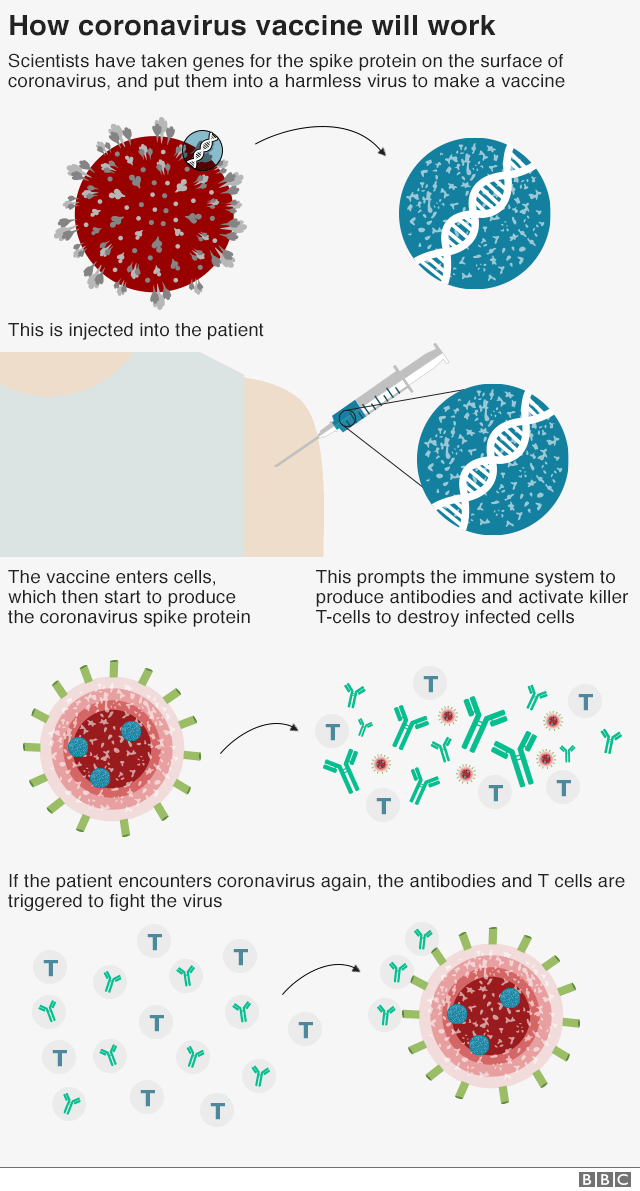
    The vaccine is made from a weakened version of a common cold virus (known as an adenovirus) from chimpanzees that has been modified so it cannot grow in humans.

    How the coronavirus vaccine works: The vaccine is made from a weakened version of a common cold virus (known as an adenovirus) from chimpanzees that has been modified so it cannot grow in humans. Scientists then added genes for the spike surface protein of the coronavirus. This should prompt the immune system to produce neutralising antibodies, which would recognise and prevent any future coronavirus infection.
    white space

    The Oxford team has already developed a vaccine against Mers, another type of coronavirus, using the same approach – and that had promising results in clinical trials.

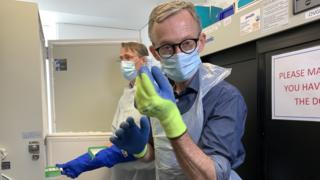
    The BBC's Fergus Walsh with a vial of the vaccine
    Fergus holding a vial of the vaccine developed by the Oxford team

    How will they know if it works?

    The only way the team will know if the Covid-19 vaccine works is by comparing the number of people who get infected with coronavirus in the months ahead from the two arms of the trial.

    That could be a problem if cases fall rapidly in the UK, because there may not be enough data.

    Prof Andrew Pollard, director of the Oxford Vaccine Group, who is leading the trial, said: “We’re chasing the end of this current epidemic wave. If we don’t catch that, we won’t be able to tell whether the vaccine works in the next few months. But we do expect that there will be more cases in the future because this virus hasn’t gone away.”

    The vaccine researchers are prioritising the recruitment of local healthcare workers into the trial as they are more likely than others to be exposed to the virus.

    A larger trial, of about 5,000 volunteers, will start in the coming months and will have no age limit.

    Older people tend to have weaker immune responses to vaccines. Researchers are evaluating whether they might need two doses of the jab.

    The Oxford team is also working with researchers in Kenya about a possible vaccine trial there, where the rates of transmission are growing from a lower base.

    If the numbers could be a problem, why not deliberately infect volunteers with coronavirus?

    That would be a quick and certain way to find out if the vaccine was effective, but it would be ethically questionable because there are no proven treatments for Covid-19.

    But that might be possible in the future. Prof Pollard said: “If we reach the point where we had some treatments for the disease and we could guarantee the safety of volunteers, that would be a very good way of testing a vaccine.”

    Is it safe?

    The trial volunteers will be carefully monitored in the coming months. They have been told that some may get a sore arm, headaches or fevers in the first couple of days after vaccination.

    They are also told there is a theoretical risk that the virus could induce a serious reaction to coronavirus, which arose in some early Sars animal vaccine studies.

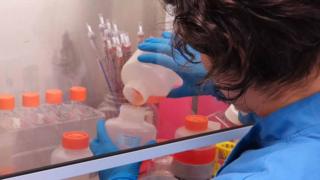
    Vaccine researcherSean Elias – Oxford Vaccine trial
    Work began on a vaccine in January

    But the Oxford team says its data suggests the risk of the vaccine producing an enhanced disease is minimal, and data from animal studies has been positive.

    Scientists there hope to have one million doses ready by September, and to dramatically scale up manufacturing after that, should the vaccine prove effective.

    So who would get it first?

    Prof Gilbert says that has not been decided yet: “It’s not really our role to dictate what will happen, we just have to try to get a vaccine that works and have enough of it and then it will be for others to decide.”

    Prof Pollard added: “We’ve got to ensure we have enough doses to provide for those in greatest need, not just in the UK but also in developing countries.”

    Coronavirus: What is a vaccine and how is one made?

    Another team at Imperial College London hopes to begin human trials of its coronavirus vaccine in June.

    The Oxford and Imperial teams have received more than £40m of government funding.

    Health Secretary Matt Hancock has praised both teams and said the UK will “throw everything we’ve got” at developing a vaccine.

    UK chief medical adviser Prof Chris Whitty has said neither a vaccine, nor a drug to treat Covid-19, is likely to be available within the next year.

  • KNH Doctors Reject ‘Dog Food’ Sent To Them By Sarova Hotel

    KNH Doctors Reject ‘Dog Food’ Sent To Them By Sarova Hotel

    Currently, health workers are everyone’s heroes given their crucial position in the pandemic. Government, organizations and individuals are all in praise of the doctors. Donations are streaming in for health workers, corporates are joining. While most are taken well, it didn’t go right for Sarova Hotel who served food packs of girheri and cabbage to KNH staff and they rejected the offer teeming it disrespectful.


    Some of the comments over this;

    Goody: Did you see the delicious food that some Doctors cooked for their fellow healthworkers?
    Your world class chefs could only come up with rotten Githeri and Rice? I must have missed it in your menu. Sarova hotels Shame on you!

    Rita Oyier: Please don’t do this again. This is not five star material. Don’t.

    Dr. Thuranira: Cheap publicity stunt. I am so disappointed. Githeri ?

    Fredrick Nyambare: Hahahaha. @SarovaHotelsKen this is the best you could do? The way your hotels make so much money. Halafu @KNH_hospital is proud of this? This shows you how Healthcare workers are regarded in this country.

    Mahugu Kimani: sarova hotel why package a meal so nicely kumbe ndani ni githeri.. please respect our health proffesionals they deserve better than that. You can do better than that.

    And here’s the poorly done Githeri, surely, Kibanda does a better job. They went, took good photos for PR but served trash food. The program is to extend for 30 days, we expect a five star hotel to serve the doctors with five star meals and nothing under for political points. We will be monitoring everyday.

  • Trump Suggests Injecting Sanitizers As Treatment For Covid-19

    Trump Suggests Injecting Sanitizers As Treatment For Covid-19

    US President Donald Trump proposed unusual methods for treating the novel coronavirus at a White House briefing Thursday, including ultraviolet light and injecting disinfectants.

    “So supposing we hit the body with a tremendous — whether it’s ultraviolet or very powerful light. And I think you said that hasn’t been checked, but you’re going test it. Supposing you brought the light inside the body, which you can do either through the skin or in some other way.

    “Sounds interesting,” Trump told reporters.

    His remarks came minutes after William Bryan, acting head of the US Department of Homeland Security’s Science and Technology Directorate, said solar light appears to kill the virus both on surfaces and in the air.

    “We’ve seen a similar effect with temperature and humidity as well, where increasing the temperature and humidity — or both — is generally less favorable to the virus,” said Bryan.

    Later, Trump came up with another treatment, this time suggesting the use of disinfectants.

    “And then I see the disinfectant where it knocks it out in a minute. One minute. And is there a way we can do something like that by injection inside or almost a cleaning? As you see, it gets in the lungs, and it does a tremendous number on the lungs, so it would be interesting to check that. You’re going to have to use medical doctors with that, but it sounds interesting to me.

    “And so we’ll see. But the whole concept of the light, the way it kills it in one minute, that’s pretty powerful,” he added.

    Trump asked the doctor leading the White House’s coronavirus response team, Deborah Birx, whether she had heard of using solar light in treating the disease.

    “Not as a treatment. I’ve not seen heat or light,” she replied.

    “Please don’t inject or consume disinfectants,” tweeted Chris Hayes, the host of a news and opinion show on American cable television channel MSNBC.

    As of Thursday evening, the US had more than 867,000 cases and over 49,000 deaths. Nearly 80,000 have recovered.

    The virus has spread to 185 countries and regions, infecting over 2.7 million and killing more than 190,000 since emerging in the Chinese city of Wuhan late last year.

  • Football: UEFA Wants Clubs To Send Teams To European Qualifiers So They’re Giving Them Out $75M

    Football: UEFA Wants Clubs To Send Teams To European Qualifiers So They’re Giving Them Out $75M

    Due to the financial strains from the coronavirus pandemic, UEFA will pay €70.4 million ($75 million) to 676 clubs to send their players to UEFA national team competitions, European football’s governing body said Thursday.

    ”The UEFA Executive Committee today decided to release immediately the club benefit payments related to the clubs’ contribution to UEFA national team competitions in light of the current crisis and the financial difficulties many clubs are facing across Europe,” UEFA said in a statement.

    UEFA added that the payments are supposed to be made after EURO 2020 playoffs, but it decided to make the payments immediately since the clubs are ailing financially due to the virus.

    ”€50m will go to clubs having released players for the 39 national teams not involved in the European Qualifiers play-offs and €17.7m will go to clubs having released players for the 16 national teams taking part in the European Qualifiers play-offs (not including payments for the play-off matches, which will be paid on completion of the play-offs),” it said.

    The remaining €2.7 million – related to players sent for the playoffs – will be paid after those matches will take place in the autumn.

    ”676 clubs from the 55 UEFA member associations will receive amounts ranging from €3,200 up to €630,000 for their contribution to the European Qualifiers and the UEFA Nations League for the 2018-20 period,” UEFA added.

    In addition to this payment, UEFA will also distribute more €130 million to clubs to send their players to UEFA EURO 2020, now postponed until 2021.

  • Photos: Governor Joho Opens Second Coronavirus Hospital In Mombasa

    Photos: Governor Joho Opens Second Coronavirus Hospital In Mombasa

    As numbers of coronavirus continues to surge mapping out Nairobi and Mombasa as the epicenters with most numbers, disaster preparedness and mitigation measures continues to be taken, at least in the case of Mombasa.

    With a fully operational Covid-19 hospital in Coast General, the need for expansion is undeniably a top priority. Today Governor Joho unveiled The Mombasa County the second COVID19 Treatment Centre domiciled at the Technical University of Mombasa.

    “The centre will be handling mild & moderate COVID-19 cases while the critical cases will be handled at the Coast General Teaching and Refferal Hospital. We also launched four ambulances with critical care capacity that will be dedicated for transfer of Covid19 patients only.” The Governor said.

  • Reprieve For Ruth Matete As Postmortem Results Reveal Cause Of Husband’s Death

    Reprieve For Ruth Matete As Postmortem Results Reveal Cause Of Husband’s Death

    It has been hectic weeks for gospel singer Ruth Matete who has been forced to fight two battles; that of losing a husband and that of fighting allegations labeled against her of having hand in his death.

    The singer who has been grilled and recorded several statements with the DCI looking into the death of her husband could finally be breathing at last.

    Postmortem done on John Apewoje showed that he died of multiple organ failures as a result of the 60% burn that he had suffered.Chiefgovernment pathologist Johansen Oduor conducted their exercise.

    Accusing fingers had been pointed at Ruth following a video recording of a Nigerian national claiming to be the manager to the late. In his wild accusations, he said Ruth had a record of violence towards her husband and that a possibility of her hand in death shouldn’t be ruled out.

    Nigerian embassy immediately ordered for the body not to be released until a postmortem and in-depth investigation into the death is done and determined. Reports however indicate that, his burial is yet to be confirmed as embassy instructed the state to wait for a go ahead.

  • Post, Delete: Itumbi’s Tweet To Defend Ruto Ends Up Putting Him In More Trouble

    Post, Delete: Itumbi’s Tweet To Defend Ruto Ends Up Putting Him In More Trouble

    It’s always advised to read, re-read before posting anything on the internet because of one key fundamental; the internet never forgets. Nothing that you post and delete will disappear. This would become the hardest lesson for Dennis Itumbi who’s now DP Ruto’s digital point man.

    Priding himself as a fact checker, Itumbi made a post as a rebuttal to the People’s Daily that linked Ruto to the Ruai land that was repossessed by the government on Wednesday.

    The piece of land which was illegitimately taken from Nairobi Sewage company was found to be under Renton Company Limited ownership and Patrick Osero listed as one of the directors.

    In their story, the newspaper revealed that Osero was a conduit of the DP and a business partner who also at one point tried to cover up for him over Weston Hotel ownership when the story of land grabbing was on fire. Osero is also listed as one of the Weston’s owners. DP would later on admit to the ownership of the hotel that sits on a grabbed land from KCAA.

    Itumbi attempted to distance the DP from the Ruai saga by posting the listed owners of the said land but this would go horribly wrong for him.

    In the list, Itumbi unknowingly revealed a long chain of DP’s conduits including Governor Waititu’s wife. Waititu who was bundled out of office last year is also entangled in endless land disputes and a close associate of the DP.

    Here’s the deleted tweet.

    People started connecting the dots.

    Mr. Kinuthia Pius pointed out, “Dennis Itumbi’s has deleted the list of Renton Company Directors: Kenneth Bolt & Kibagendi Osero currently works With DP Ruto. Susan Ndung’u – Waititu’s wife. John Nyumu- cousin to Murkomen’s wife. Delstar Invst Ltd- Shareholder is DP Ruto’s cousin. #SystemYaFacta demystified!”

    As many continued to poke holes in his tweet, he quickly deleted it and made a rejoinder which was more of a consolation and admitting that he had been subdued, “The Ruai land has been repossessed. Now let us build the sewage as was claimed. As we do that, let us discuss Land ownership in Kenya. TJRC and Ndungu Land Report are good starting points. Political Innuendo & Conjecture does not change #SystemYaFacts on Land ownership in Kenya.”