Category: Politics

  • There’s No Evidence Of Widespread Fraud As Falsely Claimed By Trump

    There’s No Evidence Of Widespread Fraud As Falsely Claimed By Trump

    It started months before Election Day with false claims on Facebook and Twitter that mail-in ballots cast for President Donald Trump had been chucked in dumpsters or rivers.

    Now, a week after the final polls closed, falsehoods about dead people voting and ballots being thrown out by poll workers are still thriving on social media, reaching an audience of millions. Trump and his supporters are pointing to those debunked claims on social media as reason to not accept that Democrat Joe Biden won the election.

    “These will probably persist for years or even decades unfortunately,” Kate Starbird, a University of Washington professor and online misinformation expert, said of the false claims about the U.S. election process. “People are very motivated to both participate in them and believe them.”

    There is no evidence of widespread fraud in the 2020 election. In fact, voting officials from both political parties have stated publicly that the election went well and international observers confirmed there were no serious irregularities.

    The issues raised by Trump’s campaign and his allies are typical in every election: problems with signatures, secrecy envelopes and postal marks on mail-in ballots, as well as the potential for a small number of ballots miscast or lost. With Biden leading Trump by substantial margins in key battleground states, none of those issues would have any impact on the outcome of the election. Many of the legal challenges brought by Trump’s campaign have been tossed out by judges, some within hours of their filing.

    But Trump, who primed his supporters for months to doubt this election’s outcome with false tales of ballots being “dumped in rivers” and baseless tweets warning of a “rigged election,” has continued his assault on the U.S. vote in more than 40 Facebook and Twitter posts since Election Day.

    “This was a stolen election,” Trump tweeted on Sunday, the day after Biden became president-elect.

    Trump’s supporters have readily echoed the president’s cries of an unfair election on Facebook and Twitter.

    Tweets and retweets with terms such as “steal,” “fraud,” “rigged” and “dead” referring to the election spiked more than 2,800% from Nov. 2 to Nov. 6, according to an analysis by VineSight, a tech company that tracks misinformation. The company found more than 1.6 million retweets containing some of those words on Nov. 6 alone.

    The false claims have shapeshifted over the last week, ranging from misleading assertions that ballots filled out with Sharpie pens in Illinois, Arizona and Michigan were thrown out to an inaccurate social media post from Eric Trump that the number of ballots cast in Wisconsin exceeded the number of registered voters.

    In recent days, prominent Republicans and Trump allies have peddled social media claims that hundreds or thousands of dead people voted in key battleground states like Pennsylvania or Michigan.

    One tweet, shared more than 50,000 times, falsely claimed that a dead woman named Donna Brydges voted in the election. Brydges is very much alive, she confirmed to the AP by phone last week. In fact, she had “just beat me in a game of Cribbage,” her husband told a reporter.

    Between Election Day and Monday, roughly 5 million mentions of voter fraud and “Stop the Steal” were made across social media and online news sites, with most of the claims focusing on closely contested states like Pennsylvania, Georgia and Michigan, according to an analysis by media intelligence firm Zignal Labs. Mentions of voter fraud have not waned since final votes were cast Tuesday.

    Last week, as Biden pulled ahead in the race, Trump supporters quickly launched dozens of “Stop the Steal” groups on Facebook and began using the platform to organize “Stop the Steal” rallies.

    The social media platforms have tried to rein in the false claims.

    Facebook quickly shut down one “Stop the Steal” Facebook group, which ballooned to more than 350,000 members in just one day, after some called for violence in it, and has taken down additional “Stop the Steal” groups. And over the last week, Twitter has covered nearly a dozen of the president’s tweets that make false or unproven claims that voter fraud occurred.

    That’s pushed a small but vocal faction of conservatives to lesser-known social media sites like Parler, which does not moderate content posted by users as closely as mainstream tech companies like Facebook, YouTube or Twitter.

    Parler has fewer than 8 million users, but its reach is quickly growing. As of Tuesday, Parler was the most downloaded app in Apple’s store, followed by MeWe. Newsmax, a conservative cable network, was in fourth place. According to Sensor Tower, which tracks such data, Parler was downloaded over 2 million times on Apple and Android in the U.S. from Nov. 3 to Nov. 9. This is more than 31 times the downloads it saw in the prior week. In that same period, Newsmax saw 583,000 installs, up more than 11 times from the previous week. MeWe hit 218,000 installs, more than 14 times the 15,000 installs it saw in the previous week.

    The conversation on Parler has centered around voter fraud and an election stolen from Trump over the last week.

    “Show the world we won’t let communist steal the White House,” one Parler user wrote Tuesday, in one of many thousands of posts using the hashtag #StopTheSteal.

    That migration of social media users could be one drawback of the good job Facebook and Twitter did fact-checking and removing false content around the U.S. election, Starbird, the misinformation expert, noted.

    “What they tried to do is commendable, which is why people are moving to other platforms,” Starbird said.-AP.

  • Is Trump Mounting A Coup Or Just Putting On A Circus

    Is Trump Mounting A Coup Or Just Putting On A Circus

    Is President Donald Trump’s unprecedented assault on the US election results a coup in progress — or mere political show?

    In this golden age of conspiracy theories, few can agree.

    Ostensibly, Trump is exercising his right to complain that the count showing Democrat Joe Biden with a solid if close win was wrong. “Rigged Election!” he tweeted in his latest broadside Thursday.-AFP.

    But the president is not making much sense.

    Plenty of US elections have been as close as his November 3 loss — or closer — and no incumbent ever alleged that his victory was stolen or refused to concede. US elections just don’t have those kinds of problems.

    More than a week after Election Day, not a single piece of credible, significant evidence of fraud has been provided.

    So what’s really going on?

    For some, Trump is finally showing his true authoritarian colors.

    This is a president who openly admires the likes of President Vladimir Putin, the king of warping democratic institutions to award himself power. Now, the theory goes, he’s following suit.

    But what if Trump is more slipshod showman than Machiavellian mastermind?

    If his team’s embarrassing courtroom failures and a bizarre press conference by his fixer Rudy Giuliani at a Philadelphia gardening center called Four Seasons Total Landscaping are anything to go by, that may be the more logical answer.

    – The coup theory –

    Still, when Trump fired his relatively independent-minded defense secretary Mark Esper on Monday, and then several other high-ranking officials, blood pressure levels shot up among those already on edge.

    “In the last 24 hours, the Secretary of Defense (SecDef), the Under Secretary of Defense for Policy (USD-P), and the Under Secretary of Defense for Intell (OUSD-I) have been sacked…. Why?” tweeted Alexander Vindman, a retired army officer turned White House staffer who was fired after testifying against Trump during his 2019 impeachment.

    Alarm bells also went off when Trump’s attorney general, Bill Barr, authorized federal prosecutors to join Trump’s quest for election irregularities.

    The Justice Department’s chief election crimes official, Richard Pilger, resigned in protest.

    Barr is “permitting the department to be weaponized to try to overturn the results of this election,” wrote former senior Pentagon lawyer Ryan Goodman and Andrew Weissmann, who was part of the special counsel’s team investigating Trump’s Russia links, in The Washington Post.

    In the most extreme scenario, some warn of a coup within the Electoral College.

    This is the mostly symbolic body comprised of representatives sent from each state to elect presidents on the basis of the popular vote.

    What if Republican state legislatures managed to send hand-picked electors who would ignore the vote and choose Trump instead?

    The doomsday scenario is being widely discussed in the media but appears far-fetched in real life.

    “To begin with, even talk of doing so would trigger massive unrest and put legislators under unprecedented pressure,” wrote Richard Hasen, a law professor at the University of California.

    But given the high stakes, nerves are jangled.

    And Secretary of State Mike Pompeo’s odd comment on Tuesday that the government is preparing for “a second Trump term” didn’t help.

    – Circuses and careers –

    The alternate theory is that Trump is just being Trump — the perpetual performer who can’t stand being out of the limelight and will leave the stage only after putting on the show of his life.

    Even though he came second, Trump got more than 72 million votes and that huge fan base is famously loyal.

    According to a Politico/Morning Consult poll, an amazing 70 percent of Republicans don’t think the election was free and fair — testimony to the power of Trump’s persuasion.

    So it would make sense for a man whose brand rests heavily on macho concepts about “fighting” and “winning” to go down in the way his followers expect.

    Beyond putting on a political circus, Trump may have more personal goals: his financial and career future.

    At an energetic 74 and in possession of a gigantic database of voter information, Trump clearly has options beyond quietly curating a presidential library.

    One clue lies in his frantic appeals for money.

    Read the fine print in Trump’s “Official Election Defense Fund” mass emails and it becomes apparent that donations won’t only go to fighting the “left-wing MOB.”

    A hefty portion is being directed to paying off Trump’s 2020 campaign debt and more is going to a newly formed Political Action Committee or PAC which will help him back chosen candidates in the future or even launch a possible new presidential bid in 2024.

    Whether or not Trump pursues electoral politics, he is widely expected to dive into broadcasting, with a reported mission to punish Fox News for what he sees as insufficient loyalty.

    Fox “forgot what made them successful, what got them there. They forgot the Golden Goose,” he said Thursday in a burst of tweets attacking Rupert Murdoch’s network and boosting the conspiracy theory peddling right-wing channels Newsmax and OANN.

    Could Trump’s post-election chaos in fact be the pilot episode for the former reality TV star’s next series?

  • Biden Moves Forward Without Help From Trump’s Intelligence Team

    Biden Moves Forward Without Help From Trump’s Intelligence Team

    WASHINGTON (AP) — The presidential race was hovering in limbo in 2000 when outgoing President Bill Clinton decided to let then-Gov. George W. Bush read the ultra-secret daily brief of the nation’s most sensitive intelligence.

    Clinton was a Democrat and his vice president, Al Gore, was running against Republican Bush. Gore had been reading the so-called President’s Daily Brief for eight years; Clinton decided to bring Bush into the fold in case he won — and he did.

    President Donald Trump has not followed Clinton’s lead. As he contests this year’s election results, Trump has not authorized President-elect Joe Biden to lay eyes on the brief.

    National security and intelligence experts hope Trump changes his mind, citing the need for an incoming president to be fully prepared to confront any national security issues on Day One.

    “Our adversaries aren’t waiting for the transition to take place,” says former Michigan Republican Rep. Mike Rogers, who was chairman of the House intelligence committee. “Joe Biden should receive the President’s Daily Brief starting today. He needs to know what the latest threats are and begin to plan accordingly. This isn’t about politics; this is about national security.”

    Youtube video thumbnail

    U.S. adversaries can take advantage of the country during an American presidential transition and key foreign issues will be bearing down on Biden the moment he steps into the Oval Office.

    Among them: Unless Trump extends or negotiates a new nuclear arms accord with Russia before Inauguration Day, Biden will have only 16 days to act before the expiration of the last remaining treaty reining in the world’s two largest nuclear arsenals. Perhaps U.S. spies have picked up tidbits about the Russians’ redlines in the negotiations, or about weapons it really wants to keep out of the treaty.

    That’s the type of information that might be in the PDB, a daily summary of high-level, classified information and analysis on national security issues that’s been offered to presidents since 1946. It is coordinated and delivered by the Office of the National Intelligence Director with input from the CIA and other agencies. It is tailored for each president, depending on whether they prefer oral or written briefs or both, short summaries or long reports on paper or electronically.

    Having access to the PDB also could help Biden craft a possible response to North Korea, which has a history of firing off missilesor conducting nuclear tests shortly before or after new presidents take office.

    Biden has decades of experience in foreign affairs and national security, but he likely has not been privy to the latest details about how Iran is back to enriching uranium, or the active cyber attack operations of Russia, China and Iran. China’s crackdown on Hong Kong is heating up. And the threat from Islamic extremists, although curbed, still remains.

    Biden is trying to play down the significance of the delay in getting access to the PDB.

    “Obviously the PDB would be useful but, it’s not necessary. I’m not the sitting president now,” Biden said Tuesday. He didn’t answer a question about whether he’d tried to reach out to Trump himself on this or any other issue, saying only, “Mr. President, I look forward to speaking with you.”

    He was also asked about needing access to classified information as soon as possible if Trump doesn’t concede the race.

    “Look, access to classified information is useful. But I’m not in a position to make any decisions on those issues anyway,” Biden said. “As I said, one president at a time. He will be president until Jan. 20. It would be nice to have it, but it’s not critical.”

    Biden is familiar with the PDB, having read it during his eight years as vice president. But threats are ever-changing and as Inauguration Day nears, his need for Trump to let him get eyes on the intelligence brief will become more critical.

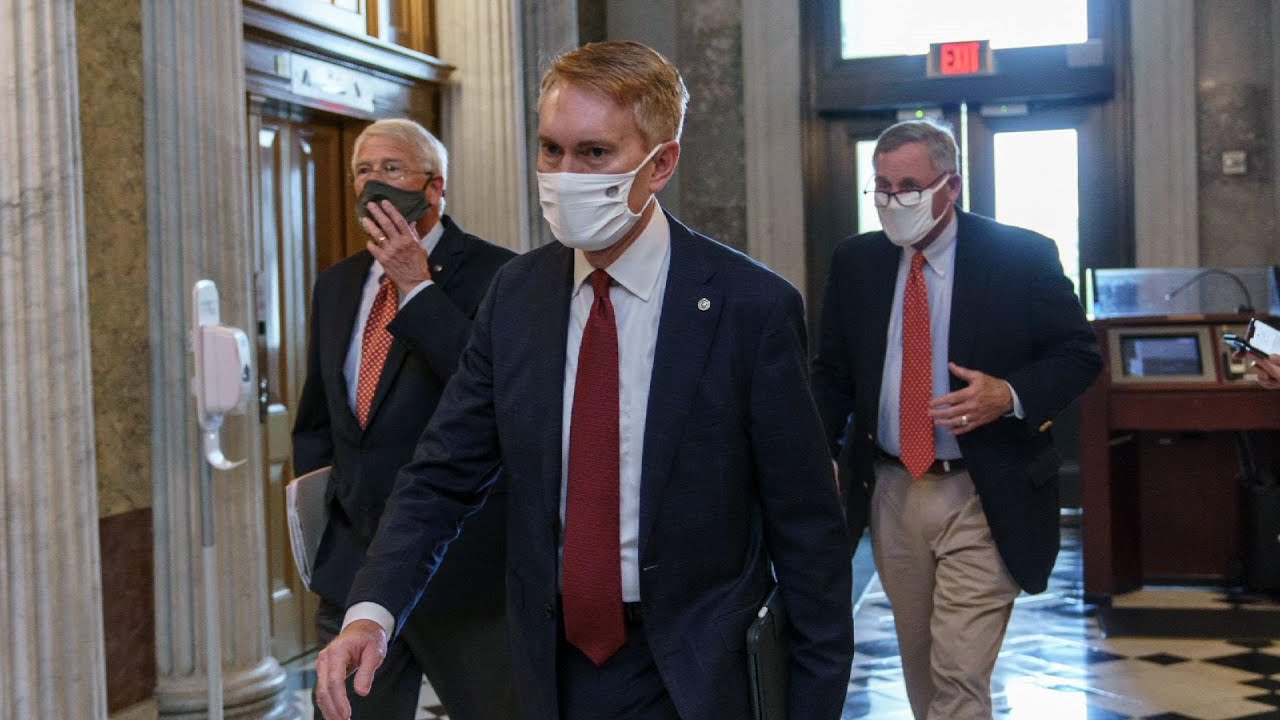
    Sen. James Lankford, R-Okla., predicted that the issue of whether Biden will get access to the intelligence brief will be resolved soon.

    “I’ve already started engaging in this area. … And if that’s not occurring by Friday, I will step in and push and say this needs to occur so that regardless of the outcome of the election, whichever way that it goes, people can be ready for that actual task,” Lankford told KRMG in Tulsa, Oklahoma, on Wednesday.

    He said Vice President-elect Kamala Harris also should be getting the briefings, which should not be a problem because she already has security clearances as a member of the Senate intelligence committee.

    While the Bush team had access to the intelligence brief in 2000, an election recount delayed the Bush team’s access to government agencies and resources for more than five weeks. Biden is missing out on all counts: More than a week into his transition, Biden doesn’t have access to the PDB, the agencies or government resources to help him get ready to take charge.

    “President-elect Joe Biden and his transition team should not suffer a similar delay,” John Podesta, who served as White House chief of staff under Clinton, and Bush’s chief of staff Andrew Card wrote in a joint op-ed published this week in The Washington Post.

    “We have since learned the serious costs of a delayed transition,” they wrote. “Less than eight months after Bush’s inauguration, two planes flew into the World Trade Center, killing nearly 3,000 Americans.”

    The 9/11 Commission Report on the Sept. 11, 2001, attacks warns of the danger in slow-walking presidential transition work in general, not just the intelligence piece. The Bush administration didn’t have its deputy Cabinet officers in place until the spring of 2001 and critical subcabinet positions were not confirmed until that summer — if then, the report said.

    For now, the office of National Intelligence Director John Ratcliffe says it can’t begin talking with the Biden transition team until a federal agency starts the process of transition, which the Trump administration is delaying.

    The office, which oversees more than a dozen U.S. intelligence agencies, said it must follow the Presidential Transition Act, which requires the General Services Administration to first ascertain the winner of the election, which Trump is contesting. GSA administrator Emily Murphy, who was appointed by Trump, has not yet officially designated Biden as the president-elect.

    Intelligence agencies have given generalized intelligence briefings — minus information on covert operations and sources and methods — for presidential nominees since 1952. President Harry S. Truman authorized them for both parties’ candidates because he was upset about not learning about the U.S. effort to develop an atomic bomb until 12 days into his presidency.

    “It’s an important and meaningful tradition, and I’m concerned that it’s not being continued,” said Denis McDonough, a former White House chief of staff during the Obama administration who oversaw the 2017 transition.

    Biden started receiving these more general security briefings after he became the Democratic presidential nominee, but it’s unclear if he is still getting those. A spokesman for Biden’s transition team declined to comment.

  • Impunity and Tribalism at JSC.

    Impunity and Tribalism at JSC.

    The contest for Judicial Service Commission (JSC) magistrate’s slot is heating up – four candidates have been cleared by KMJA to vie for the position to represent the association at the JSC, a seat that also comes with powers to hire and fire judges or magistrates.

    Those cleared for the election to be held on December 5th are Senior Principal Magistrate Everlyne Olwande (Limuru and KMJA vice president), Stellah Atambo (Kiambu), Dolphina Alego (Kakamega) and Florence Macharia (Shanzu).

    KMJA dropped Principal Magistrate Teresa Nyangena from the race on the grounds that she failed to provide all signatures for 20 members who nominated her on September 28th, 2020. Fair enough?

    The candidate who wins the race will replace Commissioner Emily Ominde who was reelected in 2015 to represent more than 500 magistrates and Kadhis in Kenya.

    The Judicial Service Act dictates that KMJA forwards the name of whoever is elected as its nominee to the president, who is expected to appoint the nominee within three days of receipt of the name.

    Impunity

    Emily Ominde Onyando Vs Everlyn Olwande.

    Everlyn Olwande was the vice president of the Kenya Magistrates and Judges Association (KMJA) and a member of ICJ-Kenya. She is currently a member of the International Commission of Justice and the International Association of Women Judges-Kenya.

    Fortunately for Olwande and thanks to sanitization of the rot in the system – Olwande’s virginity got broken by the impunity she got involved in on April when she violated Covid_19 rules put in place by the government to curb the spread of the deadly novel virus.

    Olwande was booked at Embakasi Police Station on April 10th and investigations on the offence of contravening curfew restrictions. She was then released on a cash bail and was to appear in court on April 14th 2020. However, she was never arraigned in court as expected. Why so?

    Well, the failure of her arraignment in court is clearly connected to the dots after it turned out that whoever bailed her out was the incumbent commissioner, Emily Ominde Onyando, whom she’s in the race to replace.

    However, as much this was constitutionally legal for her to be bailed out, it marinated a conflict of interest within the commission. Why did it have to be Ominde? The case died on arrival at the DPP’s office and she is now walking free through the corridors of power. Justice denied it was, as she is the favorite successor to incumbent Emily Ominde Onyando and Emily would use all resources at her disposal, bend the law to save her, set double standards for her to make sure she succeeds her at the JSC.

    Emily during her reign, she has inflicted tribalism, fear, and intimidation, ruling by the sword and so is her favorite successor. Different monkeys same forest.

    The call is simply to elect a candidate of integrity and without baggage. Kenyans are apprehensive and counting on the election of a merited candidate.

  • AFP: Some Of The False And Misleading Election Fraud Claims

    AFP: Some Of The False And Misleading Election Fraud Claims

    Allegations of fraud and foul play in the 2020 US election spread across the internet as officials counted ballots in battleground states that will determine the outcome of the closely fought vote between Donald Trump and Joe Biden.

    The claims echo repeated unfounded predictions by Trump and his campaign that fraud would occur, casting doubt on the results and laying the groundwork for legal challenges.

    Challenging the results soon after polls closed, Trump tweeted that: “We are up BIG, but they are trying to STEAL the Election.”

    A screenshot of a tweet taken on November 4, 2020

    AFP examines several other claims of fraud that are circulating online.

    Burned ballots in Virginia

    Trump’s son Eric claimed on Twitter that 80 ballots cast for the president were burned.

    “Burning 80 Trump Ballots,” Eric Trump wrote in a tweet, spreading a claim from a now-suspended account that included a video clip of the alleged incident, which is no longer viewable.

    A screenshot of tweet taken on November 5, 2020

    But the City of Virginia Beach responded to his tweet, saying: “Those were sample ballots,” and linking to a statement.

    “A concerned citizen shared a video with us that ostensibly shows someone burning ballots. They are NOT official ballots, they are sample ballots,” the statement said, referring readers to “the attached freeze frame image and photo of the official ballots, which have the bar codes.”

    Biden surge in Michigan

    The number of reported votes for Biden, the Democratic candidate, jumped by more than 138,000 on the morning of November 4, 2020, drawing online accusations of foul play.

    “So while everyone was asleep and after everyone went home, Democrats in Michigan magically found a trove of 138,339 votes, and all 138,339 of those ‘votes’ magically went to Biden? That doesn’t look suspicious at all,” one Twitter user wrote.

    A screenshot of a tweet taken on November 4, 2020

    But it was caused by human error when a zero was added as votes were counted. The mistake was quickly fixed after state officials noticed it, but a real-time report by an independent analyst fed claims of fraud online.

    Caroline Wilson, county clerk for the central Michigan county of Shiawassee, told AFP. “I added an extra zero accidentally,” thereby reporting 153,710 votes for Biden instead of 15,371.

    “The minute it was discovered, it was corrected, probably within 20 minutes, so I’m amazed how fast this spread,” Wilson said.

    When the figure was lowered by the correction, 138,339 votes were removed from Biden’s total tally without any changes to Trump’s numbers.

    Sharpie pen fraud in Arizona

    Social media users  claimed that Arizona voters were pushed to use Sharpie pens on their ballots in a bid to make them illegible and keep votes for Trump from being counted.

    “The poll workers were taking the pens from voters and making them use Sharpies. Sharpies bleed through. All of the votes marked with Sharpies couldn’t be read,” said one Facebook post.

    A screenshot of a Facebook post taken on November 4, 2020

    It included a video in which a man said: “People are coming here to vote for Donald Trump, and those votes are all getting invalidated.”

    But officials — including Arizona Secretary of State Katie Hobbs — said using a Sharpie would not invalidate ballots, while voters also had the option of bringing their own pens.

    “IMPORTANT: If you voted a regular ballot in-person, your ballot will be counted, no matter what kind of pen you used (even a Sharpie)!” Hobbs wrote on Twitter — an assessment echoed by the election department of the state’s most populous county.

    Too many voters in Wisconsin

    Posts on social media claimed that the number of people who cast ballots in Wisconsin exceeded the total number of registered voters.

    “WISCONSIN REPORTING 101+% VOTER TURNOUT! 3,170,206 Votes Counted. 3,129,000 Registered Voters,” an Instagram post said.

    A screenshot of an Instagram post taken on November 4, 2020

    But it and other posts used an inaccurate number for registered voters. According to the Wisconsin Elections Commission, the figure stood at 3,684,726 as of November 1 — and it may have risen since.

    Reid Magney, Public Information Officer of the Wisconsin Elections Commission, warned of numbers mentioned in online reports and that could be several days older.

    “Wisconsin has election day registration… Typically hundreds of thousands of people register to vote on election day across the state,” he said.

    Biden jump in Wisconsin

    Online claims that votes were fraudulently added to Biden’s tally in the battleground of Wisconsin relied on a graph that showed a sharp jump for the Democrat.

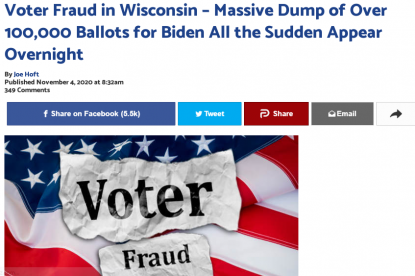
    “Voter Fraud in Wisconsin — Massive Dump of Over 100,000 Ballots for Biden All the Sudden Appear Overnight,” reads the headline of an article by right-wing website Gateway Pundit, before projections showed Biden winning the Midwestern state.

    A screenshot taken on November 6, 2020 shows the headline of an article

    The article is based on a graph from analysts at FiveThirtyEight, which shows a sudden surge in votes for Biden between midnight and 6:00 am on November 4. But it does not point to fraud.

    The graph was published on FiveThirtyEight’s election live feed in the morning of November 4, based on data from ABC News as of 6:23 am that day.

    “There’s nothing ‘magical’ about these vote drops: counties simply released a large batch of results all at once,” Curt Villarosa of ABC News, which owns FiveThirtyEight, said in an email.

    “And these batches were NOT 100% Biden votes,” he added. “Behind the blue line, there is also a red line representing the thousands of votes Trump GAINED.”

  • If Donald Trump Refuses to Leave the White House, Secret Service Will Escort Him Out

    If Donald Trump Refuses to Leave the White House, Secret Service Will Escort Him Out

    In a year of tragic firsts for the country, the unthinkable is always a possibility.

    As an early lead began to slip on election night, President Donald Trump prematurely declared victory, even as former Vice President Joe Biden appeared set to win thanks to an influx of mail-in ballots, received early but counted last in key states.

    Trump has since claimed the race was rigged and shows no sign of conceding, leading the Biden campaign to consider outcomes previously thought to be only the most radical.

    “As we said on July 19th, the American people will decide this election,” Biden’s team said in a statement Friday. “And the United States government is perfectly capable of escorting trespassers out of the White House.”

    And the Secret Service would be the ones to do it, one former U.S. official and two experts told Newsweek.

    The scenarios Newsweek discussed with its sources are hypothetical. No network has called the race and the votes are still being counted. Trump has a narrow path to victory in the electoral college. He has never said or implied that he would continue to occupy the White House after exhausting any legal challenges to the vote.

    Still, this is what happens when a sitting president doesn’t stand up to pass the baton to his or her successor. It’s never been seen before in the United States and there is no imminent threat that it will happen in January, but there is a plan in place to prevent a transition in power crisis.

    The 20th Amendment has it that Trump, or any other lame-duck leader, loses his presidential mandate January 20 at noon, and, if he tries to stick around after that, the very guard once tasked with protecting the nation’s top officeholder now has to evict him.

    “The Secret Service would escort him off, they would treat him like any old man who’d wandered on the property,” one former official involved in the transition process between former President Barack Obama and Trump told Newsweek.

    secret, service, donald, trump, escort
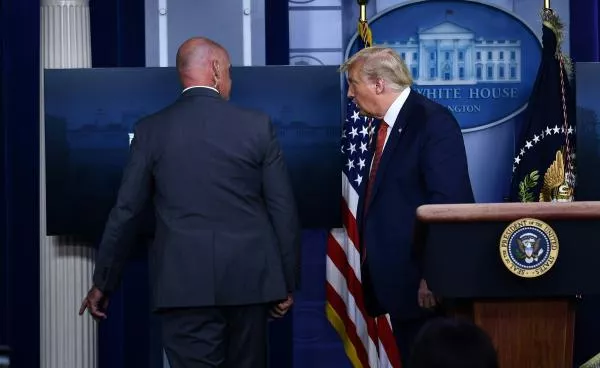
    U.S. President Donald Trump is removed by a member of the Secret Service from the Brady Briefing Room of the White House in Washington, DC after the Secret Service shot an apparently armed man outside nearby, August 10.Brendan Smialowski/AFP/Getty Images

    And whether or not Trump actually attends the Inauguration Day ceremony is irrelevant to the actual transfer of authority—in which Trump would also lose privileged modes of transportation such as the presidential Air Force One and his iconic, fortified limousine, the Beast.

    “As of noon of January 2021 the Beast doesn’t belong to him, AF1 doesn’t belong to him, and the White House doesn’t belong to him,” former U.S. Navy intelligence and counter-terrorism specialist Malcolm Nance told Newsweek.

    The system is intentionally built to work independently of the whims of whoever happens to be in the White House at the time.

    “The transition process is automated. There is no ‘do-it yourself’ move,” Nance said. “So if he doesn’t have a designated place, they’ll decide for him. Basically, the systematic things will happen whether he’s a willing participant or not.”

    Trump also loses his commander-in-chief status, meaning the Pentagon cannot and will not come to his aid should Biden be sworn in.

    Read more

    “A POTUS becomes the commander-in-chief upon taking the presidential oath of office,” a Pentagon spokesperson told Newsweek. “A former POTUS does not retain any authorities as they relate to the U.S. Armed Forces.”

    It’s not the military’s place to intervene, however. Like the former official Newsweekspoke to, Nance also indicated it would be the Secret Service to remove the president, physically if need be.

    “If he says he will not physically leave the White House, they will physically remove him,” he added. “They may have to put hands on him to remove him. They may tell him if he doesn’t make his flight, he may have to contract his own flight.”

    Such a scenario would be unprecedented. Of the 44 men who preceded Trump in the presidency, 35 have willingly ceded power either because their two-term limit expired, they lost an election or chose not to run again. Eight died and one quit.

    Trump managed to unwillingly make history last year by being only the third president to be impeached, but—like Andrew Johnson and Bill Clinton before him—the Senate saved Trump from being ousted.

    Overstaying his Oval Office welcome after an election, however, would truly be unparalleled.

    “No sitting president has ever refused to leave office or vacate the White House in the course of American history,” the White House Historical Association told Newsweek.

    donald, trump, barack, obama, joe, biden
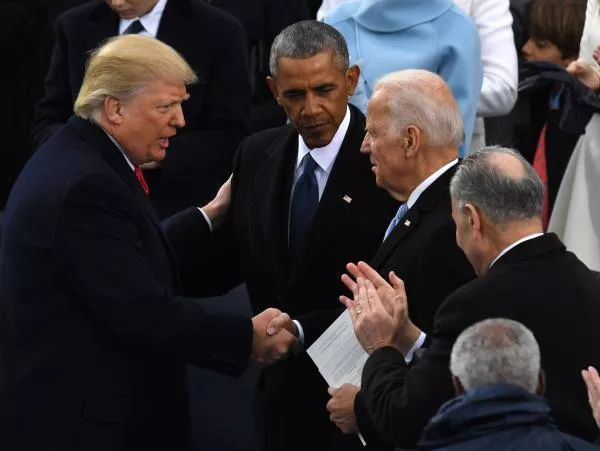
    U.S. President Donald Trump (L) shakes hands with former U.S. President Barack Obama (C) and former Vice President Joe Biden after being sworn in as president on January 20, 2017 at the U.S. Capitol in Washington, DC. Obama and Biden lost their presidential and vice presidential authorities, respectively, on noon that day.MARK RALSTON/AFP/GETTY IMAGES

    Even if Trump managed to somehow vacate the vote itself, the outcome would likely be unfavorable for him. No avenue exists for him to prolong his administration nor appoint his deputy, Vice President Mike Pence.

  • Could US Election Be Decided In The Courts?

    Could US Election Be Decided In The Courts?

    AFP

    Democrats and Republicans were gearing up Wednesday for a possible legal showdown to decide the winner of the tight presidential race between Republican Donald Trump and Democratic challenger Joe Biden.

    Trump declared overnight he was ready to go to the US Supreme Court to dispute the counting of votes, as the results remained unclear in several key states, notably Pennsylvania.

    Trump’s threat raised the specter of the election being ultimately decided, as in 2000, by a high court ruling on how states can tally votes or conduct recounts.

    – The pandemic and mailed votes –

    The legal problems are mainly tied to the Covid-19 pandemic. Social distancing put a premium on being able to vote by mail.

    Each state sets its own voting rules, and many adopted or expanded mail-in vote programs. That required changing rules on how and when mailed ballots would be collected, verified and tabulated.

    To accommodate millions of mailed ballots, state legislatures and election authorities extended the periods for receiving ballots, due to an overburdened US Postal Service, added time to count the votes, and took other steps to make the process easier.

    Expecting that more Democrats — who have by and large adopted a more cautious approach to Covid-19 — would prefer to vote by mail, Republican groups around the country filed hundreds of lawsuits to block such rule changes, saying they violated existing statutes.

    Some of those suits could be pursued in the seven key states where the vote count remained extremely narrow Wednesday, in some cases with ballots still arriving in the mail.

    “It’s clear that both candidates believe they still have a chance to win, so the fight is very much going forward. And the fight may take place in courts,” said Ohio State University election law expert Ed Foley.

    – Possible challenges –

    As in Florida in 2000, the challenges will focus on what ballots are legitimate.

    Already before election day, Republicans sued over whether states like Michigan and Pennsylvania can legitimately count ballots after November 3 election day, or count those which arrive by mail after election day.

    Trump has claimed repeatedly, without offering evidence, that ballots counted after election day, particularly those in key state Pennsylvania, would be “fraudulent.”

    Pennsylvania is particular target because, unlike Michigan and others, it agreed to sequester ballots that arrive by mail after November 3, making them clear targets.

    Republicans are also challenging oversight of the counting of mailed votes, if ballots have correct postmarks, and policies to allow voters to “cure” their mailed ballots to prevent them from being discarded due to incomplete forms or unclear signatures.

    – Close counts –

    All of those issues could give challengers the ability to disqualify individual or whole groups of ballots.

    In Wisconsin — where early returns show Biden leading by about 20,000 votes, within the one percent margin needed to request a recount — Trump’s campaign said Wednesday it will demand one.

    But experts say neither party is likely to go to court unless the margin between the two candidates is very narrow, as in Florida in 2000, when the election hinged on just 537 votes.

    Derek Muller, a law professor at the University of Iowa, said a candidate won’t sue if he or she is trailing significantly in a number of states.

    “If it comes down to one state,” he said, “then I would expect really serious litigation.”

    But if margins turn out to be two or three percentage points — say a 100,000 vote difference in Pennsylvania — “that’s pretty difficult to be litigating at the end of the day,” said Muller.

    “If you have a lawsuit about … the loss of about 10,000 votes, it’s not going to make a difference if the margin ends up being 100,000,” said Foley.

    – Skittish Supreme Court –

    Even if asked, the Supreme Court has been cautious over getting involved in voting matters that are decided by state laws.

    And, after its decision in 2000 handing the election to Republican George W. Bush left many unanswered questions about Florida’s ballot counting, the court is aware that its intervention could damage its own standing in society.

    A case would put the political leanings of the nine justices — six conservatives and three liberals — in the spotlight.

    That light would shine most harshly on the newest member, Amy Coney Barrett, who joined the court only last month, chosen by Trump.

    Trump said repeatedly that he rushed her appointment in part so she could be in place to hear any election cases, placing an immediate cloud over her.

    “The Supreme Court doesn’t have to intervene,” said Muller.

    “It felt like it needed to in 2000, but it’s not necessarily clear they would feel the same way today.”

  • US Sees Record High Turnout In Presidential Elections

    US Sees Record High Turnout In Presidential Elections

    WASHINGTON

    Nearly 160 million Americans voted in the 2020 presidential elections, a record-high turnout in the last 120 years, according to elections data website US Elections Project.

    A preliminary estimate by University of Florida professor Michael McDonald, who runs the site, recorded 159,817,000 votes.

    The turnout rate is 66.9% and it is the highest rate since 1900, which was 73.7%, he said on Twitter.

    “That is not a typo. The 2020 presidential election had the highest turnout rate in 120 years. There is still a fair amount of guesswork involving outstanding ballots to be counted. I will continue to refine these estimates over the coming weeks,” McDonald wrote.

    According to tracking by The Associated Press, Democratic candidate Joe Biden garnered 70,184,198, votes or 50,2% and President Donald Trump received 67,396,206, or 48,2%.

    In 2016, about 137.5 million Americans voted in the presidential election, according to data from the US Census Bureau.

    While Trump has prematurely claimed victory, he remains behind Biden in the race to secure at least 270 Electoral College votes. The race remains competitive, however, with Biden leading 238-213, according to The Associated Press.

  • Explainer: States To Watch Closely On Election Night

    Explainer: States To Watch Closely On Election Night

    WASHINGTON (AP) — President Donald Trump and Democratic challenger Joe Biden each have a path to win the White House. The former vice president is competitive in all the battleground states Trump carried in 2016, and has put a handful of traditional Republican states, including Georgia and Arizona, in play. Trump can win by defending a wide swath of territory he won in 2016, but his hopes for reelection are heavily dependent on the swing states of Florida and Pennsylvania.

    Grab the binoculars and focus on these 10 states as election returns start rolling in:

    FLORIDA: 29 ELECTORAL VOTES

    All eyes are on Florida, a swing state known for razor-thin election tallies. If President Donald Trump doesn’t win Florida, he’s going to have a rough time capturing enough states to stay in office. If Democrat Joe Biden doesn’t win the state, he still has other pathways to victory.

    Don’t put the state in either candidates’ win column too early. After the polls close, Florida election officials are expected to announced the results of millions of mail-in ballots cast early. If more Democrats voted in advance, it could make it look like Biden is winning. It’s important to keep watching as ballots cast on Election Day trickle in. The remaining votes might heavily favor Trump and allow him to eke out a win just as he did in 2016. Moreover, polls close an hour later in Florida’s Panhandle, which is a Republican stronghold.

    PENNSYLVANIA: 20 ELECTORAL VOTES

    Trump won the long-running Democratic state of Pennsylvania in 2016 by a little more than 1 percentage point. Biden has had a slight advantage in most polls, while some suggest Trump remains positioned to capture the state again.

    Trump’s hopes of winning boosted after Biden, in a presidential debate, called for phasing out fossil fuels. That created an opportunity for Trump in a state with a robust natural-gas industry.

    Biden, who was born in Scranton, claims some favorite-son status in the state and has traveled there a lot during the campaign from his home in nearby Delaware.

    Bucks County, once Philadelphia’s most GOP-heavy suburb, has been trending Democratic. Trump lost that county by less than 2 percentage points in 2016 and has seen his standing in the suburbs steadily erode since then.

    OHIO: 18 ELECTORAL VOTES

    Trump glided to victory in Ohio four years ago by 8 percentage points, but recent polls show this year’s presidential race tightening in the Buckeye State.

    Trump’s support in key suburbs has eroded and he has worked to keep a hold of the near-historic margins he earned from voters in rural areas of the state in 2016.

    As early voting began in the state, Biden expanded his ad buys into every corner of Ohio. Biden’s push into traditionally Republican areas signaled his campaign’s hope that the state could be within his grasp.

    Biden also added a last minute campaign stop Monday in Cleveland, which his campaign hoped would juice turnout for him.

    GEORGIA: 16 ELECTORAL VOTES

    Population changes are driving politics in the Peach state.

    Georgia, long a GOP stronghold, hasn’t voted for a Democratic presidential candidate since the 1990s, but parts of the state are leaning Democratic. Trump easily won the state by 5 percentage points in 2016, but Biden maintains he has a shot and made campaign stops in Georgia during the final week of the campaign.

    The GOP grip on Georgia is loosening as the number of older, white, Republican-leaning voters die. They are being replaced by younger people — some having moved to fast-growing Atlanta from other states — who vote Democratic.

    MICHIGAN: 16 ELECTORAL VOTES

    Michigan was long considered a Democratic stronghold in presidential contests. But Trump won it by less than 11,000 votes in 2016 with support from working-class voters and a boost from Hillary Clinton’s poor showing with Black voters in Detroit.

    Biden has teamed up with former President Barack Obama to campaign in Flint and Detroit, predominantly Black cities where strong turnout will be essential to putting the state in Biden’s win column.

    Trump isn’t ceding Michigan to Biden. In his campaign visits, Trump argued that he has promoted trade policies that have benefited Michigan’s auto industry, while pillorying the state’s Democratic governor over restrictions she has implemented to try to stem the spread of the coronavirus.

    ARIZONA: 11 ELECTORAL VOTES

    Arizona has a long political history of going Republican. It’s the home state of Barry Goldwater, a five-term, conservative senator who was the Republican nominee for president in 1964.

    Trump won Arizona in 2016, but it is no longer an ironclad GOP stalwart.

    A fast-growing Latino population — politically activated during the past decade by anti-immigrant legislation — plus explosive growth among suburbanites skeptical of Trump has energized Democrats.

    In 2018, Sen. Kyrsten Sinema became the first Democrat in three decades to win an U.S. Senate seat. Democrats also won three statewide offices, five of nine congressional seats and made gains in the state legislature that year.

    WISCONSIN: 10 ELECTORAL VOTES

    Trump won Wisconsin by fewer than 23,000 votes in 2016. To win it again, he needs to perform well outside urban areas like Milwaukee and Madison. His record on handling the coronavirus pandemic is at the forefront in many voters’ minds as cases of the virus spike in Wisconsin.

    Biden is expected to win urban areas and recent polling suggests Trump is not doing as well as he did in 2016 in GOP-leaning suburbs around Milwaukee.

    Those are key areas for successful Republican campaigns in the state. It’s unclear whether Trump can lure enough votes in the more rural areas to offset Biden strongholds in Milwaukee, Madison and Green Bay.

    IOWA: SIX ELECTORAL VOTES

    Trump won Iowa handily in 2016, yet the public health and economic crises resulting from the coronavirus pandemic are part of why Democrats think they have a chance.

    Iowa is not a must-win for Biden. A loss for the president would significantly narrow his path to reelection.

    NEVADA: SIX ELECTORAL VOTES

    Trump narrowly lost Nevada in 2016 as the state has trended toward the Democrats in the past decade, but the president thinks he can flip it.

    Trump’s campaign has invested heavily in the state and is relying on its ground game to turn out voters. Democrats, by contrast, have largely relied on virtual campaign efforts during the pandemic, save for the casino workers’ Culinary Union, which has sent workers door-to-door.

    Some Democrats fear Trump has gained momentum from increasing support from Latinos and non-college education white voters, two important constituencies in the state.

  • MPs Declare Support For BBI During Naivasha Retreat

    MPs Declare Support For BBI During Naivasha Retreat

    Members of Parliament (MPs) from both the National Assembly and the Senate have declared their support for the proposals in the recently published Building Bridges Initiative (BBI) report.

    In a statement read by Senate Minority Leader James Orengo at the close of a two-day consensus building retreat in Naivasha, the legislators said BBI will ensure that all Kenyans have access to the country’s shared prosperity.

    “We have gathered here as Members of Parliament numbering nearly 300 from the National assembly and Senate to express our unequivocal support for the BBI,” the statement read in part.

    In the statement read in the presence of President Uhuru Kenyatta and opposition leader Raila Odinga, Senator Orengo explained that shared prosperity means all communities in Kenya will be able to enjoy a share of national resources.

    “One of the methods that this will be achieved is by increasing the minimum amount of shareable revenue to the Counties from 15 percent to 35 percent,” the Siaya Senator said.

    The statement further said BBI creates a development fund which will be allocated 5 percent of shareable revenue as an additional measure to ensure resources reach the grassroots.

    “These measures and numerous others will ensure that marginalised communities especially the pastoral communities are adequately resourced,” Senator Orengo said.

    The legislator said BBI outlines measures to ensure women, the youth and people living with disability participate in national leadership and decision-making.

    “We have resolved to ensure gender equity is achieved by making specific provisions for it in the proposed Constitutional Bill,” he said.

    The Senator said after their deliberations during the two-day retreat, the MPs are now ready to start popularizing the BBI report.

    He urged all leaders and citizens to support BBI saying the process will deliver a new constitutional order for the benefit of the whole country.

    Further, Senator Orengo said BBI will strengthen Kenya’s criminal justice system to help the country deal with corruption and economic crimes expeditiously by ensuring cases are heard and determined within six months.

  • What Would A Trump Victory And A Trump Defeat Look Like

    What Would A Trump Victory And A Trump Defeat Look Like

    By Marwan Bishara

    The hate towards Donald Trump may prove as decisive in determining the outcome of this election, as hate towards Hillary Clinton did in 2016.

    Back then, many Americans hated the Clintons and hoped for anyone but Hillary to assume the presidency. Today, many hope for anyone but the incumbent president, even if it were old and tired Joe Biden.

    Hate, of course, is not new to American politics. It is a fixture of American society, any society for that matter, and there is plenty of it to go around, alas.

    Hate is rooted in paralysis and driven by despair, but it motivates, hardens and energises precisely in order to overcome despair. Hate is simple and straightforward, it protects and reassures us in uncertain times.

    But hate is also miserable and destructive.

    Hope may counterbalance hate, even if it turns out to be false hope. Indeed, many US presidents in recent memory ran on messages of hope, optimism and compassion, including Ronald Reagan, Barack Obama and the “Man from Hope” Bill Clinton.

    But a new plague of racial and political hatred infected America after its economy collapsed in the 2008 meltdown and Obama became the first Black president, and it turned into a national contagion with the rise of Trump as a populist white hatemonger nationalist.

    It has proven particularly resilient and ruinous to the country’s system of government, liberal democracy.

    It is, of course, important to distinguish two types of hate: hating the other for what they do and hating them for who they are, the latter being a more sinister, overtly racist type of hate.

    Pollsters have observed that it is not only Republicans and Democrats who are now thinking in hateful, virulent, even apocalyptic terms, but surprisingly, Independents as well.

    In effect, Trump is as much a symptom as he is a spreader of this hate virus that has weakened the nation’s immunity and raised its temperature to feverish, life-threatening levels.

    But, it is not only hate. It is not only anger.

    It is also fear, fear of Trump winning a second term.

    A Trump victory

    If Trump defies the pollsters’ predictions, as he did in 2016, and defeats Biden on November 3, many of his followers would see his victory as no less than a miracle, divine intervention, and a clear and dangerous vindication of their righteous hatred.

    Along with a Republican-led Senate and a conservative majority in the Supreme Court, Trump would rule like an autocrat, crushing the country’s liberal pillars, reversing liberal laws and limiting the freedom of the press.

    It may be an exaggeration, but liberals believe more than ever before that a Trump victory would spell the beginning of the end of American democracy.

    For what could prevent Trump from, say, naming his daughter, Ivanka, Secretary of Commerce, her husband, Jared Kushner, Secretary of State and Donald Trump Jr perhaps Secretary of Tolerance or Secretary of Greatness?

    Meanwhile, the racial and ideological divide would deepen further, as white nationalists would be empowered to reclaim public space, leading to potential civil strife.

    Contrary to conventional wisdom, a Trump triumph would also prove devastating to the Republican Party and especially to its liberal and centrist wings that have shown a lack of enthusiasm for, if not total opposition to, another Trump term.

    The president has already monopolised the party’s leadership, making its 2020 platform his own, and he is sure to continue to further radicalise it according to his whims and impulses.

    Such a triumph would also be devastating to the unity of the Democratic Party, pitting progressives against centrists, as the party comes under attack from the radical right.

    Trump has already appointed more than 200 federal conservative judges and three Supreme Court judges; if re-elected, he would transform the US judiciary and politicise it for decades to come.

    Trump would become an inspiration, a lightning rod for populist nationalists in America and around the world, triggering a domino effect with untold consequences for the Western alliance, not to say, civilisation.

    It is the fear of such an eventuality that has pushed a record 74 million voters to cast their vote early – a number that will only increase leading up to election day on November 3. This could be a sign that Americans are keen to overcome voter suppression and to seal Trump’s defeat in 2020.

    A Trump defeat

    If the polls are correct, the president will reap what he sowed. Just as the Trump presidency lived by hate, so it may perish by hate.

    But a Trump loss would have no less dramatic ramifications for US politics, starting with his potential rejection of an unfavourable result.

    He has warned repeatedly against rigged elections that could result in part from postal voting. Never mind that there is no factual basis for such a claim and that his own family has voted by mail.

    Trump hopes “his” majority in the Supreme Court would take his side in any emerging dispute, which, unlike the contested 2000 elections, would bring the country to the brink.

    But if he is declared the loser of the election, the ramifications for the Republican Party and the conservative movement in general would be no less dramatic.

    With no love lost between the party’s radical and liberal wings, the bickering, recrimination and division will start the next day. The radicals are sure to accuse the centrists of undermining the party and betraying the “brother leader”.

    These attacks could take a menacing, and even destructive, tone if any number of the centrist/liberal Republicans join the Democratic administration, as Biden hopes they would. This could further undermine the unity and effectiveness of the party.

    In other words, the demise of the Trump presidency could throw the Republican Party in disarray. This may be beneficial for the Democratic Party, but the decline of any one party in a two-party system may not necessarily serve the long-term interest of US democracy.

    Sobering up the morning after

    These elections feel like they have gone for so long that their mere conclusion will be a welcome relief.

    As one observer remarked, we have been holding our breath for too long, it is high time this ends so we can all breath normally once again.

    But the stakes are so high and the scars so deep that, regardless of the election results, the country will, for the foreseeable future, continue to pay the price for Trump’s debacles.

    It is said the best remedy for hate is love. But let us be honest, love is scarce and hardly on offer in today’s America. Nor is forgiveness or forget-ness, it seems.

    So, given that it is hard to find a vaccine for Trumpism, the only hope for the country is to fight the hate virus any way it can and slow down the contagion before it hurts more people.

    This begins by “political distancing” the government from the populist-nationalist agenda and avoiding another four more years of vitriol, in order to finally take a deep breath, for a change.

    It also means addressing the root causes of why so many people from all walks of life are so bitter and angry.

    I know better than to repeat mantras, but there is no way around improving the socio-economic conditions to tackle inequality in all its forms.

    The winner of the election also must refrain from retaliation or further humiliation of the losing party.

    Winning the vote may well prove to be the easy part. Reducing hate and restoring hope as a pandemic ravages the country will be the true challenge for the next president of the United States.

  • Tanzania’s Tundu Lissu: Jailed, Shot But Refusing To Back Down

    Tanzania’s Tundu Lissu: Jailed, Shot But Refusing To Back Down

    Tundu Lissu has been arrested countless times and was pumped full of bullets in an assassination attempt, but instead of shying away from politics the Tanzanian lawyer decided to run for president.

    At 52, Lissu walks with a slight limp after being shot 16 times in the 2017 attack he believes was politically motivated, requiring almost 20 surgeries.

    Nevertheless after returning from three years abroad, he has campaigned energetically to massive crowds, dancing on stages across the country as he rails against President John Magufuli’s government for authoritarianism and a crackdown on the opposition and freedoms.

    “I think I have handled the campaign pretty well so far but that is not to say that it’s not difficult,” he told AFP.

    “I don’t feel secure but there is a job that needs to be done. That job carries significant risk within it and it has to be done.”

    Lissu was born in 1968 in a small village called Mahambe in the central region of Singida, where he helped his family farm and took care of his father’s cattle as a young boy, while attending primary school.

    It was while listening to radio programmes on current affairs and reading voraciously that Lissu first got a taste for politics.

    He studied law at the University of Dar es Salaam and quickly plunged into human rights and environmental law.

    – ‘Not afraid’ –

    He worked from 1999-2009 for the Lawyers Environmental Action Team (LEAT), fighting for the rights of poor, rural communities, whether against industrial shrimp farming or foreign gold mining companies.

    He also worked on environmental issues between 1999 and 2002 for the Washington DC-based World Resources Institute (WRI).

    “He is not afraid to take on anyone that is challenging the rights and the livelihoods of rural people,” said Peter Veit of the WRI, who has known Lissu for almost three decades and helped set up LEAT.

    “I think that’s part of the reason why he is successful but it is also part of the reason why he has gotten such a reaction from the administration in Tanzania.”

    Veit told AFP he had discouraged his friend from returning, due to fears for his safety, but is “not at all surprised” that he did.

    “He is just driven by what he sees as the wrongs of this current administration,” he said.

    – ‘Ripped apart’ by bullets –

    Lissu’s activism led him into politics and he was elected as a member of parliament in 2010, working his way up to being number two in the main opposition party Chadema.

    While he was arrested under the previous government in connection to his mining activism, it was after Magufuli’s election that he became even more vocal, slamming the president as a dictator and denouncing a climate of fear.

    In 2017 he was arrested six times, and then, in September, as he pulled up outside his house in Dodoma, gunmen sprayed his car with bullets.

    “You have to be aware of the fact that… all my limbs, my legs, my waist, my arms, my stomach were basically ripped apart by 16 bullet shots and therefore to mend me, to put me back on my feet, took a long time,” Lissu told AFP.

    He has been taken aback by the large crowds at his rallies, after a five-year ban on opposition political gatherings.

    “After five years of repression, I was not expecting this kind of enthusiasm and mass support from the people,” he said.

    As the election draws nearer, so have efforts to frustrate his campaign, with police firing tear gas to disperse crowds who formed around Lissu on an unscheduled campaign stop.

    The election commission suspended his campaign for seven days due to “seditious language” and his entire convoy was blocked for hours by heavily armed police as he headed to launch new offices earlier this month.

    Lissu said the opposition has “gone through hell during these five years”.

    “The biggest thing has been the untold suffering. Killings of political leaders, attacks on political leaders, abductions, disappearances, torture, illegal prosecution of opposition leaders and activists in courts of law, with trumped-up charges.”

    He believes his party will win, but that the election will not be a fair race, with an election commission appointed by the president.

    Lissu is married to a fellow lawyer, Alicia Magabe and has two sons, who have been in high school in the US since he fled in 2017.-AFP.

  • Parliament is Unlawful and Shall Not Conduct Business Beyond 12th October, 2020, LSK Says

    Parliament is Unlawful and Shall Not Conduct Business Beyond 12th October, 2020, LSK Says

    Law Society of Kenya asks Cabinet Secretaries for Treasury and Interior to cease remittance of MPs salaries and withdraw their security effective October 12th if Parliament is not dissolved for failing to enact the two-thirds gender rule.

    LSK President Nelson Havi says MPs and Senators will be unlawfully in office from October 12th (21 days from when the Chief Justice issued the advisory to the President).

    “The IEBC is required to ensure the two-thirds gender principal is complied with by political parties in nominations with respect to the by-election that will ensue subsequent to the CJ’s advisory.” Havi said.

    In a letter to the police IG Mutyambai, the LSK President has threatened to take legal action against the police boss and hold him personally responsible should he defy the notice of withdrawing the police guards from the MPs to avert loss of public funds.

    “The consequence (of not dissolving Parliament) is that any legislative authority exercised by Parliament thereafter will be without the authority of the people of Kenya. Any judge before whom the petition is brought must uphold the Constitution.” Havi said in a warning to the judges.

    He continued in advice to the President, “The President is duty-bound to dissolve Parliament…the court has interpreted reasonable time as not exceeding 21 days. The President will be in violation of the Constitution should he fail to dissolve Parliament on/before October 12, 2020.”

    “There is no lacuna in the Constitution when there is vacancy in Parliament, a by-election is to be held within 90 days…new MPs elected shall serve until the next General Election August 2022. Dissolution doesn’t end term of President, Governors, MCAs.” He concluded.

  • Raila Issues His Stand On Maraga’s Recommendation Of Parliament Dissolution

    Raila Issues His Stand On Maraga’s Recommendation Of Parliament Dissolution

    Prime Minister Raila Odinga has joined the debate about the dissolution of the parliament according to the advice that the Chief Justice has given the President over the gender imbalance in the parliament.

    Here’s Raila’s stand on the issue.


    H.E. RAILA ODINGA, EGH says…

    The advisory by the Chief Justice to the President to dissolve the Houses of Parliament has placed the country and the people of Kenya in a precarious constitutional and political situation that will require careful deliberation before any action is taken.

    There are numerous ramifications to the country and the people of Kenya in dissolving one of the arms of Government which if not mitigated sufficiently could have adverse consequences in the life of the nation and its people.

    While we all have different opinions on the desirability or even wisdom of the action proposed, we have all been ushered into circumstances that require a consensus on the way forward failing which we may throw away the baby with the bath water.

    The country has been thrown into this situation because of failure by Parliament to enact the two-third gender rule as provided for in the Constitution.

    However, it remains unclear how the dissolution of Parliament would resolve the problem.

    In circumstances where institutions have failed as is the case with Parliament currently, the Constitution gives power to citizens to act directly and not through their elected representatives to have their aspirations realized.

    I appeal to the President to consult as widely as possible before taking any action on this matter and ensure that the overall interests of the people is served by any action he finally decides to take.

  • Stop Copying Me, Alfred Mutua Blasts Mudavadi For Stealing His Strategies And Ideas

    Stop Copying Me, Alfred Mutua Blasts Mudavadi For Stealing His Strategies And Ideas

    Machakos Governor Dr. Alfred Mutua has gone public in what is likely to draw a retaliation from Mudavadi. The 2022 presidential hopeful is accusing Amani Party leader of stealing his ideas and strategies.

    Below is Mutua’s statement in the same respect.


    PLEASE STOP COPYING ME HON MUDAVADI. COME UP WITH YOUR OWN ORIGINAL STRATEGIES AND IDEAS.

    In the last one year, my supporters and I have noticed that every time I go public with an idea, a concept and even part of my manifesto, a few days or weeks later, Hon. Musalia Mudavadi, comes out and says the same things or attempts to replicate what I have done.

    This has been going on for long enough. It has reached such high levels that when I strategize with my team, we joke that we have to be hush hush or Mudavadi and other leaders will copy us.

    A few weeks ago, during my speech as I announced my 2022 candidature, I said that I was a “Safe Pair of Hands” with both national and county experience and that I was a neutral and balanced leader – what Kenyans need.

    A few days later, Hon. Musalia Musavadi copied me and declared he was a “safe pair of hands” for similar reasons as mine.

    I have been addressing the youth in their street lingo “Sheng” and have videos in Sheng about shunning tribalism and also recently, calling on them not be spectators in the political arena.

    Now again, Hon. Mudavadi, has copied me and released a video targeting the youth where he struggles to speak in Sheng to them.

    My ideas have been taken by others as if they are theirs – from the concept of lifestyle audits to discussing the cleaning of corruption money using churches. My ideas of transforming Kenya have been repeated by others as their original ideas.

    Kenya needs creative and innovative leaders who have thought through how to transform Kenya and not copy artists. When you copy, it means you have run out of your own ideas.

    I respect Hon. Musalia Mudavadi as a leader and person and can even say he is more decent when compared to many others.

    But please, Ndugu Musalia, tunafaa kuchorea usoro zingine ati tunacopiana hata maformular. Mbogi zingine zinacopy mpaka ideas. Hiyo si vako, haidai tu.

    Ukijitambua, pia ucome na ma idea zako lakini zangu chorea. Ama, pia ukikwama,unaeza dandia #FreshnaMutua nikupeleke na Rieng.

    Mavijana msichochwe rahisi ivo ati kuna kamzae kamechapa na anadai ati ye ni youth. Mnaget? Wasitupime hivyo. Lenga hizo story.

    My fellow politicians, let us be original and innovative and avoid plagiarism and stealing of ideas from each other.

  • Jubilee Bows Out Of Msambweni Race, Advices Ruto’s Ally In The Race To Seek Another Party

    Jubilee Bows Out Of Msambweni Race, Advices Ruto’s Ally In The Race To Seek Another Party

    Jubilee Party announced the decision to pull out of the Mswambweni parliamentary by-election on Wednesday a week after calling upon its members to submit their applications.

    The decision announced by Secretary General Raphel Tuju on Wednesday afternoon came a day after Deputy President William Ruto made an unannounced visit to party headquarters where sources indicated he went to check on the progress of the selection process.

    Tuju, in a statement to newsrooms, said the ruling party had elected to allow ODM to contest the election unchallenged given the opposition’s cooperation with Jubilee in parliament under the Building Bridges Initiative co-headed by President Uhuru Kenyatta and ODM Leader Raila Odinga.

    He said the party was also focused on addressing the constitutional crisis triggered by Chief Justice David Maraga’s advice to the President to dissolve the Parliament over unattained two-third gender rule.

    Tuju said aspirants still interested in vying for the seat left vacant following the death of Suleiman Dori, the area MP elected on an ODM ticket but later became an ardent supporter of Ruto, could do so using other avenues.

  • It Is Presidency Or Nothing, Mt. Kenya Elders Declare

    It Is Presidency Or Nothing, Mt. Kenya Elders Declare

    The Mount Kenya leaders who met recently and declared they would accept nothing short of the presidency in the 2022 elections should not be condemned, since they were exercising their democratic rights, ODM director of political affairs, Opiyo Wandayi has said.

    Wandayi said freedom of expression, thought and conscience were enshrined in the constitution, and hence the leaders were justified in putting across their thoughts.

    He was addressing the media at Sigomere trading centre in Siaya County after a meeting of the Ugunja sub county ODM branch officials.

    A group of 50 legislators from Mt. Kenya were quoted in one of the local dailies today proposing that the region will not settle on anything less than the presidency during the next general elections.

    “We live in a democratic country where freedom of expression, freedom of thought and freedom of conscience is fully entrenched and protected by the constitution” Wandayi said and added “I take it that they were expressing their freedom of expression and conscience.

    Wandayi, flanked by the party’s county chairperson, Mrs. Emily Awita and Ugunja Chairman, Otieno Awange, said that ODM had embarked on preparations ahead of the forthcoming political season and was strengthening its grassroots organs.

    “As a party branch, we found it necessary to prepare ourselves and put our house in order ahead of an eventful season in the calendar of our politics in this country,” said Wandayi who is also the Ugunja MP.

    He said the party branch will mobilise the local youth to acquire identity cards and register as voters ahead of the proposed referendum for constitutional amendment.

    “Ugunja branch will spearhead registration of identity cards and help fast track registration of voters in preparation for the next political duel,” said Wandayi.

    Addressing the meeting, ODM director of membership and registration Rosemary Kariuki said the party was training the grassroots officials on recruitment methods.

    Kariuki said the party will embrace both manual and digital methods of registration, where the ordinary membership subscription has been increased to Sh100 up from Sh10.

    Life membership, she added, has been retained at Sh20, 000.

  • NCIC Wants Political Leaders Implicated In Hatespeech Banned From Contesting In 2022

    NCIC Wants Political Leaders Implicated In Hatespeech Banned From Contesting In 2022

    The National Cohesion and Integration Commission (NCIC) now wants the relevant laws amended to prevent political aspirants implicated in war mongering from contesting in the 2022 general election.

    Addressing the press in Garissa town Wednesday, NCIC commissioner Wambui Nyutu, said that the commission was working with other relevant institutions among them IEBC to identify the relevant laws to be amended so that current politicians and aspiring candidates implicated in war mongering are stopped from contesting.

    Nyutu said that the amendment will ensure that all the aspirants will be subjected to thorough vetting before they are cleared to contest.

    “The current political leaders have formed a habit of inciting Kenyans with their utterances and getting away with it but they know that the law will eventually catch up with them and they only have themselves to blame,” Nyutu said.

    She said that the culprits are using the courts to get bail and drag their cases to delay justice with the hope of escaping punishment.

    “As a commission we have noted with great concern the current trend by our politicians and it is for this reason that we want to do things differently because as it stands the political class think they will use the justice system to get away with the ‘sins’,” she added.

    The proposal is however likely to face strong resistance in Parliament from the politicians who will fall victim and given that they will in one way or another be involved in passing it.

    Nyutu however said that they were alive to that fact and called on party leaders to whip their members into supporting the amendments which she said was good for the country.

    Commissioner Sam Kona on his part said that wananchi have an even greater role to play in ensuring that there is not only peace but by also voting out war mongers and inciters.

    “I want to challenge Kenyans to stop this habit of cheering politicians who take to the podium and all they do is to incite them into violence. This culture must stop,” Kona said.

    “These utterances may at the face value look like they don’t mean a lot but it is a dangerous trend that can make a state plunge into chaos and fail,” Kona said.

    He said that although Garissa was calm, the border dispute between it and Tana River and Isiolo counties should be resolved because it can result in conflicts as has been witnessed in the past.

    “We are concerned as a commission over the protracted border disputes between Garissa and these two counties of Isiolo and Tana River. There is also another dispute brewing between Tana River and Kitui. We are working on how best these disputes can be resolved once and for all,” Kona noted.

    In the past two weeks, the political temperatures in the country has been heightened with Kenyans expressing concerns that it was not good for the country ahead of the 2022 elections.

    Kapsaret MP Oscar Sudi and his Emuru Dikir MP Johana Ngeno are the latest politicians to be arrested and charged for incitement.

  • Sudi Detained For Seven More Days

    Sudi Detained For Seven More Days

    Kapseret MP Oscar Sudi to be detained at Nakuru Central Police Station for 7 more days pending conclusion of investigations into incitement and hate speech allegations against him.

    Sudi is accused of making offensive comments, attacking a police officer, and owning illegal firearm.

    Before the ruling, a team of 12 advocates led by Uasin Gishu Woman Representative Gladys Shollei, her Elgeyo-Marakwet counterpart Kipchumba Murkomen, Hillary Sigei and Isaac Terer put up a spirited fight to convince the court to have the MP released on bail.

    Expecting a huge crowd, police beefed security outside the law courts to maintain order as several political leaders trooped to Nakuru, among them the local senator Susan Kihika, MPs Caleb Kositany (Soy) and Aisha Jumwa (Malindi), and Wangui Ngirici (Kirinyaga Woman Rep.

    On Monday, Sudi who was held in custody for two days pending Wednesday’s ruling on his bail application was allowed by the court to seek medication at Nakuru Referral hospital after his lawyers claimed that he was unwell.

    The prosecution sought to hold the outspoken MP for 14 days to allow time for further investigations.

    Investigating Officer James Akello told the court that his release was a threat to public order, peace, and security.

    Nakuru Chief Magistrate Joseph Kyalo had deferred the ruling on the bond application after a defence team led by the MP’s lawyer Collins Kiprono and Uasin Gishu Women Representative Gladys Shollei and prosecution conducted by state counsel Daniel Karuri presented their submissions over the matter.

    During the Court’s session convened via video link, Mr Karuri opposed the law maker’s release on bond on grounds that the current situation in Uasin Gishu County was volatile.

    According to the prosecution, Sudi will face five counts including hate speech contrary to section 139(1) (a) of the NCIC Act no 12 of 2008, assaulting a police officer contrary to section 103 (a) of the National Police Act 2011, offensive conduct contrary to section 94(1) of the penal code, resisting arrest and being illegal possession of a firearm.

    The prosecution further wants the Kapseret MP to surrender a Ceska pistol loaded with 11 rounds of ammunition that was found in a car inside his compound.

  • Governors Shutdown Counties Over Cash Crunch

    Governors Shutdown Counties Over Cash Crunch

    All non essential staff working in all 47 county governments sent on leave

    The Council of Governors on Monday ordered the shut down of all inpatient hospitals in hospitals that are run by the 47 County Governments.

    CoG Chairman Wycliffe Oparanya said the decision was made to avert a complete collapse of County Governments which have been struggling with inadequate resources caused by delay in disbursement of funds for the 2020/21 financial year.

    The counties were also directed to send all non-essential staff on a two-week leave awaiting resolution of the matter.

    The Senate has still not been able to unlock the stalemate on the flow of funds. It is therefore clear when this impasse will be resolved. In this regard, all county governments are advised to issue necessary notices as follows:

    County Health Facilities will not permit any new inpatient admissions. They will only provide minimal outpatient services.

    All nonessential services are hereby advised to proceed on leave for two weeks,” Oparanya said in a press statement.

    The Senate has delayed passage of the new Counties Revenue Sharing formula that will take effect for the next five years.

    The counties have, from the start of July, been running on their independent revenue collection which has not been enough to meet recurrent expenditure.

    On Tuesday, President Uhuru Kenyatta met with the Senate leadership alongside Oparanya and ODM Leader Raila Odinga where he committed to an additional Kshs 50 billion to Counties in the next Financial Year (2021/22).

    The President urged Senators to urgently resolve the revenue sharing stalemate at the Senate so as to avoid disruption of service delivery in the Counties.

    However, when the Senate met on Tuesday afternoon, they failed to pass a formula and instead adjourned for the tenth time – instead subjecting the President’s proposal to a special committee formed to look into the matter.