A prominent Meru-based lawyer known for filing cases against comrmon injustices by government agencies was on Wednesday shot by people on a motorcycle in Maua town.
Mr Mbogo was rushed to the St Stephen’s Kiirua Mission Hospital in Buuri Sub-County.According to witness accounts, the lawyer was puffing on a cigarette when the two attackers arrived on the motorcycle, and fired shots at him.
“We were resting when the motorcycle zoomed past his office, turned back, and fired shots at the lawyer who was smoking outside the office,” said one witness.
Another witness said the attackers acted very swiftly and made a quick getaway after the shooting.
“They were two men on the motorcycle. I just had one shot and they drove off,” said Mbogo.”We are following up to ensure that he is out of danger now, thereafter we will start investigations to catch the perpetrators of this heinous crime,” said Nelson Havi, the Law Society of Kenya (LSK) President. Mbogo who has law offices in both towns has recently taken to court the National Transport Safety Authority (NTSA) and won.
He also sued St Mary Girls High School, Igoji when it ordered home some of its students over arrears related to a controversial hostel project.He is known for representing clients on land-related issues.Presently, he is representing five clans who claimed they risk losing their land, in the Amungénti Adjudication section in Igembe South.
For the last 10 years, Mr Kirimi Mbogo, has represented the five clans of Igembe South residents in a case they they accuse former Vice President Stephen Kalonzo Musyoka of grabbing their ancestral land.
The size of the land is estimated to be 2,000 acres. In a press conference held at Meru Sports Club, Mbogo informed the press on August 13 what he alleges to be land injustices perpetrated by Mr Musyoka when he was Vice President.
According to the lawyer, the clans disposed of their land are the Oringo, Akachio, Antubaguru, Akithigi and Antubaita.
The complainants wrote a letter to investigative agencies calling for prosecution of the case and justice to be served. The letter was also copied to President Uhuru Kenyatta besides being addressed to the EACC CEO and heads of DCI and ODPP.
The lawyer said Kalonzo grabbed 2,000 acres of land in Igembe South and settled his family and his people. He went ahead to say that Kalonzo’s late father Musyoka Mairu has a homestead in the disputed land.
The complainants say that Musyoka has been pushing them further and further even after grabbing their ancestral land. “He has been pushing them further and further to kick them out of their land”, alleges Mr Mbogo, the lawyer representing the five clans of Igembe South residents.
As a consequence, the lawyer said that some people have been killed over the land dispute and blames Kalonzo and his associates of the deaths. One of the deceased was Mr Musyoka Mwenga who the lawyer says died recently in the hands of militia sponsored by Mr Musyoka and his alleged associates.
Homes razed
Additionally, the learned friend narrated that countless homes have been razed to the ground and no action has ever been taken against the former vice president despite the matter having been reported to the police. He says this was due to Kalonzo’s influence in government during the Kibaki regime when he served as his number two.
One of the government officials Mr Mbogo says was a collaborator with Kalonzo to dispossess residents of their land was area DC David Kipkemei who ordered the police to arrest and charge innocent residents. This was captured in Maua Criminal Case number 35/79/2012 and police OB/119/28/9/2012.
The residents accuse Kalonzo of making them go through untold sufferings caused by trumped up charges with allegations of creating disturbances in the disputed land.
Some of the arrested residents, however, the OCS at that time, is said to have observed that they were arrested from their homes not from the disputed land as Kalonzo and his alleged militia had told the police.
Luckily, Mbogo’s four clients were cleared of what he reiterates were trumped up charges. They were acquitted on June 24 this year.
In what appears to be whipping tribal emotions, Mr Mbogo said “Kalonzo is a Mkamba by tribe. We have interacted with them for years but they have no land within Meru land. From Igembe South to Akamba land, the nearest border is about 80 kilometres”.
The lawyer also cited that Kalonzo’s land is along Tana River.
He accuses Kalonzo of grabbing the Igembe South land totalling 2,000 acres.
Other than being accused of land grabbing, Kalonzo has been accused of being an abuser of office and the lawyer says he learnt this from “Old Kanu Regime”.
“Pressing police to withdraw a criminal case in court… is an overstepping of mandate as a VP”, said Mbogo. He said only the DPP can withdraw a criminal case in court but in public interest not other reasons.
He said some of the local leaders aware of the alleged land grabbing is Meru Senator Franklin Mithika Linturi and Meru County Secretary Rufus Miriti.
The lawyer further blamed Kalonzo for asking for intervention of President Uhuru Kenyatta on the land matter. He said, this was in Tseikuru when the president attended the burial of Kalonzo’s father Musyoka Mairu. He claimed that Kalonzo asked Uhuru to intervene as he was being disinherited of his land in Igembe South.
In a turn of events that is likely to excite DP’s camp, David Murathe who has been a thorn in the flesh for Ruto and his cronies, has been summoned by the anti corruption agency for questioning over allegations that a firm Kilig Ltd in which he’s the bank’s signatory, was irregularly awarded a Sh4B tender to supply Kemsa with PPEs.
According to the allegations, Kilig Ltd which was registered only this year January 22, was not listed amongst prequalified firms to supply Kemsa. However, it’s unexplainable how it happened but likely through tender manipulation and high ranking mobilization, the Jubilee Deputy Party Leader’s firm was handpicked and awarded the supply tender of 450,000 PPEs at Sh9,000 each.
On January 22, 2020, Wilbroad Gatei Gachoka(brother you’re Tony Gachoka) had Kilig Limited registered with a Chinese National Zhu Jinping of P O Box 36814-00200 Nairobi. On June 16, 2020, Kilig Limited after landing a lucrative deal at Kemsa, engaged a firm Entec Technology Company Ltd of P O Box 37925-00100 Nairobi, to deliver PPE kits to Kemsa from China at the price of USD 28,535,000 that is Sh3 billion.
John Mburu who’s associated with Entec remotely and was to clear the goods with KCB funding the tender. Kilig Limited having brokered the tender from Kemsa at Sh4 billion played it safe by involving Entec thus not being responsible for any criminal or legal implication. Those in the deal were to share a cool Sh1.2 billion supposedly.
Entec was to supply PPE sets in two dispatches. First were 200,000 kits on June 28 2020 and the second installment of 239,000 on July 10, 2020.
To avoid any suspicion in the dealing, Kilig was to enter an Escrow Account Management Agreement with Entec Technology.
Here once Kemsa paid Kilig, it was mandatory for it to pay Entec. Here KCB was brought in the deal. Why? KCB being a public bank was to fall under the pressure of political wheeler-dealers. Entec Technology in the documents signed with Kilig gave bank account details where its payments were to be forwarded. The said account transacts business in USD is Stanbic Bank, Westgate Branch.
Reports indicate, after Kemsa scams erupted and went public, no payments were made to escrow account. Fearing arrest, Gatei and Zhu Jinping moved shares of Kilig Limited to a city young lawyer as a major shareholder.
Grapevine have it that Gatei and Ivy Minyow Onyango, the young lawyer are lovers. In documents, Gatei did not change the firm contacts. Kilig Limited enjoyed direct procurement. Manjari signed the award letter with a three months grace period to deliver the goods. The trouble started when then Kemsa procurement director Charles Juma wrote to Manjari twice in April and June raising que0stions over why Kilig was given direct procurement for a tender that was to be competitive. By then, word had spread, Kemsa was liquid. By then, Mochache had written to Manjari in relation to an audit of procurement made on behalf of the ministry relating to Covid-19 payments using World Bank Funds.
Kemsa CEO recently accused CS Mutahi and PS Mochache of asserting pressure and singling our firms that they wanted to be argued the supply Contracts that has now blown out to a full scandals.
Acting under the instructions of the President to have a conclusive report on Kemsa scandal in 21 days, Kenya Insights has learnt that David Murathe, the family of Meru Governor Kiraitu Murungi is amongst persons of interests that have been lined up by EACC for questioning over their involvement with the medical supplies authority.
Meru Governor’s family, his wife and son were involved in the tendering through their firm Caperina Enterprises where they were awarded a Sh45M tender to supply Kemsa with surgical face masks.
While the focus has been on the national table over misappropriation of Covid funds, the biggest shock could be awaiting Kenyans as it appears the major heist happened in the counties.
According to a report by the office of controller of budget seen by Kenya Insights and presented before the senate committee outlining how the counties utilized the Covid funds, the filth is unimaginable.
The counties received Sh13.1 billion.
It turns out most counties spent the money on items unrelated to Covid19 and generally exaggerated prices for items opening a pandora box of misappropriation.
Busia County for instance spent Sh5M on food for Covid patients according the budget review even though it’s clear that they haven’t been holding much of patients in the county, even if it’s elephants eating, the amount for just food for patients is unconvincing.
Elgeyo Marakwet received Sh167.3M for Covid and according to the breakdown, spent Sh110.1M. In listing the items, there’s repetitions begins with they’re typing errors or accounting tactics to balance the books.
Breakdown of Elgeyo Marakwet Covid fund expenditure.
What is disturbing from the budget is the purchase of TVs which are unrelated to Covid, the County spent Sh240,000 on the 40” sets. There are also unexplainable items like ‘refined fuels’ which they spent Sh1.5M on. Toiletries for Sh1.5M is highly questionable.
Garissa had the highest amount spent on surgical masks at Sh6M. It should be a task to find out if indeed the said was delivered and distributed. Most counties sober average of Sh2M on surgical masks.
Homa Bay quotes Sh4.2M as amount spent on water and sanitation. The figure looks bloated.
Isiolo County lists Sh3M as money spent on face masks which they say was bought at Sh61 this is almost double the market value which is Sh20. Also they spent Sh240,000 on T-shirts on volunteers at Sh800 each, this is obviously exaggerated since an average price would be Sh500 for a branded T-shirt.
Kajiado spent Sh6,287,000 on 500 mattresses which translates to Sh12,574 unrealistic figure for hospital mattresses.
Kakamega spent Sh1.9M on publicity and further Sh522,000 on sensitization. The two items more of serves the same purpose and further scrutiny should establish what exactly they stood for. Kakamega also spent Sh46M on what they lost as executive beds, one wonders why a luxury budget had to be allocated while simple beds would do. That’s huge amount for beds when medical supplies they only spent Sh7.4M.
Kilifi spent Sh20M on the purchase of a generator for isolation center a figure that investigations should dive in on to establish the correct market figure. Sh10M on bar soaps. Bin liners for Sh3M.
Kisii has suspicious expenditures; Sh6.6M spent on ‘electrical and mechanical works to beds and wards’ which is loosely translated as maintenance of existing facilities, that amount looks outrageous with the nature of the work listed.
Kisii also spent Sh10M on food, Sh8M on ‘ICT support equipment’ this is outright outside Covid supplies. Sh6M on ‘emergency supplies’. Outrageous Sh17M was spent on fumigation, they must have been spraying with material imported from Venus.
Mandera spent Sh54M on masks, that’s not a small figure for such an item, audit on that is needed. Sh28M on hand sanitizers, again a suspicious figure. Sh16M on perimeter wall and walkway, this is absolutely unrelated to Covid and appears as a forced project to benefit the contractors and their accomplices, an audit of firms involved and investigations into possible links with county officials to siphon funds should be initiated.
Sh6.3M was spent on car hire for staff for 3 months, that amount is enough to purchase new cars to facilitate field movements. This is an old school card, the owners of the cars should be known and investigations would establish if there’s a relationship with any of county officials, this one of known ways of funds siphoning.
Garissa spent Sh19.7M on N95 masks then slides in another suspicious Sh3.7M N95 ‘plain’ masks like what’s the difference? A verification of the items therefore need to be done beyond the paperwork.
Sh1.9M on surgeon gown? What type of gown is that? Garissa also spent Sh1M to purchase Jik, yes Jik. Brooms for Sh550,000, computers and printers Sh540,000 unrelated to Covid. Also spent Sh354,000 to purchase TVs. Sh386,460 on metallic drug cabinets which coincides with the Sh16M spent on biosafety cabinets, a lot of jargon and nothing to squeeze and fit the budget.
Garissa spent Sh577.5M on Covid making it one of the top spenders and a good reason for auditor general to fully scrutinize the spendings.
Migori spent Sh1.4M on purchase of television. The confusion doesn’t end there, in the listing, there are recurring expenditures itemized in different groups Sh1.6M listed as amount for purchasing essential medicine for COVID-19 management then under there’s also anti malarial, amoxicillin listed separately yet they should be itemized under the essential medicines.
Migori expenditures.
Nakuru spent Sh9.3M on totally unrelated COVID-19 items, they bought branded bags, reflectors, umbrellas. Sh5M on awareness conferences. Sh23M in soap and food.
The expenditures are yet to be audited and the report won’t be shocking from the looks. Kenya Insights will further breakdown expenditures on all the counties.
A covert Kenyan paramilitary team armed and trained by the US and supported by UK intelligence is behind renditions and controversial killings of terror suspects in night-time raids, Declassified UK can reveal.
Clandestine Kenyan team has been paid and assisted by the CIA to take down terror suspects since 2004. “We’re really hands-on. We don’t just hand them the money once a month”, one US official said.
“Unconstitutional killings” include a family man wrongly slain due to mistaken identity, and allegations a terror suspect was summarily executed.
Britain’s MI6 plays a key role in identifying suspects for a ‘kill or capture’ list and finding and fixing their location.
Paramilitaries use covert tactics such as fake number plates and disguise themselves as aid workers on operations in refugee camps, which “shield perpetrators of abuses from any shred of accountability”.
Killings are “radicalising” Kenya, a former US ambassador and Kenyan vice president both told Declassified.
A day before being killed in August 2019, 45-year-old motorcycle taxi driver, Mohamed ‘Modi’ Mwatsumiro was heard arguing with his wife at their tin roof dwelling in the small town of Ngombeni, on the south coast of Kenya. Modi had ordered her to leave with their young child and stay with her family.
“Even though she really tried to resist, he was insistent that she must leave with the child. He became aggressive and she had to give in. It was as if he was expecting something to happen that night,” a neighbour told Kenya’s leading newspaper hours after Modi was killed.
It is not known whether Modi had asked his wife to leave because he feared he was a marked man, but Kenyan police suspected he was linked to a suicide bomber involved in the DusitD2 hotel complex terrorist attack in Nairobi in January 2019, which killed21 people including a US citizen.
Somalia-based group al-Shabaab, which isdesignatedas a terrorist organisation by the US and British governments, among others, claimed it had ordered the operation inretaliation for the US decision to relocate its embassy in Israel to Jerusalem.
Eight months later, on 30 August, the same Kenyan paramilitary team that swept in to repel the DusitD2 attackers reappeared, this time at Modi’s mud-stone home which sits among thickets of coconut palms, cashew and neem trees.
What followed took a familiar pattern for night time counter-terror raids in Kenya, many of which remain shrouded in mystery and rumour.
At just after 4am, Kenyan paramilitary commandos arrived in unmarked vehicles, armed with US-made M4 assault rifles and Glock pistols. Ordering concerned neighbours to stay indoors, the plainclothes officers stormed Modi’s home.
After the commandos breached his property, Modi hurled a grenade that failed to detonate, police later claimed. Seldom does a suspect emerge alive in such raids. Modi was no exception.
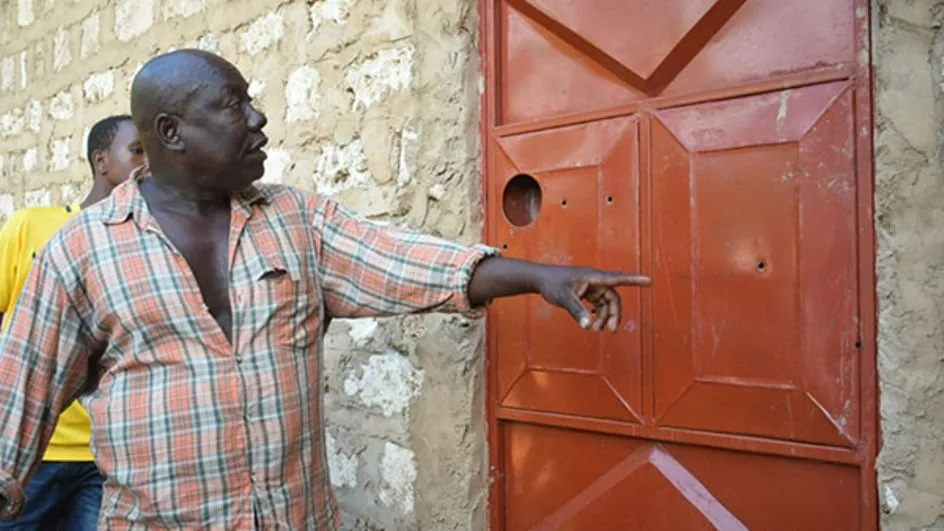
<img class="i-amphtml-intrinsic-sizer" role="presentation" src="data:;base64,” alt=”” aria-hidden=”true” />Mohammed Hamisi, a neighbour and relative of Mohamed ‘Modi’ Mwatsumiro, shows reporters bullet holes in the door to Modi’s home after the RRT raid in which he was killed. A firearms expert consulted by Declassified determined they were entry holes. (Photo: Nation Media Group / Wachira Mwangi)
A covert war
The commandos who raided Modi’s home belong to the Rapid Response Team (RRT), a clandestine ‘special team’ of the Kenyan paramilitary General Service Unit’s Recce Company. The RRT was set up, equipped, trained and is guided on tactical counter-terror operations by America’s Central Intelligence Agency (CIA), a Declassified investigation can reveal.
The secretive Kenyan team is informally known as the Rendition Operations Team and is composed of around 60 police commandos.
The CIA’s covert programme, which began in 2004, is managed by a paramilitary liaison officer at the US embassy in Kenya’s capital Nairobi, but has until now successfully avoided public scrutiny.
Based on interviews with over two dozen CIA, US State Department and Kenyan intelligence, paramilitary and police officers, this investigation has found that in its 16 years of operation, the CIA-backed team has been responsible for the capture of high-value terror suspects, as well as rendition operations, killings and alleged summary executions.
The creation of the RRT was “an indigenous solution to an indigenous problem”, a former senior CIA counter-terrorism official told this investigation. “Our leadership at CTC [CIA Counterterrorism Center] and others felt that setting up these units was important: it was something that gives value to the partnership and it puts a unit under our control for when we have targets that we feel need to go down.”
Often, the paramilitary team’s raids are driven by intelligence provided by the CIA itself, as well as Kenya’s National Intelligence Service (NIS). However, multiple current and former US and Kenyan diplomatic, intelligence and police sources said that Britain’s Secret Intelligence Service (SIS, better known as MI6) plays a key role in identifying, tracking and fixing the location of targets, as well in decisions determining their fate: kill or capture.
The American and British governments provide covert support to Kenya in order to help it defeat al-Shabaab, an al-Qaeda-linked group that has carried out dozens of deadly attacks in Kenya. Its most high profile atrocities have been on Nairobi’s Westgate shopping mall in 2013, where itkilled 67 people and on Garissa University in 2015 whichkilled 148.
Al-Shabaab and its sympathisers are also behind a number of high-profile abductions and attempts to kill foreign dignitaries, including a plot tobomb then-Secretary of State Hillary Clinton during a visit to Kenya in 2009.
Former deputy chief (operations) of the CIA’s Counterterrorism Center, Henry Crumpton explained the nature of the war on terror in Kenya. “It’s a different type of conflict, a different type of war. And it is intelligence-driven.”
Crumpton, who led the CIA’s war in Afghanistan in 2001, continued, “I think that’s why the CIA really has had the lead in many areas, long before any others, because the CIA was there and the CIA was providing value to those partners and the operations, whether they are diplomatic or law enforcement or military, even economic, all those instruments of statecraft, they’re all informed and driven by the intelligence. That’s the foundation for this conflict.”
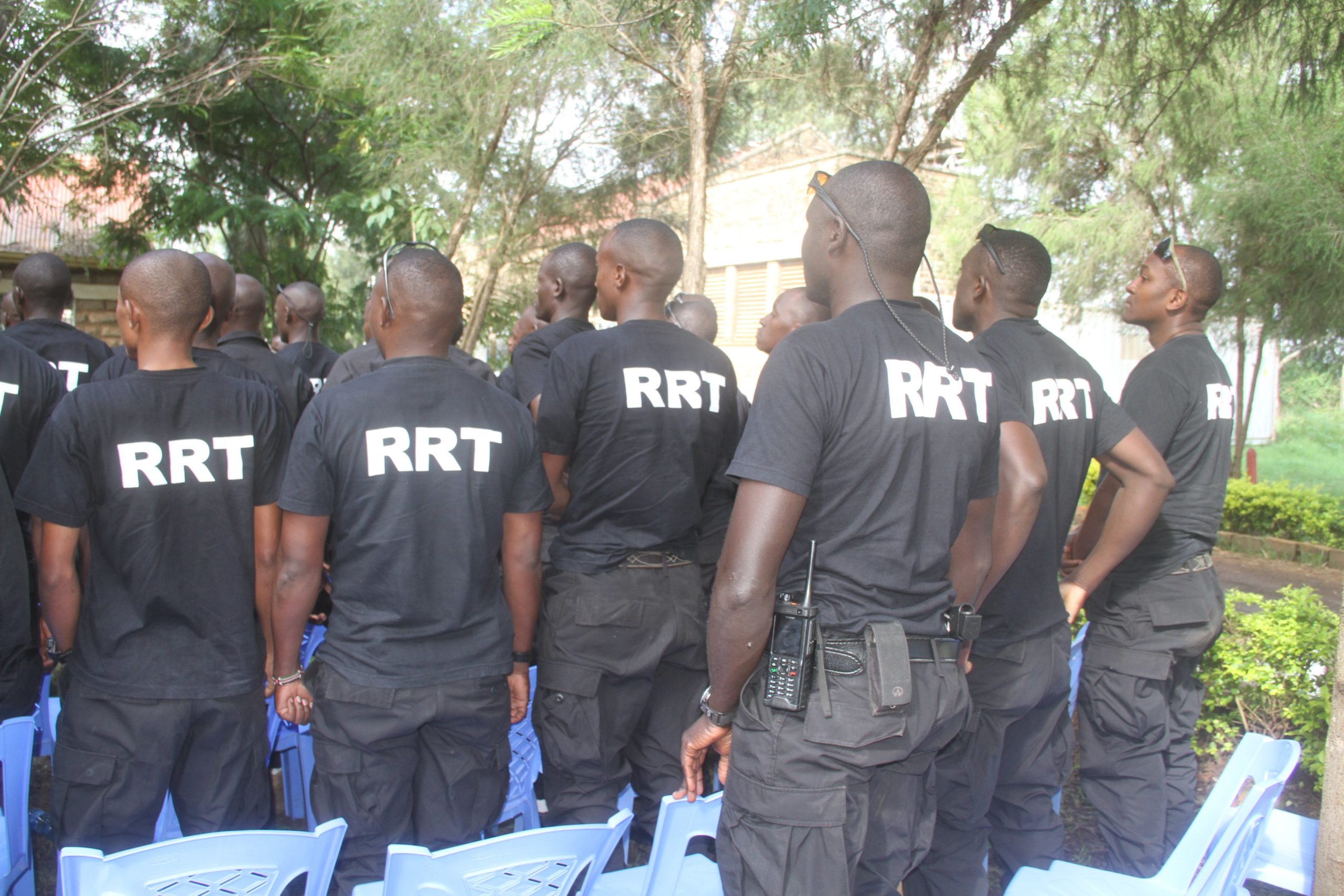
<img class="i-amphtml-intrinsic-sizer" role="presentation" src="data:;base64,” alt=”” aria-hidden=”true” />CIA-backed RRT paramilitaries participate in a Christmas ceremony in 2019 during a visit from the Kenyan police Inspector General and other senior police officers. (Photo: Kenyan National Police Service)
A former senior US official based in Africa with knowledge of US-Kenyan counter-terrorism operations said that the same agencies, CIA and MI6, also determined the fate of the target. “It’s the intelligence services identifying the threat, figuring a way out to mitigate the threat, figuring out that this is going to be a law enforcement end state [capture] or not [kill] and then dealing with it”.
The decision around the fate of a given target would be decided “between us [the CIA] and your guys on the intel side [MI6]”, the former US official continued. “We had these conversations about ‘what are we going to do with this [or that] guy?’. You know given these set of facts, what can we do with these guys?”
Modi’s post-mortem report references seven gunshot entry wounds from RRT fire: two to his left elbow, another in the right forearm, two in his chest and a further two gunshots wounds in his left upper jaw, with exit wounds in his lower jaw.
“We knew him,” Modi’s neighbour Ali Matete told reporters the day after the killing. “He conducted his prayers here, in this area, and in our mosque. But we do not know what he did. When we saw the incident today, we asked ourselves [what is going on] because we’re in darkness.”
Just over a month after Modi was killed, RRT paramilitaries were in action again, in a dawnraid on a house in neighbouring Mombasa county. Police alleged the men inside were linked to Modi and had planned to launch terror attacks. After another alleged “shootout” the three suspects emerged in body bags.
While the precise number of RRT kill or capture raids against terror suspects is unknown due to the clandestine nature of the force’s operations, Declassified has investigated over a dozen cases.
In many instances, suspects raided by the RRT have ended up dead, with a police spokesperson subsequently claiming the target was armed and dangerous. But this investigation has also found cases of mistaken killings and alleged summary executions.
Khelef Khalifa, chair of Kenyan human rights organisation Muhuri, said: “When these extrajudicial killings happen, Muslims feel they are under siege because they cannot comprehend why the government cannot arrest these people and take them to court, instead of killing them.”
Intent on remaining in the shadows, once suspects are “neutralised” – killed or captured – the plainclothes commandos of the RRT hand control of the operation to local police; typically Kenya’s Anti-terrorism Police Unit (ATPU). In doing so, the RRT successfully avoids scrutiny – let alone accountability – for operations now spanning over a decade.
So, too, does its American backers.
“The present government targets [people] in extrajudicial killings. And takes out people in Mombasa, like Rogo,” former Kenyan vice president, Kalonzo Musyoka said, referring to the late cleric Aboud Rogo who was killed by an unidentified hit squad in 2012. Police reports after Modi was killed claimed he had been radicalised by Rogo.
Describing the killings as “unconstitutional”, the former Vice President added: “This has spread bitterness…but because we are doing the bidding of the West in the war on terror, they are allowed to.”
RRT commandos and their American backers stressed that the Kenyan force is not strictly a ‘kill team’ in the way ‘Tier 1’ special force units, such asDelta Force andSeal Team 6, can and do receive express orders to take out targets. “It’s not the same as having Seal Team 6 go after a target…[but] it’s not like it’s going to be investigated if it ends up in a military end-state [killed]”, the former senior US official explained.
However, in a case investigated by Declassified, an officer confided that the unit was explicitly tasked to “eliminate” a high-value terror suspect, only to wrongly kill a family man. In two other cases, witnesses say the suspects were killed by RRT commandos without any armed resistance.
The former senior US official added, “There’s never a real investigation by the Kenyan government. They don’t want to get to the bottom of it. It’s just not going to happen.”
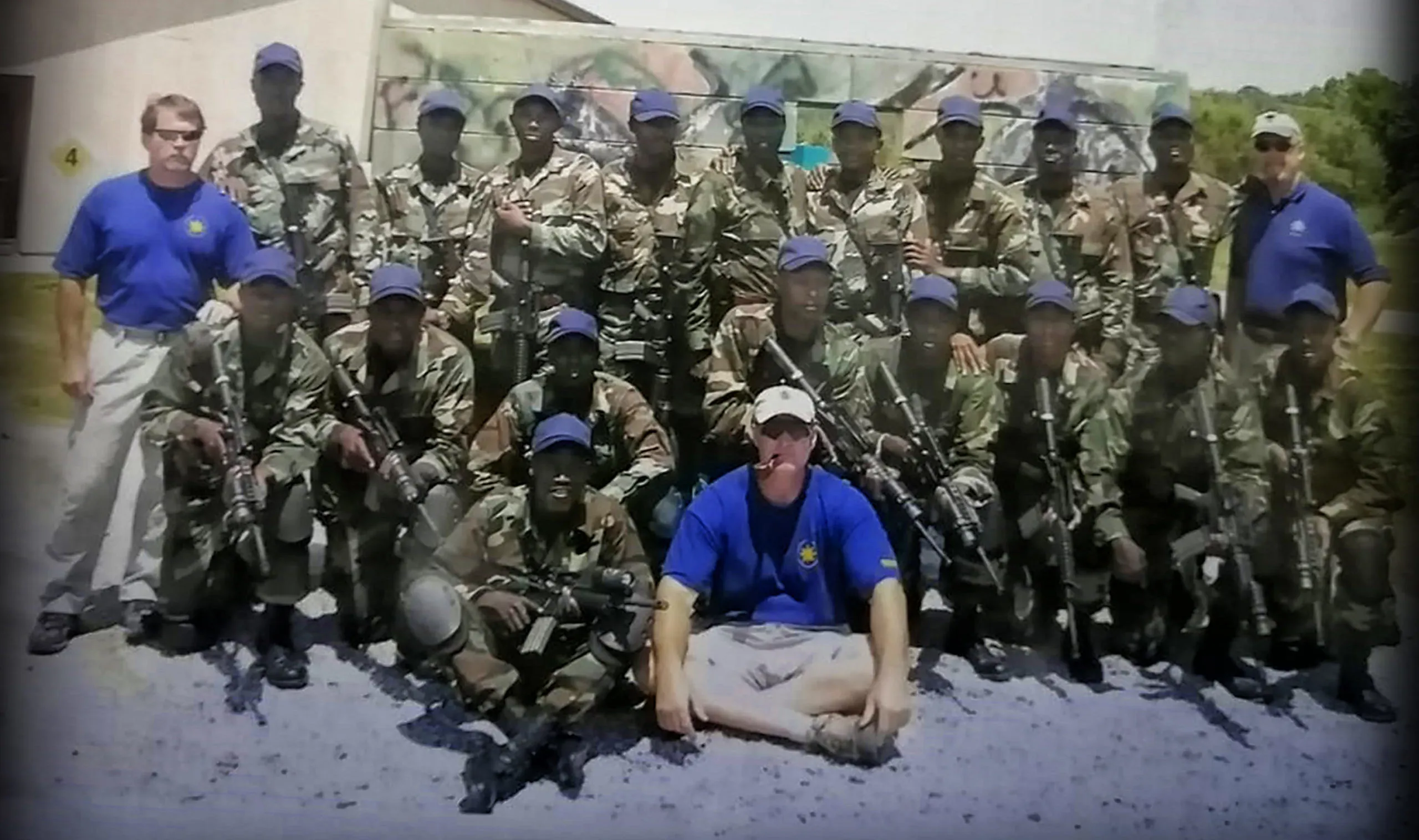
<img class="i-amphtml-intrinsic-sizer" role="presentation" src="data:;base64,” alt=”” aria-hidden=”true” />“Team 18”: the first crop of recruits undergoing their CIA-sponsored training in Rendition Operations at a US training facility in 2004. Their American paramilitary trainers called themselves Mr. Bad, Robin and Nick.
Mistaken killing
Defenders of the RRT say it has been instrumental in neutralising the threat from al-Shabaab. While the Kenyan and international press have made no mention of the RRT’s central role in counter-terrorism operations, multiple US and RRT sources confirmed that the CIA-supported team played a lead role in successfully neutralising the Garissa and DusitD2 attackers.
In another pre-dawn raid in Kenya’s coastal town of Mombasa on 28 October 2012, Omar Faraj and his wife woke to banging on their front door. Fearing that a family member had come to deliver bad news about his sick mother, Faraj rushed to answer. But before he unfastened the lock, he realised from the sound of the visitors’ voices that they were strangers.
“Open up,” the men outside demanded.
Thinking they were robbers, Faraj called his neighbour, who told him that the men were, in fact, heavily-armed plainclothes police. Unsure of what to do, Faraj, who worked as a cashier at a local butcher and as a part-time Islamic preacher, turned to his wife. She urged him not to open the door.
“He was a religious person and the Kenyan government goes after religious people,” Faraj’s wife Rahma Ali said. “Several people had died in such scenarios. I thought he’d be killed.”
Mombasa had already witnessed a string of unexplained killings of radical Muslim figures. Two months prior to Faraj’s killing, unknown assailants gunned down the radical cleric, Aboud Rogo, sparking three days of riots.
The raid that unfolded at Faraj’s home was reported as being by Kenya’s ATPU, but this investigation has learned that it was in fact led by the CIA-supported RRT.
According to a Kenyan officer briefed on the operation, on the night of the raid the team was, in fact, hunting for Fuad Abubakar Manswab,the alleged mastermind of a foiled 2011 terror attack in Mombasa, whom authorities believed to be hiding in the neighbourhood. Manswab was thought to be “armed and dangerous and someone who can engage and kill,” the officer said, noting that “he escaped a prior operation with a wound”. So the RRT were instructed to “eliminate” him.
But the Kenyan officer, corroborating further accounts obtained by Declassified, recounted how an intelligence informant mistakenly led the paramilitary team to Faraj’s home, believing that Manswab was there. “The operation’s target was somewhere else, but there was some mix-up and they headed to the wrong house,” the officer said.
Unaware they were targeting the wrong home, the commandos broke down the door and fired tear gas inside. Faraj took his wife’s hand as they climbed out of their bedroom window, hoping to scale their neighbour’s wall and reach the safety of his brother’s nearby home. They never made it.
Faraj’s wife, Rahma Ali, remembers watching the commandos open fire on her husband, who was balanced on a flowerpot trying to climb the wall. They hit him in the temple, and he fell back on top of her, blood streaming from his head.
Fearing that the commandos would kill her too, Ali, who was covered in Faraj’s blood, says she played dead next to him. In plainclothes but, according to Ali, sporting body armour and M4 carbines supplied by the CIA, the operatives approached and stood over the couple, surveying their kill.
As she lay terrified on the floor, Ali heard one of the commandos say they should make sure she was dead. But the man’s superior overruled him, declaring, “We’ve finished the job.”
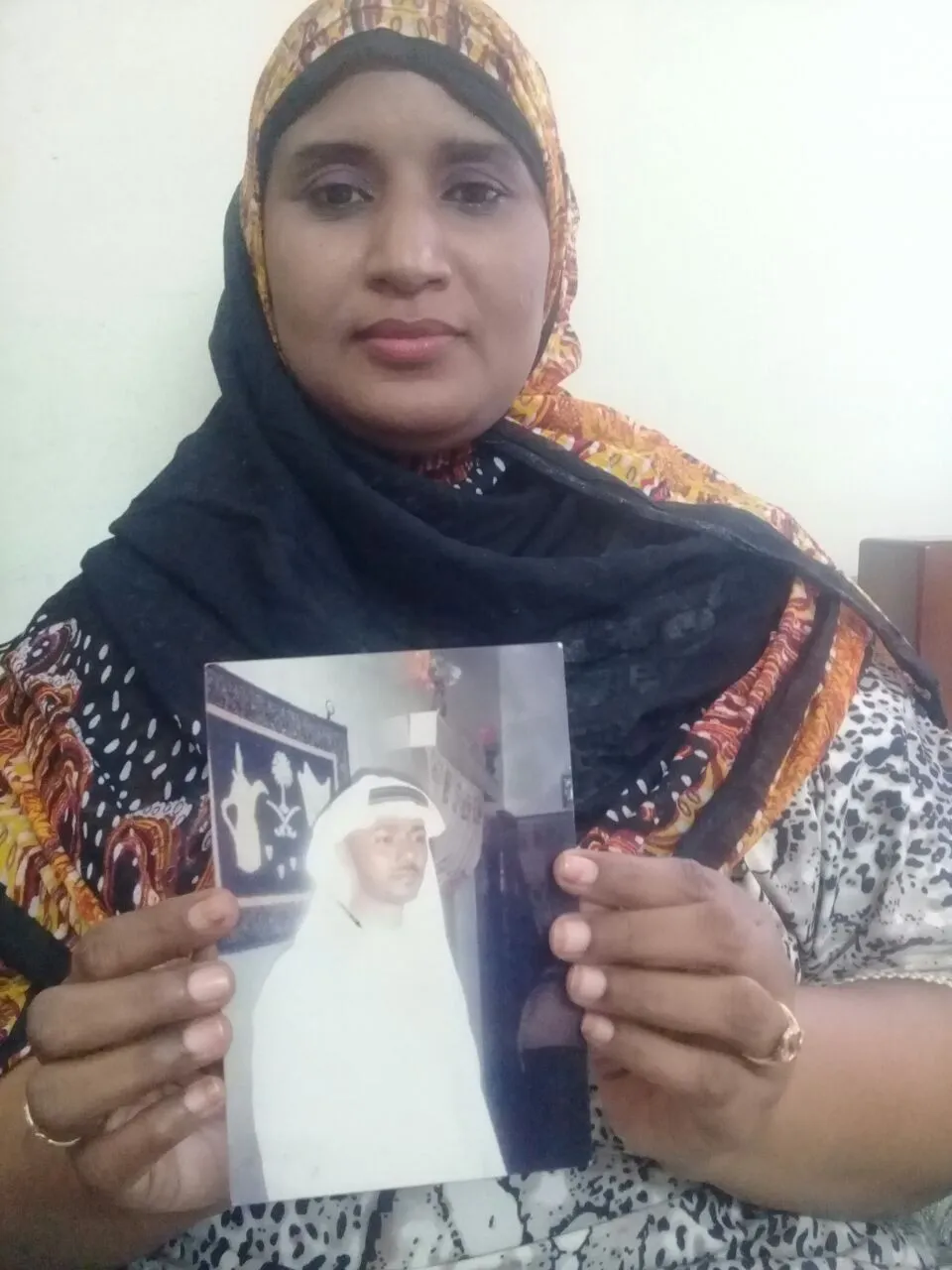
<img class="i-amphtml-intrinsic-sizer" role="presentation" src="data:;base64,” alt=”” aria-hidden=”true” />Rahma Ali holds a photo of her slain husband, Omar Faraj, taken on their wedding night. (Photo: Namir Shabibi)
Kill or capture
Faraj’s killing epitomised a shift in RRT priorities. Initially designed and trained to capture terror suspects for detention, interrogation and possible rendition to other countries, its objectives appear to have shifted mid-way through President Obama’s first term in office, at a time when suspects in Kenya became harder to capture.
“In the days before, these guys [terror suspects] were never violent and never armed”, explained a former ATPU officer who shadowed RRT commandos on multiple tactical operations. “So it was not hard to arrest them. It’s only after 2011, when Kenyan forces went into Somalia and Kenya became a legitimate target, so they are always armed. They brought a lot of arms into Kenya…[and] they can really give a good fight. So that is where the use of the Recce [RRT] came in.”
By 2011, America’s preferences for dealing with terror suspects had already been embraced in the war in Afghanistan in the form of the Joint Prioritised Effects List (JPEL), a US-UK secret list of priority targets designated for kill or capture, the former senior US official based in Africa said.
Describing JPEL targets as a list of problems to be “eliminated”, the former official continued, “That’s the mentality that carried over. I’m sorry to say, and it sounds obnoxious to say it, but it’s something we did there [in Kenya].”
Current and former members of the RRT stressed their objectives prioritise capture over killing. However, they all confirmed that any perceived threat or resistance from targets is to be met with lethal force.
“I don’t have to shoot if I don’t see your hand”, a RRT officer said, describing the team’s rules of engagement. “Because the hand is the most dangerous part…But if you have something in your hands, I don’t have to spare you because you mean danger to me.”
The senior US official familiar with RRT operations explained that the team’s tactical operations against terror suspects – surprise raids under the cover of darkness – did not always afford the “the good guys” a chance to be arrested, as in Faraj’s case.
“When they [RRT officers] say that the goal is to arrest, it’s to arrest somebody like a Louisiana parish sheriff would arrest somebody”, the former US official said, referring to Louisiana police’s reputation of being a law unto itself. “They [RRT] do have the ability to make an arrest but…the good guys don’t always stop exactly when most people think they should stop.”
Some RRT members provided a starker account.
“When we were trained on threats, we were taught human rights come later. If you have this bad guy and you cannot get him for interrogation then you’d better execute [him]”, said one of a dozen current and former Kenyan paramilitary officers who spoke on condition of anonymity.
Three ATPU officers – one former and two still serving – who had flanked the RRT on tactical operations echoed the description of RRT mission objectives. “You know the Recce Company [RRT] have been trained to take out suspects,” said a serving officer. “Their mission is just to take out suspects. You know they don’t investigate. They just identify the target, neutralise the target and then they go back.”
Sometimes, though, targets are taken alive. In 2010, Kenyan police kidnapped and rendered the suspected militants behind the al-Shabaab-inspiredbombings of a rugby club and restaurant in Kampala, Uganda, to face interrogation by American, British and Ugandan agents. Though Kenya’s ATPU was widely blamed for the renditions, multiple police and paramilitary sources confirmed that RRT operatives undertook some of them, in addition to renditions from Somalia in the years before.
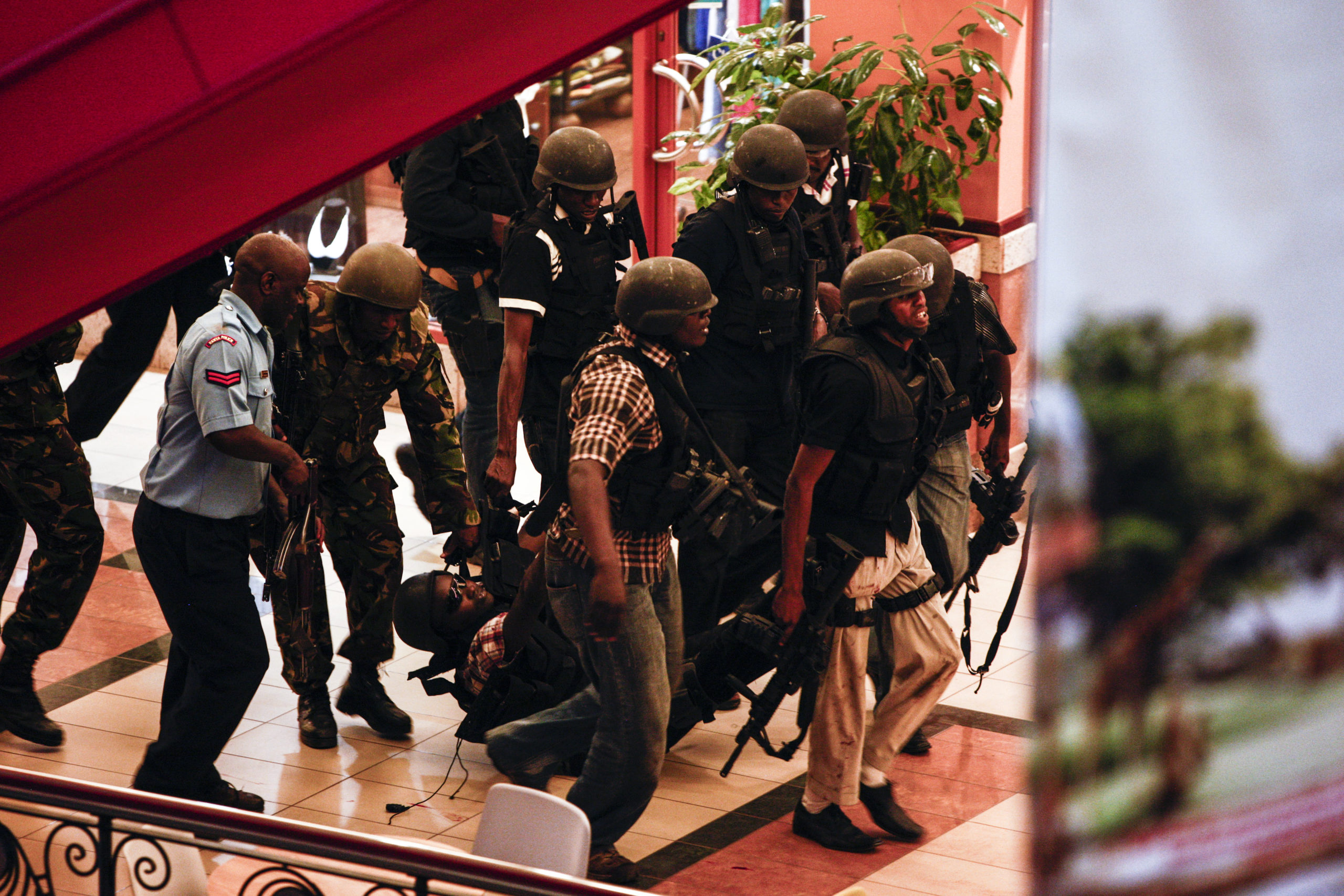
<img class="i-amphtml-intrinsic-sizer" role="presentation" src="data:;base64,” alt=”” aria-hidden=”true” />Recce Company officers help an injured man inside the Westgate shopping mall in Nairobi, Kenya, 21 September 2013, during an attack by Somali terrorist group Al-Shabaab. (Photo: EPA/Kabir Dhanji)
One RRT officer recalled a US-sponsored rendition operation to Uganda. RRT operatives captured the suspect in Nairobi, drove him overland to the western border, and then handed him over to their Ugandan counterparts. The officer recalled strong interest in the case from the RRT’s CIA handlers, explaining that “they even gave us fuel for the vehicles and our upkeep all the journey”.
But more often, RRT members set out on operations knowing the target will never be interrogated or tried. Such outcomes suited decision-makers back in Washington, according to the former senior US official based in Africa. “There’s one stat that counts more than convictions. And that’s neutralisation of a criminal organisation.”
As with the renditions, journalists and human rights activists have long blamed the ATPU for extrajudicial killings of terror suspects. But former and current US officials with knowledge of Kenyan counter-terrorism, as well as RRT officers, confirmed that the ATPU has neither the capacity, weaponry or close-quarter battle skills to undertake high-risk raids.
Additionally, the CIA has no direct relationship to the police unit; as such it cannot be tasked with neutralising high-value terror suspects. Instead, the ATPU plays an investigative role, either by claiming the arrest or handling the crime scene.
“Those guys [RRT] are highly trained and they are serious about things”, a former ATPU officer said. “Any suspect, even the amateurs, who we believe to be armed – they [RRT] are the ones to get in and neutralise [the target] then they leave us to do the investigations and collection of evidence. ATPU takes a back seat in high risk or high-value operations.”
Astudy by the Independent Medico-Legal Unit, a non-profit organisation that monitors misconduct by law enforcement, recorded 1,873 gun deaths in six urban areas in Kenya between 2009 and 2014. It found Kenyan police were involved in nearly two-thirds of the cases, many of them execution-style killings.
More recent IMLU figures show a decline in extrajudicial executions in the last five years but they still amount to over 100 per year.
The RRT does not account for the bulk of these alleged extrajudicial killings in Kenya, both US officials and RRT officers stressed, since its role is dedicated to targeting high-value or high-risk terror targets. But when suspects disappear or turn up dead, the Kenyan government rarely undertakes a formal investigation.
According to Maria Burnett, former East Africa director for Human Rights Watch, out of hundreds of extrajudicial killings that have taken place during counter-terrorism operations in recent years, “only a small handful” had been seriously scrutinised.
In Faraj’s case, the Kenyan government never acknowledged its role in his death, instead claiming that security forces killed “terrorists” after being fired upon. It was similarly unabashed about the fate of Titus Nabiswa, the police informant who led the commandos to Faraj’s house that night and whose body was later found dumped, killed by a gunshot wound to the head.
The US hand
Housed at a secretive base in the town of Ruiru, roughly 30 miles east of Nairobi, the ranks of the Rapid Response Team (RRT) have thinned in recent years as some members have decamped for Kenya’s burgeoning private security sector, which offers better pay and working conditions.
To counter these temptations, the CIA’s paramilitary liaison to the RRT providesregular financial support, including allowances for operations and bonuses for successful missions. This is designed to supplement the low wages of Kenyan police officers who make as little as $115 per month. Injured operatives are given cash payouts and treatment at Nairobi’s private Aga Khan hospital. RRT officers call these “motivation packages”.
While the amounts have varied over the years, RRT officers confirmed receiving the equivalent of a 30% “boost” to their salaries per month, paid for by the US embassy. “For a constable KSh 5,000 (US$46) is a huge amount of money”, one RRT officer said. “You could educate your child”, he added.
The RRT also receives weapons and equipment from the CIA. Initially supplied with M16 assault rifles, then M4 carbines, they have also received Glock pistols, M79 grenade launchers, body armour, helmets and M67 and Stinger CS grenades.
The RRT’s operations appear to need sign-off from the US. Multiple RRT sources independently confirmed that the team is not to be deployed by its Kenyan command for tactical anti-terror operations without the knowledge and consent of its US embassy handlers. The exceptions are for rapid response to high-profile terror attacks, such as the Westgate mall and DusitD2 attacks, and for the diplomatic protection of foreign dignitaries.
“You know, those teams are owned by their [US] trainers…They are the equippers, so they are like their bosses now. So if there is anything, they [the US] communicate direct: ‘We need this to be done’”, a Kenyan paramilitary officer with knowledge of the US embassy liaison relationship said.
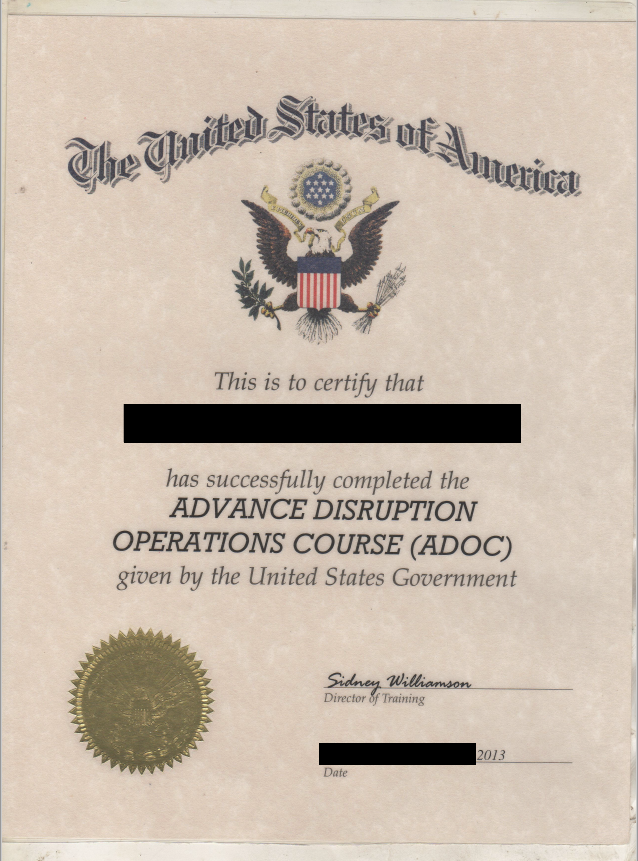
<img class="i-amphtml-intrinsic-sizer" role="presentation" src="data:;base64,” alt=”” aria-hidden=”true” />A training certificate issued to an RRT commando who underwent the CIA-organised Advanced Disruption Operations Course in 2013.
Since 2004, the CIA has paid for RRT commandos to fly to the US for SWAT-style training in rendition and disruption operations, including reconnaissance and surveillance, storming a building, close-quarter battle, and weapons handling at locations that include Annapolis Naval Academy in Maryland.
But the US role goes further. The CIA paramilitary liaison, based at the US embassy in Nairobi, is directly involved in planning some of the RRT’s operations.
Occasionally, CIA operatives themselves have participated in operations, US officials and Kenyan RRT officers confirmed. “If they really, really want the results, they will even assist directly,” one mid-ranking Kenyan paramilitary officer said.
CIA paramilitary officers and contractors have also assisted the RRT by conducting surveillance and tracking of a target, either remotely or from a nearby safehouse or vehicle. However, even as they observed operations unfolding, they maintained a careful distance, RRT officers said.
Some areas, such as the slums of Nairobi’s Eastleigh district, would often prove too dangerous for US officers. “You know the Eastleigh area is dominated by Muslim guys. So they would not dare to go there and do that surveillance without the support of armed people”, one officer said.
However, for operations in other parts of Nairobi and in Mombasa, CIA officers on the ground have assisted in planning raids, having conducted surveillance on a target’s dwelling, and provided their position, often by use of mobile phone location trackers. A senior RRT officer said such intelligence support was essential to avoiding detection.
“If we don’t have something to track the phone, we go banging on other people’s houses and it’d cause an outcry, like we are robbers, the officer said. “With that [CIA] support we were able to zero in and locate the exact areas where the targets were and avoid that issue of complaint. Because once we hit the right target, we get whatever we wanted.”
Britain’s role
Working closely with its counterparts at the Counterterrorism Unit of Kenya’s National Intelligence Service (NIS), the CIA identifies suspects and prepares target packages – intelligence and analysis on a given suspect – that include actionable intelligence. Together they decide a given target’s fate in a so-called“disposition matrix” that includes options ranging from arrest to using lethal force, according to the former senior US official based in Africa.
A former RRT officer with knowledge of this coordination with the US embassy explained, “Sometimes we would have them [target lists] in our office: you have dealt with this one, you are remaining with these ones. All that information we are being given by the US government, not the NIS.”
A mid-ranking RRT officer familiar with the target list said it included Jeremiah Onyango Okumu (‘Dudah Black’) and Samir Khan. Both faced terror charges and were disappeared, with Khan’s body subsequently found mutilated. While the officer admitted that his team had arrested Khan on the first occasion, he denied RRT’s involvement in his subsequent disappearance.
In 2015, then CIA director John Brennantold an audience, “We exchange information with our counterparts around the world to identify and track down men and women believed to be violent extremists… Our cooperation with foreign liaison quietly achieves significant results. Working together, we have disrupted terrorist attacks and rolled back groups that plot them.”
In formulating the target packages, CIA officers in Nairobi also work closely with their counterparts at MI6, Britain’s foreign intelligence service, which relies on its long-standing human intelligence network to provide actionable intelligence by finding and tracking targets and infiltrating militant circles.
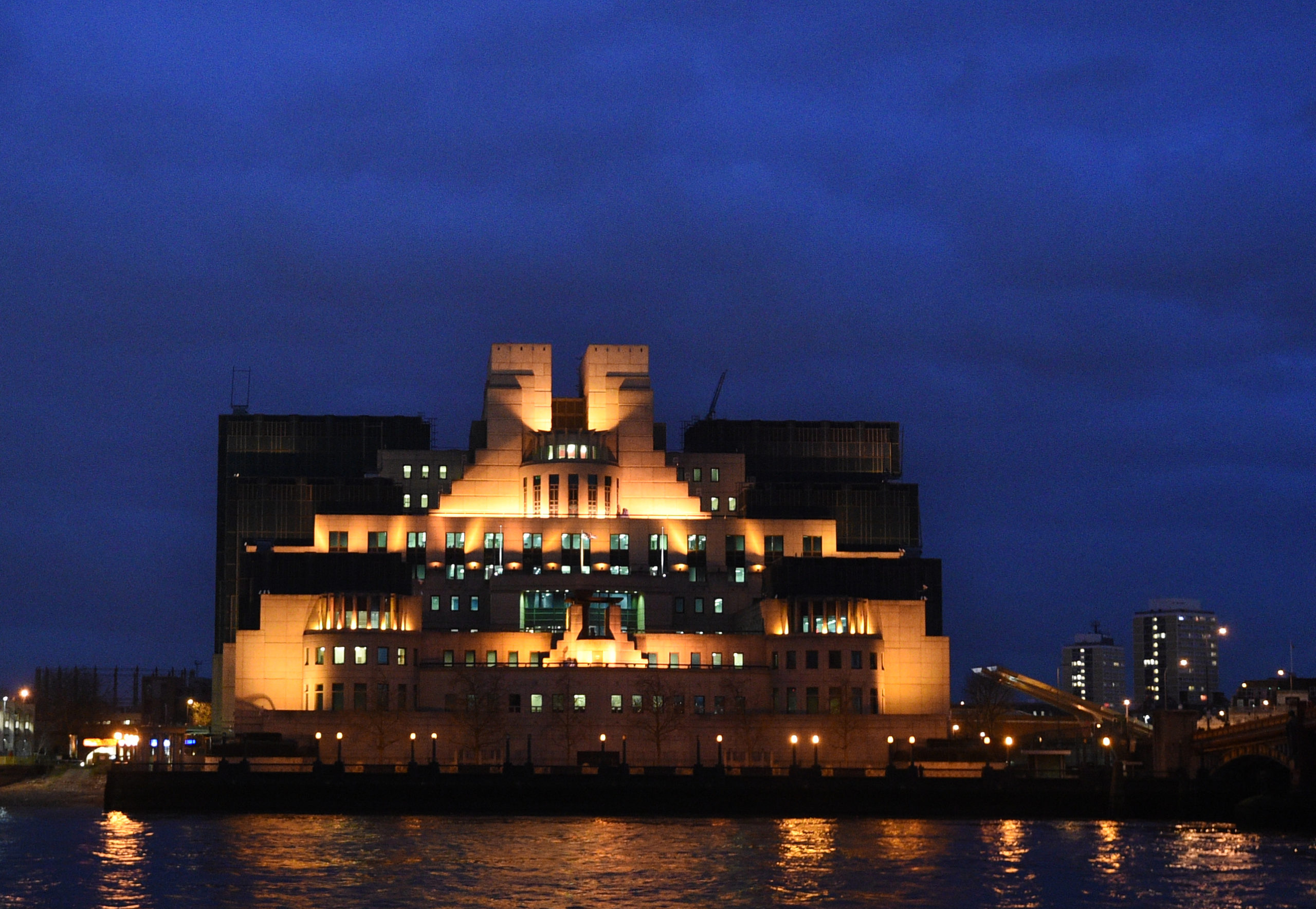
<img class="i-amphtml-intrinsic-sizer" role="presentation" src="data:;base64,” alt=”” aria-hidden=”true” />The building housing the Britain’s Secret Intelligence Service, or MI6, is seen by the river Thames in London. (Photo: EPA / Facundo Arrizabalaga)
“The Brits were worried”, a former senior CIA counter-terrorism official said, noting the influx of British ‘jihadi tourism’ to Somalia, via Kenya, after 2010. “Because they had a lot of British cases and I mean British citizens. In some respect I think the British kids were showing up there before some of our guys, before the American citizens started going to be suicide bombers.”
He continued: “If you’re working with the Kenyans you’re going to want to know about these British guys that are going to be coming to Kenya to get to Somalia”.
As well as long-standing colonial ties to Kenyan tribes and communities, MI6 boasts a specialism in human intelligence, tracking and infiltration operations. Such capabilities are often relied on by the CIA in Kenya and other covert counter-terrorism operations, such as in Yemen, two former senior US officials confirmed.
“We reinforced each other”, a former senior US State Department official said of US-UK counter-terrorism in Kenya. “But the US was very much in the lead and there was good cooperation between us and the UK on the ground. And [Kenya’s] NIS always understood that.”
Echoing MI6’s importance, the former senior CIA official recalled: “I’ve seen them infiltrate. When it comes to human intelligence in CT [counter-terrorism], I think they’re one of the best services in the world in terms of running penetrations of terrorist organisations.”
Leaked US diplomatic cablesshow that for over a decade Kenya’s intelligence service, NIS, has had “primary responsibility for CT [counterterrorism]” in the country. As lead agency, NIS is the principal beneficiary and conduit of the bulk of CIA and MI6’s efforts in Kenya, former senior CIA and State Department officials confirmed.
“They [NIS] were the meat and potatoes of everything we did”, the former senior State Department official said. “The police didn’t have much of an intel capability. Actionable information always flowed through the intelligence service.”
Unlike the CIA, actionable intelligence from MI6 does not reach the RRT paramilitaries directly, but through its CIA and NIS counterparts.
“When the British supply intel, it takes time to get down to us. The Americans come to us directly. They tell us this is what is happening and they have already informed the other authorities so we are given information to go and conduct the operation”, one paramilitary officer explained.
‘ARCTIC’
As well as working with the CIA on target development, MI6 also collaborates with a dedicated team of Kenyan intelligence officers, as part of a liaison cell within NIS’ Counter-terrorism Unit, codenamed ARCTIC, multiple Kenyan and US intelligence officials confirmed. At times, the NIS ARCTIC cell works directly with RRT operatives in finding targets and fixing their location before sending in the RRT.
One of MI6’s targets included British national Jermaine Grant. Grant had sneaked back into Kenya afterallegedly receiving paramilitary training in Somalia and was an associate of British terror suspect Samantha Lewthwaite, dubbed the ‘White Widow’.
As a British national, killing Grant would have focused scrutiny on the relationship between Britain and Kenya’s security forces. So in 2011, RRT officers, guided by NIS ARCTIC agents working in collaboration with MI6, led an operation intent on capturing him, two Kenyan officers familiar with the operation confirmed.
One Kenyan officer explained, “The Recce [RRT] and NIS were ahead of us. They arrested [him], they took away his flash disk and his purse [wallet]. After some time, they brought him to the police station but they didn’t book him in. They came and he was in the boot of the car outside the police station.”
But not all MI6 targets are as fortunate as Grant, who is now serving a 13-year jailsentence in Kenya after being convicted for possessing bomb-making material and using forged documents to obtain Kenyan citizenship.
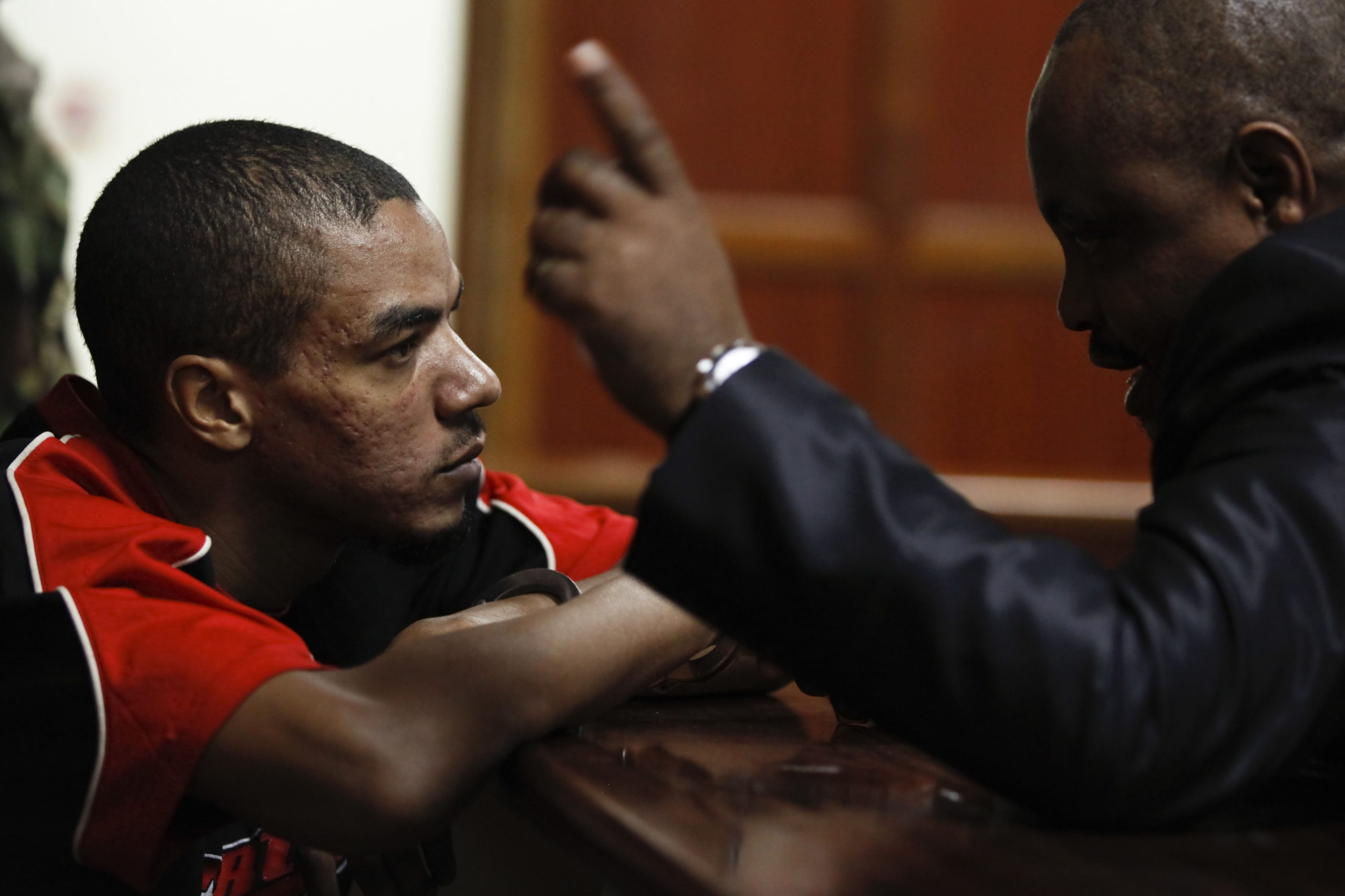
<img class="i-amphtml-intrinsic-sizer" role="presentation" src="data:;base64,” alt=”” aria-hidden=”true” />British citizen Jermaine Grant (L) talks with his lawyer (R) as he sits inside the dock at a courtroom in Nairobi, Kenya, 10 April 2012, following an MI6-ARCTIC-RRT capture operation. Grant is now serving a 13-year jail sentence. (Photo: EPA / Dai Kurokawa)
Two years later, in June 2013, RRT commandos would kill Kassim Omollo, an alleged al-Shabaab trainer, bomb expert and an accomplice of Grant, in another pre-dawn raid. Omollo had allegedly slipped back into Kenya from Somalia and was maintaining a low profile at his family home in Mombasa.
In the aftermath, a Kenyan police spokesperson claimed Omollo was killed after refusing to surrender, stating that hand grenades, a pistol, an AK-47 assault rifle, ammunition and chemicals for making home-made explosives had been recovered.
However, independent investigations report that Omollo, his wife, and their four young children were told: “We were sent to kill you.” After Omollo kissed his son, the officers pulled his children away and proceeded to shoot him in the chest, and then a further three times in the head, a witnesstoldresearchers.
Omollo’s killing was wrongly attributed by the press and human rights organisations to the ATPU, which handled the crime scene after the raid. An officer with direct knowledge of the operation confirmed that, owing to Omollo’s firearms training, an RRT team led the raid, having been guided to his location by the MI6-NIS intelligence liaison cell, ARCTIC.
‘Hands-on’
Oftenit is the CIA’s liaison—an officer in the agency’s paramilitary Special Activities Center (SAC) Ground Branch—who feeds the actionable intelligence to the RRT commandos, either directly or through the NIS.
One former liaison officer was known to the Kenyan operatives as “Matt”, said one RRT officer, who described him as a “down-to-earth guy who would sit with the guys and talk to them”. The officer added, “Matt made us form a family and we were really a family”.
Far from being exceptional, Matt’s approach reflected the CIA’s broader attitude towards its liaison partners, a former senior US State Department official confirmed. “When we support these kinds of units we’re really hands-on. We don’t just hand them the money once a month.”
The RRT commandos who worked with Matt explained that his CIA counterpart would prepare the team through the General Service Unit-Recce-RRT chain of command in advance of orders issued by Kenya’s Inspector General of police.
“We normally had that information ahead of time, from Matt or the NIS guys… We agreed on the number of people [to deploy] and then he [Matt] would drop the finances and tell me to wait until the time it’s official from the bosses. The Americans are the same people giving the information to NIS so we would work as one team,” the RRT officer explained.
Describing the CIA liaison’s hands-on approach tothe RRT,another former Kenyan commando explained, “They will spearhead everything. They will do an operation plan, share that with you, [then] they will come take you down, sit you through it.” After the operation, he added, “they debrief you and then they’re gone.”
Five current and former senior US officials with knowledge of the CIA programme told Declassifiedtheir support was key to ensuring the RRT’s professionalism. It “gave a lot of incentive for guys to want to be in that unit and stay,” said the former senior CIA official familiar with counter-terrorism operations in the region.
RRT members, he added, receive “top-tier training from some of the best operators in the world – legends in special forces – and then you get a [financial] bonus for being on call and being part of that unit.”
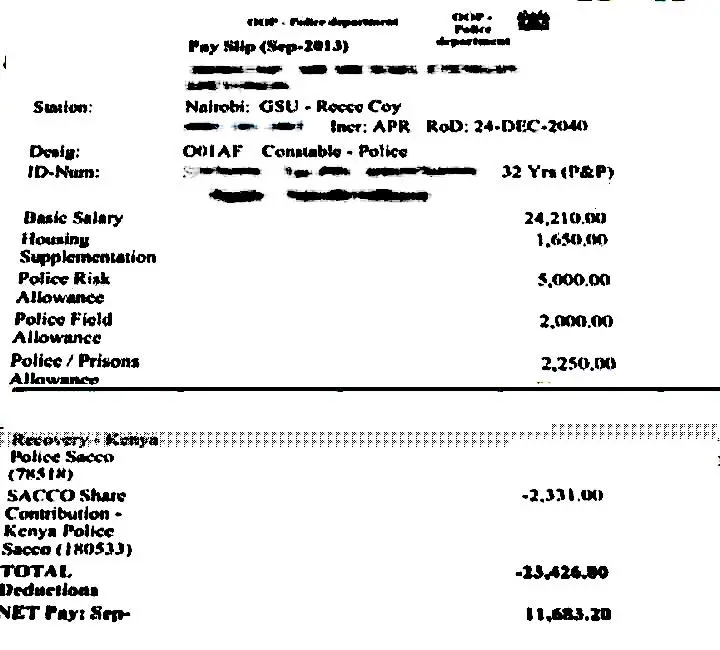
<img class="i-amphtml-intrinsic-sizer" role="presentation" src="data:;base64,” alt=”” aria-hidden=”true” />Payslip of a Recce Company commando dating to September 2013, showing the equivalent of around US$150 per month after taxes. (Photo: Boniface Mwangi)
During one raid, in Likoni, Mombasa in October 2012, RRT commandossurroundeda residential compound with two terror suspects inside. Officers demanded the suspects open the door, but one responded by hurling a hand grenade, killing an RRT commando and seriously injuring the officer commanding. It was the first time an RRT officer had been killed in a tactical operation.
What followed underlined the strength of relations between the US embassy and the commando team. The CIA liaison at the time, “Matt”, covered the cost of the injured officer’s six-week treatment and convalescence at the Aga Khan hospital, paying him multiple follow-up visits, officers confirmed.
On top of this, the injured officer received a one-off payment of 120,000 Kenyan shillings (then worth approximately US$1,400) from Matt, over ten times the officer’s monthly wage. “That person would know someone else is feeling his pain,” an RRT officer said.
Commenting on US support to the RRT, former US ambassador to Kenya, Michael Ranneberger, who left office in 2011, said, “That kind of support is critical to making them a professional force. If you’re really trying to set up a professional unit that will respect human rights and be effective in carrying out its operations, our support is critical.”
While neither the US government nor the US embassy in Nairobi has previously commented on its role in supporting the Kenyan commando team, former CIA director John Brennan did admit to knowledge of abuses by partners.
Responding to concerns raised by US Senator Ron Wyden over the CIA’s support to abusive foreign security forces in 2015, Brennansaid: “We strive to identify and, where possible, avoid working with individuals whom we believe to be responsible for such abuses. In some cases, we have decided to continue those relationships, despite unacceptable behaviour, because of the critical intelligence those services provide, including information that allows us to disrupt terrorist plotting against the United States.”
However, members of the secretive Kenyan team say their American handlers have done little to hold it accountable. Moreover, targeted killings, rendition operationsand other tactics barred by Kenyan law became routine for the unit, whose operational tempo increased dramatically after Kenya’s 2011invasion of Somalia provoked a wave of domestic terror attacks.
Avoiding detection
For 16 years, RRT operatives have managed to avoid detection and public scrutiny. Multiple RRT officers, who operate in plainclothes when on tactical counter-terror assignments, admitted using unmarked cars hired from private companies and swapping between private or unregistered number plates, in order to avoid identification.
A single RRT vehicle typically carries at least three plates which are swapped at least once on operations, upon departure from a target’s location.
The vehicles used vary but former RRT officers confirmed that the US had supplied a stock of at least six white Toyota Landcruisers (76 model), specially ordered with blacked-out windows and a custom cabin to accommodate the commandos’ needs.
Kenyan officers conducting surveillance in urban areas sometimes also appear in less conspicuous Toyota Premio sedans, while in high value operations, their CIA handlers would occasionally join them but remain at a safe distance in black, fully tinted Landcruiser Prado SUVs (J120 model).
Declassified has also learned that since 2004, RRT operatives have disguised themselves as aid workers when on operation in refugee camps such as Dadaab in eastern Kenya or Kakuma in the northwest.
In Dadaab, concerned by al-Shabaab’s infiltration of the camps, weapons smuggling and attack plans on Kenyan soil, the officers used United Nations World Food Programme (WFP) vehicles and wore WFP t-shirts while posing as aid distributors, as they sought to identify those suspected of bringing in weapons and collaborating with the militant group.
Once the suspects had been identified, and reports filed on the targets, a second team would then be sent in to “mop up” and neutralise the targets, a former RRT officer familiar with the operations said. Declassified understands that the RRT continues to send undercover officers to the camps on rotation.
A UN WFP spokesperson said the agency had no knowledge of the covert operations within the refugee camps. The UNHCR, which administers the camps, did not answer questions as to whether it had any knowledge of or involvement in facilitating the covert operations, instead noting that the Kenyan government retained responsibility for their security. The Kenya Police Service, under which the Recce Company RRT falls, did not answer requests for comment.
In another raid, on 18 May 2013, RRT operatives surrounded an apartment building outside Nairobi, according to an officer with knowledge of the operation. The target and his wife were killed after they violently resisted capture, a police spokesman would claim, and their baby was taken into custody.
The man killed was later named as Hassan Omondi Owiti, a terror suspect the police had allegedly been trailing for months. Also killed was his wife, Shekha Wanjiru.
Four witnesses told Human Rights Watch that the police had not encountered any armed resistance, contrary to the claims of Kenyan police.
But, despite the evidence compiled by the human rights organisation, there has been no known official Kenyan investigation into whether the RRT’s deadly raid was based on mistaken identity, whether excessive force was used in killing Owiti, or why his wife was also killed.
An RRT commando familiar with the incident explained that his squad operated in secret in order to avoid scrutiny and protect the team’s morale. “The work our special team does needs a lot of secrecy. If I expose myself and my team, we will become weak,” he said.
Maria Burnett, formerly of Human Rights Watch saidshe had “long-standing concerns that some Kenyan security forces make considerable efforts to conceal their identity, especially during counter-terrorism operations.” She added: “Such efforts are not only contrary to Kenyan law; they ultimately work to shield perpetrators of abuses from any shred of accountability.”
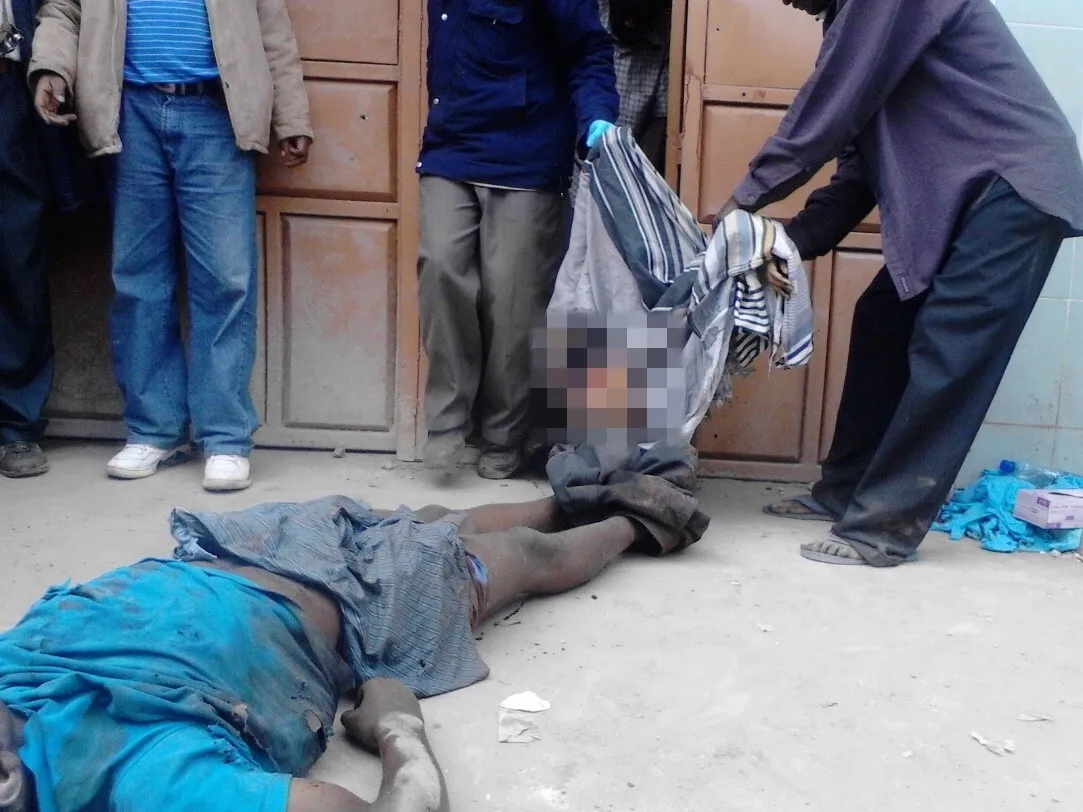
<img class="i-amphtml-intrinsic-sizer" role="presentation" src="data:;base64,” alt=”” aria-hidden=”true” />The body of Hassan Omondi Owiti in the blue t-shirt, and his dead wife, being carried out from the scene of an RRT raid. Pixelation by Declassified. (Photo: Kevin Midigo)
Successes
Current and former senior US officials with knowledge of the CIA programme in Kenya pointed to the RRT’s success in disrupting attacks.
The year 2018 witnessed one of the lowest death tolls from terror attacks in the past decade in Kenya. And while 2019 witnessed a 20% increase in casualties on the year before, the bulk of this difference was due to a single incident: the DusitD2 attack. On the whole, and with significant assistance from the CIA, Kenya has made substantial strides in disrupting terrorism.
However, while al-Shabaab’s attack on DusitD2 claimed fewer casualties than the earlier Westgate and Garissa attacks, expertsdescribed the raid as “representing a new and dangerous phase in the group’s evolution”, since it was the first major operation relying on Kenyan nationals of non-Somali descent.
Capitalising on the DusitD2 attack, in September 2019 al-Shabaab car bombers hit US and European military bases in Somalia. While the operations missed their targets, within two months a group of UN expertsdeclared that al-Shabaab’s use of improvised explosive devices reached its “greatest extent in Somali history”.
For critics of the West and Kenya’s war on terror, recent events are ominous. “We are being hit all the time. Because we are being seen as pro-American, pro-West”, former Kenyan vice president Kalonzo Musyoka said. “It’s not a matter of if, but a matter of when we get attacked again. For as long as we have our troops inside Somalia.”
All US diplomatic and intelligence sources interviewed by Declassified expressed concern about Kenya’s abuses in the war on terror. Nonetheless, former US ambassador William Bellamy, who served in Nairobi from 2003-06, said that American-backed teams like the RRT should be “safeguarded and preserved”.
“That is the kind of CT [counter-terrorism] relationship where you feel your partner is accountable and responsive and where you have some correlation between your inputs and their outputs that you can point to”, he said.
But others say that in addition to flouting Kenyan law, the killings carried out by the RRT — and the culture of impunity it exemplifies — can breed extremism.
“Heavy-handed tactics seem to have become more pronounced in response to the terrorist threat following [the] Westgate [attack],” another former US ambassador Michael Ranneberger said. “All of this, of course, is linked to the culture of impunity, and heavy-handed tactics contribute towards radicalisation.”
Musyoka provided a starker assessment. “Extrajudicial killings push people underground. People say ‘OK, this is how our relatives have been killed. We shall take revenge!’…There is nothing that really radicalises [more] than taking somebody out in a manner that is not in accordance with the law.”
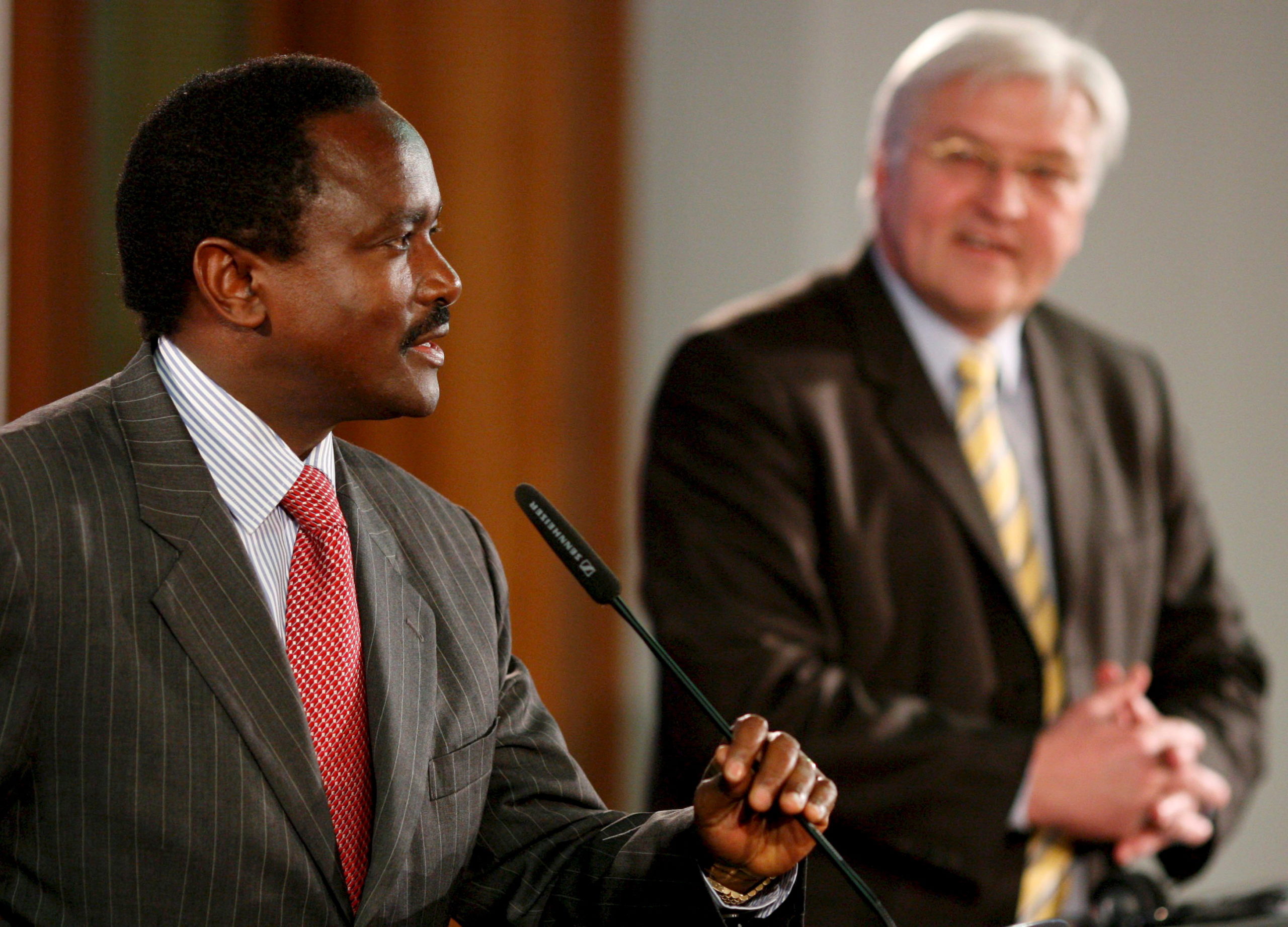
<img class="i-amphtml-intrinsic-sizer" role="presentation" src="data:;base64,” alt=”” aria-hidden=”true” />Kenya’s then Vice-President Kalonzo Musyoka (L) pictured during a press conference at the German Foreign Office in Berlin, 7 March 2008. (Photo: EPA / Soeren Stache)
Khelef Khalifa of Muhuri, which advocates for justice on behalf of victims of the war on terror, expressed similar concerns. “There is a lot of anti-American feeling because of everything they [the Kenyan police] do, people say ‘it is the Americans who fund the police to do this!’ Even when they [the Americans] know something is wrong, they don’t speak up.”
For Omar Faraj’s family still living on Kenya’s coast, every new killing or disappearance is a reminder of the night their son was murdered. In 2019, their region reportedly witnessed 43 extrajudicial killings by Kenyan police, an increase of almost 50% on the previous year.
As an elected member of the county assembly, Faraj’s brother Saad’s status brought him into contact with US ambassador to Kenya, Robert Godec, who departed in 2019.
He says he asked Godec why his government was supporting abusive units such as the one that killed his brother. “He appeared shocked when he heard the news so he gave me his contact,” Saad told Declassified. He says he reached out to Godec but never received a response.
Saad, his voice choking as he fought back tears, said: “If they are truly working to defeat extremism, they need to be sure before they take drastic decisions to eliminate people, because I’ve lost a very important person in my life. The least they can do is to come clean and say they apologise and admit the killing was a mistake.”
Former CIA deputy Henry Crumpton, dubbed a ‘master’ of covert operations, said respect for rights was key to winning the long war. “You’ve got to win allies in this kind of war and human rights abuses have no part in that. When you look at the counterterrorism programme in Kenya, it’s been successful…but I haven’t seen anything about winning the peace, and that is where the policy issue is essential.”
He added: “You can have great covert action, great law enforcement, great military cooperation, but if you don’t have a policy where you think about the long-term, then you’re just going to be engaged in the same operations, in the same districts, in the same border areas, in the same valleys, again and again.”
The US embassy in Nairobi, the Kenya Police Service and the Kenyan Ministry of the Interior did not respond to requests for comment. The CIA declined to comment while the UK Foreign and Commonwealth Office, which oversees MI6, said: “We don’t comment on intelligence matters.” DM
Namir Shabibi is a British investigative journalist who has written and produced documentaries for the BBC, VICE News and The Bureau of Investigative Journalism, among others. He previously worked as a delegate for the International Committee of the Red Cross (ICRC) in Darfur and Guantanamo Bay. Namir’s previous investigation uncovering MI6’s covert war in Yemen can be read here. He can be reached via namirreports[at]protonmail.com and on Twitter @nshabibi.
Declassified UK is an investigative journalism organisation that covers the UK’s role in the world.
This Article Was Originally Published On Daily Maverick.
The Directorate of Criminal Investigations is looking into corrupt deals at key state departments and ministries involving about Sh34 billion.
DCI George Kinoti said Friday the money is linked to scandals at the Ministries of Water and Irrigation and Lands, and the National Youth Service, Kenyan Pipeline Company, National Cereals and Produce Board and the National Health Insurance Fund.
Of the amount, Sh21 billion is linked to the Arror and Kimwarer dams scandal. The others are NCPB, Sh1.9 billion), KPLC Sh470 million, KPC Sh 2 billion and NYS Sh10.5 billion.
The cases are at different stages of prosecution. So far, the Assets Recovery Agency has frozen Sh32.9 million held in former Public Service and Youth Principal Secretary Lilian Mbogo’s accounts and those of her family members, after it emerged that suspects of stolen funds were colluding with banks to withdraw all the money and destroy evidence linking them to the scandals .
“The money was held in 11 bank accounts in her name, Lilian Wanja Munthoni Mbogo, Shara consultants, Lidi Holdings Limited, Lidi Estates Limited. Other bank accounts said to have been used as conduits for looting more that Sh1 billion from NYS were also frozen,” says the DCI, in a new publication.
The quarterly publication, The DCI, was launched Friday at the DCI headquarters in an event attended by Mr George Kinoti, Anti-Terrorism Police Unit chief John Gachomo and Police Spokesperson Charles Owino.
Admitting that the DCI has not met the public’s demand for convictions of corruption suspects, Mr Kinoti argued that convictions, though beneficial, are not a perfect measure of success. He said what is crucial is the recovery of stolen cash and property.
“There has been a lot of sustained pressure on us to get convictions at the end of the proceedings, but the public has not been told the truth — that convictions are just part of the justice system process, which takes time. The other recourse in cases like those of outright theft is recovery of the assets and sacking of the suspects. The greater good is change for the better,” said the DCI.
The publication, a first since the establishment of the directorate in 1924, highlights the directorate’s history and journey of transformation from the Criminal Investigations Department to the DCI, wins in the war against graft and terrorism, tributes to remarkable officers, among other things.
“Crime prevention and detection is at core of the work of the DCI and therefore the directorate has a duty to communicate to the public on how crime can be detected, reported and contained,” said Mr Kinoti.
He said the directorate has been keeping its investigations open amid criticism and condemnation, especially on conviction of suspects.
The pressure to ensure conviction of persons accused of graft has increased in recent weeks following the exposure of the persons alleged to have benefited from funds meant to fight Covid-19.-Saturday Nation.
As the noose on corruption continue to tighten in the country and following the directive by the President to look into the alleged Kemsa scandal, new revelations continue to unravel.
After failing to show up to the senate committee of health last week, the suspended Kenya Medical Supplies Agency (Kemsa) chief executive officer Jonah Manjari appeared before the committee on Friday and dropped a bombshell.
According to the CEO who appears to have decided not to go down alone, he named Health CS Mutahi Kagwe and PS Susan Mochache as having been directly involved in the multibillion-shilling Covid-19 scandal.
Manjari told the committee that the CS and the PS were both following up the procurement of Covid supplies and made calls and texts to him in the effect in what was asserting pressure on him.
The suspended CEO narrated to the senators how the text messages and calls would come – fast and furious – loaded with a lot of pressure directing the medical agency to act in a particular way.
“We received requests from CS Kagwe and PS Mochache mostly through phone calls and SMS to distribute commodities in hotspots. All these things came with pressure,” Mr Manjari told the committee at the Senate chambers.
He also admitted that most procurement of Covid-19-related materials such as PPEs done by the agency around March and April did not follow the correct procedure of tendering due the urgency.
PS Mochache has been accused of directing Kemsa on procurement and firms to award.
Kembi Gitura, the board chairman of the authority which buys drugs for all public health facilities in the country, said Health Principal Secretary Susan Mochache issued the instruction via a letter in April.
“We received a letter from the Ministry of Health containing a list of where we should procure from, the prices and the quantity. I can vouch on the quality of PPEs we procured,” he said when he appeared before the Health committee of National Assembly to shed light on claims of Covid-19 related procurement fraud at Kemsa.
In the letter dated April 15, 2020 addressed to suspended Kemsa CEO Jonah Manjari, the PS claimed that the World Bank had identified and approved various items to be procured by the State agency.
Documents tabled before the committee indicate that several companies including Megascope Healthcare, Tikasan Holdings Co Ltd, KEMA Ltd, Medilab and Applied Products supplied Personal Protective Equipment (PPEs) to the agency.
For instance, according to the document tabled by Kemsa, Megascope supplied face masks worth Sh91.3 million while Tikasan and Applied Products were paid Sh4.4 million and Sh417,000 respectively for various items delivered.
Kemsa owes several Covid-19 suppliers, including F and S Scientific Ltd (Sh25.4m), Chemoquip Ltd (Sh4.1m) and Faram Limited (Sh3.2m).
The State agency told MPs that it is holding stock of PPEs worth Sh6.2 billion, despite majority of healthcare workers lacking the equipment.
The medical supplies agency is on the spot after it procured the N95 (1860) masks at Sh1,300 each against the market price of Sh700.
The agency paid Sh700 for the KN95 mask that goes for Sh450 on the higher side. The agency ordered 1.84 million of the items. The prices should be lower considering that the agency is procuring in bulk for many counties. The disposable 3-ply surgical masks were procured at Sh90 per piece against the market price of Sh50 when bought in bulk.
Migori Governor Okoth Obado, his children and associates could be far more away from catching a breath according to latest developments in their troubles. Detectives handling the case are wrapping up two more charges according to a news report on Saturday Nation.
Obado will face two more charges, abuse of office and procurement irregularities which will sweep across his accomplices. This will add up to the Thursday’s charges including corruption, conflict of interest, unlawful acquisition of public property and money laundering.
Detectives are following up on up to Sh2.5B embezzled funds which are largely linked to Mr Jared Peter Odoyo Kwaga they key proxy and Chief handler of Obado said to have looted the coffers on the governor’s behalf. The investigations are done in phases and
The Thursday charges which is the first, involve Sh38.9 million that Mr Kwaga used to buy a mansion in Nairobi’s Loresho on behalf of Mr Obado, and Sh34.5 that was sent to the county chief’s children.
“That (Thursday charges) is just one component of the investigation. Initially we were looking at a figure of Sh2.5 billion but the investigation was broken down into many components. The overall investigation is more enhanced; we have gone into many other contracts that were awarded,” EACC detective said to SN.
Kwaga is alleged to have incorporated companies using his family members including his mother and brothers to win county tenders using shadowy companies; Misoft Company Limited, Tarchdog Printers, Mactebac Contractors, Deltrack ICT Services, Seletrack Consultants, Dolphus Softwares, Joyush Business, Swyfcon Engineering, Dankey Press, Atinus Services, Kajulu Business Limited, Pesulus Supplies and Victorious Investments.
Investigations revealed that Kwaga transferred kickbacks from these companies to Obado and his children.
Detectives are also investigating the second set of procurement scam in which another shadowy businessman and a close associate of the governor Ernest Omondi Owino together with his associates Elisha Odhiambo, Janet Otieno Awino, Diana Amanda Muma, Peter Namasake, David Maronga and Robert Marube formed eight companies to win tenders in the County without going through the set regulations.
They used Janto Construction, Marowa Stores, Mbingo Enterprises, Migwish Enterprises, New Team Enterprises, Queeno Investment, Ropeda Construction and Sunae Construction to win tenders worth Sh861.8 million between 2013 and 2017.
Misoft Company associated with Mr Kwaga was the biggest beneficiary, as it received tenders worth Sh416 million between 2013 and 2017. Sources tell Kenya Insights that while in the first term the relationship between the governor and Kwaga flourished, the two have been at war with Kwaga clinging to some of the property that Obado had acquired in his name. They’ve been at war.
The Kenya Medical Supplies Authority (Kemsa) exclusively procured Covid-19 related supplies from select firms at pre-set prices on the directive of the Health ministry, the agency’s board confirmed Thursday.
Kembi Gitura, the board chairman of the authority which buys drugs for all public health facilities in the country, said Health Principal Secretary Susan Mochache issued the instruction via a letter in April.
“We received a letter from the Ministry of Health containing a list of where we should procure from, the prices and the quantity. I can vouch on the quality of PPEs we procured,” he said when he appeared before the Health committee of National Assembly to shed light on claims of Covid-19 related procurement fraud at Kemsa.
In the letter dated April 15, 2020 addressed to suspended Kemsa CEO Jonah Manjari, the PS claimed that the World Bank had identified and approved various items to be procured by the State agency.
“This is to approve the procurement of goods worth Sh758, 690,583 as outlined in the annex. Disregard all other requests made in relation to Covid as they have been captured under this approval,” reads the letter from the PS tabled before the committee.
The Health ministry had denied directing Kemsa on the Covid-19 related procurement when its officials appeared before the Parliamentary committee at an earlier date.
Documents tabled before the committee indicate that several companies including Megascope Healthcare, Tikasan Holdings Co Ltd, KEMA Ltd, Medilab and Applied Products supplied Personal Protective Equipment (PPEs) to the agency.
For instance, according to the document tabled by Kemsa, Megascope supplied face masks worth Sh91.3 million while Tikasan and Applied Products were paid Sh4.4 million and Sh417,000 respectively for various items delivered.
Kemsa owes several Covid-19 suppliers, including F and S Scientific Ltd (Sh25.4m), Chemoquip Ltd (Sh4.1m) and Faram Limited (Sh3.2m).
The State agency told MPs that it is holding stock of PPEs worth Sh6.2 billion, despite majority of healthcare workers lacking the equipment.
President Uhuru Kenyatta on Wednesday ordered speedy investigations into the suspected procurement fraud at Kemsa within 21 days. This came a day after the National Assembly’s Public Accounts Committee (PAC) also ordered a forensic audit on the Sh134 billion allocated for fighting Covid-19 amid public uproar over misuse of the funds.
The PAC directed the Auditor-General Nancy Gathungu to audit cover the expenditure period between March 13 when the first case was reported in the country and July 31.
Dr Manjari was suspended alongside directors Eliud Muriithi (Commercial) and Charles Juma (Procurement) to allow for the investigations into claims of procuring Covid-19 emergency kits at exorbitant prices.-BD
The puzzles surrounding the murder of Kevin Omwenga in Kilimani continues to stiffen by the day. In the latest development, detectives have discovered two more guns a pistol a shotgun hidden in a safe in Obure’s office on Senteu Plaza on Galana Road the same office where Ouko had hidden the ceska pistol that was used in the murder.
Mystery surrounding gun possession deepened with reports that Obure had been declared unfit to be issued with a firearm.
Early 2017, the same Mini Ceska that was used in killing Omwenga was confiscated after Obure was found to have misused it by threatening another businessman, Ben Alila.
The police are yet to determine if the two discovered guns were licensed. If not then Obure is likely to face a fresh charge of being in possession of illegal firearms.
Obure had also in 2016 been accused of threatening another man with his firearm while at the Klub House on Ojijo Road in Parklands.
Obure and Ouko are suspected of murdering Omwenga.
Chris Obure Obure is the director of GLO-Jet International, a shadowy aviation firm said to be involved in the transportation of valuables, including gold.
Police are following leads that Obure and Omwenga had a bitter disagreement at a hotel in Upper Hill a day before the fatal shooting.
The deceased had planned to travel to Dubai to cement the fake gold deal that was launched in March and was to fetch Sh120 million. This is believed to be the basis of their disagreement and a reason the detectives are trailing their business links. Obure is a renowned fake gold scammer in town and Kevin had joined.
Ouko the prime murder suspect is Obure’s bodyguard and is believed to have acted on his boss’s command.
Former KPA MD Daniel Manduku who has been facing a myriad of corruption related allegations will finally have his day in court this is after DPP Haji approved the charges against him following a lengthy probe by the DCI.
The DCI had previously said that he had listed up to 22 possible charges against Mr Manduku and other senior port managers over alleged irregularities in projects.
However, what is taking Mr Manduku to court is the awarding of two companies linked to powerful and influential families to construct peripheral cargo storage facilities on behalf of the KPA next to the ICD.
The second accused in the case is the Commissioner of Customs and Border Control at the Kenya Revenue Authority Kevin Safari.
One of the companies that was awarded the controversial tender, the Nairobi Inland Container Terminal Limited (NICT) did not even apply for the tender which was floated towards the end of 2018 in the first place.
The second company — Mitchell Cotts Freight Limited — did not pay for the licence required to operate a peripheral storage facility and only did so realising the DCI had started investigations of how the tender was awarded.
“Daniel Ogwoka Manduku and Kevin Lewis Safari between December 31, 2019 and January 27, 2020 within the Republic of Kenya conspired to defeat justice by causing the payment of Sh3,166,669 for the KPA peripheral facility licence for Mitchell Cotts Freight Kenya Limited in order to correct an illegality in the unpayment of the same,” says count five in the charge sheet.
According to the probe by the DCI, Manduku irregularly awarded tenders and that there was no prior planning before engaging in the project for the manufacture of the concrete barriers.
DCI accuses Manduku of flouting the procurement rules by handpicking 10 firms that he awarded the tenders for manufacturing the concrete barriers.
Juma Fadhili Chigulu a works officer in KPA, has been co accused with Manduku for approving the payments to the manufacturer of concrete barriers.
DCI probe established that KPA made an overpayment of Sh244,837,908.59 to contractors for work not completed. Haji says the evidence is sufficient to successfully prosecute the case and has given it a go ahead.
Manduku and co accused are to be arrested and arraigned in court.
Early last year, Elizabeth, a salon owner in Nairobi, needed business supplies but didn’t have enough money to buy them. She thought she had found an answer when she came across a sponsored post on Facebook from a page called KWFT Loans Kenya.
“I saw the post had a sponsored sign and there was a Kenya Women Microfinance Bank logo. I thought to myself that this is probably the actual KWFT,” she told BuzzFeed News, referring to the Kenya Women Microfinance Bank, a reputable microfinance institution that provides loans to women.
It wasn’t KWFT.
But the page did offer unsecured loans delivered via mobile phone with an annual interest rate far lower than typical personal bank loans in Kenya, which range from 13% to 20%, or the terms offered by unregulated and often predatory mobile loan apps, a popular source of financing used by close to 20 million people in Kenya.
Screenshots via Facebook
Scam ads seen on Facebook
The link brought Elizabeth (not her real name) to a Google Form that asked her for her name and identification card number, a unique ID that Kenyans use for official activities like registering their SIM cards, opening bank accounts, and obtaining government services. She sent what the form called a loan fee of 310 Kenyan shillings ($3) via a mobile transfer to a man named Anthony Muriungi, who claimed to be a “loans agent officer.”
She soon realized she’d been scammed.
“I remember calling them a few times and getting no response. I then realized these were probably conmen, but since I hadn’t lost a lot of money, I let it go.”
A KWFT spokesperson confirmed that it was a scam, telling Buzzfeed News the page didn’t belong to the bank and that it had been warning the public about fake pages using its name. While the company does offer loans, it’s a service it offers through its app and on mobile phones through USSD, no payment is required to either access or process the loans that it gives.
The Facebook scammers weren’t done with Elizabeth.
A few days after paying the fee, she received a call from a person claiming to be a customer service representative with her phone carrier, Safaricom, carrying out a “security check” on her SIM card, claiming it had been damaged. To establish their credibility, the person read out her full name and identification card number and referred to the recent transaction she had made. They asked her to confirm her identity by stating her date of birth, her latest mobile money transactions, and her SIM card’s PIN. That kicked off the second part of the scam, which saw the fraudsters use this bounty of personal information to open a new phone account under her name and take out loans with three different mobile loan providers, destroying her rating with Kenya’s Credit Reference Bureaus.
A Safaricom spokesperson told Buzzfeed News that they were aware of these forms of social engineering, as customers had been reporting cases to them. The spokesperson said Safaricom does not call to ask for personal information from its customers. “We monitor, detect, and take action against any numbers found to be involved in phishing or smishing activities,” they said. “We work very closely with law enforcement agencies in investigation of noted fraudulent activities.”
Simon Maina / Getty Images
But what started as a small scam she dismissed as bad luck left her in financial ruin — because Elizabeth still needed the money.
“Given that I was in an emergency and couldn’t go to a bank for a loan, I ended up at a [loan shark’s] office in the central business district. He charged me about 20% interest in exchange for my laptop as security. I struggled to pay back the amount I had borrowed within a month, but in the end I paid an exorbitant amount just to get my property back.”
Elizabeth was the victim of a long-running, widespread scam that has exploited Facebook’s advertising system to steal money from struggling Kenyans. The country’s economic struggles, its high rate of Facebook use, and an innovative and widely used mobile payment system create the perfect conditions for scammers.
An investigation by BuzzFeed News has identified 52 scam loan and recruitment Facebook pages with more than 245,000 followers, targeting people in Kenya. Some were created as early as 2017; some as recently as Aug. 2. They have titles like “Tuskys supermarket jobs” and “Equity Mobile Loans.” One ad claims “NEW YEAR JOB RECRUITMENT Urgent Mass Recruitment at Tuskys supermarkets. To apply,kindly click on this link to apply.” Another claims, “JOYWO loans give you an opportunity to apply for an Unsecured Online Loan No paperwork No long procedures We are committed to arranging Cash Assistance for Women borrowers and youths living in Kenya.”
The scam pages falsely claim to belong to well-known banks, supermarkets, gas stations, and other companies known to give loans or recruit large numbers of people. They leverage the credibility of real brands to entrap people like Elizabeth into applying for fake loans or for nonexistent jobs that require real fees.
And these ads appear to be working. The Tuskys supermarket fraud, which asked for 350 Kenyan shillings in order to be short-listed for a job interview had 24,772 interactions. Another supermarket fraud, using the Naivas brand name, which requested 370 Kenyan shillings in order to be short-listed for a job as well, had 6,576 interactions, according to analytics data provided by CrowdTangle. In total, BuzzFeed News found 78,936 interactions from the 52 forms. Going by current engagement rates on Facebook, this means that the fraudsters could have reached millions of Kenyans with the help of the platform’s ad program.
Both Naivas and Tuskys supermarkets told BuzzFeed News that the campaigns weren’t theirs. This isn’t the first time such ads had been brought to their attention. In 2017 and 2019, Naivas raised the alarm about the same scam to its customers, letting them know that it only conducts recruitment processes at its head office and not via Google Forms. Tuskys also flagged the ads to its customers 2017and 2018.
In both instances, the comments sections of the cautionary posts reveal a flurry of people who’ve already been ripped off complaining about losing their money to the scammers.
Despite the scale of the rip-offs, those pages remain active. One that purports to provide KWFT loans, different from the one that ensnared Elizabeth, had at least 85 comments from people who said they had been ripped off. It remains online, as do four fake KWFT loan pages that are still active as of this writing.
A Facebook spokesperson in Kenya said the company invests heavily in trying to tackle scams and bad actors.
“We’re putting significant resources towards tackling these kinds of ads,” they said a statement. “It’s important to us that ads on Facebook are useful to people and not used to promote deceptive behavior, like using images of public figures and organizations to mislead people. We remove pages that violate our advertising policies.”
The spread of COVID-19, which has risen to 27,425 cases in Kenya since March 13, inspired scammers to create new variations.
Frederick, another victim who declined to give his real name, is a waiter who lost his job in the wake of the pandemic. He fell for a coronavirus volunteer recruitment version of the scam, where he paid a “registration fee” to get short-listed for a job but never heard back from the recipient. He blamed the legitimate-looking nature of the pages and the desperation of his situation.
“At the time I was really desperate for a job and the cash I sent them was the chunk of the little I had. It’s a shame as you can imagine how many people they have stolen from,” he said.
Noah Miller, a cybersecurity researcher and cofounder of the Sochin Research Institute in Nairobi, said the high usage of Facebook in Kenya has led people to trust it. “Facebook is a trusted zone for communication for many Kenyans. In this environment, people’s first instinct is to trust what they see,” he told BuzzFeed News. ”You will trust it more than an email that comes to you directly, and therefore it’s easier for scammers to get to you there instead of sending you an email.”
But Facebook and its regional partners seem powerless to stop the scams.
“This is a widespread problem that we’ve been facing on Facebook. We have been seeing a lot of these scams,” Shiundu said. “It’s been a game of whack-a-mole with these scammers on Facebook. When we spot one and rate it as false, they open another one and another one. We have basically been chasing them around Facebook.”
The scams have also caught the attention of Kenya’s authorities, who have repeatedly warned of an increase in such scams as COVID-19 has made people more desperate for jobs and loans. Peter Mbatha, a cyber forensics expert at the Directorate of Criminal Investigations (DCI), said when asked during a webinar in June that DCI collaborates with Facebook, but did not say whether or not they work together to combat scams. “The DCI is able to communicate with them, and we can make requests on any criminal aspects touching on individuals who have used their platforms. They usually respond when they are called upon to handle such matters and issues.”
Shiundu said automated systems and algorithms aren’t enough to catch the scammers early on.
“If we leave it to algorithms, which is what they use to flag [content] to fact-checkers, then that becomes slow, algos cannot answer everything and we find a lot of false positives,” he said.
Robin Busolo, a lawyer who handles regulatory affairs at the Communications Authority of Kenya, the body that regulates Kenya’s communications industry, told BuzzFeed News that Facebook had a responsibility to deal with crimes taking place on its platform.
“I doubt whether Facebook can be absolved from their culpability in the case where harm is meted out on their platform,” he said. But he was also frank that “we have no jurisdiction over them.”
That leaves victims of crimes that happen on Facebook like Elizabeth with no hope of seeing it reined in or penalized in Kenya, leaving caution as the only option.
“People need to be careful about how they use these online platforms,” she said. “It’s not as safe as most of us might like to think. What happened to me has probably happened to many vulnerable people, and it could’ve been a lot worse.”
This article was developed with the support of the Money Trail project.
Government Chief Pathologist Johansen Oduor conducted a postmortem on the body of Kevin Omwenga on Monday, 24th August at Montezuma Funeral Home
He revealed that the Omwenga was shot at a close range corroborating with the story given by prime suspect Robert Ouko that the two were close when the shooting occurred.
“He was shot once on the left chest area. The bullet tore through the heart then there was a collapse of the left lung and a lot of bleeding on the left side of the chest.” Oduor told reporters.
Chris Obure and Robert Ouko when they appeared before the court on Monday.
On whether the shooting was premeditated or accidental as said by Ouko in his statement to the police, Oduor couldn’t easily ascertain.
“It is hard to answer (whether the incident was accidental) because that is based on the circumstance. When I look at the bullet, it was a close shot and entered his body at an elevated angle,” said the pathologist.
He further disclosed that Omwenga suffered severe injuries in his heart and lungs and must have died instantly after the shot went off.
A video doing rounds of the lifeless body of Omwenga in his bedroom appears to confirm that he had already died by the time he was being taken to the hospital.
“The bullet exited in his back area after going through his vital organs. It looks like someone who died instantly. With the injury to heart, he had little chance of survival,” he added.
Ouko the prime suspect together with Chris Philip Obure are still being held by the police awaiting their bail hearing today. Police are asking the court to still hold them for 14 more days as they conduct further investigations as releasing them would interfere with the process given that they know the key witnesses.
Homicide detectives are yet to obtain any previous crime records of the suspects, take fingerprints and their DNA samples for analysis. They are also yet to take photo profiling and do mental assessment.
The investigations are also focusing on the ballistic examination of the firearm and obtaining its records from the Central Firearm Bureau.
Detectives will perform phone analysis and forward the same to the Cybercrime Unit at the Directorate of Criminal Investigations for analysis.
The police are also yet to decide on the criminal charges to prefer against the two.
As police continues to unravel the mysteries surrounding the shooting of Kevin Omwenga at his house in Kilimani estate, the prime suspect Robert Bodo Ouko has been cooperating with the authorities who’re piecing up the events of the night.
According to sources, Ouko in his statement claimed the incident was accidental. He said the bullet discharged as Omwenga was handing over the weapon to him.
He told the police that Omwenga was carrying the weapon as they got into the house and they had gone to the bedroom for him to hand over the weapon when the incident happened.
He also told the police that him, Omwenga and his brother in the company of the Tanzanian lady were in Obure’s office which is adjacent to Omwenga’s Galana Suites Apartment before they decided to leave for supper at the apartment. Other reports also indicate that Omwenga and Ouko has been hanging out for drinks before heading to Ngara to pick up the lady.
Ouko says that despite not being licensed firearm holder, Omwenga had asked for the gun and had it in his waist as a show off to his Tanzanian date. Omwenga had just accumulated wealth overnight and bought two exotic cars in 5 months and in cash so he wanted to be seen as a big boy.
When Ouko wanted to leave, they went to the bedroom for Omwenga to hand him over the gun and that’s when Ouko claims he accidentally shot him. On Saturday, the suspect was taken back to the house which is now a crime scene and he demonstrated how the events unfolded.
CCTV footage of the basement showing the car carrying Omwenga to the hospital as Ouko and the mysterious lady remain behind.
Ouko denies having any argument with the deceased. Four others including the Tanzanian lady who were in the house have been interviewed. The police are also following leads over the sudden wealth and his business connections with Chris Obure who’s a seasoned fraudster in town.
Omwenga went from being unable to pay rent in March to living in a Sh150,000 apartment in Kilimani, buying Porsche Panamera and a Range Rover in cash both under five months. They’re also following up on his planned ‘business’ trip to Dubai on Sunday.
Ouko has been Chris Obure’s bodyguard, the two who’re in police custody are expected to be arraigned in court today with the intention of police asking for more time to hold them as they conduct their investigations.
The events of Friday night at the Galana Suites Apartment in Kilimani where Kevin Omwenga was allegedly shit by his co conspirator Robert Bodo Ouko in a fake gold scam gone wrong, were captured partly by security cameras installed in the building.
Omwenga and Ouko who’s a bodyguard to Chris Obure another common fraudster in town and an associate to Omwenga, are said to have gotten into a heated argument over a Sh40M gold deal that they had struck back in March.
The two were arguing in the bedroom before a loud bang was heard. Wycliffe Omwenga, the brother to the deceased said he was making supper before he had the gunshot sound from his brother’s bedroom.
When he rushed to Omwenga’s bedroom, he found him bleeding from the chest. Ouko, who was the only other person in the bedroom, claimed that Omwenga had shot himself.
A mini ceska pistol that was used in the shooting belonged to Obure, it would layer be recovered from his office after Ouko tipped the police. They also recovered 13 rounds of ammunition.
The chronology of events brings a whole bunch of conflicting story with loopholes. And as police piece up evidence to find the motive for the murder, Ouko insists, Omwenga shit himself but how could this happen? Who had the gun? How and why did it end up at Obure’s office.
CCTV footage obtained by Citizen TV shows partly what transpired in the last moments before Omwenga was shot and activities outside as he was getting rushed to the hospital.
On the 7th floor of the apartment, a number of people are captured coming from the elevator to the side of the apartment where Omwenga lived.
At 9:39pm, Omwenga is seen leaving his house with a few friends only to return minutes later at 10:35pm in the company of a young lady. It appears he had gone downstairs to pick her up. Both disappear to his house.
Four minutes later, at 10:39pm, Robert Ouko the suspect, is seen disembarking from the elevator and heads straight to Omwenga’s house.
At 11:22pm, activities takes a new twist, one of Omwenga’s guests is seen rushing to the elevator, pushing the buttons severally and appears to be disturbed and in a panic mode, after four attempts, the doors open and he disappears.
At 11:24pm, Ouko is captured again on the elevator camera seeing off a guest before returning to Omwenga’s house.
CCTV footage of the basement showing the car carrying Omwenga to the hospital as Ouko and the mysterious lady remain behind.
Four minutes later, a frantic Ouko heads to the elevator, attempts to push the buttons but gets back to the deceased house again, 11:28pm.
A few seconds later at 11:29pm, he’s captured leaving through the escalator. It’s assumed this was after he had shot him.
Moments later at 11:30pm a youthful man, the building’s caretaker emerges from the escalator and rushes towards Omwenga’s house. Almost immediately, Ouko returns before leaving again. This time, camera captures him lifting his jacket whipping out what appears to be a pistol, consistent with the weapon confiscated by the police.
Basement camera captures him at 11:31pm trying to conceal what appears to be a firearm with his jacket.
Ouko returns to the house at 11:32pm in the company of another man. They’re captured carrying the injured Omwenga into the escalator, Ouko using what appears to be a sheet, wipes out the blood stains on the floor before using the sheet to cover Omwenga who was now laid on the escalator.
11:34pm, basement cameras captures Ouko and other men carrying Omwenga into a waiting van that rushes him to the nearby Nairobi Women’s hospital. Ouko and the mysterious lady who had came in with Omwenga and appears at ease, are left behind. She was in a skimpy yellow dress and black sandals.
Mystery night murder:
Two suspects arrested over the murder of businessman Kevin Omwenga. Businessmen Chris Obure & Robert Obodo are the suspects.
Events then take weird turns, Ouko later joins the rest at Nairobi Women’s Hospital where Omwenga was pronounced dead on arrival. Ouko led the rest to the station where the matter was reported. He was immediately arrested and led police to Obure’s office where the killing weapon was recovered.
Why did Ouko leave after the shooting, came back, helped carry Omwenga to hospital, went to the hospital and to the police voluntarily? Is he innocent or playing smart? There’s a single gunshot wound to the chest, nobody shoots himself in the chest, impractical. The investigations will give the answers. Meanwhile kids, stay away from dirty businesses.
When Justice Francis Tuiyott made a ruling on June 30 that removed a Chinese national, Giuo Dong (pictured), as a director and shareholder of Catham Properties Limited, there was agreement that the plaintiff could not attend the court sessions because he was being detained.
But both sides could not agree on who was to blame for Guo’s fate – or even why he had been taken into custody. “A feature of this case,” said Justice Tuiyott, “was the unavailability of Guo Dong at the trial.” “It is common ground that he is under detention in China under the Chinese authorities. There is a blame game as to who is responsible for his fate. He (Guo) alleging that it is at the malicious instance of the Chinese defendants in this matter, and they insisting it is because of crimes he committed.”
The ruling brings to an end a bruising six-year legal battle replete with claims of bribery and subterfuge over a Sh600 million property pitting Guo against his business partner-turned-nemesis, Li Wen Jie.But it is the departure of the heavy-built, smooth-talking Guo, nicknamed ‘The Big Boy’, that begs to be answered. The man’s exit from East Africa, and particularly Kenya, was as mysterious as his entry.
Those who knew Guo remember him as a smooth operator who charmed his way into Kenya’s corridors of power even as he marketed himself back in China as the ‘strongest bridge’ over which billions of yuan would flow into investment opportunities in East Africa, particularly land.But before he made his play in Kenya, Guo had established himself in Uganda in the early 1990s. Of course he might have made trips to Kenya as just another unknown Chinese businessman, and only stepped out of the shadows at around the time that the Jubilee government took over the reins of power in 2013.
It was around this time that Chinese billions flowed into the country, with mega projects such as the Standard Gauge Railway being unveiled. In early 2014, Li and Guo came together to form Catham Properties, with the intention of buying prime land in Kilimani to construct apartments. Guo’s shareholding was 85 per cent while Li’s was 15 per cent.
This land, Li told Guo, would cost Sh600 million. Guo was expected to contribute half of the cash, which he told the court that he did. After the transaction had been completed, Guo, the most influential of the two, invited Charity Ngilu, then the Cabinet Secretary for Lands, for the groundbreaking ceremony of Fountain Gardens development in which 140 apartments were to be built. Our attempts to reach Mrs Ngilu, who is now the Kitui Governor, for comment were not successful despite calling several times and sending text messages.
Guo told the court he soon learnt that the title deed for the land was forged and that the land, rather than costing Sh300 million, actually cost Sh100 million. He accused Li and a law firm of involvement in the fraud and said he reported the matter to the police, who launched an investigation.Guo then claimed that Li instituted a process of edging him out of the company. This, he said, was done by two defendants in the case – Tobias Ongalo, an advocate, and his daughter and lawyer Christine Muga. Other defendants in the case were Multi-Win Trading (East Africa) Limited, which had taken over from Guo as a shareholder, Hai-Chen, Peng Zang and Catham Properties. The defendants would, in turn, launch a counterclaim seeking for his ouster as director and shareholder of Catham Properties.
They insisted that both Guo and Li were brokers who were holding the shares in trust for Chinese investors.
Forged signature
Guo said a deed of transfer that had his signature was forged. The defendants countered that he had signed the document in China. At this point, it is worth noting that Chinese investors had been attracted by the spectacular returns on land in Kenya leading to millions of dollars flowing into real estate.
Two Chinese reporters wrote a story in 2016 titled Four Chinese Elders Dug Gold in Africa in which they told of four elderly Sichuanese businessmen who came to Kenya to work on a State engineering project in 2007. “Having realised that there was a great opportunity for profit, these four businessmen quit their jobs and each put up $385,000 (Sh41.5 million by today’s exchange rate) to buy a piece of land and develop it into residential housing. They each ended up making $1.5 million (Sh1.6 billion) from their investment.” Such narratives spurred other Chinese entrepreneurs to come to Kenya in the hopes of making their fortunes.
Unlike State-owned corporations in Africa, which have access to subsidised credit from the Export-Import Bank of China, firms such as those that dealt with Guo raised capital from family and friends, according to a 2016 article by the World Bank. Unfortunately, the funds that flowed from Beijing to Nairobi through Guo and Li were tainted with controversy. If they were not allegedly stolen in Kenya, they were never invested in Uganda.
Because even as Guo claimed to have paid Sh300 million for the Kilimani property – as well as being listed among investors who planned to build a Sh65-billion project in Athi River – he had a court case in Uganda where he had defaulted on a Sh200-million loan from Barclays Uganda. He had also defaulted on another Sh3.2 million loan from DFCU Bank that he guaranteed for his company, Guo Star Enterprises Uganda Limited in 1997. Five years earlier in December 2000, Guo had stood beside Uganda President Yoweri Museveni in a ceremony to hand over the State-owned Lira Spinning Mill to his company Guo Star Enterprises and Tianjin Haihe International Service and Engineering Corporation.
The two Chinese companies promised to invest $20 million (USh73 billion) in the project and employ 500 people. Two decades later, Lira Spinning Mill is “not working at all”, according to a Ugandan journalist that we spoke to. In 2014, Guo and Li, through another company known as Multi-Win East Africa, were talking big about setting up a Sh65-billion African Dubai in Machakos County.
Then Director of External Communications at State House Munyori Buku told one of the local dailies that he was aware of the proposed project that would “push the government’s plan to turn around the country’s economic prospects and help achieve Vision 2030.” “Such projects are a clear manifestation of the Jubilee administration’s plan to take Vision 2030 to the next level,” Mr Buku said. When contacted, Mr Buku asked for more time to refresh himself on the project, saying his memory about it was vague. He promised to get back to us, but had not done so by the time of going to press. Six years down the line, the African Dubai in Athi River – a China city of Kenya with stores, factories, residential homes and offices – remains a pipe dream.
A source said Guo and Li had established themselves as Chinese brokers, and the project might have been used to siphon funds from unsuspecting investors back home. To maintain a veneer of respectability, Guo embraced social campaigns. He would talk of the need to create cultural linkages between Kenya and China and tear down the mistrust that existed between the two nations. In October 2015, he was at the forefront of the official launch of what was dubbed The Grand Exhibition of the Eight Chinese Modern Times at the Nairobi National Museum. During the event he emphasised the need for Kenya to enhance training on Chinese culture in local institutions to build stronger ties. The event was attended by then Deputy Speaker of the Senate Kembi Gitura.
On this occasion, Guo, who a journal article said grew up in Beijing and started off by selling Ugandan coffee to China, had the title of professor. No one could confirm whether Guo had a PhD, let alone if he had completed college. “They say so much about China and the people of China when they come to Africa, and vice versa when they tour China. We must demystify the myths,” said Guo. The Big Boy had established himself as the go-to man on matters China.
In May 2014, when Chinese Premier Li Keqiang visited Kenya, reporters, rather than field their questions about Chinese investment to the embassy, rushed to Guo for comments.
Impeccable English
Sources said it was easy to see why people gravitated towards him. Unlike most Chinese nationals, Guo spoke impeccable English and possessed an easy-going manner that endeared him to both the man on the street and senior government officials. In late 2015, there were attempts to have him deported. “It is State House which intervened, but indirectly,” said a lawyer. But in court, the defendants insisted that no such plan had been hatched.
Instead, they accused Guo of making up the story “to paint Li in bad light in the eyes of Chinese billionaires.” But Guo is now behind bars in some unknown detention facility in China, which his lawyers insist was part of the grand scheme to edge him out of the company. The matter is said to have sucked in politicians and high ranking officers at the Department of Immigration and the Directorate of Criminal Investigations. The fight between Guo and Li was fierce.
A woman said to be Li’s mistress died mysteriously at the Dubai International Airport after she was hurriedly forced into a plane by police. The death, said Li’s lawyers, happened while Li, who had his own legal troubles, was fighting for his freedom at the Kibra law court. Both sides traded accusations over the incident. Li would eventually be deported in 2016 by orders from the late Interior Cabinet Secretary Joseph Nkaiserry, who declared him a security threat. Then Interior spokesman Mwenda Njoka confirmed the deportation. “There were many complaints against the man and he was finally deported.”
This article was originally published on The Sunday Standard.
Corruption continues to thrive in the county governments where fraudulent officials have turned the public coffers into their milk cows and they’re drying it.
Abdi Mohamed Ali, the director of livestock production in Mandera county is one such fraud character who ever the years since 2014 has been making deposits to his accounts; one in his name and another a joint account with his wife who is not even employed.
According to an analysis filed in court by Asset Recovery Agency (ARA), which is seeking orders to compel the staff to forfeit the money to the State, Ali had at least Sh61 million in his accounts and could only account for Sh10 million, which is his salary. He also tried to deceive the courts that he made the money from selling honey and camels which is practically impossible. In one of his accounts at equity bank, he never made any withdrawals but kept making suspicious deposits. These banks are also complicit to corruption for failing to flag such deposits. The accounts have since been frozen.
Its suspected the funds I question were embezzled from the County coffers either by Ali or his agents. According to the money trail, Ali could make even up to three transactions daily. Often, he made less than a million per transaction perhaps to evade the strict money laundering trap that capped transactions to a million. These transactions he made in Garissa, Mandera, Moyale, Eastleigh and Westlands over the years.
The lowest amount of money the county staff deposited was Sh134,000, while the highest was Sh2.1 million.ARA monitored the transactions from 2014 to February this year. Investigators scrutinised 44 deposits and concluded that they were suspected proceeds of crime.
Mandera is not new to graft cases.
In 2018, EACC through their annual corruption report termed Mandera as the county with the highest bribe amount at Ksh35,440.
In their 2019 report, EACC puts Mandera among the top ten counties where one is likely to pay a bribe.
In June 2019, EACC pitched tent at the offices of Mandera County Public Service Board investigating an alleged irregular hiring of staff.
Mr Abdifatah Ogle, a former County Public Service Board Secretary was caught as he attempted to alter a list of recently hired senior staff.
Mr Ogle wasn’t even fired he was transferred to the roads and transport docket.
EACC had initiated investigations into corruption scandals in the County as far as in 2018, it’s unclear how the case have never seen the light of the day.
EACC has not activated this case we wonder why?
In 2018, a Mandera resident, Simba Hasheem successfully filed a criminal case under private prosecution over corruption allegations against Governor Ali Roba and three county officials; Ibrahim Hassan, Alinoor Mohamed Ali and Okash Abdullahi Adan.
Through his advocate Mutuma Meja, the petitioner cited various occasions during which the county government had misappropriated funds and flouted the law.
Mr Hasheem outlined on instance on May 19, 2014 when the Mandera county government entered into an agreement with the Kenya Red Cross E-plus Limited for provision of ambulance services to the county.
Mandera County Governor, Capt. Ali Ibrahim Roba.
The county government spent Sh40,171,759 for six ambulances which translated to Sh600,000 per month for every ambulance.
This move, the applicant says was not within the confines of the law and was captured in Auditor General Edward Ouko’s report for the year ending 30, June 2015.On May 23, 2016 the county government again despite caution from the procurement department purchased an armoured vehicle for the county boss at a cost of Sh16,935,000.
The price, he noted was inflated due to the lack of competitive bidding.
Barely two months after Mandera county governor Ali Roba was sued by a resident over corruption, a section of youths in the region wrote to the Director of Public Prosecutions Noordin Haji demanding the arrest of the governor for nepotism in employment.
The youths accused the governor of hiring “slay queens and his relatives at the expense of qualified people”.
They termed the county as a hotbed of corruption, noting all that lucrative positions are shared between the governor, county secretary, MCAs, 17 chief officers and CECs.
The youths in the letter urged Haji to take action against the governor and “all persons found culpable for abuse of office so as to instill sanity in the operations of Mandera county government”.
“Since your office has the mandate and requisite resources to carry out further investigations and institute criminal proceedings, we urge you to take action against the governor and his accomplices,” the letter to Haji read.
The youths said the interview process “was a sham and all those who are appointed lack basic qualifications”.
“I would like to give an example of county secretary who was formerly a clerical officer with Post Bank.
“The county chief officer for energy and natural resources is a nurse who holds a certificate in nursing from Kabarnet Medical Training College.
“Mandera county needs a thorough audit of its employees. Even most junior positions are occupied by people with fake certificates,” they said.
They added that Mandawasco fund manager Mohamed Amin did not study accounting.
“Besides, he lacks the constitutional requirement of 10 years’ experience in public service. Our governor is incompetent,” they added.
The youths accused DP William Ruto of protecting the governor as he engages in looting the county “left, right and centre”.
They said the county boss boasts of being untouchable due to his close association with Ruto.
“To make matters worse, he is escaping accountability in the name of terror attacks. There was a time the finance office was set on fire in an explosion to scare away national auditors from doing their work. This is a diversionary tactic to escape accountability,” they added.
They called for an audit of all positions to be done so as to ascertain how many people are genuine employees.
“To make the matters even worse, all the positions have been shared among relatives of the governor. Of course we will be moving to court to challenge this employment,” they noted.
As coronavirus continues to ravage the country, government issued preventive measures including social distancing, wearing face masks and washing hands with soap or sanitizers.
In this period, existing companies pumped up their productions for sanitizers with others also venturing into the new gold market.
Following factory inspections, product certifications and market surveillance activities conducted recently by KEBS. The authority has banned the production of velvex from chandaria industries, Zoe by Flame tree Africa Limited, Nairobi among 30 brands of substandard hand sanitisers.
While issuing a statement on the matter, the authority reiterated that the list of hand sanitizers that have been ascertained as not meeting the requirements of KS EAS 789; Kenya Standard specification for Instant Hand Sanitizers.
The information was based on intelligence tips and complaints from consumers who must be protected by all means from exploitation and more so for their own personal health. Soap and water has often been proven as the best alternative. The sanitizers must be above 60% alcohol level to adequately contain the pathogens.
Below is the press statement and list of banned sanitizers by KEBS.
List.
Cofek has also reacted to this latest development.
KEBS CALLS out fake hand sanitizers in the wake of #COVID19 pandemic. Highly publicised Velvex by Chandaria Industries hand-wash passing off as a sanitizer also blacklisted by @KEBS_ke. The quality product had earlier questioned but cleared a similar product from @BidcoGrouppic.twitter.com/5Ld8Ru1VGW
— Consumers Federation of Kenya (COFEK) (@Cofek_Africa) August 10, 2020
“Coronavirus is no joke and we cannot afford to risk Kenya lives.” Reads a part in their tweet.
On February 12, 2012, Careen, a 26-year-old employee of Kenya Power at the time, was found dead in her apartment at Santonia Court in Kilimani, Nairobi.
Careen Chepchumba
The late Careen Chepchumba died of strangulation, government pathologist Dr Johansen Oduor told a Kibra court before magistrate Charles Ondieki.
During an inquest in bid to unravel cause of death of the former Kenya Power employee, Oduor revealed that Careen bled in the eyes and neck muscles due to pressure applied on her neck by her killers.
He added that the lady’s death was as a result of lack of enough oxygen supply in various parts of vital body organs.
A murder case that implicated veteran news anchor Louis Otieno.
Few days ago Santonia Court, along Kirichwa Gardens Road, is back in the limelight for the wrong reasons after the body of Sheila Njeri Murage, 33, was discovered in the flowerbed on July 17 by workers.
Those who attended the scene said blood was oozing from her nose, and she had back injuries. So far, police said no family member or friend has claimed the body.
A postmortem examination report revealed that Sheila was sexually assaulted and died as a result of head injuries due to blunt force trauma.
Three suspects linked to her death were arraigned in court on July 23. Christine Aluoch and Claire Ng’eno were released on Sh100,000 bail. The third suspect, Shem Mang’ula, was remanded for DNA profiling.
Ng’eno was allowed to access her house even though police termed it a scene of crime.
Senior Principal Magistrate Kennedy Cheruiyot directed Aluoch and Ng’eno to report daily to the investigating officer of the case until new orders are issued.
The magistrate turned down an application by the prosecution led by State Prosecutor Kennedy Panyako to deny all the three suspects bond until investigations are complete.
Lawyer Cliff Ombeta for Aluoch and Ng’eno said due to their gender they cannot be detained for extraction of some samples for DNA profiling. He said his clients will cooperate with police to the end.
Panyako said the autopsy revealed a possible murder case that was preceded by a sexual assault.“An autopsy report indicates that the deceased died as a result of head injuries due to blunt force trauma with sexual assault preceding the murder.”
He said police are pursuing crucial witnesses and other possible suspects. Sheila was among at least four people who attended a party at the apartment on July 17. Her body was discovered the following day. It is not clear if she was pushed or hit at the scene. Tenants at the apartment said they did not know her, but she was familiar as she had visited before.The tenants told police they cannot recall hearing commotion or noise. But they said they were aware there was a party at house number B 03 on the second floor. Mang’ula was at a club along Langata Road before he joined the party.
It’s at the party that he met the woman and it is not clear if they knew each other.He told police he fell asleep on the couch on the material day and was awaken hours later by the owner of the house and taken to a room. Hours after Mang’ula had left the apartment he was called by police and asked to report to Kilimani Police Station for questioning regarding the discovery of the body.
Police have interrogated at least 12 people in connection with the incident. They include neighbours and guards at the apartment. The occupants of the house told police the woman left the party but could not recall the time.
Police say there are no CCTV cameras around the compound to help them unravel the murder and know if there were other parties involved.“We call on owners of structures to have cameras in and around them to help in such incidents. We are now struggling to get to the bottom of this incident similar to another one that happened there in 2012,” said an officer aware of the probe.
The apartments belong to a politician. Guards said they did not see any other party get in and out of the compound to suggest an intruder committed the murder.
Licensed Private Laboratory – Lancet has been recieving blows derailing its public trust as patients whom they diagnose as positive turns out negative on repeat testing at Government testing facilities.
The laboratory was early in the month under scrutiny following claims by a number of Kenyans that results of the Sars-CoV-2 tests it carried out were not credible.
In the past two weeks, the laboratory has been investigated and inspections carried out by several government agencies, including the National Covid-19 Command Centre.
Two women received two sets of results from different labs with one (Lancet) showing they had coronavirus while repeat tests at Nairobi Hospital indicated they were negative.
On July 7, the Kemri and Lancet Laboratory Mombasa gave contradicting Covid-19 results for the same samples.
On June 8, Khalid Nafula Mwanaidi’s sample was taken by the lab in Mombasa and the results came back as positive on June 15.
Kemri did the a test on the same Kenyan and she was declared Covid-free.
Lancet is also being investigated for “misdiagnosing” Kiambu MP Jude Njomo’s mother. The family hurriedly buried its matriarch after being told she died of Covid-19.
A repeat of the test at Nairobi Hospital returned negative results, prompting the lawmaker to ask the Ministry of Health to investigate the contradicting results.
The samples were taken a day after the Lancet results.
Lancet Kenya is once again on the spot over discordant Covid-19 results of 17 teaching staff of St Andrew’s School Turi, who tested positive and negative three days later.
Some 24 samples were picked from the institution and taken to Lancet for testing.
However, when the school sought a second opinion and the samples taken to the Kenya Medical Research Institute (Kemri), the 17 turned negative, according to the results the institution received on Tuesday 15th.
An email by the school management to the staff after receiving the Kemri results says operations will remain as they were. “Dear team, further to the tests by the Public health team, results have come back…negative. The school will run as normal. The common areas that were closed are now open,” the email to the staff.
The Science.
Routine confirmation of cases of COVID-19 is based on the nucleic acid amplification tests (NAAT) by detecting unique sequences of viral RNA (WHO, 2020g). This test can be performed by real-time reverse transcription polymerase chain reaction (RT-PCR) technique. Real-time RT-PCR is a popular technique in molecular biology (Freeman et al., 1999) for monitoring the amplification of a targeted DNA molecule in real time. Whereas RT-PCR combines reverse transcription of RNA into DNA and PCR amplification of the DNA followed by readout using fluorescence (Bustin et al., 2009). The test is done by collecting respiratory or blood samples. The respiratory samples are obtained by a nasopharyngeal swab. The nasopharyngeal swab is a collection method of clinical test sample of nasopharyngeal secretions from the back of the nose and posterior pharynx (WHO, 2020g). The swab used for nasopharyngeal collection is a narrow stick made of a short plastic rod that is covered, at one tip, with adsorbing material such as sterile Dacron or rayon and ensuring viral transport media (WHO, 2020a). The test results are generally available within a few hours to two days.
So, in layman’s language— Covid19 test is PCR based which detect Genetic information of the virus, only possible when the virus is present and someone is actively infected. There are three genes being targeted during the test, E gene, N gene and RdRp genes. E gene is enveloped gene thus – it’s used to detect the existence of all types of corona viruses ? which include SARS, MARS and now Covid19 and thus give positive results for all common viruses in the family eg flu and common cold.
The RdRp gene in combination with E gene and N gene are more specific in looking for the severe acute respiratory syndrome and also the strain of the virus. Due to high cost that is required to run both the three test most facilities resort to doing E gene which is much cheaper but non specific. That is why people test positive when testing is based on E gene but results become negative when all the three mixed assays are used.
As per WHO regulation E Gene is for screening while N, RdRp are confirmatory so most country are testing atleast two or more genes to be certain (Corman et al.,2020; WHO 2020f)
“For a routine workflow, we recommend the E gene assay as the first-line screening tool, followed by confirmatory testing with the RdRp gene assay. Application of the RdRp gene assay with dual colour technology can discriminate 2019-nCoV (both probes positive) from SARS-CoV RNA if the latter is used as positive control. Alternatively, laboratories may choose to run the RdRp assay with only the 2019-nCoV-specific probe.”
“Initial testing algorithms and expert opinion from the European Centre for Disease Prevention and Control (ECDC) advised that E gene amplification in isolation should be treated cautiously, due to concerns of non-specificity and issues related to contamination of reagents. Early experience at Sheffield Teaching Hospitals NHS Foundation Trust (UK) on serially sampled patients with confirmed SARS-CoV-2 infection suggested that E gene detection persists beyond RdRp detection, and may offer enhanced diagnostic sensitivity. Therefore we explored the significance of E gene detection in relation to RdRp, and in the absence of RdRp detection in a retrospective evaluation of SARS-CoV-2 RT-PCR testing. “ ( Hayley Colton, Michael Ankcorn, […], and Cariad Evans Research)
“Of the samples tested, 2,593 samples (21.6%) were positive with amplification curves for one or both target genes. Amongst positive results, we found E gene amplification alone to be common (n= 319, 12.3%), although the majority were positive for both RdRp and E gene targets (n = 2273, 87.7 %) and only 1 sample (<0.1 %) had RdRp gene amplification alone.” Adds the research.
“From the E-only positive group (n=319), 69 (21.6%) samples had low level amplification in the E gene (cycle threshold (CT) ≥35) and were investigated further. Within this subset, the majority (n=59, 85.5%) were considered to be true positives because they were either a) confirmed by an alternative assay (n=48) or b) a preceding or subsequent sample was positive for both E and RdRp (n=11)”
Could it be that Lancet bases its tests on E-gene being the cheapest assay to perform but the least sensitive one?
A new report by the National Assembly’s Public Investments Committee has laid bare the plunder that could return to haunt previous and current bosses at the parastatals.
The report covers a four-year period from since onset of Jubilee 2013 – 2018.
MPs have now called on the the Directorate of Criminal Investigations (DCI) and the Ethics and Anti-Corruption Commission(EACC) to swing into action and bring the culprits to book. Adversely mentioned are parastatals with huge budgets.
These include the Kenya National Highways Authority -KeNHA, the Kenya Airports Authority -KAA, Kenya Pipeline Company-KPC, National Irrigation Board, Kenya Ports Authority -KPA, Communications Authority of Kenya -CA and the Kenya Investment Authority. Others are the Kenya Ferry Services, Kenya Plant Health Inspectorate Service, Kenya Maritime Authority and the National Social Security Fund.
The committee chaired by Mvita MP Abdulswamad Nassir says some state corporations undertook irregular procurement processes and blatantly violated the law. These illegalities led to inflated costs of projects, bleeding the national coffers.
KeNHA
For instance, KeNHA initially awarded M/s Talewa Road Construction Ltd a tender for maintenance of Mombasa-Miritini road in the 2014-2015 financial year at a contract sum of Sh341.2 million.
However, the contract was terminated due to poor performance after having paid the contractor Sh144.1 million. KeNHA then went ahead, repackaged and awarded M/s SS Mehta the contract through direct procurement at a sum of Sh292.7 million. The move brought the total contract expenditure to Sh436.8 million, an increase of over Sh95.6 million or approximately 28 per cent from the original contract sum.
“This was in breach of law and resulted in wasteful expenditure,” the PIC concludes in the report.
According to the committee, the DCI and EACC should investigate KeNHA’s ‘casual’ manner in which its management was executing contracts.
For instance, the committee observed that the management had a tendency of even not circulating the agenda in time to tender committee members. This, according to the MPs, denied members an opportunity to diligently scrutinise documents before making decisions with far-reaching ramifications to the Exchequer.
“The then tender committee of the KeNHA should be reprimanded for overseeing a policy that violated the procurement law,” the committee said.
In one instance during the construction of Thua bridge at a cost of Sh424 million, KeKHA was forced to pay the contractor M/S KIU construction a further Sh194.6 million as interest for delayed payments.
On the Timbora-Eldoret road rehabilitation, the committee noted that KeNHA varied the contract from an initial sum of Sh3.1 billion to Sh5.2 billion. This means that the contract was varied by 68 per cent, being above the authorised limit of 25 per cent.
KAA
Kenya Airports Authority also terminated various contracts after significant amounts of the contract sum were paid, the report shows.
The committee wants former managing director Stephen Gichuki reprimanded for failing to repossess grabbed Wilson Airport land.
Gichuki is also in trouble for paying monies for works not done and for allegedly awarding contracts without the relevant approval process.
This was in respect of fencing projects at Embakasi estate and Ukunda airstrip, which were valued at Sh24.5 million and Sh24.8 million respectively. He stands to be surcharged for Sh8.9 million being payments to the Ukunda contractor whose bid was terminated after land disputes delayed the project.
“It was misuse of public resources to pay the contractor Sh8.9 million for the work that was never undertaken at Ukunda airstrip,” the report reads.
MPs have also invited the DCI to probe circumstances under which the Kisumu and Manda airports title deeds were stolen only to be found days later.
PIC further wants investigations into works at the Tseikuru airstrip which has since stalled yet has received Sh227 million so far.
MPs want the EACC to go after officials who paid Sh23.6 million on non-existent temporary offices way back in 2016. The DCI has been invited to probe the tender committee for the construction of offices above JKIA parking garage for irregular use of the project’s Sh7.3 million contingency fund.
KPC
At the Kenya Pipeline Company, PIC is raising concerns about the delayed EACC probe into the direct procurement of hydrant pit valves.
PIC also observed that the company – Aero and Dispenser Co Ltd – had supplied some products to KPC in 2003 and was associated with an employee of KPC.
“The EACC should prefer charges against those found culpable failure to which the EACC chairman and CEO will be held in contempt of Parliament.”
In December 2018, however, EACC arrested KPC top brass including former managing director Charles Tanui over the irregularities. The suspects are in court.
MPs want former KPC managing director Joe Sang’ surcharged for losses in the procurement of a Sh50 million e-budgeting system which has never worked since 2015.
KPC paid Sh30 million in advance for the system which PIC says left the company exposed to loss for there was no security. Sang’ is already battling a Sh1.8 billion Kisumu oil jetty contract scandal in court.
A scandle which was whistle blown by Kenya insights severally…..
The committee wants EACC to probe the circumstances under which the Communication Authority of Kenya paid a contractor a total of Sh51 million as interest accrued for delayed payment of Sh1.2 million.
The tender for supply and installation of demountable office partitions was valued at Sh7.8 million but after the payment of the last installment, the contractor demanded interest for delays.
The matter was sorted out by an arbitrator who awarded the company, M/s Swarn Singh (Kenya) Limited, Sh51 million.
MPs also want Kericho deputy governor Susan Kikwai investigated and subsequently prosecuted over procurement irregularities at Kenya Investment Authority.
Kikwai, then CEO, is accused of failing to properly manage a contract awarded to a consultancy firm to develop an investment policy. The authority reportedly lost Sh10.3 million – excluding undetermined legal fees to its lawyers – money it says it has attempted to recover from Kikwai in vain.
“The contract for the services did not have a witness and was only signed by the CEO, indicating a possible conspiracy to defraud the public,” PIC report reads.
Kenya Maritime Authority
At the Kenya Maritime Authority, the MPs want the EACC to probe high travel expense which increased from Sh34.4 million to Sh66.1 million during the period.
The committee raised suspicions on why the duty travel allowances increased yet there were no travel documents submitted for audit verification by the management.
NSSF
At the NSSF, the panel wants the DIC to investigate the purchase of faulty SAP accounting and pension administration software.
“This casts doubt on the competency of the fund’s IT department in coming up with the required specifications.
As a result, the fund is losing money for no services rendered,” the committee says. The accounting software cost taxpayers Sh237.8 million while the social security pension administration system was bought at Sh397.8 million.
KPA
At the Kenya Ports Authority, the panel wants the DCI to probe the circumstances under which the board invested Sh2.9 billion in Chase Bank before it collapsed.
The management told the committee that since SBM took over Chase Bank, a total of Sh1.1 billion had been recovered and moved to KPA’s accounts at Citibank.
By the time Chase Bank collapsed, the investment had earned an interest of Sh74.8 million meaning that KPA had lost Sh757 million in venture.
The committee wants the DCI and the EACC to investigate the circumstances under which then KPA management and board continued investing in Chase Bank.
The committee has asked the EACC to probe what it terms as a flawed technical evaluation process for bidders at the Kenya Ferry Services.
For instance, its contract for provision of security and crowd control to a local security firm at a cost of Sh59.1 million was not professionally evaluated.
According to the committee, the management of KFS does not carry out actual vetting of bidders but instead only requests for documents on personnel without verifying their authenticity.
The Kenya Wildlife Service, which has 222 pieces of land spread across the country, had title documents for only 45 parcels of land, the report says.