Nairobi, April 22, 2021 – Kenyan police should cease harassing the Royal Media Services company and its Citizen TV broadcaster, refrain from summoning journalists for questioning, and ensure that members of the press can work without fear, the Committee to Protect Journalists said today.
On April 20, George Kinoti, the director of the National Police Service’s Directorate of Criminal Investigations, announced that he planned to summon a reporter and members of the senior management of Citizen TV for questioning, according to news reports and a statement by the Directorate of Criminal Investigations.
Kinoti accused Citizen TV of ethical breaches in an April 18 investigative report that alleged police were renting out firearms and uniforms to criminals, and called the report “false but injurious to the stability of the country” and a “deliberate, malicious attempt” to humiliate police and to create “public pandemonium,” according to the statement. Kinoti also accused the station’s reporters of illegally possessing firearms during their reporting of that story.
CPJ called Kinoti for comment today, but his phone was turned off or busy and he did not respond to a message sent via messaging app. His statement did not say when the Directorate of Criminal Investigations planned to issue a formal summons.
“Rather than treating members of the press like suspects and trying to intimidate them, the Kenyan police should be investigating the grave allegations raised by Citizen TV’s reporters,” said CPJ Sub-Saharan African Representative Muthoki Mumo. “Police should refrain from summoning Citizen TV’s management and journalists, and the government should ensure that members of the press do not face retaliatory action for reporting on security forces.”
In separate statements, the Media Council of Kenya, a self-regulatory body established under law, and the Kenya Editors’ Guild, a professional association, urged officials to address their grievances with Citizen TV through the council’s Media Complaints Commission, a body which mediates disputes over media ethics.
In the April 18 report, aired as “Guns Galore” in English and “Silaha Mtaani” in Kiswahili, a Citizen TV crew led by reporter Purity Mwambia carried out a year-long investigation documenting a network of brokers and police officers who allegedly rented police equipment including guns, uniforms, and handcuffs to criminals. The journalists themselves acquired a pistol, a rifle, uniforms, and handcuffs during the investigation, which they handed over to police this week, according to Citizen TV’s reporting.
In his statement, Kinoti accused Citizen TV of contravening Section 89 of Kenya’s penal code which carries prison sentences of up to 15 years for illegal firearms possession.
Kinoti also said the station did not adequately prove that the weapons, uniforms, and handcuffs featured in the reporting belonged to the police, and accused Citizen TV of failing to give the police the right of reply.
Section 92 of the National Police Service Act makes it a crime punishable by up to five years in prison for officers to sell, pawn, or loses through neglect their firearms, ammunition, uniforms, and other equipment.
Contacted via messaging app today, Kenya government spokesperson Cyrus Oguna referred CPJ to police spokesperson Charles Owino for comment.
CPJ called Owino and Police Inspector General Hilary Mutyambai, but their phones were either turned off or busy, and they did not respond to CPJ’s requests for comment sent via text and messaging app.
Kenya’s passport has strengthened to 72 on the mobility score, giving holders access to more than 70 countries without a visa or getting it on arrival.
The mobility score, which is an initiative of Henley Passport Index Report had last year downgraded the strength of Kenya’s travel document on account of devastating effects of the Covid-19 that lowered the number of countries that one would visit to as low as 64.
The score measures the number of countries that a person holding the Kenya’s passport can visit without having a visa or the nations where they can get visa on arrival or can get it electronically.
The Kenyan passport maintained the ninth most powerful position in Africa from seventh initially.
The Covid-19 pandemic saw global travel industry brought to a halt for some time last year, when countries imposed lockdowns to prevent the spread of the virus, leading to the closure of borders, starting last year March.
The Passport Index report 2021 indicates that Kenya emerged 72 in global ranking, behind Seychelles, South Africa, Mauritius, Botswana, Namibia, Tunisia and Swaziland among other African states.
A Kenyan can visit 29 countries without the visa and can obtain the entry document on arrival in 30 countries. Some of the countries that Kenyans can access without visa or get one on arrival include Singapore, Hong Kong, Jamaica and Fiji.
In East African Community, Kenya defeated all its peers with both Tanzania and Uganda trailing at position 73 and 77 globally.
Kenya rolled out new chip-embedded passports for its citizens in a move that targets rampant forgery and impersonation of holders. The new features are meant to make it impossible for anyone to forge or duplicate a Kenyan passport.
Roll-out of the e-passports with a 10- year validity period marked the beginning of the end of the ‘analogue’ passports that have been in use since Independence and has seen join 60 other countries that use e-passports.
A recent survey by the African continental body showed East Africa tops in free movement of people in the region, affirming the gains of an open visa scheme for the continent aimed at spurring trade and tourism.
The liberalised visa regime was set up to promote more open borders across the continent and to boost trade, security and Africa-wide integration. It has been widely publicised, with the African Union Commission voicing the need for countries to follow Kenya’s example.
Kenya is driving integration within the East African Community, with the announcement that citizens from Burundi, Rwanda, South Sudan, Tanzania and Uganda can move freely with their identity cards, work, do business and own property on an equal basis.
A rebel group has vowed to take over Chad’s capital N’Djamena barely 24 hours after killing President Idriss Deby who had won his sixth term in office after being at the helm for three decades.
Deby died of wounds suffered during a visit to front-line troops battling the rebel group on Tuesday, just hours after he was announced the winner of a recently held election. The military quickly named the late president’s son as Chad’s interim leader.
“Chad is not a monarchy. There can be no dynastic devolution of power in our country. The forces of the Front for Change and Concord are heading toward N’Djaména at this very moment. With confidence, but above all with courage and determination.” they said in a statement on Tuesday.
The rebels have claimed claimed responsibility for Deby’s death and vowed to heighten their fight for the capital as they hint at a bloody battle for political control of the oil-producing country.
Observers have questioned the events leading up to announcement of Deby’s death which was quickly followed by the military handing over power to Deby’s son against the constitutional provisions which may plunge the central African nation into violence.
“There is a great deal of uncertainty around how events in Chad will unfold: Whether the army will stay loyal to Deby’s son and continue the effort to repel the advancing rebels?” said Cameron Hudson with the Africa Center at the Atlantic Council.
Mahamat Idriss Déby Itno, 37, son of Chadian President Idriss Deby Itno PHOTO | AFP
Deby’s 37-year-old son, Mahamat Idriss Deby Itno, is a top ranking commander of the Chadian forces aiding a U.N. peacekeeping mission in northern Mali will now lead the country for eighteen months following his father’s death. The military move is against Chad’s constitution which calls for the National Assembly to step in when a president dies while in office.
The military also forced a 6 p.m. curfew and closed the country’s land and air borders as panic and fear gripped the capital. “In the face of this worrying situation, the people of Chad must show their commitment to peace, to stability, and to national cohesion,” Gen. Azem Bermandoa Agouma said.
The late Chadian President Idriss Deby Itno [Photo/courtesy]The government of Chad has not put enough efforts to calm the growing rebellion in northern region which is falling to insurgents. The rebel group has taken control which led to a fierce battle where five high-ranking military officials including the president were killed.
The military claimed that Deby fought heroically and was wounded in a battle but later died in unidentified location at the capital N’Djaména. Residents of the capital and foreigners have expressed fears that there is a story behind Deby’s death.
French Defense Minister Florence Parly expressed her condolences to the Chadian people, in a presser with her German counterpart in Paris.
“French authorities need “a bit more time” to analyze the situation” she said.
Deby grabbed power in 1990 when his rebel forces overthrew the then President Hissene Habre, who was later convicted of human rights abuses at an international tribunal in Senegal.
But Deby survived many armed rebellions and managed to cling on power until this latest insurgency led by the Front for Change and Concord in Chad.
The armed rebels trained in neighboring Libya but crossed into northern Chad on April 11 when Chad held presidential elections boycotted by opposition candidates but Deby won.
When Lebanese businessman Ali Khalil Merhi fled Paraguay while awaiting his trial and crossed the border into Brazil in 2000, he escaped mounting scrutiny from authorities. Fresh off a stint in the notorious Tacumbu Penitentiary, Merhi faced piracy charges and suspicions of links to terror financing. At the time of Merhi’s flight from Paraguay, Argentinian prosecutors also wanted to question him about a deadly terrorist attack that had left 86 dead in Buenos Aires in 1994.
Though the authorities initially investigated Merhi, the trail went cold and the investigation in Paraguay faltered. Meanwhile, Merhi moved on to new terrain. Within 20 years, he had obtained a new passport under the name Ali Khalil Myree, established more than a dozen new companies, and cultivated a new network of powerful government contacts—all in the world’s newest nation.
The Sentry found that for more than a decade, the government of South Sudan has supported the Lebanese tycoon, granting him citizenship, lucrative contracts, and even the title of honorary consul. Since his flight from Paraguay, the newly minted Myree has established himself as one of the most powerful businessmen in South Sudan’s capital of Juba. Along the way, he has registered more than a dozen companies, received public accolades, and partnered with politically exposed persons (PEPs), including the daughter of the president and the daughter of the External Security Bureau chief.
For organized crime groups, smugglers, and suspected terrorist financiers, kleptocracies like South Sudan can provide a safe haven. By cultivating the support of powerful government officials who prioritize their economic interests over the rule of law, businesspeople can conduct their operations with little scrutiny. In South Sudan, meaningful consequences for misconduct have been few and far between for suspected criminals and their government collaborators alike. The result is a prevailing environment of impunity.
The challenge, however, involves more than just a single suspected bad actor. Rather, systemic issues make the nation an attractive refuge for suspected criminals.
Unmasking Ali Khalil Merhi
In July 2020, Ali Khalil Myree received his certificate for consular representation, formally becoming South Sudan’s honorary consul to Lebanon.
Just days after Myree assumed his post, Lebanese newspaper Nida al-Watan published an article decrying the appointment, calling it an “example of diplomatic mismanagement” and claiming that the Lebanese Min- istry of Foreign Affairs had initially rejected Myree’s application due to concerns about his personal history. Shortly after, Juba-based Eye Radio wrote that the Lebanese national was allegedly a fugitive.
According to the article, he had fled Paraguay after being arrested for piracy.
Myree’s attorney, Ali Fayez Rahal, condemned the allegations in the media reports, claiming they had come from “an oppressor who wanted to steal his [Myree’s] livelihoods.”
Rahal, a member of the political bureau of the Amal Movement, a Lebanese political party and paramilitary group allied with Hezbollah, added that Myree provided significant “effort and goodwill…to his African country” and protected the interests of South Sudan’s Lebanese community.10
However, The Sentry can demonstrate—through an extensive body of corporate filings, legal records, pho- tographs, public reports, and social media posts—not only that Ali Khalil Merhi and Ali Khalil Myree are the same person, but also that the new honorary consul continued to engage in questionable business engagements and financial transactions throughout his time in South Sudan.
The Lebanese businessman has established a group of successful businesses in the world’s youngest nation, often alongside family members or PEPs. And while case files in Paraguay are not publicly accessible, a Paraguayan litigator with whom The Sentry spoke explained that under Paraguayan law, a case remains open until the subject of an investigation returns to stand trial—regardless of how many years have passed.
According to processing documents filed with Paraguay’s Tacumbu National Penitentiary, Merhi was born on August 27, 1968—the same birth date recorded on Myree’s Lebanese and South Sudanese passports.
Public reports identify Merhi’s birthplace as Machghara, a Lebanese mountain town, which matches the birthplace listed in Myree’s Lebanese passport on file with South Sudan’s Ministry of Justice.
Additionally, several of Myree’s companies in South Sudan were established alongside other businessmen from Mach- ghara, including one with the Merhi family name.
More significantly, Merhi from Paraguay and Myree in South Sudan are linked through his wife, Lila As- saad Hijazi, whom he reportedly married after his arrest in Paraguay.
On October 25, 2000, Agence France-Presse reported that “during his detention at Tacumbu Prison in Asuncion, Mr. Merhi had married Hijazi, the daughter of a prominent businessman, in accordance with Islamic law. He then invited the 1,700 inmates of the prison to a feast.”
Corporate filings and social media posts reveal that Hijazi has remained in Myree’s orbit in the decades since his departure from Paraguay, appearing alongside him as a shareholder or director of six companies in South Sudan, Lebanon, and Uganda, including Skyline Contracting, an enterprise with major interests in South Sudan.
Myree and Hijazi are also connected on Facebook, and their networks significantly overlap, particularly among members of the Merhi family from Machghara.
They have appeared together in photographs of family reunions and vacations, and on several occasions Hijazi has used terms of en- dearment when commenting on photos of Myree. Shortly after Myree’s confirmation as honorary consul, Hijazi shared a posting seeking an administrative assistant to work at the South Sudanese consulate in Beirut.
The “Megapirate” of Paraguay
When Ali Khalil Myree was tapped for the position of South Sudan’s honorary consul in Beirut in late 2019, it was not the first time his name had been floated for a diplomatic post. More than two decades prior and over 6,000 miles away, a Paraguayan congressman had lobbied for Ali Khalil Merhi to be the country’s consul to Lebanon.
At the time, Merhi was living in Ciudad del Este, a city of 227,000 people located on Paraguay’s border with Brazil and Argentina, a region known as the Tri-Border Area (TBA). Though the country’s decades-long dictatorship under Alfredo Stroessner had ended, corruption remained a major challenge, and this was particularly true in Ciudad del Este, where Merhi had opened his own office. By the 1990s, the TBA had earned a reputation as a harbor for numerous criminal networks.
Merhi seemed to thrive in what the Los Angeles Times called “a global village of outlaws,” alleged- ly cementing himself in one of the region’s chief illicit industries: piracy. Even in a competitive market, Merhi gained a reputation as a “mega-pi- rate,” reportedly becoming one of the most prom- inent distributers of counterfeit entertainment products in the TBA in the late 1990s.
But Merhi’s businesses ground to a halt the morning of February 25, 2000, when Asunción’s Anti-Terrorist Division, in coordination with the Paraguayan National Police’s Special Operation Force, mounted a raid of his home. Report- edly placing explosives to blow in Merhi’s apart- ment door in the Panorama 2 Building, Paraguay- an authorities took both Merhi and his girlfriend into custody on suspicion of copyright violation.
Three days later, Merhi was remanded to Paraguay’s Tacumbu Penitentiary.
When authorities searched Merhi’s offices in the Galeria Page—a shopping complex long considered by the US Treasury Department to be a haven for Hezbollah-linked businesses—they discovered 80 machines ca- pable of producing 20,000 CDs per day, as well as pirated CDs, PlayStation games, Nintendo cassette soft- ware, and logos and packing for several technology companies.
The search also uncovered some- thing more troubling: CDs containing videos of suicide bombers before their deaths; fundraising forms for Al-Shahid, a Hezbollah-backed branch that supports families of deceased operatives; and a bank account number where funds could be sent to Hezbollah’s militant branch, Al-Muqawama (“the Resistance”).
Once Merhi was in custody, his suspected ties to Hezbollah gained attention in Paraguay and neighboring countries. Just after his arrest, his brother Mustafa Khalil Merhi was arrested in Argentina in connection with the 1994 Argentine Jewish Mutual Aid Association (AMIA) bombing.
Shortly thereafter, the Argentinian government filed two requests to interrogate Ali Khalil Merhi in connection with the AMIA bombing.67 The Paraguayan courts fulfilled neither request, however.
The judge hearing Merhi’s case, Ruben Dario Frutos, released Merhi over prosecutors’ objections of flight risk. By June 2000, the accused had reportedly left Paraguay for the Brazilian city of Foz de Iguazu. By October, he had reportedly arrived in Lebanon, where local authorities refused to comply with extra- dition requests. In a public statement, Merhi claimed he had fled for fear of being “assassinated” by police acting on behalf of the US Embassy and Sony, the multinational corporation.
For its part, the press made a point of spotlighting Merhi’s close links with senior government officials, partic- ularly within the conservative ruling Colorado Party, to which he had once contributed significant funds. His relationship with Angel Ramón Barchini, a Colorado Party member of Lebanese descent who had pub- licly defended several people suspected of links to extremist groups in the Middle East, received particular attention. It was Barchini who, in 1997, had recommended that Merhi become Paraguay’s consul general in Beirut; the press also speculated that Barchini may have placed pressure on those investigating Merhi.
He described Merhi as an “honest merchant” and said that he was the victim of persecution after the February 2000 raid. Following Merhi’s flight from Paraguay, sources indicate that he restarted his piracy operations in Lebanon through “a satellite
pirate facility he had opened several years earlier,” according to a report from the RAND Corporation. RAND reported that Merhi’s operation, Skyline Software Systems, was located inthe Ghobeiri neighborhood in Beirut, a Hezbollah stronghold.
Although the Lebanese corporate registry does not contain records for a company by the name of Skyline Software Systems, it does contain records for a company called Skyline CD SARL, which shares a business address and a phone number with
known Merhi enterprise Skyline Contracting SAL Offshore. Sanctuary and Success in South Sudan.
In 2007, as Paraguayan investigators searched for the fugitive Merhi, a Lebanese national named Ali Khalil Myree registered his first company in Southern Sudan, according to the national corporate registry.
Despite the newly minted Myree’s outstanding criminal com- plaint in Paraguay, he acquired the essential capital, bank accounts, and identity papers to begin establishing new com- panies. Shortly after arriving in Southern Sudan, he connect- ed with his neighbor from Beirut, Nazem Adel Fayad.
A Sierra Leone-born Lebanese businessman, Fayad is alleged to have been involved in a counterfeiting scheme with his brother-in- law, diamond and arms trader Aziz Ibrahim Nassour, during the 1990s.
In response to questions from The Sentry, Fayad stated that he had never done any business with Nas- sour. He confirmed, however, that Myree joined Saharah Crash- ing Stones Co. Ltd as a major shareholder in 2007. According to Fayad, their partnership ended after several months due to business disagreements.
In October 2007, Myree incorporated another Southern Suda- nese company, Skyline Contracting Co. Ltd, with his wife, Lila Hijazi. In 2009, Skyline became an approved vendor for the United Nations (UN), supplying $2.23 million worth of cement, electrical wiring and cables, stone, and other construction mate- rials to the UN Procurement Division (UNPD) over the next five years.
As Skyline began its initial projects, Myree’s corporate footprint in South Sudan grew, often alongside as- sociates from Machghara or relatives of senior South Sudanese officials. By 2013, he had registered no fewer than 10 companies in the young country, including Skyline Travel & Tourism Agency, a company jointly owned with Nyawich Thomas Duoth, the daughter of Thomas Duoth Guet, former director general of the General Intelligence Bureau. In response to questions from The Sentry, Nyawich stated that Skyline Travel never became active, as civil war broke out shortly after she acquired shares in the company. Myree also formed Rocky Mining Industries Limited alongside President Salva Kiir’s daughter, Adut Kiir Mayar. In response to inquiries from The Sentry in 2019, Myree said that Rocky Mining never became operational.
Nevertheless, the formation of several businesses in association with PEPs, particularly in the natural resources sector, reflects a broader concern that a select few stand to gain from South Sudan’s kleptocratic status quo.
In July 2012, Skyline Contracting began depositing rounded cash transactions into the personal bank ac- count of General Malek Reuben Riak. Between 2012 and 2014, Skyline paid $88,676 into Riak’s ac- count. In 2017 and 2018, respectively, the US Treasury Department and the UN Security Council placed Riak under sanctions for his role in expanding the conflict in South Sudan, particularly for procuring weapons for the Sudan People’s Liberation Army (SPLA) and planning the 2015 offensive in Unity State. Follow- ing the UN Security Council’s lead, the EU similarly designated Riak in August 2018.
According to the EU, the Unity State offensive resulted in widespread destruction, including the forced displacement of the local population, the indiscriminate killing and torture of civilians, and the widespread use of sexual violence.
In May 2014, Myree completed construction on his flagship enterprise in South Sudan: the 120-room Crown Hotel, which received South Sudan’s “Hotel of the Year” award.
Although the country had plunged into civil war in December 2013, Salva Kiir personally opened the hotel. Named by the Financial Times as “the capital’s best spot if you want to bump into ‘all the president’s men,’ top bankers, and the city’s dealmak- ers,” the hotel has hosted high-profile government ministers, business executives, and even a Fédération Internationale de Football Association (FIFA) president.
The Crown Hotel was registered as Nour Residential Hotel on April 4, 2012. A resolution dated May 6, 2015, identified Myree, Hijazi, and several other members of the Merhi family as the company’s shareholders.
Senior South Sudanese officials have racked up exor- bitant bills while living full time at the Crown Hotel. In 2018, then-petroleum minister Ezekiel Lol Gatkuoth ac- cumulated around $680,000 in hotel fees during a long- term stay, paid for by multinational oil consortium Dar Petroleum Operating Company. Members of South Su- dan’s National Pre-Transitional Committee stayed there in 2019.
Since the Crown Hotel opened, Myree’s companies have received lucrative government contracts and licenses for natural resources. His mining firm, Sky Gold Company Ltd., received a license to explore for gold in Central Equatoria on August 18, 2015. On May 23, 2019, Gen- eral James Hoth Mai unveiled a Skyline Construction project, the Ministry of Defense’s new headquarters, also known as Eagle House.
An imposing, six-story structure, the building has reportedly been outfitted with state-of-the-art surveillance cameras and bulletproof glass. It cost the government of South Sudan more than $40 million.
Meanwhile, numerous members of the Merhi family have been listed as shareholders of Myree’s business- es in South Sudan and Lebanon, and they have visited the luxurious Crown Hotel or made their home in South Sudan.
For example, Mahdi Merhi, who lists his residence as Juba on social media and who has studied tourism and hotel management, has been photographed alongside Myree at numerous business functions and with Myree’s son from Paraguay, Khalil Merhi Sosa Otto. Another son, Mostafa Merhi, attended the Eagle House’s grand opening in 2019.
Since his arrival in South Sudan, Myree has enjoyed an explosive rise to prominence, receiving major contracts and construction projects from the government and international bodies. This photograph from May 2019 was taken at the inauguration of the new Ministry of Defense headquarters. President Salva Kiir, Ali Khalil Myree, and Lila Hijazi can all be seen on the dais. Photo: South Sudan Consulate.
Allegations of past misconduct notwithstanding, Myree has continued to appear publicly, including in his capacity as honorary consul. In October 2020, he traveled to an internally displaced persons camp in Man- galla, South Sudan, where he delivered food aid.
In December 2020, when the Honorary Consulate of the Republic of South Sudan opened in Beirut, Myree attended the festivities alongside Mayen Dut Wol, under- secretary of South Sudan’s Ministry of Foreign Affairs, and Ambassador Victoria Aru, South Sudan’s director of visas and passports.
Disrupting Kleptocracy, Improving Security
The example of Ali Khalil Myree shows why addressing state capture is more than a humanitarian concern— it is an international security imperative. Myree has for decades conducted business in places where the rule of law is weak, thriving where oversight institutions have been gutted by kleptocratic regimes. Neither his past as a fugitive nor his suspected links to potential terrorist financing have prevented him from continuing his international business activities and personal travels.
In South Sudan, he has enjoyed access to bank accounts, travel documents, and multi- million-dollar contracts, all while maintaining close relationships with influential politicians and high-ranking military officials. Operating within the country’s kleptocratic status quo, he has landed major deals without disclosing information vital to the public interest. High levels of corruption and weak systems of governance like those in South Sudan not only enable re- pression and violence but also drastically increase a jurisdiction’s appeal to organized criminal networks, including mafia-type organizations and terrorist groups. Feeble law enforcement organizations and inade- quate customs controls further embolden bad actors engaged in illicit enterprises from terrorism to drug and weapons trafficking.
Governments, law enforcement agencies, and financial institutions have numerous tools at their disposal to insulate South Sudan’s banking sector from future abuse, empower its oversight institutions, and enhance transparency. Most significantly, they can investigate and, if appropriate, impose meaningful consequences on those involved in misconduct. Nothing less than a coordinated effort to promote the rule of law, strengthen democratic institutions, and demand accountability can stem the tide of abuse.
Mali’s Supreme Court on Monday confirmed that the charges against top government officials including a former prime minister Boubou Cissé, businessmen and a radio journalist who were accused of plotting a coup d’état had been dropped.
“The court has deliberated. It has rejected the appeal of the public prosecutor lodged against a decision to drop the proceedings taken in March by the Bamako Court of Appeal”, lawyer Cheick Oumar Konaré told AFP.
The suspects including the activist and radio host Mohamed Youssouf Bathily alias “Ras Bath”, were released on Monday afternoon after spending close to four months in detention.
Other detainees included Vital Robert Diop, general manager of the Pari Mutuel Urbain (PMU, a gambling organization that bets on horse races and games of chance), Aguibou Tall who is half-brother to the former PM. Mr Tall also runs an agency working on access to telecommunications and two senior executives of the State Finance docket, Mamadou Koné and Souleymane Kansaye.
Mr. Boubou Cissé was the last head of Ibrahim Boubacar Keita’s government before he was overthrown by the military coup in August 2020 and he appeared in the case over his role in instigating the coup.
Ex-Malian President Ibrahim Boubacar Keïta [p/courtesy]Cissé enjoys connections with powerful individuals in the government and the military that enabled him to dodge arrests even after his warrant issued in late 2020 when his relatives boasted that he was “in a safe place” in Bamako.
“This decision by the Supreme Court puts a definitive end to this sinister case, and hopefully to the unnecessary persecution and attempts to undermine our honor and dignity as part of an imaginary plot,”Cissé said in a statement.
His lawyer,Kassoum Tapo added that the deliberation of the Supreme Court is without appeal, meaning that the case against the former PM of Mali is over.
This case began in December with a series of arrests by the General Directorate of State Services (DGSE, Malian intelligence) was guarded with only few details revealed to the public.
The Malian justice system concealed the personalities of those involved since the military took the grip on power after the coup that overthrew President Ibrahim Boubacar Keïta.
The ruling was not a surprise since the court of appeal had in early March ordered that the charges be dropped and that “all the defendants” be released immediately in this so-called “plot against the government of the Republic but the prosecutor’s office appealed.
Kenya is considering a plan to reimburse fuel retailers after slashing their margins in an attempt to control energy prices despite an increase in crude, according to people with knowledge of the matter.
The compensation mechanism is still being worked out and a final decision is yet to be made, the two people said, asking not to be identified as the proposal isn’t public yet. They didn’t say how much in payment was under consideration.
The Energy and Petroleum Regulatory Authority, which reviews fuel costs monthly, kept prices unchanged at a 31-month high this week even though the landed cost of gasoline increased by 9.3%. Instead, the regulator cut margins by a third to 7.95 shillings ($0.07) per liter of gasoline from the 12.39 shillings that’s usually treated as fixed rate in the pricing formula.
Margins on diesel narrowed to 10.08 shillings a liter from 12.36 shillings, according to information from the regulator, cutting returns for importers, filling-station owners and operators. The authorities told oil marketers to continue doing business as usual pending compensation for the difference, one of the people said.
On the Rise
Kenya’s fuel retail prices are at the highest in more than two years
Energy & Petroleum Regulatory Authority (Kenya)
* Prices for capital, Nairobi
The move came after an anticipated price increase spurred angry reactions from consumers in Kenya and amid mounting inflation risks and the loss of jobs because of the coronavirus pandemic. Pump prices have been the biggest contributor to inflation in East Africa’s biggest economy since July, driven by higher crude prices.
Kenya’s demand for gasoline fell 3% to 1.39 million metric tons last year and that of diesel declined 2.5% to 2.14 million metric tons as virus-containment measures curbed consumption.
Fuel Inflation
EPRA’s acting director-general Daniel Kiptoo and Andrew Kamau, principal secretary at the state department of Petroleum and Mining, didn’t respond to calls and messages seeking comment. The general manager of Rubis Energie SAS’s Kenyan unit and spokesperson of Vivo Energy Kenya Ltd., the nation’s biggest oil marketers, didn’t immediately respond to calls and text messages when separately contacted on Friday.
Kenya started collecting 5 shillings per liter of gasoline for a new price stabilization fund, but the government hasn’t drawn from it yet because the required legal guidelines aren’t in place. Some fuel retailers asked the government to consider a tax reduction to offset the losses instead of eating into their margins, according to one of the people. The regulator is expected to announce the way forward within days, the person said.
Consumers are “outraged by the ping-pong played” by the government, regulator and the companies in a deal that appears to temporarily stabilize the prices, Stephen Mutoro, secretary-general of the Consumers Federation of Kenya, said in a text message. “We have instructed our lawyers to study the new development and advise accordingly,” he said.
Aliaune Damala Badara Akon Thiam
Untitled Entertainment
c/o Evan Hainey
350 South Beverly Drive
Beverly Hills, CA 90212
Via email
Dear Akon,
Vanguard Africa and The Human Rights Foundation (HRF) are aware that you and your wife, Rozina Negusei, visited Uganda from April 2 to April 6, 2021 to discuss business and investment opportunities with Ugandan President Yoweri Museveni who appointed you as Uganda’s special envoy on tourism and culture. President Museveni also promised to find land for you to set up your investments, which reportedly includes the development of a futuristic, cryptocurrency-based city in the country.
We are writing to express our urgent concern about the association of your brand with President Museveni’s brutal regime. Museveni has exploited your meeting with him for official propaganda, as his regime seeks to capitalize on your global prestige to whitewash its image and distract from its most recent wave of repression. In recent months, state security forces have killed dozens of demonstrators, abducted hundreds of opposition supporters, and brutalized, beaten, jailed, and tortured untold numbers of Ugandans, including musician Bobi Wine, who also happens to be the country’s main opposition leader. As we write this today, several of Wine’s colleagues and music collaborators — Sir Dan Magic and Nubian Li, as just two examples — remain behind bars on trumped-up charges and have been repeatedly denied bail since December 2020.
While Yoweri Museveni may appear to some as “an honorable” and “knowledgeable leader,” as your wife and business partner publicly described him after meeting him this past February, he has ruled Uganda with an iron grip since he seized power in an armed uprising in January 1986. Over his 35 years as ruler, Museveni has sought to legitimize and extend his power through constitutional amendments and orchestrated elections marred by fraud, voter intimidation, censorship, and the jailing of his main political rivals.
In January 2020, Uganda’s subservient Electoral Commission declared Museveni the winner of presidential elections in which he was seeking a sixth term. Museveni called the election “the most cheating-free” since independence from Britain in 1962. In fact, the elections were unfree and unfair by all measures. They followed the most murderous and violent repression against civil society and political opponents in decades, and took place amidst a regime-ordered internet and information blackout, and ended with Bobi Wine being placed under house arrest for 11 days. Because of these and other related crimes, a legal complaint has been filed at the International Criminal Court against Museveni and his henchmen.
Your wife has committed $12 million to help develop Uganda’s entertainment industry, stating that, “when you develop an artist, you develop a nation.” During your meeting with Museveni, you spoke about being an artist who uses his voice “in a big way” for positive change. Please know that artists who try to do — in Uganda — what you do in a democracy without fear of retaliation, are frequently imprisoned, censored, or even killed. This has been the unacceptable norm under Museveni for decades.
No artist has suffered more persecution than Uganda’s biggest pop star, Bobi Wine, nicknamed “the ghetto president” because of his popularity and status as the leader of Uganda’s People Power Movement — a nonviolent political movement seeking democratic change. Museveni’s regime has banned Wine’s music — songs expressing Ugandans’ demands for justice and democracy and an end to tyranny — from TV and radio, and outlawed his concerts in the country. To date, over 150 of his shows have been canceled by state officials. To make a living, Wine must now perform abroad. Musician Nubian Li, a close associate of Wine’s, is currently in jail on trumped-up charges for allegedly possessing four bullets. The late musician Ziggy Wine, another close friend of Wine’s, was abducted, severely tortured, and killed in July 2019. Officials have failed to conduct any credible investigations into his murder.
Furthermore, Museveni’s regime has for several years now sought to impose strict censorship regulations on artists and performers. For example, the 2019 “Stage Plays and Public Entertainment Rules” required artists to seek a permit and submit the content of any public performance for vetting by the government’s Communication Council. Penalty for non-compliance carried a fine and/or a 6- month jail term. Officials were forced to withdraw the regulation in August 2020, but only after protests from local artists, as well as global music icons, including Bono, Seun Kuti, and Peter Gabriel.
Bobi Wine has also endured terrible repression as an opposition politician — most recently as the leading opposition candidate in Uganda’s January 2020 presidential election. Throughout the presidential campaign, Museveni’s regime deployed security forces to harass and intimidate Wine, his campaign team, and supporters. They suffered multiple forms of repression, such as repeated arrests, tear gas, stun grenades, beatings, and deadly shootings. The worst case of political violence came in November, when security forces shot dead more than 50 people while dispersing protests against Wine’s arrest. Today, about 3,000 opposition activists, demonstrators, and Wine supporters are still missing, reported to have been arrested or abducted by state security agents.
In light of the above, we urgently and respectfully request that you: explicitly make clear that any business relationship with the Ugandan government is not an endorsement of Museveni’s brutal regime; ensure that your investments provide economic opportunities to Ugandans and not just enrich their oppressors, namely, Museveni and his swaths of cronies; use your voice and platform to support or visit Ugandan artists imprisoned or persecuted for simply performing their art — a right you no doubt take for granted in the United States and other democracies; and use your extensive following on social media to galvanize further support for courageous Ugandans struggling for a country free of dictatorship, censorship, and state brutality.
You are a public figure with a great deal of social goodwill. We celebrate that BET even awarded you its global humanitarian award in 2016. In the wake of the police killing of George Floyd, you committed your art, voice, and platform for justice. You released a music video, “Ain’t No Peace,” condemning police brutality, and signed an open letter, along with 91 prominent African artists, media personalities, academics, and leaders, expressing solidarity with African Americans and the Black community globally. However, you are now publicly associating with, and literally embracing, a tyrant who commands police squadrons and battalions who kill pro-democracy demonstrators with live rounds with impunity.
You have also done a great deal of philanthropy in support of local communities across Africa, including through Akon Lighting Africa, which supports solar energy projects across the continent. However, by associating with Museveni’s dictatorship, you will be unintentionally helping to whitewash the public image of a regime with a record of systematic and murderous repression — one that has been in power longer than most Ugandans have been alive. These should not be the values that align with your brand.
Your investments in Uganda have the potential to improve the lives of many Ugandans, especially since their government has repeatedly failed them. Considering the information above, we reiterate and urge you to take the following steps:
Explicitly make clear that any business relationship with the Ugandan government is not an endorsement of Museveni’s murderous regime.
Make sure that your investments in Uganda benefit its people and not their oppressors.
Ensure that your investments in Uganda follow the UN Guiding Principles on Business and Human Rights.
Avoid posing for pictures that just legitimize regime officials. Instead, meet with figures who actually represent the Ugandan people (for example, civil society leaders, opposition politicians, or musicians). Their insights into Uganda will be valuable to your investment goals and their long-term impact.
Use your voice and influential platform to support or visit Ugandan artists imprisoned or persecuted simply for doing something similar to what you do for a living — something that has been denied to Ugandan artists who are critical of the regime.
And use your extensive following on social media to galvanize further support for courageous Ugandans struggling for freedom.
Your global influence provides you with a unique opportunity to make a difference in Uganda. We urge you to use your platform for the betterment of Ugandans in general — not the regime that oppresses them.
By Khadija Sharife (OCCRP), Mark Anderson (OCCRP), and The Namibian |
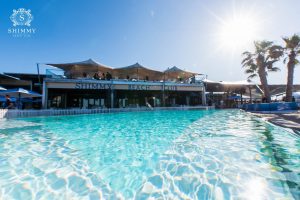
A few days after Christmas in 2016, two men met in the VIP area of the Shimmy Beach Club in the swanky waterfront district of Cape Town, South Africa. They were plotting how they might divert state funds to keep Namibia’s president, Hage Geingob, in power.
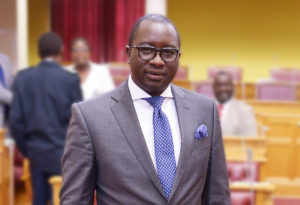
Gathered at the posh club overlooking the Atlantic Ocean sat Sacky Shanghala, Namibia’s attorney-general at the time, and James Hatuikulipi, then chairman of the board of the state-owned National Fishing Corporation of Namibia (Fishcor).
With them was Adriaan Louw, a Namibian businessman with decades of experience in southern Africa’s fishing sector.
There, they formulated the first stages of a scheme that would channel millions of dollars from Namibia’s lucrative fishing industry to the ruling South West Africa People’s Organisation (SWAPO), according to a lawyer who later became part of the deal and had direct knowledge of the meeting.
Born of Namibia’s movement for independence from apartheid South Africa, SWAPO had run the country since the 1990s. The following November, the party was due to hold a congress to pick its presidential candidate for national polls in 2019.
Whoever was chosen was virtually guaranteed to win the election. But with Namibia reeling from a devastating drought and an economic crisis that had sent youth unemployment soaring, Geingob, who had first been elected in 2014, was facing strong opposition within his own party.
So, a new investigation by OCCRP and The Namibian has found, some of the president’s most trusted advisers devised a scheme to siphon off millions of dollars from the country’s fishing industry to finance his re-election.
Bank statements, invoices, internal correspondence, and government documents show that top government officials set up several SWAPO-controlled companies that received nearly US$4.5 million skimmed from a $637 million fishing deal between the state-owned Fishcor and Louw’s company, African Selection Fishing.
Some of this money, leaked notes from party officials show, was allegedly then handed to SWAPO electors in what appears to have been a vote-buying campaign ahead of the party’s 2017 congress.
Geingob emerged as the winner of the vote — and Namibia’s presidential election two years later — in part because the party was “hijacked with money,” according to former SWAPO Secretary-General Pendukeni Iivula-Ithana.
“We learned that people were given envelopes with money after the congress,” she told The Namibian. “One did just not know where that money had come from. All the signs were there that there was money being splashed.”
Namibian authorities are investigating the fishy scheme, the details of which have never been made public before. It is the subject of an ongoing court case, but no charges have been brought.
Shimmy beach club. Photo: Contributed
Namibia’s Anti-Corruption Commission (ACC), which has probed the deal, declined to comment, saying all the information it had on the case had been handed to prosecutors.
A spokesperson for President Geingob denied the allegations, calling his record on fighting corruption “unblemished,” but declined to comment in detail as they are part of an ongoing legal case.
“At no point did the President instruct or ask someone to engage in fraudulent activities,” spokesperson Alfredo Hengari said in an email. “That is contrary to the values and principles of President Geingob, who has dedicated his entire life to Effective Governance and was also instrumental in setting up the anti-corruption mechanisms in Namibia.”
Hatuikulipi and Shanghala, two of the men who met in Cape Town to plan the scheme,are both in jail awaiting trial over a separate scandal involving Fishcor, the Fishrot bribery scandal.
Their lawyer did not provide a comment in time for publication, and attempts to reach them by personal email were unsuccessful.
Louw, the third man involved in the deal, denied being involved in anything improper, saying he was “unaware of any alleged corrupt dealings at Fishcor” when he entered into the deal and only started to suspect years later that anything was wrong.
“I have always confirmed my willingness to assist in any investigation,” he said in a written response to OCCRP. “We want to reiterate that we have not benefited one dollar from any of the alleged corrupt activities and to the contrary have suffered massive losses.”
SWAPO’s spokesperson, Deputy Minister of Defense Hilma Nicanor, didn’t respond to repeated attempts to seek comment.
Payments Like ‘Telephone Numbers’
Namibia’s SWAPO-led government has faced allegations of cronyism and elite self-enrichment for years, but “the boss,” as Hatuikulipi and Shanghala called President Geingob, wanted a more efficient way for the party to bring in cash.
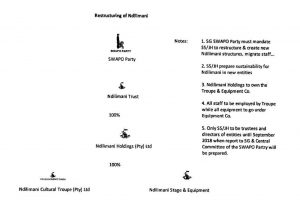
A diagram of the Ndilimani structure put together by Sacky Shanghala, with instructions detailing his and James Hatuikulipi’s roles. Credit: OCCRP
Around the same time as the Cape Town meeting, Geingob asked the two men to design a corporate structure that would help him capture more public funds for the party, according to a lawyer who worked on the deal.
The request was made simpler by the fact that Namibia had no transparency laws around campaign financing at the time.
Hatuikulipi soon got to work. He set up a holding company, Ndilimani — which means “dynamite” in the Oshiwambo language spoken in northern Namibia — that would be entirely owned by SWAPO.
Ndilimani, in turn, secretly controlled several corporate vehicles that received funds from Fishcor. It even had its own cultural troupe — which also received payments.
Private correspondence shows that Shanghala and Hatuikulipi also asked a trusted lawyer to set up a shell company that would become instrumental in SWAPO’s fishing scheme: Celax Investments.
The two men would control Celax, even as the lawyer owned it on paper.
Then, in January 2017, Hatuikulipi and Shanghala arranged for Fishcor to go into business with Louw.
On paper, the Namibian businessman seemed like the ideal partner: He had a long track record in the fishing industry and, according to the court documents, had already been promised preferential access to Namibia’s fish by the Minister of Fisheries at the time, Bernhard Esau.
Former Minister of Fisheries Bernard Esau. Photo: The Namibian
But Louw had also faced a string of lawsuits in Angola related to his fishing companies. (He told reporters the suits had been settled.)
Together, the three men formed Seaflower Pelagic Processing (SPP), a public-private joint venture between Fishcor and Louw’s company, African Selection Fishing.
Under the original terms of the venture — which Hatuikulipi wrote on official Fishcor letterhead before Shanghala approved them and personally communicated them to the Minister of Fisheries — African Selection Fishing would be the majority shareholder of Seaflower, owning 60 percent, while Fishcor would own 40 percent.
The same month Seaflower was set up, in January 2017, then-Minister of Fisheries Esau awarded Fishcor a license to catch 50,000 metric tons of horse mackerel per year for 15 years, which it then shared with its new partner, African Selection Fishing, which would run the fishing operation.
At a market rate of $850 per ton, this would be worth some $637 million.
The award was given without a competitive bidding process, in violation of Namibian laws. Thanks to recent legislative changes, the terms of the deals were kept secret.
Crucially, the government agreed to subsidize the companies’ losses if they failed to catch the entire quota, allowing African Selection Fishing to later claim extra quotas from the government, worth millions of dollars more.
The fishing quotas promised to be a boon for those involved. The lawyer who worked on the deal was told he stood to receive payments the size of “telephone numbers.”
To fatten the deal, the officials included a provision that African Selection Fishing would build a fish processing factory for Fishcor.
Under the terms of the joint venture agreement, African Selection Fishing would loan the money to build the factory, to be repaid later, which could have created an incentive for the company to inflate the cost of the factory.
The Government Gazette listed the cost of constructing the factory at N$530 million (US$40.4 million), but independent valuators said the true figure could be nearly six times less.
Louw justified the high cost of the factory by saying they used construction costs to pay for hundreds of employees, and because it was a frozen fish processing plant and so had high overhead costs.
“This was not preferential treatment, it was based on costing of the project and sustained employment of 700 workers,” he told OCCRP.
OCCRP could not verify the veracity of Louw’s claims.
In 2017, Fishcor bought local company Etale Properties’s shares in the factory for N$160 million ($13 million) — double what Etale’s director had paid for the property two years earlier — raising questions about its true value.
Around the time the Seaflower venture was formalized, Celax Investments — the company that would end up siphoning money to pay off the SWAPO voters — was secretly brought in as a partner.
seaflower pelagic processing. Photo: The Namibian
Because it was black-owned, Celax was given 25 percent of African Selection Fishing’s shares in Seaflower to comply with planned “empowerment” legislation, which would require companies in important sectors to be at least a quarter owned by “racially disadvantaged persons.
” Though the requirement is still not law, in practice it has become common in Namibia to bring in “empowerment partners.”
A source with knowledge of the deal said Celax never made any payment for its stake in Seaflower. Celax’s involvement in the joint venture was hidden until several years later, when it was revealed by an affidavit sent to the Anti-Corruption Commission.
Louw told OCCRP that Celax Investments “was meant as a reserve vehicle” until Namibia’s empowerment laws were passed, and his company had received annual confirmations that it was not active. He added that he had no “benefit or interest in these shares.”
A lawyer for Esau declined to comment in detail for this article, as the matter is part of an ongoing case, except to say the former fisheries minister “vehemently denies all allegations against him” and will respond to them “at the appropriate forum and time.”
In August 2018, African Selection Fishing reported it had incurred losses because it had caught less fish than it was allowed, and claimed more quotas worth nearly $42 million as compensation.
As part of the claim, African Selection Fishing also requested a reduction in Fishcor’s revenue from the joint venture. (Asked to comment on this, African Selection Fishing’s Louw claimed that Fishcor, which officially held the quotas, had corruptly reallocated them to third parties linked to SWAPO.)
Namibia’s High Court ruled in August 2020 that the entire deal between Fishcor and African Selection Fishing was “a cosy and parasitic” relationship possible only “under a corrupt environment.”
A False Stream
Hatuikulipi also sought to capture several other government revenue streams using apparently corrupt deals.
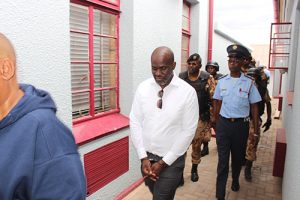
Former chairman of the board of Fishcor, James Hatuikulipi, being led into Windhoek Magistrate Court in February 2020. He and Sacky Shanghala are currently awaiting trial over revelations from the Fishrot bribery scandal, detailed below. Photo: The Namibian
In January 2019, Hatuikulipi told the same trusted lawyer involved in the fishing quota scheme about a natural gas deal that might soon require a corporate vehicle, presenting an opportunity to profit.
“With the benefit of hindsight, I can only assume that it was because of a referral by Shanghala and Hatuikulipi, who were aware that I would be a paymaster using my trust account,” said the lawyer.
In October of that year, not long before Namibia voted to re-elect Geingob as president, around $69 million was deposited into an account in the name of the lawyer at Kazakhstan’s Kaspi Bank as part of the supposed gas deal, according to online banking screenshots obtained by OCCRP.
The money was allegedly paid by a Japanese pharmaceutical company as part of a deal for liquified natural gas supplied by Qatar-based Barzan Energy & Gas through a Bulgarian company, Imperial Ventures.
But there is no evidence that the gas in question actually existed. It’s unclear why a Namibian vehicle would need to be involved in a gas deal, anyway, especially given that Namibia is not a gas exporter or trading hub.
The lawyer said he was told the deal hit a snag when the gas arrived in Japan and the buyers said it was of poor quality.
Hatuikulipi told the lawyer to pay $230,000 from his own account towards the cost of purifying the gas, but he said it was unsuccessful and the money was lost.
The lawyer’s name was removed from the Kaspi Bank account that received the $69 million deposit, and it’s unclear who currently controls it.
The details of the account given in email correspondence seen by reporters, including the bank’s email addresses, web domain and telephone numbers, do not match those listed on Kaspi Bank’s official website.
Namibia’s Anti-Corruption Commission said it was investigating a bank account in Kazakhstan.
“Government Objectives”
In June that year, Fishcor began to divert money from the fishing deal through Celax to entities controlled by or linked to SWAPO.
Banking records show that Celax received N$200,000 (US$15,800) with “Fishcor” noted as a reference for the payment on June 30, 2017.
Former justice minister Sacky Shangal. Photo: Contributed
The following day, Shanghala sent the lawyer who set up Celax a list of 17 recipients who had performed services for SWAPO and were to receive transfers from the company.
More deposits then started to appear in Celax’s accounts. Some referenced Fishcor, while others gave more cryptic descriptions, such as “celax gov obj” and “pmt gov obj,” in what appear to be references to payments for “government objectives.”
Bank records analyzed by OCCRP show that the lawyer made more than 37 payments to 18 companies and individuals on behalf of Celax, totalling some N$58 million ($4.5 million), between July 2017 and November 2018.
Most of the recipients have since been implicated in the Fishrot scandal, including a firm allegedly co-owned by Hatuikulipi named MH Properties, which received N$8 million (US$576,000) from Celax on October 23, 2017, a month before the SWAPO party congress.
Several people with ties to SWAPO also received money for party-related activities, banking records show.
On August 4, 2017, the lawyer received a deposit of N$14 million (US$1.04 million) in his law firm’s trust account from Mermaria Seafood Nam, a local fishing company owned by Samherji, the Icelandic firm at the center of the Fishrot scandal.
Hatuikulipi instructed the lawyer to send the N$14 million (US$1.04 million) to Celax’s bank accounts a day later.
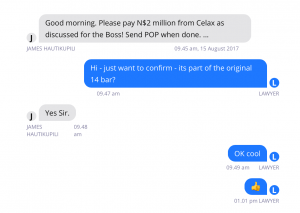
WhatsApp messages between then Fishcor chairman James Hatuikulipi and a SWAPO-connected lawyer about payments from Celax. The reference to 14 bar means N$14 million.
JAMES HAUTIKUPILI (09.45 am, 15 August 2017, left hand side): Good morning. Please pay N$2 million from Celax as discussed for the Boss! Send POP when done. …
LAWYER (09.47, right hand side): Hi – just want to confirm – its part of the original 14 bar?
JAMES HAUTIKUPILI (09.48, left): Yes Sir.
LAWYER (09.49, right): OK cool
LAWYER (01.01PM, right): THUMBS UP EMOJI
CAPTION: WhatsApp messages between then Fishcor chairman James Hatuikulipi and a SWAPO-connected lawyer about payments from Celax. The reference to 14 bar means N$14 million.
In August, he made payments worth a total of around N$3.1 million (US$230,000) to four recipients: SWAPO’s Kalahari regional arm, SWAPO leader Naftal Shailemo, SWAPO’s special youth account, and the SWAPO-linked Om’Kumo Cultural Trust.
Recipients of other payments included companies that have been identified as conduits for payments to key SWAPO officials and their associates, including JTH Trading, Erongo Clearing & Forwarding, and Om’Kumo Cultural Trust.
Other payments to SWAPO moved through the accounts of a law firm run by President Geingob’s personal lawyer, Sisa Namandje. On August 4, N$2.5 million (US$185,000), with “Fishcor” listed as the creditor and “Seaflower” as the reference, was deposited into the firm’s account.
These funds were intended, in part, “as a donation for the benefit of SWAPO Party’s November 2017 Congress activities,” according to a sworn affidavit Namandje provided to the ACC.
In total, prosecutors flagged at least N$40 million (US$2.7 million) from Fishcor and Mermaria, and a further N$50 million (US$ 3.35 million) from other companies and people that passed through the trust accounts of Namandje’s firm before being sent to SWAPO-related entities.
He has not been charged with any wrongdoing, even though Namibia’s Financial Intelligence Centre has documented the funds being sent and received.
Namandje has declined to assist the ACC with its investigation, citing, among other reasons, what he said were deliberate leaks from the Financial Intelligence Centre to “law enforcement agencies,” which then shared the information with the media.
The ACC said Namandje “is not a subject of investigation at the moment.”
Sisa Namandje. Photo: Contributed
Namandje did not respond to requests for comment. Asked about allegations that his personal lawyer was implicated in the Fishrot scandal in July 2020, Geingob shot back at The Namibian, “Is he found guilty? Do I sleep with him? What are you talking about? What are you guys up to?”
Geingob Steals the Show
As campaigning geared up for the 2017 congress, high-ranking members of SWAPO used the network of businesses that had been siphoning off money from the fishing deal to mount a furious spending campaign to win over electors.
For a while, Celax was the primary conduit for the funds that were being siphoned off from the fishing deal. But in October 2017, the Ndilimani Trust — which had been set up by Hatuikulipi and Shanghala to serve as the party’s vehicle for collecting and distributing money — was finally registered.
They planned for Celax to become integrated into Ndilimani. Still, Celax was used to make payments meant for Ndilimani during this period, since Ndilimani’s accounts hadn’t been set up yet.
Party payments moved through Celax’s account into and out of the party’s arms in 14 regions, emails and handwritten notes by party officials show. The notes suggest they were allocated to fund SWAPO’s campaigning.
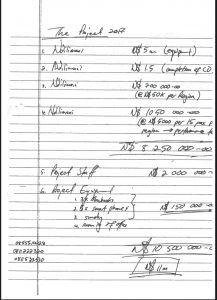
Large amounts of cash were withdrawn from Celax’s account just days before the party congress. A scribbled plan drawn up by Shanghala, titled “The Project 2017,” details N$700,000 (US$56,700) in cash payments earmarked for several of the party’s wings.
A note written by Shanghala, titled “The Project 2017,” lists N$8.25 million in payments from Ndilimani including allocations of N$700,000 “@ N$50k per Region” and “N$5,000 per 15 pax per region.” Credit: OCCRP
The diagram detailed how, one month before the polls, Hatuikulipi would withdraw N$500,000 (US$35,300) in cash from Celax accounts. The lawyer close to the fishing deal said the cash was intended for electors at SWAPO’s congress.
Some of the election-related transfers were made under the guise of contributions to Ndilimani Trust’s cultural troupe, giving local SWAPO officials cover to receive money discreetly.
Some of the alleged bribes that moved through the account of Namandje, Geingob’s longtime lawyer, were also used for the 2017 party congress.
Namandje himself confirmed at least N$7.5 million (US$607,500) was spent on SWAPO’s 2017 congress, and that funds from Fishcor also flowed into his firm’s trust account earmarked for SWAPO in the 2019 elections.
“SWAPO has lost moral ground — the voters now think we are all thugs who want to steal” – Namibia’s former Prime Minister Nahas Angula
The former SWAPO secretary-general, Iivula-Ithana, said the congress was rigged. “Only a fool will accept what transpired at SWAPO’s 2017 congress,” she said.
Namibia’s former Prime Minister Nahas Angula, a top SWAPO official who lost his seat at the party congress, said accusations of vote rigging have hurt the party.
“SWAPO has lost moral ground — the voters now think we are all thugs who want to steal,” he told The Namibian. “We struggle to convince voters because they think we are just enriching ourselves.”
Having struggled to get the vast Sino-Tanzanian Bagamoyo project off the ground, Xi Jinping’s diplomats see the change of administration in Dodoma as an opportunity to breathe life back into bilateral cooperation. The Chinese foreign minister Wang Yi will be trying to persuade Tanzanian president John Magufuli to resume construction works on the huge Bagamoyo deepwater port. Since he came to power, the project has been more or less constantly on hold.
In 2019, Tanzania suspended the construction of the $10-billion Bagamoyo port project. The project, which broke ground in 2015, was to be the largest gateway in East Africa and was a key component in China’s $900-billion Belt and Road Initiative, an ambitious transnational infrastructure building program.
The late President John Magufuli accused the Chinese project backers of presenting “exploitative and awkward” terms in exchange for financing. Chinese financiers set “tough conditions that can only be accepted by mad people,” Magufuli told local media.
“They told us once they build the port, there should be no other port to be built all the way from Tanga to Mtwara south,” Magufuli told a delegation of business people at State House in Dar es Salaam on June 14 2019.
“They want us to give them a guarantee of 33 years and a lease of 99 years, and we should not question whoever comes to invest there once the port is operational. They want to take the land as their own but we have to compensate them for drilling construction of that port,” he said.
Magufuli also argued the construction of Bagamoyo port, whose foundation stone was laid by his predecessor Jakaya Kikwete, would undermine the ongoing $522-million expansion of Dar es Salaam port that would enable it triple its current capacity when complete by the end of 2019.
In addition, Magufuli said the $50-million given out to compensate those displaced by the new port project “did not reach the beneficiaries in Bagamoyo but was diverted to benefit few individuals in Dar es Salaam.”
Tanzania Ports Authority Director General Deusdedit Kakoko told a media briefing in mid-June the Chinese had also asked Tanzanian government to guarantee compensation for any loses during the project implementation and several tax waivers including lands tax, workers’ compensation tax, skills development levy and customs duty and Value Added Tax.
“Tax calculations and audits were set to be undertaken in China and this would have been possible because they would be controlling all cargo, port and logistics,” said Kakoko.
An initial project brief indicated the port was planned to occupy 800 hectare and set aside another 1,700 hectare for a Portside Industrial Zone, which would be developed under tripartite agreement of Government of Tanzania, China Merchants Holdings International from China and State Government Reserve Fund from Oman.
The new Bagamayo port would have handled nearly 20 times more cargo than the Dar es Salaam Port, with the first phase initially slated for completion in 2017.
China Merchants Holding International Co. Ltd of China was to provide the funding for the new port with an initial agreement signed in March 2013 during the visit of the Chinese President Xi Jinping as part of the $556-million infrastructure package deals. The agreement provided that at least $500 million of the package be set aside in 2013 to kick-start the project.
The government of Tanzania issued an ultimatum to the Chinese investor in the $10 billion Bagamoyo port project to either accept and work with its terms and conditions of the contract or leave.
The government rejected and revised five stringent demands made by the investor—Beijing-based China Merchants Holdings International—because they were not beneficial to the country.
The Chinese investor has now been offered a 33-year lease instead of the 99-year one asked for. Two, the investor has been informed that there will be no tax holiday and they will be subjected to all taxes designed by the Tanzania Revenue Authority.
Three, that there would be no special status and they would be required to pay the market rate for water and electricity like any other investor.
Four, they could not start and run any other business they deemed necessary within the port without government’s approval and were open to scrutiny and regulation by relevant agencies in line with law like any other investor.
Five, they were informed that the government of Tanzania was free to develop other ports to be in direct competition with Bagamoyo.
Beijing now hopes that the new President will not play hardball like Magufuli did to their exploitative terms, having established himself as a revolutionary leader who didn’t entertain especially the Chinese advances in bed, Magufuli is one of the few African leaders who didn’t drown their countries into the deadly Chinese debt trap that has been the economical hit weapon being used. Kenya is currently suffocated with Chinese debt and there are credible fears that they might takeover Mombasa Port should Kenya fail to service their SGR loan in time.
Suluhu has the chance to play hard as Magufuli and China work with their terms or she can also get in the bouncing castle and jump with the schemers.
Over 1,500 employees at Pearl Dairy Farms Ltd have been laid off, almost a year after the company stopped exporting milk and milk products to Kenya.
Pearl Dairies, the processors of Lato Milk, stopped full-scale production at the height of a milk war with Kenya at the beginning of 2020. At the time, Kenyan authorities were confiscating imported Ugandan milk and turning away trucks on grounds that the milk had been smuggled into the country without paying taxes, thereby depressing local prices.
The move followed a surge in volumes of imported milk from Uganda amidst complaints that the country had no capacity to export such huge quantities to Kenya. Milk imported from within East African Community member states had hit 110.7 million litres by September 2019, from just three million litres in 2016. Pearl Diaries exported most of its processed milk to Kenya.
While the company was still struggling to deal with the ban, the world was hit by the COVID-19 pandemic, which forced countries to close their borders and announce lockdowns to keep the virus at bay. This meant that Pearl Dairy, which was taking at least 400,000 litres per day, from farmers for processing, could no longer maintain the pace.
Farmgate prices crashed and the price per litre of milk dropped from Shs 1200 to Shs 800. The diaries were selling at Shs 1200 per litre from Shs 1600, a fall of Shs 400 for every litre.
Seth Devendra, the managing director of Pearl Dairy says that the production capacity of the farm dropped to less than 25 per cent, critically affecting its income. He adds that with such problems, the company could not sustain its wage bill and related expenses.
Ezra Agaba, one of the affected employees says he was asked to stay home for the month and has not been recalled despite completing a month away from the job. Moses Kijoma, a milk lab attendant says he has since faced numerous domestic challenges as a result of not earning.
Uganda produces 2.6 billion litres of milk per annum. However, only about 800 million litres are consumed on the domestic market leaving the surplus for the international market.
The strained relationship between Emirates and the Nigerian Government is continuing to disrupt flights in and out of the African country. Emirates’ passenger flights to and from Nigeria are now suspended as the Nigerian Government responds to a COVID-19 testing regime they call discriminatory and lacking any scientific basis.
Ongoing tensions between Emirates and Nigerian Government
It is the second time in two months the Nigerian Government has banned the Dubai-based carrier from flying into the country. Emirates normally flies between Dubai and Lagos and Dubai and Abuja. Emirates cargo and emergency flights are exempt from the ban.
Nigeria slapped Emirates with a three-day ban on outbound flights in early February. Fueling that ban was an airline-imposed COVID-19 testing regime at Emirates that was at odds with the Nigerian Government’s regime. However, the impasse was quickly resolved, and few, if any, Emirates’ flights were impacted.
But the Emirates’ COVID-19 testing regime is firmly back on the Nigerian Government’s radar. They’ve slapped the airline with a further ban that took effect at midnight on March 17. This time the ban impacts both inbound and outbound passengers. Emirates has confirmed the ban and has suspended passenger flights to Nigeria until further notice.
This is the second Nigerian ban in two months for Emirates. Photo: Emirates
A dispute over COVID-19 testing regimes
Driving the dispute is an Emirates COVID-19 testing regime that the Nigerian Government calls discriminatory. In addition to accepting COVID-test results from local test centers not on Nigeria’s approved list, Emirates wants its passengers departing Nigeria to have three COVID-19 tests within 24 hours. That includes an initial PCR test, an antigen rapid test at the airport, and a PCR test at the arrival airport. Nigerian Aviation Minister Hadi Sirika calls the requirement nonsensical.
“Since they insist, their operations remain suspended,” he said at a media briefing last week.
The Nigerian Government believes a single PCR test with 72 hours of departure should suffice. However, Emirates disagrees. This most recent flight ban was to run for five days but remains in force. Both the Nigerian Government and Emirates say talks are continuing to resolve the issue.
“Emirates remains in close dialogue with the relevant regulators and authorities in Nigeria, and we are fully committed to making progress on a resolution to ensure the continuation and expansion of our operations,” the airline said in a statement.
Emirates is not the only airline to skirmish with Nigeria’s Government
However, it turns out Emirates has been flying very few passengers on its outbound flights from Nigeria before this present ban. Except for UAE nationals and diplomats, Dubai has banned travelers who’ve been in Nigeria within 14 days of traveling. Passengers from the two groups allowed to travel must adhere to Emirates’ COVID-19 testing rules in order to fly.
It’s not just Emirates having issues with flying to Nigeria. Dutch carrier KLM has also faced Nigeria’s displeasure with its COVID-19 testing regime. KLM had faced similar sanctions as Emirates, but according to the Nigerian Government, agreed to unwind their testing regime. As a result, KLM resumed flying passengers in and out of Nigeria from March 15.
Despite Emirates putting its flights to Nigeria on ice, a number of other long-haul airlines continue to fly into the country. Lagos’ Murtala Muhammed International Airport is hosting flights by Delta Air Lines, Ethiopian Airlines, Air France, British Airways, Turkish Airlines, Virgin Atlantic, Qatar Airways, and KLM among others across Tuesday.
Diplomatic relations between Kenya and Somalia date back many years. Kenya is home to hundreds of thousands of Somali refugees, and Somalia has been a market destination for Kenyan goods.
Recently, these relations have been ailing and now seem headed for obliteration. Between December and January, there occurred a dangerous military build-up along the two countries’ common border thanks to a coordinated campaign that misled Kenyan policymakers and infuriated the administration in Mogadishu. This sophisticated misinformation crusade is driven from the heart of Nairobi by high-profile lobby figure called Matthew Bryden.
So good is Bryden’s misinformation machine that he is thought to be responsible for the sidelining of Kenya in in a tripartite agreement signed among Ethiopia’s Abiy Ahmed, Eritrea’s Isaias Afwerki, and Somalia President Mohamed Abdullahi Farmajo. Insiders believe the three nations felt Nairobi was pushing for a ‘too aggressive’ agenda against them and agreed to push against Kenya.
Bryden’s dangerous campaign bears resemblance to Project Lakhta, an influence operation conducted by the Russians to influence the 2016 US election, and employs similar tactics to sow misinformation and create doubt in the international community to influence policymakers in and against Kenyaagainst Kenya.
Bryden, a much sought decrier who takes order only from the highest bidder, employs a team of researchers, and dictates what they post on social media pages, and when they post it.
He started his career in lobbying in East Africa in the 80s. First arriving in Somalia in 1987 as a 20-year old, Bryden was immediately hired by the Somali National Movement (SNM), an armed militia that was conducting guerrilla raids against the Somali government, to help them lobby their cause in the international arena. Afterwards, while still working with SNM, he ventured into a career in the United Nations and later various NGOs.
In 2008, he was appointed as coordinator for the Monitoring Group on Somalia and Eritrea (SEMG), during which his influence in the international community peaked. Severally, he used SEMG to advance personal goals, including accepting lobbying fee from various groups, such as Ethiopia’s TPLF, to run misinformation campaigns.
During his time at SEMG, he reportedly extorted money from a Somali business. A former colleague of his said that he threatened his victims with being blacklisted as terrorist-funding entities if they did not pay him a certain sum. Neither were influential politicians out of his reach; he frequently threatened to label them as terrorist sympathizers and have them sanctioned from international travel or their assets frozen if they didn’t bribe him.
Hired by Ethiopia to frame Eritrea
The activities of Bryden’s long stay in Africa have impacted millions of people, an appreciable amount of them at the behest of the Ethiopian government. He pushed for and lobbied on behalf of the once-powerful TPLF (the to which former Ethiopian premier the late Meles Zenawi belonged) to cripple Eritrea by creating a misinformation campaign that resulted in United Nations Security Council Resolution 1907 – which imposed an arms embargo on Eritrea, travel bans on its leaders, and froze the assets of some of the country’s political class.
Using Sahan Research, a Nairobi-based thinktank where he is a director, Bryden blackmailed high-profile prisoners for political ends. He forced them to testify to implicate Eritrea in training and supporting their activities, and used those testimonies to push for sanctions against Eritrea.
Sahan has also worked for the United Arab Emirates, which, angered by Somalia’s refusal to side with Dubai during Gulf Crisis, disbursed millions of dollars to rebels and other groups to frustrate Somalia’s fledgling administration. Sahan Research reportedly is used as a vehicle to launder funds from UAE to distribute to members of Somalia’s opposition as payment for inordinately frustrating government agenda even where there is no cause to do so.
Among notable people who are also directors at Sahan are Hussein Halane, a presidential candidate in Somalia’s upcoming election, and Kenya’s Professor Peter Kagwanja – who at one point or another has been mentioned adversely within diplomatic circles for working against Somalia interests. Kagwanja is also the husband of Kenya’s Defence Cabinet Secretary Monica Juma.
In what might have been a cruel twist of fate, in December 2020, Bryden drew up an electoral model for Somalia at the behest of Jubaland President Ahmed Madobe, which made such lofty demands of President Mohamed Farmaajo. Then Madobe shared the document with Farmaajo, he expected him to reject it straight away. To their surprise, Farmajo accepted it without question.
Bryden has also regularly run propaganda campaigns against Somalia’s military, which he often paints – on social media and other platforms – as inept, unprofessional, ill-prepared to handle the nation’s security, and as still loyal to rebel militia and warlords, in a bid to keep Somalia under an arms embargo.
Systematic rumor campaigns have often worked in many countries with stronger democratic institutions than Somalia’s, and Bryden’s crusades might explain why the international community still regards Somalia as a failed state, even when it is making steady progress.
Bryden’s campaigns are well-designed, lethal, and mostly deliver. A recent claim by media platforms associated with Bryden spoke about Somali forces being killed in the Tigray war had the objective of derailing attempts to reorganize the SNA. It succeeded in sowing panic and doubt in the country as parents whose sons were in training missions or clandestine operations forced the SNA to reveal their whereabouts, putting the lives of soldiers and other personnel in danger.
President Uhuru Kenyatta today led heads of all arms of Government in conveying their condolences to the President, the Government and the People of the United Republic of Tanzania following the death of President John Pombe Joseph Magufuli.
The Head of State led a high-powered delegation consisting of the two Speakers of Kenya’s bicameral parliament Justin Muturi (National Assembly) and Ken Lusaka (Senate) as well as acting Chief Justice Philomena Mwilu to the residence of Tanzania High Commissioner in Nairobi where they paid homage to the departed Tanzanian leader.
President Kenyatta, who was also accompanied by Cabinet Secretaries Fred Matiang’i (Interior), Adan Mohamed (EAC), Amina Mohamed (Sports) and Margaret Kobia (Public Service), expressed Kenya’s solidarity with Tanzania as the country comes to terms with the loss of its leader.
“We have come to join you in affirming our solidarity with you at this difficult time. We want you to convey our personal condolences and those of Kenyans to President Samia Suluhu Hassan.
“We are praying for her. We want you to assure her of our support and that the good work our brother (President Magufuli) had began, we shall continue with it,” the President told High Commissioner John Stephen Simbachawene who received him.
President Kenyatta recalled the historic brotherly relations Kenya has had with Tanzania saying whatever happens in the neighbouring country also affects Kenyans.
He recalled how Tanzania’s founding father President Julius Nyerere was ready to postpone his country’s independence until all other East African countries were also granted their freedom.
President Kenyatta, who was also accompanied by Kenya’s Head of Public Service Dr Joseph Kinyua, eulogized the late President Magufuli as a true Pan-Africanist who sacrificed a lot to ensure economic development not only for the citizens of Tanzania but also for East Africa and the African continent at large.
“We are here to mourn and comfort you for loosing a leader who was a true friend. He was not only committed to Tanzania’s wellbeing but also for the East African region. It is unfortunate we have lost him,” President Kenyatta said.
National Assembly Speaker Justin Muturi and his Senate counterpart Ken Lusaka gave messages of condolence on behalf of the two chambers saying they stand with Tanzanian citizens at this trying moment.
Acting Chief Justice Philomena Mwilu said the late Tanzanian leader lived a sacrificial life and passed on at a time when the Catholic faithful are observing lent which is a period of denying self for the good of others.
“He served God and we appreciate that as a devoted Catholic, the late President passed on at a time when we are observing lent.
“On behalf of the Judiciary and the entire justice system, receive our condolences,” Justice Mwilu told High Commissioner Simbachawene.
On his part, the High Commissioner expressed his gratitude to President Kenyatta saying his declaration of seven days of mourning demonstrates a spirit of true brotherhood between the two nations.
“We are very encouraged and comforted by your messages of condolence. We have lost our leader and a great friend of Kenya and also your personal friend. We thank you for demonstrating your love for Tanzania and the East Africa region,” Amb Simbachawene said.
The envoy assured the President and his delegation that he will personally deliver their condolence messages to President Samia Suluhu Hassan.
As Tanzanians mourn for President John Magufuli, whose death was announced on Wednesday due to heart disease, his near three-week absence from public sight prompted a slew of rumours that he was hospitalised in neighbouring Kenya.
According to the Daily Nation, Magufuli was discharged from Nairobi Hospital while on life support and flown to Tanzania’s capital Dar es Salaam late last week after doctors concluded that he could not be resuscitated.
The publication said he died at Mzena Hospital in Tanzania shortly after arrival from Kenya on Thursday 11 March, countering the announcement by the government that he died a week later on March 17.
Citing sources, the Daily Nation said Magufuli “was flown to Kenya secretly on March 8 after suffering acute cardiac and respiratory illnesses, was under intubation when a decision was made to fly him back home”.
Daily Nation said his entry and exit from Kenya was a guarded affair and that only select National Intelligence Service (NIS) officials and members of the National Security Advisory Committee were aware.
Timeline of Magufuli’s movements, according to the Daily Nation
February 27_:_ Last public sighting of President John Magufuli.
March 6: The date when then vice-president Suluhu later said Magufuli was taken ill.
Date not known: Magufuli’s condition suddenly deteriorates after less than 24 hours at the Tanzanian hospital.
Decision is reportedly made to fly him to South Africa, which has better facilities but doctors advised there was not enough time and was flown to Kenya instead.
March 7- 8: Magufuli is flown to Kenya secretly by air ambulance and lands at Wilson Airport. The runway is closed to other planes.
On arrival at the Nairobi hospital, he is intubated, a procedure where tubes are i inserted in the lungs to aid breathing.
March 11: Maguflui is flown back to Tanzania and arrives at Mzena Hospital. He dies shortly afterwards, according to the Daily Nation.
March 12: Prime Minister Kassim Majaliwa says Magufuli is in Tanzania and “working hard as usual”.
March 17: Tanzania’s then vice president Samia Suluhu Hassan announces Magufuli’s death due to heart disease.
Opposition says he died from coronavirus
Tanzania’s opposition leader Tundu Lissu had for the last few weeks alleged Magufuli was ill with coronavirus and as being treated in Kenya and India.
Lissu has been exiled in Belgium since 2017 after gunmen opened fire on him outside his home in a protected government compound, leaving him with 16 bullet wounds.
He briefly returned to Tanzania after being selected to lead the opposition challenge to Magufuli’s re-election in 2020.
The day Magufuli’s death was announced on Wednesday, he told Kenya’s KTV news the president had died from coronavirus a week earlier.
“Magufuli died of corona. That is one. Number two, Magufuli did not die this evening. I have information from basically the same sources which told me he was gravely ill, I have information that Magufuli has been dead since Wednesday of last week,” he told the broadcaster.
The Covid denying president
Magufuli has been playing down the impact of the Covid-19 pandemic, claiming Tanzania had freed itself from the Covid” through prayer.
He also rejected any lockdowns or measures such as mask-wearing.
“That’s why we are all not wearing face masks here. You think we don’t fear dying? It’s because there is no Covid-19,” he said.
But Magufuli later admitted what he called a “respiratory disease” was still circulating.
Ugandan President Yoweri Museveni is suing a local media group for reporting a claim that he and his inner circle were vaccinated against COVID-19 weeks before the first doses arrived in the country.
Lawyers representing President Yoweri Museveni said they filed a case against the Daily Monitor after the independent newspaper carried a story first published by The Wall Street Journal with the title: “Members of President Yoweri Museveni’s inner circle were offered vaccines from China state-owned drug maker Sinopharm.”
According to the Wall Street Journal investigation, the offer by the Chinese government was meant to promote their vaccines. Similar offers were also reported in Peru and the Philippines.
The newspaper said in Peru, nearly 500 politically connected people, including then-President Martin Vizcarra, were secretly given the vaccine, which was undergoing clinical trial.
The lawsuit alleges the article published by the Monitor was intentionally reckless, malicious and published without due care.
Museveni’s lawyers said the story presented him as having engaged in the dishonest activities of influence peddling, nepotism, scheming and conspiracy.
They added that the article also portrayed Museveni as having abdicated his duties and obligations to frontline workers fighting COVID-19, and other groups vulnerable to the pandemic.
“That presents him in a very bad light,” said Oscar Kihika, Museveni’s head of legal affairs. “So, he’s praying for damages for defamation.”
Museveni’s lawyers also attached a copy of Twitter messages in response to the article in which different social media users commented on the allegation. One Twitter user Identified as Hotim 3mmy tweeted, “What if I told you the jab also cure corruption and ensure immortality on its recipients.” Mugema Stephen responded, “Few Ugandans would take it then if it cured corruption.”
Museveni attacked the Daily Monitor twice recently, saying it is one of Uganda’s problems. He described the newspaper as evil, irresponsible and needing self-discipline.
Museveni denied the claims in the article and instead warned he would drive the Daily Monitor bankrupt.
“That was before we imported the vaccine,” Museveni said. “Now, Monitor must apologize. In front page. To say that I got vaccinated secretly when my people were still in danger. I only care about myself. Monitor must apologize. Big, big letters. If they don’t, I go for you. And I have already told the lawyers, get massive money from those crooks.”
Daily Monitor managing director Tony Glencross said it is an independent newspaper, free to publish what it believes its audience needs to know, and the paper is preparing a defense.
“In these kind of cases, the court will order that mediation must take place,” he said. “If the mediation is not successful, then we will battle it out in court.”
In their letter acknowledging receipt of the suit, the newspaper’s lawyers said that the words quoted in the suit, even if untrue, cannot pass the test of defamatory publication.
They said that any immunization against a pandemic should be sought by any right-thinking member of society and cannot therefore lower the reputation of anybody.
They added that the president takes precedence over all persons and if he and those close to him are immunized first against a pandemic for the president’s own safety, there cannot be any interference of loss of reputation.
On Wednesday evening she had the task of announcing to Tanzanians that President John Magufuli had died and now Vice-President Samia Suluhu Hassan is due to take his place as the country’s head of state.
First elected as Magufuli’s running mate in 2015, she was re-elected last year along with him and according to the constitution, should serve out the rest of the five-year term in the top job.
She become’s Africa’s only current female political head of government – the Ethiopian presidency is a largely ceremonial role – and join a short list of women on the continent who have made it to the top.
The 61-year-old is affectionately known as Mama Samia – in Tanzanian culture that reflects the respect she is held in, rather than reducing her to a gendered role.
But she was a surprise choice for a running mate in 2015, leaping over several other more prominent politicians in the Chama Cha Mapinduzi (CCM) party, which has been in power in one form or another since independence in 1961.
First elected to a public office in 2000, she came to national prominence in 2014 as the vice-chairperson of the Constituent Assembly, created to draft a new constitution. There her calm demeanour in managing occasional outbreaks of pandemonium and the way in which she dealt with some of the more outspoken members earned her plaudits.
Samia Suluhu Hassan has served as President Magufuli’s deputy since 2015. AFP
In terms of personality she strikes a contrast with Magufuli.
Where he appeared impulsive, not afraid to speak off the cuff and let his feelings be known, she is more thoughtful and considered.
She is also said to be a good listener who believes in following the correct procedures.
‘Capable leader’
One MP, January Makamba, who worked with her in the vice-president’s office, has called her “the most underrated politician in Tanzania”.
“I have observed at close quarters her work ethic, decision-making and temperament. She is a very capable leader,” he said.
But where this places her in terms of policy is not yet clear. Most significantly she has to decide whether to continue her predecessor’s sceptical approach to dealing with coronavirus.
There was no doubt that she was loyal to the president but she was not afraid to strike out on her own.
Perhaps the most significant evidence of that was in 2017 when she visited opposition leader Tundu Lissu in hospital in the Kenyan capital, Nairobi, after he had survived an assassination attempt.
With people speculating that state agents had been involved, the pictures of the visit sent shockwaves through the country.
Mr Lissu went into exile afterwards – returning briefly to take part in elections last year – but went back to live in Belgium, saying he had received more death threats.
Private person
Despite being vice-president since 2015, and having served as a state minister in the previous government, little is known about Ms Samia’s private life.
She was born in January 1960 on Zanzibar – the semi-autonomous islands off the coast of mainland Tanzania. Later she went on to study public administration, first in Tanzania and then as a post-graduate at UK’s Manchester University.
In 1978, she married Hafidh Ameir, who is known to be an agricultural academic but has also kept a low profile. Since Ms Samia became vice-president, the two have not been pictured together.
They have four children with one, Mwanu Hafidh Ameir, who is currently a member of Zanzibar House of Representatives.
African female presidents
The role of Ethiopia’s President Sahle-Work Zewde is largely ceremonial. Reuters
1993-1994 – Sylvie Kinigi – caretaker President of Burundi, following the killing of Melchior Ndadaye
2006-2018 – Ellen Johnson Sirleaf – elected President of Liberia
2009 – Rose Francine Rogombé – Interim President of Gabon following the death of Omar Bongo
2012 – Monique Ohsan-Bellepeau – Acting President of Mauritius, after the resignation of Sir Anerood Jugnauth
2012-2014 – Joyce Banda – President of Malawi, after the death of Bingu wa Mutharika
2014-2016 – Catherine Samba-Panza – transitional President of Central African Republic, elected by parliament
2015-2018 – Ameenah Gurib-Fakim – President of Mauritius, elected by parliament
2018-present – Sahle-Work Zewde – President of Ethiopia, elected by parliament
The Africa Center for Disease Control (Africa CDC) Director Dr. John Nkengasong has said that the Covid-19 situation in Kenya is normal with epidemics.
Speaking on the weekly briefing, Dr. Nkengasong said that the rise in infections happens whenever restrictions are lifted or when the epidemic appears to have been contained adding that stringent restrictions are counterproductive to economic activity.
“Countries cannot perennially be under lockdown or strict restrictions, because this hurts the economy,” said Nkengasong and added that, “the rise in infections is the result of the lifting of restrictions and the thought that the pandemic was over when the second wave ended within a short time.”
While noting that Kenya had done exceptionally well in flattening the curve twice, Dr. Nkengasong advised that instead the Kenya government and governments around the continent need to scale up the vaccination exercise to help achieve the herd immunity and save more lives.
“The benefits accruable from the AstraZeneca vaccination against COVID-19 continue to outweigh its risks,” he said and added that from the evidence available and as discussed during the AFTCOR special session, Africa CDC concluded that all AU Member States continue to roll-out AstraZeneca vaccine as part of their vaccination campaigns while ensuring routine monitoring, reporting and evaluation of adverse events following immunization.
He called on members states to make policy decisions pertaining to vaccination roll-out based on evidence and thorough regulatory review process warning that the whole continent is not yet out of the woods and that countries must maintain high standards in ensuring that the health protocols are adhered to, including washing hands with soap and water, keeping social and physical distancing as well as wearing facemasks.
Also ReadHigh court upholds FGM ban in Kenya
The Africa CDC Director said that over the past week Africa had recorded a total of 66,764 new cases indicating a 3% decrease from the previous week, but warned that East Africa and Northern Africa had recorded the highest proportion of new cases at 28% each.
The Southern region recorded 25%, the Western region 15% and the Central region 3%. Kenya leads with a 44% average increase in new cases, Ethiopia: 19%, Egypt 2% average increase while the Democratic Republic of Congo has seen a decrease in infections of 11%, South Africa has registered a 14% average decrease and Nigeria a 23% average decrease.
In the report released by Dr. NKengasong, new deaths on the continent in the past week are 2,029.
Five countries on the continent recorded the highest numbers of new cases in the week; Ethiopia 9,329, South Africa 8,352, Libya 5,335, Egypt 4,421 and Kenya 4,409.
So far total cases due to Covid-19 in Africa have reached 4,062,388 which is 3.4% of total cases reported globally.
Total recoveries are 3,649,317 accounting for 90% of the total cases reported in Africa. While the total number of deaths are 108,659 which is a case fatality rate of 2.7%.
President John Magufuli of Tanzania, a prominent COVID-19 skeptic in Africa whose populist rule often cast his East African country in a harsh international spotlight, has died. He was 61 years old.
Magufuli’s death was announced on Wednesday by Vice President Samia Suluhu, who said the president died of heart failure.
“Our beloved president passed on at 6 p.m. this evening,” said Suluhu on national television. “All flags will be flown at half-mast for 14 days. It is sad news. The president has had this illness for the past 10 years.”
The vice president said that Magufuli died at a hospital in Dar es Salaam, the Indian Ocean port that is Tanzania’s largest city.
Magufuli had not been seen in public since the end of February and top government officials had denied that he was in ill health even as rumors swirled online that he was sick and possibly incapacitated from illness.
Magufuli was one of Africa’s most prominent deniers of COVID-19. He had said last year that Tanzania had eradicated the disease through three days of national prayer. Tanzania has not reported its COVID-19 tallies of confirmed cases and deaths to African health authorities since April 2020.
But the number of deaths of people experiencing breathing problems reportedly grew and earlier this month the U.S. embassy warned of a significant increase in the number of COVID-19 cases in Tanzania since January. Days later the presidency announced the death of John Kijazi, Magufuli’s chief secretary. Soon after the death was announced of the vice president of the semi-autonomous island region of Zanzibar, whose political party had earlier reported that he had COVID-19.
Critics charged that Magufuli’s dismissal of the threat from COVID-19, as well as his refusal to lock down the country as others in the region had done, may have contributed to many unknown deaths.
The UN’s top court allowed Somalia’s case to go ahead in a long-running maritime dispute with Kenya Monday, saying it regretted Nairobi’s refusal to attend.
Kenya announced earlier that it would snub this week’s International Court of Justice hearings after the Hague-based court refused to allow further delays in the case.
Somalia has asked the ICJ to rule in the dispute, potentially deciding control over a large Indian Ocean zone that is rich in fish and which might contain substantial crude oil reserves.
“The court regrets the decision of Kenya not to participate in the oral proceedings,” ICJ President Joan Donoghue said.
But the court would go ahead with hearing Somalia’s case, and would use written evidence provided by Kenya instead, Donoghue said.
Somalia criticised Kenya’s “defiance” of the ICJ, which was set up after World War II to rule in disputes between UN member states.
“We are deeply concerned that Kenya has decided not to appear at these hearings,” sad Mahdi Mohammed Gulaid, opening Somalia’s case.
He said it was “inconsistent with the rule of law” and Kenya’s commitment to the court.
Kenya “has no grounds to complain about its treatment by the court” after the ICJ granted three previous requests for delays that held up the case by 18 months, he said.
– ‘Regrettable decision‘ –
“Fortunately this regrettable decision to boycott the oral hearings cannot prevent them proceeding, nor can Kenya’s defiance prevent the court from fulfilling its mission,” added Gulaid.
The ICJ is hearing a case brought by Somalia in 2014.
Somalia, which lies northeast of Kenya, wants to extend its maritime frontier with Kenya along the line of the land border, in a southeasterly direction.
Kenya wants the border to head out to sea in a straight line east, giving it more territory.
The disputed triangle of water stretches over an area of more than 100,000 square kilometres (40,000 square miles).
Kenyan prosecutor Kihara Kariuki had earlier said in a letter his country would not be participating because the Covid-19 pandemic had “hampered Kenya’s ability to prepare adequately for the hearing.”
In its letter, Kenya also argued that holding the ICJ hearings virtually did not allow it to present its case in the most effective way.
The ICJ on Monday however dismissed Kenya’s request for a “thirty minute opportunity to orally address the court before the commencement of the actual hearings.”
Kenya recalled its ambassador to Somalia in February 2019 after accusing Somalia of selling oil and gas blocks at a London auction despite the pending delineation case before the ICJ.
Kenya also contested the ICJ’s authority to rule in the case, but the court dismissed its objections in 2017.
Tanzanian President John Magufuli has remained out of sight since late February, amid rumors he has COVID-19. Officials have insisted he is well, but the country’s vice president said Monday it is normal for people to get sick. She asked Tanzanians to ignore outside information that may cause confusion.
Speaking in the northeastern town of Tanga at the launch of a government project, Tanzania’s Vice President Samia Suluhu Hassan made comments that seemed to refer to President John Magufuli without mentioning him by name.
“I want to confirm to you Tanzania is safe. It’s normal for a human being to undergo checkups like flu and fever and could suffer other illnesses. I want to plead with Tanzanians, if there was a time to hold together is now. This is the time to build unity. It’s not a time to listen to information coming from outside,” said the vice president.
Tanzanian authorities have come under pressure to reveal Magufuli’s health status after some people, including opposition politicians, said he was sick with coronavirus. The president has not been seen in public since February 27, and several media reports said he was taken abroad for treatment.
Since the worldwide pandemic began a year ago, Magufuli has either denied the virus is present in Tanzania or said it can be defeated with steam inhalation and prayer. Philbert Komu is a political commentator and teaches philosophy at the University of Dar es Salaam. He said the vice president is trying to keep Tanzanians calm.
“Her comments seem to be normal to me for someone to be sick with the flu or coughing. It should be a normal thing to us. It shouldn’t bring too much chaos and uprising in a state like Tanzania. … I really believe that she wanted to deliver a message that she has not clearly really wanted to say,” said Komu.
On Friday, Prime Minister Kassim Majaliwa refuted claims the president was sick, saying he was well and working. Ansbert Ngurumo is a Tanzanian journalist in exile who runs an online news website, Sauti Kubwa, meaning “loud voice.”
He said Tanzanian government officials tend to hide the health status of government officials.
“From the look of things, it’s like if you don’t provoke them, if we don’t keep asking questions, they will never tell us in time. Even the most recent event from the statehouse when Ambassador John Kijazi, Magufuli’s top aide in the statehouse, we never knew he was sick until they told us he is dead. So, they are not in a position to tell us what is happening now. They are just waiting to tell us the eventuality if he is dead or if he finally recovers from wherever he was,” said Ngurumo.
Tanzania stopped recording COVID-19 positive cases just a few weeks after announcing its first case in March 2020. After months of downplaying the virus’s effect recently, government officials called on the population to take precautions and wear masks.