Tag: Kamlesh Pattni

  • How Bishop Mark Kariuki’s Deliverance Church Became Vehicle for Sh10 Billion Land Fraud

    How Bishop Mark Kariuki’s Deliverance Church Became Vehicle for Sh10 Billion Land Fraud

    Explosive investigation reveals how religious leaders, Goldenberg mastermind Kamlesh Pattni, and late spymaster’s estate orchestrated Kenya’s largest church-backed land scam

    In what could be Kenya’s largest church-backed investment scandal, thousands of faithful believers have lost approximately Sh10 billion in a sophisticated land fraud scheme that weaponized religious trust to fleece congregants across the country.

    Investigation has uncovered how Bishop Mark Kariuki’s Deliverance Church network became the unwitting front for a complex web of forgery, corruption, and illegal land transactions orchestrated by Goldenberg scandal mastermind Kamlesh Pattni and associates linked to the estate of former intelligence chief James Kanyotu.

    The Sunday Sermon That Launched a Billion-Shilling Scam

    It began as a typical Sunday service in 2014 at Deliverance Church Kasarani, Nairobi. But what started as worship quickly transformed into what congregants thought was a divine opportunity for homeownership.

    Church elders announced the launch of “Imani Estate” – a sprawling 500-acre residential development in Ruiru, Kiambu County, where plots measuring 50×100 feet were being offered at between Sh2.5 million and Sh4.4 million.

    The sales pitch was compelling: prime land in the heart of Ruiru town, marketed by trusted religious leaders, sold through the church’s commercial arm, Ukombozi Holdings Limited.

    For thousands living as tenants in Kasarani, Zimmerman, Githurai 45, and Mwiki, it seemed like answered prayers.

    “Sadly, we were duped by the men of God who were not honest enough to tell us that the property they were selling was not legally theirs,” Michael Kamau, who invested Sh9 million in two plots and built a Sh34 million luxury maisonette said.

    The Goldenberg Connection

    Court documents reveal the sophisticated fraud began with land originally owned by Kangaita Coffee Estates Limited, where late intelligence supremo James Kanyotu held majority shareholding.

    Kamlesh Pattni
    Kamlesh Pattni

    After Kanyotu’s death in 2008, the 500-acre property became part of his contested estate, with High Court restraining orders prohibiting any transactions.

    Despite these legal restrictions, the land was allegedly sold to Trendsetters Investments Limited – a company linked to Kamlesh Pattni, the controversial businessman at the center of the Sh158 billion Goldenberg scandal that nearly bankrupted Kenya in the 1990s.

    In a labyrinthine scheme, Trendsetters then “sold” the land to Marriott Africa International Limited, which subdivided it into over 1,000 plots before fraudulently transferring ownership to Ukombozi Holdings Limited – the church’s investment vehicle.

    Business Registration Service records show Ukombozi Holdings is owned by Bishop John Masinde (founder of Deliverance Church International), Bishop Mark Kariuki (General Overseer of Deliverance Churches Kenya), and three associates: Peter Keefar Njogah, Jim Kenny Kimani, and George Gichana.

    Forensic Evidence Exposes Forgery

    The house of cards began collapsing when two forensic document examiners – Chief Inspector Bernard Cheruiyot and Vincent Chelongo – testified that key documents used to legitimize the land transactions were sophisticated forgeries.

    “After examining the questioned signatures, he concluded that the letters of consent were forgeries,” Justice Oguttu Mboya noted in his damning July 10, 2025 judgment that declared the entire transaction “null and void.”

    The investigation revealed that consent letters dated July 26, 2012, and May 6, 2014, allegedly authorizing the land sale, were fabricated.

    These forged documents became the foundation for transferring billions of shillings worth of property from the Kanyotu estate to Pattni’s network.

    Victims Speak Out

    Stephen Mbugua represents thousands of victims caught in the web of religious manipulation and financial fraud.

    In 2018, he paid Sh2.5 million for a 50×100 plot directly to Ukombozi Holdings. By January 2019, he had invested an additional Sh9 million in a residential house, financing it through a Sacco loan.

    “I deposited the money directly to Ukombozi Holdings Limited and came to learn about active court cases on the property after I had paid for the land,” Mbugua revealed.

    “What is troubling is that as we speak, all our leases stand cancelled through a gazette notice and the people who sold the property to us are nowhere to answer our questions.”

    Mercy Wanjiku, whose husband paid Sh3 million for a plot, expressed shock that government-issued documents could be subsequently cancelled.

    “How can the government claim our ownership documents are forgeries yet they came from their office and we have previously used the same documents to acquire loans?” she questioned.

    The Pattni-Kanyotu Nexus

    Court testimony revealed the intricate relationship between the scandal’s key players.

    Willy Kihara, claiming to be Kanyotu’s son, testified that “Ukombozi Holdings Ltd is selling the land on behalf of Kamlesh Pattni.”

    James Kanyotu.
    James Kanyotu.

    This connection links the current fraud to Kenya’s most notorious financial scandal – Goldenberg – where Pattni’s companies received billions in fraudulent export compensation claims for non-existent gold and diamond exports.

    The investigation uncovered suspicious corporate structures suggesting coordinated deception.

    Marriott Africa International Limited and Trendsetters Investment Limited – supposedly separate entities in the transaction chain – shared the same Westlands postal address and had overlapping shareholding through Jophece Yego.

    Government Gazette Cancels Thousands of Titles

    On August 15, 2025, the government issued Gazette Notice Number 11373, ordering all affected persons to surrender titles derived from the illegal subdivision of Land Reference Number 11261/76 within 90 days, or face automatic cancellation.

    “Notice is given to all affected persons to surrender all titles resultant of the illegal subdivision to the office of the Chief Land Registrar,” declared P.M. Ng’ang’a, Registrar of Titles.

    The order affects thousands of homeowners who invested life savings based on church endorsement and government-issued documentation.

    The scandal has drawn in high-profile political figures, with Lands Cabinet Secretary Alice Wahome facing accusations from Kiambu Senator Karungo Wa Thang’wa regarding her alleged involvement.

    Wahome, who previously represented Margaret Nyakinyua (Kanyotu’s widow) in estate matters, has denied wrongdoing and threatened defamation action.

    Bishops Silent as Empire Crumbles

    Despite multiple attempts to reach Bishop Mark Kariuki and Bishop John Masinde for comment, both religious leaders have remained conspicuously silent.

    Neither responded to calls or text messages requesting explanation of how they advertised contested land to congregants or whether sale agreements contained refund clauses.

    Their silence contrasts sharply with their previous prominent church appearances promoting the “divine opportunity” that has left thousands financially devastated.

    Systemic Failures Exposed

    The Imani Estate scandal exposes critical weaknesses in Kenya’s land governance and religious oversight systems:

    Registry Failures: Government offices processed transactions despite existing court injunctions, raising questions about internal controls and possible corruption.

    Religious Exploitation: Churches operating commercial entities without adequate regulatory oversight, using spiritual authority to market questionable investments.

    Judicial Gaps: Complex ownership disputes spanning multiple courts – magistrates’, High Court, Tribunal, Court of Appeal, and Environment and Land Court – creating procedural delays that benefit fraudsters.

    Due Diligence Vacuum: Thousands invested based purely on church endorsement without independent verification of ownership or legal status.

    The Goldenberg Playbook Revisited

    The Imani Estate fraud bears striking similarities to Pattni’s Goldenberg methodology: complex corporate structures, forged documentation, exploitation of government processes, and targeting of ordinary citizens through trusted intermediaries.

    Where Goldenberg used export compensation schemes, the current fraud weaponized religious faith and homeownership aspirations to separate victims from their money.

    Seeking Justice

    Victims have secured a three-month court stay order while pursuing legal remedies, but prospects for recovery remain uncertain.

    With church leaders silent, Pattni-linked companies claiming legitimacy, and the Kanyotu estate in protracted succession battles, thousands of families face financial ruin.

    Michael Kamau’s Sh34 million maisonette now stands on contested ground, facing possible demolition.

    His investment represents just one family’s shattered dreams multiplied across thousands of victims who trusted their church leaders’ endorsement.

    The Imani Estate scandal represents a devastating betrayal of religious trust, exploiting the faithful’s desire for homeownership to facilitate Kenya’s largest church-backed investment fraud.

    As court battles continue and victims seek justice, the case stands as a stark warning about the vulnerability of ordinary citizens when religious authority, criminal sophistication, and systemic governance failures converge.

    For the thousands of families facing financial devastation, the promised land of Imani Estate has become a testament to how easily faith can be weaponized by those who see congregation as customers and salvation as a sales opportunity.

    Editorial Note: This investigation is based on court documents, victim testimonies, and public records. Bishops Mark Kariuki and John Masinde were contacted multiple times for comment but did not respond by press time.

  • What Kamlesh Pattni Has Become: From Goldenberg Architect to International Pariah

    What Kamlesh Pattni Has Become: From Goldenberg Architect to International Pariah

    An Investigation into the Transformation of Kenya’s Most Notorious Businessman

    In the opulent confines of a Dubai hotel room, surrounded by lawyers clutching wheeled briefcases full of documents, sits a man who has spent the last three decades as one of Africa’s most controversial figures.

    Kamlesh Pattni, the architect of Kenya’s infamous Goldenberg scandal, has transformed from a young goldsmith into what international authorities now call the leader of a global gold smuggling and money laundering network.

    At 60, Pattni cuts a different figure than the brash 25-year-old who once convinced Kenya’s government to pay him billions for non-existent gold exports. Gone is the flashy businessman of the 1990s.

    In his place sits “Brother Paul,” a self-proclaimed Christian preacher who punctuates his carefully measured responses with phrases like “glory to God” and claims his net worth exists “in heaven.”

    But beneath this religious veneer lies a troubling reality: Pattni has evolved from a domestic scam artist into an international operator whose activities have caught the attention of the world’s most powerful governments.

    The Making of an International Criminal Network

    The transformation began after Pattni quietly slipped out of Kenya in 2021, ostensibly when COVID-19 travel restrictions lifted. What followed was a methodical expansion of operations across Southern Africa that would eventually trigger one of the most significant sanctions actions against African gold traders in recent history.

    Al Jazeera’s undercover operation shows that Pattni is now involved in a similar scam in Zimbabwe, exporting gold to Dubai and then laundering both the money and the precious metal.

    The 2023 “Gold Mafia” documentary exposed a sophisticated network that dwarfed his earlier Kenyan operations in both scale and international reach.

    The global network led by Kamlesh Pattni (Pattni) has facilitated illicit activities by bribing officials, deploying trusted supporters to mask ownership, and weaving a global web of businesses to hide the illicit activities.

    According to the U.S. Treasury Department, this wasn’t just gold smuggling—it was systematic looting that has “robbed Zimbabwe’s citizens of the benefit” of their natural resources.

    Sanctions and the Price of Notoriety

    In December 2024, the consequences of Pattni’s expanded operations finally caught up with him.

    The measures, including asset freezes, confiscation of property and travel bans, target Kenyan-British businessman,

    Kamlesh Pattni. Pattni allegedly bribed officials in Zimbabwe to earn illicit profits from the country’s gold and diamond trade.

    The sanctions weren’t limited to Pattni alone. Sanctions have also been imposed on Pattni’s wife and brother-in-law for their involvement in Russian money laundering through the gold trade, connecting his network to broader geopolitical concerns about financing Russia’s war in Ukraine.

    When confronted about these sanctions during our exclusive interview, Pattni dismissed them as “misinformed and based on fake news.”

    He claims to have petitioned the U.S. Office of Foreign Assets Control with “facts different from what they saw in the Al Jazeera expose,” but provides no evidence that these appeals have gained traction.

    The Niger Gambit: A Defiant Return to Form

    Perhaps most remarkably, even under international sanctions, Pattni hasn’t retreated. Instead, he’s doubled down with his most audacious move yet.

    The agreement, inked on Wednesday, 23 April 2025, creates Royal Gold Niger SA, a joint venture between Niger’s government and Dubai-registered Suvarna Royal Gold Trading LLC, where Pattni is chief executive.

    Despite his international reputation — which includes alleged involvement in Kenya’s infamous Goldenberg scandal and fresh sanctions slapped on him in 2023 for his alleged role in a gold smuggling network — Pattni was received with full honours in Niamey, as Niger pitched the project as a step toward economic sovereignty.

    The Niger deal reveals much about what Pattni has become: a man who views international sanctions not as a deterrent but as a business obstacle to be circumvented.

    His explanation for how he secured the deal despite being sanctioned is telling: “Niger is a military-based government and it’s not like you can go and they know you are like a conman or something. They have got intelligence checks.”

    This suggests Pattni has learned to leverage geopolitical tensions, targeting governments that may be less concerned about Western sanctions or more willing to challenge international financial controls.

    The Preacher’s Paradox

    Central to understanding what Pattni has become is his transformation into “Brother Paul,” a Christian preacher who claims to have “converted a lot of Mungiki” and planted churches across multiple countries.

    This religious identity isn’t mere window dressing—it’s become integral to his self-presentation and, arguably, his business model.

    “I only fear God because he is the one who passes the judgement,” he told us when asked about seeking forgiveness for his role in Kenya’s economic troubles. “You think I would be sitting here if I had done a crime?”

    This fusion of religious conviction with criminal enterprise creates a fascinating psychological profile.

    Pattni genuinely appears to believe that his activities serve a higher purpose, frequently claiming that Goldenberg “saved Kenya” and that his current operations help countries “achieve the best out of their minerals.”

    The Pattern Emerges

    What emerges from three decades of following Pattni’s career is a clear pattern: he identifies countries with weak governance structures, valuable natural resources, and desperate need for foreign exchange.

    He then presents himself as a solution—a man with the international connections and expertise to unlock their potential.

    His claim that Niger produces “96 tonnes” of gold annually while official statistics show only “six to seven tonnes” echoes his original Goldenberg pitch: there’s massive hidden value that only he can access.

    The fact that this value involves circumventing international oversight isn’t a bug in his system—it’s a feature.

    What Pattni Represents

    Kamlesh Pattni has become something unique in African business: a transnational criminal entrepreneur who operates at the intersection of legitimate government partnerships and illicit financial networks.

    He’s learned to weaponize weak governance, exploit sanctions regimes, and leverage geopolitical tensions to maintain operations despite international pressure.

    His evolution from domestic scam artist to international sanctions target reflects broader changes in how financial crime operates in the 21st century.

    Where once criminals were limited by geography and technology, figures like Pattni now operate across continents, utilizing everything from shell companies to cryptocurrency to religious ministries as vehicles for their activities.

    The Unrepentant Legacy

    Perhaps most striking about Pattni today is his complete lack of remorse.

    He shows no acknowledgment that his activities have harmed anyone, instead presenting himself as a misunderstood entrepreneur whose only crime was being ahead of his time.

    “I have done good to Kenya,” he insisted during our interview. “The record speaks for itself. I have forgiven all those who persecuted me because they wanted me finished. I don’t know what I should repent about.”

    This unrepentant stance, combined with his continued operations despite international sanctions, suggests Pattni will remain a disruptive force in African mineral markets for years to come.

    At 60, showing no signs of slowing down and backed by what he claims is divine mandate, Kamlesh Pattni has become something perhaps more dangerous than a simple criminal: a true believer in his own mythology.

    The question isn’t whether Pattni will attempt another major scheme—it’s where and when.

    And given his track record of identifying vulnerable systems and exploiting them with remarkable persistence, the international community would be wise to take notice of wherever this self-proclaimed prophet of gold next decides to perform his “miracles.”


    This investigation is based on exclusive interviews, court documents, and extensive research into public records. The author attempted to reach representatives of the governments of Niger, Zimbabwe, and Kenya for comment, but received no responses by publication time.


  • Niger’s Gold Gamble: Military Junta Enlists Notorious Goldenberg Mastermind to ‘Unlock Mineral Wealth’ — Economic Catastrophe Looms

    Niger’s Gold Gamble: Military Junta Enlists Notorious Goldenberg Mastermind to ‘Unlock Mineral Wealth’ — Economic Catastrophe Looms

    In a shocking development that threatens to devastate Niger’s already fragile economy, the military junta that seized power in July 2023 has turned to one of Africa’s most notorious financial criminals to manage the country’s precious mineral resources.

    Kamlesh Pattni, the architect of Kenya’s catastrophic Goldenberg scandal that siphoned away nearly 10% of the nation’s GDP in the 1990s, has now descended on Niger with promises of “unlocking mineral wealth” for the sanctions-hit West African nation.

    Images recently surfaced showing Pattni—who has been sanctioned by both the US and UK for alleged gold smuggling and money laundering—signing a minerals deal with Niger’s military government.

    Pattni Inks deal with Niger military government.
    Pattni Inks deal with Niger military government.

    The agreement puts Pattni in position to control the country’s uranium and gold exports, despite his history of massive financial crimes.

    “It is a structural revolution because, from now on, Niger’s gold will no longer just be extracted, it will be processed here for the benefit of Nigeriens,” declared Col. Ousmane Abarchi, Niger’s minister in charge of minerals, seemingly oblivious to Pattni’s destructive history.

    A PATTERN OF PREDATION

    Security experts familiar with Pattni’s operations describe a chilling pattern: identify vulnerable nations in crisis, exploit their desperation, and vanish with billions in stolen wealth. The FBI reportedly describes him as a “virus that infects economies and mutates to survive.”

    Pattni’s Goldenberg scheme in Kenya was no small-time fraud.

    The scheme exploited government export compensation schemes with non-existent gold and diamond exports, ultimately stealing an estimated 158 billion Kenyan shillings (then $1.5 billion)—funds that fueled hyperinflation and economic collapse.

    The Justice Samuel Bosire Commission that investigated the scandal branded Pattni “a thief and a cheat.”

    Yet, he escaped serious punishment and continued his operations in Zimbabwe, where he allegedly orchestrated another gold smuggling operation under the guise of religious exports.

    THE DESPERATION EQUATION

    Niger’s military rulers, desperate to circumvent sanctions imposed by ECOWAS and Western powers, appear to be following the same self-destructive path as previous Pattni victims.

    “The junta is part of a textbook Pattni operation,” said a West African financial intelligence source.

    “When governments find themselves isolated and desperate for funds, Pattni appears with promises of quick riches—but his only true skill is extraction of wealth for himself.”

    The similarities to Kenya’s situation in 1992 are striking.

    Then, President Daniel arap Moi faced intense pressure as Kenya transitioned to multi-party democracy.

    Needing funds to maintain power, Moi’s government embraced Pattni’s schemes—with devastating consequences for ordinary Kenyans.

    INTERNATIONAL FUGITIVE

    While Niger’s junta celebrates their new partnership, international law enforcement agencies tell a different story.

    Pattni remains under Interpol’s red notice as a “high-risk financial operative” with substantial hidden assets in the UAE and Switzerland.

    Both the FBI and British authorities list him as a fugitive wanted for fraud, money laundering, and conspiracy.

    The US Federal Bureau of Investigations’ 2024 transnational crime alert specifically warns that Pattni’s operations “exploit vulnerable states for personal gain.”

    COUNTDOWN TO CATASTROPHE?

    For Niger, the consequences could be catastrophic. Minerals represent the country’s most valuable resources, particularly its uranium deposits, which are among the world’s largest.

    “Niger’s junta has essentially handed the keys to their treasury to a man who has repeatedly proven he will steal everything not bolted down—and then come back with tools for the rest,” said an international financial crimes expert who has tracked Pattni’s operations.

    As Pattni positions himself as a “financial consultant” to help the sanctions-hit nation, history suggests the only person likely to be enriched is Pattni himself.

    For a country already facing insurgencies and international isolation, the economic devastation that follows could push Niger to the breaking point.

    With Western powers and ECOWAS watching closely, Niger’s deal with a known financial predator may have sealed its economic fate before the ink on the agreement has even dried.

  • Controversial Gold Baron Kamlesh Pattni Secures Major Refinery Deal With Niger

    Controversial Gold Baron Kamlesh Pattni Secures Major Refinery Deal With Niger

    In a move raising eyebrows across international financial crime monitoring circles, Kamlesh Pattni, the notorious architect of Kenya’s Goldenberg scandal and subject of recent gold smuggling investigations, has secured a major deal with Niger’s military government to establish a gold refinery in the West African nation.

    The agreement, signed Wednesday at Niamey’s House of Uranium, establishes a joint venture between Niger and Pattni’s Dubai-based Suvarna Royal Gold Trading LLC to create “Royal Gold Niger SA.”

    The company will be responsible for installing a gold refinery, jewelry manufacturing facility, and precious stone processing center in Niger.

    “It is a structural revolution because, from now on, Niger’s gold will no longer only be extracted, it will be transformed here, for the benefit of the Nigerien people,” said Niger’s Minister of Mines, Commissioner-Colonel Abarchi Ousmane, during the signing ceremony attended by other government officials.

    A Controversial Figure Returns to the Spotlight

    The deal marks a remarkable comeback for Pattni, who has been at the center of multiple gold-related scandals across Africa for decades.

    Most recently, he was implicated in a 2023 Al Jazeera investigative documentary titled “Gold Mafia,” which exposed elaborate gold smuggling operations in Zimbabwe.

    The Al Jazeera investigation revealed how Pattni and other gold traders allegedly used their connections to launder money and smuggle gold out of Zimbabwe, circumventing international sanctions and depriving the country of much-needed revenue.

    Following the exposé, Pattni reportedly faced sanctions from several international financial monitoring bodies.

    The Goldenberg Scandal: Kenya’s Largest Financial Fraud

    Pattni first gained international notoriety in the 1990s as the mastermind behind Kenya’s Goldenberg scandal, widely considered the largest financial fraud in the country’s history. The grand theft nearly sunk the country’s economy.

    As a young businessman in his twenties, Pattni established Goldenberg International, which received government subsidies for supposedly exporting gold and diamonds from Kenya to foreign markets.

    Investigations later revealed that most of these exports never existed.

    The scheme cost Kenyan taxpayers an estimated $600 million to $1 billion—approximately 10% of the country’s annual GDP at the time.

    Despite facing numerous charges, Pattni managed to avoid significant jail time through a combination of legal maneuvers, settlements, and political connections.

    Zimbabwe’s “Gold Mafia” and Recent Controversies

    The 2023 Al Jazeera investigation showed Pattni had not abandoned his gold trading activities. The documentary series revealed his alleged involvement in Zimbabwe’s gold smuggling networks, where he reportedly worked with political elites to move gold out of the country illegally.

    According to the investigations, Pattni’s operations in Zimbabwe allegedly involved converting smuggled gold into cash to circumvent international banking restrictions and sanctions imposed on Zimbabwe.

    “Pattni has demonstrated a remarkable ability to reinvent himself across different African countries whenever his operations come under scrutiny in one jurisdiction,” said a Nairobi-based financial crimes analyst. “His business model typically involves cultivating high-level political connections and exploiting regulatory weaknesses in the gold supply chain.”

    Niger’s Gold Ambitions Under Military Rule

    Pattni Inks deal with Niger military government.
    Pattni Inks deal with Niger military government. The ceremony took place at the Uranium House, in the presence of the Minister of Mines, Commissioner-Colonel Abarchi Ousmane, the Minister of Budget, Mamane Sidi and the CEO of Suvarna, Pattni Kamlesh Mansukhal Damji, who initialed the documents.

    Niger’s decision to partner with such a controversial figure comes as the country’s military government, which took power in a July 2023 coup, seeks to gain greater control over its natural resources and reduce foreign influence.

    The agreement aligns with statements from Niger’s ruling National Council for the Safeguarding of the Fatherland (CNSP) about enhancing sovereignty over mineral resources.

    Minister Ousmane emphasized this nationalist vision during the signing ceremony: “This partnership is part of the strategic vision of our mining policy, devoted to the enhancement of the mining chain.”

    Niger has significant untapped gold reserves, with artisanal mining having been a source of livelihood for many communities since the 1950s.

    The country’s military rulers appear eager to formalize and industrialize this sector, potentially as a way to generate revenue amid international sanctions imposed after the coup.

    Concerns from Financial Crime Monitors

    The involvement of Pattni, with his history of gold-related scandals, raises questions about transparency and regulatory oversight.

    “When individuals with a track record of involvement in illicit gold trading gain access to newly formalized supply chains, there’s significant risk of corruption and continued illicit activities,” said a representative from Global Witness, an international NGO that investigates natural resource exploitation and corruption speaking to Al Jazeera.

    International financial intelligence units have previously flagged Pattni’s operations for potential money laundering risks.

    Following the Al Jazeera exposé, several banking institutions reportedly severed ties with companies associated with him.

    The Dubai Connection

    Pattni’s company, Suvarna Royal Gold Trading LLC, is based in Dubai, United Arab Emirates—a global hub for gold trading that has faced criticism for lax regulations regarding the origin of gold imports.

    A 2020 report by the Financial Action Task Force (FATF) highlighted vulnerabilities in the UAE’s gold market that could enable money laundering and illicit gold trading.

    The country has since implemented reforms, but critics argue implementation remains inconsistent.

    According to trade analysts, establishing refineries in gold-producing African countries while maintaining connections to Dubai-based trading houses creates opportunities to control both the supply and distribution channels of gold.

    What’s Next for Niger and Pattni?

    At the signing ceremony, Mr. Pattni expressed satisfaction with the partnership terms, saying it “is part of the vision of the Nigerien authorities.”

    The Niger government claims the joint venture will generate local employment, increase tax revenues, and help combat illicit gold trading networks.

    However, governance experts question whether adequate safeguards are in place to prevent potential abuse.

    As Niger moves forward with this controversial partnership, international financial monitoring bodies will likely scrutinize the operations of Royal Gold Niger SA closely.

    The success or failure of this venture may have significant implications for Niger’s mining sector and for Pattni’s continued operations across Africa.

  • US, UK Freezes Pattni’s Assets Over Links To Gold Smuggling And Money Laundering

    US, UK Freezes Pattni’s Assets Over Links To Gold Smuggling And Money Laundering

    The United Kingdom has announced sanctions against Kenyan businessman Kamlesh Pattni for money laundering through gold exports from Southern Africa.

    Sanctions have also been imposed on Pattni’s wife and brother-in-law Mukesh Mansukhlal Vaya for their involvement in Russian money laundering activities via the United Arab Emirates.

    Pattni is accused of orchestrating illicit activities through bribery, deploying loyal associates to conceal ownership, and creating a web of businesses to disguise the origins of illegal transactions.

    “Kamlesh Pattni is an involved person within the meaning of the Global Anti-Corruption Sanctions Regulations 2021 on the basis of the following ground: Pattni is or has been involved in being responsible for or engaging in serious corruption. Specifically, Pattni has been responsible for and engaging in serious corruption, namely bribery, in support of his illicit gold trading enterprises,” the UK government states on its sanctions list.

    During public inquests, former President Daniel Arap Moi was mentioned as one of the powerful politicians who facilitated payments in billions to Goldenberg International and its subsidiaries. Mr Pattni was charged but later acquitted.

    A statement from the UK government noted that the sanctions aim to disrupt and deter the illicit gold trade by freezing the assets of Pattni and his associates, who were implicated in the Goldenberg corruption scandal in the 1990s.

    The UK government emphasized that illicit gold trade undermines legitimate markets, fueling corruption, eroding the rule of law, and entrenching human rights abuses such as child labor.

    Mr Pattni allegedly used Suzan General Trading to claim incentives from the Zimbabwe government, under a programme intended to boost mineral exports.

    In its claim documents, the dossier shows, Suzan General allegedly inflated the amount of gold it exported from Zimbabwe.

    The move will see Washington DC seize all assets owned in the US by Mr Pattni, and all individuals and companies on the sanctions list.

    Under US law, people holding any assets on their behalf in the US are required to surrender them to the Office of Foreign Assets Control (OFAC).

    “As a result of today’s action, all property and interests in property of these targets that are in the United States or in the possession or control of US persons must be blocked and reported to OFAC. In addition, any entities that are owned, directly or indirectly, 50 percent or more by one or more blocked persons are also blocked,” the statement from the US Treasury reads in part.

    “OFAC’s regulations generally prohibit all dealings by US persons or within the United States (including transactions transiting the United States) that involve any property or interests in property of blocked or designated persons.”

    Individuals sanctioned by the US alongside Mr Pattni and his brother-in-law Mr Vaya, nephew Mishaal Hitesh Pattni, suspected right-hand man Sanjay Keshavji Vaya, Raj Vaya Sanjay, Rahul Sood, David Paul Crosby and Dmytro Abakumov.

    The companies sanctioned are Rubini Investments (British Virgin Islands), Manurama Ltd (Kenya), Samaria Holdings Ltd (UK), Suzan General Trading (PVT) Ltd, Skorus Investments (PVT) Ltd (Zimbabwe), Mirdk Fyuels 0500, Royal Sona 0500, Sakhara Petroleum 0500, Supreme Ef Iks 0500 (Kyrgyzstan), Fiza Gold and Bullion Trading LLC, Golden Luxury Jewellery Trading LLC, Marwa Investments Ltd, Memories Golden Jewellery LLC, Precious Bullion DMCC, Rubini Investment Group Ltd, Ruhmeer Diamonds DMCC, Samaria Holdings Ltd, Sun Multinational DMCC, Sun Star Travel & Tourism LLC and Suzan General Trading JLT (UAE).

    In a statement marking International Anti-Corruption Day, the US Department of the Treasury’s Office of Foreign Assets Control (OFAC) condemned the network, alleging it deprived Zimbabwe’s citizens of the benefits of their natural resources while enriching corrupt officials and criminal enterprises.

    “Across the globe, when corrupt actors like Pattni exploit gaps in governance to benefit themselves and their cronies, communities suffer and public trust is eroded,” said Bradley T. Smith, Acting Under Secretary of the Treasury for Terrorism and Financial Intelligence.

    He added, “Corruption respects no borders, and its consequences are felt worldwide. As we observe International Anti-Corruption Day, the United States reaffirms its commitment to using all available tools to hold such individuals accountable.”

    The action, coordinated with the Federal Bureau of Investigation (FBI) and the United Kingdom, underscores a global crackdown on corruption and illicit financial networks.

    Additionally, the UK stated that Russia uses the illicit gold trade to launder money and evade sanctions, thereby supporting President Vladimir Putin’s war efforts.

    The UK also sanctioned Belgian gold trader Alain Goetz, who oversees gold refineries and companies across Africa.

    Goetz is accused of smuggling gold mined in the Democratic Republic of the Congo (DRC) by armed groups implicated in severe human rights violations.

    His sanctions fall under the Democratic Republic of the Congo (Sanctions) (EU Exit) Regulations 2019.

    Additionally, Anto Joseph, CEO of several gold trading companies, including Paloma Precious, was sanctioned under the Russia (Sanctions) (EU Exit) Regulations 2019.

    The UK alleges that Paloma Precious has purchased over $300 million worth of Russian gold, indirectly financing the Russian government and its war in Ukraine.

    “Paloma Precious’ transactions have contributed to revenue streams that could fund Russia’s war efforts,” the statement read.

    UK Foreign Secretary David Lammy emphasized the threat posed by corruption to national and international security.

    “It[corruption] enables the activities of dictators, smugglers and organised criminals around the world, making our streets less safe and our borders less secure,” Lammy said.

    Lammy also referenced the recent ouster of Syria’s Bashar al-Assad, claiming his regime had been sustained by proceeds from the illegal Captagon drug trade.

    The UK government pledged to intensify efforts to combat corruption. Lammy announced additional funding for the National Crime Agency’s International Corruption Unit and welcomed Baroness Hodge as the UK’s Anti-Corruption Champion.

    The UK described illicit gold trade as a threat to legitimate commerce, fueling corruption, undermining the rule of law, and perpetuating human rights abuses like child labor.

    The government also accused Russia of leveraging illicit gold to evade sanctions and fund President Vladimir Putin’s war in Ukraine.

    To address these challenges, the UK announced plans to develop a comprehensive anti-corruption strategy by 2025.

    The initiative will involve collaboration across government, law enforcement, private sector, civil society, and academia to create a unified national response.

    The sanctions follow Operation Destabilize, a major investigation by the National Crime Agency (NCA) that exposed Russian money laundering networks linked to organized crime globally.

  • Gold Mafia: Kamlesh Pattni Is Back, Now In Zimbabwe Dirty Cash Laundering

    Gold Mafia: Kamlesh Pattni Is Back, Now In Zimbabwe Dirty Cash Laundering

    An investigation by Al Jazeera has revealed some of Southern Africa’s largest gold-smuggling operations, exposing how these gangs help criminals around the world launder millions of dollars of money while helping governments circumvent international sanctions.

    Gold Mafia, a four-part series by Al Jazeera’s Investigative Unit (I-Unit) based on dozens of undercover operations spanning three continents, and thousands of documents, also shows
    how government officials and businesspeople are profiting from the illegal movement of gold across borders.

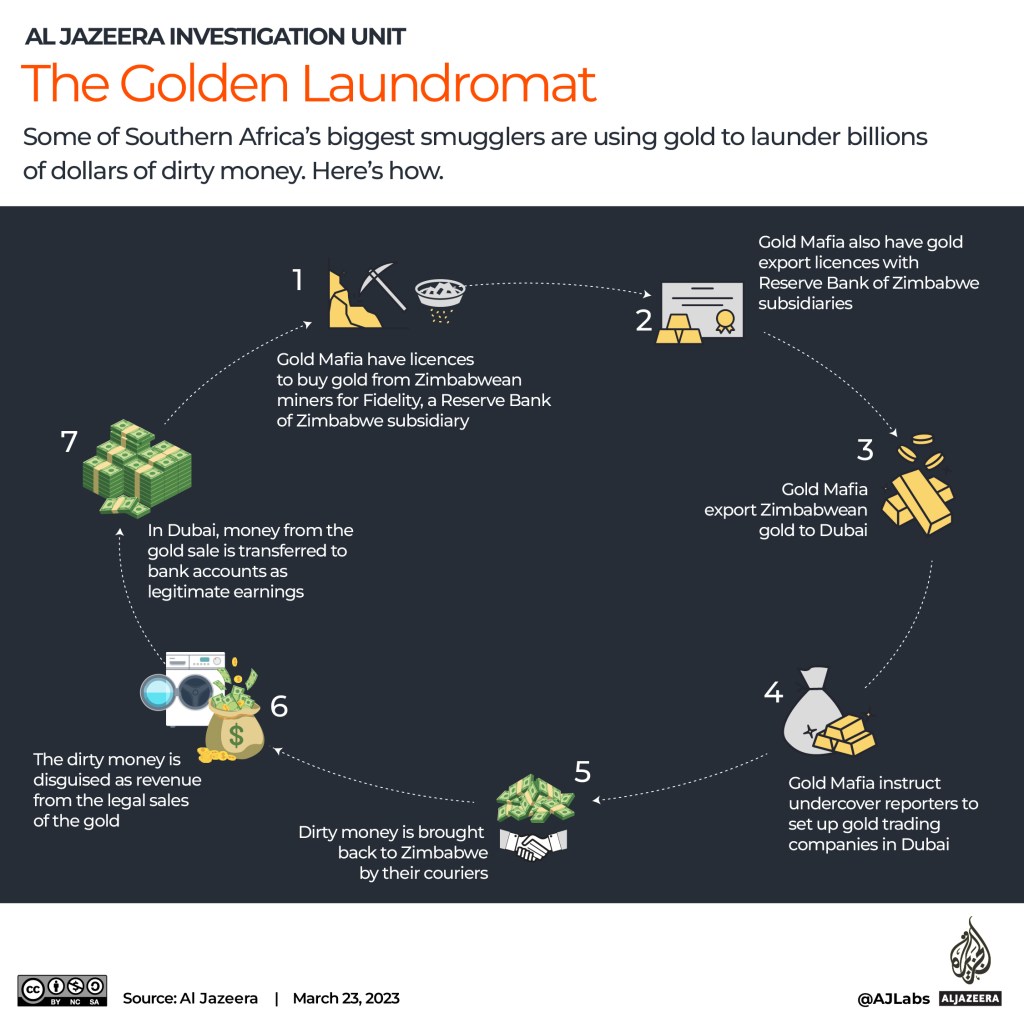
    The investigation reveals how millions of dollars worth of gold is smuggled every month from Zimbabwe to Dubai, allowing criminals to whitewash dirty money through a web of shell companies, fake invoices and paid-off officials.

    The investigation also shows how Zimbabwe President Emmerson Mnangagwa’s government is systematically using gold smugglers to get around the chokehold of Western sanctions imposed on the country. The money laundering and gold-smuggling schemes involve one of Zimbabwe’s most influential diplomats, and go all the way up to the president and his circle.

    The smugglers include millionaires, one of whom was accused of almost bankrupting Kenya through a similar, corrupt scheme also involving gold.

    Gold smuggling, money laundering

    Posing as criminals from China looking to launder more than $100m, Al Jazeera’s undercover reporters managed to gain access to these smugglers and gangs.

    Zimbabwe is a key player in these operations. Gold accounts for almost half – at least $2bn – of the country’s exports. But the nation faces a strict international sanctions regime, and even though its gold trade is not in itself banned by the West, the broader strictures against Zimbabwe make it harder to export the precious metal through official channels.

    However, using a web of companies and patronage from some of Zimbabwe’s most powerful individuals, smugglers have turned those constraints on trade into an opportunity to launder millions of dollars and help the government in Harare get around some of the consequences of sanctions.

    The process is as simple as it is cunning: Criminals from around the world with large volumes of unaccounted cash can give that money to the Zimbabwe government, directly or through smugglers. The Zimbabwe government desperately needs US dollars since the county’s own currency has little international value following years of hyperinflation.

    In exchange, launderers get clean, legitimate cash — from the sale of Zimbabwean gold — transferred to their bank accounts.

    ‘Good washing machine’

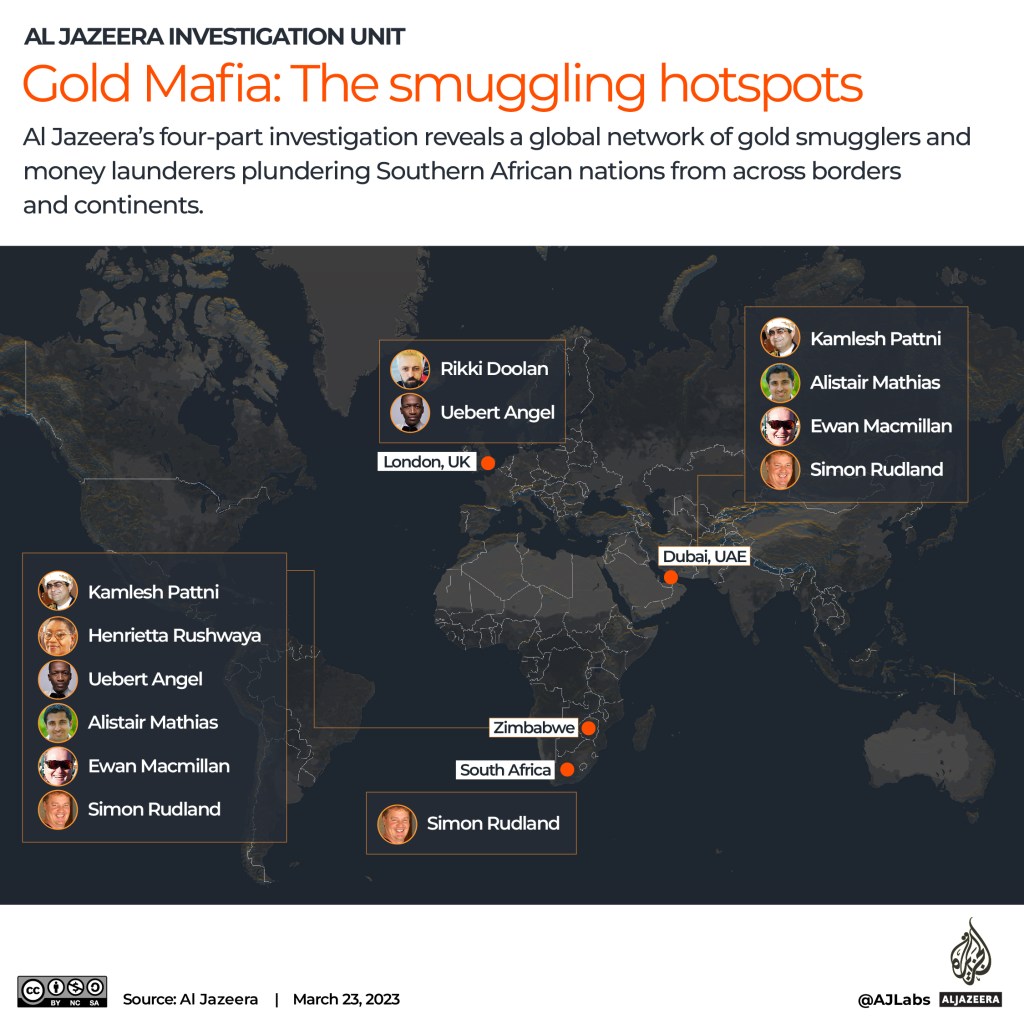
    One of the smuggling operations the I-Unit encountered was led by Uebert Angel, Zimbabwe’s ambassador-at-large to Europe and the Americas. Angel was appointed personally by President Emmerson Mnangagwa with the responsibility of securing global investments for Zimbabwe, and is one of the country’s most influential diplomats.

    Angel, who is also a prominent pastor, works with his deputy, Rikki Doolan. The duo made an offer to Al Jazeera’s undercover reporters that Angel could use his diplomatic cover to smuggle dirty money into Zimbabwe. That cash would then be used to buy Zimbabwean gold with the help of Henrietta Rushwaya, president of the country’s mining association and a niece of Mnangagwa.

    “It’s a good washing machine, right?” Doolan said, a smile on his face, while speaking with Al Jazeera reporters.

    Angel and Doolan, who met the reporters in London, repeatedly claimed that the country’s president was on board with their plans. Angel had another laundering idea, too: He proposed using the unaccounted money to build a hotel near Victoria Falls, a popular tourist attraction in Zimbabwe.

    ‘It’s very clean that way’

    If access to power is the currency that Angel and Doolan peddled, gold is the calling card of a string of — at times rival — smuggling operations.

    One of the gangs is run by Kamlesh Pattni, a businessman who in the 1990s was accused of pocketing hundreds of millions of dollars belonging to the Kenyan exchequer through a gold smuggling scheme. He was charged but never convicted. Al Jazeera’s undercover operation shows that Pattni is now involved in a similar scam in Zimbabwe, exporting gold to Dubai and then laundering both the money and the precious metal.

    Pattni’s biggest competitor, a gold smuggler named Ewan Macmillan, also offered to help launder money for Al Jazeera’s reporters. Like Pattni, Macmillan uses a group of couriers to transport hundreds of kilos of gold per week from Zimbabwe to Dubai, where it is then laundered through a web of companies and false invoices. Central to Macmillan’s operations is his business partner Alistair Mathias, who advises clients on how to cleanse their dirty cash.

    Finally, Al Jazeera obtained details of how Simon Rudland, one of Zimbabwe’s richest men, launders money through both Zimbabwean and South African companies. Rudland is the owner of Gold Leaf Tobacco, one of Southern Africa’s biggest cigarette brands, especially on South Africa’s black market.

    These smuggling gangs have official licences from Zimbabwe’s central bank that allow them to sell the country’s gold in Dubai, documents accessed by Al Jazeera show. They are expected to return the proceeds from those sales to the central bank.

    Instead, Pattni, Macmillan and Matthias have a well-oiled money laundering mechanism in place. They told Al Jazeera’s undercover reporters to set up shell companies in Dubai that would serve as a front for the gold trade. The legitimate money earned from the sale of Zimbabwean gold in the emirate would be transferred to the bank accounts of these shell firms. And the smugglers would instead carry the dirty cash back with them to Harare, where they would deposit it with the central bank.

    “So, it’s very clean that way,” said Mathias, Macmillan’s partner.

    Kamlesh Pattni

    A gold smuggler involved in a scandal that robbed Kenya of 10 percent of its GDP in the 1990s moved his smuggling operation to Zimbabwe and Dubai.

    Kamlesh Pattni was involved in the so-called Goldenberg scandal, a gold smuggling operation that robbed Kenya of 10 percent of its GDP and led to charges of corruption against many members of then President Daniel Arap Moi’s government. After years of prosecution, Pattni was acquitted.

    Pattni, who later became a self-proclaimed pastor and sometimes goes by the name Brother Paul, is now running a similar scheme in Zimbabwe from his base of operations in Dubai.

    Undercover Al Jazeera reporters pretending to be Chinese criminals were offered several options by Pattni to launder more than $100m.

    He would do this by effectively turning the dirty money into gold that is exported from Zimbabwe to Dubai, where Pattni owns several gold-trading companies.

    Pattni exports gold bars and jewellery from Zimbabwe through his company Suzan General Trading, which gets paid an incentive by the government to sell gold overseas.

    The plan Pattni suggested would mean the dirty money, in US dollars, would be flown to Harare, where it would be declared as the proceeds of the gold exported by Suzan General Trading.
    That money is then used to buy gold in Zimbabwe, which would then be exported to one of Pattni’s Dubai based companies.
    Owning both the exporter in Zimbabwe and the importer in Dubai gives Pattni the opportunity to launder the money, which would then be paid into a Dubai bank account and would appear to come from legitimate gold trade.

    Pattni himself would take a 10 percent commission.

    ‘Always have the king with you’

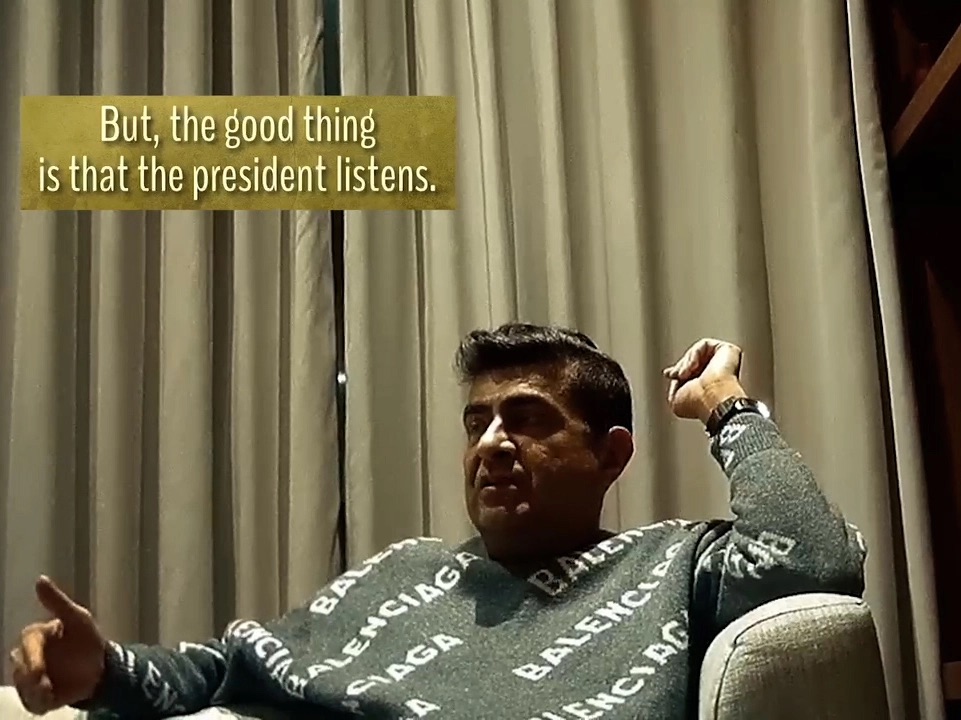
    During the secretly recorded conversations with Al Jazeera reporters, Pattni claimed that the country’s president, Emmerson Mnangagwa, was aware of his gold-smuggling and money laundering operations.

    When asked about Mnangagwa’s involvement, Pattni said: “He knows of course, yes. But he can’t, he will not talk too openly.”

    “When you work you must always have the King with you, the president.”

    Pattni showed several WhatsApp conversations he allegedly had with Mnangagwa, adding that “he has to be informed.”

    The scheme helps Zimbabwe secure large amounts of US dollars, a hard currency the country can then use on its internal and international markets at a time when its own currency has lost much of its global standing because of hyperinflation.

    Kamlesh Pattni once smuggled gold out of Kenya, now he is doing the same in Zimbabwe [Al Jazeera]

    Goldenberg scandal

    Since the 1990s, Pattni has cultivated close ties with several leaders all over Africa, and was quick to boast of that proximity while speaking with Al Jazeera’s reporters. He showed them photos of himself with former Libyan President Muhammar Gadaffi, former Zimbabwean President Robert Mugabe and ex-Kenyan presidents Daniel Arap Moi and Mwai Kibaki.

    His rise to power started in his home country Kenya — at a tailor’s shop in Nairobi. At a time when Western sanctions were strangling the country’s economy, Pattni told our reporters that he bumped into the East African nation’s head of intelligence while looking for a suit. He offered to bring in revenue in exchange for gold. Pattni claimed the intelligence officer took him to meet President Arap Moi.

    Pattni’s company, Goldenberg International, was granted an exclusive licence to export Kenyan gold, but instead, he smuggled gold from what is now the Democratic Republic of Congo.

    That gold was then sold abroad, while Pattni’s company charged the government a 35 percent commission. He said he was an “adviser” to Arap Moi, who was under growing domestic and international scrutiny over his refusal to allow multi-party elections.

    “In 1992, there was a lot of fights, riots in the street and they wanted [a] multi-party [system],” Pattni said. “We advised just make it multi-party because ‘the money is with you, you will still win [the election].’”

    “I help[ed] the president to survive.”

    After Arap Moi eventually left office in 2002, Pattni was charged with several counts of fraud in a court case that would drag on for more than a decade. Arap Moi and many members of his government were also implicated in the scandal, accused of receiving bribes from Pattni and his aides. But Pattni was eventually acquitted — and no one has been convicted in the scandal.

    When asked to explain the revelations emerging from Al Jazeera’s investigation, Pattni denied any criminal wrongdoing in Kenya and emphasised that he had never been convicted in relation to his activities in that country. He denied involvement in any kind of money laundering or sanctions busting, as well as employing anyone to smuggle cash or offering to deal with funds he knew originated from illegal sources. He said that when he met with Al Jazeera’s undercover team, he thought he was meeting with an investor who wanted to buy a stake in hotel businesses and “to divest of a portfolio in China into gold buying and mining in Zimbabwe”.

    (Al Jazeera IU).

  • Pattni winning against CBK in Laico Regency dispute

    Pattni winning against CBK in Laico Regency dispute

    A company belonging to Goldenberg mastermind Kamlesh Pattni has persuaded the Supreme Court to determine its dispute with the Central Bank of Kenya (CBK) over a multi-million shilling claim linked to sale of Laico Regency Hotel.

    Five Supreme Court judges led by Deputy Chief Justice Philomena Mwilu agreed with Westmont Holdings that its suit is of public importance after the company was instructed to deposit Sh20 million before pursuing the claim against CBK.

    Westmont Holdings acted on behalf of a Malaysia-based Lynwood Development Limited to pay Sh185.5 million to the bank’s regulator in April 1997 which was a 10% deposit for the purchase of Laico Regency (formerly Grand Regency Hotel) but the interest accrued.

    The hotel was later sold to Libya Arab Investment Company (Laico) forcing Westmont to sue seeking refund of the Sh185.5 million and the interest.

    Westmont is accusing the CBK of defrauding it of Sh185 million over the failed sale of Grand Regency hotel which is now Laico Regency Hotel but CBK argues that Mr Pattni paid the money to offset a loan he owed the regulator.

    The new twist and vigorous challenge by the regulator has now set the stage for another heated legal battle which will once again cost the taxpayers heavily.

    CBK will be forced to pay Sh2.8 billion if the Supreme Court rules in favour of the Pattni owned firm.

    But the firm had lost a similar bid in July at the Court of Appeal where judges rejected their application challenging the requirement to deposit the amount within 45 days.

    Westmont, however, got a reprieve after the five judges of the Supreme Court agreed to hear the case stating the court needs to determine whether an order for security for costs is unreasonable as it impedes a litigant’s access to justice, by imposing a condition before being heard which is against the law.

    CBK argues that Westmont closed business in May 2002 and therefore lacked the capacity to start or conduct an appeal, either directly or indirectly through a lawyer or firm of advocates.

    The banks regulator is represented by senior counsel Philp Murgor who argued that there was no possibility of his client ever recovering costs awarded in the High Court and at the Court of Appeal if Pattni’s firm lost the appeal.

    He also added that Jasmine See, who filed an affidavit in support of Westmont, is a foreigner who does not reside in Kenya and holds multiple passports including that of US and Malaysia.

    But Westmont had contested the condition to deposit the amount as a ploy prohibit them from accessing justice and a contravention of Article 48 of the Constitution that requires the access to justice to be reasonable.

    Lynwood also told the court that it was aware of the CBK’s intention to sell the hotel from Mr Pattni and paid the 10% of the hotel’s purchase price.

    Pattni who is a major shareholder of export firm Goldenberg International, was at the architecture of a scam that involved re-exporting gold and diamonds.

    The scam cost Kenya more than $600m (Sh66.4 billion) between 1990 and 1993 with the former President Daniel arap Moi and his allies receiving huge kickbacks.

    Lynwood has maintained that Westmont was its agent and it remitted US $ 3, 700,000.00 to the CBK for the sale of the Grand Regency Hotel.