Over 100 Members of Parliament (MPs), alongside President William Ruto and Prime Cabinet Secretary Musalia Mudavadi, are heading to Addis Ababa, Ethiopia, to support former Prime Minister Raila Odinga’s bid for the African Union Commission (AUC) chairmanship.
The high-stakes election is set to take place during the African Union (AU) Summit on February 15-16, 2025.
Raila Odinga, a veteran Kenyan politician and former Prime Minister, is vying for the AUC’s top seat against two formidable candidates: Djibouti’s Foreign Minister Mahmoud Ali Youssouf and Madagascar’s former Foreign Minister Richard Randriamandrato.
The AUC chairmanship is a critical position responsible for driving the AU’s agenda, promoting continental integration, and addressing challenges such as conflict resolution, economic development, and climate change.
President Ruto’s active support for Raila’s candidacy underscores the significance of the bid for Kenya’s political landscape.
The bipartisan backing from leaders across Kenya’s political divide highlights Raila’s enduring influence and the strategic importance of the AUC role for the East African region.
A win for Raila would mark a historic achievement for Kenya, positioning the country as a key player in continental affairs.
Raila’s campaign has gained momentum in recent months, with reports indicating that he has secured endorsements from at least 28 African countries.
His platform emphasizes pan-Africanism, economic integration, and strengthening the AU’s capacity to address regional conflicts and humanitarian crises.
The Kenyan delegation, which includes lawmakers from both the ruling party and the opposition, is set to engage in last-minute lobbying efforts ahead of the election.
Raila and his team are scheduled to depart for Addis Ababa on February 12, where they will join other African leaders and delegates for the summit.
Regional Implications and Strategic Stakes
The AUC chairmanship election is not just a contest of personalities but also a reflection of regional dynamics and geopolitical interests.
East Africa, which last held the position in 2008 with Gabon’s Jean Ping, is keen to reclaim the seat. Raila’s candidacy has been endorsed by the East African Community (EAC), with regional leaders rallying behind him as a unifying figure with extensive experience in governance and diplomacy.
However, Raila faces stiff competition. Djibouti’s Mahmoud Ali Youssouf is seen as a strong contender, given his country’s strategic location and active role in regional security initiatives.
Madagascar’s Richard Randriamandrato, meanwhile, brings a wealth of diplomatic experience and has been campaigning on a platform of revitalizing the AU’s economic agenda.
Analysts suggest that Raila’s chances hinge on his ability to consolidate support beyond East Africa and address concerns about the AU’s effectiveness under his leadership.
“Raila’s bid is a test of Kenya’s diplomatic clout and his ability to navigate the complex politics of the AU,” said Dr. Amani Abou-Zeid, a political analyst specializing in African governance.
What’s at Stake for Kenya and President Ruto
For President Ruto, Raila’s success would be a significant political win, bolstering his administration’s standing both domestically and internationally. It would also signal Kenya’s growing influence in continental affairs. Conversely, a loss could be seen as a setback for Ruto’s diplomatic strategy and his efforts to position Kenya as a regional powerhouse.
As the AU Summit approaches, all eyes are on Addis Ababa, where African leaders will decide the future direction of the continent’s premier institution.
Raila Odinga’s bid represents not just a personal ambition but a broader aspiration for Kenya and East Africa to play a leading role in shaping Africa’s future.
Türkiye’s President Recep Tayyip Erdogan announced late Wednesday that Ethiopia and Somalia reached an agreement to solve the conflict between the two nations in Ankara-mediated peace talks.
“We have taken the first step toward a new beginning based on peace, cooperation between Somalia, Ethiopia,” President Erdogan said at a joint news conference with his Somalian counterpart Hassan Sheikh Mohamud and Ethiopian Prime Minister Abiy Ahmed.
Ankara’s fundamental expectation is to establish peace and stability “in this distinguished corner” of Africa between Somalia and Ethiopia, he added.
Türkiye believes the agreed-upon joint statement by Somalia and Ethiopia will establish a solid foundation for cooperation and prosperity based on mutual respect, he said.
Erdogan said Türkiye, Somalia and Ethiopia will plan future steps together and implement projects to boost regional peace and prosperity
He also praised Somalia’s president and Ethiopia’s prime minister for “reaching this historic reconciliation with great dedication” during the Ankara-mediated peace talks.
During the joint press conference, Erdogan emphasised the importance of the agreement for ensuring Ethiopia’s access to the sea, which is vital for its economy.
“I believe with the meeting we had today, especially with Ethiopia’s demands to access the sea, my brother Hassan Sheikh Mohamud will give the necessary support for accessing the sea,” he stated.
Ethiopian Prime Minister Abiy Ahmed reiterated that Ethiopia’s pursuit of secure maritime access is intended as a peaceful initiative that would benefit neighboring countries.
“We have addressed the misunderstandings that have occurred over the past year. Ethiopia’s desire for secure access to the sea is a peaceful venture and will benefit our neighbors; it should be viewed through the lens of collaboration, not skepticism,” he remarked.
Somali President Hassan Sheikh also highlighted the significance of this agreement in halting their differences, stating that Somalia is “ready to work with the Ethiopian leadership and the Ethiopian people.”
The leaders agreed to initiate technical discussions by February 2025, aiming to complete them within four months.
These talks will focus on establishing commercial arrangements that ensure Ethiopia’s reliable and sustainable access to the sea under Somalia’s sovereignty.
Ahmed hailed Türkiye for its efforts in resolving the Somalia-Ethiopia conflict during the talks.
Mohamud also hailed Türkiye’s efforts in resolving the perennial territorial and political conflict between Somalia and Ethiopia.
Somalia and Ethiopia fell out earlier this year after the Ethiopians announced plans to build a port in Somalia’s breakaway region of Somaliland, which has struggled to gain international recognition despite governing itself and enjoying comparative peace and stability since declaring independence in 1991.
Somalia is firmly opposed to Somaliland’s independence bid.
Landlocked Ethiopia, which has thousands of troops in Somalia to fight al Qaeda-linked insurgents, said it would officially recognise Somaliland’s independence in exchange for a strategic strip of land, near where the Red Sea meets the Indian Ocean.
The spat has drawn Somalia closer to Egypt, which has quarrelled with Ethiopia for years over Addis Ababa’s construction of a vast hydro dam on the Nile River, and to Eritrea, another of Ethiopia’s foes.
Turkey has close ties with both Ethiopia and Somalia, training Somalia’s security forces and supplying development assistance in return for a foothold on a key global shipping route.
Türkiye has been working to end tensions between the two countries.
Ethiopia emerges as Africa’s leading wheat producer, thanks to Prime Minister Abiy Ahmed’s push towards making Ethiopia a wheat-exporting nation.
The United States Department of Agriculture (USDA) reports that Ethiopia’s wheat production for the 2022/2023 season has increased by 27%, hitting a new high of 7 million tonnes. This significant rise from the previous 5.7 million tonnes results from favorable rainfall in the Ethiopian highlands. Following Prime Minister Abiy Ahmed’s March 2022 forecast of a 4 million tonnes harvest, Ethiopia’s wheat production now exceeds its domestic needs for the first time in decades, eliminating the necessity for imports and facilitating exports.
Positioned as the foremost wheat producer in sub-Saharan Africa, with an annual demand of approximately 9.7 million tonnes, Ethiopia has embarked on substantial efforts to boost wheat production and reduce reliance on inconsistent imports. Initiatives include the Agricultural Businesses Corporation distributing 25,300 tonnes of disease-resistant seeds adaptable to various environmental conditions for the March season.
Additionally, the Ministry of Agriculture advocates for cluster farming and offers subsidized fertilizers to increase production, aiming to meet local demands and extend supplies to neighboring countries. The USDA’s estimates are predicated on an 18% increase in the area cultivated, mainly under irrigation, now spanning 2.3 million hectares. Productivity is anticipated to climb by 8% from the previous year and 6% from the five-year average, reaching an unprecedented 3 tons per hectare. Prime Minister Abiy Ahmed has recently launched a national initiative in the Bale Zone, Oromia region, propelling Ethiopia into its wheat export phase, marking a significant step forward in the nation’s agricultural export goals.
Prime Minister Abiy Ahmed’s pivotal role in transitioning Ethiopia into a wheat-exporting country realizes a long-held aspiration. With successful off-season summer cultivation and cluster farming approaches, Ethiopia has begun its initial wheat exports, underscoring the nation’s commitment to enhancing its wheat production capabilities and establishing a landmark in Ethiopia’s agricultural progression.
Ethiopia’s recent agreement with the unrecognized state of Somaliland, granting it access to the Red Sea, is a move that has raised eyebrows across the international community. This controversial decision by Prime Minister Abiy Ahmed’s government, however, is just the tip of the iceberg in a series of domestic and economic crises plaguing Ethiopia.
Domestically, the Abiy regime has been accused of exacerbating ethnic tensions, particularly targeting the Amhara community and other ethnic groups. Reports of human rights abuses and ethnic violence have marred Ethiopia’s international image and raised questions about the government’s commitment to a cohesive, peaceful, and inclusive national identity. This internal unrest not only destabilizes the nation but also undermines its social fabric, further complicating the task of nation-building. This move by the Abiy regime can be interpreted as an attempt to shift focus from domestic issues. Ethiopia is currently grappling with internal conflicts and economic challenges, including human rights allegations in Amhara and Tigray and a recent default on its debts. By engaging in this agreement, the Ethiopian government seems to be diverting public and international attention away from these pressing issues.
The economic situation in Ethiopia is equally alarming. The country is currently in a state of default on its debts, a situation that reflects deep-seated economic challenges. The Ethiopian currency, the Birr, is facing the threat of devaluation amidst skyrocketing inflation rates. Such economic turmoil not only affects the day-to-day lives of Ethiopians but also casts doubt on the nation’s ability to meet its international obligations and maintain economic stability.
Additionally, the Ethiopian economy’s heavy dependence on foreign aid and donations adds another layer of vulnerability. With the international community increasingly concerned about the government’s human rights record and its handling of internal conflicts, there is a real risk that this vital lifeline could diminish. This would further exacerbate the economic crisis, leading to a vicious cycle of poverty and instability.
The decision to engage with Somaliland must be viewed within this broader context. While seeking access to the Red Sea is a strategic economic move for landlocked Ethiopia, aligning with an entity unrecognized by the international community adds to the nation’s growing list of geopolitical missteps. This not only provokes neighboring countries, particularly Somalia, but also risks alienating key international partners who are crucial for Ethiopia’s economic survival.
Furthermore, aligning with Somaliland could be seen as Ethiopia implicitly supporting its claim of independence, a stance that directly challenges Somalia’s territorial integrity. Somalia, which views Somaliland as part of its sovereign territory, has reacted strongly against this agreement. This has the potential to escalate tensions between Ethiopia and Somalia, and could even draw in other regional players, increasing the risk of a wider conflict.
The potential fallout from this agreement extends beyond diplomatic relations. The heightened tension could scare away foreign investors, wary of instability and unpredictability in the region. For Ethiopia, which is in dire need of foreign investment for its economic growth and development, this is a counterproductive outcome.
Moreover, the possibility of a regional conflict, with countries like Eritrea possibly supporting Somalia against Somaliland and Ethiopia, adds to the already complex and volatile situation in the Horn of Africa. Such a conflict could have disastrous consequences, further destabilizing the region and leading to a humanitarian crisis.
In conclusion, Ethiopia’s agreement with Somaliland, viewed against the backdrop of domestic ethnic strife, human rights concerns, and a precarious economic situation, reflects a risky gamble by the Abiy Ahmed regime. While the quest for Red Sea access is understandable, the method and timing raise serious questions about the government’s priorities and its understanding of regional dynamics. This move could exacerbate Ethiopia’s challenges, both domestically and internationally, potentially leading to further isolation, economic hardship, and instability. The government’s focus should instead be on addressing its internal issues, stabilizing the economy, and fostering a more inclusive and peaceful national environment.
(The author can be contacted for further comments or inquiries : [email protected])
Nearly half the world is on Facebook or one of its apps. The social media platform has revolutionised the way that humans communicate – but only now are we beginning to understand the consequences of this revolution. Fake news, conspiracy theories, hate speech, incitements to violence: these all thrive on Facebook, thanks to an algorithm that has been trained to prioritise shares and likes over our safety.
The Continent is the first African publication to obtain access to thousands of documents leaked by Frances Haugen, a former Facebook data scientist. These documents prove that Facebook knows that its platform can cause immense harm to the people that use it. They prove that Facebook has not done nearly enough to protect the people who use it – especially if those users happen to live outside of the English- speaking western world.
Ethiopia is a case study in how Facebook can inflame tensions and fuel real-world violence. But unless Facebook – and the other social media giants – change the way they operate, it may also be a sign of things to come everywhere else.
On August 30, nine months into Ethiopia’s brutal civil war, a Facebook user who goes by the name Northern Patriot Tewodros Kebede Ayo posted a clear incitement to violence on his page.
He accused the Qimant, an ethnic minority in Ethiopia’s Amhara region, of supporting the opposition forces. He called them “snitches”, and singled out the Qimant residents of Aykel, a small town in Amhara.
Writing in Amharic, he said: “The punishment has been imposed … the clean-up continues.”
Two days later, between September 1 and 2, more than a dozen Qimant in Aykel were dragged from their homes and butchered on the street, allegedly by members of the feared Fano militia – an Amhara nationalist paramilitary group that has been implicated in multiple atrocities. This was reported at the time by Al Jazeera, and two sources have independently confirmed this account to The Continent.
On September 1, users on another Facebook account – a page called “The Fano Patriotic People’s Radical System Change” – joined in the online lynch mob: “No mercy for the Qimant,” one post said, even as the killings in Aykel were happening. Another user on the page had previously, in May 2020, laid out a 14-page road map on how to organise the Fano militia, with both violent and non- violent options.
There is no evidence that there is a direct causal link between these Facebook posts and the massacre in Aykel. What we do know, however, is that Facebook staff already knew about both of these accounts, and were worried about their potential to incite violence.
Months earlier, in a leaked internal document seen by The Continent, a team within Facebook had found that these accounts were key nodes in a major online disinformation network aligned to the Fano militia, codenamed Disarming Lucy.
According to Facebook’s own data, this network was co-ordinating “calls for violence and other armed conflict in Ethiopia”; and “promoting armed conflict, co-ordinated doxxing, recruiting and fund-raising for the militia”.
The Facebook team that had discovered Disarming Lucy recommended that all the accounts associated with it be taken down. This was in March 2021. But as of today, The Continent can reveal that every single one of those accounts is still active – and many are still spreading hate speech and inciting violence.
The Continent reached out to Facebook for comment on this and other issues raised in this article, but received no response prior to publication.
The algorithm is the problem. Between Facebook, Messenger, WhatsApp and Instagram, more than 3.6-billion people regularly use one of Facebook’s apps (the company has recently rebranded and is now known as Meta). Ironically, for a company that is built on the sharing of personal information, Facebook’s inner workings have always been relatively opaque. Until now.
In May 2021, a data scientist named Frances Haugen resigned from her job with Facebook’s civic integrity unit. That’s the unit, based in Facebook’s San Francisco headquarters, that was supposed to monitor – and, crucially, mitigate – all the ways in which Facebook causes harm, including the spread of hate speech and disinformation on the platform. It was disbanded in the wake of the American election last year.
Haugen had grown increasingly disillusioned with Facebook, coming to believe that it was putting profit ahead of providing users with meaningful protection.
Before she left the company for good, Haugen took more than 10,000 documents with her. She copied them by taking photos of her computer screen – in some of the documents, her silhouette is even visible in the reflection.
She shared these documents first with the United States Congress, and then with the Wall Street Journal.
Now she’s shared them with a small
consortium of journalists from around the world, including The Continent, which is the only African newspaper represented. The documents are drawn largely from the civic integrity unit and Facebook’s internal workplace forum.
They paint a damning picture of a company that understands exactly how dangerous its platform can be – but which has repeatedly failed to take actions to make it safer, especially outside of the US. Haugen describes herself as “an algorithm person”. She is an expert in the intricacies of Facebook’s back-end, rather than the political complexities of individual countries, which gives her an insider’s perspective on how hate speech spreads so wildly on the platform.
The key point, confirmed in a number of internal experiments, is that content that is inflammatory and extreme is more likely to go viral, generating what Facebook calls Meaningful Social Interaction (MSI) – a metric that measures reach and impact on Facebook (and which is central to how Facebook makes money).
Most of Facebook’s features are designed to maximise MSI, which means that the algorithm has a tendency to promote extreme content.
Or, in Facebook-speak, according to one leaked internal memo: “Analyses consistently document that harmful content and low quality Producers disproportionately garner distribution from unconnected reach compared to benign content and high quality Producers.” And, from another leaked document: “It’s no secret Facebook’s growth-first approach to product development leads us to ship risky features.”
In other words: it appears that the prevalence of hate speech and disinformation on Facebook is not a bug. It’s a feature. An unprofitable trade-off
There are, broadly, two ways in which Facebook can tackle this problem. The first is by tweaking the way Facebook works, to make it harder for people to share problematic content. These changes can be subtle, but have an enormous impact nonetheless.
Guards oversee food aid being delivered to local communities in the wake of Ethiopia’s conflict with Tigrayan rebels in Chena, Ethiopia, on Oct. 10. JEMAL COUNTESS/GETTY IMAGES
One change favoured by Haugen is to make it more difficult for Facebook users to reshare content from people who are not in their friends list. Currently, it’s as easy as pressing the share button, which requires little effort or thought. Internal experiments have shown that disabling the share button in these contexts leads to an instant, dramatic reduction in the spread of fake news and hate speech. Users are still free to reshare the content, but they have to copy and paste it to do so – and even this minimum level of effort makes most people think twice.
Technical solutions like this work across different countries and languages. It’s a quick, comprehensive fix. The only problem, as far as Facebook is concerned, is that it also has a strongly negative impact on MSI: people share things less, they like things less, they engage less. In a briefing with the civic integrity team, the notes of which are among the leaked documents, Facebook CEO Mark Zuckerberg makes his position clear, directing the team not to go ahead with any changes “if there was a material trade-off with MSI impact”.
This left the civic integrity team with an impossible task, according to another document. “…integrity teams spend months searching for win/wins – pro- safety features that are also pro-growth. But there’s the thing: these solutions- without-downside almost never exist.”Or, as Haugen put it in a briefing with journalists on Thursday: “Facebook knows how to make these harms better. But they also know that no one can catch them. So they keep falling on the side of profits.”
Underfunded and understaffed
The second option available to Facebook is to tackle hate speech and disinformation on a case-by-case basis, using a combination of human moderators and machine learning to analyse individual posts. This approach requires enormous financial and human resources, which Facebook appears to be reluctant to commit outside of the United States.
For Ethiopia, for example, two sources told The Continent that there are fewer than 100 people working on content moderation across the four Ethiopian languages that are supported by Facebook (Amharic, Oromo, Somali and Tigrinya). With some 6.4-million Ethiopians on Facebook, this works out to less than one moderator per 64,000 people.
To compound the problem, the vast majority of Facebook’s spending is directed towards the US. According to financial records, in 2020 just 13% of the company’s budget to combat misinformation went to countries outside of the US – even though these countries account for 90% of Facebook’s user base.
Nor is machine learning an effective solution. Not at the moment, anyway. Timnit Gebru, a computer scientist who studies algorithmic bias, told The Continent that major errors can happen when computers are responsible for translating and assessing content for languages they do not prioritise.
“You have to have people who are following, investigating and understanding the context very clearly, like journalists. However, the social media platforms working on this don’t seem to have that.”
“Facebook needs to do better as far as content moderation on the continent goes,” said Eric Mugendi, Africa programme manager at Meedan, a tech non-profit that aims to improve the quality of online discourse. “Additionally, the platform needs to allocate more resources to local languages that are spoken widely in the continent and used on the platform, but are not properly monitored for potential harm. They need to acknowledge the real world harm that their inaction has led to, and much more needs to be done.”
Violating community standards
In Ethiopia, a country engulfed in a civil war that has been characterised by multiple accounts of massacres and atrocities, that real-world harm is all too visible.
Earlier this month, Facebook deleted a post by Prime Minister Abiy Ahmed that called on citizens to “bury the terrorist TPLF”. The post violated its community standards against inciting violence, the company said. (If anyone understands the power of Facebook, it is Abiy: he was swept into power on the back of the grassroots, youth-led Qeerroo movement, which was itself enabled and then supercharged through Facebook).
But even more explicit posts by other prominent figures remained online. Berhan Taye, a digital rights researcher and activist, personally reported one post by media personality Mesay Mekonnen, which called for all Tigrayans to be placed in concentration camps. Multiple media reports confirm that Tigrayans in Addis Ababa are currently being rounded up and held in detention facilities around the capital.
Taye was told by Facebook that the post was reviewed, but “doesn’t go against one of our specific community standards”. Only after she escalated her complaint, using her own connections within Facebook, was the post removed.
The problems Ethiopia is experiencing are mirrored elsewhere in the developing world, Taye told The Continent. “[Facebook claims] less than 10% of Ethiopians use Facebook, implying investing in a place like that doesn’t make sense. But when you look at markets like India, Philippines or Brazil where Facebook has over 500-million users, Facebook has equally failed. Either they don’t care, or don’t know the impact the platforms have and are figuring out things after they have transpired.”
‘We are still blind’
“People across Africa should be concerned about Facebook’s poor handling of the Ethiopa crisis because it is indicative of the quality of the response we are likely to see in other African countries,” said Rosemary Ajayi of the Digital Africa Research Lab.
Facebook – or rather Meta, now – insists it is taking its responsibilities in Ethiopia seriously. In a statement on Tuesday, the company said that “for more than two years, we’ve been implementing a comprehensive strategy to keep people safe on our platform given the severe, long-standing risks of conflict”.
But the leaked documents tell a different story. As of December 2020, Ethiopia was categorised as having the weakest level of protection among the countries the civic integrity team had identified as at risk. In an attached rubric, this level is described as: “We are still blind to the extent of the problem”.
And basic safety features that are available to US and western audiences are not available to many Ethiopian users, the same document shows; despite the clear risks, Ethiopian users are without protection against misinformation, civic harassment, civic spam and fake accounts.
This leaves them vulnerable to the kind of inflammatory rhetoric that accompanied the massacre in Aykel, and has been a consistent, hate-filled soundtrack to Ethiopia’s civil war.
Rebel fighters in the Tigray region of Ethiopia have taken control of the regional capital Mekelle from government troops which have since called for a ceasefire.
Ethiopia announced a “unilateral ceasefire” in Tigray on Monday after the rebels seized the city of Mekelle.
The government said it was pausing its operations in the region to avoid disruptions to the farming season and distribution of humanitarian aid to the starving citizens.
The rebel fighters have also gained control of the town of Shire which is about 140km to the north-west. The take over comes after Eritrean troops backing the Ethiopian army abandoned the city.
The eight-month fight between the Tigray People’s Liberation Front (TPLF) and government forces has claimed thousands of lives, millions displaced and up-to 350,000 exposed to famine.
Mekelle has been under the control federal army since November 28, three weeks after fights broke out with the Ethiopian Prime Minister Abiy Ahmed launching attacks on rebel fighters for killing federal troops.
Supporters of TPLF fighters celebrating the rebel take over of Mekelle town [p/courtesy]But the fights between the pro-Tigray Peoples Liberation Front forces – and the government forces never stopped even with capture of the Tigray capital. Only a few scenes of jubilation were seen in the streets of Mekelle on Tuesday, a day after it fell in the hands of the rebels.
“The city is celebrating, everyone is out dancing,” confirmed the interim administration member. Everyone is excited, there is music in the streets. Everyone has their flags out and the music is playing. I don’t know how they got them, but everyone has fireworks,” a resident told AFP.
And fights are still expected to continue after Getachew Reda who speaks for the rebels told Reuters that their fighters would “destroy the enemy” by crossing into Eritrea and the Ethiopian region of Amhara where militants are backing government forces.
Rebels are taking control of Mekelle after the last bunch of officials from the regional interim administration left the town on Monday. Local media reported that soldiers and federal police were also fleeing the city as the rogue ones looted banks and harassing locals.
Government forces broke into a UNICEF office in Mekele on Monday and confiscated satellite equipment used in carrying out humanitarian work.
“The members of the Ethiopian military entered our office premises in Mekelle ……. and they confiscated our satellite equipment, which we still haven’t recovered up to this point” Victor Chinyama, UNICEF’s Ethiopia Chief of Communications said.
The first Dollar Billionaire in Zimbabwe, 58-year-old Strive Masiyiwa who, according to FORBES estimates has a net worth of $2.8 billion, has said that Digital technologies present opportunities for developing nations to build new industries and deliver better services.
Earlier this week, Pathways for Prosperity released a report( that we have highlighted in this article) ascertaining that only 30 per cent amongst 80 per cent of people in developing countries who live under a cellular network have ever used the internet.
Speaking during the launch of the report, Billionaire Strive Masiyiwa, who’s also the Econet’s founder said that;
“Digital technologies offer powerful tools to grow businesses and nations, enabling entrepreneurs to access markets and gives governments innovative ways to deliver better services.”
In the report titled The Digital Roadmap: how developing countries can get ahead— 26 recommendable steps on how nations can use to harness new technologies to deliver development to their citizens are highlighted.
Here is the report courtesy of Pathways for Prosperity.
Key Findings
This is a critical moment in history. Some countries will prosper in a new global digital economy, but countries that are not ready will risk being left behind.
Countries have the agency to act now. The Digital Roadmap identifies five priority areas for countries to create their own digital future.
Technology will not guarantee success, no matter how innovative it is. Just as important as new technology is the social and economic environment in which technology is used.
Technology will almost always be a force for growth, but technology is not automatically a force for inclusion. Without a ddeliberate effort to include everyone, digital technologies can end up entrenching existing inequality.
Government, civil society and the private sector should come together to craft a shared national vision. Everyone has a role to play in major economic transformation.
With new digital technologies come opportunities for low and middle-income countries to diversify their economies, create new jobs, transform agriculture, and improve health and education. But digital technologies can also entrench exclusion and disrupt peoples’ livelihoods. This report, based on two years of research and analysis, is underpinned by learning and extensive engagement with policymakers, entrepreneurs, civil society and academics from around the world.
Five priorities to get ahead in the digital age
The Digital Roadmap presents an overarching vision for a globally connected world that both delivers on the opportunities presented by technology and limits downside risks. Importantly, it also sets out how this vision can be achieved.
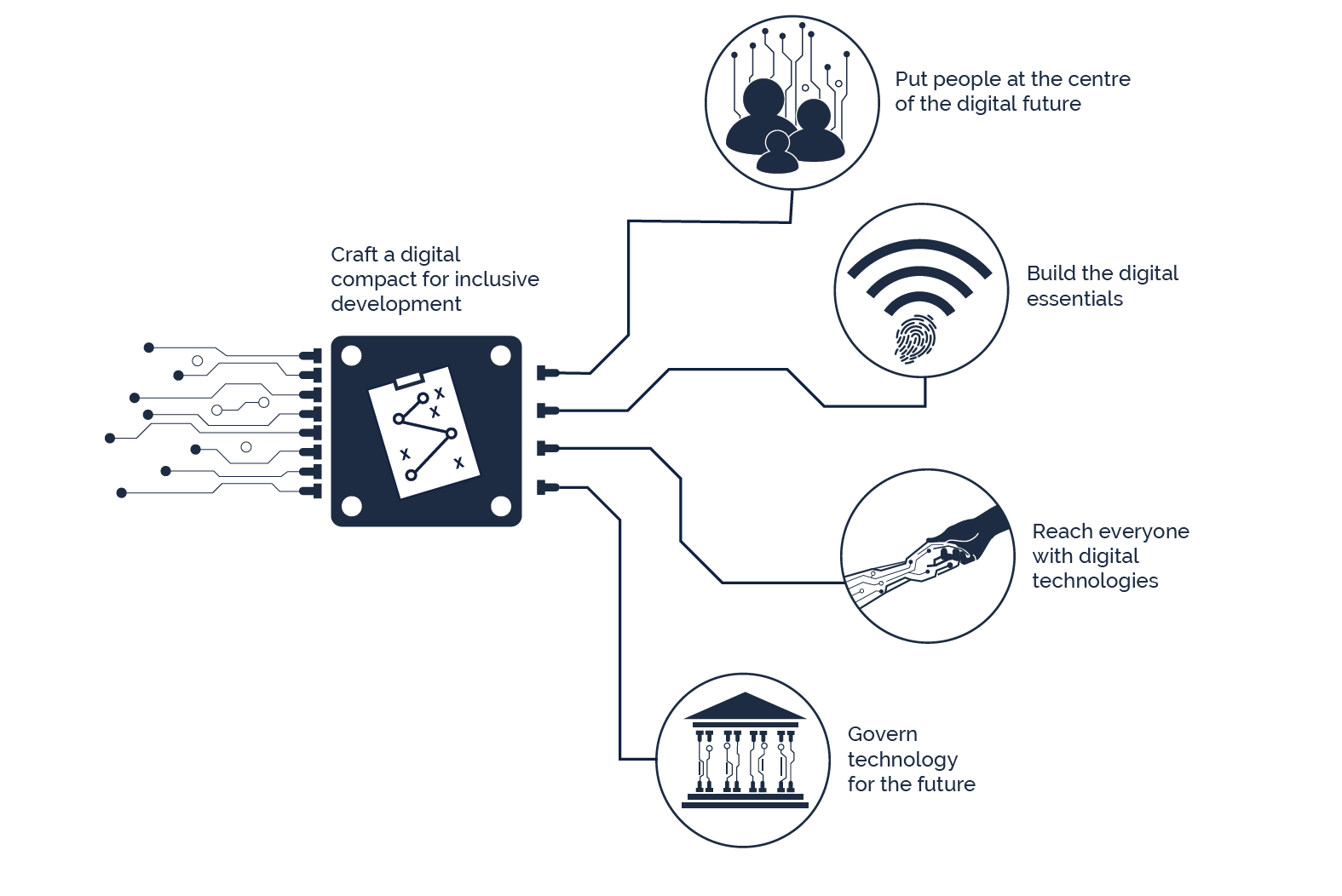
Craft a Digital Compact for Inclusive Development
Embracing country-wide digital change will be disruptive. Navigating it requires coordinated action. Reconfiguring an economy will result in some resistance. The best way to achieve buy-in, and to balance trade-offs, is through dialogue: the private sector and civil society in its broadest sense (including community leaders, academia, trade unions, NGOs, and faith groups). The political economy of upheaval is difficult, but change can be managed with discussions that are inclusive of multiple groups. These dialogues should result in a national digital compact: a shared vision of the future to which everyone commits. The Pathways Commission has supported three countries – Ethiopia, Mongolia and South Africa – as they each developed country-wide digital strategies, using the Digital Economy Kit.
Put People at the Centre of the Digital Future
Rapid technological affects peoples’ lives.Failure to put people at the centre of social and economic change can lead to social unrest. The pace and intensity of change means it’s all the more important that people are at the centre of the digital future – not the technology. This requires equipping people to benefit from opportunities, while also protecting them from the potential harms of the digital age. Governments should take responsibility for ensuring that vocational education is truly useful for workers and for business in the digital age. The private sector needs to be involved in keeping curricula up to date.
Build the Digital Essentials
Digital products and services cannot be created in a vacuum – essential components need to be in place: physical infrastructure, foundational digital systems (such as digital identification and mobile money), and capital to invest in innovation. These are the basic ingredients needed for existing firms to adopt more productive technologies, and for digital entrepreneurs to build and innovate. Having reliable infrastructure and interoperable systems means that firms and service providers can focus on their core business, without having to build an enabling environment from scratch.
Reach Everyone with Digital Technologies
If technology is to be a force for development for everyone, it must reach everyone. Just over half of the world’s population is connected to a digital life; for the rest, digital opportunities don’t mean much. Without digital connections, people can’t participate in digital work platforms, benefit from new technologies in education, or engage with government services online. Women, people with lower levels of education, and people in poverty are usually those who lack digital access. Reaching everyone requires looking beyond current business models. The private sector needs to design for inclusion, ensuring the poorest and most marginalised consumers, to ensure they are not left even further behind.
Govern Technology for the Future
The unprecedented pace of change and the of new risks in the digital era (such as algorithmic bias, cybersecurity, and threats to privacy) are creating headaches for even the most well-resourced countries. For developing countries, the challenges are even bigger. Digital technologies fundamentally shape what people do and how they do it: freelancers may face algorithms that determine chances to get hired. Banks might face a financial system with heightened risk from new, non-bank deposit holders. These issues and many others require new and adaptive approaches to decision-making. Emerging global norms will need to consider the needs of developing countries.
The Pathways for Prosperity Commission works to create conversations and to encourage the co-design of country-level solutions aimed at making frontier technologies work. The commission’s efforts are aimed at helping the world’s poorest and most marginalised men and women.
Pathways Commission reports that it has piloted the Digital Economy Toolkit in Ethiopia, Mongolia, and South Africa as a foundation for their national digital strategies. The panellists at the launch insisted on training on 21st-century skills to accommodate Africa’s growing labour force. According to research, it is estimated that by 2030, the labour force will grow by 285 million.
The billionaires also urged the governments to develop a ‘National Digital Compact’ to guide digital transformation and navigate the impacts that technologies are having on their societies and economies.
In Kenya for instance, such a move will mean empowering citizens with digital skills, giving them access to digital platforms, and providing a social safety net for those whose livelihoods are disrupted by technological change. Not imposing useless social media tax or registering social media users so that the government can dictate what Netizens have, are and will be doing on their independent platforms.
DCI sleuths have officially started investigations into an alleged postpaid billing fraud at Kenya Power.
On 27th of June, DCI had summoned 200 Kenya Power staff and customers summoned to record their statements at its headquarters.
According to DCI director George Kinoti, millions of monies were lost through a collusion between the staff, brokers and over 5,000 customers.
Those directors at KPLC and private companies implicated will report to the DCI headquarters on diverse dates in July for further questioning.
A source at DCI headquarters told this site that Tens of the suspects have already recorded their statements with DCI detectives.
Fraud cases have hit most of state-owned parastatal.
This is not the first time senior managers at KPLC are being arrested and questioned.
July last year, KPLC managing board was arrested over the procurement of defective transformers and the irregularities in pre-qualifying 525 companies.
18 Kenya Power staffs were dismissed after an audit report revealed that 350 out 500 contractors did not meet the set criteria.
Government auditors recommended investigation of 19 Kenya Power employees that had shortlisted companies registered by their cronies and relatives.
Kenya Power has been at the center of corruption for ages, last year, KPLC spent 15 times more to buy power from Independent Power Producers (IPPs) compared to Kengen.
Kenya Power’s electricity purchase costs summary for 2018 seen by this site records that KPLC spent a total of Sh64.8 billion to buy 10.7 billion kilowatts of power from 19 producers up from Sh60.4 billion in 2017.
Kengen was the biggest beneficiary of which they sold 7.9 billion kilowatts at Sh37.02 billion.
Our checks reveals that Kenya Power bought a kilowatt of power from Triumph Power Generating Company at a cost of Sh69.26 compared to Sh4.63 from Kengen.
Other IPPs including Gulf Power Limited sold a kilowatt at sh26.34, Iberafrica Power at 16.96, Power Tecnology Solution at sh14.70 and Tsavo Power sold a kilowatt at Sh11.77.
Also Orpower 4 Inc, a subsidiary of Israel owned, OrmatTechnology, a firm listed on New York Securities Exchange sold 1.18 billion kilowatts to Kenya Power which earned them Sh11.4 billion.
This means Orpower 4 inc sold a kilowatt at Sh9.68, more than double that of Kengen.
Ethiopia sold 18.3 million kilowatts to Kenya at Sh27 per unit and Uganda 1.26 billion kilowatts at Sh6.54 per unit.
This is, amongst other irregularities that the DCI are investigating, is what saw KPLC Managing Director Ken Tarus suspended.
Our investigators checks reveals a list of the most notorious companies on the DCI’s radar;
Moi University Campus (North Rift), Safaricom Investments Co-op Society Ltd, Nairobi Womens Hospital, Uchumi Supermarkets (North Rift), Holy Cross Fathers (Nairobi North) and Dandora Catholic.
Detectives will also question the involvement of Sasini Coffee House Limited, Turbo Highway Eldoret, Eldoret Polytechnic, Franscisca Sisters of Anna (Western Kenya) and Seventh Day Adventist Church, South Nyanza on the billing fraud.
Here is the full list of those summoned by the DCI
PRESS RELEASE || INVESTIGATIONS INTO ALLEGATIONS OF FRAUD IN KENYA POWER BILLING SYSTEM( POST PAID).1/3
The following Company Directors and individuals to report without fail to @DCI_Kenya Headquarters~Investigations Bureau(Block B) as per the dates indicated. pic.twitter.com/VCofgqg4wV