Tag: Donkey

  • Chinese Donkey Abattoir In Turkana On The DCI Radar Over Pollution, Animal Theft And Racial Harassment

    Chinese Donkey Abattoir In Turkana On The DCI Radar Over Pollution, Animal Theft And Racial Harassment

    Three weeks ago, Kenya Insights wrote about why the Population of donkeys in Kenya has dropped by half in less than a decade. China interests in Kenya has seen an increase in demand for donkey meat both for local consumption and skin for export to China a move that has now caused a sharp decline in the animals in Kenya.

    According to Animal rights activists, the overgrown demand to feed the billion population of Chinese could soon make donkey extinct in Kenya where they play a vital role as beasts of burden mostly in rural areas.

    Image result for Silzha Company Limited

    A few weeks after, a Chinese company operating a donkey abattoir in Lodwar, Turkana County is on the frying pan for selling uninspected donkey meat and enslaving local workers.

    Angry Lodwar, Turkanas, resident have now urged the police to investigate Silzha Company Limited over claims of environmental pollution and mistreatment of local workers by the Chinese bosses. The firm is located at Napetet in Turkana Central,  five kilometers from Lodwar town, and is run by two Chinese nationals.

    According to local authorities, Silzha slaughters an average of 30 donkeys daily and exports the donkey meat to China and other countries.

    “It is more than one a year and some of us have not been paid. I don’t have any source of money.  We have been patient for a long time to the extent the walls of trust have started cracking. Donkeys from Sasame, Karebur,  Kokuro, and Lomanakeju in Turkana North have not been paid for since last year.  We have reported the issue to police station Lodwar OB 18/20/05/2019,” Mohammed Katembo, a field Manager of Silzha Limited said.

    “Life is becoming hard here because we work with no pay, my family depends on me, my children are at home because of school fees, we are tired of empty promises each and every time,” Production supervisor Lucas Ereman stated. 

    Pieces of donkey meat packed in trays before transportation. [Bakari Ang’ela, Standard]

    There have been also a lot of concerns on the safety of the meat. “We are giving government investigative agencies one week to ensure that this Chinese company is investigated and health measures put in place to guarantee the safety of meat and food handling, failure to which we will hold demonstrations” Joseph Emuria, a resident warned.

    Emuria said the slaughterhouse has led to the theft of donkeys across the county as unscrupulous people rush to supply animals to the fast-growing abattoir.

    “I foresee the extinction of donkeys in future if these the Chinese donkey meat dealers continue slaughtering the animals at this rate,” said Mr Emuria.

    He alleged that the company is exporting rotten meat to unknown destinations as public health officers take no action. The local residents led by their area chief Patrick Lorogoi also raised concern over increasing cases of donkey theft in the area. Lorogoi said complaints of donkey theft have been reported to the police who have launched investigations.

    “We suspect that the Chinese are buying stolen donkeys unknowingly. We have established that they don’t ask for livestock movement permits, but that is a matter under investigation,” the Chief reported.

    He said he has received complaints from several residents working as casual labourers in the Chinese firm who claim they have been working without payments for several months.

    “There are several Chinese nationals doing manual jobs in the abattoir and we suspect they are illegal immigrants. We have asked the police to investigate them but no action has been done. We have been demanding for our pay for more than three months but they have refused to release our dues,” a worker in the abattoir who declined to be named for fear of victimization alleged.

    On their defense, Liu Wenchen and  Jiang Baogui, the Chinese nationals managing the abattoir denied the claims, saying they export quality donkey meat.“We package and sell all the meat to our international markets. We don’t want wastage because we buy the donkeys at high prices,” he said.

    But inside, workers were busy loading donkey meat in carton boxes amid a stinking smell of meat. There are no refrigerators to store the meat awaiting export.

    “We are not happy with the manner in which the Chinese are doing the donkey meat business. We have reported this matter to relevant government officers but our concerns have fallen on deaf ears.” A donkey keeper Geoffrey Lokuruka said.

    Turkana Central sub-county Police Commander David Mburukwa said police are investigating six Chinese labourers working in the abattoir after complaints that they were in the country illegally.

    “For now, we are not looking into the complaints raised by locals working in the abattoir because that is a labour issue and can be handled by other organs,” Mburukwa said.

    However, company manager Liu Wanchen said the firm was facing financial challenges and promised that they will be paid soon. Ironically,  Liu acknowledged that they usually export spoilt meat to avoid unnecessary losses because they buy animals at higher prices.

    Turkana Veterinary Doctor Benson Longo’r told The Standard the county was also investigating the abattoir for failure to adhere to health standards and Kenyan rules. He said the county department had previously warned the management against dealing in uninspected donkey meat.

    There are times we have stopped the company from slaughtering some sick donkeys that according to our assessment, their meat would be unfit for consumption,” he said.”Let them pack spoiled meat but they will not get transportation permit,”  he warned.

  • Donkeys Population In Kenya Has Gone Down By Half In The last Ten Years And Here’s Why

    Donkeys Population In Kenya Has Gone Down By Half In The last Ten Years And Here’s Why

    China interests in Kenya has seen an increase in demand for donkey meat for local consumption and skin for export to China a move that is now causing a sharp decline in the animals in Kenya.

    According to Animal rights activists, the overgrown demand to feed the billion population of Chinese could soon make donkey extinct in Kenya where they play a vital role as beasts of burden mostly in rural areas.

    Since 2014, four abattoirs have been set up in Kenya to meet demand. The meat is considered a delicacy in China and the skins are processed to create ejiao, a traditional remedy used to treat everything from anaemia to dizziness. However, according to a recent report by the African Network for Animal Welfare (ANAW), the slaughterhouses are operating at below half their capacity.

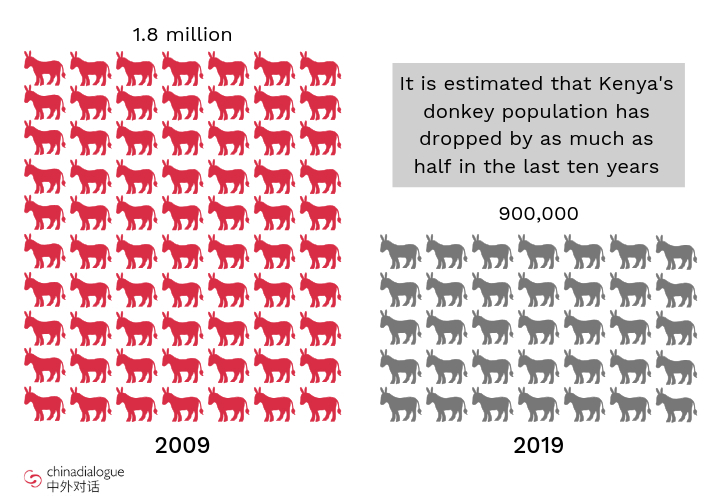
    The report, which was written earlier this year estimates that donkey numbers in Kenya have fallen by as much as half over the past ten years, from 1.8 million animals in 2009 to about 900,000 today.

    ANAW chief operations director Kahindi Lekalhaile warns that abattoirs are making the trade unsustainable by slaughtering too many animals. Donkeys are slow to reproduce, with a gestation period of 11-14 months.

    According to Joseph Ng’ethe, a water vendor who relies on his donkey to make a living, an animal can be sold for 15,000 to 25,000 Kenyan shillings (US$145-242), up from 6,000-8,000 shillings (US$58-78) four years ago. Male donkeys tend to fetch a higher price as do animals from areas near highways and towns.

    There is now a shortage of breeding males and an increase in thefts. Ng’ethe notes that in his area, 60 kilometres southwest of the capital Nairobi, there’s a new case of donkey theft each week.

    “During the day, we used to leave our donkeys alone in the fields to roam and graze freely, but not anymore. The risk of them being stolen is too high.” Ng’ethe said.

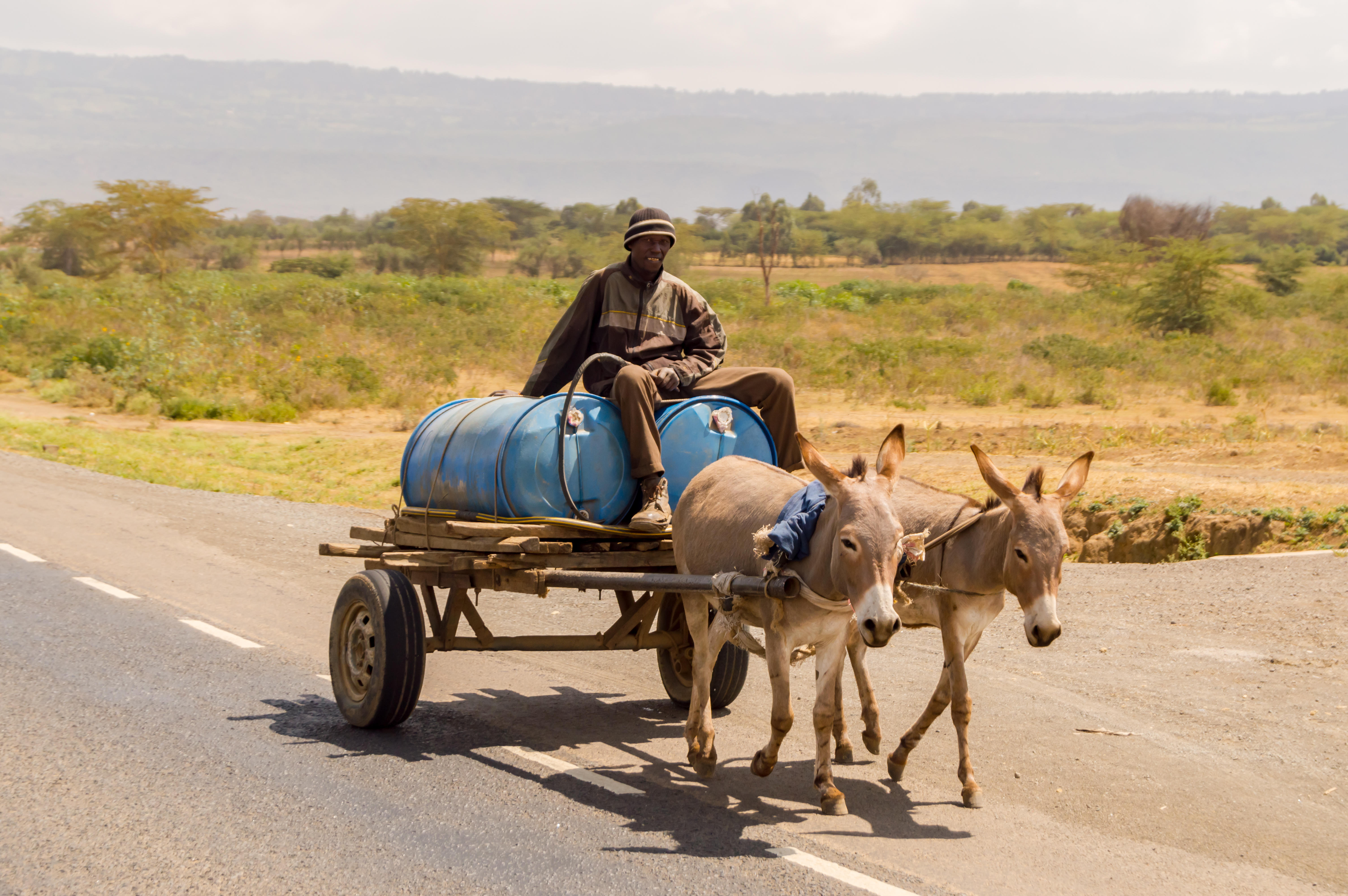
    Everyone who has grown or let’s say toured the Kenyan remote regions, donkeys play an even more vital role in everyday life. According to conservationist Noor Ali, donkeys are everything in the arid north where he’s based. With few roads, they are relied on to transport supplies such as food, water, firewood, and yes, even medicines.


    Delivering water in Kenya’s rift valley Photo courtesy.

    The popularity of ejiao in China has grown with the country’s prosperity. Marketing of healthy lifestyles has helped Dong-E-E-Jiao, the country’s largest producer, to increase the cost of ejiao products 20 times since 2005. Meanwhile, China’s donkey population has fallen rapidly, from 9.4 million in 1996 to 1.2 million in 2018 and who knows how many are remaining now.

    “As donkeys are no longer an important part of China’s agriculture sector, the domestic supply of donkeys could not meet the demand of the ejia industry anymore,” Qin Yufeng, chief executive officer of Dong-E-E-Jiao, said in 2017.

    Kenya’s newest donkey abattoir is located in Machakos county to the southeast of Nairobi. It was set up late last year by Chinese multinational the Fuhai Group. Manager Patrick Kithyoko says the operation slaughters about 500 to 700 animals a day, well below its maximum capacity of 1,000.

    Kithyoko says the abattoir pays well for the animals it slaughters but with fewer available, it has yet to stockpile enough skins and meat to make exporting to China cost-effective.

    “We hope to attain the right tonnage to be able to ship out products by December,” he said.

    The Fuhai abattoir joins three others in Kenya, all competing for a limited number of animals. With donkeys in such high demand, a thriving cross-border trade has developed. Kithyoko sources animals from across East Africa. Noor Ali corroborates, reporting that donkeys are a new addition to livestock on sale at the busy Sololo market on the border with Ethiopia.

    donkey numbers in Kenya have fallen by as much as half over the past ten years
    Source: Unpublished report by the African Network for Animal Welfare (ANAW)

    According to a recent report by the People for the Ethical Treatment of Animals (PETA)-Asia, the animals are squeezed into trucks without food and water for journeys that can take up to two days. Many of them die en route, and the poor conditions continue in the holding pens before slaughter.

    “There are virtually no laws against the abuse of animals in farms or slaughterhouses in Kenya, so none of the violence captured in our video footage is punishable from a legal standpoint,” says Nirali Shah, PETA-Asia’s special projects coordinator.

    The ANAW report also supported these findings, which accuses all four of Kenya’s abattoirs of failure to comply with international animal welfare standards, including those set by the World Trade Organisation and the World Organisation for Animal Health.

    According to Nina Odongo, acting head of the Kenya Society for the Protection and Care of Animals, some of the cruel practices include the slaughter of pregnant donkeys.

    Odongo says the Kenyan authorities should not have licensed the abattoirs without first setting up a breeding programme to meet demand and conducting a feasibility study into the industry’s sustainability.

    “Studies have shown that communities benefit more when they keep their animals. We are therefore advocating for policy reform to curtail this trade.” ANAW’s Kahindi Lekalhaile said

    Shah points out that 12 other African countries have closed Chinese-funded abattoirs and developed policies to control the export of donkey skins to China. She said  PETA has also written to the Ministry of Agriculture demanding they follow suit with immediate action to ban all Kenyan donkey slaughterhouses.

    “The reality is that there are more effective alternatives to ejiao, such as modern drugs and herbal medicines, that don’t require animals to be killed,” she says. “Most people have no idea that donkeys are suffering so terribly or what this cruel industry is all about.”

    Nicholas Ayore, deputy director of the Directorate of Veterinary Services says that licensed abattoirs are closely monitored to ensure they adhere to acceptable standards for handling and slaughter. He denies that donkey numbers are declining as a result of the trade.

    “A ban on the trade would not be something as simple as the activists are assuming. It would have to be guided by a policy paper after research showing that donkey populations [were] on the decline,” he says.