Tag: Desert locusts

  • UN Donates Sh1 Billion To Boost The Fight To Wipe Out Ethiopian Desert Locust

    UN Donates Sh1 Billion To Boost The Fight To Wipe Out Ethiopian Desert Locust

    UN humanitarian chief Mark Lowcock has released Ksh1 billion (US$10 million) from the UN’s Central Emergency Response Fund (CERF) to help fight devastating desert locust outbreak in Kenya.

    We had highlighted the struggle to eradicate the deadly locusts here, Why We Can’t Eat Out The Locust Menace

    The outbreak, which is affecting the Horn of Africa, Southwest Asia and the Red Sea, is the worst of its kind in 25 years for Ethiopia and Somalia – and the worst Kenya has seen for 70 years. The impacts in these countries are particularly acute as pastures and crops are being wiped out in communities that were already facing food shortages.

    The US$10 million allocation from the UN’s Central Emergency Response Fund will go to the UN’s Food and Agriculture Organization (FAO) and fund an increase in pesticide aerial spraying operations which, given the scale of the current swarms, is the only effective means to reduce the locust numbers.
    This devastating locust outbreak is starting to destroy vegetation across East Africa with alarming speed and ferocity. Vulnerable families that were already dealing with food shortages now face the prospect of watching as their crops are destroyed before their eyes. We must act now. If left unchecked, this outbreak has the potential to spill over into more countries in East Africa with horrendous consequences. A swift and determined response to contain it is essential. This allocation from the UN Central Emergency Response Fund will fund a massive scale-up in aerial operations to manage the outbreak.” Secretary-General for Humanitarian Affairs and Emergency Relief Coordinator Mark Lowcock said

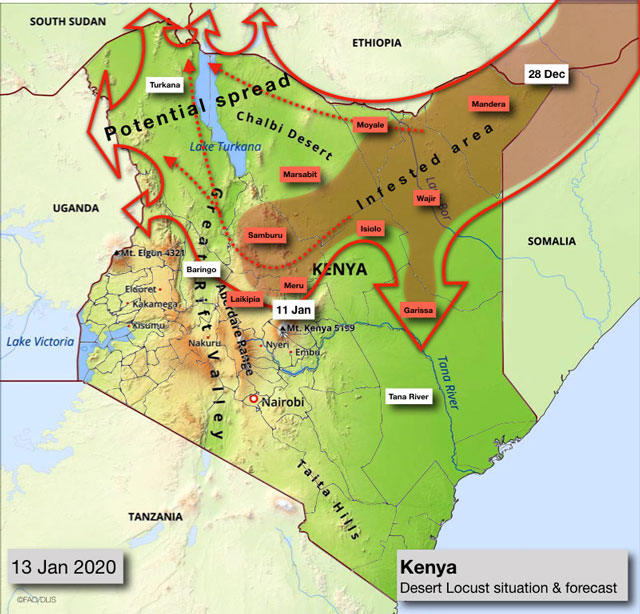
    In Kenya, which was hit by back-to-back droughts and then floods in 2019, the past week has seen a significant and extremely dangerous increase in swarm activity, and eight counties are now affected.

    In Somalia, tens of thousands of hectares of land have been affected in Somaliland, Puntland and Galmudug (Mudug), and mature swarms are present in the Garbahare area, near the Kenyan border. Meanwhile, recent weather in East Africa has created conditions that support rapid locust reproduction.

    Today’s allocation comes from the UN’s Central Emergency Response Fund, Established by the UN General Assembly in 2005 as a global fund ‘for all, by all’, CERF enables timely, effective and life-saving humanitarian action supporting UN agencies and others to kick-start or reinforce emergency response across the world, which provides rapid funding in response to sudden-onset or rapidly deteriorating crises and is designed to grow into a $1 billion-a-year emergency relief mechanism.


    Additional reporting by The Independent


  • Why We Can’t Eat Out The Locust Menace

    Why We Can’t Eat Out The Locust Menace

    There has been an intriguing talk about how the locust invasion menace, which is in eight counties now and supposedly getting out of hand, that the locusts can be turned into meals.

    But can we really eat out the locust? Can they be trapped, fried and reserved? Who will do that and at what cost—the taxpayers will be facilitating this? Who wants to eat the locust?  Do they really need them?

    According to Dr Stephen Njoka, the Director of Desert Locust Control Organization for Eastern Africa, trapping and frying the insects can’t be a viable and much needed solution to efforts to eradicate the desert locusts.

    “You cannot finish all the locusts by eating them, one swarm may have up to 40 million insects,”  Njoka said.

    “The communities that eat them should be careful not to eat the ones that have been sprayed with the pesticide,” Njoka warned the public.

    Speaking at his first press conference since appointment as Cabinet Secretary Ministry of Agriculture, Peter Munya said the government is in control and the locust problem will soon end.

    “We are adding more resources to contain the problem in key areas of Marsabit, Isiolo and Mandera,” he said adding that the government has hired three more aircraft to be deployed tomorrow (Thursday).

    The locust started crossing the border of Ethiopia and Somalia into Kenya late last month. They have so far invaded eight counties of Mandera, Wajir, Marsabit, Garissa, Isiolo, Meru, Samburu and Laikipia.

    The government has no actual figures of the amount of destruction coursed by the desert locusts in Kenya so far, but they have destroyed 175,000 acres of farmland in Somalia and Ethiopia according to the Food and Agriculture Organisation (FAO).

    “The swarms of locusts are feeding in a non-discriminatory manner on the green matter. This will bring famine to both humans and animals. Controlling them will be a challenge unless the government increases capitation and tools to control the pests,” said Timothy Munywoki, senior agronomist at Amiran Kenya Limited in charge of crop protection and product development.

    According to NASA’s Earth Observatory, part of an average swarm can eat the same amount of food in one day as about 10 elephants, 25 camels, or 2,500 people.

    Kenya had a locust invasion in 2007 but the situation was contained. The last time the country had a locust invasion that was similarly threatening was in 1961.

    The documents at the Desert Locust Control Organisation for Eastern Africa (DLCO-EA) that was formed in 1962 in response to a locust invasion in 1961 state that the current threat was similar to that of 1961. Kenya had a locust invasion in 2007 too but was contained. DLCO-EA reports indicate that the plague that wrecked Eastern Africa region causing massive hunger and deaths across happened in 1940s.