Tag: China

  • After Venezuela Blow, Iran Supply Risks Test China’s Oil Strategy

    After Venezuela Blow, Iran Supply Risks Test China’s Oil Strategy

    – ‘About 50 million barrels of Iranian crude are currently sitting offshore China and Malaysia, providing a supply cushion to any disruption,’ says Kpler analyst Matt Smith

    – Halt in Iranian flows could force Chinese refiners to sharply cut processing rates or seek more expensive replacement crude on global markets, according to Argus Media analyst Tom Reed

    Tensions in the Middle East have pushed oil prices higher and cast new uncertainty over Iranian crude flows, a development that experts say could ripple through China’s refining sector just as another key source of discounted oil, Venezuela, becomes increasingly constrained.

    China is the world’s largest crude oil importer, bringing in roughly 11.6 million barrels per day (bpd) in 2025, according to the Center on Global Energy Policy (CGEP) at Columbia University. Analysts estimate that around 2.6 million bdp of these imports consist of discounted or sanctioned crude, including approximately 1.38 million bpd from Iran, making Tehran one of China’s most significant external suppliers.

    These discounted barrels have become particularly important for independent refiners, often referred to as “teapot” refineries, which operate largely in the eastern province of Shandong. Unlike large state-owned companies, these installations typically rely on lower-cost crude supplies to remain competitive in domestic fuel markets.

    But the supply cushion is now under pressure from two directions. Iran’s exports face growing risks as its war with Israel and the US escalates, while shipments from Venezuela – another key source of heavy discounted crude for Chinese refiners – have already begun to shrink after Washington captured President Nicolas Maduro and diverted Venezuelan oil toward American markets.

    Iranian crude flows provide critical supply

    Despite the potential risks, as Iran faces large-scale US-Israel attacks, including strikes on oil depots, analysts say China’s supply chain currently includes buffers that could mitigate the immediate impact of any disruption.

    Matt Smith, lead oil analyst at energy analytics firm Kpler, said a significant volume of Iranian crude is already positioned near China in storage or transit. “About 50 million barrels of Iranian crude are currently sitting offshore China and Malaysia, providing a supply cushion to any disruption,” Smith told Anadolu.

    He added that Iran increased shipments ahead of the recent escalation in the Middle East, meaning additional cargoes are already en route to Chinese buyers.

    These barrels could help Chinese refiners manage short-term supply disruptions if exports from Iran were temporarily interrupted.

    Smith, however, added that refiners have already begun adjusting their crude sourcing strategies amid shifting market conditions.

    “China has increasingly been pulling in more Russian crude in recent months, given growing discounts as India has dialed back purchases,” he said.

    According to him, Russia has become the leading supplier for Shandong since late last year, overtaking Iran as refiners search for alternative discounted barrels.

    Middle Eastern supply routes remain key

    While disruptions to Iranian exports would affect certain refiners, analysts say the larger concern lies in the stability of Middle Eastern supply routes, including the Strait of Hormuz, which is effectively closed to oil shipping due to the war.

    Smith said that nearly half of China’s seaborne crude imports originate from the Middle East, making the region a critical pillar of its energy security.

    “Supply disruptions in the Strait of Hormuz are a much, much bigger issue than the loss of Venezuelan crude,” he said.

    The strait carries about 20% of the world’s oil shipments and is considered one of the most important energy chokepoints. Any sustained disruption could affect not only Iranian exports but also shipments from other major Gulf producers that supply Asian markets.

    Independent refineries most exposed

    The most immediate effects of any Iranian supply disruption would likely be felt by independent refineries clustered in eastern China.

    Tom Reed, China crude analyst at Argus Media, said these facilities depend heavily on Iranian oil as a core part of their feedstock mix.

    “Shandong independent refineries process around 2.5 million bpd of crude, so Iranian supplies are absolutely central to their operations,” Reed told Anadolu. “It would be extremely difficult for the teapots to replace the 1.3 million bpd of Iranian crude they currently receive.”

    These refiners have historically relied on discounted crude from sanctioned producers to remain profitable in a competitive domestic market. In recent years, Iranian supplies have become one of the most important components of that strategy.

    Limited alternatives for refiners

    If Iranian flows were interrupted, Reed said independent refiners would face difficult choices in securing replacement supplies.

    “They would either have to cut runs drastically or compete in the global market for replacement grades,” he said.

    Before 2022, Shandong refiners were among the largest buyers of Brazilian crude, which could once again become an alternative source if Iranian shipments were disrupted.

    However, Reed said, switching to those supplies would come with a significant cost increase.

    “That would mean accepting costs of around $15 per barrel higher than what they currently face,” he said.

    Such a price increase could quickly erode refining margins, particularly for smaller facilities that already operate on relatively thin profit margins.

    Potential refinery run cuts

    Reed said the loss of discounted Iranian and Venezuelan crude could force refiners to adjust their operating rates.

    “Both refinery run cuts and potential shutdowns are likely if discounted Iranian and Venezuelan crude becomes unavailable,” he said.

    Lower refinery runs could then tighten fuel supply in domestic markets and push prices higher. “This would force up prices for gasoline and diesel in China,” Reed added.

    But structural changes in China’s transport sector may limit the long-term impact of higher fuel prices.

    Demand for gasoline and diesel has already been gradually declining as electric vehicles and alternative fuel technologies expand across the world’s second-largest economy.

    “Demand for both fuels is currently being destroyed at the rate of about 200,000 bpd each year due to increasing use of electric vehicles and electric or gas-fueled trucking,” Reed said.

    Petrochemicals likely less affected

    Despite potential pressure on fuel markets, analysts say China’s petrochemical sector is less exposed to disruptions affecting independent refineries.

    According to Reed, much of China’s petrochemical feedstock is supplied through large state-owned companies rather than independent refiners.

    While Shandong refiners produce some petrochemical products such as ethylene and aromatics, the majority of China’s output comes from major state-owned firms or specialized cracking facilities that process imported naphtha.

    As a result, disruptions affecting discounted crude supplies would likely have a greater impact on transport fuels than on petrochemical production.

    Despite the potential risks associated with Iranian supply disruptions, analysts note that China maintains a relatively diversified crude import portfolio compared with many other Asian economies.

    “China is the largest single market for Brazilian crude, West African crude and Canadian crude, giving it more supply options than other countries in the region,” Reed said.

    Anadolu Agency

  • DeepSeek Hit By Cyberattack As Users Flock To Chinese AI Startup

    DeepSeek Hit By Cyberattack As Users Flock To Chinese AI Startup

    Chinese startup DeepSeek said on Monday it will temporarily limit registrations due to a cyberattack after the company’s AI assistant amassed sudden popularity.

    The startup earlier in the day was also hit by outages on its website after its AI assistant became the top-rated free application available on Apple’s App Store in the United States.

    The company resolved issues relating to its application programming interface and users’ inability to log in to the website, according to its status page. The outages on Monday were the company’s longest in around 90 days and coincides with its sky-rocketing popularity.

    DeepSeek last week launched a free assistant it says uses less data at a fraction of the cost of incumbent players’ models, possibly marking a turning point in the level of investment needed for AI.

    Powered by the DeepSeek-V3 model, which its creators say “tops the leaderboard among open-source models and rivals the most advanced closed-source models globally”, the artificial intelligence application has surged in popularity among U.S. users since it was released on Jan. 10, according to app data research firm Sensor Tower.

    The milestone highlights how DeepSeek has left a deep impression on Silicon Valley, upending widely held views about U.S. primacy in AI and the effectiveness of Washington’s export controls targeting China’s advanced chip and AI capabilities.

    Technology stocks were hammered on Monday, sending the shares of Nvidia and Oracle plummeting.

    AI models from ChatGPT to DeepSeek require advanced chips to power their training. The Biden administration has since 2021 widened the scope of bans designed to stop these chips from being exported to China and used to train Chinese firms’ AI models.

    However, DeepSeek researchers wrote in a paper last month that the DeepSeek-V3 used Nvidia’s H800 chips for training, spending less than $6 million.

    Although this detail has since been disputed, the claim that the chips used were less powerful than the most advanced Nvidia products Washington has sought to keep out of China, as well as the relatively cheap training costs, has prompted U.S. tech executives to question the effectiveness of tech export controls.

    Little is known about the company behind DeepSeek, a small Hangzhou-based startup founded in 2023, when search engine giant Baidu released the first Chinese AI large-language model.

    Since then, dozens of Chinese tech companies large and small have released their own AI models, but DeepSeek is the first to be praised by the U.S. tech industry as matching or even surpassing the performance of cutting-edge U.S. models.

  • China’s DeepSeek Threatens ChatGPT’s Dominance Of AI Sector

    China’s DeepSeek Threatens ChatGPT’s Dominance Of AI Sector

    Chinese startup DeepSeek’s launch of its latest AI models, which it says are on a par or better than industry-leading models in the United States at a fraction of the cost, is threatening to upset the technology world order.

    The company has attracted attention in global AI circles after writing in a paper last month that the training of DeepSeek-V3 required less than $6 million worth of computing power from Nvidia H800 chips.

    DeepSeek’s AI Assistant, powered by DeepSeek-V3, has overtaken rival ChatGPT to become the top-rated free application available on Apple‘s App Store in the United States.

    This has raised doubts about the reasoning behind some U.S. tech companies’ decision to pledge billions of dollars in AI investment and shares of several big tech players, including Nvidia, have been hit.

    Below are some facts about the company shaking up the AI sector worldwide.

    Why is DeepSeek causing a stir? 

    The release of OpenAI’s ChatGPT in late 2022 caused a scramble among Chinese tech firms, who rushed to create their own chatbots powered by artificial intelligence.

    But after the release of the first Chinese ChatGPT equivalent, made by search engine giant Baidu, there was widespread disappointment in China at the gap in AI capabilities between U.S. and Chinese firms.

    The quality and cost efficiency of DeepSeek’s models have flipped this narrative on its head. The two models that have been showered with praise by Silicon Valley executives and U.S. tech company engineers alike, DeepSeek-V3 and DeepSeek-R1, are on par with OpenAI and Meta‘s most advanced models, the Chinese startup has said.

    They are also cheaper to use. The DeepSeek-R1, released last week, is 20 to 50 times cheaper to use than OpenAI o1 model, depending on the task, according to a post on DeepSeek’s official WeChat account.

    But some have publicly expressed scepticism about DeepSeek’s success story.

    Scale AI CEO Alexandr Wang said during an interview with CNBC on Thursday, without providing evidence, that DeepSeek has 50,000 Nvidia H100 chips, which he claimed would not be disclosed because that would violate Washington’s export controls that ban such advanced AI chips from being sold to Chinese companies. DeepSeek did not immediately respond to a request for comment on the allegation.

    Bernstein analysts on Monday highlighted in a research note that DeepSeek’s total training costs for its V3 model were unknown but were much higher than the $5.58 million the startup said was used for computing power. The analysts also said the training costs of the equally-acclaimed R1 model were not disclosed.

    Who is behind DeepSeek? 

    DeepSeek is a Hangzhou-based startup whose controlling shareholder is Liang Wenfeng, co-founder of quantitative hedge fund High-Flyer, based on Chinese corporate records.

    Liang’s fund announced in March 2023 on its official WeChat account that it was “starting again”, going beyond trading to concentrate resources on creating a “new and independent research group, to explore the essence of “AGI” (Artificial General Intelligence). DeepSeek was created later that year.

    ChatGPT makers OpenAI define AGI as autonomous systems that surpass humans in most economically valuable tasks.

    It is unclear how much High-Flyer has invested in DeepSeek. High-Flyer has an office located in the same building as DeepSeek, and it also owns patents related to chip clusters used to train AI models, according to Chinese corporate records.

    High-Flyer’s AI unit said on its official WeChat account in July 2022 that it owns and operates a cluster of 10,000 A100 chips.

    How does Beijing view DeepSeek?

    DeepSeek’s success has already been noticed in China’s top political circles. On January 20, the day DeepSeek-R1 was released to the public, founder Liang attended a closed-door symposium for businessman and experts hosted by Chinese premier Li Qiang, according to state news agency Xinhua.

    Liang’s presence at the gathering is potentially a sign that DeepSeek’s success could be important to Beijing’s policy goal of overcoming Washington’s export controls and achieving self-sufficiency in strategic industries like AI.

    A similar symposium last year was attended by Baidu CEO Robin Li.

    (Reuters) 

  • Musk, MrBeast, Larry Ellison – Who Might Buy TikTok?

    Musk, MrBeast, Larry Ellison – Who Might Buy TikTok?

    Jimmy Donaldson – aka MrBeast – was jubilant as he told his tens of millions of TikTok followers about his bid to buy the platform.

    “I might become you guys’ new CEO! I’m super excited!” Donaldson said from a private jet. He then proceeded to promise $10,000 to five random new followers.

    The internet creator’s post has been viewed more than 73 million times since Monday. Donaldson said he could not share details about his bid, but promised: “Just know, it’s gonna be crazy.”

    Donaldson is one of multiple suitors who have expressed interest in purchasing TikTok, the wildly popular social media platform that’s become the subject of a fast-moving political drama in the United States.

    Last year, then-President Joe Biden signed a law that gave TikTok’s China-based parent company ByteDance until 19 January to sell the platform or face a ban in the United States.

    The legislation addressed concerns about TikTok’s links to the Chinese government and worries about the app being a national security risk.

    President Donald Trump has floated the possibility of a joint venture.

    “I would like the United States to have a 50% ownership position,” he said in a Truth Social post on Sunday. “By doing this, we save TikTok, keep it in good hands and allow it to [stay up].”

    Trump has since signed an executive order that allows the app to stay operational for another 75 days.

    Earlier this month, Bloomberg reported that China was considering a TikTok sale to Elon Musk, the world’s richest man and a close ally of President Trump, who already owns the social media platform X.

    Musk himself wrote on X this week that while he has long been against a TikTok ban, “the current situation where TikTok is allowed to operate in America, but X is not allowed to operate in China is unbalanced. Something needs to change”.

    At a news conference Tuesday, Trump was asked by a reporter if he would be open to Musk buying the platform.

    “I would be if he wanted to buy it, yes,” the president replied.

    “I’d like Larry to buy it, too,” Trump added, referring to Oracle chairman Larry Ellison, a long-time Trump supporter who was on stage with him for a separate announcement.

    Oracle is one of TikTok’s main server providers, managing many of the data centres where billions of the platform’s videos are stored.

    Last year, Oracle warned that a TikTok ban could hurt its business. The cloud computing giant was also a leading contender to buy the social media platform in 2020, back when Trump was trying to ban it.

    Billionaire investor Frank McCourt has also expressed interest in TikTok, and has been doing media interviews about the prospect for several months.

    McCourt has said he wants TikTok to run on technology overseen by the Project Liberty Institute, which he founded. He has been critical of data collection practices of social media companies.

    Project Liberty is bidding for TikTok without its proprietary algorithm. McCourt told CNBC this week that Project Liberty is “not interested in the algorithm or the Chinese technology” even as he acknowledged that the platform is “worth less” without it.

    Ultimately, President Trump is likely to have a major role in selecting a US buyer of TikTok.

    “It’s going to be a winner that’s likely to be politically sympathetic to President Donald Trump,” said Anupam Chander, a law professor at Georgetown University.

    Prof Chander said the 50-50 joint ownership model does not comport with the law’s requirements, which might prompt Trump to pressure Congress into revising the law.

    For now, the platform’s future remains in limbo.

    Prof Chander said the Biden administration made an “unforced error” by allowing the law to give the president outsized control over who owns TikTok.

    “It was a terrible idea to put the future of a massive information platform into this political maelstrom,” Prof Chander said.

  • China To ‘Gift’ Kenya New Foreign Affairs Ministry Headquarters, Raises Spying Fears

    China To ‘Gift’ Kenya New Foreign Affairs Ministry Headquarters, Raises Spying Fears

    The Kenyan government has announced plans to relocate its Ministry of Foreign Affairs headquarters in Old Treasury building along Harambee Avenue to a new location.

    Making the announcement on Friday, Foreign Affairs Principal Secretary (PS) Korir Sing’oei revealed that the government of China had offered to spearhead the construction project as a mark of appreciation for the 60 years that the two countries have enjoyed a close diplomatic relationship.

    “Grateful to the Government of the People’s Republic of China for its commitment to support the Ministry of Foreign Affairs in the construction of the Ministry’s new headquarters as a visible marker of 60 years of diplomatic relations.” He said.

    The PS added that he had met with the technical team but don’t indulge more details including cost and location of the project that is set to change the dynamics of international relations.

    “Received the technical team in charge of project design in my office today.”

    Spying

    Many Kenyans have reacted sharply to the announcement with many expressing their fears that the Chinese government would use the building to extend their now common international espionage missions.

    China has been accused in the past of giving similar offers of construction projects only to end up planting spying devices and this accusations have not only been about African countries but elsewhere around the world where the espionage regime had come under scope.

    The May 2020 article by Voice of Africa (VOA) referenced a report by the Heritage Foundation, a U.S.-based conservative think tank, which stated that Chinese companies built at least 186 government buildings in Africa and 14 “sensitive intragovernmental telecommunications networks.”

    “These buildings include residences for heads of state, parliamentary offices, and police or military headquarters,” the article read in part.

    For these reasons, Kenyans have credible reasons to fear for their privacy, here’s some of the reactions from Kenyans to the new development of china building Kenya’s Foreign Office;

    “Bugs from entrance to exit hugs in the loo, bugs in the stairs, bugs on the window, bugs in the offices, bugs all over.” Richard Odiawo said.

    “That will stealthily transmit everything live to Beijing like Big Brother Africa.” Kanyi Gioko.

    Yano, another Kenyan added, “Building they’ll build alright but every inch of every room will be bugged with listening devices and cameras.”

    “Bugged AU Addis HQ didn’t teach us anything?” Hot Shotcreative said.

    Engineer Nyasireka on X, warns of intense spying should the project succeed, “The Chinese built the African Union headquarters for free and proceeded to install a sophisticated spy equipment.
    Even if the officials speak in Kalenjin only, trust some Chinese to translate it accurately.”

    Ministry of Foreign Affairs officials when they held a meeting with the Chinese delegation in Nairobi.
    Ministry of Foreign Affairs officials when they held a meeting with the Chinese delegation in Nairobi.

    Chinese hackers targeted Kenya

    Last year, Reuters reported on how Chinese hackers targeted Kenya’s government in a widespread, years-long series of digital intrusions against key ministries and state institutions.

    The hack aimed, at least in part, at gaining information on debt owed to Beijing by the East African nation: Kenya is a strategic link in the Belt and Road Initiative – President Xi Jinping’s plan for a global infrastructure network.

    The hacks constitute a three-year campaign that targeted eight of Kenya’s ministries and government departments, including the presidential office, according to an intelligence analyst in the region.

    An analyst also shared with Reuters research documents that included the timeline of attacks, the targets, and provided some technical data relating to the compromise of a server used exclusively by Kenya’s main spy agency.

    A Kenyan cybersecurity expert described similar hacking activity against the foreign and finance ministries.

    Between 2000 and 2020, China provided nearly $160 billion in loans to African countries, primarily for infrastructure projects.

    Kenya used over $9 billion in Chinese loans to fund railways, ports, and highways. Beijing became Kenya’s largest bilateral creditor and a significant player in the East African consumer market and logistical hub.

    However, by late 2019, Kenya’s financial strains were evident when a hack of a government-wide network was attributed to China.

    The breach began with a “spearphishing” attack, where a Kenyan government employee unknowingly downloaded an infected document, allowing hackers to infiltrate the network and access other agencies.

    The attacks appeared focused on Kenya’s debt situation. An intelligence analyst in the region claimed that Chinese hackers carried out a campaign against Kenya that began in late 2019 and continued until at least 2022.

    Chinese cyber spies subjected Kenya’s president’s office, defense, information, health, land and interior ministries, counter-terrorism center, and other institutions to persistent and prolonged hacking activity.

    The intelligence analyst working in the region – said Chinese hackers carried out a far-reaching campaign against Kenya that began in late 2019 and continued until at least 2022.

    According to documents provided by the analyst, Chinese cyber spies subjected the office of Kenya’s president, its defence, information, health, land and interior ministries, its counter-terrorism centre and other institutions to persistent and prolonged hacking activity.

    More accusations of China hacking and spying

    In Africa, Chinese owned Huawei Technologies Co., the worlds largest telecommunications company, dominates African markets, has publicly been selling legal security tools that governments use for digital surveillance and censorship.

    The company has been accused of helping African governments spy on their political opponents, including intercepting their encrypted communications and social media, and using cell data to track their whereabouts.

    In Uganda, a threat to the 3-decades long authoritarian regime of President Yoweri Museveni, Bobi Wine, had returned from Washington with U.S. backing for his opposition movement, and Uganda’s cyber-surveillance unit had strict orders to intercept his encrypted communications, using the broad powers of a 2010 law that gives the government the ability “to secure its multidimensional interests.”

    Government officials asked Huawei help to hack into Bobi wines social media. The Huawei engineers, identified by name in internal police documents reviewed by The Wall Street Journal, used the spyware to penetrate Mr. Wine’s WhatsApp chat group, named Firebase crew after his band. Authorities scuppered his plans to organize street rallies and arrested the politician and dozens of his supporters.

    In May 2018, Uganda’s Mr. Museveni signed a $126 million deal with Huawei for the safe-cities project after a classified bidding process involving two Chinese companies, paying $16.3 million up front and financing most of the rest with a $104 million loan from Standard Chartered Bank, according to documents presented to a parliamentary committee.

    Ugandan intelligence officers have confirmed they were taught how to use the spyware for reading emails and texts but not encrypted communications.

    In Zambia, according to senior security officials there, Huawei technicians helped the government access the phones andfacebook pages of a team of opposition bloggers running a pro-opposition news site, which had repeatedly criticized the then President Edgar Lungu.

    The Huawei employees located the bloggers and were in contact with the police units deployed to arrest them.

    Huawei technicians helped intercept the communications of opposition bloggers running a news site named Koswe, or “The Rat,” which had repeatedly criticized Mr. Lungu, the two Zambian officials in the Cybercrime Crack Squad said.

    In 2012, a data theft incident began at the African Union (AU) Headquarters in Addis Ababa, Ethiopia, where information from the AU’s computer systems was allegedly transmitted to servers in China. This continued, at the same time every night, for five years, until it was discovered in January 2017.

    The bulk of the computer systems that were compromised in the African Union Headquarters were supplied by Chinese telecommunications company Huawei.

    The big question has been whether Chinese companies are just doing this for the money, or whether they’re pushing a specific kind of surveillance agenda.

    Former US President Trump signed an executive order that allows the U.S. to ban telecommunications gear and services from “foreign adversaries,” a term widely interpreted to refer to Huawei. The Commerce Department added Huawei to the “Entity List,” citing national security concerns, which effectively bars companies from supplying U.S.-made technology to Huawei without a license.

    Despite the companies denial, It is very evident how Huawei is a complicit in Chinese and now the African government spying.

    Other Chinese Projects in Kenya

    The Chinese government has been overseeing construction projects in Kenya, including buildings, roads, and the Kenya Standard Gauge Railway (SGR).

    However, some projects have been criticized for irregularities, such as the construction of Hazina Towers, a project funded by the National Social Security Fund (NSSF).

    In April 2024, China Jiangxi International Limited Kenya’s Director was unable to account for the money paid for the downsized building.

    The Senate’s Public Investment Committee raised concerns over the company’s refusal to pay NSSF the project mobilization fees.

    On May 1, Busia Senator Okiya Omtatah filed a petition to uncover an alleged Ksh777 billion overpayment of funds through the SGR to Chinese constructors, claiming the excess billions were paid to China Roads and Bridge Corporation (CRBC) at taxpayers’ expense.

  • Tullow Oil Global CEO And Exploration Director Forced To Resign For Exaggerating Oil Discovery In Ghana

    Tullow Oil Global CEO And Exploration Director Forced To Resign For Exaggerating Oil Discovery In Ghana

    Questions have started arising from what exactly is the dangling London-listed Tullow Oil (LON:TLW) doing in Kenya’s Ngamia 1 and 2 just like other ‘African’ discoveries the firm has allegedly invested in.

    Tullow Oil, which is active in Ghana, Kenya, and Uganda, has seen recently setbacks in its flagship projects in Africa.

    In Ghana, production performance has been significantly below expectations from the Group’s main producing assets, the TEN and Jubilee fields, the company said in a statement, slashing its production guidance for FY 2020 from the FY 2019 forecast.

    The British based oil exploration firm Tullow Oil has dropped with immediate effect its global CEO Paul McDade and Exploration Director Angus McCoss following the executive’s poor management and exaggerated productivity of key West African exploration market.

    In an operational update issued on Monday, Executive Chair Dorothy Thompson noted that the board has been disappointed with the poor performance of the African assets.

    “The Board has, however, been disappointed by the performance of Tullow’s business and now needs time to complete its thorough review of operations. A review of the production performance issues in 2019 and its implications for the longer-term outlook of the fields has been undertaken and has shown that the Group needs to reset its forward-looking guidance,” Thompson said,

    Independent reserve audits are indicative of flat output following the downward adjustment in reserve volumes.

    “In light of these new production forecasts, there will be a thorough reassessment of the Group’s cost base and future investment plans in order to allocate appropriate capital to the Group’s core production assets, development projects and continued exploration,” added Tullow.

    In the half-year to June, Tullow posted a net profit of Ksh.10.5 billion supported largely from growth in discovered resources, lower operational costs and a slide in short-term debt maturities.

    In Kenya, Tullow Oil also has to reach an FID on-field production and completed a deal to export 200,000 barrels of crude oil, in its first-ever export of the commodity.

    “We are now an oil exporter. Our first deal was concluded this afternoon with 200,000 barrels at a decent price of US$12 million. So I think we have begun our journey and it is up to us to ensure that those resources are also put to the best use to develop our country to make it both prosperous and to ensure we eliminate poverty in Kenya,” President Uhuru Kenyatta said.

    Commercial quantities of crude oil in Kenya were discovered in 2012 in the South Lokichar Basin. Africa-focused Tullow Oil, which discovered the resources, has continued its exploration and appraisal drilling campaigns in Kenya.

    In June this year, Kenya’s government signed an agreement with France’s major Total, Tullow Oil, and Africa Oil to develop an oil processing facility with a capacity of 60,000 bpd-80,000 bpd, as part of Kenya’s plan to begin commercial oil production within a few years.

    In the release of its first-half results last week, Tullow Oil had said that it expected the first export cargo of oil of the Early Oil Pilot Scheme (EOPS) to be sold and lifted in the third quarter of 2019.

    Regarding the full field development, Tullow Oil said that Kenya’s government has gazetted the land required for the upstream development in Turkana, and pipeline land surveys by the National Lands Commission began in the first week of July.

    “An Upstream Water Framework agreement has been drafted by Tullow and submitted to the Government of Kenya for their review. Given this significant progress, the FID of the Development is now targeted for the second half of 2020,” Martin Mbogo, Managing Director at Tullow Oil Kenya said.

    But the Africa-focused oil explorer and producer has been silently shelving slashed productions. This has seen the firm suspend dividend amid massive poor productions.

    Is Tullow Oil frying Kenya? Will we ever see Kenya export oil? Why is the government signing closed agreements with the firm that has now clearly been exposed of productivity exaggeration?

    I don’t have access to the feasibility study results the firm allegedly did, but I’m of a perspective that we don’t have oil that can run nor be drilled for more than a decade. We are in a corrupt country that might be exporting air at the expense of poor taxpayers. Tullow Oil is a scam blanketed by petroleum CS John Munyes and a real time-bomb waiting to explode with coffers funds.


  • Tik Tok’s Global Success A Threat To Silicon Valley Apps

    Tik Tok’s Global Success A Threat To Silicon Valley Apps

    TikTok, an app that allows users to create short videos with music, filters, and other features. Right now, China-based TikTok is the popular trending app in the world. It’s been downloaded over a billion times in the two years that it’s been around. Even Facebook founder Mark Zuckerberg is perturbed.

    Tik Tok is blowing to an extent the silicon valley apps have sought the governments ‘protection’. Which, by the way, if you look at it, they already have. Zuckerberg’s increased anti-China rhetoric is an attempt to please US lawmakers and to fend off regulation. US senators have been criticizing TikTok for censorship, privacy, and child safety. About 41 percent of TikTok users are aged between 16 and 24.

    TikTok is an iOS and Android social media video sharing that was launched in 2017 by Chinese developer ByteDance. ByteDance, a Beijing-based company founded in 2012 by Zhang Yiming. ByteDance is one of the most valuable startups in the world estimated to be worth about $75 billion.

    In 2019, Zhang Yiming, Tik Tok founder was listed in the top 20 of the Hurun China Rich List with $13.5 billion in wealth, surpassing more established tech tycoons, such as the founder of search giant Baidu.

    Since launching in 2017, TikTok has been downloaded more than 1.5 billion times, according to US-based research agency Sensor Tower. It has huge followings globally something that has threatened US-based Silicon Valley companies, like Facebook, Google, Twitter.

    Forbes estimates show that TikTok has 1 billion monthly active users, the figure is the same or probably more than Facebook-owned Instagram. Tik Tok has been set and it’s destined to floor Instagram, Snapchat, Facebook, Twitter, and they have massive data, right now,  the world’s most valuable asset.

    TikTok now requires users to verify their age after the Federal Trade Commission accused Musical.ly of violating US child-privacy laws and fined them $5.7 million in February this year.

    Reuters reported in September that CFIUS, which reviews deals by foreign acquirers for potential national security risks, is probing ByteDance’s $1 billion acquisition of social media app Musical.ly in 2017, which laid the foundations for TikTok’s rapid growth.

    China-based ByteDance in their response said that they are seeking to provide assurances to the Committee on Foreign Investment in the United States (CFIUS) that personal data held by TikTok is stored securely in the United States and will not be compromised by Chinese authorities.

    TikTok is also hiring more U.S. engineers to reduce its reliance on staff in China.

    “Shifting a company’s operations away from China, geographically and technically, can give CFIUS more comfort that the company is really independent of its Chinese owner and the Chinese government,” said Nevena Simidjiyska, a partner at  Fox Rothschild LLP law firm.

    Personally, TikTok is far way better and the opposite of Instagram. Insta is all about vanity and fake aspiration and wannabe chest thumbing ‘best life’ bluffs.  Everything feels very artificial on Instagram.

    TikTok is real, I mean, users film themselves in their bedrooms, roadside, living room, school, street, church, bars, smoking zones, farms, etc. It’s all about short clips, all about kind of goofing around, a pass and totally recommendable.


  • Russian Parliament Plans To Ban Apple Products From Next Year

    Russian Parliament Plans To Ban Apple Products From Next Year

    According to a report by BBC, the Russian Parliament has passed new legislation for electronics that run apps to have pre-installed Russian software.

    According to new the bill, electronics such as smartphones, computers, and smart TVs must be sold with locally-made Russian software pre-installed. This means apart from the first-party software, the devices should have Russian alternatives pre-installed in order to qualify for their sale to avoid being banned in the country.

    The new law will be effective from July 2020. This might lead to a ban on not only Apple iPhones but also other products with foreign software. Inside the Russian parliament Photo|Al Jazeera

    The European Union has a similar law which has made Android OEMs to let users select their choice of apps while setting up the device. In this case, Apple, Samsung, and other major electronics manufacturers may choose not to sell their devices in the Russian Federation instead of having to install varied software.

    As the Kremlin prepares to roll out the list of every gadget that will need to be updated, it is not physically possible to install Russian-made software on all devices. A move the Federal Government says will attract manufacturers from the Russian market.

    “When we buy complex electronic devices, they already have individual applications, mostly Western ones, pre-installed on them. Naturally, when a person sees them… they might think that there are no domestic alternatives available. And if alongside pre-installed applications, we will also offer the Russian ones to users, then they will have a right to choose.” Oleg Nikolayev, one of the co-authors of the legislation said.

    According to the Association of Trading Companies and Manufacturers of Electrical Household and Computer Equipment (RATEK), it is not possible for many worldwide companies to install Russian-made software which means they will be forced to exit the market.

    Apple’s iOS operating system is a closed system, it isn’t likely that the iPhone would be offered with unknown Russian software pre-loaded. Russia has slapped the smartphone giants off their markets.

    Statcounter data report released early last month indicates that Samsung has the largest smartphone market share in Russia with 22.04 percent. China’s Huawei has a 15.99 percent market dominance then Apple’s iPhone with a market share of 15.83 percent.

    This is coming at a time when the Kremlin had passed another controversial law. Two weeks ago, they legislated an Internet Law which enabled officials with the power to restrict internet traffic creating an internet firewall like the one in China.

  • Government Blames Kenyans For Chinese Racism In SGR

    Government Blames Kenyans For Chinese Racism In SGR

    Last week, President Uhuru Kenyatta inaugurated the Nairobi – Naivasha second phase of the Standard Gauge Railway, which honestly goes to nowhere, forget Jubilee’s promises. And not just that, but also, the Chinese government has since cut funds for the SGR project after the government failured to prove project viability.

    In a bizarre report that appeared in the Sunday Standard last week revealed the racism, blatant abuse, bad treatment, wildlife deaths, and lack of skills transfer that characterizes the SGR trains. This happens under the nose of Jubilee government that choke out Sh1 billion monthly from taxpayers to repay the SGR.

    Beneath this shiny veneer is a tale of pain, anguish and broken dreams for a multitude of Kenyans who feel trapped on the train that ably fits the moniker Orient Express, because on it, Chinese nationals have created a small kingdom in which they run roughshod over Kenyan workers who say they are experiencing neo-colonialism, racism and blatant discrimination as the taxpayer foots the Sh. 30 million a day bill for the train, which losely translates to Sh. 1 billion at the end of every month.” Reads part of the Standard report. 

    The investigation report by the Standard revealed that Chinese workers were running a racist little kingdom at the trains and they had systematically excluded Kenyan workers from the core duties such as trotting the trains.

    Our investigation has revealed that Kenyan drivers have taken charge of the 472 kilometre ride just once, on the project launch with President Uhuru Kenyatta as a passenger, when two female drivers, Alice Gitau and Concilia Owire made the trip. When the cameras and VIPs exited the scene, the Chinese drivers took back control. They have never again been allowed to navigate the passengers from either end of the train track. Those who were trained two years ago in anticipation, have remained assistant shunting drivers, since the launch of Madaraka express, and only sit and watch as the Chinese drivers cruise to the coast and back,” the Standard reported.

    The investigation also revealed that Kenyan workers at the SGR were not allowed to travel in the same vehicles with the Chinese, even if it’s carrying one Chinese or eat at the same tables with them.

    More excesses are allowed on the freight trains where there is little visibility. Chinese staff are allowed excesses such as smoking while in the locomotive and use of mobile phones, crimes that will get their Kenyan counterparts fired,” the report said.

    The government response, however, points the blame finger on Kenyans, including those facing maltreatment. The States spokesman said that Kenyans should comprehend the work the Chinese are doing rather than focussing on the racial insults they are receiving from the Chinese. Aren’t we re-colonised already!?

    The Chinese developer and operator of the SGR, China Road and Bridge Corporation, stands accused of discriminating Kenyan workers, who according to the government are expected to take over the running of the rail service in 10 years.

    Baseless firing leading to unemployment, racial assignments, impoverished salaries, racial sitting arrangement, catering and personal hygiene services among others injustices the government wants Kenyans to ‘enjoy and celebrate.’

    According to the government, they have set up a “systems” to resolve issues surrounding the operations of Madaraka Express passenger service and the cargo train. Efforts to get to understand the said systems always turn futile as there is nor recorded or existing system!

    The State through Colonel Cyrus Oguna, the official government spokesman, keep on blaming Kenyans for not seeing the ‘good sides of the’ white elephant project.

    One thing Kenyans have to honestly know is that SGR is an expensive irrelevant project. Kenya pays China 1 Billion monthly, which roughly transilates to over Sh33 Million daily.

    In short, for SGR to be fully proffitable for both the contractor and Kenya, the successor of the white elephant after a whole damn decade, the Trains are supposed to ferry more than 35,000 Kenyans to and fro Mombasa daily, that leaves freight trains as side profits. Now, you get the joke Jubilee bluffed the whole Nation with.

  • Revealed: Chinese Contractor In Sh37 Billion Stalled Thwake Dam Is Blacklisted By World Bank

    Revealed: Chinese Contractor In Sh37 Billion Stalled Thwake Dam Is Blacklisted By World Bank

    Yesterday, Kenya Insights wrote about how the taxpayers are going to lose sh38 billion paid out as security advances and insuarence of sub-contractors of stalled and most not yet started dam projects.

    And today according to MPs’ report, the Chinese firm awarded the Governments tender to develop Sh37 billion Thwake Dam project had been blacklisted by the World Bank.

    Water Ministry transferred Sh37 billion for the Thwake Dam project in Makueni to a Chinese firm-China Gezhouba Group Limited. However the report by National Assembly Environment Committee revealed that the Chinese firm had been blacklisted by the World Bank over procurement irregularity. How did this pass the PS and CS secretaries who are directly involved in the proccurement process?

    Patrick Mwangi, the then Water Principal Secretary had disapproved the deal but was repealed after Public Procurement Oversight Authority cleared the firm.

    “China Gezhouba had been contracted to undertake the Thwake Dam project after being cleared by the Public Procurement Oversight Authority (PPOA) despite reservations by then Principal Secretary,” states the report tabled in Parliament.

    In what seems to be a proccurement to take this country deep in the real dam, the same blacklisted CGG firm was, apparently, also awarded Sh6.8 billion Northern Water Collector Tunnel tender in Murang’a by the Water ministry.

    But going with the history, Jubilee government has been dashing out multi-billion tenders to non existing firms or blacklisted ones.

    Take for instance, the Parliament blacklisted French firm Idemia, formerly IT Morpho after  irregular procurement of election equipment in the 2017 General Election. The same firm was awarded by the same IEBC to provide Huduma Namba technology worth Sh6 billion.

    In July last year, another firm that had been blacklisted back in 2013, Hydery (P) Limited was allowed to import 35,000 tonnes of sugar.

    This is a clear picture of how Jubilee administration is fighting corruption. Development bite and corruption spank to a country that is slowly rather openly being auctioned to foreign States in massive borrowings flowing in.


  • Taxpayers To Lose Sh38 Billion In Stalled Dam Projects

    Taxpayers To Lose Sh38 Billion In Stalled Dam Projects

    The National Assembly Committee on Environment has stated that sh38.4 Billion that the government made in advance payments of five stalled and collapsed dam projects cannot be recouped.

    According to the committee, the construction of the five dams has either yet to start, sluggish development, stalled altogether or their contracts have been terminated.

    The records indicate that the following dam projects have received these advance payments;

    Itare Dam got Sh4.2 billion, Karimenu II dam received Sh4 billion, Badasa Sh2 billion, Umaa Dam Sh1.6 billion and Thwake Multi-Purpose Dam has received Sh7.4 billion.

    The Committee has also raised concerns regarding the ongoing construction of Chemususu Dam and the Northern Collector Tunnel.

    Kimwarer and Arror dams that the Treasury made advance payments of Sh19 billion, that led to the prosecution of suspended Treasury Secretary Henry Rotich, including Sh11 billion debt insurance, Sh4.6 billion as loan interest and other costs were not part of the Environment Committee’s report.

    “The Auditor-General should institute a performance audit to inquire into the circumstances under which Athi Water Works Development Agency made the Sh4 billion advance payments to Chinese firm AVIC before acquisition of the requisite land for implementation of the Karimenu II Dam, leading to loss of public funds through idle time,” Kareke Mbiuki, who chairs the committee, said in the report on the Inquiry into the Status of Dams in Kenya.

    The committee has also asked the government to urgently engage the Italian firm, CMC Di Ravenna, to secure a subcontractor to complete the Sh28.9 billion Itare Dam project since the main contractor filed for bankruptcy in Italy.

    “This will save the project from permanently stalling. There is urgent need to renegotiate the terms of the loan to allow for a subcontractor to complete the project,” Mr Mbiuki said The committee said the broke Italian contractor had raised bills totalling Sh4 billion at the time of filing the report on October 11.

    The committee also wants the Water and Irrigation ministry to closely watch China Ghezuoba, the main contractor in the Sh36.7 billion Thwake Multi-Purpose dam.

    According to the committee, work progress at Thwake dam meant for hydro generation, irrigation and providing water for domestic use is sluggish yet the Chinese contractor has already received sh7.4 billion.

    Thwake project is fully Chinese owned as the report noted that it is handled supervised by Chinese contractors. No local professional has been included in the senior positions nor in the oversight of the project.

    In January 2018, China’s AVIC ventures received Sh4 billion to construct sh26.8 billion Karimenu II dam. On the ground, there is zero of work recorded after 2 years.

    In the Sh6.8 billion World Bank-backed Northern Collector Tunnel, the MPs want the Auditor-General to conduct a special audit of the Kigoro Water Treatment Plant that cost the taxpayer an additional Sh4.5 billion.

    “The auditor should establish if indeed the country realised value for money and report to Parliament within six months from the date of adoption of the report.”

    China’s Sino Hydro Corporation was awarded a contract to construct sh14 billion Mwache Dam. They valued the land at the site at sh1.8 million per acre yet they are paying land and property owners Sh550K. The committee has proposed to block any advance payment to the firm.

    The committee established that taxpayers lost Sh1.6 billion through an arbitral award to a contractor after terminating the Umaa Dam contract.

    Taxpayers also lost Sh2.4 billion in the government-funded Sh3.3 billion Badasa dam. The Chinese contractor terminated the contract with only half of the works done.

  • Most Unsafe Gadget Huawei Suffers 1Million Cyber-attacks Daily

    Most Unsafe Gadget Huawei Suffers 1Million Cyber-attacks Daily

    You remember when the late Jacob Juma was murdered and investigations into his gruesome death led by the former CID now DCI boss Ndegwa Muhoro launched that never clearly yielded something? Nairobi’s CCTV cameras apparently failed to capture the most important video details of the murder that has remained a blame game to this very date. Huawei CCTV that costed Kenyans billions of shillings and almost zero benefits, to say the least, was at the center of all that.

    Away from that, the Chinese tech giant Huawei stomachs more than a million cyberattacks per day on its computers and networks.  China’s under fire Huawei security chief, John Suffolk has confirmed this.

    According to Suffolk most of the attacks are focused on IP-theft, and Huawei, which leads the world for 5G network innovation and files more patents than any other company, has accused the U.S. government of mounting cyberattacks as part of its concerted campaign against them.

    Last month, Huawei alleged in the media that; “The U.S. law enforcement has threatened, coerced and enticed existing and former employees, and has executed cyberattacks to infiltrate Huawei’s intranet and internal information systems.”

    Suffolk, however, did not attribute the attacks to any country or particular threat actor and did not confirm whether they were from nation-states or competitors. He, however, acknowledged that although almost all attacks are defended, some attacks on older systems get through.

    “Cyberattacks have included a type of theft of confidential information by sending a computer virus by email.” Reads Huawei’s report

    Such phishing or business email often rely on social engineering to trick employees into installing malware disguised as attachments, or visiting fake sites or viewing social media clips that are laced with harmful code.

    Suffolk used the media to confirm his claims that although Huawei is battling its own allegations around cybersecurity, vulnerable to intelligence tasking by Beijing within overseas markets—either to steal or disrupt. Suffolk told the media that if the company’s CEO Ren Zhengfei was ever asked to compromise the company, he would blankly refuse to do that if he was pressurized to do that, he would close the company down.

    Last week, the EU report warned that the combination of new technologies and 5G networks risks hostile state control of critical infrastructure, logistics, transportation even law enforcement. Even though the report failed to openly mention China or Huawei, but did reference sole 5G suppliers from countries with poor democratic standards, which clearly means Huawei and China was the reference.


  • India Cuts Tax To Lure Apple Production Outsourcing To Mumbai

    India Cuts Tax To Lure Apple Production Outsourcing To Mumbai

    India has slashed off taxes impossed on manufacturing and production in a move to attract global phone manufacturers like Apple to move production of their devices to the country.

    India introduced new tax legislation which lower taxes in its manufacturing sector. The move aims at making the country more appealing to both local and international manufacturers.

    “We have redone the entire architecture of taxation law as far as manufacturing is concerned. As of now, this corporate tax cut in itself is massive. Mobile phones already are a success story.” Prasad told The Economic Times

    India’s Communication Minister believes that the tax cuts will attract players like Apple, Foxconn, and Flextronics planning to scale production in India.

    “We are already the second biggest manufacturer of mobile phones in the world. Now, even Apple is coming in a big way, Foxconn 2 and 3 will launch base.” Prasad said.

    Indian minister has said that they are setting up the country as main replacement of China as the ideal manufacturing destination for electronics.

    “Apple reportedly is going to open its biggest state-of-the-art shop in Mumbai, and Samsung is withdrawing from China,” Prasad went on.

    While Microsoft is heavily investing in Africa, India might likely win the deal owing to the previous production of low-cost iPhone models as well as the new tax cuts.

    Apple has been very is open to the idea of shifting manufacturing from China to reduce its dependence. Moreover, RT reveals that Apple asked its suppliers to shift up to 30% of its production away from China.


  • Twitter Bans And Suspends Fake News Accounts

    Twitter Bans And Suspends Fake News Accounts

    In yet another series of twitter purges and suspensions, Jack Dosier’s platform has permanently cleared off thousands of accounts from its platform for spreading misinformation, fake news, anti-government messages, and pro-propaganda war.

    According to twitter’s official blog, the purge affected pro-Saudi accounts coming from Egypt and the United Arab Emirates directed at Qatar and Yemen as well as others from China seeking to sow discord among protesters in Hong Kong.

    Twitter has also flagged off additional fake accounts in Spain and Ecuador. Ths move comes after a series of actions by social media giants such as Facebook and now Twitter cracking down on manipulation, often by state-controlled entities disguising their identities.

    Last month, Facebook removed fake accounts based in Egypt, Saudi Arabia and the UAE for posting misinformation about Middle East hotspots and others involved in coordinated inauthentic behaviour focused on Hong Kong.

    Twitter removed 273 accounts working in concert in a multi-faceted information operation to target Saudi rivals Qatar and Iran among other countries, as well as amplify pro-Saudi government messaging. These accounts were created and managed DotDev, a technology company based in the UAE and Egypt.

    “We have removed a network of 273 accounts originating in the United Arab Emirates (UAE) and Egypt. These accounts were interconnected in their goals and tactics: a multi-faceted information operation primarily targeting Qatar, and other countries such as Iran. It also amplified messaging supportive of the Saudi government. We also found evidence that these accounts were created and managed by DotDev, a private technology company operating in the UAE and Egypt. We have permanently suspended DotDev, and all accounts associated with them, from our service.” Reads part of Twitter statement on their blog. 

    Saudi Arabia, along with the UAE, Bahrain, and Egypt, has enforced an economic boycott of Qatar since June 2017, accusing the Gulf nation of links to extremist groups and being too close to Iran. Twitter also notably shut down the account of Saudi royal court adviser Saud al-Qahtani.

    The close confidant of Prince Mohammed bin Salman, who ran Riyadh’s media center and managed an electronic army unabashedly defending its image, was implicated in the killing of Washington Post columnist Jamal Khashoggi in October 2018 but was never formally charged.

    Twitter also suspended a separate group of 4,258 accounts operating from the UAE, with messaging mainly targeting Qatar and Yemen.

    “Additionally, we suspended a separate group of 4,248 accounts operating uniquely from the UAE, mainly directed at Qatar and Yemen. These accounts were often employing false personae and tweeting about regional issues, such as the Yemeni Civil War and the Houthi Movement.” Twitter said.

    Six accounts linked to Saudi Arabia’s state-run media were also flagged by Twitter for being engaged in coordinated efforts to amplify messaging that was beneficial to the Saudi government.

    “Our investigations also detected a small group of six accounts linked to Saudi Arabia’s state-run media apparatus which were engaged in coordinated efforts to amplify messaging that was beneficial to the Saudi government. While active, the accounts in this set presented themselves as independent journalistic outlets while tweeting narratives favourable to the Saudi government.  Separately, we have also permanently suspended the Twitter account of Saud al-Qahtani for violations of our platform manipulation policies. This account is not included in the archives disclosed today.” Twitter said.

    This follows the identification in August of more than 200,000 fake accounts in China engaged in fuelling public discord in Hong Kong. Twitter and Facebook are both banned in mainland China. Hong Kong has seen months of unrest as citizens protest what they say is an erosion of freedoms under Beijing’s tightening grip. While Beijing has not intervened directly, its powerful media machine has steadily ramped up a war of words.

    “In August, we disclosed that we had identified a network of more than 200,000 fake accounts based in the PRC which were attempting to sow discord about the protest movement in Hong Kong. Today, we are publishing additional datasets relating to 4,301 accounts which were most active in this information operation to further public awareness and understanding. ” Twitter said. 

    Twitter said it removed 259 accounts operated by the conservative Partido Popular that were active for a relatively short period and consisted primarily of fake accounts engaging in spamming or retweet behaviour to increase engagement.

    “We have removed 259 accounts we identified as falsely boosting public sentiment online in Spain. Operated by Partido Popular, these accounts were active for a relatively short period, and consisted primarily of fake accounts engaging in spamming or retweet behaviour to increase engagement.” Twitter posted. 

  • China’s First Robot Police Officer

    China’s First Robot Police Officer

    In Kenya, Police officers are known popularly as AFANDE! A phrase shortened from  “A Fine Day Sir”, and China being the world’s fastest tech innovators have now launched their first-ever robotic patrol Police officer RPO, named WALI.

    According to China Police, Wali is powered with advanced 5G technology and high-definition cameras, the smart robot has a facial recognition system and can transmit real-time 360-degree street views back to police stations.

    Image may contain: 2 people, people standing and outdoor
    Shanghai’s first robot police officer patrols the streets

    As it strolls along the popular shopping district, Wali is intelligent enough to know when the streets get crowded and to remind people to take care of their belongings.

    With further system updates, the smart robot is expected to connect passersby with police officers via real-time video calls in the future and provide people in need with assistance 24/7.

    Shanghai’s first robot police officer Wali attracted many curious passersby on the busy Nanjing Road since its debut. And Has also attracted a couple of critics as well, just like you’ll expect any tech innovation to have the I’s and Nay’s.

    Image may contain: one or more people, people standing and outdoor


    Image may contain: 1 person, dancing, standing and outdoor

    Some of the Chinese said that this will make their Police more lazy as they will only be sitting in the Stations and overfeeding with very less first-hand deep surveillance left to the tech cop, Wali.

    This got me thinking, If they introduce this in Nairobi and they leave her alone in the streets, a town where apparently, crooks walk away with sh72Million without firing a bullet and according to DCI, the same heist masterminds had no clue how to use the cash, will she patrol and send the information to the Traffic headquarters along Thika road or she will be the most sought after Police machine because street smarts will walk away with her?

    Image may contain: one or more people, camera and outdoor


  • Donkeys Population In Kenya Has Gone Down By Half In The last Ten Years And Here’s Why

    Donkeys Population In Kenya Has Gone Down By Half In The last Ten Years And Here’s Why

    China interests in Kenya has seen an increase in demand for donkey meat for local consumption and skin for export to China a move that is now causing a sharp decline in the animals in Kenya.

    According to Animal rights activists, the overgrown demand to feed the billion population of Chinese could soon make donkey extinct in Kenya where they play a vital role as beasts of burden mostly in rural areas.

    Since 2014, four abattoirs have been set up in Kenya to meet demand. The meat is considered a delicacy in China and the skins are processed to create ejiao, a traditional remedy used to treat everything from anaemia to dizziness. However, according to a recent report by the African Network for Animal Welfare (ANAW), the slaughterhouses are operating at below half their capacity.

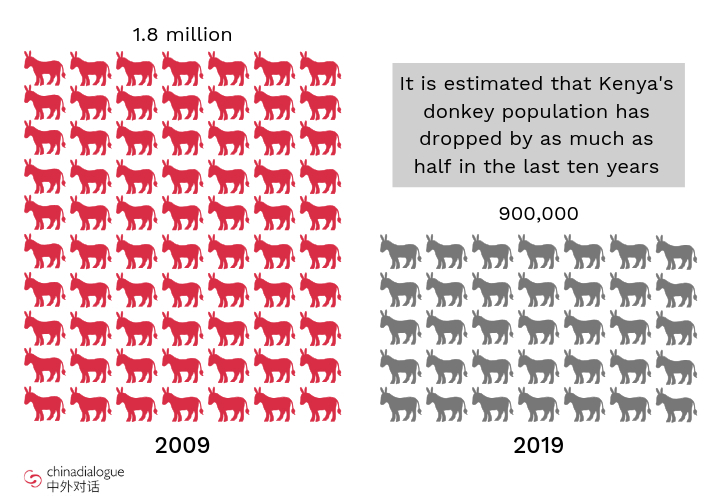
    The report, which was written earlier this year estimates that donkey numbers in Kenya have fallen by as much as half over the past ten years, from 1.8 million animals in 2009 to about 900,000 today.

    ANAW chief operations director Kahindi Lekalhaile warns that abattoirs are making the trade unsustainable by slaughtering too many animals. Donkeys are slow to reproduce, with a gestation period of 11-14 months.

    According to Joseph Ng’ethe, a water vendor who relies on his donkey to make a living, an animal can be sold for 15,000 to 25,000 Kenyan shillings (US$145-242), up from 6,000-8,000 shillings (US$58-78) four years ago. Male donkeys tend to fetch a higher price as do animals from areas near highways and towns.

    There is now a shortage of breeding males and an increase in thefts. Ng’ethe notes that in his area, 60 kilometres southwest of the capital Nairobi, there’s a new case of donkey theft each week.

    “During the day, we used to leave our donkeys alone in the fields to roam and graze freely, but not anymore. The risk of them being stolen is too high.” Ng’ethe said.

    Everyone who has grown or let’s say toured the Kenyan remote regions, donkeys play an even more vital role in everyday life. According to conservationist Noor Ali, donkeys are everything in the arid north where he’s based. With few roads, they are relied on to transport supplies such as food, water, firewood, and yes, even medicines.


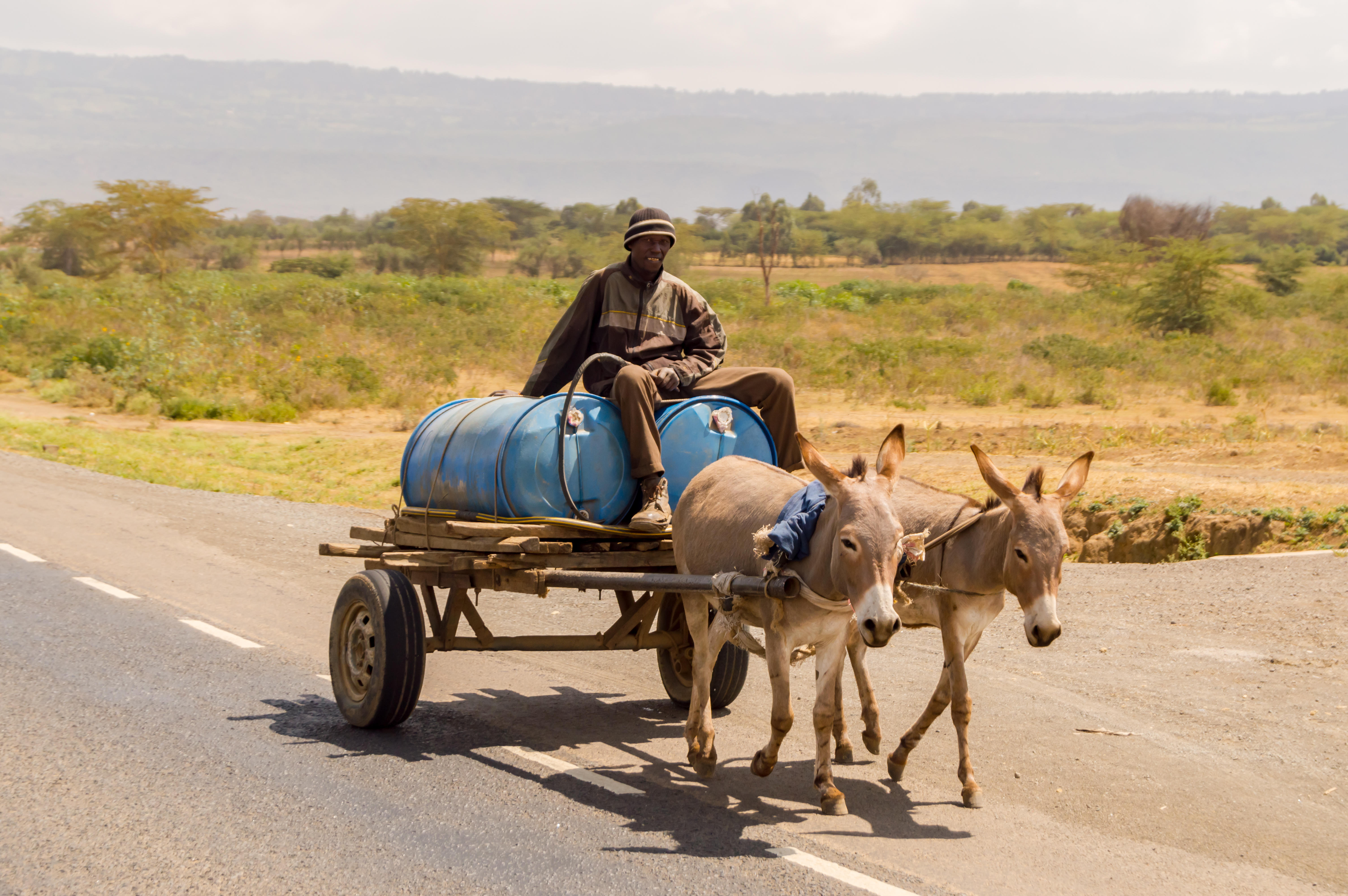
    Delivering water in Kenya’s rift valley Photo courtesy.

    The popularity of ejiao in China has grown with the country’s prosperity. Marketing of healthy lifestyles has helped Dong-E-E-Jiao, the country’s largest producer, to increase the cost of ejiao products 20 times since 2005. Meanwhile, China’s donkey population has fallen rapidly, from 9.4 million in 1996 to 1.2 million in 2018 and who knows how many are remaining now.

    “As donkeys are no longer an important part of China’s agriculture sector, the domestic supply of donkeys could not meet the demand of the ejia industry anymore,” Qin Yufeng, chief executive officer of Dong-E-E-Jiao, said in 2017.

    Kenya’s newest donkey abattoir is located in Machakos county to the southeast of Nairobi. It was set up late last year by Chinese multinational the Fuhai Group. Manager Patrick Kithyoko says the operation slaughters about 500 to 700 animals a day, well below its maximum capacity of 1,000.

    Kithyoko says the abattoir pays well for the animals it slaughters but with fewer available, it has yet to stockpile enough skins and meat to make exporting to China cost-effective.

    “We hope to attain the right tonnage to be able to ship out products by December,” he said.

    The Fuhai abattoir joins three others in Kenya, all competing for a limited number of animals. With donkeys in such high demand, a thriving cross-border trade has developed. Kithyoko sources animals from across East Africa. Noor Ali corroborates, reporting that donkeys are a new addition to livestock on sale at the busy Sololo market on the border with Ethiopia.

    donkey numbers in Kenya have fallen by as much as half over the past ten years
    Source: Unpublished report by the African Network for Animal Welfare (ANAW)

    According to a recent report by the People for the Ethical Treatment of Animals (PETA)-Asia, the animals are squeezed into trucks without food and water for journeys that can take up to two days. Many of them die en route, and the poor conditions continue in the holding pens before slaughter.

    “There are virtually no laws against the abuse of animals in farms or slaughterhouses in Kenya, so none of the violence captured in our video footage is punishable from a legal standpoint,” says Nirali Shah, PETA-Asia’s special projects coordinator.

    The ANAW report also supported these findings, which accuses all four of Kenya’s abattoirs of failure to comply with international animal welfare standards, including those set by the World Trade Organisation and the World Organisation for Animal Health.

    According to Nina Odongo, acting head of the Kenya Society for the Protection and Care of Animals, some of the cruel practices include the slaughter of pregnant donkeys.

    Odongo says the Kenyan authorities should not have licensed the abattoirs without first setting up a breeding programme to meet demand and conducting a feasibility study into the industry’s sustainability.

    “Studies have shown that communities benefit more when they keep their animals. We are therefore advocating for policy reform to curtail this trade.” ANAW’s Kahindi Lekalhaile said

    Shah points out that 12 other African countries have closed Chinese-funded abattoirs and developed policies to control the export of donkey skins to China. She said  PETA has also written to the Ministry of Agriculture demanding they follow suit with immediate action to ban all Kenyan donkey slaughterhouses.

    “The reality is that there are more effective alternatives to ejiao, such as modern drugs and herbal medicines, that don’t require animals to be killed,” she says. “Most people have no idea that donkeys are suffering so terribly or what this cruel industry is all about.”

    Nicholas Ayore, deputy director of the Directorate of Veterinary Services says that licensed abattoirs are closely monitored to ensure they adhere to acceptable standards for handling and slaughter. He denies that donkey numbers are declining as a result of the trade.

    “A ban on the trade would not be something as simple as the activists are assuming. It would have to be guided by a policy paper after research showing that donkey populations [were] on the decline,” he says.

  • Is Kenya Settling The China Loans With Crude Oil

    Is Kenya Settling The China Loans With Crude Oil

    Kenya exported the first batch of her crude oil from Ngamia 1 fields to China in what seemed like a breakthrough, but Kenyans should expect no revenues from the sold oil yet from China.

    Andrew Kamau, the Petroleum principal secretary said that the government will use the 1.2 billion, supposed to be received from the sale, to cover for the expenses that the explorer incurred in market testing for the crude.

    Mr. Kamau had previously revealed that Kenya had sold the crude oil to ChemChina UK Ltd and a selected delegation of the ministry of petroleum is set to visit Ngamia 1 to explain to Turkana leaders so that they explain to locals of what to expect from the inaugural sale of Kenya’s crude.

    “We will be meeting all the leaders next week to explain to them what the sale means because, as we have always said, the Early Oil Pilot Scheme is a market test and not necessarily a commercial venture,” Mr. Kamau said.

    According to the PS, the government is, apparently supposed to recover the cost of setting up the oil drilling machines, rehabilitation of storage tanks and expensive trucking of the crude that saw the pilling of 200,000 barrels headed for Beijing in two weeks.

    “I think we have begun our journey and it is up to us to ensure that those resources are put to the best use to develop our country to make it prosperous and to ensure we eliminate poverty in Kenya,” President Kenyatta said.

    What comes as sour news is that, Turkana, according to Kenya National Bureau of Statistics ranking, is among the top poorest counties in the whole of Kenya. Last year’s household integration survey revealed that Turkana county alone accounts for close to 15 percent of the hard-core poverty in Kenya. The country is also food-deficient, with 66.1 percent of its population considered food poor.

    Personally, I think the government is playing with not only people’s emotions but also money. The State itself has the said stats and reports of what the people of Turkana should get from the start of this project. See people can’t question everything that’s going on right now because the same very government has declined to disclose its production sharing contracts with British oil explorer Tullow.

    Constitutionally, the Petroleum Act 2019, provides for profit-sharing between the national government (75 percent), county government (20 percent) and the local community (5 percent), but that will only be known after the cumulative cost of the Early Oil Pilot Scheme is done, including how the cost will be recovered.

    See the government should have told the people of Turkana and Kenyans at large that they were, allegedly, intending to pay off the huge accumulated China grants and loans with the crude oil. The fact is that Kenya and China kept their deals secret, with even the announcement of the crude oil buyer coming two weeks after the deal was made.

    Nobody knows clearly, maybe those deeply involved in the Petroleum Ministry and the government, why Tullow Oil insisted that the buyer would remain secret, citing a ‘non-disclosure agreement,’ moments before PS Kamau revealed that they had settled on the Chinese oil multinational.

    “Non-Disclosure Agreement does not allow us to reveal the name of the winning bidder unilaterally. However, the process was competitive; a group of target buyers was invited to bid for the crude with the winning bidder selected based on the price offered,” Tullow country manager Martin Mbogo said.

    This comes at a time when a coalition of 16 civil society organizations from the Kenya Civil Society Platform on Oil and Gas had been pushing for full disclosure of the contracts which specify how the costs incurred by Tullow Oil will be recovered when oil is sold.

    “A normal production sharing contract has a cap on how much is allocated to cost recovery to ensure every year you still get some money. It may take long to make full cost recovery, which is usually a recipe for suspicion, especially from local communities,” KCSPOG Coordinator Charles Wanguhu said 

    We can’t clearly know what the government is doing, rather it will do with the funds that will be generated from the sale of this precious crude oil. It also remains unclear to know how much Tullow Oil has spent in the Turkana Oil fields and the recent audit that had been commissioned by the government yet to be made public for perusal.

  • Nepotism: Kalenjins Dominates The Kenya’s Beijing Embassy

    Nepotism: Kalenjins Dominates The Kenya’s Beijing Embassy

    Hello Kenya West,

    I have been following your timely, and accurate posts in the https://t.co/4d7VefGqTM for two years. I want to expose this public service appointment to Kenya’s foreign missions. The Embassy of Beijing had the Following as the counselors and ambassador for the time i visited Beijing in 2016.
    1. Ambassador- Michael Kinyanjui (Kikuyu)
    2. Deputy Ambassador- John Odipo (Luo)
    3. Education counselor- Reuben Kipturgo (Kalenjin)
    4. Defense Attachee – Kalenjin
    5. Commerce- Omuse (
    6. Imigration- Edward Mbuthia (Kikuyu)
    7. Akinyi (luo)- Finance
    etc. The office was properly or slightly well constituted.

    Currently, when the term of former ambassador and his deputy elapsed we had Sarah Serem (Kalenjin) as ambassador, MR Waweru (deputy Ambassador), and the following: This is as per the trip I had recently to Beijing in June…
    1. Sarah Serem (Kalenjin) as ambassador,
    2. MR Waweru (Kikuyu) (deputy Ambassador),
    3. Education counselor- Reuben Kipturgo (Kalenjin)
    4. Defense Attachee – Kalenjin
    5. Commerce- Limo (Kalenjin)
    6.
    7. kalenjin
    Mainly it has staff from the two tribes Kalenjin and Kikuyu…. But as currently constituted, the number of Kalenjins are the majority. You can confirm with ministry of foreign affairs or public service commission. Do they want Kalenjin language to be spoken at the embassy? Why can’t we have a mixed creed of people from the diverse tribes in Kenya to be seconded to work in the embassy? This office stinks….. as we are for Building Bridges Initiative, we cant build bridges of tribalism and favoritism. Please spread this information, and let us have equal representation in embassies too. Last time I Checked, in the US, Kenyan embassy was also full of Kikuyus I do not know if that has changed.

    Disclamer: Opinion Only reflects the views of the writer and  doesn’t reflect that of Kenya Insights.

  • Expert Analysis: Breaking Down The China’s Africa Schemes

    Expert Analysis: Breaking Down The China’s Africa Schemes

    By Reinhard Asamo

    China’s Africa Strategy
    Decades ago, China influence in Africa was limited. Its aid influence were highly significant and its diplomats relatively unskilled. And many Chinese were unsure about their country’s role as an International actor in the International system. In many instances, China did very little rather than defending core interest like “one China”.

    Recently, However, strong economic growth , a more sophisticated generation of Chinese leaders , better scholarship from Chinese government to Africans and a domestic population more confident of china as a global actor have given China a more proactive approach in global politics.

    Chinas motives are clear: they are looking for new suppliers for their industries raw materials. Its exporters want market and their governments want support in International Organizations and its propaganda to counter the US influence in the global politics. Africa is therefore a good ground for these strategies. In fact, the whole issue for the Chinese scramble is purely a resource grab. Chinese growth coupled with dwindling oil and mineral deposits is a major factor in the scramble for the African continent. China is the largest consumer of the petroleum product and natural gas and other minerals like copper, cobalt and natural gas.

    Chinas motives are clear: they are looking for new suppliers for their industries raw materials. Its exporters want market and their governments want support in International Organizations and its propaganda to counter the US influence in the global politics. Africa is therefore a good ground for these strategies. In fact, the whole issue for the Chinese scramble is purely a resource grab. Chinese growth coupled with dwindling oil and mineral deposits is a major factor in the scramble for the African continent. China is the largest consumer of the petroleum product and natural gas and other minerals like copper cobalt and natural gas.

    In the coming years, China domestic oil production will diminish and this might make it likely be the global consumer of such products. China has no strategic oil reserve unlike the United States. That is the reason China has a lot of interest in Nigeria, Sudan, Angola, Gabon and Kenya. China imports about 28% of its oil products and gas from Sub Sahara Africa compared to 15% of the United States.

    In the coming years, China domestic oil production will diminish and this might make it likely be the global consumer of such products. China has no strategic oil reserve unlike the United States. That is the reason China has a lot of interest in Nigeria, Sudan, Angola, Gabon and Kenya. China imports about 28% of its oil products and gas from Sub Sahara Africa compared to 15% of the United States.

    However, China’s Africa strategy is more than resources but also to open new markets for their products. We have seen Kenyan market flooded with sub standards goods thereby creating a crowding effect for the local goods and services. Ethiopia for example has 90% of the market composed of Chinese products.

    Sadly, Chinas unparalleled competitiveness in the developed International Markets is hurting Africa’s economies especially in the textile industry. African leaders are actually treating China as a global power in the Continent.
    China is determined to establish long term relationships with the Africa’s elite. These are through exchange programs like scholarship. It is therefore not surprising that Chinese language is to be taught in Kenya alongside the English language. Chinese medical doctors train African ones and provide free medical equipment to African counties. On the economic front, China has opened many investment and trade promotion centers to promote trade with the African continent. The Chinese has created special funds and have reduced bottlenecks for the Chinese investors.

    This is aimed at encouraging investment among its people. China uses summits and conferences to reach the African leaders. China view Africa as a market for its arms. Chinese sale of arms to Africa is second to Russia. This is compounded by the fact they don’t lecture African countries on good governance and democracy. Chinese telecommunication giant Huawei for example has huge contracts to provide mobile services in countries like Kenya, Nigeria and Zimbabwe. President Mugabe for example refers to china “My friend number one” Just because they don’t lecture Africans on the need to inculcate democratic principles and uphold Human Rights. The same sentiments are shared by President Kagame and Omal EL Bashir of Sudan. In Africa where the rule of law often doesn’t exist, China’s state led business model could prove a disaster for a continent that is still left with fragile pseudo democracies with no strong civil societies and non-state actors to oversight the excesses of the governments.
    In this fragile environment, Chinese influence could complicate democratic consolidation and good governance. Chinas unwillingness to put any conditions to its assistance to African countries could further jeopardize International efforts to promote good governance. China has always used its Veto power at the UNSC to thwart efforts meant at imposing sanctions on states that are considered rogue. Africa will therefore provide a test whether china is a world power able to exert influence beyond its borders.

    There is increasing Chinese participation in the energy and resource sectors particularly in fragile states such as Sudan, Angola and DRC. This is linked to attempts by some fragile states to evade pressure by western donors and NGOs to promote more transparent and better governance. Chinese aid is growing throughout the region, particularly in recent years, and appears to be carefully targeted to complement its commercial activities, Including in fragile states.

    While these major policy challenges are clear, important key knowledge gaps exist which need to be filled if policy responses are to be appropriately nuanced for Individual country circumstances. The major knowledge gaps are with regard to:

    * The need for baseline studies to assess the changing future impact of China on SSA.
    * Analyses of the determinants of SSA competitiveness and the steps required to enhance productivity (for example, in clothing, textiles, footwear and furniture, as well as in export-oriented food crops);
    * A more thorough assessment of indirect impacts of China’s trade on SSA, facilitating the development of appropriate policies for providing special and differential treatment to low income SSA economies in global markets;
    * Determining the impact of China on consumer welfare, income distribution and absolute poverty levels in SSA, through an analysis of the consumer benefits derived from cheaper imports, and the distributional implications of a switch in specialization away from labor-intensive manufactures to capital intensive commodities;
    * Distinguishing generic from sub-regional and country-specific impacts, aiding the classification of different types of SSA economies;
    * Identifying likely future areas of threat and opportunity;

    This growing Chinese presence raises major policy challenges for SSA if the manifold opportunities are to be grasped and the threats minimized:
    * It poses particular threats to the manufacturing sector. Here the outlook is not entirely bleak, but SSA countries need to take explicit steps to counter act the dangers posed to existing and future capabilities in industry.
    * Although the commodity boom favors some SSA economies, it poses very severe problems of economic management. Poorly-handled, a resource boom can easily become a resource-curse. Much can be learned from the experience of other countries (including in SSA) in handling these resource booms.
    * Notwithstanding the welfare gains to the poor from lower import prices, the expansion of capital-intensive mineral production and the decline of labor – intensive manufactures pose severe challenges for poverty-alleviation and income distribution. There is, moreover, the additional problem that resource-production is closely associated with violence, corruption and fragile states. Policies to ameliorate these potential adverse poverty-related impacts need to be addressed.
    * Linked to this, China has actively forged closer links with fragile states and this has undermined attempts by the global community to enhance transparency and better governance. There is also emerging evidence that attempts to foster better corporate and environmental governance are also being undermined by China’s presence in some SSA countries.
    * African economies are being pulled in different directions with regard to their linkages with other economies. One pressure is to sustain historical links with the EU and North America, cemented by various preferential trading agreements. Another pressure is to strengthen links with other SSA economies, particularly in southern Africa. A third pressure is to enhance links with Asia in general, and China in particular.

    Scarce administrative and strategic capabilities may require SSA economies to choose how they respond to these various pulls. There are strong arguments for a concerted ‘look East’ policy.
    * The key capability which SSA economies require is the development of dynamic capabilities to scan changing environments, to develop appropriate strategic responses and to implement these strategies effectively. Unless these capabilities are built – in government, in the corporate and farming sectors, and in civil society – the opportunities offered by Chinese growth may be overwhelmed by the threats which are raised. This applies particularly to emerging sectors of Chinese demand (for example, imports of food products).

    The writer Is an economist by profession.

    Twitter : @Asamoh_

    DisclaimerThis article expresses the author’s opinion only. The views and opinions expressed here do not necessarily represent those of Kenya Insights or its Editors. We welcome opinion and views on topical issues. Email:[email protected]