Pop star Rihanna’s net worth is estimated at $1.7 billion, making her the richest woman musician in the world, but her music is not the primary source of her wealth, Forbes magazine said on Wednesday.
The Barbados-born singer, whose birth name is Robyn Fenty, derives an estimated $1.4 billion of her fortune from her 50% stake in the Fenty Beauty cosmetics line, Forbes reported.
The rest of Rihanna’s wealth comes from her share of the Savage x Fenty lingerie company and her income as a singer and actress, the magazine said.
Rihanna’s beauty company, of which LVMH owns the other half, is known for its broad range of 50 skin tones, including dark shades for women of color, which were rare when it launched in 2017. This made it a leader in inclusivity in the industry.
The singer of “Umbrella” and “Love the Way You Lie” ranks second behind Oprah as the richest female entertainer, Forbes said.
The first Dollar Billionaire in Zimbabwe, 58-year-old Strive Masiyiwa who, according to FORBES estimates has a net worth of $2.8 billion, has said that Digital technologies present opportunities for developing nations to build new industries and deliver better services.
Earlier this week, Pathways for Prosperity released a report( that we have highlighted in this article) ascertaining that only 30 per cent amongst 80 per cent of people in developing countries who live under a cellular network have ever used the internet.
Speaking during the launch of the report, Billionaire Strive Masiyiwa, who’s also the Econet’s founder said that;
“Digital technologies offer powerful tools to grow businesses and nations, enabling entrepreneurs to access markets and gives governments innovative ways to deliver better services.”
In the report titled The Digital Roadmap: how developing countries can get ahead— 26 recommendable steps on how nations can use to harness new technologies to deliver development to their citizens are highlighted.
Here is the report courtesy of Pathways for Prosperity.
Key Findings
This is a critical moment in history. Some countries will prosper in a new global digital economy, but countries that are not ready will risk being left behind.
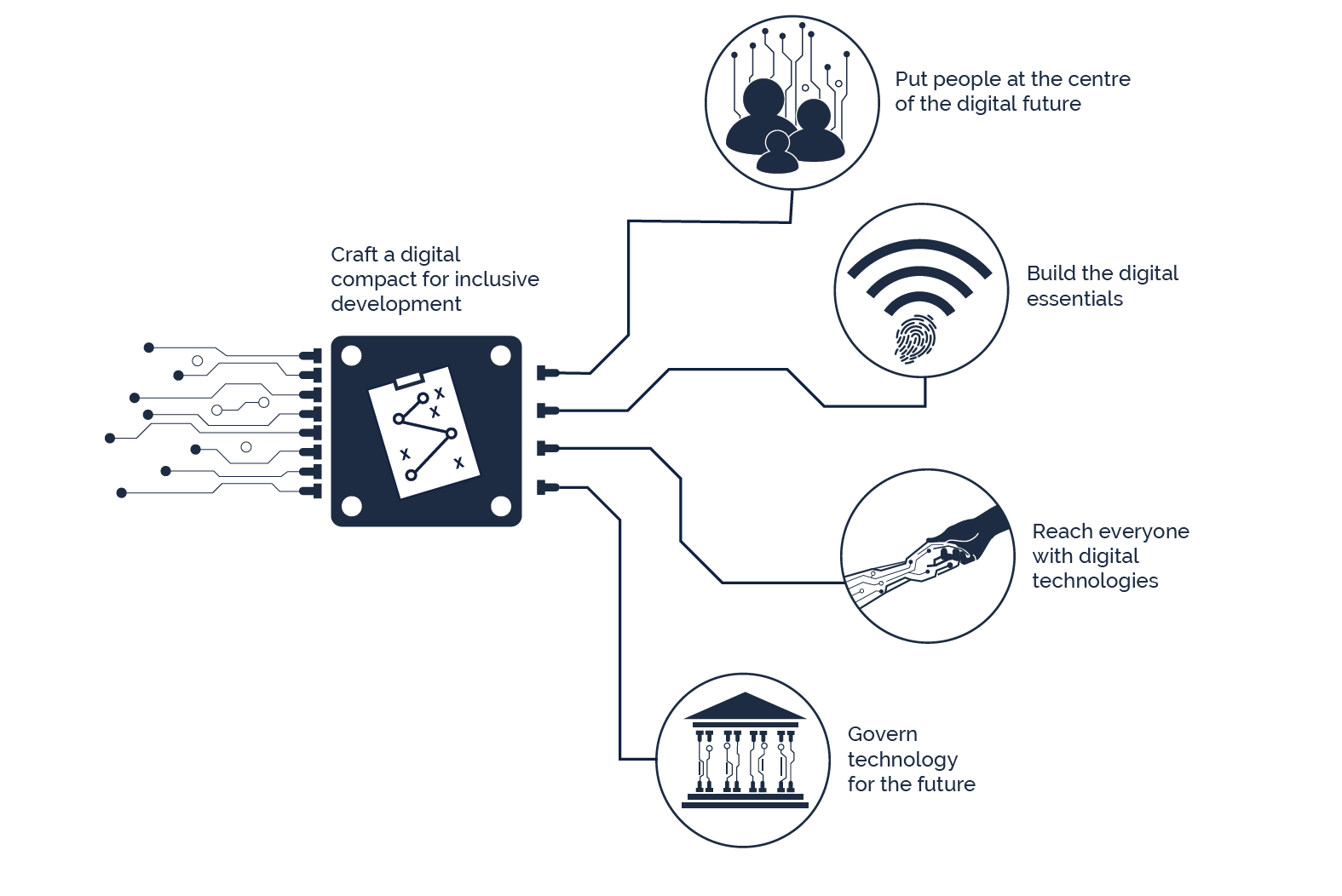
Countries have the agency to act now. The Digital Roadmap identifies five priority areas for countries to create their own digital future.
Technology will not guarantee success, no matter how innovative it is. Just as important as new technology is the social and economic environment in which technology is used.
Technology will almost always be a force for growth, but technology is not automatically a force for inclusion. Without a ddeliberate effort to include everyone, digital technologies can end up entrenching existing inequality.
Government, civil society and the private sector should come together to craft a shared national vision. Everyone has a role to play in major economic transformation.
With new digital technologies come opportunities for low and middle-income countries to diversify their economies, create new jobs, transform agriculture, and improve health and education. But digital technologies can also entrench exclusion and disrupt peoples’ livelihoods. This report, based on two years of research and analysis, is underpinned by learning and extensive engagement with policymakers, entrepreneurs, civil society and academics from around the world.
Five priorities to get ahead in the digital age
The Digital Roadmap presents an overarching vision for a globally connected world that both delivers on the opportunities presented by technology and limits downside risks. Importantly, it also sets out how this vision can be achieved.
Craft a Digital Compact for Inclusive Development
Embracing country-wide digital change will be disruptive. Navigating it requires coordinated action. Reconfiguring an economy will result in some resistance. The best way to achieve buy-in, and to balance trade-offs, is through dialogue: the private sector and civil society in its broadest sense (including community leaders, academia, trade unions, NGOs, and faith groups). The political economy of upheaval is difficult, but change can be managed with discussions that are inclusive of multiple groups. These dialogues should result in a national digital compact: a shared vision of the future to which everyone commits. The Pathways Commission has supported three countries – Ethiopia, Mongolia and South Africa – as they each developed country-wide digital strategies, using the Digital Economy Kit.
Put People at the Centre of the Digital Future
Rapid technological affects peoples’ lives.Failure to put people at the centre of social and economic change can lead to social unrest. The pace and intensity of change means it’s all the more important that people are at the centre of the digital future – not the technology. This requires equipping people to benefit from opportunities, while also protecting them from the potential harms of the digital age. Governments should take responsibility for ensuring that vocational education is truly useful for workers and for business in the digital age. The private sector needs to be involved in keeping curricula up to date.
Build the Digital Essentials
Digital products and services cannot be created in a vacuum – essential components need to be in place: physical infrastructure, foundational digital systems (such as digital identification and mobile money), and capital to invest in innovation. These are the basic ingredients needed for existing firms to adopt more productive technologies, and for digital entrepreneurs to build and innovate. Having reliable infrastructure and interoperable systems means that firms and service providers can focus on their core business, without having to build an enabling environment from scratch.
Reach Everyone with Digital Technologies
If technology is to be a force for development for everyone, it must reach everyone. Just over half of the world’s population is connected to a digital life; for the rest, digital opportunities don’t mean much. Without digital connections, people can’t participate in digital work platforms, benefit from new technologies in education, or engage with government services online. Women, people with lower levels of education, and people in poverty are usually those who lack digital access. Reaching everyone requires looking beyond current business models. The private sector needs to design for inclusion, ensuring the poorest and most marginalised consumers, to ensure they are not left even further behind.
Govern Technology for the Future
The unprecedented pace of change and the of new risks in the digital era (such as algorithmic bias, cybersecurity, and threats to privacy) are creating headaches for even the most well-resourced countries. For developing countries, the challenges are even bigger. Digital technologies fundamentally shape what people do and how they do it: freelancers may face algorithms that determine chances to get hired. Banks might face a financial system with heightened risk from new, non-bank deposit holders. These issues and many others require new and adaptive approaches to decision-making. Emerging global norms will need to consider the needs of developing countries.
The Pathways for Prosperity Commission works to create conversations and to encourage the co-design of country-level solutions aimed at making frontier technologies work. The commission’s efforts are aimed at helping the world’s poorest and most marginalised men and women.
Pathways Commission reports that it has piloted the Digital Economy Toolkit in Ethiopia, Mongolia, and South Africa as a foundation for their national digital strategies. The panellists at the launch insisted on training on 21st-century skills to accommodate Africa’s growing labour force. According to research, it is estimated that by 2030, the labour force will grow by 285 million.
The billionaires also urged the governments to develop a ‘National Digital Compact’ to guide digital transformation and navigate the impacts that technologies are having on their societies and economies.
In Kenya for instance, such a move will mean empowering citizens with digital skills, giving them access to digital platforms, and providing a social safety net for those whose livelihoods are disrupted by technological change. Not imposing useless social media tax or registering social media users so that the government can dictate what Netizens have, are and will be doing on their independent platforms.
Kenya’s most renown Politician and late billionaire Njenga Karume’s granddaughter Michelle Karume has died in a US-based medical facility after spending a few of her last days on earth begging for financial help.
The 26 years old Michelle Karume succumbed to cancer in the US last Saturday days after penning a painful plea for funds from home to treat her cancer. From her pleas for help, Michelle’s last days were spent in agonizing pain after lacking basic medicines such as painkillers.
This, as a fierce inheritance battle for her grandfather’s immense wealth, rages on back here in Kenya. Michelle stunned the court in a past session when she interrupted lawyers and cried to the presiding judge that she was dying of cancer and could not afford medication. The Judge directed the trustees of Karume’s estate to provide the required funds to meet her medical expenses.
The late businessman Njenga Karume (Courtesy)
Michelle was among the grandchildren that Karume had put in his Will as beneficiaries of his vast estate that was estimated at Sh17.8b last year. Prior estimates had placed his wealth by the time of his death at more than Sh100b. As the inheritance matter drags on in court, Michelle’s emotional letter that was also shared with the family’s lawyers, painted a picture of destitute last days.
In an uncanny reference to her death, Michelle wrote that her time was running out.
“I kindly would like to know the way forward because it is such a terribly long time since I was on treatment, it is going to a year now,” she wrote.
According to the late Michelle, she did not understand why there was no money to help her get treatment and accusing the family of neglecting her after her grandfather’s death.
Michelle Karume deceased
Her grandfather’s vast wealth did not help her when she needed it most, and only brought her pain and more pain.
“The clock is ticking while every day I sit by my phone to hear some good news on funds, but three months later I am waiting here; still waiting for my phone to ring, but in return, I get less communication to a point nobody can pick up my calls,” she wrote.
From the distressing messages that the deceased send and shared before her last breathe indicate that her financial distress fuelled by her need for medical attention had been ongoing for at least three years.
According to Michele’s messages, she has not been receiving funds from as far back as 2016 something she shad claimed that saw her miss out on a clinical trial which could have diagnosed and treated cancer before it progressed further.
It was not until last December when Michelle travelled to the US on the belief that the funds would be unlocked. She was enrolled for the clinical trials in January, but the anticipated money did not come, prompting her to drop out. She then expressed her wish to come back home.
“Living here has been very tough, my son has no routine in lifestyle as he doesn’t go to school, but I wish to enroll him in daycare that also requires money,” Michelle wrote.
She said the hospital called every day to inquire if she was still interested in the clinical trial and that she kept pleading for more time to find the money.
Jay Z becomes the first Forbes rated Hip Hop Billionaire Artist.
Over a decade ago, world’s richest man Warren Buffet, had lunch with Jay -Z at the Hollywood Diner in Omaha, Nebraska.
The two who were at a very separate and different socioeconomic level conversation was extended to Buffett’s Berkshire Hathaway offices.
That’s what made richest man alive say this, “Jay is teaching in a lot bigger classroom than I’ll ever teach in. For a young person growing up, he’s the guy to learn from”
An Edition of the Forbes 400
According to 2010 Forbes 400 package, the Hip Hop inspired Jay-Z already had a blueprint for his own ten-figure fortune.
Forbes has been following Jay-Z moves and a decade later since he first met Buffett, Jay Z has an accumulated fortune worth $1 billion according to Forbes.
Forbes published that Jay-Z’s steadily expansive kingdom of fortune compromised of strong liquor brands, his art, real estate, which included his homes in Los Angeles, the Hamptons, Tribeca and stakes in Uber.
According to forbes, Jay Z was once the Brooklyn’s notorious Marcy drug dealer who later cleaned up to become a musician.
Jay Z started his own label, Roc-A-Fella Records, to release his 1996 debut, Reasonable Doubt.
Forbes records indicate that Jay Z has since produced 14 No. 1 albums, 22 Grammy awards and over $500 million in pretax earnings in less than a decade.
Forbes also published that Jay Z has his own brands which skyrocketed his fortune much faster without any cosign promotions.
Jay Z runs a clothing line Rocawear that started in 1999.
Forbes records indicate that Rocawear has made a profit of $204 million from 2007 alone since it changed to Iconix.
Forbes also published that co-owns D’Ussé cognac with Bacardi.
According to forbes, Jay Z also own Tidal, a multi-million music-streaming service.
Super producer Kasseem said Jay Z is bigger than hip-hop. He said Jay is a blueprint for the American culture.
“A guy that looks like us, sounds like us, loves us, made it to something that we always felt that was above us.” Kasseem told Forbes.
Kasseem “Swizz Beatz” Dean, is the super producer behind some of Jay-Z’s biggest hits (“On To The Next One,”
Kasseem also Produced Beyoncé’s worldwide banger “Upgrade U”
According to Forbes, they calculated Jay Z’s net worth by studying his artist’s stakes in companies like Armand de Brignac champagne that Jay Z fully owns.
Forbes published that they applyed US customary discount to private firms, then added up his income, subtracting a healthy amount to account for Jay Z’s superstar lifestyle.
“We checked our numbers with a roster of outside experts to ensure these estimates were fair and conservative.” Forbes published.
Jay-Z is a real and massive business man. For instance, Jay Z owns;
Armand de Brignac
Valued at $310 million
File photo of Jay Z owned Amand de Brignac champagne Photo|Forbes
Jay-Z launched the $300 gold bottles of the “Ace of Spades” champagne Brand in 2006 with His Music video “Show Me What You Got.”
Jay Z’s verse on Meek Mill’s “What’s Free” put a half-billion-dollar value on his wine brand.
Cash & investments
Valued at $220 million
According to Forbes, Jay Z investing portfolio in Uber alone is worth over $90 million.
D’Ussé
Valued at $100 million
D’USSE Cognac Vsop 750 ML Photo|Forbes
Eric Schmidt, Beverage Marketing Corp.’s Director of Alcohol Research said that D’Usse’ moves more that 200,00 cases of liquor and has an 80% annual growth
Tidal
Valued at $100 million
A screenshot of the Tidal App
Jay-Z purchased the Scandinavian streaming service’s parent company for just $60 million in 2015.
He relaunched Tidal later that year bringing on board his celebrity wife, Beyoncé, and other music millionaire like Kanye West and Calvin Harris.
Roc Nation
Valued at $75 million
According to Forbes, the international entertainment company,Roc a Nation started over a decade ago as part of a joint venture with concert giant Live Nation.
Roc Nation represents top Stars through its sports agencts ,Kevin Durant, Todd Gurley.
It also has a record label and artists management Arm under Rihanna and J. Cole.
Music catalog
Valued at $75 million
A photogrid of Jay Z sampled Albums
According to Forbes, Jay Z negotiated the eventual return of his master recordings from a the label that helped him launch his career.
Before the beginning of his stint as Def Jam’s chief in 2004, Jay Z had a separate deal with EMI he later clawed back his publishing rights.
Currently Jay Z’s hits clock close to a Billion streams annually.
Art collection
Valued at $70 million
Jay-Z boasted about a Basquiat in his kitchen corner In the song “Picasso Baby,”
For over a decade, he’s been collecting masterpieces like Basquiat’s “Mecca,” purchased in 2013 for a reported $4.5 million.
“He’s rapped about it all in detail,” says Fab 5 Freddy, a contemporary and friend of the late painter.
Real estate
Valued at $50 million
One of Jay Z’s Homes / NEWSCOM
After welcoming twins in 2017, Jay-Z and Beyoncé bought a pair of homes to match: a $26 million East Hampton mansion and a $88 million Bel Air estate.
Also, Jay-Z owns a Tribeca penthouse valued at $66.85 million. He bought it in 2004 for only $6.85 Million.
*All prices and market value are Forbes estimated figures*