Category: US Unrest

  • Kenya Deports US Capitol Insurrectionist Sturgeon  Who Fled To Hide In Kenya After Attack

    Kenya Deports US Capitol Insurrectionist Sturgeon Who Fled To Hide In Kenya After Attack

    On January 6th a group of domestic terrorists allied to the then President Trump attacked the US Capitol where the senate were voting to stamp president Biden’s win by certifying the electoral votes . This followed a lengthened campaign of baseless claims of election fraud by President Trump.

    His numerous petitions were thrown out of courts as they lacked merits, in his many attempts to block the win of Biden, Trump called upon his supporters to turn up in Washington DC where he promised his cult that things would get wild. When Trump and other leaders invited the mob to raid the Capitol to stop the voters certification, they heeded and launched one of the biggest attacks in the country.

    At the end five people died including a policeman. FBI has since been following up and arresting the insurrectionists who stormed the Capitol.

    One of them is Sturgeon – who lives in Montana US. On learning that the FBI was on the trail of all those who stormed DC, he fled to Kenya on the 24th February and purchased a return ticket for April 5th 2021.

    Having been located in Kenya by the FBI , they collaborated with Kenyan authorities who ordered his deportation and subsequent handover to the American authorities. He left Kenya on 5th March and arrived in the US on 6th where he was scooped up by the feds upon arrival at JFK Airport in NYC.

    Isaac Steve Sturgeon is accused of picking up a metal police barricade, pushing it into officers and crawling under to access the Capitol Building on Jan 6.

  • US: Cities, Businesses Brace For Post-Election Violence

    US: Cities, Businesses Brace For Post-Election Violence

    Many cities and businesses in the US have braced for potential violence and chaos on Tuesday and beyond as long-awaited elections bring both high stakes and charged emotions.

    Although some 100 million Americans have taken advantage of early mail-in voting, more than 50 million are still expected to cast their ballots in person on Election Day, a significant increase from the 139 million who cast ballots in 2016.

    But the looming threat of election-related violence in US cities and streets led many business owners to board up windows and shut their stores.

    In Florida, some stores including Macy’s, Target, and CVS were boarded up in Miami’s upscale Design District as major retailers across the country have intensified security measures to prevent any damages to their stores in the potential post-election violence. Similar measures were seen in Washington D.C.

    “The stakes are high for this election and the national mood appears dark,” the Brookings Institution said in a report on Oct. 27.

    “Violence could manifest in ways big and small. Local extremists might seek to ‘defend’ a polling place and, in so doing, intimidate voters form another party,” the think tank added.

    The possibility that election results could be delayed, or contested, have businesses and homeowners worried that commercial and residential properties may see some damage if case of riots.

    Democrats have pointed to statements by US President Donald Trump that seem to welcome, encourage, and foreshadow violence if he fails to win or the result is less than clear cut.

    In several statements, Trump hinted that he will commit to a peaceful transfer of power only if the elections are far from ”fraud.” On the Election Day, Trump told Fox News that he will declare victory only when there is a victory.

    The US states of Arizona, Florida, Georgia, Michigan, North Carolina, and Pennsylvania are seen as swing states in the race between Trump and his Democratic contender Joe Biden.

    Some other states, such as Minnesota, Iowa, New Hampshire, Ohio, Wisconsin, and Texas, could bring surprises to election observers.

    Public unrest is still fresh in the minds of Americans, with massive and prolonged protests and deadly riots earlier this year in the states of Oregon and Minnesota following the death of George Floyd, a Black man, under the knee of a white police officer.

    Americans also recently witnessed protests and riots in at least a dozen states after there was no indictment for police officers for the death of Breonna Taylor, an African-American woman who fatally shot in her apartment.

    In major cities, local police departments have also notified the public there might be street closures due to scheduled rallies and protests on Tuesday and Wednesday, when organizers have promised “count every vote” demonstrations.

  • No Green Cards untill 2021 as US President Trump signs into law Executive order halting their issuance.

    No Green Cards untill 2021 as US President Trump signs into law Executive order halting their issuance.


    WASHINGTON

    US President Donald Trump signed an executive order suspending the issuance of a number of employment-based visas through the end of 2020, including the H-1B which are used for highly skilled workers and common in the tech industry.

    “Temporary workers are often accompanied by their spouses and children, many of whom also compete against American workers. Under ordinary circumstances, properly administered temporary worker programs can provide benefits to the economy,” the order reads.

    “But under the extraordinary circumstances of the economic contraction resulting from the Covid-19 outbreak, certain non-immigrant visa programs authorising such employment pose an unusual threat to the employment of American workers,” it continues.

    The order also applies to H-2B visas for short-term seasonal workers, H-4 visas for spouses of H-1B visa holders, L-1 visas for executives transferring to the US from positions abroad with the same employer, as well as certain J-1 visas which are given to researchers, scholars and other specialised categories.

    It will not apply to visa-holders already in the United States, or those outside the country who have already been issued valid visas


    The new restrictions will prevent about 525,000 people from entering the United States between now and the end of the year, including 170,000 green-card holders who have been barred from coming to the country since April, according to a Wall Street Journal report, citing a senior Trump administration official.

    The Trump administration will grant exemptions for health-care workers focusing on treating and researching Covid-19 as well as those working in the food supply chain, including seafood and food packaging, said the report.

    A number of American tech industry and other business leaders have warned that the move will weaken companies’ ability to recruit top talents to the US and lead them to move more operations abroad.

    “Today’s proclamation is a severe and sweeping attempt to restrict legal immigration. Putting up a ‘not welcome’ sign for engineers, executives,  IT experts, doctors, nurses and other workers won’t help our country, it will hold us back.

    Restrictive changes to our nation’s immigration system will push investment and economic activity abroad, slow growth, and reduce job creation,” Thomas Donohue, the CEO of U.S. Chamber of Commerce, said in a statement.

    “American businesses that rely on help from these visa programs should not be forced to close without serious consideration,” nine Republican senators wrote in a May 27 letter addressed to Trump, “guest workers are needed to boost American business.”

    Meanwhile, as many as 64 percent of Americans believe immigrants primarily fill jobs Americans don’t want, according to a recent poll conducted by the Pew Research Center.

    The Monday order is the latest effort by the Trump administration to cater for immigration hardliners and groups, a key constituency of the president’s political base that argue American workers should be prioritised, especially amid the economic downturn due to the coronavirus pandemic.

    The new restrictions, which will take effect on June 24, expand a temporary immigration ban the Trump administration introduced in April that blocked some family members of U.S. citizens and reduced the number of high-skilled workers from immigrating to the country for the time being

  • Facebook takes down Trump ads ‘for violating our policy against organized hate’

    Facebook takes down Trump ads ‘for violating our policy against organized hate’


    Facebook (FB) on Thursday said it had taken action against ads run by President Trump’s re-election campaign for breaching its policies on hate. The ads, which attacked what the Trump campaign described as “Dangerous MOBS of far-left groups,” featured an upside-down triangle.

    The Anti-Defamation League said Thursday the triangle “is practically identical to that used by the Nazi regime to classify political prisoners in concentration camps.”
    “We removed these posts and ads for violating our policy against organized hate. Our policy prohibits using a banned hate group’s symbol to identify political prisoners without the context that condemns or discusses the symbol,” Andy Stone, a Facebook spokesperson, told CNN Business.
    The hate group to which Facebook was referring in its statement is Nazis, the company confirmed.
    The ads targeted the far-left group antifa, calling on Trump supporters to back the President’s calls to designate the group a terrorist organization.
    Responding to criticism of the ad earlier Thursday, the Trump campaign claimed the red triangle was “a symbol widely used by Antifa.”
    The campaign pointed CNN Business to several links to poster, sticker, and magnetwebsites that sell unofficial merchandise designed by their users that contains the symbol. The campaign did not point to any examples of antifa activists wearing the symbol.
    The ADL said Thursday that some antifa activists have used the symbol, but it is not particularly common.

    According to Facebook’s political ad library, a set of ads featuring the offending symbol began running on Wednesday on Trump’s main Facebook page, the “Team Trump”campaign page, and Vice-President Mike Pence’s Facebook page.

    The paid ad was seen almost one million times in Facebook users’ feeds on Trump’s page alone, according to data from Facebook.
    In a statement, Tim Murtaugh, director of communications for the Trump campaign, insisted the red triangle is a “symbol used by Antifa.”

    Murtaugh added, “We would note that Facebook still has an inverted red triangle emoji in use, which looks exactly the same, so it’s curious that they would target only this ad.”
    “The image is also not included in the Anti-Defamation League’s database of symbols of hate,” he said.
    Responding to that defense, the ADL pointed out that its database is not a database of historical Nazi symbols, but of symbols commonly used by modern extremists in the US.
    Facebook’s removal of Trump’s ads could escalate tensions between the White House and Silicon Valley.
    Facebook CEO Mark Zuckerberg was criticized last month for not taking action on a Trump post that said “looting” leads to “shooting,” amid racial unrest across the country. Twitter (TWTR) flagged the same Trump post on its platform as glorifying violence.
  • For Shoving to the ground a 75-year old, 57 Buffalo special officers resigns from the special team

    For Shoving to the ground a 75-year old, 57 Buffalo special officers resigns from the special team

    Fifty-seven police officers in Buffalo, New York, have resigned from the force’s emergency response team following the suspension of two officers who allegedly pushed a 75-year-old protester to the ground, a source close to the situation said Friday.

    An investigation is underway in a protest incident Gov. Andrew Cuomo called “wholly unjustified and utterly disgraceful.” The man was seriously injured.
    Video of the demonstration Thursday shows a row of officers walking toward the man and two pushing him. His head bleeds onto the sidewalk as officers walk past him, some looking down at him.
    The demonstrators in Niagara Square were, like those across the country, calling for racial justice after the killing of George Floyd in Minneapolis police custody.
    The 57 officers resigned from the emergency unit but not from the force. The Buffalo mayor’s office said that the 57 members that resigned from the unit make up the entire active emergency response team.
    A few members of the unit are out currently and are not included in the 57 that resigned, according to the mayor’s office.
    “Fifty-seven resigned in disgust because of the treatment of two of their members, who were simply executing orders,” Buffalo Police Benevolent Association president John Evans told WGRZ on Friday. WKBW also reported news of the resignations.
    The man’s identity, Martin Gugino, was confirmed by Cuomo’s office. Gugino is hospitalized in serious but stable condition, authorities said.
    An attorney representing Gugino released a statement saying Gugino is “alert and oriented” and described him as a longtime peaceful protester and human rights advocate.
    “Mr. Gugino requests privacy for himself and his family as he recovers,” said Kelly V. Zarone. “He appreciates all of the well wishes he has received and requests that any further protests continue to be peaceful.”
    Megan Toufexis, Gugino’s niece, told CNN that her uncle attended the protest Thursday to discuss First Amendment rights with police.
    Protests in the city continued into the evening Friday.

    Buffalo mayor says officers should receive due process

    Mayor Byron Brown said he wants the two suspended officers to get due process. “I am not calling for them to be fired.”
    Speaking of the injured man, the mayor said, “He was asked to leave numerous times last night.”
    Police felt that it was important to clear the area before fights broke out among the protesters, the mayor said. He stressed that the instructions from the police managers to officers was to be careful, protect residents and use common sense.
    In response to questions about the emergency response team, Brown said that the city has a contingency plan. “Buffalo will be safe this weekend,” he said. “We have a contingency plan, we always have a contingency plan.”
    CNN reached out to police and the association for further comment. New York State Police say they are sending additional officers to the city following the resignations.
    The demonstrators in Niagara Square were, like those across the country, calling for racial justice after the killing of George Floyd in Minneapolis police custody.
    Based on the initial video, police issued a statement that said Gugino tripped and fell, police spokesman Mike DeGeorge told CNN.
    After more videos became available, police amended that statement, and Buffalo Police Commissioner Byron Lockwood suspended the officers without pay and opened an investigation, he said.
    “The department moved swiftly” and “corrected” the information, DeGeorge said.
    Brown called the incident “disheartening” and said his thoughts were with Gugino.
    Prosecutors are investigating, the Erie County District Attorney’s Office tweeted.
    https://twitter.com/daeriecountyny/status/1268893552395849728?s=21
    Gugino had a head injury and could not give a statement to investigators Thursday night, the tweet said.
    Cuomo said the officers should be fired and prosecutors should move “fairly but quickly.”
    “When I saw the video, I got sick to my stomach,” Cuomo said. “I would encourage the district attorney not to do what happened in Minneapolis, which the delay itself caused issues,” said the governor, adding, “People don’t want vaguery. They are upset and want answers.”
    Earlier on Twitter, he said, “This incident is wholly unjustified and utterly disgraceful. … Police Officers must enforce — NOT ABUSE — the law.”
    https://twitter.com/nygovcuomo/status/1268739684504604673?s=21
    Cuomo said he spoke with Gugino.
    “Thankfully he is alive,” Cuomo said Friday at his daily news conference in Albany. “You see that video, and it disturbs your basic sense of decency and humanity.”
    Cuomo also called out attacks on police officers, saying, “You have incidents of police getting hit with bricks in the head. Who are we?”

    {CNN}
  • Co-Founder of Reddit Alexis Ohanian Quits Board, seeks a Black as his favorite replacement.

    Co-Founder of Reddit Alexis Ohanian Quits Board, seeks a Black as his favorite replacement.

    Reddit co-founder and World Tennis record holder Serena William’s husband Alexis Ohanian announced his resignation from the board of the social media site and urged the board to replace him with a black candidate.

    Ohanian, who is white, implicitly linked his move to protests around the globe over the killing of George Floyd, a black man who died in Minneapolis after a police officer pressed his knee against his neck for several minutes, even after he stopped pleading for air and became unresponsive.

    Said he made the decision for the sake of his daughter.

    “I’m writing this as a father who needs to be able to answer his black daughter when she asks: “What did you do?,” Ohanian said in a blog post. He pledged to use future gains on his Reddit stock to “serve the black community, chiefly to curb racial hate.”

    He also said he would give $1 million to Colin Kaepernick’s Know Your Rights Camp. Former NFL player Kaepernick is known for kneeling to protest police brutality and racism in 2016, and later filed a grievance claiming the league had blacklisted him as a result.

    Reddit, based in San Francisco, calls itself “the front page of the internet” and has millions of users. LIke all social media sites, it has had issues over the years balancing freedom of speech against posts with racist, inflammatory and abusive intent.

    Co-founder and CEO Steve Huffman said in a Reddit post that the board would honor Ohanian’s wish to be replaced by a black candidate. He also said Reddit was working with moderators to explicitly address hate speech.

  • Camera Phones Brings To The World The Real Police Brutality And Racial Violence On The Blacks In America

    Camera Phones Brings To The World The Real Police Brutality And Racial Violence On The Blacks In America

    On May 25, 2020, unarmed, 46-year old Minneapolis resident George Floyd died after being restrained by officer Derek Chauvin whose knee was lodged into his neck as he lay handcuffed, face down in the street for 8 minutes and 46 seconds. Considered a “gentle giant” by family members, friends and co-workers because of his height, George Floyd was an African American man who was arrested by Chauvin, a white police officer, for allegedly using a counterfeit $20 bill to buy cigarettes at a local grocery store. Before his death at a local hospital about an hour later, bystanders watched as Chauvin maintained pressure on George Floyd’s neck as three other officers did absolutely nothing to stop what clearly was an intrusive use of force. All of these actions were captured on the camera phones of nearby onlookers attempting to help yet another Black man immobilized by the police.

    In the last eleven years, mobile technology has become a communications staple for vulnerable populations, particularly smartphones. Twenty-five percent of African Americans and 23 percent of Latinos are smartphone-dependent, carrying the medium as their primary mode of communication. In recent years, individuals, who have witnessed physical encounters between citizens and the police, recorded them, sometimes revealing the depth of the institutional terror waged on Black people by law enforcement.

    With the long history in America of violence against Black people, the ubiquity of video recordings has recast the narrative surrounding police violence and heightened public concerns about law enforcement. In today’s world, virtually anyone can be a videographer and filmmaker. The combination of smart phones, video recording apps, and social media platforms have generated a revolution in public empowerment. Rather than having to take the word of African Americans over the police, people can see the violence for themselves and demand justice.

    These factors should explain why recorded observations of police brutality against African Americans trigger protests, even during a global pandemic. Technology is becoming part of the story regarding how marginalized populations in the U.S. and across the world are recording injustice and thereby, gaining personal empowerment. Leveraging the internet, civilian-generated video content can move public opinion toward more critical views of law enforcement and mass incarceration.

    The troubling pattern

    In the Floyd case, videos taken by onlookers’ camera phones showed his final moments as he screamed out three words, “I can’t breathe!” followed by cry for help to his deceased mother. The recordings reminded people of the same phrase previously heard from another unarmed Black male named Eric Garner, who was placed in a tight chokehold by officer Daniel Pantaleo in Staten Island, New York. After being arrested on July 17, 2014 for allegedly selling single cigarettes from a carton without a tax stamp, Garner’s physical exchange with law enforcement ended with him on the ground, turned on his side to stabilize his breathing until his death an hour later at a local hospital. After seeing Eric Garner overpowered by police, more than 50 national demonstrations rejecting Pantaleo’s actions erupted. One month later these would be followed by the protests and riots in Ferguson, Missouri, after Officer Darren Wilson failed to be charged for killing unarmed 18-year old Michael Brown after he was accused of stealing cheap cigars and shoving a convenience store clerk. Three years after Brown’s death, surveillance footage revealed a non-violent African American male in a convenience store, countering Officer Wilson’s story.

    George Floyd’s fate is shockingly similar to those of Eric Garner, Michael Brown and the countless others whose lives were shortened by police brutality. The recordings of his encounter sparked protests among thousands of Minnesotans and out-of-state protestors, demanding that all four officers be immediately fired and charged. Five days later, Chauvin would be charged with third-degree murder and within days of transferring his case to the state’s attorney general, Keith Ellison, the charges were upgraded. Ten days into the national protests, the remaining three officers were charged with aiding and abetting in the crime that caused Mr. Floyd’s death.

    Why are police shootings more visible?

    Not since the painful images of the open casket for Black teenager Emmett Till in 1955 has all of America seen what racial violence looks like in the U.S. Emmett’s mother, Mamie Till Bradley, decided to televise his funeral with an open casket, allowing mourners in person and on television to see his mangled stature, swollen face, and body after being brutally attacked in the South.

    Despite Trayvon Martin’s fatal encounter with White vigilante George Zimmerman not being videotaped, the 17-year old’s death in 2012 was probably the next most powerful image of an unarmed, Black man in a “hoodie,” that invoked suspicion of this young student who was walking in his mother’s neighborhood.

    But before Martin, the murder of 22-year old, Oakland native, Oscar Grant, was the first police brutality incident to be recorded and shared via an early generation smartphone. Grant, whose story was later told in the 2013 movie Fruitvale Station, was fatally shot after being handcuffed and restrained by two Bay Area Rapid Transit Officers working for Oakland’s public transit system. Bystanders used their camera phones to capture the moments when unarmed Grant stood up only to be pushed back to the ground and shot by one of the police officers within seconds. But this video did not reach the scale of online audience of others, mainly because social media companies like Twitter and Facebook, as well as other online platforms, were not as quite mature. Compared to its 2.6 billion subscribers in the first quarter of 2020, Facebook only reported 150 million users at that time, which contained the images of activism around Oscar Grant’s death to the Oakland area, where several days of protesting occurred.

    1 in 1,000 African American men have a higher chance of being killed by the police over their lifetime, according to 2019 research. The deaths of Black women follow, despite the lack of national visibility on their cases. The 2015 police body cam footage of Sandra Bland showed a violent slamming of her body to the ground after being stopped during a routine traffic stop in Waller, Texas. Three days later, she would be found dead in her jail cell, which the chief medical examiner ruled a suicide. The recent police shooting of EMT Breonna Taylor in Louisville, Kentucky, has gained greater profile during the protests, especially as its been shared that she was shot at least 8 times during a police search warrant executed at the wrong home. To raise the profile of Black women and girls shot by police in the national debate, legal advocate, Kimberlee Crenshaw, launched an online campaign, #SayHerName to tell their stories.

    Even when there’s video, indictments of police are not easy

    One of the few cases where a video recording led to an indictment of an officer was the death of Walter Scott in North Charleston, South Carolina. Scott, an unarmed Black man was shot in his back as he ran from a routine traffic stop in 2015. After his death, the arresting Officer Michael Slager tried to lie about what happened, but an onlooker, Feiden Santana, recorded the entire incident on his cell phone. The recording and Santana’s testimony were presented in court, resulting in a 20-year sentence in jail for this rogue cop.

    But incriminating footage from camera phones may not always result in charges being filed against a given police officer(s). Even with a video, it took five years in the Eric Garner case to fire Pantaleo, due to a lengthy federal investigation and a strong New York City police union who decried any punitive actions against him. In 2019, Attorney General William Barr ordered the case to be closed. In Baltimore, the very public arrest of African American Freddie Gray in 2015, followed by the immediate indictments of all six police officers by State’s Attorney Marilyn Mosby, still resulted in no convictions.

    Immediately after George Floyd’s death, President Donald J. Trump asked the Department of Justice and FBI to expedite the investigation into the details. But that all shifted within one week when the White House leaned into the protests and started focusing on far-left groups, progressive anarchists, and bona fide criminals, all of whom they suggested were infiltrating legitimate protests. Attorney General Barr would soon announce an investigation into far-left groups, like Antifa, despite the presence of known white supremacist disrupters driving some of the looting and violence in various cities.

    And now, President Trump’s new focus on “law and order,” rather than the restoration of democracy and racial healing, is increasing the proliferation of surveillance by the police and military to censure these ongoing mass protests around the country. The images and videos of military de-escalation tactics that include tear gas drops and batons from protestors’ camera phones are as equally disturbing as the recording of Floyd’s murder. In various cities, some police are also deploying facial-recognition-technologies to scan the crowds of protestors and gathering location data to improve upon protest surveillance and restraint.

    Technology brings pain to life

    Police brutality has emerged from a history of the state’s invasive surveillance and persistent assaults on African Americans and their lifestyles. These recordings bring visibility to the historical terror and fear African Americans feel in the presence of police. Sometimes, these occurrences result in deadly consequences for Black people who cannot easily escape the realities of being racially profiled or targeted within and outside of their communities.

    But unfortunately, despite how tragic and mentally traumatic the deaths of Oscar Grant, Trayvon Martin, Eric Garner, Michael Brown, Walter Scott, Sandra Bland, Breonna Taylor, George Floyd, and the countless others have been, there will be more Black men and women dying while in police custody without the structural, behavioral and policy changes to policing in America. And before these changes are even instituted, we need a national acknowledgement that racism and discrimination have normalized violence against people of color.

  • Trump Says He Hopes George Floyd ‘Looking Down’ And Seeing Today’s Jobs Numbers As ‘A Great Day For Him’

    Trump Says He Hopes George Floyd ‘Looking Down’ And Seeing Today’s Jobs Numbers As ‘A Great Day For Him’

    WASHINGTON (AP) — President Donald Trump took a victory lap Friday morning after the government reported surprising job gains for last month, seizing on the data to predict that the worst of the coronavirus pandemicand its economic disruption was in the rear-view mirror.

    The unemployment rate dropped to a better-than-expected 13.3%, but that is still on par with what the nation witnessed during the Great Depression.

    With the country in upheaval over the death of George Floyd, Trump said that an economic rebound was his answer to racial inequality, saying it “is the greatest thing that can happen for race relations.”

    Trump spoke from the Rose Garden hours after the Labor Department said that U.S. employers added 2.5 million workers to their payrolls last month. Economists had been expecting them instead to slash another 8 million jobs amid the ongoing fallout from the response to the pandemic.

    “This shows that what we’ve been doing is right,” Trump said of the jobs numbers. “This is outstanding what’s happened today.”

    Trump spoke nearly an hour and only briefly mentioned Floyd, the black man who died after a police officer pinned his neck down last week in Minneapolis. The president otherwise touted an economic recovery from the COVID-19 crisis that has disproportionately affected black Americans.

    “Hopefully George is looking down right now and saying this is a great thing that’s happening for our country,” Trump said. “This is a great day for him. It’s a great day for everybody.”

    On the economy, Trump pitched himself as key to what he claimed would be a “rocket ship” rebound, and offered that as an argument for his reelection in November. “I’m telling you next year, unless something happens or the wrong people get in here, this will turn around,” Trump said.

    It’s unclear how many jobs lost as a result of the pandemic are permanently lost, whether the reopenings in states will create a second surge of COVID-19 deaths. In addition, the report from mid-May doesn’t reflect the effect that protests across the nation have had on business.

    Some economists forecast the rate could remain in the double-digits through the November elections and into next year.

    Trump predicted a swift bounce-back for an economy that was largely shuttered to slow the spread of the virus, saying the economy would see a “very good” July and August and a “spectacular” fall. “We’ll go back to having the greatest economy anywhere in the world,” he said.

    Trump also defended his handling of the pandemic, saying that had he not acted to recommend closings more than 1 million Americans would have died. More than 108,000 people are confirmed to have lost their lives due to COVID-19, according to a tally from Johns Hopkins University.

    Now, though, Trump said states and cities should be lifting remaining restrictions. “I don’t know why they continue to lock down,” he said of some jurisdictions that have maintained closings.

    “You do social distancing and you wear masks if you want,” Trump said, but added that states need to reopen.

    Trump also claimed “tremendous progress” is being made by pharmaceutical manufacturers on developing vaccines and therapeutics for the virus.

    The May job gain suggests that businesses have quickly been recalling workers as states have reopened their economies, but it may take months for all those who lost work in April and March to find jobs. Some economists forecast the rate could remain in the double-digits through the November elections and into next year.

    Trump also a signed an extension of the Paycheck Protection Program, the federal subsidy program that is helping keep millions on the job. The bipartisan law gives companies more flexibility in using funds from the forgivable federal loans to pay their workers and cover other qualified expenses.

  • Amid George Floyd Protests UN Staff Cautioned Not To Get Involved By Hypocrite SG Guterres

    Amid George Floyd Protests UN Staff Cautioned Not To Get Involved By Hypocrite SG Guterres

    By Matthew Russell Lee

    Amid protests about the murder of George Floyd, the United Nations of Antonio Guterres who has refused to answer Inner City Press’ questions about UN peacekeepers’ rapes in South Sudan and about Cameroon killing journalist Sam Wazizi, leading even UN staff to increasing call him “racist,” has essentially told UN staff to not participate. From a memo forwarded to Inner City Press:

    “Dear colleagues,  In recent days, demonstrations as a result of the death of George Floyd have occurred in New York City, in other locations in the United States, and in other cities around the world.  In these uncertain times, staff members may be wondering whether they can participate in public demonstrations that may be organized in their duty stations… Staff Regulation 1.2 (f) provides as follows:   “While staff members’ personal views and convictions, including their political and religious convictions, remain inviolable, staff members shall ensure that those views and convictions do not adversely affect their official duties or the interests of the United Nations. They shall conduct themselves at all times in a manner befitting their status as international civil servants and shall not engage in any activity that is incompatible with the proper discharge of their duties with the United Nations. They shall avoid any action and, in particular, any kind of public pronouncement that may adversely reflect on their status, or on the integrity, independence and impartiality that are required by that status.”

    The I.C.S.C.’s 2013 Standards of Conduct for the International Civil Service states, in paragraph 9, further explains the meaning of Staff Regulation 1.2(f) as follows:  “Impartiality implies tolerance and restraint, particularly in dealing with political or religious convictions. While their personal views remain inviolate, international civil servants do not have the freedom of private persons to take sides or to express their convictions publicly on controversial matters, either individually or as members of a group, irrespective of the medium used. This can mean that, in certain situations, personal views should be expressed only with tact and discretion.”

      Staff Regulation 1.2 (h) further stipulates as follows:   “Staff members may exercise the right to vote but shall ensure that their participation in any political activity is consistent with, and does not reflect adversely upon, the independence and impartiality required by their status as international civil servants.”

    The Comment 4 to Staff Regulation 1.2 (h), as set forth in the Secretary-General’s Bulletin on The Status, Basic Rights and Duties of Staff Members, ST/SGB/2016/9, is as follows:  “Staff regulation 1.2 (h) also addresses participation in political events in public such as a political rally. While staff may have political views, their status as impartial international civil servants never ceases while in service, and expression of a particular political opinion or opinion about a particularly sensitive political matter in public may not be compatible with that status.”  Given the obligations of staff members under Staff Regulations 1.2 (f) and 1.2 (h), as elaborated by the comments of the I.C.S.C. and the Secretary-General, participation in public demonstrations in the current circumstances may not be consistent with the independence and impartiality required of us as international civil servants.

     Observance of the Law and Regulations  Pursuant to Staff Regulation 1.1 (f), the privileges and immunities of the United Nations pursuant to Article 105 of the Charter of the United Nations do not furnish any excuse to staff members “to fail to observe laws and police regulations of the State in which they are located.”

     Staff Rule 1.2 (b) requires staff members to “comply with local laws.”  Thus, staff members should consider the consequences of participating in public demonstrations given the public health orders during the ongoing novel coronavirus pandemic to maintain social distancing, to avoid large gatherings and to practice other public health measures that may be incompatible with participation in mass protests.

     Moreover, insofar as some of the protests have given rise to violence and property damage, the risk that a United Nations staff member could be swept up in an uncontrolled demonstration, including facing arrest or detention, could bring substantial disrepute to the Organization.  In New York City or other locations in which curfews have been imposed, staff members must observe such curfews and similar public orders, for which public authorities have made exceptions, such as for essential workers and for health or similar emergencies.  Staff should check with their local Security and Safety officials about these public orders.

    Finally, pursuant to Staff Rule 1.5(d), “any staff member who has been arrested, charged with an offence other than a minor traffic violation or summoned before a court as a defendant in a criminal proceeding, or who has been convicted, fined or imprisoned for any offence other than a minor traffic violation shall immediately report the fact to the Secretary-General.” And if they are charged with rape, Guterres will do nothing and will refuse to answer questions on it.

  • George Floyd GoFundMe Donations Has Raised Sh130M Breaking The Company’s Records

    George Floyd GoFundMe Donations Has Raised Sh130M Breaking The Company’s Records

    George Floyd‘s killing is impacting the world in a way we’ve never seen before … and it’s also inspiring more people than ever to donate to a cause.

    Launched just a little more than a week ago, the Official George Floyd Memorial Fund has already received the highest number of individual donations for a GoFundMe page … a spokesperson for the site told TMZ.

    With nearly 500k donations and counting, the fundraiser’s amassed nearly $13 million. We’re told the campaign has gone global, getting donations from 125 countries.

    George’s brother, Philonise, says the money will cover funeral and burial expenses, provide counseling, pay for lodging and travel for all court proceedings, and assist the family going forward as they seek justice for George. A portion of the funds will also go to George’s estate to take care of his kids and provide for their education.

    A different fundraiser was also set up on behalf of George Floyd’s daughter, Gianna Floyd, has raised more than $1 million to go toward her “care and future.”

    Floyd’s family set up a GoFundMe on Tuesday to benefit 6-year-old Gianna, who was seen in a recent viral video shouting, “Daddy changed the world!” while on the shoulders of former NBA player Stephen Jackson during a protest against police brutality.

    The donation page — which you can visit here— has surpassed the $1 million mark in a single day and now at $1.6 million thanks to more than 51,000 who donated as of the time of posting this.

    Interestingly, number 2 on the GoFundMe donations list launched in December 2018 to raise money to build the wall at America’s southern border. That has 300k donations, but it’s raised more than $25 million.

    Third place is a coronavirus campaign raising funds for intensive care beds in pandemic-ravaged Italy. That got more than 206k individual donations in less than 3 months.

  • Twitter Removes Trump Campaign Tribute Video To George Floyd

    Twitter Removes Trump Campaign Tribute Video To George Floyd

    (Reuters) – Twitter Inc has disabled U.S. President Donald Trump’s campaign tribute video to George Floyd on its platform, citing a copyright complaint.

    The clip, which is a collation of photos and videos of protest marches and instances of violence in the aftermath of Floyd’s death, has Trump speaking in the background.

    Floyd’s death last week after a fatal encounter with a police officer has led to nationwide protests. In widely circulated video footage, a white officer was seen kneeling on Floyd’s neck as Floyd gasped for air and repeatedly groaned, “I can’t breathe,” before passing out.

    Twitter said the video on the president’s campaign account was affected by its copyright policy.

    “We respond to valid copyright complaints sent to us by a copyright owner or their authorized representatives,” a Twitter representative said.

    The three-minute 45-second video uploaded on Trump’s YouTube channel was tweeted by his campaign on June 3.

    The clip, which is still on YouTube, had garnered more than 60,000 views and 13,000 likes. The video-streaming platform’s parent Google did not immediately respond to a request for comment.

    The social media platform has been under fierce scrutiny from the Trump administration since it fact-checked Trump’s tweets about unsubstantiated claims of mail-in voting fraud. It also labeled a Trump tweet about protests in Minneapolis as “glorifying violence.”

    Trump has pledged to introduce legislation that may scrap or weaken a law that shields social media companies from liability for content posted by their users.

  • George Floyd Memorial Service Held In Minneapolis

    George Floyd Memorial Service Held In Minneapolis

    WASHINGTON 

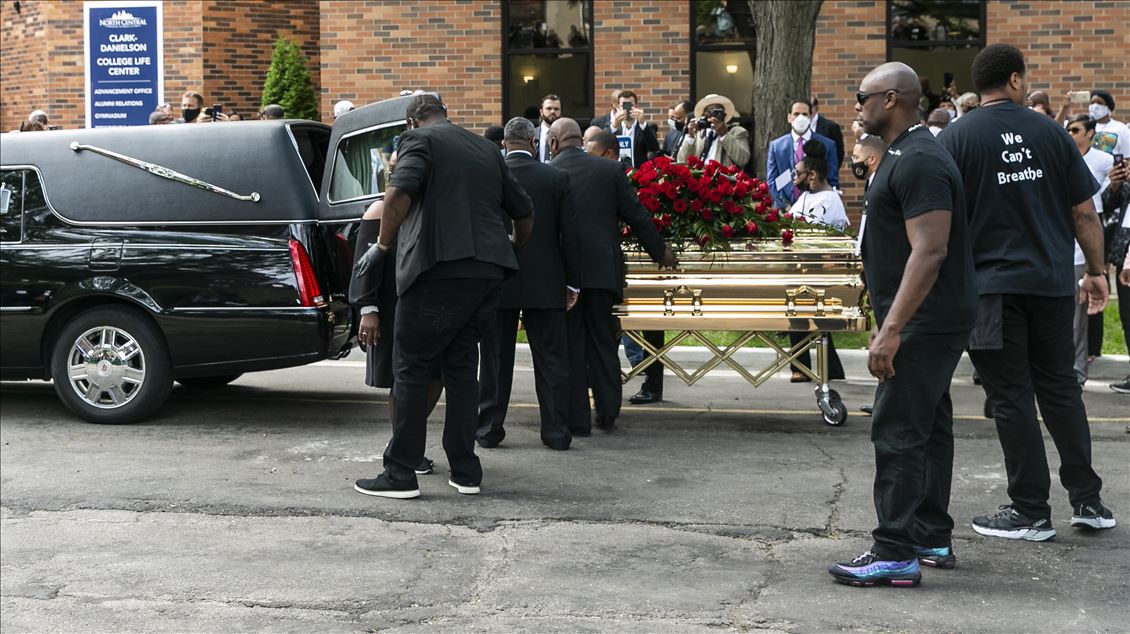
    Hundreds of mourners Thursday attended the first of several memorials for George Floyd – an unarmed, handcuffed black man who was killed in police custody late last month.

    George Floyd Memorial service held in Minneapolis

    The service at North Central University in Minneapolis, Minnesota, was attended by Floyd’s family and Ben Crump, the civil rights attorney representing the family, and celebrity guests.

    “All these people came to see my brother. That’s amazing to me, that he touched so many people’s hearts. Because he’s been touching our hearts,” Floyd’s brother, Philonise, said at the service. “We want justice for George. He’s going to get it.”

    The head of the school announced the establishment of a George Floyd Memorial Scholarship.

    “I am now challenging every university president in the United States of America to establish your own George Floyd Memorial Scholarship Fund,” said Scott Hagan.

    Floyd, 46, died last week in Minneapolis when a now former police officer knelt on his neck for nearly nine minutes. His last words, “I can’t breathe,” became a slogan for worldwide protests.

    Reverend Al Sharpton eulogized Floyd, saying he should not be among the deceased and he did not die from a common health condition.

    “He died of a common American criminal justice malfunction. It is not a normal funeral, not a normal circumstance, but it’s too common and we need to deal with it,” said Sharpton.

    Crump said Floyd was killed by “the other pandemic that we are far too familiar with, it was the pandemic of racism and discrimination.”

    An independent autopsy Monday found Floyd was killed by “asphyxiation from sustained pressure.”

    His death prompted largely peaceful mass demonstrations that have continued across the US, though some have devolved into violence and looting.

    Officer Derek Chauvin was taken into custody last Friday when authorities announced an initial set of charges that were upgraded Wednesday from third-degree murder to murder in the second-degree.

    At the end of the service, the crowd stood in silence for 8 minutes and 46 seconds — the length of time Floyd was pinned down by Chauvin.

    Sharpton called it “a long time.”

    Chauvin will now face second-degree murder charges. Three other officers at the scene when Floyd was arrested for allegedly using a $20 counterfeit bill at a store — Tou Thao, J. Alexander Kueng and Thomas Lane — were charged with aiding and abetting murder in the second degree, a felony offense.

    A memorial services will be held in Raeford, North Carolina, where Floyd was born, with a public viewing and a private service for the family Saturday.

    A public memorial and private service will take place Monday and Tuesday next week in Houston, Texas, where Floyd was raised. HIs funeral is scheduled for 11 a.m. Tuesday.

  • Kanye West Launches College Fund for George Floyd’s Daughter, Reveals $2 Million in Additional Donations

    Kanye West Launches College Fund for George Floyd’s Daughter, Reveals $2 Million in Additional Donations

    It’s been nearly 10 days since the May 25 death of George Floyd at the hand of a Minneapolis police officer, during which time massive protests against police violence have taken place across the country. But while tens of thousands have taken to the streets to express their anger at the systemic racism that has gripped the United States, the usually vocal Kanye West has been surprisingly quiet.

    Today the rapper revealed via a representative that he has donated $2 million so far to charities associated with Ahmaud Arbery, Breonna Taylor and George Floyd and has set up a college fund to cover tuition for Floyd’s 6-year-old daughter Gianna. In addition, the rapper has pledged to cover legal costs for the Arbery and Taylor families. And in his hometown of Chicago, he’ll also be aiding black-owned businesses with financial contributions.

    The deaths of Arbery and Taylor — in Georgia and Louisville, respectively — preceded the killing of George Floyd.

    Along with former officer Derek Chauvin, who has been charged by Minnesota Attorney General Keith Ellison with second-degree murder, in addition to the charge of third-degree murder filed last week, officers Tou Thao, Thomas Lane and J. Alexander Kueng were charged on Wednesday with aiding and abetting second-degree murder.

    Said Ellison at a press conference on Wednesday: “George Floyd mattered. He was loved. His family was important. His life had value, and we will seek justice for him and for you, and we will find it.”

    Floyd died after being pinned down by the neck for nearly nine minutes during an arrest.

    Thao was seen on video watching as Chauvin held Floyd to the ground with his knee. Floyd was seen complaining that he could not breathe, and bystanders urged the officers to come to his aid, without avail.

    The Hennepin County Medical Examiner’s office ruled the death a homicide, though it differed with an independent autopsy performed on behalf of the Floyd family in its conclusion on the precise cause of death. The family autopsy concluded that Floyd died of asphyxiation, while the coroner’s report indicated it was the result of the police restraint in combination with underlying medical conditions and intoxication.

    All four officers were fired shortly after the arrest.

  • George Floyd Was Infected With COVID-19, Autopsy Reveals

    George Floyd Was Infected With COVID-19, Autopsy Reveals

    (Reuters) – George Floyd, whose fatal encounter with Minneapolis police stirred a global outcry over racial bias by U.S. law enforcement, tested positive for the coronavirus, his autopsy showed, but the infection was not listed as a factor in his death.

    The official cause of death, according to the full 20-page report made public on Wednesday by the Hennepin County Medical Examiner’s Office, was cardiopulmonary arrest while Floyd was being restrained by police taking him into custody on May 25.

    The coroner ruled the manner of death to be a homicide. Four police officers since fired from their jobs for their role in the incident, which was captured on a bystander’s cellphone video, are being held on criminal charges, one of them accused of murder.

    The video showed that officer using his knee to press Floyd’s neck into the street for nearly nine minutes while the 46-year-old victim gasped for air and repeatedly groaned, “please, I can’t breathe.” Floyd was pronounced dead at a hospital a short time later.

    The video immediately went viral on the internet, igniting nine days of nationwide protest and civil strife. Demonstrators have also taken to the streets overseas, from Germany to New Zealand.

    The autopsy, in listing cardiopulmonary arrest as the cause of Floyd’s death, also cited “complicating law enforcement subdual, restraint and neck compression.”

    The report listed several additional factors as “significant conditions” contributing to Floyd’s death, including heart disease, high blood pressure and intoxication from the powerful opioid fentanyl, as well as recent methamphetamine use.

    The report further noted that a nasal swab sample collected from Floyd’s body came back positive for COVID-19, and that Floyd had also tested positive on April 3, nearly eight weeks before his death.

    The county’s chief medical examiner, Dr. Andrew Baker, concluded that the post mortem test result “most likely reflects asymptomatic but persistent … positivity from previous infection.” There was no indication in the autopsy report that coronavirus played any role in Floyd’s death.

    Dr. Michael Baden, one of two medical examiners who conducted a private autopsy for Floyd’s family, told the New York Times that county officials never told him, or the funeral director, that Floyd had tested positive for COVID-19.

  • US Defense Secretary Says He Doesn’t Support Trump’s Suggestion Of Deploying Military On Protestors

    US Defense Secretary Says He Doesn’t Support Trump’s Suggestion Of Deploying Military On Protestors

    WASHINGTON (AP) — President Donald Trump on Wednesday took credit for a massive deployment of National Guard troops and federal law enforcement officers to the nation’s capital, saying it offered a model to states on how to quell protests nationwide.

    Trump argued that the massive show of force was responsible for protests in Washington and other cities turning more calm in recent days and repeated his criticism of governors who have not deployed their National Guard to the fullest.

    It was a striking contrast to the harsh crackdowns outside the White House on Monday night, advocated by the president who wanted to make the aggressive action in the nation’s capital an example for the rest of the country, a senior White House official said Tuesday.

    “You have to have a dominant force,” Trump told Fox New Radio on Wednesday. “We need law and order.”

    He quickly pivoted to the politics of the moment, adding, “You notice that all of these places that have problems, they’re not run by Republicans. They’re run by liberal Democrats.”

    The Defense Department has drafted contingency plans for deploying active-duty military if needed. Pentagon documents reviewed by The Associated Press showed plans for soldiers from an Army division to protect the White House and other federal buildings if the security situation in the nation’s capital were to deteriorate and the National Guard could not secure the facilities.

    President Donald Trump walks from the White House through Lafayette Park to visit St. John’s Church Monday, June 1, 2020, in Washington. (AP Photo/Patrick Semansky)

    But interest in exerting that extraordinary federal authority appeared to be waning in the White House. Though the crackdown on the Washington demonstrations was praised by some Trump supporters Tuesday, a handful of Republicans expressed concern that law enforcement officers risked violating the protesters’ First Amendment rights. Trump’s defense secretary also distanced himself from Trump’s decision to walk across Lafayette Park for a photo opportunity at a church after the demonstrators had been cleared.

    Pentagon Chief Mark Esper, who walked with Trump to St. John’s Church on Monday evening, insisted he did not know the president’s destination.

    “I didn’t know where I was going,” Esper told NBC News. He said he had expected to view damage to a bathroom facility that had been vandalized in Lafayette Park, across from the White House, and talk with National Guard troops positioned there.

    Protests have sprung up following the death of George Floyd, a black man who died after a white Minneapolis police officer pinned him down and pressed Floyd’s neck with his knee. Violent demonstrations have raged in scores of American cities, a level of unrest unseen for decades.

    The situation in Washington escalated Monday, becoming a potent symbol of Trump’s policing tactics and a physical manifestation of the rhetorical culture war he has stoked since before he was elected. Nearly 30 minutes before a 7 p.m. curfew in Washington, U.S. Park Police repelled protesters with what they said were smoke canisters and pepper balls.

  • “We Cannot Turn A Blind Eye To Racism And Exclusion”: Pope Francis Speaks On George Floyd’s Death And US Riots

    “We Cannot Turn A Blind Eye To Racism And Exclusion”: Pope Francis Speaks On George Floyd’s Death And US Riots

    Pope Francis has said that he is praying for the soul of George Floyd and all victims of racism, adding that nothing is gained by violence.

    “Dear brothers and sisters in the United States, I have witnessed with great concern the disturbing social unrest in your nation in these past days, following the tragic death of Mr George Floyd,” Pope Francis said in a video broadcast on June 3.

    “We cannot tolerate or turn a blind eye to racism and exclusion in any form and yet claim to defend the sacredness of every human life. At the same time, we have to recognize that the violence of recent nights is self-destructive and self-defeating. Nothing is gained by violence and so much is lost,” the pope said.

    Pope Francis prayed for the intercession of Our Lady of Guadalupe, the patron of the Americas, to intercede for peace, justice, and reconciliation in the U.S. at the end of his Wednesday audience, livestreamed from the Vatican’s Apostolic Palace.

    “Today I join the Church of St Paul and Minneapolis, and of all the United States, in praying for the rest of the soul of George Floyd and all the others who have lost their lives because of the sin of racism,” the pope said.

    “Let us pray for the comfort of families and friends who are heartbroken, and pray for national reconciliation and the peace we yearn for.”

    Cities across the U.S. have seen widespread protests in the wake of the death of George Floyd. Some protests have turned to nights of rioting, and conflicts with police. At least five people have died amid the protests.

    In the video of the arrest, an officer with the Minneapolis Police Department can be seen kneeling on Floyd’s neck for several minutes after he was taken into custody. Floyd could be heard saying “I can’t breathe” several times. He died soon after.

    Former Minneapolis police officer Derek Chauvin was arrested on May 29, and has been charged with third-degree murder and manslaughter. He and the three other officers present at Floyd’s arrest were fired from the Minneapolis Police Department.

    Catholics across the Twin Cities have called for justice and unity in the wake of Floyd’s death.

    Clergy in Minnesota, including the Archbishop Bernard Hebda of St Paul-Minneapolis, participated in a silent walking protest June 2 to pray at the location where George Floyd died in police custody.

    Archbishop Hebda had offered a Mass for the soul of George Floyd and for his family on May 27.

    “Our Lady of Guadalupe, Mother of America, intercede for all those who work for peace and justice in your land and in the world. God bless you all and your families,” Pope Francis said.

  • Biden Dominates Trump With Real Presidential Speech In Philadelphia: Read Biden’s Full Speech On George Floyd’s Death

    Biden Dominates Trump With Real Presidential Speech In Philadelphia: Read Biden’s Full Speech On George Floyd’s Death

    Former Vice President Joe Biden criticized President Donald Trump Tuesday morning for leaving America leaderless in a moment of domestic crisis, one day after federal officers tear-gassed peaceful protesters to disperse them and make way for Trump to take photos in front of St. John’s Church in Washington, DC.

    “When peaceful protestors are dispersed by the order of the president from the doorstep of the people’s house, the White House — using tear gas and flash grenades — in order to stage a photo op at a noble church, we can be forgiven for believing that the president is more interested in power than in principle,” Biden said.

    “More interested in serving the passions of his base than the needs of the people in his care,” he continued. “For that’s what the presidency is: a duty of care — to all of us, not just our voters, not just our donors, but all of us.”

    As widespread protests and unrest continued Monday night in multiple American cities following the death of George Floyd at the hands of Minneapolis police officer Derek Chauvin, Biden attempted to draw a contrast with Trump — who on Monday did not call for peace, but instead threatened to use military force to dispel protests if governors didn’t call on their National Guards to do so first.

    “The country is crying out for leadership…leadership that brings us together,” Biden said, adding he would recognize the First Amendment rights of peaceful protesters if elected president. “We can’t leave this moment thinking we can turn away and do nothing. The moment has come for our country to deal with systemic racism.”

    Standing in front of a backdrop of American flags, Biden gave a somber address from the Mayor’s Reception Room in Philadelphia City Hall, surrounded by state and city officials, including Philadelphia Mayor Jim Kenney and Rep. Brendan Boyle. On Monday, Biden met with local black leaders in his home city of Wilmington, Delaware, and took a knee — a sign of protest against police brutality toward black people — at the end of the meeting.

    Philadelphia itself experienced three days of sometimes violent clashes between police officers and protesters. On Monday, protesters blocking the Vine St. Parkway in the city were met with tear gas by police. And further south, Washington, DC, was the site of massive peaceful protests on Monday at times violently dispersed by police.

    Biden called for an end to riots and looting that many cities have experienced over the past week, but he also called for an end to police using excessive force to halt protests. The former vice president accused Trump of fanning the flames of violence between police and protesters, rather than using his leadership to quell it.

    “When he tweeted the words, ‘When the looting starts, the shooting starts’ — those weren’t the words of a president,” Biden said. “They were the words of a racist Miami police chief from the 1960s.”

    The former vice president also called on Congress to swiftly enact policing reforms in the coming days and weeks, including outlawing police use of chokeholds and enacting standards for use of force. He also appealed to the country to come together and begin to heal.

    “We’re a nation enraged, but we can’t let our rage consume us. We’re a nation exhausted, but we can’t let our exhaustion defeat us,” he said. “I truly believe in my heart of hearts, we can overcome.”

    Following are Biden’s full remarks, as prepared for delivery.

    Biden’s full remarks in Philadelphia

    “I can’t breathe.” “I can’t breathe.” George Floyd’s last words. But they didn’t die with him. They’re still being heard. They’re echoing across this nation.

    They speak to a nation where too often just the color of your skin puts your life at risk. They speak to a nation where more than 100,000 people have lost their lives to a virus — and 40 million Americans have filed for unemployment — with a disproportionate number of these deaths and job losses concentrated in black and brown communities. And they speak to a nation where every day millions of people — not at the moment of losing their life – but in the course of living their life — are saying to themselves, “I can’t breathe.”

    It’s a wake-up call for our nation. For all of us. And I mean all of us. It’s not the first time we’ve heard these words — they’re the same words we heard from Eric Garner when his life was taken six years ago. But it’s time to listen to these words. Understand them. And respond to them — with real action.

    The country is crying out for leadership. Leadership that can unite us. Leadership that can bring us together. Leadership that can recognize the pain and deep grief of communities that have had a knee on their neck for too long. But there is no place for violence. No place for looting or destroying property or burning churches, or destroying businesses — many of them built by people of color who for the first time were beginning to realize their dreams and build wealth for their families. Nor is it acceptable for our police — sworn to protect and serve all people — to escalate tensions or resort to excessive violence. We need to distinguish between legitimate peaceful protest — and opportunistic violent destruction.

    And we must be vigilant about the violence that’s being done by the incumbent president to our democracy and to the pursuit of justice. When peaceful protestors are dispersed by the order of the President from the doorstep of the people’s house, the White House — using tear gas and flash grenades — in order to stage a photo op at a noble church, we can be forgiven for believing that the president is more interested in power than in principle. More interested in serving the passions of his base than the needs of the people in his care.

    For that’s what the presidency is: a duty of care — to all of us, not just our voters, not just our donors, but all of us. The President held up a bible at St. John’s church yesterday.

    If he opened it instead of brandishing it, he could have learned something: That we are all called to love one another as we love ourselves. That’s hard work. But it’s the work of America. Donald Trump isn’t interested in doing that work.

    Instead he’s preening and sweeping away all the guardrails that have long protected our democracy. Guardrails that have helped make possible this nation’s path to a more perfect union. A union that constantly requires reform and rededication – and yes the protests from voices of those mistreated, ignored, left out and left behind. But it’s a union worth fighting for and that’s why I’m running for President.

    In addition to the Bible, he might also want to open the US Constitution. If he did, he’d find the First Amendment. It protects “the right of the people peaceably to assemble, and to petition the government for a redress of grievances.” Mr. President: That is America. Not horses rising up on their hind legs to push back a peaceful protest. Not using the American military to move against the American people.

    This nation is a nation of values. Our freedom to speak is the cherished knowledge that lives inside every American. We will not allow any President to quiet our voice. We won’t let those who see this as an opportunity to sow chaos throw up a smokescreen to distract us from the very real and legitimate grievances at the heart of these protests.

    And we can’t leave this moment thinking we can once again turn away and do nothing. We can’t. The moment has come for our nation to deal with systemic racism. To deal with the growing economic inequality in our nation. And to deal with the denial of the promise of this nation — to so many.

    I’ve said from the outset of this election that we are in a battle for the soul of this nation. Who we are. What we believe. And maybe most important — who we want to be. It’s all at stake. That is truer today than ever. And it’s in this urgency we can find the path forward.

    The history of this nation teaches us that it’s in some of our darkest moments of despair that we’ve made some of our greatest progress. The 13th and 14th and 15th Amendments followed the Civil War. The greatest economy in the history of the world grew out of the Great Depression. The Civil Rights Act of 1964 and Voting Rights Act of 1965 came in the tracks of Bull Connor’s vicious dogs. To paraphrase Reverend Barber — it’s in the mourning we find hope.

    It will take more than talk. We’ve had talk before. We’ve had protests before.

    Let us vow to make this, at last, an era of action to reverse systemic racism with long overdue and concrete changes. That action will not be completed in the first 100 days of my Presidency — or even an entire term. It is the work of a generation. But if this agenda will take time to complete, it should not wait for the first 100 days of my Presidency to get started. A down payment on what is long overdue should come now. Immediately.

    I call on Congress to act this month on measures that would be a first step in this direction. Starting with real police reform. Congressman Jeffries has a bill to outlaw choke holds. Congress should put it on President Trump’s desk in the next few days. There are other measures: to stop transferring weapons of war to police forces, to improve oversight and accountability, to create a model use of force standard — that also should be made law this month. No more excuses. No more delays.

    If the Senate has time to confirm Trump’s unqualified judicial nominees who will run roughshod over our Constitution, it has time to pass legislation that will give true meaning to our Constitution’s promise of “equal protection of the laws.”

    Looking ahead, in the first 100 days of my presidency, I have committed to creating a national police oversight commission. I’ve long believed we need real community policing. And we need each and every police department in the country to undertake a comprehensive review of their hiring, their training, and their de-escalation practices. And the federal government should give them the tools and resources they need to implement reforms.

    Most cops meet the highest standards of their profession. All the more reason that bad cops should be dealt with severely and swiftly. We all need to take a hard look at the culture that allows for these senseless tragedies to keep happening. And we need to learn from the cities and precincts that are getting it right. We know, though, that to have true justice in America, we need economic justice, too. Here, too, there is much to be done.

    As an immediate step, Congress should act to rectify racial inequities in the allocation of COVID-19 recovery funds. I will be setting forth more of my agenda on economic justice and opportunity in the weeks and months ahead. But it begins with health care. It should be a right not a privilege.

    The quickest route to universal coverage in this country is to expand Obamacare. We could do it. We should do it. But this president — even now — in the midst of a public health crisis with massive unemployment wants to destroy it. He doesn’t care how many millions of Americans will be hurt — because he is consumed with his blinding ego when it comes to President Obama.

    The President should withdraw his lawsuit to strike down Obamacare, and the Congress should prepare to act on my proposal to expand Obamacare to millions more. These last few months we have seen America’s true heroes. The health care workers, the nurses, delivery truck drivers, grocery store workers.

    We have a new phrase for them: Essential workers. But we need to do more than praise them. We need to pay them. Because if it wasn’t clear before, it’s clear now. This country wasn’t built by Wall Street bankers and CEOs. It was built by America’s great middle class — by our essential workers.

    I know there is enormous fear and uncertainty and anger in the country. I understand. And I know so many Americans are suffering. Suffering the loss of a loved one. Suffering economic hardships. Suffering under the weight of generation after generation after generation of hurt inflicted on people of color — and on black and Native communities in particular.

    I know what it means to grieve. My losses are not the same as the losses felt by so many. But I know what it is to feel like you cannot go on. I know what it means to have a black hole of grief sucking at your chest. Just a few days ago marked the fifth anniversary of my son Beau’s passing from cancer. There are still moments when the pain is so great it feels no different from the day he died. But I also know that the best way to bear loss and pain is to turn all that anger and anguish to purpose.

    And Americans know what our purpose is as a nation. It has guided us from the very beginning. It’s been reported. That on the day John F. Kennedy was assassinated, little Yolanda King came home from school in Atlanta and jumped in her father’s arms. “Oh, Daddy,” she said, “now we will never get our freedom.” Her daddy was reassuring, strong, and brave. “Now don’t you worry, baby,” said Martin Luther King, Jr. “It’s going to be all right.” Amid violence and fear, Dr. King persevered.

    He was driven by his dream of a nation where “justice runs down like water and righteousness like a mighty stream.” Then, in 1968 hate would cut him down in Memphis. A few days before Dr. King was murdered, he gave a final Sunday sermon in Washington. He told us that though the arc of a moral universe is long, it bends toward justice. And we know we can bend it — because we have. We have to believe that still. That is our purpose. It’s been our purpose from the beginning.

    To become the nation where all men and women are not only created equal — but treated equally. To become the nation defined — in Dr. King’s words — not only by the absence of tension, but by the presence of justice. Today in America it’s hard to keep faith that justice is at hand. I know that. You know that. The pain is raw. The pain is real.

    A president of the United States must be part of the solution, not the problem. But our president today is part of the problem. When he tweeted the words “When the looting starts, the shooting starts” — those weren’t the words of a president. They were the words of a racist Miami police chief from the 1960s. When he tweeted that protesters “would have been greeted with the most vicious dogs … that’s when people would have been really badly hurt.” Those weren’t the words of a president — those were the kind of words a Bull Connor would have used unleashing his dogs.

    The American story is about action and reaction. That’s the way history works. We can’t be naïve about that. I wish I could say this hate began with Donald Trump and will end with him. It didn’t and it won’t. American history isn’t a fairytale with a guaranteed happy ending.

    The battle for the soul of this nation has been a constant push-and-pull for more than 240 years. A tug of war between the American ideal that we are all created equal and the harsh reality that racism has long torn us apart. The honest truth is both elements are part of the American character.

    At our best, the American ideal wins out. It’s never a rout. It’s always a fight. And the battle is never finally won. But we can’t ignore the truth that we are at our best when we open our hearts, not when we clench our fists.

    Donald Trump has turned our country into a battlefield riven by old resentments and fresh fears. He thinks division helps him. His narcissism has become more important than the nation’s well-being he leads. I ask every American to look at where we are now, and think anew: Is this who we are? Is this who we want to be? Is this what we pass on to our kids’ and grandkids’ lives? Fear and finger-pointing rather than hope and the pursuit of happiness? Incompetence and anxiety? Self-absorption and selfishness? Or do we want to be the America we know we can be. The America we know in our hearts we could be and should be.

    Look, the presidency is a big job. Nobody will get everything right. And I won’t either. But I promise you this. I won’t traffic in fear and division. I won’t fan the flames of hate. I will seek to heal the racial wounds that have long plagued this country – not use them for political gain. I’ll do my job and take responsibility. I won’t blame others. I’ll never forget that the job isn’t about me. It’s about you. And I’ll work to not only rebuild this nation. But to build it better than it was. To build a better future. That’s what America does. We build the future. It may in fact be the most American thing to do.

    We hunger for liberty the way Harriet Tubman and Frederick Douglass did. We thirst for the vote the way Susan B. Anthony and Ella Baker and John Lewis did. We strive to explore the stars, to cure disease, to make this imperfect Union as perfect as we can. We may come up short — but at our best we try.

    We are facing formidable enemies. They include not only the coronavirus and its terrible impact on our lives and livelihoods, but also the selfishness and fear that have loomed over our national life for the last three years. Defeating those enemies requires us to do our duty — and that duty includes remembering who we should be.

    We should be the America of FDR and Eisenhower, of Rosa Parks and Martin Luther King Jr., of Jonas Salk and Neil Armstrong. We should be the America that cherishes life and liberty and courage.

    Above all, we should be the America that cherishes each other – each and every one. We are a nation in pain, but we must not allow this pain to destroy us. We are a nation enraged, but we cannot allow our rage to consume us. We are a nation exhausted, but we will not allow our exhaustion to defeat us.

    As President, it is my commitment to all of you to lead on these issues — to listen. Because I truly believe in my heart of hearts, that we can overcome. And when we stand together, finally, as One America, we will rise stronger than before.

    So reach out to one another. Speak out for one another. And please, please take care of each other. This is the United States of America. And there is nothing we can’t do. If we do it together.

  • Independent Autopsy Of George Floyd Shows It Was A Homicide Different From The Official Findings

    Independent Autopsy Of George Floyd Shows It Was A Homicide Different From The Official Findings

    MINNEAPOLIS (AP) — A medical examiner on Monday classified George Floyd’s death as a homicide, saying his heart stopped as police restrained him and compressed his neck, in a widely seen video that has sparked protests across the nation.

    “Decedent experienced a cardiopulmonary arrest while being restrained by law enforcement officer(s),” the Hennepin County Medical Examiner’s Office said in a news release. Cause of death was listed as “cardiopulmonary arrest complicating law enforcement subdual, restraint and neck compression.”

    Under “other significant conditions” it said Floyd suffered from heart disease and hypertension, and listed fentanyl intoxication and recent methamphetamine use. Those factors were not listed under cause of death.

    A Minneapolis police officer was charged last week with third-degree murder in Floyd’s death, and three other officers were fired. Bystander video showed the officer, Derek Chauvin, holding his knee on Floyd’s neck despite the man’s cries that he can’t breathe until he eventually stopped moving.

    A separate autopsy commissioned for Floyd’s family also called his death a homicide. It concluded that that he died of asphyxiation due to neck and back compression, said the family’s attorney, Ben Crump, who called for the charge against Chauvin to be upgraded to first-degree murder and for three other officers to be charged. He didn’t say what the charges against the other officers should be.

    That autopsy, by a forensic pathologist who also examined Eric Garner’s body, found the compression cut off blood to Floyd’s brain, and that the pressure of other officers’ knees on his back made it impossible for him to breathe, Crump said.

    Both the medical examiner and the family’s experts differed from the description in last week’s criminal complaint against the officer of how Floyd died. The complaint, citing preliminary findings from the medical examiner, listed the effects of being restrained, along with underlying health issues and potential intoxicants in Floyd’s system. But it also said nothing was found “to support a diagnosis of traumatic asphyxia or strangulation.” Neither side has released its full autopsy report so far.

    The family’s autopsy found no evidence of heart disease and concluded he had been healthy.

    Floyd, a black man who was in handcuffs at the time, died after Chauvin, who is white, ignored bystander shouts to get off Floyd and Floyd’s cries that he couldn’t breathe. His death sparked days of protests in Minneapolis and around America.

    The complaint provided no details about intoxicants. In the 911 call that drew police, the caller described the man suspected of paying with counterfeit money as “awfully drunk and he’s not in control of himself.”

    Floyd’s family and attorneys, like the families of other black men killed by police, commissioned their own autopsy because they didn’t trust local authorities to produce an unbiased report.

    The family’s autopsy was done by Michael Baden and Allecia Wilson. Baden is the former chief medical examiner of New York City, and was hired to do an autopsy of Garner, a black man who died in 2014 after New York police placed him in a chokehold and he pleaded that he could not breathe.

    Baden also did an autopsy at the family’s request for Michael Brown, an 18-year-old shot by police in Ferguson, Missouri. He said Brown didn’t reveal signs of a struggle, casting doubt on a claim by police that a struggle between Brown and the officer led to the shooting.

    Dr. Judy Melinek, a forensic pathologist from the San Francisco Bay area who blogs about the subject and is not connected with the case, said the key difference between the medical examiner’s conclusions and those of Baden and Walker are the official finding of “significant” conditions for Floyd, including heart disease and drugs in his system.

    Baden and Wilson acknowledged on a conference call with reporters that they didn’t have access to the tissue samples that the medical examiner kept that might have given more information on his health. Nor did they have their own toxicology results yet.

    Melinek said it’s not unusual for different pathologists to reach different determinations, given that they may be looking at different information and that they’ve had different experiences and training.

    Under the law, a medical examiner determines the cause and manner of death, but it’s up to prosecutors to decide whether criminal charges are warranted. The term homicide means only that a person’s death was caused by another person.

    Chauvin, who was also charged with manslaughter, is being held in a state prison. The other three officers on scene, like Chauvin, were fired the day after the incident but have not been charged.

    The head of the Minneapolis police union said in a letter to members that the officers were fired without due process and labor attorneys are fighting for their jobs. Lt. Bob Kroll, the union president, also criticized city leadership, saying a lack of support is to blame for the days of sometimes violent protests.

    When asked to respond, Mayor Jacob Frey said Kroll’s opposition to reform and lack of empathy for the community has undermined trust in the police.

    Gov. Tim Walz announced Sunday that Attorney General Keith Ellison would take the lead in any prosecutions in Floyd’s death. Local civil rights activists have said Hennepin County Attorney Mike Freeman doesn’t have the trust of the black community. They have protested outside his house, and pressed him to charge the other three officers.

    Freeman remains on the case.

  • Forces Violently Cleared The Way From Protestors For Trump To Take A Photo At St. John’s Church In Washington

    Forces Violently Cleared The Way From Protestors For Trump To Take A Photo At St. John’s Church In Washington

    WASHINGTON

    US President Donald Trump made a surprise visit to St. John’s Episcopal Church in Washington, DC on Monday which was vandalized during overnight protests over the death of George Floyd.

    His visit came shortly after he said he would be “going to pay my respects to a very very special place” during his press briefing at the White House.

    To pave the way for Trump and his entourage to walk to the church, which also suffered damage from a fire set by protesters in its basement, police used tear gas to clear protestors from Lafayette Park, the focal point of a fourth day of protests.

    Trump posed for photos in front of the church and raised a black-covered Bible for reporters to see.

    “We have a great country. Greatest country in the world,” said Trump.

    Speaking to CNN, Mariann Budde, bishop of the Episcopal Diocese of Washington, DC, rebuked Trump’s visit, which she said she found out about by watching it on TV.

    “I am outraged. The president did not pray when he came to St. John’s, nor as you just articulated did he acknowledge the agony of our country right now,” said Budde.

    The protests have been raging in the US since May 25 when a video went viral on social media showing Floyd being pinned down by Derek Chauvin, a white police officer in Minneapolis, Minnesota, as he was being arrested.

    Chauvin knelt on his neck for nearly nine minutes.

    Shortly after, Floyd appeared to lose consciousness, but Chauvin maintained his position on the victim.

    He died shortly after being taken to a hospital.

    His last words were “I can’t breathe,” which became the slogan of the nationwide protests.

    Floyd was killed by “asphyxiation from sustained pressure,” an independent autopsy found Monday.

  • Trump Vows To Deploy Heavily Armed Military On Protesting US Citizens

    Trump Vows To Deploy Heavily Armed Military On Protesting US Citizens

    Washington (AFP) – US President Donald Trump on Monday said he was deploying thousands of “heavily armed” soldiers and police to prevent further protests in Washington, where buildings and monuments have been vandalized near the White House.

    “What happened in the city last night was a total disgrace,” he said during a nationwide address as tear gas went off and crowds protested in the streets nearby.

    “I am dispatching thousands and thousands of heavily armed soldiers, military personnel and law enforcement officers to stop the rioting, looting, vandalism, assaults and the wanton destruction of property.”

    He denounced “acts of domestic terror” after nationwide protests against the death of an unarmed African American George Floyd in police custody devolved into days of violent race riots across the country.

    “I want the organizers of this terror to be on notice that you will face severe criminal penalties and a lengthy sentences in jail,” Trump said as police could be heard using tear gas and stun grenades to clear protestors just outside the White House.

    He also called on state governors to “deploy the National Guard in sufficient numbers that we dominate the streets” before heading on foot for a photo op at the riot-damaged St. John’s, the two-century-old “church of the presidents” across from the White House.

    One week after Floyd died in Minneapolis, an autopsy blamed his videotaped death squarely on a white police officer who pinned him down by the neck with his knee for nearly nine minutes as Floyd pleaded, “I can’t breathe!”

    “The evidence is consistent with mechanical asphyxia as the cause of death, and homicide as the manner of death,” Aleccia Wilson, a University of Michigan expert who examined his body at the family’s request, told a news conference.

    The unrest has been the most widespread in the United States since 1968, when cities went up in flames over the slaying of civil rights icon Martin Luther King Jr., and rekindled memories of 1992 riots in Los Angeles after police were acquitted in the brutal beating of black motorist Rodney King.