Attention-seeking Muturitriggered a storm of criticism after posting an Easter message on X (formerly Twitter) on April 18.
Instead of spreading cheer, the former Public Service Cabinet Secretary drew outrage with a graphic showing himself emerging from clouds beside a cross—an image many mistook for an obituary.
Kenyans on X didn’t hold back. They slammed the post as tone-deaf, egotistical, and disturbing.
What Muturi likely meant as a spiritual gesture quickly became a public relations disaster, fuelled by mockery, satire, and brutal honesty from netizens who saw right through the spectacle.
Attention-Seeking Muturi Roasted for ‘Obituary’ Easter Poster
Kenyans on X did not hold back when Justin Muturi’s Easter poster went live. The image, which showed him appearing to emerge from the clouds beside a glowing cross, immediately struck the wrong chord.
Users slammed the former Cabinet Secretary, calling the graphic eerie, confusing, and offensive. Many thought it was an obituary.
Others assumed it was a hacked or parody account. The Easter message, printed in small text, was barely noticed under the dramatic image.
“The communications manager and the graphics designer need to be off the payroll like yesterday,” one user wrote bluntly.
Poor Design, Poor Judgment
One comment summed up the general sentiment: “Had to read again and again. Thought this was bad news.” Others flooded the post with sarcastic condolence messages, mocking what they saw as Muturi’s desperation for attention.
While some users offered constructive feedback—like using warm yellows, florals, or celebratory fonts—most couldn’t ignore what they felt was an attempt to stay relevant through shock value.
Muturi’s decision to include the national Coat of Arms, despite no longer holding public office, only added fuel to the fire. Users questioned whether he still thought of himself as a state official, especially after being fired.
Muturi’s Recent Attacks on Ruto Add Context
Justin Muturi’s fall from grace hasn’t gone quietly. Since being fired by President William Ruto and replaced by Geoffrey Ruku, Muturi has launched consistent attacks on the administration.
He accused Ruto of trying to force him into signing a shady Ksh129 billion deal with Russian investors—while still at the airport.
The funds were meant for a tree-planting project, but Muturi claimed he was never given time to review the documents.
Calling Ruto’s presidency “the most unfortunate thing that could have happened to Kenya,” Muturi has since adopted a combative tone. His Easter post, in the eyes of many, was just another attempt to grab headlines.
Final Thoughts
Kenyans have a sharp eye and an even sharper tongue online. To them, Muturi’s poster wasn’t just bad design—it was tone-deaf, vain, and attention-seeking.
And with the backlash spreading fast, one thing is clear: if Muturi wanted to resurrect his public image this Easter, he failed spectacularly.
A man who had been paying Sh80,000 in monthly upkeep for his unborn child with his estranged lover has been threatened with a one-month jail term if he fails to settle the outstanding arrears of Sh320,000 within two weeks.
The arrears, which were filed as a contempt of court application in May 2022, amount to four months’ worth of payments.
Last year, N.E.W, the woman involved, brought the case to court, seeking monthly upkeep for her unborn baby, which was conceived with the man, I.S.
On June 12, High Court Deputy Registrar TE Marienga ruled that the man must pay the arrears specified in the consent judgment within 15 days; otherwise, he will be incarcerated for 30 days, with the woman being responsible for his daily subsistence.
The court found that I.S. had failed to fully comply with the consent judgment established by Justice Antony Mrima between him and the woman.
Initially, when the woman sued him, the man voluntarily entered into a consent agreement, agreeing to pay her Sh80,000 per month as upkeep for the unborn child. The matter was subsequently withdrawn.
The agreement, facilitated by lawyer Danstan Omari on behalf of the woman and the man’s lawyers, included a one-time payment of Sh250,000 to cover all expenses incurred by the woman since conception. They also agreed that the woman would have full custody, care, and control of the child.
Additionally, the man committed to providing annual medical coverage for the mother and child, including inpatient services, and allocated Sh50,000 for outpatient care.
He also promised to make monthly payments of Sh80,000 on or before the 5th of each month for the child’s upkeep.
While the man made a few monthly payments and provided the one-time payment, he stopped paying altogether in January 2022, leading the woman to sue him for disobeying the court orders.
Lawyer Danstan Omari [p/courtesy]The woman claimed that the father of her baby had disregarded the court orders derived from their consent agreement.
In his defense, I.S. argued that he had not refused to pay but stated that his business had been adversely affected by Covid. He requested a review, proposing to pay Sh40,000 instead of Sh80,000 until his business improved.
He claimed to have significant expenses, including rent, salaries, school fees, family support, medical costs, loan repayments, and more. He argued that he had only Sh100,000 remaining and could allocate only Sh40,000 for upkeep.
He further asserted that the woman was employed and earned a decent salary, suggesting that she could care for the child while he revived his businesses.
The court dismissed his request to modify the payment amount, stating that renegotiation could only occur if both parties agreed to it.
The court ruled that the man was in breach of the consent judgment, dated May 18, 2022, and noted that he had the opportunity to pay the proposed Sh40,000 since January but had failed to do so.
Furthermore, the court emphasized that there was no evidence to support his claimed expenses and deemed his actions not in the best interest of the child, as required by law.
Prior to the consent agreement, the woman had stated that she had a brief, intimate relationship with the man from January to March 2021, which resulted in her pregnancy.
She alleged that they broke up after he became violent and accused her of infidelity. Despite his constant threats and lack of emotional and financial support, she decided to keep the child.
During this time, she claimed that she needed child upkeep due to her unemployment and the emotional turmoil she experienced while going through the pregnancy alone.
In the wake of the devastating accident that struck Londiani in Kericho County, our hearts collectively ache for the lives lost and the families left to grapple with unimaginable grief.
The deep scars of this tragedy will forever remind us of the preciousness of life and the need to come together as a community to offer comfort, solace, and unwavering support.
As the sun sets over the horizon, we find ourselves united in sadness, but also in determination to stand by those affected by this heart-wrenching incident.
We extend our heartfelt condolences to the families who have lost their loved ones, and we send our thoughts and prayers to those who are fighting for their lives in hospitals.
Amidst the sorrow and grief, we find glimmers of hope in the acts of courage and kindness that emerged amidst the chaos. Strangers became heroes, helping the injured and comforting the distressed. Our collective humanity shone through as people from all walks of life came together to support one another.
To the families who have lost their beloved, we stand with you, wrapping our arms around you as you navigate through this dark chapter in your lives. Your pain is our pain, and we vow to be here for you, to listen, to share your sorrow, and to offer a shoulder to lean on. Together, we will find strength in unity and find ways to honor the memories of those no longer with us.
For those who are recovering in hospitals, we send healing thoughts and positive energy your way. Your resilience and determination in the face of adversity inspire us all. Remember, you are not alone in this journey towards recovery. We are a community, and together, we will work to rebuild and heal.
As we reflect on this tragedy, let us also acknowledge the efforts of the authorities and emergency responders who rushed to the scene and worked tirelessly to save lives. We must support their efforts to prevent similar accidents in the future and create safer roads for everyone.
To family and friends of all affected by the Londiani accident, My sincerest condolences for you at this time. We need alot of reforms in the travel sector, especially roads, but I know @kipmurkomen is on top of things. pic.twitter.com/ssOXWRjdSR
To the entire community of Londiani, know that you are not alone in this sorrow. Surround yourselves with loved ones, friends, and neighbors. Lean on each other for strength and encouragement. Reach out to those who may be struggling silently, offering them a listening ear and a comforting embrace.
In times of great sorrow, we often find the best in humanity. Let this tragedy become a catalyst for change, a reminder that life is precious, and we must do all we can to protect and cherish it. Let us come together to advocate for safer roads, better infrastructure, and improved healthcare facilities to ensure that such tragedies become rare occurrences.
As the days pass and the wounds heal, let us remember the lives lost not with bitterness, but with love and fond memories. May their spirits guide us to be more compassionate, more empathetic, and more united as a community.
Together, we will rebuild and heal. Together, we will support one another in our grief and find solace in the knowledge that we are not alone. Let us carry the memory of the Londiani victims in our hearts as we move forward, with the hope that brighter days will come.
Though the scars of this tragedy will remain, so too will the strength and resilience of the Londiani community, shining as a beacon of hope and unity to the world.
The journey already seems long – bumpy and rough road for handpicked Lady Justice Martha Koome.
Her nomination decision bangled with legal controversies and gender sympathy.
1. The end didn’t justify the means.
The concluded JSC interview for CJ position candidates position was for the first time interrupted by High Court in the history after 4 petitions filed by citizens over conflict of interest and integrity concerns among some members of the Judicial Service Commission whom they wanted removed from the bench of interviewers.
High Court ordered for an halt into the Nomination process until the cases are heard and determined. But JSC filed an appeal at the appelate court and whose 3 bench judge: Justice Roselyne Nambuye, Patrick Kiage and Sankale Ole Kantai quashed the High court decision to halt the process and instead greenlighted the process to resume – and also barring High court further from hearing the petition filed pending determination of appeals filed by the Commission JSC and Attorney General.
The Court of Appeal in its decision to quash High Court’s judgement termed the authority of the High court to have been under attack adding that the High court should strive to facilitate Obedience and to observance of constitutional bounds and statutory timelines.
The court of appeal argued that the right channel of that case petition, was to be presented to National Assembly by way of petition as per Article 251 of the constitution says.
However much this was the appropriate channel through National Assembly, but Parliamentary sittings was adjourned almost a month ago and the petitioners only legal place of refuge was the Judiciary at that time of crisis. In this case for me, only the High court was fair enough.
2. Tax Compliance and Wealth Declaration.
Among the vital requirements for candidates for the CJ position was personal declaration of wealth of both the candidate and the spouse and Tax return compliance so as to prove transparency, integrity. And among the 10 candidates- it was only Court of Appeal President Justice William Ouko who complied as per the requirement by JSC for candidates to produce tax compliance and wealth declaration forms.
Justice Martha Koome, CJ nominee only produced 2 of the 3 required wealth declaration forms and even failed to submit her spouse’s wealth declaration form as per the requirement for any public officer.
3. Who chaired the process?
The law provides for either Chief Justice or Deputy Chief Justice to steer the JSC process and despite DCJ and acting CJ Philomena Mwilu being present in the panel, it was JSC Vice Chairperson Prof Olive Mugenda – an illegality contrary to the law. And this was among the concerns petitioners raised on the credibility of the due process only to be quashed away by court of appeal.
4. Making public score sheet for each candidate.
For the sake of acknowledgment of the sovereignty of the the people of Kenya – general public, for the sake of integrity, credibility, faithfulness and fairness of the process and as one of the 3 arms of Government – and many people like Prof Makau Mutua would agree with me that making public score sheet of the candidates only brews public confidence and trust in the process and in the Judiciary.
It’s unfortunate and unfair that even the candidates themselves don’t receive their own score sheet results to even at least help them self-evaluate themselves. It is such nitty gritties that poke holes in the fine linen of the Justice system.
Despite some critics surfacing Martha Koome’s 1986 graduation results where she attained PASS results – an illustration of an average public officer for the job of 1st class owners candidates also partially jeopardizes her qualification for the top job in one way or the other but the most important is she passed and graduated.
5. Principal Judge, High Court of Kenya- Lydia Achode (Luo) (female)
As a matter of ethnic cards by the deep state ( of which unfortunately still plays a bigger role) that deliberately made Prof Olive Mugenda chair the process seems to have not been in favor of the Only over-qualified candidate William Ouko(Luo) being head of the Judiciary when it’s already a Luo the Chief Registrar and at the same time Principal Judge of the High court is already a Luo – not forgetting William Ouko by the time of his candidacy he was the Head of Court of Appeal. So, his nomination would have brewed ethnic Balkanization and so they had to handpick under-qualified Martha Koome instead and of which they failed on gender balance as you can see on the above list.
JSC Nominee Lady Justice Martha Koome was the only least scandalous candidate amongst them all as other candidates were marinated with controversies and in public domain. Hence the handpicking of her for her ‘faithful’ life and journey.
In this whole process, the process was coated with illegal dissensions of which justifies that the product- CJ nominee Martha Koome was fixed to be.
Aid packets were dropped in Kandak, South Sudan in 2018. South Sudan is one of the world’s top recipients of foreign aid, with many of its citizens relying at least partially on the international community to provide food and healthcare.
Freelance journalist covering Africa
JUBA
An investigation by
When the pandemic struck, many feared South Sudan could be one of the hardest hit countries in Africa – years of conflict had hollowed out its healthcare system and the threat of famine was on the horizon.
Heeding the warnings, the European Union, the United States, and the World Bankchipped in more than $100 million for the COVID-19 response, while the IMF has given some $200 million in loans.
At a glance: COVID-19 corruption charges
Officials accused of charging for COVID-19 tests that were supposed to be free
Government allegedly suspended hand sanitiser imports and allowed a small local company to be sole producer, leading to a shortage.
Officials accused of charging for certificates showing negative results that were required for ground and air travel.
Aid workers reported receiving threats from the government for pushing back on staffing requests; one doctor from a foreign aid group was told to leave the country.
Millions of dollars went to renovate a coronavirus hospital, but it still stands empty because it was reportedly unsuitable as an infectious disease facility.
Worrying death toll projections have yet to materialise – fewer than 150 people have died of the virus in the past year despite a recent uptick in cases – but familiar patterns of alleged profiteering emerged after the first cases were reported.
A black market appeared for COVID-19 tests that were supposed to be free. An inflated contract was awarded to a company to renovate a hospital that still sits empty. And the government authorised one small outfit to produce hand sanitiser – while banning imports of the product as people scrambled to find supplies. The New Humanitarian found these and other examples after interviewing nearly 30 government officials, business owners, and aid workers, as well as reviewing documents, emails, and text messages as part of an investigation with Al Jazeera.
“Every time there is a crisis, the government ignores its citizens, relies on international aid, (and) doesn’t help its own people,” said Edmund Yakani, head of the Community Empowerment for Progress Organization, or CEPO, a civil society group in South Sudan.
But in South Sudan – one of the world’s top recipients of foreign aid – schemes that arose after the pandemic followed a familiar pattern: Donors respond to crises, and aid groups are left to shoulder the country’s humanitarian needs while South Sudan spends little on its own people.
About this investigation
After months of sifting through documents and hearing first hand accounts, worrying allegations have come to light in the world’s youngest country. …
That imbalance has rankled some and sparked fresh discussions about whether there is a better way to do aid in South Sudan – even though it is unclear whether funds for the COVID-19 response were misappropriated.
“The wealth of this country – from oil and elsewhere – bypasses its people, siphoned off in secrecy with no public accountability for how it is spent,” said David Shearer – the UN’s head of mission in South Sudan – in his final address to the UN Security Council in March. The international community, he noted, had failed to question its role in South Sudan’s continuing dependence on foreign aid.
“True sovereignty means responsibility – being responsible – to really care, in a tangible and demonstrable way, for all the nation’s 12 million citizens,” Shearer said.
Some government leaders have said such sentiments smack of colonialism.
“Our friends when they come, they come with high assumptions (that) they know it all,” said Mayen Machut Achiek, the health ministry’s undersecretary.
Alex McBride/Al Jazeera
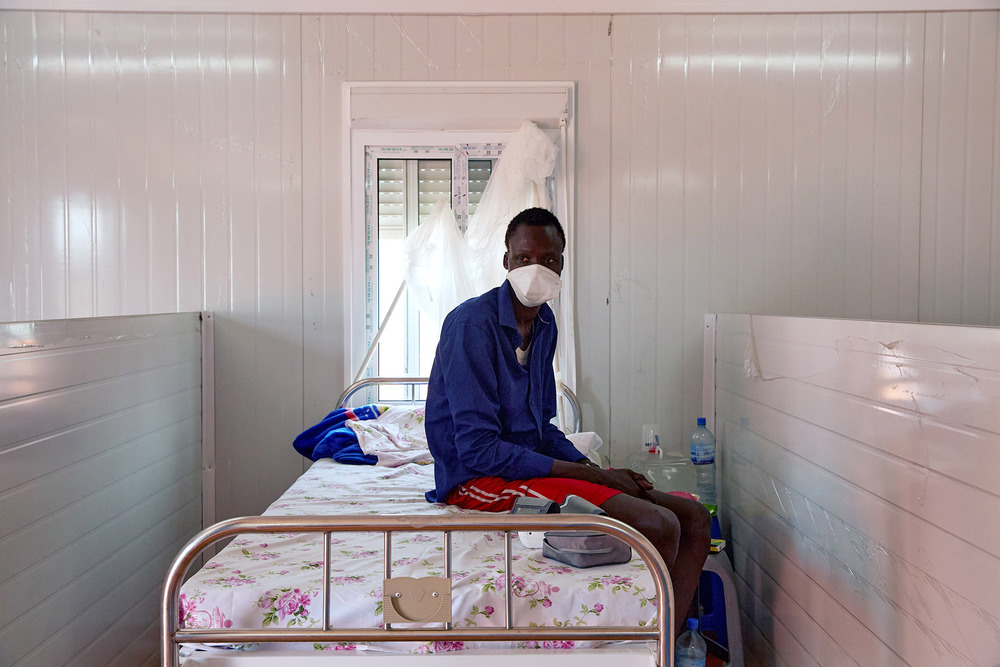
A suspected COVID-19 patient sits in a Juba hospital on 24 April, 2020. Early predictions were dire, but fewer than 150 people in South Sudan have died from the coronavirus, although cases are rising.
Aid tensions
In January, the UN’s emergency aid coordination body, OCHA, released a worrying report, detailing an overview of South Sudan’s bleak humanitarian situation and noting escalating violence against aid workers.
Renewed fighting last year had resulted in the relocation of aid workers, ambushes of humanitarian convoys, the looting of lifesaving supplies, and the targeting of relief workers based on ethnic identities, the report noted.
Opaque bureaucratic and regulatory snags had also resulted in “diverted resources that would have otherwise been used for lifesaving supplies”, the report noted.
South Sudan was already grappling with multiple crises when the pandemic hit.
The announcement of a long-awaited transitional government in February 2020 was quickly overshadowed by intensified local level fighting as well as floods.
The first cases of COVID-19 appeared in April 2020 and were traced to UN workers – sparking a backlash against the UN and other aid groups.
The same month, the World Health Organization became aware of allegations that some Ministry of Health officials were charging for COVID-19 tests when they were supposed to be free, according to a WHO email received by The New Humanitarian in July and shared with Al Jazeera.
Fraud’s familiar patterns
Tests were offered for $50, while test certificates needed for ground and air travel were sold for $400, a UN worker said in a text message sent to other aid workers in July and seen by reporters. Speaking on behalf of the government, Angelo Goup Thon and Mathew Tut Kol, government officials involved in the coronavirus pandemic response, denied the allegations.
The health ministry also handpicked at least 500 largely untrained staff from the ministry to work on the response and be paid between $450 and $1,500 a month with donor funds, three senior humanitarian officials involved in the response told reporters, speaking on condition of anonymity to ensure their ability to keep working in the country.
Although it’s not uncommon to hire untrained workers in emergency responses – the same was true with the Ebola response in the Democratic Republic of Congo – many of the proposed salaries were triple to what skilled civil servants would normally earn, and the government has failed in recent years to pay health workers for months.
The International Organization for Migration, which had been helping the government to perform health screenings on travellers, was among the UN agencies that received a list of requested workers from the government. The Health Ministry followed up with a verbal request to pay salaries of up to $2,000 a month, according to an internal IOM email seen by reporters. The email noted that government discussions were heated, including “shouting and verbally abusing IOM staff on (the) phone and in-person”.
In response to questions from reporters, the IOM confirmed in an email to The New Humanitarian on 26 March that the government had asked for staffing allowances for COVID-19 responders, as well as the recruitment of additional staff.
“… IOM communicated to the Ministry that the set provisions and budgets of the project could not be amended and that no additional staff would be hired or additional allowances paid,” said IOM spokesperson Safa Msehli, adding that passengers at Juba International Airport were now being screened by the Ministry of Health.
Kol, part of the government’s COVID-19 response team, said people chosen for the response weren’t selected for their political connections. However, he acknowledged that many lacked training – something the government was addressing, he said.
The International Medical Corps, meanwhile, decided to send its lead medic home to Nigeria in December after reporting that he had been allegedly threatened by Thuou Loi, South Sudan’s then-director general of international health and coordination.
When asked about the medic, Loi told reporters the allegations were “misleading by all accounts’ ‘, but he wouldn’t say if he requested that the medic leave the country. IMC’s country head, meanwhile, wrote to South Sudan’s health minister in December, saying that the situation was “unsettling,” according to the IMC letter seen by The New Humanitarian and shared with Al Jazeera.
COVID-19 corruption claims around the globe
This isn’t the first time that claims of corruption and COVID-19 have overlapped.
Selected cases curated by Izzy Ellis.
The letter was not provided to reporters by IMC, and the organisation also declined to give any details about the alleged threats or incident.
Achiek, the health ministry’s undersecretary, said it was “not acceptable” if aid workers had been threatened, but that he didn’t like being “manhandled” by aid partners.
Donors have largely provided most of South Sudan’s healthcare funding for years.
In the 2019-2020 budget, South Sudan’s government allocated nearly $14 million to the Ministry of Health, but a separate government report detailing official expenditures shows that only $3 million of that had been received nine months into the fiscal year.
After the pandemic struck, South Sudan allocated $5.48 million for the response from 1 April through 30 September 2020, according to government documents shared with reporters by a government official.
Of those funds, $3.8 million in contracts was awarded to a South Sudanese company with Lebanese and South Sudanese shareholders, AFK Concept Ltd.
As part of pandemic preparations, the company was meant to renovate the Dr. John Garang Infectious Disease Center in Juba, according to documents seen by The New Humanitarian and shared with Al Jazeera.
Part of that amount included $22,500 for landscaping and $168,000 for painting – costs nearly double those of other companies reporters contacted for estimates of similar work.
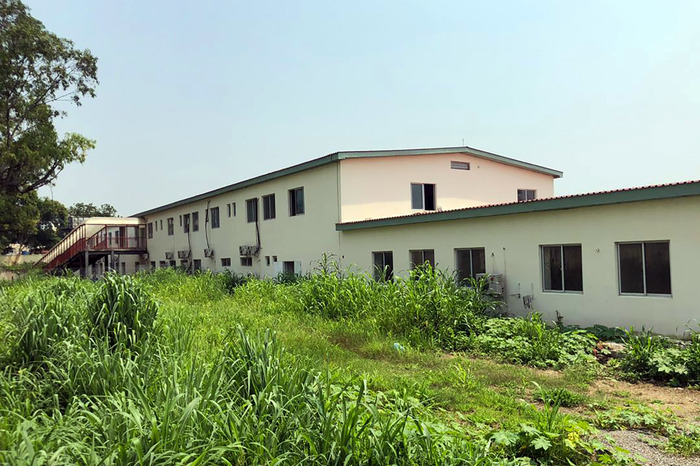
The hospital constructed by AFK Concept Ltd. in Juba has failed to meet the criteria of an infectious disease centre, despite millions of dollars in funding.
The roughly 250-bed facility was meant to be the main hospital for COVID-19 patients. In December, it was still being used largely for storage. Hospital staff told reporters it failed to meet the needs of an infectious disease centre, including too few toilets and structures that were inadequate to quarantine infected patients.
Attempts to reach out to AFK went unanswered. An email sent to AFK in March bounced back, several text messages and phone calls to one of the company’s shareholders went unanswered or did not go through, and repeated calls to AFK’s office in Juba went unanswered.
The health ministry called the amount allocated for the renovations “excessive”, and said in December that “nobody has been paid anything so far”.
However, the government contract and payment details – shared with reporters by a government official who requested anonymity – tell a different story.
One document noted that $1.4 million was paid as the first instalment for equipment and supplies, while some $2.4 million was directly disbursed “through a check issued by the Ministry of Finance and Planning in the name of the AFK CONCEPT LTD”.
The $3.8 million awarded to AFK was also noted in a separate letter from the finance ministry to the health ministry in April.
Hand sanitiser monopoly
While every country was scrambling to buy hand sanitiser, South Sudan made it even harder by suspending imports and authorising one domestic company to produce it.
The Drug and Food Control Authority gave Sinco Medical exclusive authorisation to manufacture and distribute the sanitiser, according to several importers and one UN official familiar with the agency’s reported directive, who spoke to reporters and requested anonymity for safety fears. The authorisation letter was shared with The New Humanitarian by the watchdog group The Sentry.
In March 2020, the Drug and Food Control Authority told a businessman and his colleagues they wouldn’t be allowed to import 100,000 bottles of hand sanitiser from Kenya but instead had to buy from Sinco.
The man asked not to be named because he feared for his safety. He said he hadn’t faced such an import ban in five years of working in South Sudan.
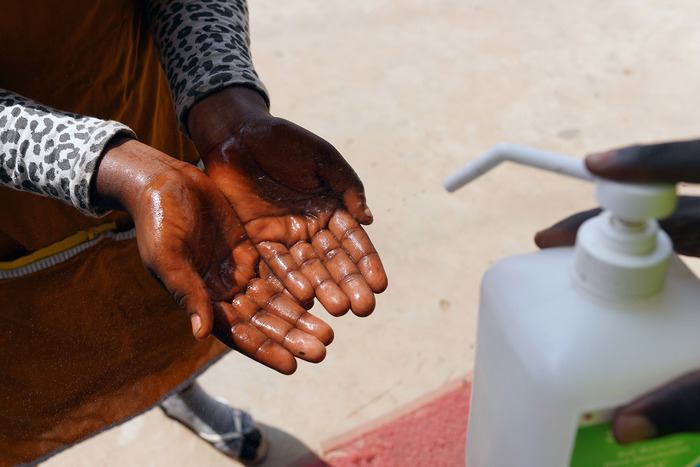
A woman has her hands sprayed with hand sanitizer before entering a supermarket in Juba, South Sudan, 1 April, 2021.
Charles Acaye, owner and chief executive officer of Sinco – a medical supplies importer – said the government’s aim was to promote domestic business.
Several civilians across the country told reporters they struggled to find sanitiser months after coronavirus cases started to emerge. Prices had soared more than tenfold, according to a May report by the Sudd Institute, a local think tank that has researched the economic consequences of COVID-19.
The head of the Drug and Food Control Authority did not respond to repeated requests for comment.
The allegations of profiteering come as South Sudan appeals for more than five million doses of COVID-19 vaccines – some 132,000 have already arrived – but some in the international community have also started to ask whether the government should start doing more for its people.
Elizabeth Shackelford, a former US diplomat in South Sudan, said the time to put better controls on foreign assistance to the country would have been in 2011, when it became the world’s newest independent state.
“It’s much easier to build in a practice of accountability from the start,” said Shackelford, now a senior fellow on US foreign policy at the Chicago Council on Global Affairs. “We have long tended to turn a blind eye to it.”
The New Humanitarian Investigations Editor Paisley Dodds, freelance editor Sharon L. Lynch, former TNH investigative intern Izzy Ellis, and freelance journalist Michael Gibb contributed to this report from London.
Supremacy wars between Transport CS James Macharia and his junior Eng. Francis Gitau have intensified and are expected to erupt in public as he heightens his lobbying to take over the position of his boss. Gitau argues that Macharia is not qualified to run the Transport Ministry.
Macharia is a professional banker but the rude secretary who is an engineer has managed to pull professional colleagues to his side to head plum positions as he relies on other powerful forces around President Uhuru Kenyatta to oust the average CS.
Gitau feels smarter than his boss as boasts of being the brain behind mega projects at the ministry including the Nairobi express highway which is currently under construction.
The powerful junior secretary even lobbies local and international companies to land lucrative road construction tenders with Kenya Urban Roads Authority (KURA), Kenya National Highway Authority (KeNHA) and Kenya Roads Boards Kenya Rural Road Authority (KeRRA) where he has associates to aide his dirty dealings.
The rivalry between the two was also exposed when Gitau blamed his boss, CS Macharia, after President Uhuru Kenyatta transferred another cash cow, Kenya Ports Authority from the Transport ministry to the Treasury headed by CS Ukur Yatani.
Eng. Francis Gitau [p/courtesy]Macharia and Yatani also became sworn enemies after the Transport CS tried to influence the appointment of new KPA managing director which Yatani nullified and ordered for fresh interviews.
The two CSs do not see eye to eye after it emerged that even with KPA being under National Treasury, Macharia has secretly tried to influence the recent appointment of the agency’s new MD that pushed Yatur to nullify the results and order for fresh interviews.
Gitau has also repeatedly blamed Macharia for letting the ministry lose control over serious parastatals like KPA for his ache for money. The money hungry secretary wants KPA to remain under the Transport ministry for him and other tender bandits to loot through multi million tenders at the state agency.
CS Macharia opted to work with middle men behind the curtains to have one Sylvester Kasuku land the KPA top job to facilitate their dirty operations -mostly dishing out of lucrative tenders to crooks who appreciate with kick backs. Mr. Kasuku is the former chief executive officer of Lamu port-South Sudan –Ethiopia transport corridor.
But the politics have overshadowed the recruitment of the new KPA boss which has been dogged by one issue after the other. On April 12 2021, the KPA board argued that the 45-day deadline issued by Yattani did not specify if weekends and holidays were excluded.
CS Macharia in his response has also accused Gitau of colluding with rogue procurement officials at KeRRA including Margret Wanja Muthui, the long serving procurement officer who was transferred to the ministry.
Gitua and Wanja are extremely close and Gitau is the man behind Wanja’s move to challenge her transfer to the ministry of transport and public works.
Wanja was forcefully transferred by KeRRA MD Philemon Kandie who replaced her by Cathrine Kangangi- his mistress whom he planted to aide his looting schemes. Like Gitau, Eng. Kandie is also crafting ways to take over from KeNHA’s Director General Peter Mundinia whose term will expire later in the year.
Transport CS Macharia further hit back at his junior Gitau whose wealth is attributed to theft of public funds. Gitau owns multi million properties in Nairobi and Mombasa. Gitau who dons Italian suits and strictly transacts is always in private clubs where he is entertained by Chinese contractors.
Bitter wars to control Sh200 billion tender have erupted at the Kenya Rural Roads Authority (KeRRA) with the powerful cartel at the agency forcing out senior staffers who have declined to toe the lines.
At the center of the latest battles is the move by KeRRA Director General Eng. Philemon Kandie who is working for the cartels to kick out Margret Wanja Muthui who heads the Procurement department. Kandie has been accused of being the hidden hand behind unprocedural transfer of staffers deemed as ‘hurdles’ in their corrupt dealings.
There have been numerous attempts to forcefully transfer Muthui to the ministry of Transport, Infrastructure, Housing, Urban Development and Public Works to tilt the table in favor of Kandie and his powerful forces to bag the tenders worth over Sh200 billion.
Muthui joined KeRRA’s procurement department in November 2009 and was later elevated to become the procurement manager in 2014 but on February 10 2021 Eng. Kandie ordered Muthui to handover her responsibilities and report to her new station at the Transport ministry.
KeRRA Director General Eng. Philemon Kandie [p/courtesy]She challenged the move in court where Justice Maureen Onyango suspended her transfer and fixed the inter parte hearing on March 15 after Kerra board had on February 10 appointed unqualified Catherine Kangangi as the acting procurement manager.
Kangangi has questionable papers but she is being favored for the position because she is Kandie’s mistress with whom he has been spotted in many secret places. She can also be trusted as a ‘safe hand’ to oversee Kandie and his cartels’ shady deals.
KeRRA cartels are also targeting one Peter Gichohi- the man behind the shoddy Sh1.2 billion Sigiri Bridge in Busia county that collapsed after Uhuru Kenyatta inspected it ahead of 2017 polls.
The bridge was built by a Chinese firm, Chinese Overseas- Construction and Engineering Company whose manager is Jerome Xzue Hu who enjoys close business links with Gichohi, Muthui and many Chinese contractors.
The former chief executive of the Independent Electoral and Boundaries Commission Ezra Chiloba is facing a possible jail term after investigations found that he presided over the looting of Sh691.5million through dubious tenders during 2017 polls.
A report by the Parliament Accounts Committee (PAC) shows that Chiloba oversaw the awarding of noncompetitive tenders which he used with other culprits to siphon the amount through shady catering deals in counties.
Ugunja MP Hon. Opiyo Wandayi who chairs the PAC committee has stated that Chiloba has not given satisfactory explanations over the expenditure or surcharged and must be compelled to do so.
Chiloba became a controversial figure after the opposition outfight NASA accused him of meddling with the 2017 elections in favor of the Jubilee Party. Jubilee candidate President Uhuru Kenyatta won those elections but his win was nullified after NASA challenged them at the Supreme court and fresh polls called.
But Chiloba chose to take a three week leave ahead of the October 26 2017 repeat elections without divulging into details of his decision but defended the IEBC claiming that the election would be conducted as ordered by the Supreme Court.
He took a short leave when the opposition coalition NASA was on the other hand calling for his resignation after they accused him of serving partisan political interests.
ODM leader Raila Odinga claimed that Chiloba was the “coup plotter in chief” who dominated operations of the electoral body and suppressed all attempts to initiate reforms.
IEBC Chairman Wafula Chebukati, L, and Ex-C.E.O Ezra Chiloba [p/courtesy]
In October 2018 the defiant who boasts of ‘powerful connection’ was fired from the IEBC after he snubbed summons to appear before a disciplinary hearing of the commission relating to post-election spending audit.
He had been suspended for several months when he received his employment with the IEBC was officially terminated. His tenure was marred with controversies including the shock resignation of Commissioner Dr. Roselyn Akombe and a fall out with IEBC chairman, Wafula Chebukati who suspended him twice. Chiloba unlawfully paid Sh25.9 million ($432) for 600 electronic identification kits that were delivered to Kenya free of charge.
An internal audit report filed in court in 2018 revealed that the tenders wars led to Chiloba’s suspension and later his firing after he retaliated by suing Wafula Chebukati and four other commissioners.
He said it was designed to deprive him of his employment “in circumstances in which it appears by way of innuendo, or implication, that he is under investigation, or his conduct the subject of an audit process”.
Chiloba then disappeared from the public eye with rumors that he would vie for Trans Nzoia governor position in the 2022 elections but his ‘powerful connections’ have bagged him a lucrative job. In December 2020, ICT CS Joe Mucheru appointed Chiloba as a member of the Youth Enterprise Development Fund for a three year term.
South Africa’s president announced tighter restrictions late Monday due to the coronavirus pandemic, including possible arrest for not wearing a face mask in public.
“From now on, it is compulsory for every person to wear a mask in a public space. A person who does not wear a cloth mask covering over the nose and mouth in a public place will be committing an offence,” Cyril Ramaphosa said a televised address.
Ramaphosa said those found not wearing a mask in public could be arrested and prosecuted.
“On conviction, they will be liable to a fine or to imprisonment for a period not exceeding six months, or to both a fine and imprisonment,” he said.
The South African leader said although this is a drastic measure, it is now necessary to ensure compliance with the most basic of preventative measures.
South Africa on Sunday reported over one million COVID-19 cases — the highest number on the continent.
Ramaphosa also announced that the nationwide curfew will be extended from 9 p.m. (1900 GMT) to 6 a.m. (0400 GMT).
He said only permitted workers including medical and security personnel or emergency staff may move during the curfew hours, but nobody else is allowed outside their place of residence during the curfew.
The new rules will last for 14 days, the president said.
“Non-essential establishments – including shops, restaurants, bars and all cultural venues – must close at 8 p.m.,” Ramaphosa said.
He further announced that the sale of alcohol from retail outlets and on-site consumption of alcohol will not be permitted.
“The prohibition on consuming alcohol in public spaces like parks and beaches remains,” he said. “Distribution and transportation will be prohibited with exceptions that will be explained by the minister [later in the week]”.
The president also said that night clubs and businesses engaged in the sale and transportation of liquor will not be allowed to operate.
He said these regulations may be reviewed within the next few weeks if they see a sustained decline in infections and hospital admissions.
South Africa, which is currently battling its second wave of COVID-19, has 1,011,871 confirmed COVID-19 cases and 27,071 deaths reported. Nearly 850,000 people have recovered.
With Kshs 500/- monthly subscription by its nationwide members, knumlo hasn’t shown the favor of reciprocating back the fruits of the seeds down by members.
The union has had zero sensitization to enjoy accomodation of all new and old MLOs in the field. This questions the seriousness, aggressiveness of the office and how misplaced their priorities are.
Statistics show that majority of MLOs in the field market inclusive of recent graduates aren’t aware of 5 year old KNUMLO but the old engine AKMLSO since AKMLSO is what is taught in school when reality in outside world —it’s dead rotten with maggots and has no clinical significance.
Like one among my favorite personalities, Thomas Sankara said, “It took the madmen of yesterday for us to be able to act with extreme clarity today. I want to be one of those madmen. We must dare invent the future.”
KMPDU madmen like Ouma Oluga, Daisy Korir made KMPDU what it is today to the extent of being imprisoned in maximum prison in 2017. Apparently KNUMLO has no madmen to secure the brighter future tomorrow but cool kids who enjoys the comfort of office set up and title of their positions.
How many MLOs would want to be the madmen today if called upon?
In frontline, I would want to. In the spirit of solidarity.
Call me power hungry, illusionary or whatever you’d like to perceive of me in the negative way but am out on my feet standing and not on my knees begging to defend the dignity, power, ethic and rightful share of MLOs and better life for my family tomorrow. I want every innocent MLO to enjoy back the value of their hard-work and recover with profit burdening medical school fees. Call me the madman of today. I dont care.
The silence of the majority in this time of oppression is a sign lost hope and contentment with 2,000 risk allowance while madmen are standing up fighting for 30,000 then a section of fearful, selfish, egocentric MLOs are cocooning themselves in “Other cadres” waiting to reap what Nurses, KMPDU, Clinical officers has sown through blood and sweat.
It’s time, MLOs stop being like scarecrows to be seen but at least creatures to be heard.
Without fear of favor I repeat — MLOs, WE should stay woke, better die on our feet than live on our knees begging every time. Also remember Not everyone who chased the zebra caught it, but he who caught it, chased it.
Well, these words are easier said than done.
Literally, Adressing these grievances and keeping the office on toes needs strong legal team and of which requires alot of funding. But nobody knows if this could be the cause of silence of this office. They haven’t spoken about it either — and of which only means the union bank account is bloated with millions of dollars and they’re just squandering the funds with their proxies at the expense of fighting for the welfare of the MLOs.
Not forgeting that Pride becomes before a fall. These leadership positions are about Potential, Courage, Attitude, Aggresivenes and not Ego, Title or Education level. (You’ve heard “Sex for Grades?♂️” ). Whether Bsc or Dip, all we need at the moment is the experience, visionful team, cauragious, dare-devil, strategical team, and most importantly financial muscle.
MLO family need results, increased wages, increased risk allowance, needs no delayed salaries, needs every GoK dispensary to have a well equiped lab, needs purge of quacks, needs motivation. MLO family doesn’t need infights. MLO family doesn’t need “Everyone for himself, God for us all” mentality.
MLO family needs way forward not infight criticism. The Family needs a signal. And all these are only possible in Unity of madmen and change of evil plans and elements in KNUMLO.
We shall overcome as a goodwill family. Viva to those who’re ready to join my madmen movement operation. Wait for my signal, henceforth.
During this Covid19 pandemic, Medical laboratory scientists have played the biggest role from collection of samples, testing and Diagnosis making them the highest risk group in this fight. And that’s just the tip of an iceberg.
If a census is to be conducted today among Kenyans to get wind of their knowledge about Unions and Associations of different medical practioners, 99% won’t be able recognise Union/Association of Medical Laboratory Scientists whilst 99% will recognise Dr. Oluga -Kenya Medical Practitioners and Dentist Union (KMPDU), Dr. Jackson Kioko- Pharmacists and Poisons Board (PPB) and Dr. Panyako Kenya National Union of Nurses (KNUN). These unions have the strongest devil-daring management-leaders, vibrant, speaks to Government regularly in the language they best understand and gives government sleepless nights marinated with wild thoughts and mixed reactions – protecting welfare of their members.
When these very same people in case study get to seek treatment in hospitals, they are only satisfied with treatment when sent to the lab for testing because long gone are the old-era days when clinical officers or MOs could run hospital set up without lab tests and diagnose and treat patients on assumption basis. This new era has made laboratory the epitome of clinical hospital organogram and a vital organ in Diagnostic-treatment of a patient.
In layman’s language, every new patient gets the feeling of satisfaction on physical examination by the Doctor but not until his/her test samples taken and tested – diagnosis made and then given right medication for treatment. This mentality magnifies how vital Lab is in a clinical hospital set up. But with all these glory and respect, medical laboratory scientists have failed to shine in the national outlook, Association of Kenya Medical Laboratory Scientific Officers (AKMLSO) which was formed decades ago and 5 years old Kenya National Union of Medical Laboratory Scientific Officers (KNUMLSO) have lost focus and have become waitress on the dinner table serving KMPDU, PPB and KNUN when they all ought to be dinning together on the dinner table as equal partners.
Medical laboratory scientists lacks proper and vibrant representation to bargain for its rightful share and demand for proper welfare of its members who are suffering in oppression upto the extent that their partners demean their existence out of pride brought to them by their well structured Union leadership.
This sleepy association AKMLSO and Kenya National Union of Medical Laboratory Scientists (KNUMLO) have failed terribly, they’ve decided to be maimed and have cocooned themselves in silent mode as their members are sinking in economic debts due to low wages and salaries as they cant even give the government ultimatums leave alone organizing a strike and laying down tools to gain a bargaining power at the dinner table like other unions do.
Their absence in the scenes and off the screens have belittled the Medical laboratory members and escalated discrimination by other partner healthcare professionals
AKMLSO and KNUMLSO were formed on the ground of 3 main pillars like other partners unions in the healthcare docket to:
1. To carter and promote medical laboratory professionalism and welfare to its members
2. To foster closer relationship between its members and other health professionals
3. To unite medical laboratory and scientists board in Kenya
Congratulations to leadership of Pharmacy and Poisons Board (PPB), Kenya National Union of Nurses (KNUN), Kenya National Union of Clinical Officers (KNUCO) and Kenya Medical Practitioners, Pharmacists and Dentists Union (KMPDU)
~~~~~~~~~~~~~~~
“We from the lab
We exist
We are the troponin
Behind the heart attack
We are the blood type
Behind a safe transfusion
We are the HCG
Behind a life that it is growing
We are the hope to control the pandemic
Behind the COVID testing
We give hope to patients
We give answers to doctors and nurses
We cheer the good news that are released through our computers
And we feel the sorrow for the bad news that follow
We are humans
Not machines
Some of us have a gift of drawing blood without bruises or pain
But some of us need that blood
Because we can not get a vein
So we bring the blood to the lab
So results can helps the doctors to intervene
Do not worry , none of us drink it
We, Medical Laboratory Professionals chose to be who we are
We save lives everyday even if a patient will never know what we look like
But all we care is that we helped the healing
We gave hope or closure
We helped diagnose the pain
The earache , the sore throat
We deserve respect
We are part of the clinical team
We give to the clinicians the pieces that they need to finish the diagnosis puzzle
We are not fake
We are real
We studied
We trained
We gave our commitment
To help find the cure
To defeat the disease
But most important
We care about the person behind every single vial or tube that we touch
We care for the person behind every single result we typed
So think about us when you had you check up or you were not feeling well
So think about us when the doctor tells you that your glucose was normal or your potassium is low
Think about us when your dream to be a parent was confirmed
Think about us when the blood you received during surgery saved your life
Think about us when you recovered
Because if you need us again
We will be here.”
MLOs, WE should stay woke, better die on our feet than live on our knees begging every time. Also remember Not everyone who chased the zebra caught it, but he who caught it, chased it.
The eldest son of the late businessman and politician Lawrence Nginyo Kariuki has asked the High Court to let him run his father’s Sh4 billion estate, accusing his mother and some siblings of unilaterally transferring cash from corporate accounts to their own personal accounts.
James Anthony Kariuki told the High Court’s Family Division that the estate risks being wasted away since the family squabbles are hurting strategic and management decision-making.The senior Kariuki died on February 24, leaving behind a contested Will, a widow (Margaret Wangari Nginyo) and nine children, including three from two other women.
The latest rift in the succession battle erupted in Margaret’s household that had previously put up a united front against the claims resulting from the children born out of wedlock – Brenda Nyambura Kiragu, Alex Ndoria Karuri and Austine Wachira Karungo.
James told the court that his mother and siblings Silas Macharia Kariuki, Scholastica Njeri Kariuki and Jane Wambui Kariuki have liquidated a total of Sh71 million in fixed deposit accounts of Pema Holdings Limited at I&M Bank.
They transferred the cash in two transactions to a current account they control and without the knowledge of James, court documents show.“It has come to my knowledge that a further Sh61 million has been withdrawn from the Pema Holdings account and transferred to the joint account without my knowledge or involvement,” said James in court papers.“It is my belief the 4th defendant (his mother) has been guided in her actions by the 5th, 6th and 7th defendants (his siblings).”His claims back those of her step-sister, Brenda, who has also sued lenders — Consolidated Bank, I&M Bank and Co-operative Bank — over hundreds of millions of shillings in accounts and for offering Margaret’s children access to the finances without letters of administration.
Mr Kariuki had a total of Sh335 million in fixed deposit accounts, with most of the cash at Consolidated Bank of Kenya.Cash in his other savings accounts, including at Equity and Habib Bank, have not been disclosed.His vast estate, including real estate, farming, bank deposits and government bonds, had little debts.
The estate is the subject of an inheritance court fight triggered by a woman claiming to be a widow of the late politician and three other children born out of wedlock – Brenda, Alex Ndoria Karuri and Austin Wachira Karungo — who were all excluded from the Will.Brenda, through court, pushed for extraction of DNA before Nginyo’s burial that proved the politician was her father.
James reckons that his father’s wish for him to lead the family business was defied after the deceased’s eldest child, Jane — listed as an employee of the First Lady Margaret Kenyatta– started giving roles to other siblings.“I noticed my sister, Jane, was imposing herself in business matters with little knowledge of the work that my father and I had done for 25 years…her actions did not align with our father’s wishes,” he said.“Dad made it clear that in his absence, I as the eldest son, should take over the leadership of his business affairs.”Now, James has applied for the court to offer him authority to manage the estate, pending the conclusion of the inheritance fights.
Kariuki’s first wife, Margaret, and four of her children –James, Scholastica, Jane and Silas–had earlier sought permission to run the deceased’s estate as trustees and executors, triggering court fights.James told the court that the prolonged succession battle could lead to the deceased estate going to waste.
He reckons that tenants are defaulting on rent and that his siblings as minority shareholders are carrying out suspicious financial transactions that puts at risk the family empire.“That there is a real likelihood that unless the Honourable Court intervenes by granting the petition as prayed, the estate shall and continue to lose income from rental properties and the assets belonging to the companies be plundered to the great detriment of the estate of the deceased,” James said in a court affidavit.
The kind of authority he is seeking will see him run the estate under the supervision of the court. He will not have the power to distribute the estate’s assets. The move is meant to offer stability to the family business as the court case, which can take years, proceeds.
James has taken the stance that the rights of all children including those born out of wedlock should be honoured.“That I have pleaded with my family and then probate lawyer, to a point that I have been forced to abandon my attempts at an amicable resolution so as not to appear to be taking sides,” he said in the affidavit.
Jane Wambui Kiragu has defended the cash withdrawals in a separate affidavit.She says the withdrawals had her father’s blessings, adding that the money was used for legitimate purposes, including meeting the deceased’s funeral expenses.She argued that the law allows executors to pay out of the estate of the deceased any outstanding debt.
Some of the money was used to fund ongoing projects that were initiated by her father, she said.Kariuki was more successful in business than in politics, amassing a fortune that places his heirs among the richest families in the country. Court documents show he owned land and buildings in Nairobi, Kiambu and Ngong valued at Sh3.2 billion. His most famous property is Nginyo Towers in Nairobi’s central business district.He owned a 120-acre farmland in Tigoni, Kiambu, in which he grew coffee and tea and kept livestock.
His investment firms, including Nginyo Investments and Pema Holdings, have assets of Sh221.3 million.He had also invested Sh84.1 million in government bonds, generating an annual interest income of Sh9.4 million.
Kariuki owned shares in a few Nairobi Securities Exchange-listed firms with a market value of about Sh18.5 million. His biggest stock market investment is 101,200 shares of East African Breweries Limited (EABL) currently valued at Sh17.2 million.He owned several luxury cars and farm machinery valued at Sh33.1 million, including a Toyota Landcruiser and Mercedes Benz.
Kariuki’s estate has minimal debt and has significant liquidity, with cash and cash equivalents representing about 10.5 percent of the total assets.The court case threatens to freeze the deceased’s estate that would leave the heirs with nearly Sh400 million each, assuming equal distribution to Margaret and the nine children.
Parliament had last year proposed a minimum betting stake of Sh50 but the Interior Ministry successfully appealed for doubling of the minimum stake in a bid to tame ‘irresponsible betting’. The National Assembly’s Sports, Culture and Tourism committee agreed to the submission which if approved by lawmakers will make it expensive to bet.
Gamblers who bet using less than Sh100 risk a Sh5 million fine if Parliament enacts into law recommendations aimed at cutting betting among the youth.
Currently, gamblers stake as low as Sh5 on sites like BetPawa, Betika, Elite Bet, BetYetu fuelling the rapid growth of online gambling among the young and vulnerable seeking millions in prize money.
Gamblers will also risk a jail term of up to six years if they bet with a stake of less than Sh100 under the recommendations that seek to keep gaming out of the reach of the youth and the un-employed.
“Amend by deleting the word ‘fifty’ and substitute thereof with the words ‘one hundred’ to promote responsible gaming and to prevent addictive gamin,” the committee says in its report of the Gaming Bill, 2019.
The committee’s recommendations are contained in the report that is before Parliament for debate and adoption.
The proposal to increase the minimum betting stake approved by Parliament will be a boost to telcos like Safaricom who will enjoy increased transfer fees for punters depositing cash into the accounts through M-Pesa.
This is the latest bid by the State to stem a betting craze with a recent survey by Geopoll shows that 76 per cent of Kenyan youth are engaged in betting — the highest in Africa.
The report shows the youths, a majority who are jobless spend an average of Sh5, 000 on betting per month.
Many if not all concerned Kenyans have been left tongues wagging over the actions of Kenya Medical Training College continuation to freeze its operations when actually they should be among the frontliners during the 1st schools reopening phase in which Universities resumed their operations and openned their doors for the Final year class to shoot their last bullets as life has to continue and learners need to learn how to acclamatize to new norm.
Many if not all concerned Kenyans have made memes as a way of expressing their mixed reactions amongst them the very same KMTC studentsas to why and how on earth would medical school be shut down when Patients and Covid19 patients need the most their holistic care, while many institutions worldwide are conducting research are striving to find cure vaccine for the virus while our very own institutions are baby sitting their students at home.
Many if not all concerned Kenyans have been wondering the logistic where Primary school and Secondary school pupils resumed their operations and KMTC believes perhaps their students are more careless than their younger siblings? Smh!
Many if not all concerned Kenyans are wondering how on earth you wouldvirtually practise midwifery, how you would virtually practice phlebotomy, how you would virtually perform a surgical operation. Actually how possible to theorise these practical lesson and expect to certify these students to the market as qualified professionals?
With many Final year studentsat home baby-sitting, left frustrated, being confused with heartbreaking Memos every now and then – their dreams and opportunities are now at stake.
With this year’s graduation plan changed to be conducted virtually, sigh of relief to the graduating class of 2020 for cutting down the usual graduation fees remains a fallacy. The fees has stood still when logically and actually the cost of budget and expenditure will be minimal as compared to normal previous years. Raising eyebrows whetherKMTC is a caring Organization or a Money making organization? An act of wanting to Spend less and Earn more.
And being an Independent institution under Ministry of Health which is corrupt to the core, illustrates how arrow points the eater.
Schools could in the next three weeks reopen for in-person teaching for three other classes in primary and secondary institutions.
Education stakeholders seem to have reached an agreement to reopen schools for the second phase. In the proposal, in-person learning for Grade 3, Standard 7 and Form 3 learners will resume.
The three classes account for about three million learners. The proposal is to be presented to the President. If adopted, it will mean those in Grade 1-2, Standard 5-6, and Form 1-2 and pre-primary will remain at home.
With four weeks gone by since the first reopening, Nicholas Gathemia who represents the Kenya Primary School Heads Association, said failing to reopen soon enough would create a headache for teachers.
It is going to be a headache for teachers to manage two parallel calendars.
Education stakeholders are also concerned about inequity as many learners are still at home, while others are in school.
Nicholas Maiyo, the Kenya Parents Association chairman, said many parents have a difficult time explaining to Grade 4 pupils why they have to go to school while their siblings in upper classes are still at home.
“Latest December we should have all learners back in school… we have observed and realised that children at school are more disciplined than while at home,” he said.
Maiyo said since no vaccine is available, schools will borrow from what other countries have done. He said students should be restricted to the use of reusable masks.
Maiyo said this is because learners may be tempted to recycle disposable masks, thus exposing them to infection.
The revised school calendar issued by the ministry showed that the second term, which started on October 12, would end on December 23, allowing learners to break for only one week.
Learners will report back to school on January 5 for another 11 weeks. Standard 8 candidates will sit the Kenya Certificate of Primary Education exam between March 22 and March 24. Those in Form 4 will sit their exams between March 25 and April 16.
While most countries in the world are fighting exponential growth of coronavirus infections, China seems to have gotten the situation under control.
That’s been largely due to the Chinese government’s ability to enforce preventive measures more successfully than Western democracies. Individualism, a patchwork approach and fear of stopping economic growth backfired in the U.S. and some European countries.
An overlooked factor that helped flatten the curve in China: Technology.
Social distancing, contactless transactions, cleaning and gathering diagnostic data have been made possible by automated technologies developed at Chinese companies.
Another company from Shenzhen, MMC (MicroMultiCopter), used megaphone-equipped drones to patrol the streets, warning groups of people who failed to wear masks to disperse. The drones are capable of spraying disinfectants in public places and measuring individual thermal signatures, helping to reduce the spread of the virus. In addition, the MMC drones monitored traffic, enabling uncongested vehicle movement and faster response rates in case of medical emergencies.
Other technologies have been employed as well. Chengdu city in Sichuan Province armed epidemic-control personnel with high-tech smart helmets that can automatically measure people’s temperature when they enter a five-meter range. The helmet sounds an alarm if anyone has a fever.
Artificial intelligence
If you think that something is missing, you’re right. We haven’t mentioned AI — artificial intelligence. Alibaba, the Chinese tech and e-commerce multinational company, has developed AI that allegedly can detect coronavirus infections with 96% accuracy.
Finally, China’s vast surveillance system is finally being put to a good use: Facial-recognition cameras come equipped with thermal sensors that can detect people with fevers and those not wearing masks.
Mobile apps also play a big role here — Tencent and Alipay have developed apps that inform users if they’ve been in contact with a virus carrier and whether they should stay at home or be allowed in public spaces.
For these apps to work, however, additional personal data need to be provided by the user. Alipay’s app, which is in use in over 200 cities, classifies people by color codes: Red is for supervised quarantine, yellow is for self-quarantine and green means unrestricted movement.
The Airport Authority Hong Kong (AA) is using several latest disinfection technologies including a full-body disinfection channel and cleaning robots in the Hong Kong airport to reduce the risk of the #COVID19 spread. Find out how they work pic.twitter.com/mrn7S8VoVz
The lack of transparency of how these codes are generated has already led to much confusion and frustration, which is only amplified by the fact that the data entered in the app are shared with the government and police. The same is true of the surveillance. Privacy was never a big topic in the People’s Republic of China (PRC), and now the last shreds are being obliterated in the name of public safety. The country may eventually subdue the coronavirus infection, but at what cost?
Still, there are things that we Westerners could learn from the Chinese. Seeing empty streets of European and American cities on the news gives me hope that people are finally realizing this isn’t “just a flu” and that we need to take things seriously.
Tech can help, but this time it plays second fiddle to staying home and abiding by protective measures against the virus. Until a vaccine is approved, this is the best way the curve can be flattened and the burden on health-care professionals can be reduced to a sustainable level. So, until further notice, stay home and stay safe.
The High Court has ordered Kenya’s largest network provider Safaricom PLC to pay a former customer service reports department’s director Pauline Wangechi Warui a total of Sh61.7 million in compensation for unlawful termination.
Wangechi was fired on March 20, 2015, after a whistleblower exposed how her department was doctoring customer service reports at the telco, signing a mutual separation agreement that was to see her get a Sh47.2 million exit package. But, about one year later, she sued for unlawful termination, claiming that she was coerced into signing the exit deal.
High Court Judge Maureen Onyango ordered Safaricom to pay her eight months’ worth of her salary (an additional Sh14.5 million) for failing to follow the right procedure in letting Wangechi go.
the judge further declined to order Wangechi to return the Sh47.2 million she had earlier received. Safaricom had demanded that she refund the cash in the event that her case was successful, arguing that by suing, she had breached the terms of their separation agreement.
In terminating her services, she says Safaricom late CEO Bob Collymore let her go after inside investigations revealed that its call-center system data had been altered to show that the department was doing well when, in reality, the performance was below par.
The Chinese Embassy in Kenya has warned citizens against making discriminatory remarks against its citizens visiting Kenya from China over the deadly Corona Virus saying that such treatment could endager their lives.
“We call upon a rational and scientific approach towards Chinese communities, firmly object any irresponsible and even racist remarks as seen from one of the MPs today,” read a tweet from the Embassy.
The warning came after one Mavoko MP Peter Makau made what could be regarded as an inflammatory appeal to his Constituents against the Chinese community in Athi River. Makau asked residents to isolate themselves from Chinese after 198 China citizens landed at Jomo Kenyatta International Airport.
Kenyans have been accused of treating the Chinese Nationals as an epidemic with pictures circulating online to support the claims.
Kenyans are furious with the government for allowing flights from the virus hit China into the country.
Yesterday at around noon, DCI detectives nabbed blogger Cyprian Nyakundi in the company of Emmanuel Ong’era on an allegation that the duo had received a Sh1 Million bribe to pull down alleged defamatory articles on the bloggers’ site— cnyakundi.com.
@DCI_Kenya Detectives based at Gigiri have today afternoon arrested two suspects namely Cyprian Andama Nyakundi and Emmanuel Nyamweya Ong'era after successful investigations touching on extortion, blackmail and false accusations.
What exactly is the importance moreso the need of having Freedom of speech and others in our Constitution when an ordinary Mwananchi can’t enjoy nor be protects by it!? Why do we have Constitutional Freedom yet we ain’t Free?
The arrest has since attracted huge reactions from Netizens. Under hashtag, #NyakundiSetUp Netizens are expressing their mixed opinions about the blogger. The biggest questions amongst thousands being asked on the trending tag are how did the DCI determine that the posts were false without investigations? Why is the DCI setting up whistleblowers instead of picking from where they have exposed? Why is the institution being controlled by Narcotic Lords—who the same agency should be mobbing out?
It was not clear why the police would arrest Nyakundi yet the allegations of money laundering by Victoria Commercial Bank were not investigated.
According to Blogger Robert Alai, the drug dealer paid a few cops from DCI who then lured Nyakundi into the trap where he was arrested and allegations of extortion dumped on him.
Hey @ODPP_KE how is it that Uhuru is complaining of Judiciary’s incompetence when drug lords like Tinta Akasha are the ones now managing operations at @DCI_Kenya ?
Earlier on, Lawyer Miguna Miguna stated that both the bank executives and the purported extortionists should’ve been arrested.
So, Who is this Nurdin Tinta Akasha that wants Senior blogger Cyprian Nyakundi silenced?
The Akasha’s first Kin Baktash Akasha, who has been jailed in the US over Narcotics trafficking and first married as a teenager, had lured his younger brother, Ibrahim Abdalla Akasha, into his notorious ways. Both controlled the empire that survived their father’s death and the violent family feuds over wealth that followed. Baktash and Ibrahim are sons of Fatuma, the late patriarch’s third wife.
Before his murder, there was an in the Akasha family, and Baktash and Kamaldin — his slain brother from an unidentified woman but raised by Karima (one of the late Akasha’s wives) — were close and acted as bodyguards for their father.
But hell broke loose after their father’s death, apparently over control of the spoils. Kamaldin was killed at the height of the squabbles, sparking a new wave of blame and violent clashes.
Baktash and his half-brother Hassan (son of Karima) publicly accused their other brother, Nurdin Akasha “Tinta”, for Kamaldin’s murder, which remains unsolved to date.
Baktash inherited most of his father’s wealth and took in Kamaldin’s children and the children of a deceased sister.
The slain baron had three wives and also had a child with a fourth woman. Karima was the first wife. Her firstborn was Habab Noordin. Her other children were Hassan and twin daughters.
Kamaldin was born out of a relation between the late Akasha and an unnamed woman he divorced before marrying Karima.
The third wife was Hayat whose children are daughter Najma Bazuna, son Nurdin ‘Tinta’, Durzia, Feisal and Abdalla.
Fatuma was the fourth woman in the late Akasha’s life and is the mother of Baktash, Warda and Ibrahim.
Habab was jailed for 10 years by a Tanzanian court after he was found guilty of being in possession of Mandrax in 1997. He was later freed after the conviction was quashed.
Habab, who lives a low profile life in Mombasa said while speaking to local media that, while declining to say much about his clan, that the family came to Kenya during colonial times when his grandfather, Abdalla Ibrahim, came from Sudan after years in Iraq.
He said his father, whose date of birth he did not disclose, established a transport firm and formed the Kenya National Transport Company before selling it to the Government after independence.
Tinta, the alleged mafia behind Cyprian Nyakundi’s arrests lives and operates mining and jewellery businesses in Sudan where Habab’s twin sisters are married.
The Akashas have vast interests in real estate in Mombasa and Nairobi besides owning properties in Zambia, South Africa, Mozambique and Sudan. There were also extensive investments in real estate and the transport sector in Kenya, Switzerland, Sudan and Lebanon.
Although some reports suggest the senior Akasha introduced the narcotics trade to his arsenal of businesses in the 1970s and 1980s, the family has always denied any association and until now, two have been successfully prosecuted and one convicted.
Significantly, many of Akasha sons and their wives were licensed to carry firearms, which they were accused of misusing.
Recently, it was revealed that police had always been aware that the late Akasha’s licensed gun was never recovered after his death and is still being used by one of his sons without a licence.
There is still a suspicion that the Akasha’s drug trade had been allegedly revived. Local media had reported that the Narcotics trade had expanded with the arrival in Kenya of Vijaygiri Goswami in Mombasa on November 22, 2012.
In November 2014, Mr Goswami, with whom Baktash and Ibrahim have been shipped to the US, admitted he knew the family patriarch in the early 1980s, in Zambia and other nations of southern Africa.
Goswami, who entered Kenya on a business visa through Jomo Kenyatta International Airport after leaving a Dubai jail a week earlier, appeared to have been resuming an old friendship.