Category: Reviews

The formal analysis & assessment of products and services.

  • Reader Beware: Fake News Hits Media Houses

    Reader Beware: Fake News Hits Media Houses

    Fabricated content is news content that is false, designed to deceive and do harm to individuals, groups of people or a community. In recent days three top media houses in Kenya have become victims of this type of fake news.

    Fake news targeting media houses and especially the print media is slowly rearing its head back to undermine brands, and the propagators are not even hiding it.

    According to Unesco, the purveyors of disinformation prey on the vulnerability or partisan potential of recipients whom they hope to enlist as amplifiers and multipliers. In this way, they seek to animate us into becoming conduits of their messages by exploiting our propensities to share information for a variety of reasons.

    On May 30, a fabrication of The Star newspaper was shared on social media. The original print of the front page of the paper was totally different and read “Uhuru to make final decision on Duale” while the other read “Ruto’s Ksh 3B Payout”.


    On the May 28, the newspaper suffered another blow. The front page read “The double agent” while the legitimate headline was “Safaricom boss: why I climbed Mt Kilimanjaro

    The previous day on May 27, The Standard newspaper was the target and had its front page manipulated to read “Rachel in Hiding?” The legitimate cover story was about former Prime Minister Raila Odinga speaking about collaborating with President Uhuru Kenyatta in a government of national unity.

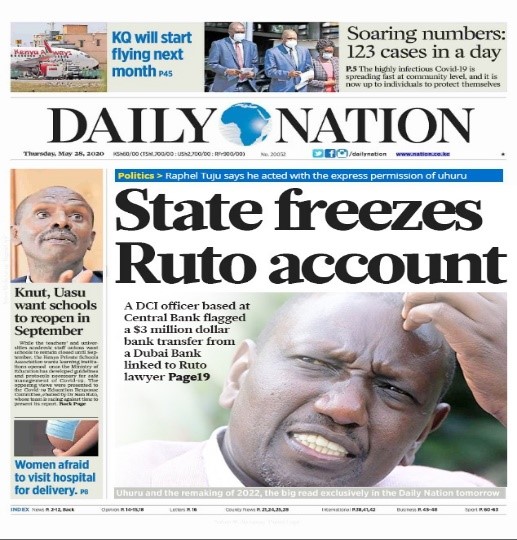
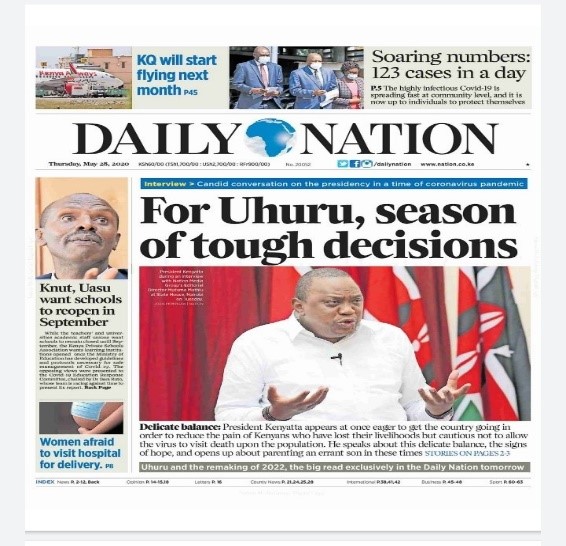
    Daily Nation was not spared either by the peddlers of false information.

    All the media houses affected by the fabricated content were swift enough to use their online handles to dismiss the misinformation.

    In his article on How media organizations can get real and confront fake news, Andreas Pyrcek notes that for media companies, trust is under siege — and without it, they cannot sustain the value of their brand or drive the subscription and advertising revenues that are their lifeblood.

    In fighting fake news Pyrcek says media houses can distinguish their brand and protect their reputation by tackling the complex and multifaceted problems created by unreliable information and other interference. This includes taking steps to rebuild lost trust when necessary.

    He further shares practical ways media houses can build trust in the fake news era. The the steps include:

    1. Building a culture of integrity, compliance and ethics that support accurate and well-verified information, with a focus on quality content and journalism
    2. Strengthening cybersecurity to prevent breaches that generate fake news
    3. Monitoring content on news platforms, social media and other interactive channels to identify potentially damaging fake news items
    4. Creating a crisis management plan to react quickly and effectively when problems occur

    According to Claire Wardle in her article on 5 Lessons for Reporting in an Age of Disinformation, doing journalism in the digital age is incredibly hard. This is a problem that is increasingly becoming hard to manage for the mainstream media and the news industry has even started grappling with the difficult questions being raised in the current environment.

    In conclusion, she notes that most senior editors, many of whom developed their journalistic skills before the digital age, have no idea of the risks faced by their journalists everyday. But the decisions being made by newsrooms around the world are impacting how disinformation spreads. The professional media is a critical part of the information ecosystem, and currently it is vulnerable and being used to spread false and misleading information.

  • For Apple Products In Kenya, Harlem Technologies Is The Authorized And Reliable Dealer

    For Apple Products In Kenya, Harlem Technologies Is The Authorized And Reliable Dealer

    Forbes recently published its annual study on one of the world’s most valuable brands. Coming as no surprise to most, the front-runner Apple topped the list of branding behemoths for the ninth year running, amassing an eye-watering brand value of $205.5 billion—up 12% over last year.

    The top ten, as reported by Forbes, is as follows:

    1. Apple: $205.5 billion
    2. Google: $167.7 billion
    3. Microsoft: $125.3 billion
    4. Amazon: $97 billion
    5. Facebook: $88.9 billion
    6. Coca-Cola: $59.2 billion
    7. Samsung: $53.1 billion
    8. Disney: $52.2 billion
    9. Toyota: $46.6 billion
    10. McDonald’s: $43.8 billion

    At first glance, there’re no names you wouldn’t expect to see. But the list tells another story: by industry, tech brands are dominating, and the trend is showing no signs of slowing down.

    While Apple leads the pack by a sizeable margin, its fellow techy top 10ers have witnessed explosive double-digit growth since last year, with Coca-Cola being the only non-tech brand in the top seven.

    So how do tech giants, particularly Apple, command such an authoritative presence in the mind of the modern consumer?

    Perceived value

    What’s perceived value? It’s a customer’s evaluation of the benefits and costs of one brand compared to another—a primary factor as to why the world’s most valuable brands are so successful.

    What makes perceived value so important from a company perspective is that customers may be willing to pay a higher price because they deem the brand to be of a high quality and/or a status symbol. This gets to the heart of Apple’s continued success over its competitors.

    Despite Samsung actually selling more phones during the last months of 2017, Apple still managed to receive 87% of total smartphone profits—a huge monopoly.

    Why? The power of the Apple brand. The iconic status Apple has received among its hardcore fanbase explains why they can charge so much more than their rivals, despite the technology itself being of more or less the same quality.

    Like it or lump it, Apple are able to price their products at a premium precisely because they know their brand has the power to pull in sales from a staunchly loyal following.

    So from a branding perspective, what makes Apple so special?

    Branding lessons from Apple

    It’s hard to find a more inspirational branding success story than Apple’s. Founded by two college dropouts, its pioneering expansion into various industries and new services such as Apple Pay and iTunes helped to propel Apple into becoming America’s first $700 billion company.

    Apple’s iconic branding strategy has always focused on emotion—bolstered by a forward-thinking creative visionary, Steve Jobs, at the helm. Since the brand’s inception in 1976, Apple has put a priority on building a community of dedicated fans in an almost religious fashion.

    By maintaining an aura of secrecy surrounding the inner workings of their brand, the hype surrounding their product releases is unrivaled; creating conversations among both techies and laymen alike.

    Apple have always positioned themselves as something different; they “Think different.” Unlike any other tech company, the nuts and bolts of their business model, i.e. what their products actually do, is not what really what brings in sales.

    Their consumers don’t think: “I want this because it’s a Dual-SIM, 64GB, 12-megapixel hexa-core processing smartphone.” They think: “I want this because it’s an Apple iPhone.”

    The air of premium exclusivity that Apple employs when promoting new product releases, and the meticulous attention to the aesthetics of its products, has enabled the Apple brand to be associated with luxury in the eyes of its followers. And that is what many of its consumers are paying a premium for: a symbol of status that is driven by emotion, not practicality.

    Customers are more likely to remember—and purchase—products and services that make them feel good

    Are you familiar with the term unboxing? Put simply, unboxing is when consumers record the actual process of unwrapping their newly purchased Apple products. Why? Because the products make them feel good.

    Unboxing videos offer an unvarnished and honest peek at products, while positioning the ‘unboxer’ in a central position within a brand’s community. No one tells these people to create these videos, but Apple facilitates a user experience that expands way past the purchase stage, which is why when you search for unboxing videos on YouTube, you can find an array of hits with a somewhat staggering view count.

    The momentous following of the Apple brand does, of course, present the organization with a formidable reputation to live up to. All technology-leading products which Apple delivers are not only designed to match the brand promise, but are fundamental in keeping Apple so profitable.

    So, how does Apple incorporate customer experience into branding? They put the customer at the heart of everything they do. Take their ‘Shot on iPhone’ campaign for example. Not only does it showcase the sheer versatility of the iPhone camera, but it features charming videos shot by real people.

    Offering their customers the opportunity to be part of something huge—the first instalment of the campaign was viewed at least 6.5 billion different times—Shot on iPhone successfully coupled human emotion with real product benefits. Showing how their products fit into people’s lives, the campaign reinforces the brand pillars of Apple and further solidifies an emotional connection with the audience.

    The importance of emotion in brand loyalty

    No matter how entertaining or creative your brand campaigns are, if there’s no emotional connection with your audience, your marketing strategy is likely to miss its mark.

    It is that emotional connection that has cultivated such brand loyalty among Apple fans and enabled them to get away with pricing their products so much higher than competitors. When we asked famed tech vlogger David Di Franco about what the brand meant to him, this is what he had to say:

    Ever since switching to the Mac in 2004, I knew there was something about Apple that really connected with me on a personal level. From the consistency in their product designs to the passion behind what they stand for, Apple has quickly become one of my favorite brands of all time. And honestly, I don’t see that changing anytime soon. I’m now an Apple fan for life.

    David Di Franco: Creative Tech Vlogger and Apple Aficionado @DavidDiFranco

    So what is the key to brand loyalty? While there’s no easy answer, promoting a brand personality that your audience can relate to can go a long way. After all, what is a brand? As famous author and branding expert Marty Neumeier explains: “a brand is a person’s gut feeling about a product, service, or organization.”

    If you want brand loyalty, do as Apple did—emotionally connect with your customers and start a movement that you believe in. The rest will certainly follow.

    A number of Kenyans are embracing the Apple brand, it’s however, prudent to find the most reliable dealers in town for your iPhone and other Apple products. Normally, Kenya Insights don’t do products endorsements, but after a lengthened engagements lady of over 5 years, we can proudly endorse Harlem Technologies as a reliable seller for genuine Apple products and also for other electronics. This the only firm we’re certain of from experience to be offering after sales services and honors the warranty terms. So when you purchase from them, you’re guaranteed to get satisfaction from any arising issue of your purchase.

    If you need an iPhone, iPad, iMac or any other product, contact Harlems through +254 721 992 980 and more importantly, use KINYANBOY as a code to get discounts on any purchase that you make.

  • How The Media Will Be Like After The Coronavirus Pandemic

    How The Media Will Be Like After The Coronavirus Pandemic

    By Media Observer

    Coronavirus will end, as most people hope. Or, as the experts now tell us, humanity will have to learn to live with the virus. Either way, the tough preventive restrictions imposed by governments must be lifted sooner than later or economic collapse would spark revolts.

    President Uhuru Kenyatta has outlined an economic stimulus plan. That is the strongest hint yet – a favourite phrase in Kenyan journalism – that the government will soon open up the country. It would make no sense to embark on economic revival under the current restrictions. How do you revamp tourism without movement of people?

    It is almost impossible to tell when the economy will be fully revived. But this much is certain: Covid-19 has hit the media so hard that investors and workers in the sector must brace themselves for a radically different future.

    Reflecting on the impact of coronavirus on the media in Southern Africa, the Namibian media scholar Admire Marepredicts that the post-pandemic period is likely to be characterised by financially weak media.

    “Such a scenario would make it difficult for the media to undertake investigative reporting and continue with its watchdog role. It would create a conducive environment for the spread of misinformation, disinformation and conspiracy theories without being debunked by the mainstream media.”

    Why is this scenario likely? Because mainstream media is dependent on advertising. Revenue streams have dried up as businesses have been ravaged by the pandemic, putting journalism at risk.

    Print media, already in great financial distress everywhere due to digital disruption before the outbreak, faces an uncertain future. Publications have folded in many parts of the world. They simply can’t compete with big tech firms that now receive the bulk of advertising due to their wide reach at low cost.

    Of all forms of journalism, print media – the written word – is the most authoritative as it provides an in-depth, permanent record. But it is the most expensive to produce and distribute.

    “There is a greater likelihood that most print organisations are going to be forced to go online without sufficient time and resources to take on the global tech giants. Unfortunately, some media companies are most likely to file for bankruptcy,” Mare writes.

    Veteran Nation business editor and columnist Jaindi Kisero wrote on May 13 that, “Right now, the trends I see in the new media industry are worrisome. Literally, all news media companies are struggling. We are confronted by widespread financial distress across all major media companies.”

    Kisero warned that financially weak media would be bad for democracy and called for “appropriate policy responses” to create strong, vibrant media. But he did not say what those responses should be.

    Media houses are businesses. Besides the government creating an enabling environment for them to thrive, what else might be done to prop them up? To be sure, it is not the business of government to create strong, vibrant private media.

    The current business model of media reliance on advertising is collapsing due to advances in ICT. In addition, advertising compromises media freedom and erodes credibility in the eyes of the public, as writer and journalist Rasna Warah has documented. It is a contradiction that private individuals pursuing a profit should be trusted to protect an important public good like media freedom.

    So, what to do? It appears Covid-19 will hasten the dawn of a new media era. The media of the future will be small, non-commercial and supported by communities much like religious organisations, civil society and charities. Churches are non-profit, yet they are big and influential. The best human rights groups globally are non-profit.

    The American communication scholar Victor Pickardproposes that journalism should be delinked from business. Media houses should evolve into non-profit institutions financed by private individuals and organisations that support press freedom.

    Another model is the strengthening of public-funded media that do not rely on profit. KBC and KNA need more funding and better management to become strong media institutions at the service of Kenyans.

    Covid-19 is a mortal threat to media enterprises. But journalism will not die. It will be practised under new models.

  • Covid-19: Evidence Suggests That The Risk Of Transmission On Board Aircraft Is Low

    Covid-19: Evidence Suggests That The Risk Of Transmission On Board Aircraft Is Low

    The International Air Transport Association (IATA) said Tuesday it supports the wearing of face coverings for passengers and masks for crew on board aircraft as an interim measure against the coronavirus pandemic.

    The association, representing some 290 airlines comprising 82% of global air traffic, said it does not support mandating social distancing measures that would leave “middle seats” empty.

    IATA also said the wearing of a mask is a critical part of a layered approach to biosecurity to be implemented temporarily when people return to traveling by air.

    “The safety of passengers and crew is paramount. The aviation industry is working with governments to re-start flying when this can be done safely,” said Alexandre de Juniac, IATA’s director-general and CEO, in a statement.

    “Evidence suggests that the risk of transmission on board aircraft is low. And we will take measures – such as the wearing of face coverings by passengers and masks by the crew – to add extra layers of protection,” he said.

    De Juniac said there must be a solution that gives passengers the confidence to fly and keeps the cost of flying affordable.

    In addition to face coverings, other layers of temporary biosecurity measures being proposed include temperature screening of passengers, airport workers and travelers.

    Also, IATA would like to have boarding and deplaning processes that reduce contact with other passengers or crew and to limit movement within the cabin during flight.

    Other measures include more frequent and deeper cabin cleaning, as well as simplified catering procedures that lower crew movement and interaction with passengers.

    Aircraft seats fitted with the Aviointeriors [-]
    ‘Glassafe’ shield.
    AVIOINTERIORS
    “When proven and available at scale, testing for COVID-19 or immunity passports could also be included as temporary biosecurity measures,” said IATA.

    Evidence, although limited, suggests that the risk of virus transmission on board aircraft is low even without special measures, it added.

    It cited contact tracing for a flight from China to Canada with a symptomatic COVID-19 passenger revealed no onboard transmission.

    “We need a vaccine, an immunity passport, or an effective COVID-19 test that can be administered at scale. Work on all of these is promising. But none will be realized before we will need to re-start the industry,” said de Juniac.

    In March alone, IATA had said global passenger traffic plunged nearly 53% compared to the same period a year earlier, the biggest plunge in recent history.

  • ‪Israeli Security Firm Finds Flaw In iPhone, iPads That May Have Allowed Hackers To Steal Data For Years‬

    ‪Israeli Security Firm Finds Flaw In iPhone, iPads That May Have Allowed Hackers To Steal Data For Years‬

    (Reuters) – Apple Inc (AAPL.O) is planning to fix a flaw that a security firm said may have left more than half a billion iPhones vulnerable to hackers.

    The bug, which also exists on iPads, was discovered by ZecOps, a San Francisco-based mobile security forensics company, while it was investigating a sophisticated cyberattack against a client that took place in late 2019. Zuk Avraham, ZecOps’ chief executive, said he found evidence the vulnerability was exploited in at least six cybersecurity break-ins.

    An Apple spokesman acknowledged that a vulnerability exists in Apple’s software for email on iPhones and iPads, known as the Mail app, and that the company had developed a fix, which will be rolled out in a forthcoming update on millions of devices it has sold globally.

    Apple declined to comment on Avraham’s research, which was published on Wednesday, that suggests the flaw could be triggered from afar and that it had already been exploited by hackers against high-profile users.

    Avraham said he found evidence that a malicious program was taking advantage of the vulnerability in Apple’s iOS mobile operating system as far back as January 2018. He could not determine who the hackers were and Reuters was unable to independently verify his claim.

    To execute the hack, Avraham said victims would be sent an apparently blank email message through the Mail app forcing a crash and reset. The crash opened the door for hackers to steal other data on the device, such as photos and contact details.

    ZecOps claims the vulnerability allowed hackers to remotely steal data off iPhones even if they were running recent versions of iOS. By itself, the flaw could have given access to whatever the Mail app had access to, including confidential messages.

    Avraham, a former Israeli Defense Force security researcher, said he suspected that the hacking technique was part of a chain of malicious programs, the rest undiscovered, which could have given an attacker full remote access. Apple declined to comment on that prospect.

    ZecOps found the Mail app hacking technique was used against a client last year. Avraham described the targeted client as a “Fortune 500 North American technology company,” but declined to name it. They also found evidence of related attacks against employees of five other companies in Japan, Germany, Saudi Arabia, and Israel.

    Avraham based most of his conclusions on data from “crash reports,” which are generated when programs fail in mid-task on a device. He was then able to recreate a technique that caused the controlled crashes.

    Two independent security researchers who reviewed ZecOps’ discovery found the evidence credible, but said they had not yet fully recreated its findings.

    Patrick Wardle, an Apple security expert and former researcher for the U.S. National Security Agency, said the discovery “confirms what has always been somewhat of a rather badly kept secret: that well-resourced adversaries can remotely and silently infect fully patched iOS devices.”

    Because Apple was not aware of the software bug until recently, it could have been very valuable to governments and contractors offering hacking services. Exploit programs that work without warning against an up-to-date phone can be worth more than $1 million.

    While Apple is largely viewed within the cybersecurity industry as having a high standard for digital security, any successful hacking technique against the iPhone could affect millions due to the device’s global popularity. In 2019, Apple said there were about 900 million iPhones in active use.

    Bill Marczak, a security researcher with Citizen Lab, a Canada-based academic security research group, called the vulnerability discovery “scary.”

    “A lot of times, you can take comfort from the fact that hacking is preventable,” said Marczak. “With this bug, it doesn’t matter if you’ve got a PhD in cybersecurity, this will eat your lunch.”

  • Study Shows Kenyan Women On Contraceptive Have Higher STI Rates

    Study Shows Kenyan Women On Contraceptive Have Higher STI Rates

    The STI rate on women on birth control in the country is sky rocket high.

    According to a new study Kenyan women on long-acting contraceptives recorded higher rates of sexually transmitted infections, compared to the general population.

    The study showed that a high number of women in the study who went for modern family planning methods, had gonorrhoea and chlamydia.The study was done in four African countries, Kenya included.

    The reason, the study states, is that long-acting contraceptives do not require repeated health-carevisits and are probably the most convenient preventive modalities.

    In Kenya, 900 women in Kisumu took part in the study, locally coordinated by the Kenya Medical Research Institute. It was meant to establish whether the use of hormonal contraception, particularly Depo, may increase women’s risk of HIV acquisition.

    The Echo trial included sexually active, HIV-negative women aged 16-35 years, seeking effective contraceptives and willing to be randomly assigned one of the three hormonal contraceptive methods.

    Women were followed for 12-18 months across nine sites in SA, three in Kenya, eSwatini and Zambia.

    The open-label clinical trial conducted compared HIV risk women on the three most commonly used methods of hormonal contraception: the DMPA-IM shot, a copper intrauterine device (IUD) and a levonorgestrel (LNG) implant.

    According to the findings, chlamydia infection was 18 per cent at baseline (start of the study) and 15 per cent at last visit. Overall, gonorrhoea stood at five per cent; this is despite treatment during follow-up visits.

    “There is lack of progress in stopping the spread of STIs worldwide. This is a wake-up call for those concerned. We should ensure everyone, everywhere can access the services needed to prevent and treat these debilitating diseases,” Dr Peter Salama, the executive director for Universal Health Coverage and the Life-Course at WHO, said.

    STIs seem to have been forgotten. There arewomen participating in clinical trials and have access to treatment, yet STI prevalence is still high. Experts recommended STI testing should now be offered at family planning clinics.

    “We must be careful we don’t turn family planning solely into HIV prevention services.” Dr James Kiarie, coordinator of WHO’s human reproduction team, said.

  • Google Report: How To Join Illuminati Tops

    Google Report: How To Join Illuminati Tops

    What have you been google searching?Google Kenya trends In the ‘How to’ category have released their  most trending searches.

    How to-do category indicates the highest key problems faced by Kenyans.

    Top trending How-to, search was,How to lose weight. The same question topped last annual search trends. Tackling obesity the increased awareness on healthier lifestyles.

    How to cook Mandazi came second. First quarter of the year has couple of celebrations like, New year’s eve, Valentine’s Day, mother’s Day, Women’s day, World’s cancer day, labour day and many more.

    Increased family and friends meet ups and reunions believed to be the reason behind this. With some indicators showing that increased price of maize flour was the reason behind the trendy search.

    How to withdraw Money From Sportpesa was the third. Kenyan gambling market erupted to hire scales. The get rich quick society has found refuge in the Kenya’s popular betting site.

    Also Read:Kiambu County Budget Line Puzzle

    The key search that has recurred was How to join the illuminati. Are Kenyans willing to sell their souls? Has the religion failed in mentoring the society?

    Lastly How to get pregnant. Yet another recurring search on the Kenya’s search trends. This indicates higher the struggles Kenyans may have with fertility

  • Cytonn Opens Doors To The Public As They Unveil The Ridge Show House

    Cytonn Opens Doors To The Public As They Unveil The Ridge Show House

    If you are looking for something to do this weekend, CytonnInvestments is holding an open day on Saturday for clients and members of the public on site at The Ridge.

    The show house for the project will be unveiled, giving guests a preview of what the finished product will be like. Visitors get to sample the distinct and magnificent lifestyle development and ask the management questions on any issues about Cytonn’s activities.

    The event will run from 12 noon to 4 pm, so that clients have enough time to explore the site, view the show house, and interact with the management of Cytonn.

    The Ridge.

    Alongside the open day, the company is offering a 5% discount for early buyers, which will run for a limited time. Interested guests are advised to sign up and reserve their slots before spaces run out.

    This project was made for people who want to live in luxury and style, at surprisingly affordable rates. The list of amenities goes on and on, but I think the best part about it is the location. Imagine living just a few minutes from Windsor Golf Club, Two Rivers Mall, UNEP headquarters, and only 10 km from town!

    The luxury project will have 1,2,3 & 3 bedroom apartments withdomestic servants’ quarters (DSQ).

    Just a few months ago, Cytonn handed over the Amara in Karen, another of its projects, which is currently 100% complete and sold, proving they have what it takes to deliver beautiful, exclusive homes that perceptive Kenyans can enjoy.

    If you want to buy a home or to invest, this is your opportunity! You cannot afford to miss out. RSVP here.

  • Why Jamii Telecom’s Faiba 4G Unlikely To End Safaricom’s Dominance But A Game Changer For Kenya

    Why Jamii Telecom’s Faiba 4G Unlikely To End Safaricom’s Dominance But A Game Changer For Kenya

    Safaricom remains the telecommunication giant in Kenya with a market share of 71.2 percent in Kenya according to 2016 second quarter statistics report by the Communication Authority of Kenya (CA) this translates to about 28M active subscribers. This leaves other players like Airtel, Telkom Kenya, and Equitel with mere 28.8 percent share scramble.

    Jamii Telecoms Ltd is the latest entry into the Mobile Operator market making it the 5th entrant. With a 4G market launch, Faiba has caused serious ripples with many analysts saying it could be the game changer to Safaricom’s dominance that has been in play for more than a decade. However, it is easier said than done, we’ve seen several companies come and go citing unfair market environment attributed to the Saf’s dominance.

    Faiba 4G is however not a usual launch, in a country with estimated 86% internet penetration with about 41M Kenyans accessing the internet and majority through their smartphones, Jamii Telecoms saw a perfect opportunity. Famed for the Faiba broadband home and businesses high-speed internet connectivity, they already have a ground with over 120K subscribers to kick them off.

    During the launch of Faiba 4G

    The Communication Authority of Kenya awarded Jamii the prestigious 4G spectrum amidst complaints, especially from Safaricom that it was unprocedural and that the company didn’t pay the required Sh2.5B for the 4G license. So far only Safaricom and Telkom Kenya have acquired the 800MHz spectrum, Airtel still at 3.75G. Despite the complaints of favoritism, Faiba 4G is officially live with mind-boggling data price tags.

    A look at JTL’s pricing signals competitive times ahead: 1GB data bundles will cost Sh50 (valid for one day), 70GB at Sh3,000 (valid for a month) and 210 GB at Sh6,000 for a month as well.

    Safaricom on the other hand offers 150MB for Sh50 (valid for a day), 1GB for Sh500 (valid for a month) and 12GB at Sh3,000 (valid for a month).

    Airtel’s 1GB 24-hour data bundle costs subscribers Sh99, 6GB costs Sh1,000 (valid for a month) and 24GB goes for Sh3,000 (valid for a month).

    Safaricom which offers highest internet speed compared to its competitors yet have highest data prices in the market is viewed as the main target as Faiba seeks to take a huge chunk of the share. Faiba 4G operates on band 28, 700MHz frequency spectrum, this is both great news and bad. First, it’s great since it will give consumers miraculous internet speeds, from tests, we’ve learned the Faiba 4G speeds goes up to 72Mbps, it also has higher penetration capabilities like into buildings as compared to the 800MHz spectrum now used by Safaricom and Telkom.

    Secondly, Faiba 4G is limiting in so many ways; device selectivity, only those with 4G enabled phones with VoLTE features will be able to access their internet or their own Faiba mobile. Most Kenyans own budget smartphones that aren’t necessarily 4G VoLTE enabled thereby limiting the number of people able to use their services.

    VoLTE stands for voice over LTE and it’s more or less exactly what it says on the tin. It’s voice calls over a 4G LTE network, rather than the 2G or 3G connections which are usually used. The big advantage of VoLTE is that call quality is superior to 3G or 2G connections as far more data can be transferred over 4G than 2G or 3G.

    Faiba 4G promises lifetime on-net calls as long as you have an active data bundle, while this sounds appetizing, it is also limiting that such calls can only happen if both have VoLTE enabled phones and within 4G area, when network signal weakens, the call quality is reduced or disconnects.

    Faiba 4G’s mi-fi

    So far, there’s no provider that beats Faiba 4G’s data bundles but the biggest headache that will stall their immediate boom is the device selectivity and also network reachability. Nairobi, Nakuru, Kisumu, Eldoret, Mombasa, and Thika are covered by the Faiba 4G with 300 bases and a plan to extend the bases to 1000 in the next 3 years.

    Disrupting Safaricom’s dominance is not a walk in the sand and needs more than a flashy launch with heavenly offers. Reliability, reachability, innovations are some of Safaricom’s confidence zones that have seen them stand firm in the market. Mpesa remains one of re greatest innovations by Safaricom that has made it East Africa’s giant. Kenya, for instance, is synonymous with mobile transactions, the economy is literally running on Mpesa with billions moved across the platform annually.

    Mpesa actually could as well be Safaricom’s biggest asset that keeps it afloat. We’ve seen Airtel money even with zero rate transactions, unable to beat of Mpesa, not for anything but reliability, agents are spread all over the country and it’s not a hustle to access your money compared to other providers. Therefore, if Faiba 4G is to hack this, then they must not play the same cards by competitors that have failed but come up with new innovations and strategies to level Mpesa dominance. Faiba Money is set for launch as well. Accessibility of Safaricom network even in the most of remote areas also makes it stand out and a major preference, if Jamii can invest heavily to match up the reach then they’re in the right lane to beat it off.

    According to the management, all is not lost for Faiba 4G as they’re likely to change bands from 700MHz depending on the availability of frequencies, this will obviously increase their reach and capture more customers angry for affordable data services. We’re also told they have solid strategies that will spread over the next coming years to totally disrupt and maul a good share of the market. As it stands, it’s a wait and sees situation.

    Coming months, Kenyans are likely to witness a brutalizing corporate war as Faiba, Safaricom, Telkom fight for customers loyalty and the data market share. As the giants engage in the brawl, consumers can sit back and expect affordable, quality data services, a competitive market is often a blessing to the consumers. Safaricom is unlikely to let go easily what they have and so is Telkom, Airtel and Equitel both who’re struggling to rise. Faiba 4G as the new entrant has to go an extra mile to make an impact in the market but until then the market is open but literally a one man’s show.

  • How The Future Of Social Media Marketing Is Going To Be

    How The Future Of Social Media Marketing Is Going To Be

    After 3 months of real meditation and research, Here is What I Think the Future of Social Media Marketing is Going to be. Please read Every single tweet here because it matters. Social Media is the new age of media and the arena of attention. It is therefore very important for brands to fully lay a foundation to be able to remain relevant in the market.

    We are going to live in the age of the thank you economy where people’s emotions and feelings come first before they make decisions to buy products. Influencers will have more power than internal brand marketing teams. Brands will need to start fully rebranding to products that relate to their customers and their passions. For example, CocaCola producing customized Coke bottles for influential figures and their fans. Let me make this clear, the biggest asset we all trade in on Social Media is the Attention of customers and fans. The faster brands learn this the better they will be in positioning themselves.

    Start now and avoid disappearing into the world of noise. Today is the best time to start your digital journey before other people start to give wrong or half-baked information about your brand. Create Authenticity early. Customers and fans feedback modified by brand strategists will be the sole source of information for innovations and rebranding. Social media will be very instrumental in collecting these voices to facilitate brand improvement.

    Talent Acquisition is going to 70% be based on Social media as a source of background checks. With platforms like Twitter, Facebook and LinkedIn will provide businesses with choices on getting the right talents that resonate with their brands. Your Next competitor will start their business on Social Media and acquire real fans and customers before the actual business kick starts. You will most likely regret not having put your brand online early when they take away all your customers.

    Your Brand Website and Blog will be the two sole sources of authentic information about your business. Youtube, Facebook, Twitter, and LinkedIn will simply help you share content from your website to your customers and fans. Fast-forward to the future, and we should see global social media usage continue on its upward trajectory. In just 4 years, eMarketer projects will nearly double by 32.7%. By 2021 4.5 billion of the world’s population will be on social networks. No matter where your business is located in the world, the psychology of consumers will almost be similar as a result of Social Media effect. Break the mentality of “for us, we are African, Asian, European or American,” just adopt a global brand standard.

    When news breaks in the future, it will be covered by a multitude of eyewitnesses streaming live video. These streams will knit together into a single immersive video, enabling the viewer to virtually experience the event in real time. I think that anything we talk about in 25 years is going to sound like science fiction. Mobile is the first step toward the portable future of social media and how we consume it, and I think wearables will be a big part of that.

    Imagine shopping on an e-commerce store with a friend, virtually trying things on your avatar that’s representative of your likeness and conversing in real time with that friend, all while on the go in different places. Keyboards on desktops, laptops, tablets, and smartphones will become increasingly irrelevant, as interactions on what was once called social media will largely be voice-controlled. Holographic displays will be shifting into the mainstream.

    My bet is that social will be less about standalone apps and websites and more about the “piping” of the Internet. In the future the Internet will operate more like electricity does today. 16. Communication in the future will be built on the foundation started by what is today called social media, but it will look much different. The most dramatic change by 2030 will not only be the amount of data that will be available to everyone but also the decision-making power of that data. We currently have thermostats that learn our preferences, & Nike even knows how often and how fast we run.

    All I do all week is look at my phone, reading articles, liking posts, sending emails/tweets. In the future, I will “disconnect” by putting on Oculus virtual reality glasses when I get home and suddenly I’ll be sitting courtside at the WWE ring with my Facebook friends. I think that [social media] will be more integrated into everything. As you think further down the road, I don’t think that there’s going to be something called social media that people will be talking about in 20 years.

    I see more of a divide happening between socializing and publishing via social media, and platforms like Facebook that merge the two will probably need to pick a lane and change significantly. Conclusion: The best business tools on social media are going to be as expensive as buying traditional media equipment today. Brands with bigger budgets will have better tools than those with low budgets.

  • How The Presidential Election Was Rigged Filed Evidences By NASA Shows

    How The Presidential Election Was Rigged Filed Evidences By NASA Shows

    Supreme Court is set to hear fully the petition filed by NASA against the declaration of Uhuru Kenyatta as the winner for Presidential Election by IEBC.

    NASA principals Raila Odinga and Kalonzo Musyoka, who are the petitioners in the case, believe the evidence they have is sufficient to prove that the Independent Electoral and Boundaries Commission (IEBC) conducted a shambolic election marred with massive irregularities and rigging, in violation of the Constitution.

    They claim that IEBC colluded with President Kenyatta to deny them victory by allowing 14,000 defective returns from polling stations representing over seven million votes.

    As a result, the total presidential votes cast exceeded those of other elective positions of Governor, Senators and Members of National Assembly by over 500,000 votes.

    “IEBC became a law unto itself in total breach of the people’s will. The presidential election was so badly conducted that it does not matter who won or was declared the winner. The nature of the flaws is that the commission cannot accurately determine the results of each candidate,” they said.

    According to the petition drawn by Murumba and Awele Advocates, the leaders argue that IEBC violated principles of a free and fair election, and the rigging happened during voting, counting and tabulation of results. Disrespect for public institutions kills obligation to higher authority
    They are also accusing Jubilee of using State resources to campaign. NASA leaders are questioning why rejected votes were deliberately inflated in their strongholds to reduce Raila’s percentage.

    They argue that the relay and transmission of results from polling stations to the constituency and National Tallying Centre was compromised with a predetermined decision to ensure Kenyatta maintained the lead.

    “The late ICT director Chris Msando had stated that the system would only function when data was accurately matching the Form 34A. This was however manipulated leading to unverified results from 10,000 polling stations representing approximately five million votes,” the lawyers claim.

    They accuse IEBC of taking sides during the elections by favouring Jubilee and disregarding a decision of the Court of Appeal that election results declared at the polling stations are final.

    According to the petition, IEBC allegedly colluded with Jubilee to eject NASA agents from polling stations in Central and Rift Valley to conceal evidence of rigging.

    They maintained that the declared final presidential results were not based on results from polling stations, given the differences captured in Forms 34A and Forms 34B. The petition claims that IEBC used ungazetted and undesignated polling stations and presiding officers in areas considered Jubilee strongholds who in turn submitted invalid returns in favour of President Kenyatta.

    “Even at the point of filing the petition, IEBC is still in the process of fraudulently altering and tampering with the Forms 34A. It is not possible to verify the number of forms used in the elections which shows the results announced were unlawful,” the lawyers say.

    The petition has also revisited the controversy of rejected votes which stood at 477,195 accounting for 2.6 per cent of the voters cast. They claim this was deliberate to reduce Raila’s total tally. They argue that scrutiny of the rejected votes confirmed that 395,510 votes were unlawfully deducted from Raila and added to President Kenyatta. According to the lawyers, Kenyatta openly intimidated public officers and improperly influenced them to support his re-election which went against election Code of Conduct.

    “He contravened the law with impunity using his position as the Head of State. This disadvantaged his competitors and cumulatively affected the conduct, result and outcome of the presidential election thereby making it null, void and unconstitutional,” say the lawyers.

    Tap on the images to read through the files

    [pdf-embedder url=”https://cms.kenyainsights.com/wp-content/uploads/2017/08/The-Petition.pdf” title=”The Petition”]

    Affidavits

    [pdf-embedder url=”https://cms.kenyainsights.com/wp-content/uploads/2017/08/Stephen-Kalonzo-Affidavit.pdf” title=”Stephen Kalonzo Affidavit”] [pdf-embedder url=”https://cms.kenyainsights.com/wp-content/uploads/2017/08/Raila-A.-Odinga-Affidavit.pdf” title=”Raila A. Odinga Affidavit”] [pdf-embedder url=”https://cms.kenyainsights.com/wp-content/uploads/2017/08/Moses-Wamuru-Affidavit.pdf” title=”Moses Wamuru Affidavit”] [pdf-embedder url=”https://cms.kenyainsights.com/wp-content/uploads/2017/08/Mohamed-Barre-Affidavit.pdf” title=”Mohamed Barre Affidavit”] [pdf-embedder url=”https://cms.kenyainsights.com/wp-content/uploads/2017/08/Ibrahim-Mohamud-Ibrahim-Affidavit.pdf” title=”Ibrahim Mohamud Ibrahim Affidavit”] [pdf-embedder url=”https://cms.kenyainsights.com/wp-content/uploads/2017/08/Godfrey-Osotsi-2-Affidavit.pdf” title=”Godfrey Osotsi 2 Affidavit”] [pdf-embedder url=”https://cms.kenyainsights.com/wp-content/uploads/2017/08/Godfrey-Osotsi-1-Affidavit.pdf” title=”Godfrey Osotsi 1 Affidavit”] [pdf-embedder url=”https://cms.kenyainsights.com/wp-content/uploads/2017/08/Dancun-Anunda-Affidavit.pdf” title=”Dancun Anunda Affidavit”] [pdf-embedder url=”https://cms.kenyainsights.com/wp-content/uploads/2017/08/Benson-Wasonga-Affidavit.pdf” title=”Benson Wasonga Affidavit”] [pdf-embedder url=”https://cms.kenyainsights.com/wp-content/uploads/2017/08/George-Kegoro-Affidavit.pdf” title=”George Kegoro Affidavit”] [pdf-embedder url=”https://cms.kenyainsights.com/wp-content/uploads/2017/08/Dr-Nyangasi-Oduwo-Further-Affidavit-2.pdf” title=”Dr Nyangasi Oduwo Further Affidavit 2″] [pdf-embedder url=”https://cms.kenyainsights.com/wp-content/uploads/2017/08/Dr-Nyangasi-Oduwo-Affidavit-1.pdf” title=”Dr Nyangasi Oduwo Affidavit 1″] [pdf-embedder url=”https://cms.kenyainsights.com/wp-content/uploads/2017/08/Ole-Kina-Affidavit-final.pdf” title=”Ole Kina Affidavit – final”] [pdf-embedder url=”https://cms.kenyainsights.com/wp-content/uploads/2017/08/Ogla-Karani-Affidavit.pdf” title=”Ogla Karani Affidavit”]

  • Garbage Kenyan Gospel Artists Outsmarted By The Secular Emcees In Their Own Game

    Garbage Kenyan Gospel Artists Outsmarted By The Secular Emcees In Their Own Game

    By Nicholas Olambo 

    Gospel music was the thing in Kenyan entertainment after the secular lost it and left the market to be dominated by foreign music/artists. Well, the disease that brought secular down is now in the gospel, after being left in the hands of cartels comprising of a couple of Dee Jay Units, bootlickers and monied boys and girls masquerading as artistes.

    The industry is now on a speedy down ward trend, filled by filthy scandals that stink to the highest heavens. Gospels artistes no longer make gospel music, even the name of Jesus Christ can hardly be found in their content. 2016 was the year that revealed it all from the release of ‘Yesu Nipe Nyonyo,’ Willy Paul and Size 8’s ‘Tigana we’ to Jimmy Gait’s ‘Yesu ndio sponsor’ that was desperately seeking to gain relevance with the street colloquial that was the thing at the time. The street meaning of a ‘sponsor’ is any older person who finances the lifestyle of a young person in exchange for sex.

    Now with the so-called gospel artistes doing ‘goscular music,’ serious secular artists have stepped in to save the face of gospel music. The biggest gospel hits of the year 2016 were done by secular artists. Nyashinski, a former member of an all boy rap group, Kleptomaniacs, made a comeback after nearly a decade in the United States with a secular hit ‘Now you know, ’ and a super gospel hit ‘Mungu Pekee’ which is purely a prayer, testimony, and self-motivational anthem for any God fearing person.

    Imposters who have been passing for gospel artists feel threatened; they are almost being rendered jobless. It has now been proven that gospel music is beyond quoting John 3:16, Malachi 3:10 or being signed to DJ Mo’s System Unit and Sadic’s Genius Entertainment but making good music from writing to performance that is in line with the ministry.

    Secular artistes are safely sailing in these troubled gospel waters, spanking the sleeping gospel artists on their a**s but they won’t wake from their sleep. An all boy band Sauti Sol also released a killer gospel hit ‘Kuliko Jana.’ Sauti Sol is a giant in East Africa and a multi-award winning group, they stepped in the booth with Red Fourth Choir and did just what the Giants do, crashing the sleeping gospel artists in their home ground like a military boot on an ant. It’s a new year, will gospel artists live to their name or let the secular artists take over.

  • Analysis: Can Kenya Sustain The Growing Heavy Public Debt

    Analysis: Can Kenya Sustain The Growing Heavy Public Debt

    Public debt has been an issue of public discourse for centuries. The debate is not about to end anytime soon. With developing countries investing much more resources in public infrastructure, education and other social amenities, public debt is expected to become even a bigger point of discussion moving forward. Just before the March 4, 2013, General elections, Kenya for the first time, held a presidential debate. Uganda followed suit earlier on this year. From those debates, it is evident we are yet to start discussing ideas in our presidential debates. My guess, however, is that going forward, these discussions are going to tackle key issues affecting these emerging market economies, key among them the issue of Public debt.

    To start us off, let us try to understand some key terms. Debt refers to a contractual obligation in which a party uses the counterparty’s money or any other valuable resource with the view of repaying it at a later date, with interest. People have been borrowing since time immemorial, and they are not about to stop anytime soon. As long as resources for satisfying human needs and wants are limited, we shall always consume something we do not currently own with intent to repay at a later date. Just like individuals, body corporate and governments too, borrow. Public debt is what a government owes to its lenders. Government/ Sovereign debt can be used synonymously with public debt. Public debt can either be domestic or foreign. The former involves borrowing from within a country’s borders and among its citizens while the latter involves borrowing from outside the country’s borders. It could be a loan from foreign nationals, foreign governments or even international financial institutions. Ordinarily, domestic debt is denominated in the local currency while foreign debt is likely to be denominated in a foreign currency. External debt, on the other hand, is the amount of money owed to foreign investors by both the government as well as the private sector.

    Since the year 2013, Kenya’s public debt has been on an upward spiral. According to Keynesian Economics, there are two possible scenarios that would put a country’s debt on an upward trajectory; War and recession. Since war is unanticipated, it is usually not planned for adequately in the budget, and therefore in the event of war breaking out, the country is likely to start borrowing to fund the cost of the war. In a recession, the economy has slumped. Jobs are scarce, and demand for products within the economy dwindles. This reduces tax revenue that the government had anticipated and corporate profits plunge, leading to lower corporate taxes being availed to the government. In such a case, the government will operate on a budget deficit, which is, in fact, public debt. For the last four years, Kenya has neither had a war nor a recession. In fact, the Kenyan economy has grown enormously over the period, as H.E the president has persistently said.

    Key Facts and Figures

    As at 2013, Kenya’s debt ceiling was Ksh. 800 billion. That same year, Parliament in its wisdom or lack thereof raised this ceiling by 500 basis points. We ended the year with a debt ceiling of Ksh. 1.2 Trillion. By the end of 2014, Parliament had more than doubled our debt ceiling. It now stood at Ksh. 2.5 Trillion.This figure was higher than our budget for the financial year 2014/2015 which stood at Ksh. 1.7 trillion. Kenya Debt to GDP ratio has grown from below 30% in 2012 to currently stand at 49.7%, 4.97 points above the treasury’s benchmark.

    Is Debt Bad?

    In life, nothing is bad. Similarly, nothing is good in absolute terms. What matters is a person’s perspective. In the corporate world, most capital projects are undertaken through use of debts. Most individuals develop themselves by using debt. The government too can make enormous economic progress through the use of debt. In the corporate world, you will rarely find a company that operates on 100% equity. In fact, theoretically, the most valuable firm would be the one that is 100% leveraged. This is because, interest expense as a cost of capital, is a member of an exclusive club called “allowable tax deductions” To illustrate, let’s assume we have Firms A and B. A’s capital structure is 100% Equity while B’s capital structure is 100% debt. If these two companies make the same earnings before interest and tax, firm B will end up paying the lesser tax. Equity, as a cost of capital, is expensive. In practice, however, strong B does not exist. And if it did, it would have a very high risk compared to A. What companies therefore do, is to find a balanced mix between equity and debt. They get a debt that will enable them to enjoy tax benefits while not unnecessarily raising their risk profile. Finding the right balance is what governments should look at while borrowing.

    Measuring a country’s public debt

    There are various ways that can be used to judge whether a country’s debt is healthy or moving in the wrong direction. This article will attempt to look at Kenya’s sovereign debt using two approaches. The first method, which is preferred by most researchers, is to measure debt as a percentage of GDP. There is no rule of the thumb here. However, the world bank looks at it from two angles; developed economies and emerging market economies. According to the world bank, an extended debt to GDP ratio of above 77% drags economic growth. In fact, it states that for every additional point above the 77% mark, the country loses 1.7% in economic growth. For emerging market economies such as Kenya, the ratio should not exceed 64%. Any figure above that slows economic growth by 2% each year. As a matter of policy, the Kenyan treasury has set its target Debt: GDP ratio as 45%. This is 19 percentage points lower than what the World Bank considers to be the benchmark. To this, end one must appreciate the government’s proactiveness. 19 percentage points is a field, wide enough to play all manner of games.
    The second approach that can be used to measure a country’s debt is to look at it about Government revenues. This measure gives you a rough figure of how long it would take for the government to pay its debts if it were to use its ordinary revenue to pay for its debts. The current debt for our country stands at Ksh. 3.2 trillion. The government, on average generates Ksh. 100 billion every month. If we were to use our tax revenues to pay our debts exclusively, it would take us 32 months only! This is, of course, wishful thinking.

    Is Kenya headed in the right direction?

    There is no simple answer to this question. As alluded to earlier, it is evident we cannot explain our growing debt using Keynesian Economics. However, in a growing economy, the following variables are expected to be on an upward spiral as well. They include population, revenues, expenditure among others. To cater for the increasing need to provide service to the growing public, the government will need to dig deeper into its pocket. At this point, debt is the only option. Unlike in private sector budgeting where expenditure is based on revenue, in public financial management, revenue is based on expenditure. The government comes up with an expenditure plan, before creating revenues. This is why most governments operate deficit budgets.
    It is tough to answer the above question. The answer depends on who you ask. I know of a particular person who when asked about our high Debt: GDP, answers by stating that the USA’S Debt: GDP is at 106%.

    “This is more than double our own; we should not worry.” He concludes.

    France is at 116%, and Japan is at 228%. Bahama’s at only 6%. So if indeed Debt: GDP meant much, Bahama’s would be the most financially stable country in the world. This was as at 2015. Greece closed the year 2015 at 188%. We all know where Greece is, economically speaking.

    The above argument is simplistic. It does not take into consideration the individual components of that debt.

    Public debt is composed of domestic debt and foreign debt. A large chunk of the US debts are owed to its citizen, and even those owed to foreigners are mostly dollar-denominated thereby eliminating the foreign exchange risk. If bad comes to worse, the FED can just print more dollars to repay its debts. Conversely, as at August 2015, 51.9% of our public debt was external. The risk associated with the foreign debt is that it is exposed to foreign exchange fluctuations, meaning if the shilling were to fall, we would spend more money to pay the debt than we had anticipated. Of course, the government can still hedge against this exposure through the use of derivatives, such as interest rate swaps. However, such derivatives also come at a cost. Japan has the same case as the USA, most of its debts are owed to its own citizens. So, our Debt to GDP ratio should not blind us.

    In conclusion, it is not easy to determine if our public debt is sustainable or not, however, if you try to find ou the answer, here is my advice: Borrowing for the purpose of incurring recurrent expenditure is financial illiteracy unless you are in a financial crisis. Secondly, borrowing to loot, in the name of infrastructure development, and borrowing to invest in white elephants like the SGR, is not sustainable.

    Finally, it is Adam Smith who once said,
    “What can be added to the happiness of a man who is in health, out of debt, and has a clear conscience?”

    The writer writes to inform.
    Follow on Twitter: @pcmakokha
    Facebook: PC Makokha

    DisclaimerThis article expresses the author’s opinion only. The views and opinions expressed here do not necessarily represent those of Kenya Insights or its Editors. We welcome opinion and views on topical issues. Email:[email protected]
    www.pcmakokhasays.wordpress.com.

  • Kenya Media Council Hatches A Plot To Have Moha JichoPevu, Dennis Onsarigo Fired And Control What Journalists Post Online

    Kenya Media Council Hatches A Plot To Have Moha JichoPevu, Dennis Onsarigo Fired And Control What Journalists Post Online

    fb_img_1473763672569
    Mohammed Ali, Jicho Pevu

    The Media Council of Kenya has come out guns blazing to send stern warning to journalists with dissenting, rebellious voices, in a cautioning statement, the council addressed on a number of emerging issues touching on the media’s coverage of the campaigns as well as the conduct of journalists during the electioneering period ahead of the 2017 general election.

    The Council advised media houses to let go of politicians in newsrooms; journalists and media practitioners that have declared affiliation to political parties/movements/groupings or indicated their intentions to vie for elective positions in 2017. The Code of Ethics for the Practice of Journalism in Kenya is very clear on this and related conflict of interest matters. This according to sleuths speaking to Kenya Insights, was stealthily slotted in from high powers following emergence of photos of KTN’ Mohammed Ali and Dennis Onsarigo having a meeting with CORD leader Raila Odinga at a private location in Mombasa. The Jicho Pevu pioneer is also on record vying for Nyali Parliamentary seat.

    The photos that were widely circulated by Dennis Itumbi insinuated from his caption that the two journalists were in alliance with the opposition leader. Itumbi went further to attack Moha asking him to call off journalism and go wholely into politics if so was his intention. Ironically, Itumbi and Uhuru have both been pictured together with journalists, its also said Itumbi has intimate affair with Citizen’s Jackie Maribe, would that also be read as ethics compromise as in the case of the investigative duo?

    Charles Kerich, Chairman, Media Council of Kenya went further to advise media houses to develop and implement social media policies. To this end, the MCK will work closely with media houses that are yet to put in place such, to develop social media policies. The call for control over what journalists post online comes at a time when those deemed to be system’s critics as Moha, Onsarigo, James Smart and SADIQUE sHABAAN HAVE INCREASINGLY ABD STEADILY BEEN HITTING THE GOVERNMENT BELOW THE BELT AND GIVEN THEIR huge following and influence were told the establishment is not amused and worried hence need to regulate content.

    fb_img_1473798291761
    Dennis Itumbi making out with Citizen tv’s Jacque Maribe
    fb_img_1473798282605
    Maribe in a photo moment with the President

    While journalists, like all other citizens, have rights to be active on social media and by extension enjoy freedom of expression, the body insists they should draw the line between personal opinion in private space and walls, and views that suggest that a journalist is biased. It is unrealistic for media practitioners to spew biased opinions on their social media pages, and expect not to be viewed as partisan by people who expect to be covered fairly.

    The Council insists that journalists/media practitioners should avoid openly affiliating with political parties and must be perceived to be neutral. The MCK, which is mandated to accredit all media practitioners in Kenya, will withdraw the accreditation of journalists who want to work for political parties, and this withdrawal will mean that they are not authorised to work as media practitioners in the country.

    All parties in a political contest, in the lead up to the elections, deserve to be covered fairly by the media. There are claims the council alludes to particularly from some counties, that some politicians have influenced journalists to the extent that their competitors do not enjoy any fair coverage, and only make it to the media with negative stories. Media houses are advised to investigate these claims and take appropriate action. In the same vein, the Council wishes to request media houses to establish/ strengthen their public editors’ offices to help deal with such.

    The Media Council of Kenya urges all media houses to be cognizant of the welfare of their reporters and correspondents, and to facilitate them adequately in their coverage of political events. The culture of brown envelop journalism, where news sources spend money to obtain favourable coverage, should be highly discouraged through firm action against those breaking the law.

    fb_img_1473763582103
    Mohammed Ali pictured talking to the President
    fb_img_1473763537337
    Mohammed Ali and Dennis Onsarigo pictured talking to Raila and Joho

    Talking of media freedom and balancing interests, its ironical that Charles Kerich, who is Chairman, Media Council of Kenya giving the contradiction of interests lectures also doubles as the Chief Editor to the Star, a predominantly political publication, doesn’t his position put him in a compromising state. Beside and unfortunately, it’s nearly impossible to disconnect the media from political interference while the same politicians are the owners of the media houses. In this case for example, you wouldn’t expect Charles Kerich to approve a hammering article on Kidero who is his boss and shareholder of the Star.

    The move to control what journalists post online is a challenge to the freedom of speech and whichever way and explanations to be used in justifying the regulation won’t rub off the fact that it’s a gagging order barring the journalists from freely expressing themselves without fear of losing their job. With the newsrooms severely regulated and items sieved, the only remaining free platform where journalists have been able to give unsieved news, becomes latest target as the final nail on the coffin.

  • Kenya’s Mainstream Media Once Again Misses The Big Point On Facebook’s CEO Mark Zuckerberg Nairobi Surprise Visit, Opts For Mediocrity

    Kenya’s Mainstream Media Once Again Misses The Big Point On Facebook’s CEO Mark Zuckerberg Nairobi Surprise Visit, Opts For Mediocrity

    Mark Zuckerberg enjoying local dish of fish with ugali at local food joint, Mama Oliech
    Mark Zuckerberg enjoying local dish of fish with ugali at local food joint, Mama Oliech

    The Kenyan Mainstream Media has been criticised for none objectivity and over emphasising on irrelevant angles of stories for a real time, the ploy has once again played out in the latest visit of a prominent figure, Facebook’s Founder. The memory is still fresh in many people’s mind how the disjointed Kenyan media reported to the air visiting US pPresint of the U.S. Obama was breathing when he touched down in Nairobi previous year. His jet and security detail dominated the headlines compared to the core issues behind the visit.

    Concentrating on sideshows inclines the public’s view, given the fact that majority of Kenyans consume their news via mainstream media and that they have the sole responsibility of setting the agenda, they ought to separate themselves from yellow journalism to being subjective and practice seriousness in the profession.

    On his surprise tour of tech hubs in Africa, Mark Zuckerberg has made a pit stop in Nairobi. Announcing his arrival on Facebook, he described talking with entrepreneurs working out of the tech space, the iHub, and dining on ugali and tilapia with Kenya’s cabinet secretary for information and communications, Joe Mucheru. Announcing his core intent for the visit, Zuckerberg wrote on his Facebook page. “I’m here to meet with entrepreneurs and developers, and to learn about mobile money—where Kenya is the world leader.”

    Headlines of Kenya’s mainstream media concentrating on the slideshows ;

    Screenshot_2016-09-02-10-41-21Screenshot_2016-09-02-10-45-08Screenshot_2016-09-02-10-45-08


    Nairobi makes sense as Zuckerberg’s next stop. It is home to the world’s largest mobile money platform, M-Pesa, the crowdsourced disaster mapping platform Ushahidi and companies like M-Kopa, a solar company that sells power to the rural poor on credit, or Bridge International, a controversial for-profit school chain that the Facebook co-founder supports. Other Mobile Banking platforms running in Kenya includes Airtel Money, Orange Money.

    Mobile money in Kenya, which allows mobile phone users to send or receive money, undergirds much of the country’s economy from banking and credit scoring to sports betting. For the first six months of this year, 1.59 trillion Kenyan shillings (about $20 million) flowed through mobile money platforms.

    In nearly all leading Kenya’s mainstream outlets, they’ve emphasised on the sideshows of where the Billionaire digital entrepreneur was having his lunch his dressing code. While these are news material, they shouldn’t dominate headlines in serious journalism specs. The mainstream media is once again proving Juvenal in the line of duty. Sensationalism should be left to click baiting blogs and not the mainstream platform. Once again you’ve let us down.

  • Secret Meeting Reveals The Sh400M Racket Behind Nationwide School Fires

    Secret Meeting Reveals The Sh400M Racket Behind Nationwide School Fires

    Education CS Fred Matiang'i
    Education CS Fred Matiang’i

    For the past weeks schools have been going up in flames with over 10,000 students sent home scored charged in courts for arson including teachers. Some students have been heavily punished, about 15 students who recently set ablazeLangata dormitories have been sent to Kamiti maximum prison where hardcore criminals are detained perhaps a move to send a severe warning to the rest.

    As the cases of school fires continue to thrive one critical issue that has taken centre stage is as to who and what elements could be behind the fires. Several theories have been forthcoming including politics.

    Initially, the fires started in Kisii the home ground of education CS Fredrick Matiang’i, and it was theorised that jealous local leaders wanted him out of the seat, and the fires would be used as a sign of discomfort and rebellion to his leadership in the education helm.

    Another angle that was introduced came from KNUT officials that the strict and dictatorial policies that the CS introduced including overhauling the schools calendar and activities were to blame. KNUT Sec Gen Sossion is on record saying the students were unhappy and showed rejection to the stiff policies. KNUT has threatened to cease duty should the ministry go ahead with charging teachers for arson.

    Talking of terrible policies, the CS has issued a warning that any school that burns it’s head teacher would automatically be demoted. This is a misinformed and exposing innocent teachers to victimisation. It doesn’t automatically mean the headteachers are part of the syndicate of anything an enemy would take advantage to sponsor a fire in individual school to have the headteacher demoted. That thought needs revision.

    Ministry of education officials bundled themselves in a hotel in Naivasha on Monday for a secret crisis meeting with agenda of finding out the factors behind the fires. According to a mole speaking to Kenya Insights, the findings of the ministry’s investigations points fingers at the exams leaking cartel. The cartel is accurate on KCSE, which is just months away from starting.

    The syndicate that includes KNEC officials, security officers, middlemen and teachers is said to be raking cool Sh400M annually on leaking the exams a menace that has dealt credibility blow to the exams council The KNEC’s New chairman and immediate former UoN VC Prof Magoha has promised to make this year’s exams leak proof and the cartel is scared to death with the reality of losing out on this year’s loot.

    While theories continue to emerge more schools continue to go up in flames, an amicable solution should be up to salvage the education sector which is on fire.

  • Expert Analysis Exonerates Passaris Dress As Naughty Photographer Left In Trouble

    Expert Analysis Exonerates Passaris Dress As Naughty Photographer Left In Trouble

    The social media has been abuzz with the ‘exposing’ Esther Passaris’ dress, the former model who has maintained her beauty and fashion glamor through the years, was attending a beauty contest event where unfortunately she became a target of the naughty and unruly photographers who frequent social events to milk hens, hunting for controversial photos just to attract traffic to their blogs and social media profiles.
    Who should hold the shame in this case where the gubernatorial aspirant was photographed in a supposed revealing dress making her the center of Internet trolling, is she the one to bare the shame or the photographer who took the picture and with photoshop advancements manipulated it into his twisted fantasies?
    Fashion experts are now saying the shame is not on Passaris but the young photographer and all those who took pride in sharing the flawed pictures and trolled her. Photography goes beyond pressing the capture button, the new breed of photographers who don’t get the difference between taking photographs and photography are ruining the excellent course used in telling stories. We are looking at a breed of young photographers who with an HD camera, naked girls and an Instagram page think that they’re professionals given the likes and wows they get on their posted photos.
    img_20160914_183502
    Passaris Poses at the event
    A professional photographer in the case of Passaris’ dress knows that under normal light, no one in the room is exposed to her thighs which happen to be the photographer’s focus. It’s just in this particular photographers image and not any other despite the event being thronged by a battery of journalists. The man who took and shared the picture and used it in passing a misinformed and maligning judgment on Passaris can be likened to men who would cheer and take part in a ‘rape’ ordeal of a woman because it’s fun or the woman’s fault according to them. While the woman will be stumbling to cover her nakedness, they will strip her so to laugh some more. “If this is who you are. My shame is your shame. I cannot tell who committed a bigger crime.” Says Passaris on the controversial picture.
    The real picture vs the manipulated photo
    The real picture vs the manipulated photo
    Lastly, this was a fashion show for crying out loud, while decency is key, there must be freedom for women to dress freely and express themselves, do we want to see Passaris and other women to dress in tents to satisfy the unenlightened mentality of the archaic conservatives? Even Michele Obama rocks such a similar dressing style, and people don’t peel off their nerves. We’ve come a long way in acceptance, and the mentality of judging a woman’s morals by how she dresses is not only backward but also a primitive. When trousers first came, and women started putting them on, they were called prostitutes, mini dresses they were called the same forgetting in the foredays women walked around in even more revealing traditional clothes if not butt naked. Some people need a brain OS update and accept the fact that we’ve advanced, and freedom of dressing should be maintained, I’m yet to hear of a case of a woman dictating how men should dress.
  • NASCOP Launches Anza Sasa Campaign That Will Revolutionize Treatment For HIV Positive Persons

    NASCOP Launches Anza Sasa Campaign That Will Revolutionize Treatment For HIV Positive Persons


    Health CS, Nicholas Muraguri delivering his speech during Anza Sasa launch at Weston Hotel, Nairobi.
    Health CS, Nicholas Muraguri delivering his speech during ‘Anza Sasa’ campaign launch at Weston Hotel, Nairobi.

    The Ministry of Health through the National AIDS and STI Control Program (NASCOP) has launched a campaign dubbed “Anza Sasa” to encourage all those who test HIV positive to get ARV treatment regardless of their CD4 Count. In the past, only those with a CD4 count of 500 and below were eligible for treatment.

    “ The aim of providing antiretroviral treatment to all people living with HIV is two pronged; first,, it will enable the individual who is on antiretroviral therapy to reduce the level of the virus circulating within their body to an undetectable level and as such reduce further damage to their immune system and improve the body’s ability to fight off infections averting unnecessary illnesses, disabilities and even deaths related to HIV said Dr. Sirengo, Head of the National AIDS and STI Control Program (NASCOP). Secondly, with an undetectable viral load level, further transmission to people who are uninfected with HIV will be minimized”.

    New Guidelines on Use of Antiretroviral Drugs for Treating and Preventing HIV Infection in Kenya 2016 were also launched to provide guidance on the use of antiretroviral medicines for treating people living with HIV. Kenya currently has 1.5 million people living with HIV and an estimated 900,000 have been receiving treatment.

    “As a paradigm shift from previous guidelines, these new guidelines that are in line with international standards and World Health Organization recommendations stipulate that all people living with HIV be put on treatment with the lifesaving antiretroviral medicines”, said Dr.Nduku Kilonzo, NACC. The services will be offered free of charge at all public health facilities providing HIV care and treatment services in Kenya.

    Another new shift is that the use of antiretroviral medicines to prevent HIV transmission will particularly be emphasized through the elimination of mother to child transmission of HIV (eMTCT) program where all pregnant women identified to be HIV-infected will be started on antiretroviral medicines immediately upon diagnosis in order to reduce transmission of HIV to the unborn baby. Upon delivery, infants born to a mother who is HIV-infected will be tested for HIV at birth or within two weeks after delivery.

    “The infants who are identified to be HIV-infected will be initiated on antiretroviral medicines immediately in order to increase their chances of survival whereas infants who are not infected will be provided with preventive antiretroviral medicines for twelve weeks after birth, this will go a long way in reducing new infections among children, said Cabinet Secretary for health, Dr. Cleaphas Mailu. The breast feeding women will be closely followed up to ensure that they closely adhere to antiretroviral therapy and remain virally suppressed throughout the breastfeeding period in order to prevent HIV transmission to their babies.

    Antiretroviral therapy is now also recommended for HIV negative persons to prevent acquisition of HIV and is known as pre-exposure prophylaxis. This intervention will be accessible at specific HIV prevention, care and treatment service delivery settings under close supervision by NASCOP and County Health team and will be available to populations at high risk of acquiring HIV .

    “The Ministry of Health is committed towards the implementation of the recommendations provided in the Guidelines on use of Antiretroviral drugs for treating and preventing HIV Infection in Kenya 2016 towards reducing new HIV infections and deaths related with HIV and reaching HIV epidemic control” said Dr. Cleaophas Mailu Cabinet Secretary, Health

    Other guidelines and documents that were launched during the same function included Integrated Biological and Behavioral Survey for Key Populations, the Polling Booth Survey 2015, Report, Reaching the Unreached: The Evolution of Kenya’s HIV/AIDS Prevention Programme for Key Population report and a training manual on Responding to Violence against Key Populations to Promote Access to HIV Services

    NASCOP’s Voluntary Medical Male Circumcision program also launched Results of Active Adverse events surveillance for PrePex circumcision in Kenya. To prevent occupational exposure to HIV among health workers, a report on Occupational Exposure to Blood/Body Fluids and HIV Post Exposure Prophylaxis in Health Care Facilities in Kenya (2011 – 2014) was also launched as well as several handbooks on HIV treatment literacy materials for parents, caregivers, children and adolescents were also launched. And as the country moves towards strengthening quality and efficiency in the health sector, HIV commodity management guidelines were launched.

  • FLY 540 At It Again, Throws Out Passenger With DISABILITY

    FLY 540 At It Again, Throws Out Passenger With DISABILITY

    Fly 540 crew gets aboard the plane
    Fly 540 crew gets aboard the plane

    Fly 540 Aviation Company yet again finds itself in the wrong spotlight following discrimination claims by a physically handicapped client. Mr Muhib Noorani, the proprietor of Rocky Driving School, is the latest victim of a worrying trend of disdain for Persons with Disabilities (PwD) by the airline. Mr Muhib says that the airline’s staff in Eldoret denied him access to the aircraft because of his physical condition.

    “I booked Fly 540 as I had been told there was no other flight. I checked in at 6.35pm, but they wouldn’t let me aboard. They didn’t give any explanation for the refusal. I was asked to look for other means to get to my destination and let the other passengers behind me check in,” he narrated in an emotional testimony.

    “This is the first time I’ve been made aware of my disability. I had to speak out so that other citizens in a similar condition don’t have to go through such trauma. Disability is not inability, and we didn’t choose to be this way.”

    Unpleasant history

    This is not the first time a complaint has been lodged against the low-cost aircraft. A few months ago, another PwD- a paediatrician at Nyeri Provincial Hospital, complained of a ‘dark-skinned, very tall and intimidating’ Fly 540 pilot who had kicked her out of the aircraft claiming that she was going to delay everyone.

    Dr Agnes Mithamo said that the pilot wouldn’t even let some volunteers help her up the stairs of the plane. “The pilot told me that he had the powers to decide whether I was going to use the aircraft or not. He ordered the men who had volunteered to help me aboard to take me back to the lounge. It was humiliating.”


    In 2014, Bishop Jackson Kosgei, the current chairperson of Kenya Film Classification Board and father to musician Emmy Kosgei, was forced to crawl his way out of the aircraft after the staff blatantly refused to help him disembark.

    The chairperson of Kenya Disability Parliamentary Association (KEPIDA), nominated MP Isaac Mwaura, has condemned such incidences and said that they will call for sterner actions such as suspension of the airline’s license since even parliamentary summons has failed to tame the practice. “We cannot allow systemic discrimination of Kenyans with disabilities,” Mr Mwaura has warned.

    A Fly 450 response to a client on Facebook stating their policies on persons with disability
    A Fly 450 response to a client on Facebook stating their policies on persons with disability

    Save