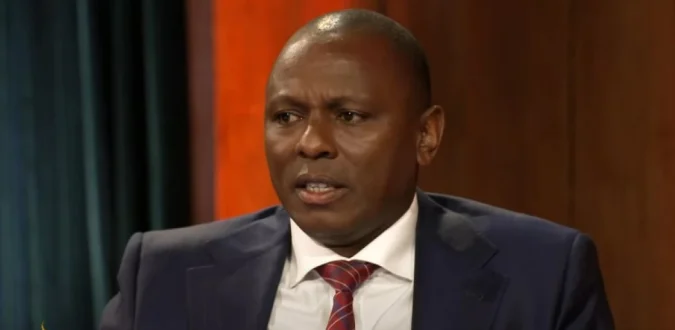
President William Ruto on Sunday, March 9, 2025, donated Ksh20 million to AIC Fellowship Annex in Eldoret to support church projects. This comes just a week after his controversial Ksh100 million donation to Jesus Winner Ministry Church in Nairobi sparked public outcry.
Speaking during the church service in Eldoret, President Ruto defended his donations, stating that no one would stop him from supporting churches.
“My donations to churches are aimed at helping them play a key role in fighting drug abuse and other vices among Kenyan youth,” said President Ruto.
His remarks followed protests at Jesus Winner Ministry Church in Roysambu, Nairobi, where citizens demonstrated against the president’s Ksh20 million donation to the church. The protests, organized online under the hashtag #OccupyJesusWinner, gained momentum on Sunday, leading to the arrest of 38 individuals at the church premises.
Police reported that the suspects were taken to Kasarani Police Station for questioning. Meanwhile, Bishop Edward Mwai of Jesus Winner Ministry Church claimed that unnamed individuals had mobilized thugs to demonstrate at his church.
“People I know very well used them and even sent some here today. Someday, they will know there is God’s presence at this altar. May God forgive our children who are being used in such a manner,” said Bishop Mwai.
He added, “Watu wameingia kwenye mitandao wakaniita majina mbaya, nimewasamehe, na Mungu awasamehe… pia kupitia kwa hiyo maneno ya mitandao kuna watu walikuwa hawanijui, sasa wamenijua.” (People have gone online and called me names, I have forgiven them, and may God forgive them… through these online discussions, some people who didn’t know me now know me.)
The protests were sparked by President Ruto’s visit to the church on March 2, 2025, where he pledged Ksh20 million and an additional Ksh100 million for an upcoming fundraiser. Heavy police presence was reported at the church on Sunday as youths attempted to storm the premises. Bishop Mwai confirmed that he had ordered the release of those arrested, despite police beating them for allegedly planning chaos.
Governor Fernandes Barasa’s decision to reinstate three previously sacked County Executive Committee Members (CECs)—Godfrey Owori, Benjamin Andama, and Livingstone Imbayi—has ignited a firestorm of criticism and raised serious questions about his leadership capabilities. The trio, dismissed last year for alleged poor performance, are now back in the fold, prompting residents and analysts to wonder if this U-turn reflects indecision, a dearth of talent, or a troubling reliance on political expediency over public interest.
Barasa’s administration made headlines in 2024 when he axed half his cabinet, including the three CECs, accusing them of failing to meet their mandates. At the time, the governor framed the purge as a bold step toward improving service delivery in a county grappling with crumbling infrastructure, underfunded healthcare, and persistent corruption allegations. Yet, the sudden reappointment of Owori, Andama, and Imbayi has left many scratching their heads. “If they were unfit then, what’s changed now?” asked Jane Amunga, a Kakamega resident and small business owner. “This feels like a government without a plan.”
The move has fueled speculation about Barasa’s ability to assemble a competent team. The reinstated Finance CEC, Livingstone Imbayi, reportedly lacks a formal background in accounting, a glaring red flag for a county with a complex budget and a history of financial scrutiny. Similarly, the Health docket, already strained by under-resourced hospitals and poor service delivery, now falls under an official with no evident expertise in the field. Critics argue that sidelining experienced figures like Dr. Mariam Were and Dr. Bernard Wesonga—both let go in earlier reshuffles—represents a squandered chance to retain proven talent.
Political observers see the reappointments as a symptom of deeper leadership frailties. “This isn’t just about bringing back old faces; it’s about a governor who can’t seem to chart a consistent course,” said Dr. Peter Oloo, a governance expert based in Nairobi. “Reinstating dismissed officials without a clear justification undermines credibility and suggests a lack of viable alternatives.” Some point to political pressure as a possible motive, noting Barasa’s rocky relationship with his party, the Orange Democratic Movement (ODM), and his predecessor, Wycliffe Oparanya, as potential influences on his decision-making.
The administration’s woes extend beyond the CEC saga. Barasa’s earlier dismissal of 10 chief officers sparked a bitter standoff with the County Public Service Board (CPSB), leading to a power vacuum that forced the governor to centralize duties. This has resulted in noticeable delays in project implementation and service delivery, with residents complaining of deteriorating roads and stalled development initiatives. “We’re seeing a government stretched thin, unable to function effectively,” said Moses Luvutse, a local activist. “The governor’s focus seems to be on survival, not solutions.”
Public frustration is palpable. Kakamega’s hospitals remain plagued by shortages of staff and supplies, while corruption allegations continue to dog the county. Yet, rather than addressing these crises, Barasa’s administration appears caught in a cycle of dismissals and rehiring, eroding trust among a populace desperate for progress. “We elected him to fix things, not to play musical chairs with his cabinet,” Amunga added.
The county’s media liaison, Mr. Juma, pushed back against this narrative, calling reports of leadership weakness “misleading and opinionated.” In a statement to The Weekly Vision, he warned that unsubstantiated claims could face legal scrutiny, though he offered no specific defense of the reappointments. The lack of a detailed explanation from the governor’s office has only deepened public skepticism.
Barasa’s tenure has been marked by turbulence since he took office in 2022, from clashes with the CPSB to a summons by the Ethics and Anti-Corruption Commission (EACC) over a KETRACO scandal during his prior role. His latest move reinforces a perception of a leader struggling to balance political survival with effective governance—a challenge not unique to Kakamega but starkly evident here.
As the county awaits Barasa’s next steps, the reappointment of fired CECs stands as a glaring indictment of his administration’s direction. Kakamega’s residents, yearning for a government that delivers results, are left with a lingering question: Can this leadership rise above its weaknesses, or will it remain mired in a pattern of missed opportunities? The answer, for now, remains uncertain.
The Orange Democratic Movement (ODM) party leader Raila Odinga has said the National Dialogue Committee (NADCO) report must be fully implemented for the party to continue its cooperation with the President William Ruto’s Kenya Kwanza government.
Raila made the remarks on Monday March 3, 2025 during his public consultation forum with ODM delegates at Billionaires Resort in Malindi Town, Kilifi County.
“I’m consulting all my party members and getting their views and concerns and we find solutions to the problems bedeviling the country such as high cost of living, the SHA problems, abductions and devolution struggles and this are the things we want the government to address,” he said.
Kilifi ODM leaders gave Raila the nod to press on with demanding for accountability and compensation of families of people who died during the 2023 Azimio protests and the 2024 anti Finance Bill protest.
Raila was received by the Kilifi County ODM Chairman and Kilifi County Assembly speaker Teddy Mwambire, Governor Gideon Mung’aro and his deputy Flora Chibule.
Other leaders present include Senator Steward Madzayo, Kaloleni MP Paul Katana, Kilifi County MP Getrude Mbeyu, several MCAs and party delegates.
Raila made the remarks, a few days after returning to Kenya after losing in the AUC chairmanship elections.
Since his return, the ODM party leader has been demanding action from the government, seeking compensation for the demonstrators who lost their lives during the 2023 Azimio protests and the 2024 Anti Finance Bill protests.
Governor Mung’aro on his part insisted that counties were still struggling since most devolved functions have been retained at the national level such as the roads fund.
“We have had a meeting with our party leader and we have resolved to continue the push of implementation of the NADCO report because Kenya is for everyone and we have given Baba the mandate to lead the process,” he said.
At the same time, Senator Madzayo called on the government to compensate families of those who died during the 2023 and 2024 protests and those who lost their livelihoods after getting life-threatening injuries during the protests.
“Those who were rendered hopeless and lost their livelihoods must be compensated fully before we can move forward and on the issue of abductions, they must stop,” he said.
The National Cohesion and Integration Commission (NCIC) has issued a stern warning to former Deputy President Rigathi Gachagua over statements alleging that President William Ruto is orchestrating a scheme to remove Chief Justice Martha Koome from office.
In a notice dated Thursday, February 27, NCIC Chairman Samuel Kobia cautioned Gachagua against making remarks that could undermine peaceful coexistence among Kenya’s ethnic communities.
“Your allegation that there is a scheme hatched by the President to remove the Chief Justice from office because of her ethnicity is misleading and meant to promote negative ethnicity. Such statements are likely to incite feelings of animosity among Kenyans, thereby undermining peaceful coexistence,” the commission stated.
The NCIC also took issue with Gachagua’s remarks warning President Ruto against visiting Meru County if Chief Justice Koome is removed from office. The commission emphasized that such statements violate the constitutional rights of the President, who has the freedom to visit any part of the country to discharge his duties.
“Your statement warning the President not to set foot in Meru County if Chief Justice Martha Koome is removed from office is a direct violation of the President’s constitutional right as the symbol of national unity. He has the right to visit any part of the country to fulfill his official duties as the duly and lawfully elected President of the Republic of Kenya,” the commission added.
The NCIC urged Gachagua to exercise restraint and carefully choose his words, warning against hate speech or advocacy of discrimination.
“Having reviewed the statements attributed to you, the Commission cautions you to exercise more restraint and choose your words more carefully. While freedom of speech is guaranteed by our Constitution, you are advised not to engage in utterances that amount to propaganda for war, incitement to violence, hate speech, or advocacy of hatred based on discrimination,” the commission stated.
Additionally, the NCIC called on Gachagua to refrain from making remarks that could disrupt peace among ethnic groups.
“In the interest of national cohesion and unity, we ask you to desist from such or similar utterances or conduct, the particulars of which are best within your knowledge, from the date of this notice. These statements are likely to interfere with the peaceful and harmonious coexistence of ethnic groups,” the commission concluded.
Gachagua’s remarks were made during a church service at AIPCA Antubetwe Kiongo Church in Igembe North, Meru County, on Sunday, February 23. During the event, he warned President Ruto against alleged plans to remove Chief Justice Koome from office.
“If you chase our Martha Koome, don’t set foot in Meru. You chased Rigathi Gachagua, and the Mt. Kenya people were silent. You thought they were cowards,” he said.
Gachagua further threatened to call for protests if the alleged plan is executed, accusing President Ruto of undermining the leadership of the Mt. Kenya region.
“This is too much now. How do you purge the leadership of an entire community that made you president? If Koome is dismissed and I call for protests, will you come out? We are not going to sit back as Ruto destroys the leadership of Mount Kenya,” he added.
Sudan’s ruling military junta has lauded Saudi Arabia, Kuwait, Egypt, and Qatar for rejecting the recent establishment of a parallel government by the paramilitary Rapid Support Forces (RSF) in Nairobi.
In a statement, the Sudanese Ministry of Foreign Affairs also acknowledged the support of African members of the UN Security Council—Algeria, Somalia, and Sierra Leone—along with Russia, China, the United States, the United Kingdom, Guyana, and Türkiye.
The ministry accused Nairobi of adopting an “irresponsible stance” by supporting the RSF, which it labeled a “genocidal militia.”
“These clear positions affirm that the Kenyan presidency’s reckless decision to embrace the RSF and attempt to legitimize its unprecedented atrocities is isolated both externally and internally,” the statement read.
The diplomatic standoff follows the RSF’s February 23 agreement with 23 allied groups, including the Sudan People’s Liberation Movement-North, to form a parallel government in RSF-controlled territories.
This move has heightened tensions between Kenya and Sudan’s military leadership under General Abdel Fattah al-Burhan.
The Sudanese military which governs form Port Sudan has gone further to label Kenya a “rogue state,” accusing it of violating international norms by engaging with the RSF.
The Sudanese government has renewed its call for global condemnation of what it describes as a “grave threat to regional peace and security.”
It urged the international community, regional organizations, and particularly the African Union, to take a firm stance against actions undermining Sudan’s stability and violating international law.
On February 28, Saudi Arabia’s Foreign Ministry stated its opposition to any “illegitimate steps or measures taken outside the framework of Sudan’s official institutions that may affect its unity and do not reflect the will of its people, including the call to form a parallel government.”
Riyadh reaffirmed its commitment to Sudan’s security, stability, and territorial integrity, urging all parties to prioritize national interests over factional disputes to prevent division and chaos.
Qatar similarly expressed “full support for the unity, independence, sovereignty, and territorial integrity of the sisterly Republic of Sudan.”
Doha rejected any “interference in Sudan’s internal affairs” and called on all factions to prioritize national unity and avoid fragmentation.
Kenya, however, has defended hosting the RSF meeting, describing it as a nonpartisan platform for dialogue and rejecting accusations of taking sides in the Sudanese conflict.
In a statement, the Ministry of Foreign Affairs emphasized Kenya’s commitment to facilitating peaceful resolutions to regional conflicts while accusing Sudan’s military of undermining democratic progress.
Prime Cabinet Secretary Musalia Mudavadi emphasized Kenya’s dedication to regional peace and stability while dismissing claims of bias in hosting Sudanese civilian and RSF representatives.
He also noted that Sudanese groups have previously sought mediation in neighboring countries, arguing that Nairobi is merely providing a platform for dialogue, as other regional states have done in the past.
“We note that this is not the first-time groups in Sudan have sought solutions to their crisis by leveraging the good offices of neighboring countries,” Mudavadi stated.
“Indeed, in January 2024, parties and stakeholders to the Sudanese conflict met in a neighboring country to chart a way forward on inclusive dialogue and the return to civilian rule.”
NAIROBI – A political deal brewing between Orange Democratic Movement (ODM) leader Raila Odinga and President William Ruto could see Raila appointed as Kenya’s non-executive Prime Minister, sources close to the negotiations have revealed.
The arrangement, which echoes past power-sharing agreements in Kenya’s history, is reportedly nearing completion and could reshape the structure of the Kenya Kwanza administration in the coming days.
According to insiders, Raila is pushing for a cooperation model similar to the 1997 deal he struck with then-President Daniel Moi, which allowed ODM to retain its identity.
However, President Ruto favors a more formalized agreement akin to the 2008 National Accord brokered with President Mwai Kibaki, which birthed a grand coalition government. “Raila wants ODM’s autonomy preserved, but Ruto is keen on a concrete pact that ensures long-term collaboration,” a source disclosed.
The centerpiece of this deal is the creation of a Prime Minister’s office for Raila, a position that would be established through an Act of Parliament rather than a constitutional amendment.
While the 2010 Constitution does not provide for such a role, the implementation of the National Dialogue Committee (Nadco) report—compiled last year amid talks between Kenya Kwanza and Raila’s Azimio la Umoja coalition—could pave the way. The report, which may soon be fast-tracked through Parliament, proposes the Prime Minister’s office as part of a broader government restructuring.
A Strategic Alliance
The talks come in the wake of last year’s Gen Z-led protests, which shook the country and pushed Ruto to seek Raila’s support to stabilize his administration. Sources indicate that Raila’s security detail has already been enhanced, and he is expected to operate from Harambee House Annex once the office is formalized. Meanwhile, Deputy President Kithure Kindiki will relocate to his Karen offices, and Prime Cabinet Secretary Musalia Mudavadi will retain his Railways headquarters base, unaffected by the new structure.
Raila’s return to the political fold is also set to bring significant perks for ODM.
Negotiations reportedly include offers of up to 12 Principal Secretary positions—though Raila is pushing for 16—as well as Cabinet slots, parliamentary committee roles, ambassadorial postings, and other senior appointments.
There is even talk of creating a new Ministry for Devolution and replacing Attorney General Justin Muturi with an ODM nominee.
Constitutional Concerns
However, the proposed Prime Minister’s office is not without controversy. Legal experts warn that it could face challenges, given that the Constitution only recognizes the President, Deputy President, Attorney General, and a maximum of 22 Cabinet Secretaries within the Executive. “The 2008 National Accord was a product of a different constitutional era. Today’s framework doesn’t easily accommodate such an office,” said political analyst Gitile Naituli.
Despite these hurdles, Ruto appears determined to cement the alliance. At the burial of Baringo Senator William Cheptumo on Saturday, he hinted at the convergence of Kenya Kwanza and Azimio agendas, setting the stage for a major government shake-up.
Analysts speculate that only a handful of Cabinet Secretaries, particularly those allied to retired President Uhuru Kenyatta, will survive the anticipated reshuffle.
ODM Divisions
Within ODM, the deal has sparked dissent. Leaders like Siaya Senator James Orengo and Secretary General Edwin Sifuna are said to oppose the arrangement, setting the stage for a tense party meeting in Nairobi today.
Critics argue that aligning with Ruto dilutes ODM’s opposition credentials at a time when Kenyans are grappling with economic hardships and demanding accountability.
Political analyst Martin Andati suggests Raila’s new role could position him as a “co-principal” alongside Ruto, given that his responsibilities would be legislated by Parliament—unlike Mudavadi’s Prime Cabinet Secretary role, which has been overshadowed by Head of Public Service Felix Koskei.
“Raila’s influence would eclipse Kindiki’s, making him a formidable figure in this government,” Andati noted.
Public Spending Questions
The creation of the Prime Minister’s office also raises fiscal concerns. With the Presidency already allocated Sh20 billion in 2024, adding another high-profile office could strain public coffers—contradicting Ruto’s Sh177 billion spending cut announced last July. “The focus seems to be on power-sharing rather than service delivery or economic recovery,” Naituli lamented, accusing leaders of prioritizing tribal alliances over national progress.
Since returning from Dubai after his African Union Commission chairmanship bid, Raila has enjoyed VIP treatment at public events alongside Ruto, with MPs and speakers like Moses Wetangula and Amason Kingi openly referring to him as “Prime Minister.”
At the Coast last week, he spoke after Kindiki but before Ruto, signaling his elevated status.
Raila’s Demands
Beyond securing a foothold in government, Raila has called for compensation for families of protesters killed in 2023 and 2024, condemned abductions of dissenters, and urged action on economic woes and the higher education funding crisis.
Whether these demands will be met as part of the deal remains unclear.
As Kenya awaits the finalization of this historic pact, the question looms: will Raila’s inclusion stabilize Ruto’s administration, or will it deepen public disillusionment with a political class seen as out of touch? Only time—and Parliament—will tell.
Kisumu residents have called on Orange Democratic Movement (ODM) party leader Raila Odinga to broaden his consultations as he prepares to join the broad-based government.
Speaking on Sunday, the locals expressed support for his engagement with Kenyans but urged him to also consult religious groups, civil society, and the youth.
Job Mandela emphasized that while they back Raila’s efforts, discussions should not be confined to ODM, as many Kenyans support the process.
“Raila is consulting on our behalf, and we are fully behind him,” he said, adding that he should resist intimidation or coercion and focus on strengthening ties with the Kenya Kwanza administration.
“Let no politician, especially within ODM, derail this process. We want it concluded quickly so that we get into government,” he added.
Joe Obuya cautioned Raila against falling for political traps ahead of the 2027 General Election, warning that the same politicians urging him to abandon talks with President William Ruto had misled him before.
“We want to assure Raila that the 6 million-plus who voted for him in 2022 support him in negotiating on our behalf,” he said, stressing that the government must prioritize service delivery.
He pointed to Raila’s past collaboration with former President Mwai Kibaki, which led to tangible benefits for Kenyans, and urged a similar outcome in his engagement with Ruto.
Lilian Onyango, a businesswoman in Kisumu, expressed anticipation for the formalization of the agreement, citing hopes for peace and stability.
“We want unity and an end to demonstrations that lead to destruction and loss of lives. I support Baba working with Ruto for the sake of the country,” she said.
Raila Calls for Unity and Full Implementation of the Constitution
Speaking during the burial of Baringo Senator William Cheptumo on Saturday, President Ruto urged leaders to set aside political interests and prioritize national unity.
Since losing the African Union Commission chairmanship bid, Raila has been consulting within his ODM party and in his Nyanza stronghold, engaging grassroots leaders, elders, and county officials. He has called for patriotism and urged Kenyans to abandon political suspicion.
“We must ensure that our constitution, which is rated among the best in the world, is fully implemented,” he said. “Once this is done, bad governance and corruption will be relegated to the museum.”
Raila also emphasized the need for equitable resource distribution and a stronger parliamentary role in governance.
Ruto Pushes for Opposition Collaboration
President Ruto has hinted at upcoming political realignments, pushing for a collaboration agreement with opposition parties, starting with ODM.
“We need to be patriotic about Kenya. We can disagree, but we must never disagree on the destiny of Kenya,” he said.
Ruto dismissed leaders opposing his unity efforts, even as figures in the opposition—led by Deputy President Rigathi Gachagua—begin forming alliances to challenge his leadership in 2027.
“It doesn’t matter who you are or what you believe in. We share a country and a destiny. If Kenya succeeds, we all succeed. If Kenya fails, none of us succeeds,” Ruto said.
National Assembly Speaker Moses Wetang’ula and Senate Speaker Amason Kingi echoed Ruto’s sentiments, urging both Raila and Ruto’s supporters to embrace their unity.
“Raila and Ruto were the main contenders in 2022. If they are now working together to unite the country, why should their supporters be angry?” Wetang’ula asked.
He further warned against political hostility, quoting historian Ali Mazrui: “When elephants fight, the grass suffers. But when elephants make love, the grass suffers even more.”
Former Prime Minister, Raila Odinga is now calling for the compensation of victims of the 2023 Azimio anti-government protests as well as those of Gen Z demos last year.
Speaking in Mombasa, Raila said the compensation must be given to those who got injured in the two protests.
To those who lost their lives, the former PM said that their families should be compensated.
According to Raila, this is just one of the conditions they have put in place for negotiations with the government.
He, however, noted that while the compensation is a condition, what is important is to ensure such acts do not happen again in the country.
“Wale vijana ambao walipata majeraha na wazazi wa wale ambao waliuawa mwaka wa 2023 wakati wa maandamano ya Azimio na ya mwaka jana ya Gen Z wapewe ridhaa au jamii yao wapewe ridhaa. Hio ni sharti ambalo tumeweka tukubaliane. Muhimu zaidi ni kwamba maneno hayo yakome yasiwe yanaendelea katika nchi yetu,” he said.
This loosely translates to, “The youths who were injured and the parents of those who were killed in 2023 during the Azimio protests and last year’s Gen Z protests should be compensated or their families compensated. That is a condition we have agreed upon. The most important thing is that such acts should not continue in our country.”
During his remarks, Raila stated that in his consultations, various issues that need fixing have come up.
He said these include ethnic discrimination, especially when Kenyans are looking for jobs, corruption, weakening devolution, especially in health, education matters and the arbitrary arrests and enforced disappearances.
He insisted that these are just some of the many issues Kenyans want to see improved.
The meeting was held at the Elimu na Mazingira Building in Mombasa ahead of a crucial consultative meeting with the ODM Mombasa branch leadership.
According to Mombasa Governor and ODM deputy party leader Abdulswamad Nassir, their discussions focused on strengthening party structures, enhancing grassroots mobilization, and aligning the vision for a more prosperous and equitable future for all.
“As we continue to advance the ideals of justice, inclusivity, and development, this engagement reaffirms our commitment to unity and progress within the ODM family and for the people of Mombasa,” he said.
The Treasury has responded to claims in a section of the media suggesting irregularities in Exchequer withdrawals, amounting to Ksh 1.3 trillion in just seven months.
In a statement Sunday, National Treasury PS Chris Kiptoo dispelled the allegations of irregularities, assuring that at no point has public money been lost or misappropriated.
However, he explained that the automation of the Exchequer process is underway, and some transactions, including debt payments, transfers to counties, the Judiciary Fund, and the Equalisation Fund, had not been integrated due to their distinct approval processes.
On 1st July 2024, the National Treasury, in collaboration with the Central Bank of Kenya (CBK) and the Controller of Budget (CoB), launched a major reform initiative to automate the Exchequer process to enhance efficiency, reduce processing time, improve accountability, and strengthen financial oversight.
“However, certain transactions—including debt payments, transfers to Counties, the Judiciary Fund, and the Equalisation Fund—were not included in the first phase of automation due to their distinct approval processes. The integration of these transactions into the automated system is currently underway, with full automation expected by the end of the 2024/25 financial year,” said Kiptoo.
He went on to affirm that all withdrawals, whether processed manually or electronically, are subject to strict legal and financial oversight.
“ Every transaction undergoes due diligence and approval by the Controller of Budget, ensuring full compliance with public finance regulations. At no point has public money been lost or misappropriated through this process,” he stated.
He said Treasury was ready to provide a comprehensive response to the concerns once it receives the official report from the Controller of Budget.
“Once the Treasury receives the official report from the Controller of Budget, a comprehensive response will be provided to address any further concerns”, he said.
As part of the reforms, all National Government Ministries, Departments, and Agencies (MDAs) have been successfully onboarded onto the automated system, ensuring that Exchequer requests and approvals by the CoB are processed digitally.
He added, “ The National Treasury remains committed to transparency, prudent financial management, and safeguarding public resources in line with its mandate”.
The Kenya Defence Forces (KDF) have ceded a 20-acre parcel of land in Nairobi’s Roysambu to a flamboyant city preacher on the intervention of President William Ruto.
President Ruto confirmed the controversial decision on Sunday during a chruch service at the Jesus Winner Ministry where he was hosted by Bishop Edward Mwai, a close ally that he flaunted GSU protection in public appearances.
KDF had numerously contested a transaction involving the said parcel by Uchumi Supermarket, a public listed supermarket chain that collapsed over debt.
“In your prayers to me, you fronted the land contestation issue, and you told me you wanted it resolved. Because you prayed for me to become the Chief of the Armed Forces, and God gave me that power, I gave orders to the Ministry of Lands to do their mandate,” Ruto announced.
“Since I am the Commander-in-Chief, I told KDF that this land is a holy place, and the church will be built there. I will personally join hands with you to make it happen,” he said while pledging a Sh120 million donation.
He also took a swipe at unnamed clerics over their criticism of the government urging them to “learn” from Bishop Mwai.
Ruto’s remarks come amid increasing criticism from prominent clergy, particularly from the Catholic Church and the Anglican Church of Kenya (ACK), over his handling of the economy, governance, and corruption.
The Catholic bishops, led by Archbishop Anthony Muheria, have been at the forefront of questioning Ruto’s policies, including high taxation, the cost of living, and governance failures.
The rift escalated when the Catholic Diocese of Nairobi ordered a refund of President Ruto’s donation to a parish in Nairobi’s Soweto in November 2024.
Sh120mn pledge
However, on Sunday, Ruto was full of praise for Bishop Mwai, commending him for working with the government instead of criticizing it.
“I wish the other bishops of other churches would have conducted themselves like Bishop Mwai. Instead of pointing accusing fingers, we all can contribute to finding solutions to the issues facing the youth and the country,” Ruto stated.
The President lauded Jesus Winner Ministry’s role in youth employment, specifically mentioning its contribution to his labor export program, which aims to send skilled Kenyan youth abroad for work opportunities.
“I want to congratulate in a very special way Bishop Mwai and the leadership of Jesus Winner Ministry for taking responsibility for the youth and preparing them for export labor employment opportunities,” he said.
Ruto revealed that Labour Cabinet Secretary Alfred Mutua would visit the church on Wednesday to list youths at the church in the Kazi Majuu labor export initiative.
“How I wish other people and other churches could do what Jesus Winner Ministry is doing—being part of the solution instead of worsening problems,” he added.
Ruto committed to donating Sh20 million immediately and raising an additional Sh100 million through a fundraising drive.
“I will donate Sh20 million first, and we will plan a harambee with my friends to raise Sh100 million in support. This church will be built so that we embarrass the enemy of this country,” Ruto declared, without elaborating on who he was referring to as “the enemy.”
Church-State Divide
The President dismissed critics questioning his frequent donations to churches, insisting that his contributions are acts of faith rather than political patronage.
“I have been criticized for giving donations to churches, but when we give to churches, we don’t give to humans, bishops, or congregations—we give to God [and] I have searched the Bible, and nowhere does it say that when you give to God, the bishops return the money. I am a product of giving to God, and I am unapologetic about it,” he declared.
Ruto’s remarks on Sunday underline a growing division between his administration and sections of the church, with some clergy accusing him of weaponizing religion for political gain while selectively rewarding those who align with his government.
In recent months, several prominent Kenyan bishops have taken a firm stand against political donations, rejecting financial contributions from politicians, particularly those in President Ruto’s administration.
Catholic Archbishop Anthony Muheria has been vocal in urging the clergy to decline questionable donations, emphasizing that the church should not be used as a platform for political endorsements.
The Anglican Church has also distanced itself from financial contributions tied to political figures, with Archbishop Jackson Ole Sapit previously stating that churches should not be turned into “campaign podiums” through monetary gifts aimed at securing political favor.
His decision to award contested military land to a pro-government church leader raises questions about state favoritism, given that other religious leaders critical of his administration have faced backlash rather than presidential endorsements.
Speaking during the celebrations to mark 20 years of the ODM party in Busia, Raila avoided commenting about 2027, saying he will be traversing all regions to ensure the views of all Kenyans are captured.
“Wangapi wanasema baba aendelee kushauriana na watu kwanza nipate maoni?” he posed amid applause from the crowd.
“Tutashauriana na ninawahakikishia kwamba tutachukua msimamo ambao utalenga matakwa and haki ya wakenya wote,” he said.
A section of leaders led by Kisii Governor Simba Arati who spoke during the event, had suggested that Raila must be in the ballot.
He said the ODM party’s mission is to lead the country in 2027.
“As ODM party, we are prepared for 2027 by any means, either by ourselves or through coalition to ensure we clinch that seat,” he stated.
He also vowed action against some members he said are trying to wreck the party from within.
Arati had also thanked President William Ruto for supporting Raila in the failed AUC chairperson bid.
In his address, Raila also led the attendees in observing a moment of silence for lives lost in the Turkana ambush attack by suspected militia from the Ethiopian Dassanech community.
Rigathi Gachagua, Kenya’s former deputy president, has claimed that the government is planning to arrest him.
He insists he has no problem with it, boldly stating, “Jela ni za wanaume” (prisons are for men).
The alleged plot follows his remarks about an attempt to remove Chief Justice Martha Koome.
As political tensions rise, Gachagua remains defiant, urging opposition leaders to stand strong. But what’s really happening? Let’s break it down.
Government’s Alleged Plan to Arrest Gachagua
Rigathi Gachagua says authorities planned to arrest him over the weekend, accusing him of inciting unrest.
Speaking at the launch of Martha Karua’s People’s Liberation Party on February 27, he revealed that the scheme followed his recent statements in Meru.
“I warned them to leave Martha Koome alone or face consequences, and they wanted to arrest me for it,” he said. Gachagua believes his defense of the judiciary is being used as an excuse to silence him.
Despite the looming threat, he remains unshaken. “I told them I was home with tea ready. If they wanted to arrest me, we could share tea and then head to the cells together,” he remarked, emphasizing that leaders must sacrifice for justice.
What Did Gachagua Say in Meru? A Warning to President Ruto
On February 23, while addressing a gathering in Meru, Gachagua issued a stern warning to President William Ruto.
He accused the government of trying to remove Chief Justice Martha Koome, calling it an attack on democracy.
“The judiciary must remain independent. If they interfere with Martha Koome, we will not sit back and watch,” he declared.
His speech sparked mixed reactions, with supporters praising his courage and critics accusing him of political incitement.
Calls for Action Against The Impeached DP
Following his remarks, some leaders called for his arrest. They urged law enforcement and the National Cohesion and Integration Commission (NCIC) to take action, arguing that his statements could fuel political unrest.
Rigathi Gachagua: “I’m Not Afraid of Jail; Come Arrest Me.”
Gachagua insists that he is ready for any consequences. He dismissed the fear of imprisonment, saying prisons today are far better than the mud-walled houses he grew up in.
“They plan my arrest every day, but I’m not worried. The cells today have bricks and even washrooms inside,” he joked.
He also encouraged opposition leaders to stay fearless. “We cannot let fear control us. If we do, where will Kenyans find hope?” he asked.
His bold stance has fueled debate, with many wondering whether his arrest would be politically motivated or justified.
In a heated exchange on Al Jazeera’s Head to Head, Kimani Ichung’wah, Kenya’s Majority Leader in the National Assembly and a staunch ally of President William Ruto, dismissed allegations of state-sponsored abductions and enforced disappearances as a “conspiracy” aimed at tarnishing the government’s image.
The interview, hosted by Mehdi Hasan at London’s Conway Hall, saw Ichung’wah face tough questions about Kenya’s human rights record under Ruto’s administration, particularly in light of violent crackdowns on protesters during the 2024 anti-Finance Bill demonstrations.
“I do not believe there are enforced disappearances perpetuated by the state in Kenya,” Ichung’wah asserted, addressing claims that Kenyan police and security services have been involved in the kidnapping and disappearance of activists.
The Kenya Human Rights Commission (KHRC) reports that since Ruto assumed office in 2022, at least 63 civilians have been killed, 65 individuals have been forcibly disappeared, and over 1,400 protesters have faced unlawful detention.
These figures have fueled widespread outrage, particularly among Kenya’s youth, who spearheaded the June 2024 protests against the controversial Finance Bill.
Host Mehdi Hasan pressed Ichung’wah on specific cases, including the alleged abduction of the son of former Attorney General Justin Muturi, now the Cabinet Secretary for Public Service and Human Capital Development.
Muturi has publicly stated that his son was taken by National Security Services after joining the 2024 protests and was only released following President Ruto’s intervention.
Ichung’wah, however, was quick to discredit Muturi’s account. “I tell you emphatically he has reasons to lie,” he said, accusing Muturi of “playing politics with a very unfortunate incident.”
In a striking aside, Ichung’wah hinted at Muturi’s precarious position in the cabinet, stating, “Justin Muturi knows he’s probably on his way out. He definitely knows it.”
The interview, which aired recently and is available on YouTube, sparked a flurry of reactions online and among Kenyan political circles.
Critics of the Ruto administration seized on Ichung’wah’s remarks as evidence of a government in denial.
“To call documented abductions a conspiracy is an insult to the families still searching for their loved ones,” tweeted prominent activist Boniface Mwangi.
Meanwhile, supporters of Ichung’wah praised his defiance, with one X user writing, “Kimani stood his ground against biased questioning. Kenya’s progress won’t be derailed by lies.”
Beyond the abduction controversy, Hasan also grilled Ichung’wah on his personal wealth, a sensitive topic amid growing public frustration with Kenyan MPs flaunting lavish lifestyles.
When asked about Minority Leader Junet Mohamed’s quip that Ichung’wah was worth 5 billion Kenyan shillings (approximately $38 million USD), the Majority Leader chuckled before clarifying, “Not 5 billion. Probably about close to 1 billion.”
His candid admission drew gasps from the live audience and reignited debates about the disconnect between Kenya’s political elite and its struggling populace.
Ichung’wah acknowledged the criticism, calling it “rather unfortunate” for MPs to flaunt their wealth online.
“Members of parliament in my party in the House who I see flaunting things that are not palatable with Kenyans, I tell them, ‘Hey bro, this is not good,’” he said.
Yet, his comments did little to quell the backlash, with many Kenyans on X pointing to his own admission of a near-billion-shilling net worth as hypocritical.
The Al Jazeera interview comes at a time of heightened political tension in Kenya, with Ruto’s administration facing mounting scrutiny over its handling of dissent.
The 2024 protests, initially sparked by the Finance Bill, evolved into a broader movement against government overreach, corruption, and economic mismanagement.
Human rights groups have accused the state of employing heavy-handed tactics, including extrajudicial killings and abductions, to silence critics—a charge Ichung’wah vehemently rejected during the interview.
Public reaction to the Head to Head episode has been polarized. On X, some hailed Hasan’s rigorous questioning, with one user posting, “Mehdi didn’t let Ichung’wah off the hook—finally someone holding these leaders accountable.”
Others, however, accused the host of pushing a “Western agenda” against Kenya’s government, with a pro-Ruto commenter writing, “Mehdi Hasan tried to ambush Kimani, but he showed the world Kenya won’t bow to foreign pressure.”
As the debate over Kenya’s political climate intensifies, Ichung’wah’s remarks on Al Jazeera are likely to fuel further controversy, both at home and abroad.
For now, the allegations of state-sponsored abductions remain a contentious issue, with critics demanding concrete answers and the government steadfastly denying any involvement.
NARC-Kenya Party leader Martha Karua has rebranded her party to People’s Liberation Party at an event attended by Kalonzo Musyoka, Eugene Wamalwa and Rigathi Gachagua.
During the launch, Karua emphasized the need for unity of purpose to ensure prosperity and for elected leaders to prioritize service delivery.
“The call for unity is the foundation of the liberation movement and our commitment today is to do just that,” she stated.
During the ceremony, Musyoka stated that the party will join an action-oriented unity movement.
“We are going to unite under an idea, under an agenda. It cannot just be unity for the sake of removing an individual because of misrule,” he said.
On his part, Gachagua urged the youth to register as voters ahead of the 2027 general elections and not just fight for liberation on social media.
“The real transformation of this country will happen on the ballot, Gen-Z, register as voters and on the election day wake up early and go vote to elect the leaders you want. We will support you,” he said.
PLP has new colors including purple, lilac, and white, moving away from red, white, and green of the NARC-Kenya party.
In addition to the new name, the party’s slogan will henceforth be “Unite” and “Liberate,” replacing the old one, “One Kenya, One Nation, One People.”
The party’s symbol has also changed from a red rose to a purple rose.
According to Karua, the change in the colour of the petals does not signify a shift away from the party’s original mission, which was established in 2006.
The one-time Presidential candidate in 2013 explained that the broader strategy of PLP aims to resonate more with the Generation Z demographic, who are expected to play a pivotal role in the 2027 General Election.
The rebrand comes after Eugene Wamalwa opened the new Democratic Action Party of Kenya (DAP-K) headquarters in a ceremony which was also attend by former Deputy President Rigathi Gachagua
It also comes as impeached Deputy President Rigathi Gachagua has been on the lookout putting together a coalition of the willing, which so far has involved Wiper Leader Kalonzo Musyoka, Eugene Wamalwa (DAP-Kenya), and Karua, signaling their willingness to work together.
is a big win for the former Speaker of Kisumu County Assembly after the Court of Appeal declared that his impeachment unlawful.
A three-judge Bench Wednesday ruled that Onyango Oloo’s ouster violated his constitutional rights, particularly his right to a fair hearing.
Justices Festus Asike-Makhandia, Hellen Omondi and Luka Kimaru also ordered the Kisumu County Assembly to pay Oloo six-month salary and outstanding allowances.
The judges found that Oloo had not been given sufficient time to prepare his defence, and that the impeachment proceedings had been rushed and unjust.
The court also determined that the process had not adhered to the necessary legal procedures, including the provisions of the County Assembly Standing Orders.
The decision overturns a previous ruling by the Employment and Labour Relations Court, which had upheld the impeachment.
Oloo was kicked out after allegations of misconduct, abuse of office and failure to perform his duties effectively. His impeachment was also based on allegations that he was facing corruption charges regarding the Sh4.1 billion Lake Basin Mall scandal at a Miliamani Court
The ouster Motion was presented to the Clerk on September 17, 2019, and was swiftly approved and scheduled for debate the next day. Oloo was served with an impeachment notice via WhatsApp on the debate day.
The notice, sent at 1.26pm, invited Oloo to defend himself before the Assembly at 3.00pm.
The former Speaker argued that this short notice did not give him a reasonable opportunity to prepare and present his case, thus violating his rights.
“I was only given a mere one-and-a-half hours to prepare a defense against serious charges. This clearly goes against the principles of natural justice, which guarantee fair hearing and administrative fairness,” said his petition.
Through his legal team led by Prof Tom Ojienda, Oloo further claimed that he was barred from accessing the assembly to present his case, with hired goons obstructing his entry.
Despite attempts to appear and request an adjournment, MCAs proceeded with the Motion, resulting in a vote of 42 members, constituting 75 per cent of the members, in favour of his impeachment.
The Court of Appeal agreed, noting that this was a breach of his right to a fair trial, which is a fundamental aspect of the Constitution, according to the court.
“The notice for the impeachment hearing was sent to him only hours before the session, leaving him with insufficient time to prepare a defense.”
The court also criticised MCAs for failing to follow procedures during the impeachment process.
“The Kisumu County Assembly did not comply with its own rules of procedure, and as such, the impeachment process was tainted and unconstitutional,” the judges ruled.
National Assembly Majority Leader Kimani Ichung’wah has shed light on his net worth dismissing speculation about his source of wealth.
Speaking in an interview with Al Jazeera on February 27, 2025, Ichung’wah refuted claims that he was worth Ksh5 billion, stating that his net worth is closer to Ksh1 billion.
“Not Ksh5 billion definitely, Probably about close to Ksh1 billion,” Ichung’wah stated.
Source of wealth
He emphasized that his wealth did not primarily come from his salary as a legislator but from years of business and work outside politics.
“My wealth is largely not from my salary. I’m just about a billion shillings. Don’t look at what someone is earning today. I wasn’t born an MP. I just arrived in the public scene having had another life in other organizations other than in politics, done business over the years,” he said.
He further criticized the notion that public servants should only possess wealth derived from their government salaries.
“Therefore, the perception that people who are in public service should not own or have any other thing other than what they earn from public service stops,” he explained.
National Assembly Majority Leader Kimani Ichung’wah during an interview on Al Jazeera on February 27, 2025. PHOTO/Screengrab by K24 Digital/YouTube
Defending his net worth, Ichung’wah maintained that he has not engaged in flaunting his wealth.
“I have never had to flaunt anything because I have nothing to flaunt, but it’s so unfortunate and nobody should do that. A number of those who have done that have regretted what they had to show the public,” Ichung’wah stated.
He further stated that he had cautioned other members of parliament from flaunting their wealth on social media.
“Members of my party who I see flaunting things that are not palatable with Kenyans I tell them ‘Hey, Bro this is not good,’” he said.
Focused on work
Ichung’wah went on to dismiss assertions that the Kenya Kwanza administration is targeting its online critics, arguing that despite being labelled on social media as President William Ruto’s wife, he remains focused on his work.
“I am less concerned with what people say online or on social media. I have been called William Ruto’s wife because I work closely with him, and I take it in my stride. But I will have to do my work and do it to the best of my ability. That’s my concern, and I believe everyone within the Kenya Kwanza administration is less bothered by what people say online,” Ichung’wah stated.
The wrangles at UoN are far from over. Several key questions remain unanswered as pressure mounts for a transparent recruitment process. Will Anangwe challenge his removal?
Who will fill the vacant position? And will the next VC be appointed based on merit, or will money and politics dictate the outcome?
For now, the university remains on edge, with lecturers, students, and stakeholders waiting for clarity on its leadership.
What is certain is that UoN’s power struggles are a reflection of deeper governance issues within Kenya’s higher education sector.
Power Struggles and Allegations Shake University of Nairobi Leadership
The University of Nairobi (UoN) is in turmoil as leadership battles intensify over the appointment of a new Vice-Chancellor (VC) and Deputy VC.
At the center of the storm is the UoN Council Chair, Professor Amukowa Anangwe, who now faces mounting opposition.
Allegations of mismanagement, corruption, and power struggles have engulfed the institution, forcing the Education Cabinet Secretary, Julius Ogamba, to intervene.
With high stakes in play, reports indicate that contenders for the top positions are engaging in underhanded tactics, including fundraising efforts to influence appointments.
Adding to the tension, the Universities Academic Staff Union (UASU) UoN chapter has demanded Anangwe’s removal, accusing him of overstepping his authority.
Meanwhile, political interference has further complicated the saga, dragging Prime Cabinet Secretary Musalia Mudavadi into the controversy.
The unfolding drama highlights deep-seated governance issues at Kenya’s premier university, leaving staff and students uncertain about the institution’s future.
Leadership Wrangles at UoN
The fight for control at the University of Nairobi has exposed cracks in its governance.
At the heart of the crisis is Professor Amukowa Anangwe, a man once seen as a reformist but now facing fierce opposition from lecturers and staff.
His troubles began when the council, which he chairs, was accused of manipulating the process of appointing the next VC and Deputy VC.
Insiders claim that some aspirants for the top jobs are raising funds to secure their preferred candidates.
This has raised concerns about the integrity of the selection process, with fears that merit may take a backseat to political and financial influence.
The UASU UoN chapter has emerged as a vocal critic, arguing that Anangwe has taken over management roles beyond his mandate, effectively sidelining the acting VC, Professor Matgarer Hutchinson.
The union’s dissatisfaction escalated when staff threatened to strike if Anangwe remained in office.
In response, Education CS Julius Ogamba revoked Anangwe’s appointment in a gazette notice dated February 21, 2025. However, the sudden dismissal, which left the chairmanship position vacant, has raised more questions than answers.
The Role of Politics in the UoN Power Struggle
The battle at UoN has drawn the attention of powerful political figures, sparking accusations of interference and betrayal. While Ogamba’s decision to remove Anangwe appeared to be a victory for UASU and reformists, it also exposed political rifts within the government.
Prime Cabinet Secretary Musalia Mudavadi, a longtime ally of Anangwe, has been criticized for not shielding him from the axe.
His silence has fueled speculation that he either approved the removal or was unable to prevent it. This has reportedly left his supporters within the university and political circles frustrated.
The growing involvement of politicians in UoN’s affairs underscores the institution’s significance beyond academics.
As one of Kenya’s top universities, its leadership appointments often carry political weight, influencing both policy and financial decisions at the national level.
The UoN Council’s Response and Future Implications
Following Anangwe’s dismissal, the UoN Council issued a strongly worded statement on February 19, 2025, dismissing allegations of mismanagement.
The council maintained that the university’s governance structures remain intact and that claims of corruption and irregularities are exaggerated.
Despite this, critics argue that the council itself is part of the problem. The members, including Chancellor Professor Patrick Verkooijen, acting VC Professor Matgarer Hutchinson, and PS for Higher Education and Research Beatrice Inyangala, have been accused of lacking transparency in key decisions. Other council members include Denrick Ayot (representing the PS National Treasury and Planning), Carren Omwenga, Ahmed Abdullah, Parmain Narikae, and Sally Toroitich.
With Anangwe out, attention now shifts to who will take over the chairmanship and whether governance reforms will follow.
If the selection process remains controversial, UoN could face prolonged instability, affecting both academic operations and its reputation.
Former Deputy President Rigathi Gachagua has announced that he is open to working with veteran opposition leader Raila Odinga to form the next government.
Speaking during an interview with radio stations from the Kamba community, Gachagua noted that he has not closed his political doors to a possible partnership with Odinga, who recently teamed up with President William Ruto to establish a broad-based government setup.
“If our Gen Z children, who are not with him (Ruto), decide to turn out and vote, we will defeat him, even if he is with Raila. It will be upon him (Raila) to decide—if he chooses to stand with Kenyans, he will come so that we can have a sit-down and agree on some things,” Gachagua stated.
“If he wants to go ahead and cooperate with William Ruto, who has been abandoned by the people, then we have no problem with that. We have a plan, and we have listened to Kenyans who are looking up to us,” he added.
However, Gachagua stated that the option of working with the former Prime Minister was not conditional, as Odinga was free to choose which side of the political history books he wanted to be on.
Furthermore, he stated that if Odinga decided to collaborate with the President in advancing what he described as oppressive policies, it would be his personal choice.
“We are up to the task of bringing change and challenging Ruto, with or without Raila. It will be his personal decision to choose which side of history he wants to be on. If he wants his legacy to be marred by working with the oppressors, that is up to him,” Gachagua said.
“We can have a discussion and see what role he can play in the liberation of our country. Irrespective of the decision he makes, we are okay.”
Gachagua, who has seemingly been open to a coalition agreement with former Vice President and Wiper Party leader Kalonzo Musyoka, however, dismissed claims that Odinga teaming up with Ruto would diminish his chances.
Odinga himself, since losing the African Union Commission chairperson bid, has indicated that he would likely work with the government.
Additionally, during a press address at State House Mombasa on Monday, he assured the country and his support base that he would announce his political way forward after consultations.
Shortly after being hosted by Ruto in Mombasa, Odinga flew to Kisumu, where he met leaders from his party, the Orange Democratic Movement (ODM), including interim party leader Anyang’ Nyong’o and other grassroots leaders.
Meanwhile, the former Deputy President urged the Kamba community to team up with him and Kalonzo to take over the country’s leadership in the 2027 elections.
Additionally, he outlined his vision of leveraging his political numbers to win major elective seats in the country, including the gubernatorial posts for Nairobi and Mombasa counties.
Environment Cabinet Secretary Aden Duale has called out the Standard Media Group after his scheduled interview on Spice FM was abruptly canceled.
Taking to social media on Tuesday, February 25, Duale expressed his frustration, suggesting that the media house’s actions reflect a broader pattern in their editorial decisions.
“My sincere apologies to the listeners of Spice FM. The station’s owners have abruptly canceled my interview for reasons best known to them. This move speaks volumes, and now you can clearly see the pattern behind the Standard Newspaper’s recent headlines,” he stated.
Duale further pointed out what he perceived as biased media coverage, noting that just a day earlier former Deputy President Rigathi Gachagua was given an open platform on KTN News.
He alleged that the former DP dominated the interview show and spread falsehoods.
“Just yesterday, the impeached Rigathi Gachagua was given an open stage on KTN News to peddle falsehoods and wild imaginations,” he claimed.
“The platform was his, and he used it as expected. But let it be known; I did not seek this interview. They reached out to me. I was ready. Ipo Siku!”
Kenyans have since expressed mixed reactions following Aden Duale’s post, with many taking to social media to share their opinions on the matter.
Some users criticized the Environment Cabinet Secretary for prioritizing media appearances over his official duties, while others defended him, arguing that government officials should have a platform to communicate with the public.
The Independent Electoral and Boundaries Commission (IEBC)has projected that it needs a Sh61.7 billion budget for the 2027 General Election.
Deputy Chief Executive Officer (CEO) Obadiah Keitany during a presentation to Parliament on Tuesday, highlighting several key financial requirements that the amount will cover.
This includes a Sh7 billion allocated for boundary delimitation, pending a court advisory.
The IEBC also anticipates registering an additional 5.7 million voters, bringing the total to 28 million by 2027.
Additionally, fourteen pending by-elections are projected to cost approximately Shh480 million.
“The Commission projects an additional 5.7 million new voters to have a total of 28 million in the 2027 General Election,” he said.
“We have the budget for boundary delimitation of Sh7 billion but we are still waiting for the Court advisory.”
Likewise, IEBC plans to replace 45,352 Kenya Integrated Election Management System (KIEMS) kits, excluding the 14,000 units purchased in 2022.
In total, 59,352 kits are required, with the replacement expected to cost Sh7 billion, considering each kit is priced at Sh65,000.
Advertisement. Scroll to continue reading.
Keitany noted that the IEBC has outstanding bills amounting to Sh3.8 billion.
Finance Director Osman Ibrahim noted that KIEMS kits become obsolete after ten years, necessitating their replacement to ensure the integrity and efficiency of the electoral process.
The commission has faced challenges in continuous voter registration since 2022 due to budget constraints and the absence of appointed commissioners.
According to the electoral body, Kenya’s 2022 general elections involved 22,120,258 voters and were among the most expensive globally, costing approximately Sh44.6 billion.
The IEBC emphasizes the importance of timely and adequate funding to facilitate comprehensive preparedness for the upcoming elections, including technological upgrades, voter education, and the execution of pending electoral activities.