Author: Agencies

  • History Of Accusations Against Sean ‘Diddy’ Combs

    History Of Accusations Against Sean ‘Diddy’ Combs

    A string of sexual assault allegations have been made against Sean “Diddy” Combs, one of the most successful music moguls in the history of rap.

    Four women, including his long-time partner Casandra “Cassie” Ventura, have filed lawsuits against the musician, accusing him of sexual and physical abuse.

    Producer Rodney “Lil Rod” Jones filed a similar suit in February, alleging Combs abused him over a year-long period when he was living on the star’s properties and working on his music.

    In a statement issued last December, Combs defended himself against what he described as “sickening allegations” made by “individuals looking for a quick payday”.

    “Let me be absolutely clear: I did not do any of the awful things being alleged,” he said, adding he would fight to clear his name.

    However, in March 2024, federal agents raided two houses owned by the star “as part of an ongoing investigation” into sex trafficking.

    His lawyer called the action an “unprecedented ambush” and a “gross overuse of military-level force”, and maintained his client’s innocence.

    Combs – who has also gone by the names Puffy, Puff Daddy, P Diddy, Love, and Brother Love – essentially rewrote the rules of hip-hop in the 1990s, but his career has been punctuated by controversies.

    Here is a timeline of his career and the accusations made against him.

    1969-89: Early life in New York

    Sean John Combs was born in Harlem and raised in Mount Vernon, New York.

    His mother, Janice, was a teacher’s assistant, while his father Melvin was a former member of the US Air Force who became an associate of the drug-trafficker Frank Lucas, who later inspired the Ridley Scott film American Gangster.

    In 1972, Melvin was fatally shot in his car during a drug transaction after being misidentified as an informant. Combs was just two, although he didn’t learn the circumstances of his father’s death until much later.

    Raised by his mother, he was a flashy kid who loved rap music and played football for the school team.

    As a teenager, he danced in music videos for artists such as Diana Ross and the Fine Young Cannibals.

    Taking a cue from his mother, who worked multiple jobs to support Sean and his sister Keisha, he also worked six separate newspaper delivery routes, before enrolling to study business administration at Howard University.

    Early 1990s: Party plans turn into tragedy

    At university, Combs gained a reputation for throwing lavish parties, some of which attracted more than a thousand guests.

    After booking musicians such as Heavy D and Terry Riley to play at these gigs, he came to the attention of Uptown Records’ founder Andre Harrell, who gave him an internship in New York.

    Combs eventually dropped out of university to work there full-time, guiding the early careers of artists including Mary J Blige and Jodeci.

    However, tragedy struck in 1991, when Combs co-promoted a celebrity basketball game and concert at City College of New York. Nearly 5,000 people showed up to the gymnasium, which could only fit 2,730 people. In the ensuing crush, nine people died and 29 people were injured.

    An inquiry by the New York Mayor’s Office cited Combs for hiring inexperienced security guards. However, the star and his lawyers maintained he was not responsible for security at the event.

    “City College is something I deal with every day of my life,” the musician said in 1998. “But the things that I deal with can in no way measure up to the pain that the families deal with. I just pray for the families and pray for the children who lost their lives every day.”

    No criminal charges were filed over the tragedy, but family members of the people who died sued the promoters, the college and the city, accusing them of negligence.

    The case was settled for $3.8m (£3m), of which Mr. Combs paid $750,000.

    Mid-to-late 1990s: A new beginning

    Getty Images Mary J Blige and Sean Combs
    Combs struck upon the idea of pairing R&B singers like Mary J Blige with the street-tough sounds of hip-hop/Getty Images

    While at Uptown, Combs signed a young Brooklyn rapper called Christopher Wallace – aka Biggie Smalls, or the Notorious B.I.G. – and started work on his debut album.

    But his relationship with Harrell broke down and Combs was fired. He retaliated by setting up his own label, Bad Boy Records, and taking Biggie with him.

    The star’s debut album, Ready To Die, was hailed as an all-time rap classic, selling millions of copies and generating the multi-platinum singles Juicy and Big Poppa.

    Combs quickly expanded the Bad Boy roster, releasing hit albums by Faith Evans, Ma$e, 112 and Total.

    The label’s sound was slick and polished. Its biggest singles lifted chunky samples from well-known hits. The practice was frowned upon by hip-hop purists, but it was catnip to radio programmers.

    1997: Notorious B.I.G. is murdered
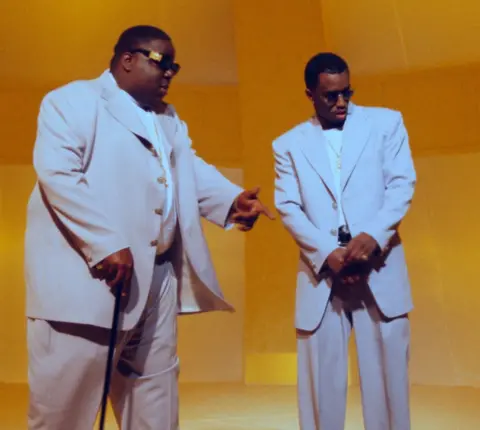
    Getty Images The Notorious B.I.G. and Puff Daddy (as he was then known) on the set of the Hypnotize music video in 1997
    The Notorious B.I.G. and Puff Daddy (as he was then known) on the set of the Hypnotize music video in 1997/Getty Images

    In March 1997, Biggie Smalls was gunned down in a drive-by shooting at the age of 24.

    The murder has never been solved, but it has consistently been linked to the East-Coast-West-Coast rivalry that consumed rap music in the 1990s and which had previously claimed the life of Tupac Shakur.

    Combs, who had been travelling in the car behind his friend, poured his grief into a song, I’ll Be Missing You, which became one of the biggest songs of 1997.

    The song, based around The Police’s Every Breath You Take, also featured on Combs’ debut album, No Way Out, which sold seven million copies worldwide.

    1999: New York shooting

    By this stage, Bad Boy had become one of the most important labels in rap. Aside from its own releases, artists including Mariah Carey and Jennifer Lopez were asking Combs to remix their songs, hoping for a dash of hip-hop credibility.

    But there was trouble, too. In May 1999, Combs was arrested on suspicion of assaulting Interscope Records executive Steve Stoute, after a disagreement over a music video. He pleaded guilty to harassment and was sentenced to a one-day anger management class.

    Later that year, he was charged with criminal possession of a weapon when police found two nine-millimetre guns in his car, after an argument in a club turned violent.

    Combs and his then girlfriend Jennifer Lopez were both arrested. Combs was later acquitted of all charges. Lopez was not charged.

    2003: Sued by business partner

    A former president of Bad Boy Entertainment sued Combs in 2003, alleging that his former business partner threatened him with a baseball bat and forced him into signing over his shares in the company.

    In his lawsuit, Kirk Burrowes also says that Combs intimidated Mary J Blige into dropping him as her manager in 2001.

    Combs denied the allegations, calling them “complete fantasy”.

    An appeals court dismissed the case in 2006, ruling that the statute of limitations has expired.

    2005-2018: Relationship with Cassie Ventura
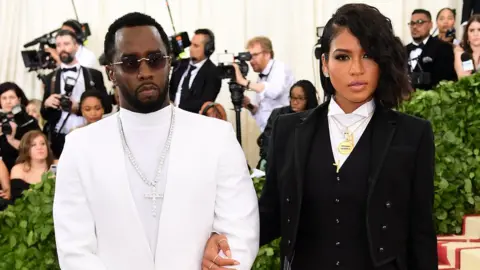
    PA Media Sean Combs and Cassie Ventura
    Sean Combs and Cassie Ventura were in an on-and-off relationship for more than a decade./PA Media

    In 2005, 20-year-old singer Casandra Elizabeth Ventura scored a minor club hit in Germany with her debut single, Me & U.

    After hearing it on a night out, Combs convinces Cassie (as she is known professionally) to join Bad Boy Records for a 10-album deal.

    Her self-titled debut was released in 2008 and its futuristic, space-age R&B proved to be a hit with critics.

    By that stage, Combs and Ventura were in a relationship. But in a civil lawsuit filed in December 2023, she said the mogul had used his position of power to “set the groundwork” for a “manipulative and coercive romantic and sexual relationship”.

    Her lawsuit included multiple graphic descriptions of violent abuse, alleging that Combs “regularly beat and kicked Ms Ventura, leaving black eyes, bruises, and blood”.

    Ventura also alleged sexual abuse and rape, and claimed that many of these incidents were witnessed by Combs’ “tremendously loyal network” who “were not willing to do anything meaningful” to stop the violence.

    Combs strenuously denied the allegations and accused Ventura of trying to extort him. They settled the case a day after it was filed in New York, with Combs’ lawyer saying the settlement was “in no way an admission of wrongdoing”.

    2007-2024: Business ventures

    Music took a back seat after 2007, when Combs signed a deal with British drinks company Diageo to promote the French vodka brand, Cîroc, in the US for a 50-50 profit split.

    His endorsement saw the brand placed in dozens of music videos – including Diddy’s own single “Ciroc Star” – and helped increase sales from 40,000 to 2,000,000 cases per year by 2014.

    Around the same time, he co-founded the media company Revolt, whose TV channels and websites are described as “the unapologetic, authoritative voice of hip-hop culture”.

    Combs’ involvement with both companies came to an end in 2023-24. He had previously sued Diageo, accusing it of neglecting his brand because of race.

    2015: Arrested for fighting football coach

    In 2015, Combs got into a scuffle with his son’s football coach prompted by an argument during training.

    As the row escalated, Combs allegedly threatened an intern with a kettle bell. He was later arrested and charged with assault with a deadly weapon.

    The charges were subsequently dropped. A representative for Combs said press accounts of the incident were “wholly inaccurate”.

    2019: Gina Huynh alleges abuse

    The first allegations of abuse to surface against Combs came from his model ex-girlfriend Gina Huynh.

    Although largely unreported at the time, Huynh gave an interview to YouTube personality Tasha K, where she said Combs had been physically abusive and offered her money to get an abortion during their on-off, five-year relationship.

    On one occasion, she alleged that Combs had once “stomped on my stomach really hard – like, took the wind out of my breath”.

    He did not respond to the accusations.

    September 2023: Musical comeback
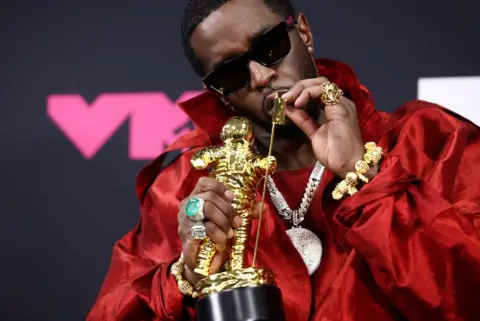
    Getty Images Sean Combs at the MTV Awards
    The musician won a lifetime achievement award last year, shortly before accusation against him started piling up./Getty Images

    Combs ended an eight-year musical hiatus with the release of his fifth record. Titled The Love Album: Off The Grid, it featured collaborations with The Weeknd, Justin Bieber, 21 Savage and Mary J Blige.

    The release coincided with Combs being named a “Global Icon” at the MTV Awards.

    In November, The Love Album earned the star his first solo nomination at the Grammys, in the best progressive R&B album category.

    However, he pulled out of the ceremony as his legal troubles mounted.

    November 2023: Three lawsuits in the space of one week

    In the same week as Cassie filed (and settled) her lawsuit against Combs, two more women came forward with claims of abuse and assault.

    In a complaint filed in Manhattan, Joi Dickerson-Neal accused the star of drugging and sexually assaulting her when she was a college student in 1991. She also claimed he recorded the attack and distributed the footage without her consent.

    A third woman, Liza Gardner, also filed court papers accusing Combs of coercing her into sex in the early 1990s and then, a couple of days later, choking her so hard that she passed out.

    The lawsuits all came shortly before the expiration of the New York Adult Survivors Act, which temporarily allowed people who said they were sexually abused to file claims, even after the statute of limitations had expired.

    Combs denied all the allegations against him, while his spokesperson called the lawsuits a “money grab”.

    “The claims involving alleged misconduct against Mr Combs from over 30 years ago and filed at the last minute are all completely denied and rejected by him,” they said in a statement.

    “The New York Legislature surely did not intend or expect the Adult Survivors Act to be exploited for improper purposes. The public should be sceptical and not rush to accept these unsubstantiated allegations.”

    December 2023: Underage sex claim

    A fourth woman sued in December, claiming she was “sex trafficked” and “gang raped” by Combs, former Bad Boy Records president Harve Pierre and another man in 2003, when she was 17 years old.

    In court papers, the woman alleged she was given “copious amounts of drugs and alcohol” before the attack and was left in so much pain that she could barely stand or remember how she got home.

    In response, Combs said he “did not do any of the awful things being alleged”, while Pierre said the “disgusting allegations” were “false and a desperate attempt for financial gain”.

    The judge in the case later ruled that the woman, who filed her case anonymously, would have to use her real name if she wanted to proceed.

    December 2023: Diddy’s denial

    On 6 December, Combs responded to the flurry of lawsuits with a statement on his Instagram page.

    “ENOUGH IS ENOUGH,” he wrote. “For the last couple of weeks, I have sat silently and watched people try to assassinate my character, destroy my reputation and my legacy.

    “Sickening allegations have been made against me by individuals looking for a quick payday. Let me be absolutely clear: I did not do any of the awful things being alleged. I will fight for my name, my family and for the truth.”

    February 2024: Accusations of grooming

    Music producer Rodney Jones Jr, who produced nine tracks on The Love Album, sued Combs in February 2024, accusing the star of making unwanted sexual contact and forcing him to hire prostitutes and participate in sex acts with them.

    In court papers filed in New York, Jones also claimed that Combs tried to “groom” him into having sex with another man, telling him it was “a normal practice in the music industry”.

    Combs’ lawyer, Shawn Holley, called the producer “nothing more than a liar” and described his claims as “pure fiction” that can be discredited by “overwhelming, indisputable proof”.

    March 2024: Combs’ properties raided

    Getty Images Aerial photo of home
    Aerial view of raid on Sean “Diddy” Combs home in LA./Getty Images

    One month later, federal agents raided two properties owned by Combs in Los Angeles and Miami. Computers and other devices were confiscated while officers searched his Californian mansion.

    Combs was also stopped at an airport in Miami as he prepared to leave for the Bahamas, according to the New York Times. He is said to have handed over a number of electronic devices and was not detained.

    The Department of Homeland Security said the searches formed “part of an ongoing investigation”, but it was not clear how their inquiries were related to the civil cases against Combs.

    His lawyer called the raids a “witch-hunt based on meritless accusations made in civil lawsuits” and said his client was innocent.

    -BBC.

  • How Money Laundering Is Done Through Kenyan Banks

    How Money Laundering Is Done Through Kenyan Banks

    Kenya’s banking industry has in recent years been in the crosshairs of nationalregional and international watchdogs, given the country’s role as a financial hub in eastern Africa. In 2023, Kenya enacted laws to curb money laundering and combat terrorism financing.

    While the laws have led to tougher sanctions on some banks, the risk of money laundering remains, and the country was recently greylisted by the Financial Action Task Force. A grey list contains countries that are actively working with the Financial Action Task Force to address loopholes in countering money laundering, terrorist financing, and proliferation financing.

    Constance Gikonyo, a corporate law academic who has researched the place of banks and piracy in money laundering, answers questions about existing loopholes.

    How is money laundered through banks?

    Money gained illegally can be laundered by placing it into the financial system through banks. Those who launder money typically engage in “smurfing” and “structuring”.

    This is the breaking down of large sums of money into smaller transactions to evade the reporting threshold and avoid suspicion. In Kenya, the reporting threshold has been increased from US$10,000 to US$15,000. Banks have to report certain transactions to the Financial Reporting Centre.

    Once in the financial system, the money is moved around in a process known as layering. Funds are moved through different banks using different transactions and bank accounts to disguise the illicit origin of the money.

    Once the money is disguised, the banks will again be involved in the process of integration. This is where the money is deposited into the bank account of the person or entity that finally uses it.

    That way, the criminal proceeds are integrated with legitimate funds. These funds make their way into the economy through investments such as purchasing a property.

    Why are banks the prime targets of money launderers?

    Banks offer a gateway into the financial system. Once the funds are in the financial system, it is easier to disguise their illegal origin. Also, technological advancements and the integration of the global financial system make it easier and faster to move money around and across borders.

    Some banks have weak know-your-customer procedures—mandatory checks meant to identify and verify customers when opening an account and periodically over time. These can be exploited. Banks don’t always continue monitoring customers effectively.

    There are also cases of complicit individuals within banks using the system to aid money laundering.

    What are the duties of banks?

    Kenya’s law, the Proceeds of Crime and Anti-Money Laundering Act, imposes duties on banks in seeking to deal with money laundering.

    Banks must:

    Evaluate their customers thoroughly. The due diligence should be based on an assessment of the customer as a risk. The riskier a customer appears to be, the more comprehensive the evaluation should be.

    Keep records of transactions and customer identification information for at least seven years after the end of the engagement.

    Report suspicious transactions and cash transactions of US$15,000 or more to the Financial Reporting Centre, an agency created under the same law to fight money laundering.

    Hire money laundering compliance officers and ensure continuous staff training on anti-money laundering and combating the financing of terrorism. All banks are required to develop internal policies, procedures and controls to combat these crimes.

    What challenges do banks face in fighting money laundering?

    Technological advancements mean that money launderers can be a step ahead of the measures the banks have put in place.

    The criminals can find ways to avoid detection by the systems in banks. The rise of digital and cyber-enabled financial crimes increases the challenge for banks.

    Compliance requirements mean banks have to invest in personnel, technology and training. This increases their operating costs. Banks also invest in research to help identify weaknesses in their systems.

    Banks have to balance regulatory requirements with customer service and customer privacy. Customer background checks can be intrusive but a bank faces sanctions and reputational risks if it does not do them.

    Corrupt individuals working in banks can assist in money laundering. Banks should vet staff when they hire them, especially those in sensitive roles, and continuously monitor them.

    The global nature of the financial system means banks must deal with financial institutions and different regulatory standards in different jurisdictions. Compliance with all these can be a challenge. Criminals will identify the loopholes and gaps created by these differences and seek to exploit them.

    What are the main markers of a well-governed financial system?

    A well-governed financial system has effective policies and practices for combating money laundering and the financing of terrorism. The relevant authorities ensure that the laws are enforced.

    There should also be international cooperation and engagement between the private sector and relevant regulatory and enforcement agencies.

    Effective supervision by the central bank is a feature of a well-governed system. Central banks ensure the stability, soundness and integrity of the banking system.

    They should establish a proper regulatory framework for banks, tighten their licensing and approval processes, ensure continuous monitoring and examination of sector players, and provide early warning systems. Weak supervision would mean that consumers were not adequately protected.

    This leads to a loss of public trust and international confidence. Financial instability could be the result.

    The public and private sectors should collaborate actively. In Kenya, the Financial Reporting Centre and the Law Society of Kenya are working together towards implementing the anti-money laundering provision which requires lawyers to report entities that make suspicious transactions.

    Regulatory bodies and law enforcement agencies need resources to do their work. Preventing, identifying and dealing with financial crimes requires funds to innovate, and develop staff capacity and infrastructure.

    Transparency and accountability in financial institutions encourage compliance with regulatory standards. Banks with a culture of innovation and investment in new technologies are best placed to achieve transparency and accountability.

    The Conversation.

  • How To Add Two WhatsApp Accounts On One Phone

    How To Add Two WhatsApp Accounts On One Phone

    WhatsApp has rolled out the ability to have two different accounts on a single device.

    The Meta-owned platform announced the multiple account feature in October last year for Android users to rid users of the need to have multiple devices for their different accounts.

    To register a second account on WhatsApp, a user needs to have a separate phone number or a device that supports multiple SIM cards.

    Your active account will be the one you are currently logged into, while your idle account is the one you are not currently using.

    WhatsApp says that idle accounts will still get alerts about messages and phone calls. To see the content, one just needs to switch to the account.

    Like the traditional way of customizing profiles, users who have two accounts logged onto a device will have the ability to customize each profile by setting a picture and about text, notification settings, and privacy settings.

    At present, the feature is only available for Android users and supports two accounts.

    CREATING ACCOUNT

    To create a second account, go to Settings, then Account and tap Add Account.

    Confirm that you agree to the Terms of Service and Privacy Policy, then select your country from the drop-down list.

    Enter your phone number in international phone number format and tap Done or Next, then tap OK to receive your 6-digit registration code through SMS or phone call.

    Enter the registration code to complete the registration.

    Set up your new profile, enter your name, and then tap Next. You can also add a profile photo and fill in the About field.

    To switch between accounts, go to more options at the top-right of the home screen, then tap Switch accounts.

    REMOVING ACCOUNT

    To remove an account from your device, go to Settings, then Account and tap Remove account.

    Tap Confirm to confirm you want to remove this account from this device.

    Removing an account only takes it off the device one is currently using and the account’s groups and channels remain unaffected.

    However, one loses any messages or data not backed up.

    WhatsApp says if a user has linked devices, the account will be removed in 14 days.

    To delete an account completely, go to Settings, then Account and select Delete account.

  • Economic Advisor Who Was Fired By Two Presidents

    Economic Advisor Who Was Fired By Two Presidents

    From archives to this day… Kenyans are hoping that the man once rejected by two Presidents still have some magic not yet revealed. Will his bottoms up economic model that has kicked off with Ksh. 500 given to the hustlers- soon prove to be the philosophers stone?”

    In 2003, David Ndii was tasked by former President Mwai Kibaki to develop an Economic Recovery Strategic Plan to bolster the economy under the NARC Government.

    He was to work closely with Governor Anyang’ Nyong’o, who was then the Minister for Planning and National Development. He found a way to avoid being guided through by Nyong’o, as he wanted to get all the credit for the plan.

    “Upon completion of the paper, Ndii handed it over to the then Head of Civil Service Amb. Francis Muthaura, who was also a close confidant of President Mwai Kibaki. When Muthaura shared the paper with Kibaki, the president trashed it saying, “This reads like a first-year economics essay.”

    “President Kibaki then called Joseph Kinyua, who was then Permanent Secretary for Planning, and instructed him to rewrite the paper. Mr. Kinyua brought together a solid team to work on this and the end product of their assignment is what we know today as Vision 2030 Economic Blueprint.

    “Ndii felt slighted. He resulted to spewing sour grapes against Kibaki’s handling of the economy by fighting his economic programs in his regular newspaper columns. He reserved his punches on the infrastructure projects which were being implemented on the strength of the Vision 2030.

    He often referred to the ambitious Thika Superhighway as a white elephant project. Mind you the superhighway has in the last 12 years unlocked in a huge way the economic potential of areas along the 50KM stretch that it cuts through.

    Fast forward to 2008, when President Paul Kagame’s government reached out to Kenya for assistance to recruit top advisors to his administration. The then Rwandan Ambassador engaged Prof. Mutahi Ngunyi to help with the recruitment process, from among the country’s top intellectuals. Ndii was among the people who was recruited in this process, as an economic advisor.

    The salary negotiated with World Bank for Ndii’s services was $20,000, an equivalent of Ksh2 million per month based on current exchange rates. After three Months, allegedly the Rwandan ambassador called Prof. Ngunyi and lamented that he was going to fire one of the guys he had recruited.

    The guy to be fired happened to be Ndii, and the reasons for his firing included incompetence and a condescending attitude. He would abuse members of the mainly youthful team (some of them drawn from Tony Blair’s Delivery Unit). He demoralized the team and he himself could not deliver.

    “The incompetent, problematic man rejected by 2 sitting presidents is now the lead economic advisor; the one energetically pushing a phoney economic model which he has branded as wheelbarrow-nomics,” wrote Pauline Njoroge on Facebook.

    WHO IS DAVID NDII?

    David Ndii (born in Kiambu, Kenya) is an economist, columnist, and author. He is described as “one of Africa’s best-known economists and an outspoken anti-corruption crusader.

    He is a Rhodes Scholar at Oxford University. Ndii holds a doctorate and master’s degrees in economics from Oxford, masters and bachelor’s degrees from the University of Nairobi.

    For several years, he was chief strategist of the National Super Alliance coded NASA.

    He later became an open critic of the economic policy of the Uhuru Kenyatta administration, writing several open letters and tweets criticizing the government’s economic policies and borrowing of loans.  

    Ndii opposed Kenyatta and Prime Minister Raila Odinga handshake project, called the BBI. Together with other activists, he petitioned the High Court of Kenya in the landmark case, which was argued all the way to the Supreme Court of Kenya, leading to the collapse of the Building Bridges Initiative.

    He would go on to support the presidential bid of William Ruto. He subsequently was involved in crafting the Kenya Kwanza manifesto, which was anchored on the bottom-up economic model.

    After Ruto won the Presidency, Ndii was appointed the chairperson of the President’s Council of Economic Advisors (CEA) in President Ruto’s State House. Many are now curious if his economic model will work as anticipated or get a third sacking?

  • Sodium cyanide in Kenya’s gold market: controlling a toxic chemical in the context of criminality and corruption.

    Sodium cyanide in Kenya’s gold market: controlling a toxic chemical in the context of criminality and corruption.

    By Global Initiative Against Transnational Organized Crime (GI-TOC)

    For many years, mercury was the chemical of choice for artisanal miners extracting gold in Kenya. Today, sodium cyanide is increasingly being used to process gold-bearing ore – a trend seen around the world in what has been described as a ‘cyanide revolution’.

    However, criminality and corruption in Kenya’s gold sector have left authorities struggling to regulate this potentially lethal chemical and contain its environmental impacts.

    The shift to sodium cyanide

    Sodium cyanide is more efficient in processing lower-grade gold ore than mercury is. According to Joshua Boiwo, geology officer for Migori county in south-western Kenya, ‘Using mercury can get between 25% and 50%, maximum 60% of gold, but with cyanide, you get 95% or even 100% of gold from ore.’

     This means that piled ‘tailing’ from gold extraction – ongoing in Kenya since the colonial period – is a proverbial gold mine and a magnet for firms wanting to perform gold ‘leaching’, the process of extracting gold from this waste product.

    However, many of these leaching sites operate illegally. ‘Where there is enough tailing to sustain a leaching site, we often build one quickly, work on tailing from an area for six months to a year,’ explained Joshua Achieng (not his real name), a representative of investors at leaching sites in Migori and Narok counties. ‘Once the area is exhausted, we move on to the next area. This avoids government inspection … most [sites] are illegal. That is why we have leaching sites in urban centres to complete the process from illegal sites.’

     At the time of his interview with the GI-TOC, Achieng was managing five different leaching sites, only two of which were legally licensed.

    ‘Sometimes we only get alerted that a site is in place once they have moved on after finishing the tailing in the area,’ said Boiwo. ‘It becomes harder to start looking into how cyanide can be decommissioned when there are no legal persons [who can be traced and held responsible].’

    A gold leaching site in Migori county, Kenya, that uses sodium cyanide to extract gold from waste products of previous gold mining. Sodium cyanide can contaminate water sources if the proper precautions to secure leaching sites are not followed.

    Yet the health of local communities and their livestock is put at risk if the strict protocols necessary to ensure that sodium cyanide is used safely are ignored, as the chemical can contaminate water sources. Many of the temporary leaching sites Achieng describes have been the cause of environmental damage, as they are left untreated. However, by this point, the leaching groups have moved onto other sites, leaving no means for residents to hold them accountable.

    ‘We had been fighting for control of mercury in the gold-mining sector, especially with artisanal and small-scale [mining’s] effects on the environment, then – boom! Sodium cyanide came in and its impact [on health] is more rapid,’ said David Maganya, director of the iHope Foundation, an NGO based in Migori working on rural health issues, including those connected to the mining sector.

    Opaque ownership and licensing problems

    Most investors who run illegal leaching sites accuse the authorities of rendering it impossible for them to operate legally, due to delays in the approval of licences for leaching sites, in addition to corruption and political interference.

     Obtaining a licence can take up to two years – even though the sites themselves may take mere months to clear. Migori county, for example, reportedly had 10 official licensed sites yet 40 applications awaiting approval as of September 2021.

     Most sites operating in the region are illegal.

    Many in the industry point to a lack of resources in the relevant departments: for example, just three officers from the Department of Geology oversee Migori, Homa Bay, Kisii, Nyamira and Narok counties, which encompass a huge gold-mining region. This makes it difficult to identify and control leaching sites. James Siagi, the National Environment Management Authority officer in Migori county, acknowledged that this has been a challenge. ‘In surveys, we often find illegal sites … We often give them time to apply [for a licence] or close them and rely on police to effect these orders,’ he said.

    This situation renders the ownership and management of leaching sites opaque to surrounding communities: often the names of the companies, directors or ultimate ownership of sites are unknown. There are few local workers – much of the skilled labour is provided by workers from overseas – and they are often paid in cash, leaving a scant paper trail. Most locals name a site after the majority group of the foreign nationals working there, which can often be Tanzanian, Indian or Chinese nationals.

    Corruption and violence in the gold sector

    People in the industry claim that political figures are often the ultimate beneficiaries of the business. In September 2019, an operation by authorities in Migori county led to the closure of over 40 gold-mining and processing plants operating illegally, including two reportedly controlled by the Migori county governor Okoth Obado.

    This is allegedly indicative of the industry today.

    Alfred Mukhwasi, a clerk at a law firm in Kakamega, said that most leaching sites are run by people with political connections, which allows processes to be sidestepped when drawing up agreements and buying land. ‘A year ago, I did a land sale agreement by some Indian traders through a company that was buying land locally. When I protested it could be illegal to include gold leaching as a prospect for what they will do in the land, they insisted the agreement will sail through because they were backed by senior government officials. Sure enough, six months later a leaching plant was up and running,’ Mukhwasi said.

    Operating outside the legal system has also left leaching sites at a higher risk of conflict, as disputes over gold deals and rivalries between businesspeople are manifested through violence rather than the courts.

    One such incident took place on 18 March 2021, when armed men wearing General Service Unit (Kenyan paramilitary police) uniforms attacked a gold-leaching site in Isebania, close to the Tanzanian border. Part of the raid was captured on CCTV phone footage at the premises of businessman Daniel Mogesi Ngocho, who claimed that the officers stole 2.5 kilograms of gold worth 11 million Kenyan shillings (Ksh) as well as Ksh2 million in cash (approximately US$95 000 and US$17 000, respectively).

    Arriving in unmarked Toyota Land Cruisers, the police moved to the leaching site and forced their way through by jumping over the gate, beating up three workers and briefly abducting two others. They tortured the men and forced their way into a safe house. They then proceeded into a nearby bar owned by the same trader, started beating up patrons further, then left.

    Advocate Mwita Kerario, representing Ngocho, said that neither the police in Migori nor at the nearby Isebania police post were aware of the raid and that they would pursue the case with the government. Ngocho was later charged for tax evasion by the Kenya Revenue Authority in the Kisii High Court. ‘I wish to know how much tax I owe the government or what law I have broken to allow this kind of attack from paramilitary [troops] and not regular police, who came in without a search warrant or bothered to tell me what happened. I was charged in court, but nothing is yet to come clear,’ the businessman said.

     Since the attack, Ngocho has lost clients, business partners and trust; he has been forced to close down the site and has greatly scaled down on gold investment.

    Again, there is a suggestion that this is politically linked. Sources familiar with the leaching site (speaking on condition of anonymity) said that it has been used as a front by senior Migori county government officials and local politicians. The raid may have been the result of a disagreement between these parties, as local government were unaware it would take place, suggesting that the order for the raid came from higher up.

    The risk of violence – in disputes between business rivals or corrupt authorities – has shaped how leaching sites operate. ‘For security, we often use urban centres for either leaching or finalizing the process of purifying gold from leaching sites, because in rural areas, getting attacked by criminals is easier. Most urban sites have high brick-and-mortar perimeter walls, razor or live wire on top and several gates and sections cordoned off for security,’ said Achieng.

    Cyanide supply chains

    All those in the leaching industry whom the GI-TOC spoke to reported that sodium cyanide is rarely bought in Kenya, because of strict regulations around its handling and transport.

    For example, under Kenyan law, cyanide must be transported in an openly marked vehicle showing its contents, which attracts unwanted attention to leaching sites that are operating illegally.

    Instead, the chemical is often smuggled in from Tanzania.

     ‘Tanzanians have a chokehold control on cyanide, mercury and sulphuric acid routes in gold mining in Kenya; they have managed to evade all taxes to be paid [by using] smuggling routes … a tonne of cyanide is between Ksh400 000 and Ksh500 000 [US$3 400–US$4 300], and it has remained steady for a long time,’ said JB Jobando, a gold trader who owns a (legal) leaching site in Wagusu area in Bondo sub-county. ‘I have tried to import the chemicals from Uganda … where I have gold interests in Arua, [but] taxes and dealing with government places a tonne of cyanide at Ksh600 000–Ksh700 000 [US$5 100–US$6 000], with more costs incurred when transported openly in Kenya.’

    Once the chemical is bought in Tanzania, it is transferred to smaller sealed tanks of about 120–200 litres across the border. ‘We strictly use minivans with tinted windows to transport the chemicals through panya [smuggling] routes,’ said Muyedi. Minivans – as opposed to the trucks used to smuggle other products – are chosen because the substance is poisonous and must be handled carefully.

    Migori county geology officer Boiwo also confirmed that most sodium cyanide and the skills to use it come from nearby Tanzania, where it has been in use for a long time. This reliance on Tanzanian supply chains means that many sites in Kenya are Tanzanian-controlled.

    The risk of an opportunity missed?

    The ‘cyanide revolution’ could be a golden opportunity for Kenya’s mining sector, allowing businesses to make profitable use of what is otherwise simply a waste product. However, criminality in the sector, vested political interests and the use of violence are instead turning this opportunity into a risk.

    Migori county police commander Mark Wanjala, environment agency officer Siagi and geology officer Boiwo all agree that an effort across Kenyan government departments to control leaching and cyanide use is the best strategy for bringing stability to the sector. ‘Police can arrest, but we need experts from other departments to ensure an all-round operation that will help in court cases,’ said Wanjala.

    In the meantime, as long as these toxic substances are being used by groups operating outside the law, the health of Kenyan communities and livestock is being put at risk.

  • Tycoon Ngungi Kiuna’s Firm Supplied Maseno With Faulty Equipment In Controversial Sh44M Tender

    Tycoon Ngungi Kiuna’s Firm Supplied Maseno With Faulty Equipment In Controversial Sh44M Tender

    When former Maseno University deputy vice chancellor in charge of academic affairs Mary Walingo hand-picked a company to supply Xerox machines, she set in motion a chain of events that could now see the institution lose millions of shillings while offering a peek into financial irregularities that have nearly bankrupted some higher learning institutions.

    The contract saw Maseno University pay Sh44 million for machines that barely functioned for the six years the contract was in force in violation of public procurement laws.

    Maseno University contracted XRX Technologies, a firm owned by billionaire businessman Ngugi Kiuna, on February 8, 2010 to supply the machines.

    XRX was also to offer printing and binding services that were beyond the machines’ capability.

    The firm delivered and installed 19 machines within various buildings at the university’s main campus in Kisumu County.

    Under the deal, Maseno was to pay Sh700,662 with additional fees for other services that the photocopying machines were incapable of performing

    Of the 17 machines Maseno acknowledged receiving, only two were functional. Despite the machines malfunctioning, the university still paid the monthly fees in the first three years.

    Prof Walingo, currently the vice chancellor at Maasai Mara University, is under investigation over suspected embezzlement of Shi90 million at the institution.

    Two years into the contract between Maseno and XRX, the university started defaulting on the monthly payments. In May 2012, eight Maseno University bosses met three officials from XRX in a bid to resolve the payment standoff. The parties resolved to reconcile accounts and determine unpaid debts.

    Any undisputed debts such as those accruing from printing of look into the debts claimed by graduation materials, calendars and examination papers were to be settled within seven days of the meeting.

    In the course of a series of meetings, Prof. Walingo was tasked with heading a committee that would look into the debts claimed by XRX. The committee however failed to prepare a report or give feedback in relation to the debts.

    In another meeting held in December 2014, the university expressed its dissatisfaction with the machines. Homa Bay County Assembly Speaker Elizabeth Ayoo who was at the time Maseno University’s legal officer, said in the meeting that the institution’s bone of contention was that the malfunctioned machines were in that state because XRX was not servicing them.

    XRX however insisted that It only stopped servicing the machines in 2013 when Masenos debts had grown substantially, The university presented XRX with a report showing that only two out of the 17 machines asessed were working.

    “The service levels of the Xerox machines were very unsatisfactory. The status report shows most machines are not in good working conditions mainly due to lack of routine service the supplier,” acting ICT services director George Omuono said in the report.

    At the end of the December 2014 meeting. Maseno University agreed to the Sh25 million that had at the time accrued before the end of the year. However, after defaulting, XRX sued the university for Sh44 million.